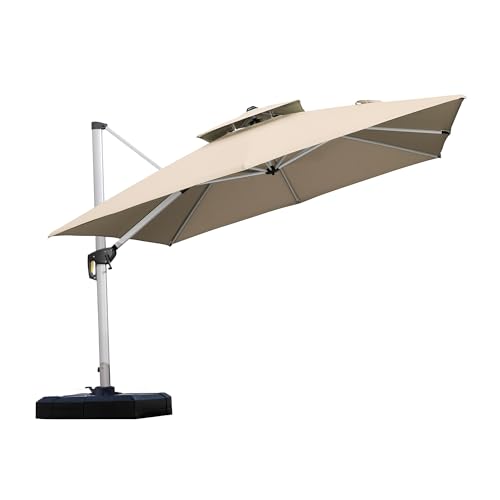
Where to buy
Check the latest price, availability and delivery on Amazon. Orders are placed on Amazon. We may earn a commission from qualifying purchases.
- Best overall for backyards: PURPLE LEAF Cantilever Patio Umbrella 10′ x 10′ Square Double Top, Beige — Check on Amazon
- Grand Patio 12FT Sunbrella Cantilever Round Umbrella with Base, Flax — Check on Amazon
- California Umbrella 9′ Sunbrella Aluminum Patio Umbrella, Crank Lift, Auto Tilt, Antique Beige — Check on Amazon
- PURPLE LEAF Cantilever Patio Umbrella 10′ x 10′ with Solar LED Light, Grey — Check on Amazon
- Best Choice Products 10x10ft Cantilever Patio Umbrella with Base Included, Solar LED Lights, Sky Blue — Check on Amazon
- FiberBuilt 9′ Market Umbrella, Fiberglass Ribs, Pulley and Pin Lift — prose-only pick, see the review below for why
Read the full guide ↓
Disclosure: As an Amazon Associate, dailyhomedecorating.com earns from qualifying purchases. Links to Amazon on this page are affiliate links; they cost you nothing extra. Listing details such as price and availability change often, so check the current Amazon listing before you buy.
The best patio umbrella for backyards under $500 has to solve a problem apartment guides never face: a backyard’s sun moves across a big, open sky, the seating is spread over a deck, a lawn edge and maybe a pool apron, and the umbrella you buy this spring is expected to still be standing — and still be presentable — five summers from now. Under $500 is the tier where that expectation becomes reasonable. It is the budget where canopies stop being thin polyester and start being solution-dyed acrylic, where cantilever frames get heavy enough to stay composed in a breeze, where bases start arriving in the box, and where the difference between brands is no longer marketing but construction: rib material, hub design, fabric weight and whether replacement parts exist when a crank cable tires in year four.
This guide covers the backyard brief specifically. The picks were chosen for ground-level, full-sky conditions: large shade footprints for family seating, rotation that tracks the sun from a late breakfast to an early-evening drink, fabrics that survive being the most sun-exposed object in the garden, and frames that tolerate the reality of backyard life — kids cranking, guests tilting, a canopy occasionally left up when a summer squall rolls through faster than the forecast promised. Two of the six are cantilevers with their bases included, which matters more in a backyard than anywhere, because a cantilever’s true price and true footprint is always umbrella plus ballast. One is a classic 9 ft market umbrella in genuine Sunbrella for the dining table. One adds solar LED light for evenings. And one is a prose-only pick — a commercial-grade fiberglass-rib market umbrella we recommend on the strength of its maker’s specifications, presented without a purchase link because we could not complete our direct listing cross-check for it; we would rather show you an honest recommendation than a convenient link.
A note on the base question, because it decides more backyard purchases than any fabric choice. A market umbrella stands in a base or through a table, and the base weight must match the canopy size and your site’s exposure — a sheltered deck between fences is not a hilltop lawn. A cantilever needs substantially more ballast, placed on a level, hard surface; on grass, plan a paver pad or a deck corner, because a cantilever base rocking on soft ground works its frame loose over a season. Every pick below states its base situation plainly, and the buying guide section gives the placement rules that keep these umbrellas upright and their warranties meaningful. If your yard is smaller or your budget tighter, our guide to Best Patio Umbrella Under $500 covers the wider field across categories; this page is the backyard cut of that tier.
In this guide
Quick Picks
Short on time, or comparing several options at once? Each row below names a backyard situation and the umbrella that suits it, with a link to the listing where we have one.
| Backyard situation | Pick | Why it stands out | Link |
|---|---|---|---|
| Best overall | PURPLE LEAF 10′ x 10′ Square Double Top Cantilever, Beige | Double-top vented canopy, wind-rated frame design and full rotation over family seating | Check on Amazon |
| Biggest shade | Grand Patio 12FT Sunbrella Cantilever with Base, Flax | A 12 ft Sunbrella canopy with its base included — shade for a whole seating group | Check on Amazon |
| Best for the dining table | California Umbrella 9′ Sunbrella, Antique Beige | Genuine Sunbrella, crank lift and auto tilt in the classic centre-pole format | Check on Amazon |
| Best for evenings | PURPLE LEAF 10′ x 10′ Cantilever with Solar LED, Grey | Solar LED light built into the canopy for shade that turns into evening ambience | Check on Amazon |
| Best value with base | Best Choice Products 10x10ft Cantilever with Base, Solar LED, Sky Blue | Base included and lights included at the accessible end of the tier | Check on Amazon |
| Best commercial-grade market umbrella | FiberBuilt 9′ Market Umbrella, Fiberglass Ribs | Contract-grade fiberglass ribs that flex instead of snapping — recommended prose-only | Prose-only — see review |
How we chose the best patio umbrella for backyards under $500
Backyard selection starts with exposure. We prioritised umbrellas built for open sky: canopies in solution-dyed fabrics that will not fade to a different colour by August, venting that lets gusts pass instead of loading the frame, and rib and hub construction rated by their makers for real wind rather than showroom calm. PURPLE LEAF, for example, states a wind-resistant frame design for its double-top cantilever line, and we treated such maker-stated design goals as a starting point for scrutiny, not as a promise — no patio umbrella is a leave-it-up-in-a-storm product, and our reviews say so where it matters.
Second, we verified before we recommended. Every linked pick in this guide was cross-checked against the Amazon Creators API for this site, matching listing title to ASIN directly, so the umbrella named in each review is the umbrella the link reaches. One pick — the FiberBuilt — is presented prose-only because our API cross-check for that brand was interrupted by an API rate limit before it could be completed; rather than link on partial verification, we recommend it on its manufacturer’s published specifications and leave the link off. We also screened every brand against CPSC recall records: the umbrella recalls on file there involve other makers — a solar market umbrella sold through a warehouse club, an older lighted cantilever from a home-goods chain — and none of the products in this guide is a recalled model. Solar LED picks deserve one specific note: follow the maker’s battery care instructions, store the solar panel as directed in winter, and never charge a solar puck with a random adapter — the recall history in this category is largely a battery-care story, and it is avoidable.
Third, we ranked for the way backyards are actually used. Shade mobility mattered: a cantilever that rotates 360 degrees shades the loungers at noon and the dining chairs at five without anyone moving a base that weighs as much as a person. Coverage honesty mattered: we state plainly which picks shade a couple and which shade a crowd. And total cost mattered: where a base is included we say so in the headline facts, and where it is not, the review tells you to budget for a properly weighted one, because an umbrella review that hides the base is hiding part of the price.
The 6 best backyard patio umbrellas under $500, reviewed
1. PURPLE LEAF 10′ x 10′ Square Double Top Cantilever, Beige — best overall
Who it suits: The typical family backyard: a deck or patio with a seating group that migrates through the day, and owners who want one substantial umbrella rather than a rotation of cheap ones. The square canopy is the right shape for the rectangular way people actually arrange outdoor furniture.
Pros: The double-top design is the headline: a vented second tier at the crown lets hot air escape and gives gusts a path through instead of a wall to push, and PURPLE LEAF builds this line around a wind-resistant frame brief, with a 240gsm fade-resistant canopy the maker rates for three years of fade resistance. The 10 ft square covers a four-to-six-person seating arrangement properly, the pole stands off to the side so the shade is uninterrupted, and the rotation and tilt adjustments are genuinely one-person operations — the handle action is smooth enough that adjusting shade becomes a reflex rather than a project. Assembly is realistically a half-hour job for two people, and the beige colourway sits comfortably against decking, stone and lawn alike.
Honest limitation: The base is the buyer’s responsibility on this model, and a 10 ft cantilever demands the maker’s specified ballast, fully filled, on a level hard surface — treat that as part of the purchase, in money and in patio footprint. The square canopy’s corners also catch crosswinds more than a round canopy’s curve does; in an exposed yard, close it when the weather turns, as with every pick here.
Choose this if you want the strongest all-round backyard cantilever in the tier and have a level spot for a properly weighted base. Skip it if your patio is small or your yard is a wind tunnel — the dining-table format below will serve you better. Check on Amazon
2. Grand Patio 12FT Sunbrella Cantilever Round Umbrella with Base, Flax — biggest shade
Who it suits: Large backyards with a defined outdoor room: a sectional, a pair of loungers and a side table, or a dining set for eight that a 10 ft canopy leaves half-exposed. When the seating group is genuinely big, canopy size stops being a luxury.
Pros: Twelve feet of Sunbrella — the genuine solution-dyed acrylic — is the largest quality canopy in this guide, and Sunbrella is the fabric that makes a five-year backyard umbrella plausible: it resists fading, mildew and the general grey tiredness that overtakes lesser canopies. The base is included, which at this size is not a convenience but a correctness feature, since the ballast in the box is the ballast the frame was designed around. The aluminium pole keeps corrosion out of the picture, tilt adjustment handles the low western sun that a big fixed canopy would otherwise miss, and the flax colourway is the neutral that works against brick, timber and stone.
Honest limitation: Size is a commitment. The filled base is a large, heavy footprint that needs a level paved or decked area, the canopy’s swing radius must clear fences, eaves and tree limbs through its whole rotation, and a 12 ft canopy is the first thing a storm notices in your yard. This is a pick for space-rich, reasonably sheltered backyards.
Choose this if your seating group is large and your patio can give the base a permanent, level home. Skip it if your yard is compact — the 10 ft PURPLE LEAF covers most real seating with less commitment. Check on Amazon
3. California Umbrella 9′ Sunbrella Aluminum Patio Umbrella, Antique Beige — best for the dining table
Who it suits: Backyards organised around outdoor dining. If your umbrella’s job is to stand through a table and shade six people eating, the centre-pole market format remains the right tool: symmetrical, stable, and free of the cantilever’s base footprint and swing radius.
Pros: The canopy is genuine Sunbrella solution-dyed acrylic from a specialist shade maker, with the fabric longevity that is this guide’s recurring theme. The crank lift means the umbrella opens in seconds — relevant because the correct habit, closing it after every meal, only survives if opening it again is effortless. Auto tilt angles the canopy against morning and evening sun without moving the table, which at a set dining position is the adjustment that actually gets used. The aluminium frame and bronze-finish pole will not rust-stain your deck, and the maker’s replacement-canopy ecosystem means a tired canopy in year five is a part, not a new umbrella.
Honest limitation: The shade stays where the table is. A market umbrella cannot rotate its coverage to the loungers or the kids’ paddling pool, and its 9 ft canopy, tilted or not, will leave the ends of a long table in sun at low angles. The base is sold separately, and a freestanding 9 ft — one not steadied by a table — needs a properly heavy one.
Choose this if dining is the centre of your backyard life and fabric quality is your priority. Skip it if your shade needs to move around the yard through the day. Check on Amazon
4. PURPLE LEAF 10′ x 10′ Cantilever with Solar LED Light, Grey — best for evenings
Who it suits: Backyards that stay in use after sunset — the household that eats outside late, reads on the loungers into the dusk, and wants the shade structure to become the light source instead of being abandoned at dark.
Pros: The solar LED system is integrated into the canopy ribs, so the light falls exactly where the shade fell: over the seating, from above, without a separate lantern to hang, charge or knock over. The panel charges through the day on the canopy crown, and the umbrella underneath the lights is the same 10 ft square cantilever format as our top pick, with 360-degree rotation, tilt adjustment, an aluminium frame and the maker’s fade-resistant 240gsm fabric. In grey, it is also one of the more contemporary-looking picks here, suiting the rendered-wall and composite-deck end of backyard design.
Honest limitation: LED ribs give ambience, not task light — you will still want the porch light for reading small print or grilling. The solar battery is a wear component with a finite life, and it deserves the maker’s care routine: clean panel, sensible winter storage, no improvised chargers. As with the double-top model, the base is a separate, fully-weighted commitment.
Choose this if your backyard evenings are the main event and you want one structure for day and night. Skip it if your yard empties at sunset — the standard double-top is the same shade without the electronics. Check on Amazon
5. Best Choice Products 10x10ft Cantilever with Base Included, Solar LED, Sky Blue — best value with base
Who it suits: Buyers who want the complete cantilever package — umbrella, base and evening lights — at the accessible end of this budget, and who would rather have the whole system working this weekend than assemble it over three purchases.
Pros: The value proposition is completeness. The base is included, which removes the most common way cantilever buyers go wrong — under-ballasting with whatever was cheap — because the supplied base is the one the maker pairs with this frame. The 10×10 ft canopy rotates a full 360 degrees, the solar LED lights extend the umbrella into the evening, and the crank operation keeps daily opening and closing realistic. Sky blue is the cheerful, pool-adjacent colourway in this guide, and for a family yard with a paddling pool or a light deck, it looks the part.
Honest limitation: At this end of the tier, the fabric and finish are a class below the Sunbrella and solution-dyed acrylic picks: expect a shorter cosmetic life in hard sun and treat the canopy as a consumable on a multi-year horizon. Fill the included base completely — “included” only helps if it is also full — and follow the solar panel care notes as with the PURPLE LEAF above.
Choose this if you want a complete, working cantilever system with the least total spending and the fewest decisions. Skip it if you are buying for a decade — the fabric-first picks above are the long game. Check on Amazon
6. FiberBuilt 9′ Market Umbrella, Fiberglass Ribs — best commercial-grade market umbrella (prose-only)
Who it suits: Wind-prone backyards and buyers who think like hotels. FiberBuilt builds umbrellas for resorts, restaurants and pool decks — environments where an umbrella is opened daily, abused by weather and expected to survive — and its 9 ft market umbrella brings that contract-grade brief to a residential table or a freestanding base.
Pros: The defining feature is the ribs: flexible fiberglass, half an inch in diameter on the maker’s specification sheet for the 9 ft octagon, with molded nylon joints and end tips. Fiberglass flexes under gust load and returns to shape where aluminium bends and steel snaps, which is why the hospitality industry standardised on it. The pole is two-piece aluminium at 1.5 inches diameter, the lift is a pulley-and-pin system with no crank cable to fatigue, and the canopy is solution-dyed acrylic with a standard upper vent. It is a deliberately simple, repairable machine: no electronics, no proprietary crank, nothing that cannot be understood with the umbrella open on the lawn.
Honest limitation: We are presenting this pick prose-only, without a purchase link, because our direct listing cross-check for this brand could not be completed — and we do not attach links we have not verified. Pulley-and-pin lift is also a two-handed, stand-up operation, less convenient than a crank for daily use, and the commercial aesthetic is plain: this is equipment, not décor. Search the maker and its authorised dealers by name if it appeals.
Choose this if your yard is windy, your umbrella lives outdoors all season, and durability outranks convenience features. Skip it if you want one-hand operation or integrated lighting.
Comparison table
| Pick | Format | Canopy | Base status | Best for | Link |
|---|---|---|---|---|---|
| PURPLE LEAF 10′ x 10′ Double Top, Beige | Cantilever, 360° rotation | 10′ x 10′ square, double-top vented, 240gsm | Sold separately | All-round backyard shade | Check on Amazon |
| Grand Patio 12FT Sunbrella, Flax | Cantilever, tilt | 12′ round, Sunbrella acrylic | Included | Large seating groups | Check on Amazon |
| California Umbrella 9′ Sunbrella, Antique Beige | Market, crank lift, auto tilt | 9′ round, Sunbrella acrylic | Sold separately | Dining tables | Check on Amazon |
| PURPLE LEAF 10′ x 10′ Solar LED, Grey | Cantilever, 360° rotation | 10′ x 10′ square, 240gsm, LED ribs | Sold separately | Evenings outside | Check on Amazon |
| Best Choice Products 10x10ft, Sky Blue | Cantilever, 360° rotation | 10′ x 10′ square, LED ribs | Included | Complete value system | Check on Amazon |
| FiberBuilt 9′ Market, Fiberglass Ribs | Market, pulley and pin lift | 9′ octagon, solution-dyed acrylic | Sold separately | Windy yards, commercial build | Prose-only |
How to choose a patio umbrella for a backyard
Decide the format from the furniture, not the photos. If your backyard life centres on a dining table, a market umbrella through the table is stable, symmetrical and simple. If it centres on loungers, a sectional or a pool edge — anywhere a centre pole would stand in the way — a cantilever earns its price. Many established backyards end up with one of each over time, and this tier is exactly where that pairing becomes affordable; our guides to Best Patio Furniture Set For Backyards Under $500 and Best Outdoor Sectional For Backyards Under $500 cover the furniture side of that planning.
Size the canopy to the seating group plus a margin. Shade shrinks as the sun angles: a canopy shades its full footprint only near midday. As a working rule, choose a canopy at least two feet wider than the seating arrangement in its longest dimension, and prefer 10 ft or more for a family group. Rectangles and squares suit rectangular furniture; round canopies suit round tables and lounger pairs. If your group is genuinely large, the 12 ft Grand Patio in this guide exists precisely for you — and if it is a couple and a dog, it does not.
Treat the base as part of the umbrella. For market umbrellas, match base weight to canopy size and exposure, and add a table’s stabilising effect only if the umbrella truly stands through it. For cantilevers, use the maker’s specified ballast, filled completely — water is convenient and removable for winter, sand is heavier per volume and stays put. Site the base on a level, hard surface; on lawn, pour or lay a small paver pad. A base rocking on grass loosens frames and voids the point of buying a good one.
Buy fabric for the years you actually expect. Backyard umbrellas live outside. Solution-dyed acrylic — Sunbrella above all — is the difference between a canopy that looks right in year four and one that embarrasses the patio in year two. If your yard is shaded by trees and the umbrella is a fair-weather accessory, mid-tier fabrics are a rational saving; if it stands in full sun from April to October, fabric is the last place to economise. A fitted cover, used in winter and during long absences, roughly doubles canopy life at any tier — see Best Deck Box Under $500 for the storage side of winter care.
Plan for wind as a certainty, not a risk. Every umbrella in this guide must be closed in storms and when the yard is empty on a gusty day. Venting helps, fiberglass ribs forgive, and heavy bases hold — none of it licenses leaving a canopy up in a squall. Position matters too: a spot sheltered by the house or a fence line lives an easier life than the middle of an open lawn, and rotating a cantilever’s canopy parallel to a prevailing breeze while closed reduces the daily battering.
Common mistakes backyard buyers make
Under-ballasting the cantilever. The single most expensive mistake in this category. A 10 or 12 ft cantilever on a half-filled base will go over in the first real gust, and it will land on the furniture it was shading. Fill the specified base fully, or choose a package — like the Grand Patio and Best Choice Products picks — where the matched base comes in the box.
Buying canopy size for the party, not the week. The one big gathering a year tempts buyers to 12 ft and beyond, and then the oversized canopy spends fifty ordinary weeks shading two chairs, catching wind and dominating the yard. Size for your typical seating; rent or borrow shade for the exceptional day. A Best Gazebo For Backyards Under $500 is often the better answer for event-scale coverage.
Leaving it up through a storm “because it is rated”. Maker wind figures describe frame design goals in controlled terms, not a promise about your yard, your base or a thunderstorm’s gust front. The correct storm procedure for every pick in this guide is identical: close it, strap it, and, for market umbrellas in exposed sites, lay it down or store it.
Skipping the cover and the winter plan. UV and weather age an idle umbrella nearly as fast as a working one. A cover on the closed canopy, a dry storage spot for the off-season, and five minutes of bolt-checking each spring are the difference between the five-year umbrella this tier promises and a two-year disappointment.
Forgetting the evening. A backyard umbrella that only works until sunset abandons half the yard’s life. If your household eats and sits out late, the solar LED picks in this guide — or a plan for Best Outdoor String Lights For Backyards Under $500 — belong in the original purchase decision, not as an afterthought.
Final recommendation
Most backyards should start with the PURPLE LEAF 10′ x 10′ Double Top cantilever: it is the most complete balance of coverage, venting, rotation and build in the tier, and it will shade the way a family actually moves around a yard. If your seating group is large and your patio can host it, the Grand Patio 12FT Sunbrella with base included is the step up that genuinely adds something — the most shade and the best fabric in one box. Dining-centred yards should take the California Umbrella 9′ Sunbrella and spend the remainder on the table it deserves. And if your yard is the windy one on the street, read the FiberBuilt review again: commercial fiberglass ribs are the unglamorous, correct answer, even without a link from us. Whichever you choose, fill the base, close it in storms, and cover it in winter — at this budget, those three habits are what turn a purchase into a five-year fixture.
Fabric, frames and ribs: what the specifications actually mean
Backyard umbrella listings are dense with terms that sound like quality and sometimes are. This section translates the ones that matter, using this guide’s picks as the reference points. Solution-dyed acrylic — the family that includes Sunbrella — is coloured before the fibre is formed, so the colour runs through the material rather than sitting on its surface. That is why it resists fading for years where a surface-dyed or standard polyester canopy visibly tires in a season or two of full sun, and why it can be cleaned more assertively after the barbecue incidents that backyard life guarantees. When a listing gives a fabric weight such as 240gsm, as PURPLE LEAF does for its cantilever canopies, it is describing a substantial, tightly woven cloth — not a guarantee on its own, but a good sign next to the thin, unweighed fabrics of budget umbrellas.
Ribs are the umbrella’s skeleton and its most common failure point. Aluminium ribs are light and corrosion-free but bend permanently when overloaded. Steel is strong and unforgiving in the same way, with rust added. Fiberglass — the FiberBuilt’s whole reason to exist — flexes under a gust and returns, which is why commercial sites standardise on it. Venting is the canopy’s pressure valve: a single vent at the crown helps, and the double-top design on our lead pick gives hot air and gusts a genuine path through, reducing the sail effect that works frames loose over a season. Lift systems divide into crank (fast, one-handed, with a cable that is a wear item), pulley and pin (slower, two-handed, almost nothing to wear out), and push-up (simplest, hardest on shoulders at 9 ft and above). None is best in the abstract; the right one is the one that matches how often you will open and close the thing, which in a well-run backyard is daily.
Finally, tilt and rotation are shade-multipliers that cost no floor space. A market umbrella’s tilt buys back the first and last hours of the day, when the sun’s angle would otherwise slide under a level canopy. A cantilever’s rotation does that and more, relocating the entire shade footprint around its base — the feature that lets one umbrella serve a backyard’s whole daily migration. When you compare two umbrellas of the same size, the one with the better adjustment range is, in useful shade terms, the bigger umbrella.
A season with a backyard umbrella: setup, care and winter
Setup day decides more than any other. Assemble a cantilever with two people, on the spot where it will live, and fill the base there — a filled cantilever base does not travel across a yard gracefully. Level matters: a base rocking on an uneven paver works every bolt in the frame a little looser with every breeze, so shim or re-bed the spot before the umbrella goes up, not after it starts to lean. Run the canopy through its full open, tilt and rotation travel and note what it clears and what it threatens — the fence, the eave, the climbing rose — while you can still move the base a foot in the right direction.
In season, the routine is short and non-negotiable. Open in the morning if the day asks for it, close when the yard empties or the sky darkens, strap the canopy when it will sit closed for days. Brush leaves and pollen off before they bake on, rinse the canopy when it looks dusty, and let it dry open before closing it after rain — mildew is a storage disease. A cover earns its keep during any idle stretch longer than a week and during pollen season in tree-heavy yards. Check the base’s fill monthly; water finds ways out, and a base at eighty percent is a frame working twenty percent harder than it should.
Winter is where this tier’s value is protected or lost. The best outcome is a dry indoor corner for the canopy and pole; the acceptable outcome is a breathable cover, a drained or freeze-safe base per the maker’s instructions, and a sheltered spot out of the prevailing wind. Solar models want their panels stored as the maker directs. Five minutes of bolt-checking and a full open-close cycle each spring will tell you everything about how the umbrella wintered — and a canopy that finally tires in year five is, for the Sunbrella and FiberBuilt picks, a replaceable part rather than a funeral.
Poolside and lawn-edge: the backyard’s other two settings
Not every backyard umbrella lives on a patio, and the two other classic placements deserve their own logic. Poolside is a cantilever’s natural home: the pole stands on the apron, clear of wet feet and lounger traffic, and the canopy hangs over the water’s edge where swimmers rest — the one place a centre pole physically cannot go. Poolside picks demand two extras: corrosion-proof everything, because chlorinated splash is a chemical environment, which is why this guide’s aluminium frames matter here; and a base position that no running child will ever meet at speed, which argues for the base-included packages whose ballast sits low and flush. The PURPLE LEAF square and the Grand Patio 12 ft are this guide’s poolside answers, in that order for most pools.
The lawn edge is the market umbrella’s overlooked territory: a table set on the grass for the evening, a reading chair under the tree line where the tree’s own shade stops at four. The governing problem is the base — a market umbrella’s base on grass needs a level, firm footing, and a cantilever base on lawn needs a paver pad, full stop, because soft ground lets ballast shift and frames loosen. The FiberBuilt earns a second mention here: pulley-and-pin simplicity and flexing ribs are exactly the virtues a semi-permanent lawn installation rewards, and its commercial bones do not care that the setting is informal. Whichever setting you are furnishing, the rule that travels is the same: the umbrella is a system of canopy, frame and ground, and the ground is the part buyers most often forget to buy.
What we left out, and why
A guide is also its exclusions, and three categories of backyard umbrella were deliberately kept out of this tier’s picks. The first is the oversized budget cantilever — the very large, very cheap offset umbrellas that flood marketplaces each spring. Their canopies are thin, their frames flex in the wrong places, and their bases are afterthoughts; in a backyard, where an umbrella is a multi-year fixture over the people you love, the saving is not worth the structure. The second is the wooden market umbrella in its decorative forms: beautiful in a photograph, but wood poles and ribs in a full-weather backyard demand a maintenance devotion most households honestly will not sustain, and the aluminium and fiberglass alternatives in this guide deliver the same shade without the sanding schedule.
The third exclusion is subtler: beach umbrellas and tilt-pole picnic models pressed into backyard service. They are designed for sand anchoring and supervised afternoons, not for bases, seasons and unattended yards, and their appearance in backyard searches is a category error rather than a bargain. If your backyard’s real need is event-scale coverage for one weekend a year, the honest answer is a gazebo or a borrowed canopy, not a permanent umbrella stretched past its brief — which is why our final recommendations keep returning to the same discipline: match the tool to the setting, fill the base, and let the umbrella you buy be excellent at the job it will actually do fifty weeks a year.
A last word on budget discipline
Under $500 is a ceiling, not an instruction. The backyard that buys the California Umbrella for its table, weights it properly and spends the rest of the tier on the seating underneath has allocated better than the yard that stretches to the largest cantilever and then cannot afford its base fill, its cover or its second season. Equally, the household that knows it will live outdoors for a decade should not let a thrift instinct talk it out of the fabric tier its summers deserve. The discipline runs in both directions: spend where the years will notice — fabric, ribs, ballast — and refuse to spend where only the first photograph will. Do that, and whichever pick in this guide lands in your yard will still be earning its place when the neighbours are assembling their third cheap one.
FAQ
Is a 10 ft umbrella big enough for a family backyard?
For a seating group of four to six, yes — a 10 ft square or round canopy shades a typical arrangement with the margin low sun requires. Groups of eight or more, or a sectional plus loungers, are 12 ft territory. Measure your furniture arrangement and add roughly two feet in the longest dimension.
Cantilever or market umbrella for a backyard?
Choose by furniture. Dining tables favour market umbrellas — stable, centred, simple. Loungers, sectionals and pool edges favour cantilevers, whose offset pole keeps the shade area clear and whose rotation follows the sun. Exposure matters too: market umbrellas in heavy bases tolerate careless weather slightly better than big offset canopies.
How heavy should a cantilever base be?
Use the umbrella maker’s specified ballast for your exact model and fill it completely — cantilevers in this size class need substantial weight, and the correct figure is in the manual and the listing. Water filling is removable for winter; sand filling is heavier and more permanent. Never run a cantilever on a partially filled base.
Can I leave a backyard umbrella out all winter?
The frame can winter outside in mild climates under a cover, but the canopy will live longer stored dry indoors. At minimum: close it, fit a breathable cover, check the base before freeze if it is water-filled, and store solar panels as the maker directs. A spring check of bolts, cables and ribs takes minutes.
What is the advantage of fiberglass ribs?
Flex. A fiberglass rib bends under a gust and returns to shape, where metal ribs bend and stay bent or snap. That is why hotels and resorts standardise on fiberglass-rib umbrellas like the FiberBuilt in this guide. The trade-off is usually a simpler lift system and a plainer look.
Are solar LED umbrellas safe?
The solar picks in this guide are current models from their respective makers and are not recalled products. The category’s one major recall involved a different maker’s warehouse-club umbrella and its battery puck. Follow the maker’s battery instructions: charge only as directed, keep the panel clean, store it sensibly in winter, and retire a swollen or damaged battery rather than charging it.
Should a backyard umbrella stay in its base year-round?
The base can stay; the umbrella should not have to. In mild climates a covered, closed umbrella in a heavy base winters acceptably in place, but the canopy’s life is measurably longer stored dry indoors, and the base itself should be checked before any freeze if it is water-filled. Think of the base as landscape and the umbrella as equipment: one stays, the other is cared for.
What is the single best upgrade for an existing backyard umbrella?
Almost always the base. A good umbrella on an under-weight base is a hazard wearing a quality label, and moving to the maker’s specified ballast — filled completely — improves safety, stability and the frame’s working life in one purchase. After that, a fitted cover is the cheapest years you can buy for any canopy in this guide.
How long should a backyard umbrella at this tier last?
With the routines in this guide — closed in storms, covered when idle, stored dry in winter — the frame should serve for many seasons and the Sunbrella and solution-dyed canopies for years before they tire. The honest variable is exposure: a hilltop yard and a fenced garden are different lifetimes wearing the same product, which is why the care sections above matter more than any single specification.


