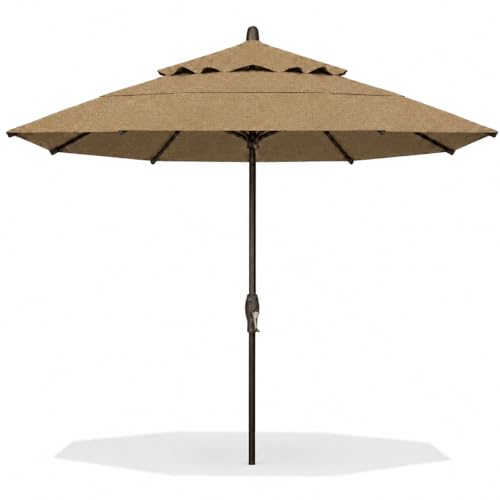
Best patio umbrella for outdoor entertaining under $300
Where to buy
Check the latest price, availability and delivery on Amazon. Orders are placed on Amazon. We may earn a commission from qualifying purchases. Patio umbrella bases are almost always sold separately — budget for the base as well as the umbrella.
- Best overall for hosts: Treasure Garden 11ft Double Wind Vent Patio Umbrella — Check on Amazon
- Best over a sectional: Grand Patio 10Ft Cantilever Umbrella with Cross Base — Check on Amazon
- Best in changeable weather: EliteShade USA 9ft 3-Tier Market Patio Umbrella — Check on Amazon
See more Amazon options
- Best after-dark atmosphere (prose): Le Conte 10ft Patio Umbrella with Solar LED Lights — check price on Amazon (see the review below for why this pick is listed without a direct link)
- Best second umbrella: Sunnyglade 9′ Patio Umbrella with Tilt and Crank — Check on Amazon
- Best workhorse for frequent parties: Abba Patio 9FT Lyon Outdoor Patio Umbrella — Check on Amazon
Read the full guide ↓
Disclosure: As an Amazon Associate, dailyhomedecorating.com earns from qualifying purchases. Links to Amazon on this page are affiliate links; they cost you nothing extra. Listing details such as price and availability change often, so check the current Amazon listing before you buy.
Entertaining outdoors rearranges the priorities of shade. The best patio umbrella for outdoor entertaining under $300 is not the one that shades a quiet Tuesday coffee — it is the one that keeps eight guests comfortable at 2 p.m., does not drip the evening’s conversation into a discussion of its wobbling pole, swings to cover the drinks table when the sun drops, and, ideally, still looks intentional when the string lights come on. Hosts ask more of an umbrella than anyone else, and under $300 is the budget where those asks can genuinely be met: specialist 11-foot canopies, rotating cantilevers, vented performance fabrics, and lighted options all live in this tier.
Think about what a party actually does to an umbrella. It gets opened early and left up for hours, so fabric and frame endurance matter more than in private use. It shades a crowd, not a chair, so coverage and tilt range decide whether the two guests at the table’s west end spend dinner squinting. It stands in the middle of traffic — serving paths, cooler runs, kids orbiting the snack table — so stability is a safety feature, not a spec: a tipped umbrella at a party is not an embarrassment, it is an injury with witnesses. And it gets operated by guests, which means the crank-and-tilt umbrella that anyone can adjust beats the clever mechanism only you understand.
This guide picks for hosts accordingly. Coverage first: the headline picks are 10- and 11-foot canopies that shade a real gathering. Movement second: auto-tilt and 360-degree rotation, because a host cannot ask the party to move when the sun does. Atmosphere third: one prose-listed lighted pick for after-dark hosting, chosen carefully — the one major umbrella recall of recent years involved a solar battery design, so our lighted recommendation comes with explicit care guidance and no direct link, and the guide explains why. Throughout, base discipline is treated as part of hosting: the well-ballasted umbrella is the one nobody at the party ever has to think about.
If you entertain rarely, some of this is over-engineering, and the value picks in the list will serve a twice-a-summer barbecue perfectly. If your yard hosts monthly, read the whole guide — the difference between the picks is measured in parties per season, not minutes of shade.
In this guide
Quick Picks
| Pick | Best for | Canopy | Key feature |
|---|---|---|---|
| Treasure Garden 11ft Double Wind Vent Patio Umbrella | Dinner parties at a big table | 11 ft | Sunbrella, auto-tilt |
| Grand Patio 10Ft Cantilever Umbrella with Cross Base | Sectionals and lounge layouts | 10 ft offset | 360-degree rotation |
| EliteShade USA 9ft 3-Tier Market Patio Umbrella | Gusty party days | 9 ft | 3-tier vented canopy |
| Le Conte 10ft Patio Umbrella with Solar LED Lights | Evening gatherings | 10 ft | Solar LED rib lights |
| Sunnyglade 9′ Patio Umbrella with Tilt and Crank | A second zone of shade | 9 ft | Light, easy to reposition |
| Abba Patio 9FT Lyon Outdoor Patio Umbrella | Frequent, heavy use | 9 ft | Sturdier 8-rib frame |
How These Picks Were Chosen
We judged candidates as hosting equipment. Coverage had to suit a gathering — 10 feet and up for the headline picks — or, for the supporting picks, a clearly defined second zone such as a drinks station or a grill-side chair. Mechanisms had to be guest-proof: crank lifts and simple tilts that a helpful uncle can operate without a tutorial. Stability was assessed as a system — frame build plus the ballast each format honestly requires — because an umbrella review that ignores the base is reviewing half a product.
Specifications were checked against maker information and listings verified before linking, via the Amazon Creators API where confirmation was possible; the lighted pick is deliberately prose-only, both because its exact variant could not be confirmed and because we want buyers of any solar-battery umbrella to read the maker’s own charging and care instructions on the listing before purchase. All candidates were screened against US patio-umbrella recall records, and the recalled solar-battery model sold through a warehouse club in past seasons is excluded from this guide entirely — it is not the lighted pick, and no pick here shares its battery-puck design.
Finally, we priced honestly within the under $300 ceiling for the umbrella itself, while repeating the host’s golden rule: the base is part of the purchase, and a party is the worst possible place to discover that yours is too light.
The Picks in Detail
Treasure Garden 11ft Double Wind Vent Patio Umbrella — Best overall for hosts
Who it suits: the host whose table seats six to eight and whose lunches run long — the 11-foot Sunbrella canopy covers the whole setting, and auto-tilt lets you chase the sun between courses without standing on a chair.
Treasure Garden is a specialist umbrella maker, and this 11-footer shows it: a bronze-finish aluminum frame, a double wind vent, and a deluxe auto-tilt that keeps tilting as you continue turning the crank, so there is no button to hold while you lean. In the configuration we checked, the canopy is Sunbrella — the benchmark solution-dyed acrylic — which is the fabric class hotels and restaurants buy when a canopy has to survive several seasons of daily sun.
Key specs: 11 ft canopy, Sunbrella fabric, deluxe auto-tilt, bronze aluminum frame, double wind vent.
Pros:
- 11-foot canopy: the whole table, shaded, with overhang
- Sunbrella fabric looks crisp season after season of parties
- Auto-tilt adjusts as you crank — mid-meal shade fixes take seconds
- Double vent keeps the big canopy calm in party-day breezes
Honest limitation: It needs a heavy base and a real storage spot, and it tops the budget — hosts who entertain twice a year will not amortize it the way monthly hosts will.
Choose it if you host often and your table is the yard’s social center. Skip it if your gatherings are small or your yard is sheltered and small-scaled.
Grand Patio 10Ft Cantilever Umbrella with Cross Base — Best over a sectional
Who it suits: the lounge-style party — sectional, low table, drinks in hand — where a center pole would split the group and a rotating offset canopy can be swung from the seating to the buffet as the afternoon turns.
This Grand Patio model hangs its 10-foot canopy from a side arm, so no pole stands in the middle of your seating. The mast rotates a full 360 degrees — you follow the sun by swinging the canopy rather than moving chairs — and the canopy tilts to block low morning or evening sun. It stands on a cross base, which is only a frame: it must be weighted with base weight plates or sand bags, sold separately, before the umbrella is safe to open.
Key specs: 10 ft offset canopy, 360-degree rotation, tilt adjustment, steel frame, cross base (weights sold separately).
Pros:
- 360-degree rotation moves shade between zones without moving furniture
- Tilt handles the low sun of evening drinks
- No pole in the middle of the sectional
- 10-foot canopy covers a real lounge setting
Honest limitation: Ballast is the whole game: fill the cross base completely (150 lb or more) before guests arrive, not after the first wobble. Polyester canopy is a class below the Sunbrella pick.
Choose it if your entertaining centers on lounge furniture. Skip it if your parties are sit-down dinners at a holed table — take the Treasure Garden.
EliteShade USA 9ft 3-Tier Market Patio Umbrella — Best in changeable weather
Who it suits: the host in a gusty climate whose parties cannot be rescheduled around wind — the three-tier vented canopy bleeds gusts instead of fighting them, so the umbrella stays calmer when the weather will not cooperate.
The 3-tier version of EliteShade’s 9-footer splits the canopy into three overlapping tiers. The gaps between tiers give wind and rising heat a path out, so the umbrella flutters less and feels calmer in gusty weather than a single-skin canopy of the same size. The fabric is the same solution-dyed, UPF 50+ performance material as the standard EliteShade, with the same long non-fading claim from the maker.
Key specs: 9 ft canopy, 3-tier vented design, solution-dyed performance fabric, UPF 50+, crank open.
Pros:
- Tiered vents release wind and heat — noticeably calmer in gusts
- Solution-dyed UPF 50+ fabric, fade-resistant for seasons of events
- Commercial-grade build for frequent open-close cycles
- 9-foot size suits a standard dining set completely
Honest limitation: At 9 feet it covers a dining set, not a crowd — for parties beyond eight, pair it with a second umbrella rather than expecting miracles.
Choose it if your party days are windy days and you are tired of closing umbrellas mid-event. Skip it if your yard is calm and your parties are large; coverage picks come first.
Le Conte 10ft Patio Umbrella with Solar LED Lights — Best after-dark atmosphere (prose)
Who it suits: the evening host — dinner that starts at seven and ends under the stars — who wants the table lit without cords across the deck or a separate lantern to store.
Le Conte’s solar LED umbrellas add light strips along the ribs, charged by a solar panel on top, so the table stays usable after dark without running a cord. The shade itself is a conventional 10-foot crank-and-tilt market umbrella; the lights are the reason to buy it, and also the part to treat with care — follow the maker’s charging guidance and never leave a solar puck charging indoors on an adapter unless the manual explicitly allows it.
Key specs: 10 ft canopy, solar-powered LED rib lights, crank and tilt (maker listings).
Pros:
- Rib lights turn the umbrella into the evening’s light source
- 10-foot canopy covers a dining setting
- Solar charging means no cord across the entertaining space
- Conventional crank-and-tilt shade by day
Honest limitation: Read this before buying any lighted umbrella: follow the maker’s charging instructions exactly, never charge a solar puck indoors on an adapter unless the manual explicitly permits it, and remove and store the puck as directed in winter. This pick is prose-only so you read the actual listing and manual first; it is a different design and maker from the recalled warehouse-club umbrella, which we do not recommend in any form.
Choose it if your parties reliably run past dark and you will follow the care instructions. Skip it if you want zero-maintenance shade; a plain umbrella plus separate lighting is simpler.
Check price on Amazon by searching the model name — we list this pick without a direct buy link because we could not confirm the exact listing variant at review time, and we would rather send you to search than to the wrong product page.
Sunnyglade 9′ Patio Umbrella with Tilt and Crank — Best second umbrella
Who it suits: the host who already has table shade and needs a flexible second zone — over the grill master’s chair, the kids’ table, the drinks station — that can be carried wherever this week’s layout puts it.
The Sunnyglade pairs a 9-foot polyester canopy with an aluminum pole, which matters anywhere the umbrella lives outdoors year-round because aluminum does not rust the way painted steel can once the finish chips. It opens with a crank, tilts with a push button, and the canopy is a waterproof-coated polyester with a small vent at the top. The whole umbrella is noticeably lighter than steel-pole rivals, which makes it easier to lift in and out of a base or table hole.
Key specs: 9 ft canopy, aluminum pole, push-button tilt, crank lift, waterproof polyester canopy.
Pros:
- Light aluminum build: one person repositions it between courses
- Crank and tilt cover any side zone
- Rust-proof pole for a life lived outdoors
- Value positioning leaves budget for the main umbrella and bases
Honest limitation: It is a supporting actor: 9 feet of polyester shade that needs a properly weighted base wherever it lands, and it will not outlast the premium picks.
Choose it if you entertain in zones and rearrange furniture per party. Skip it if you need one umbrella to do everything; start at the top of this list.
Abba Patio 9FT Lyon Outdoor Patio Umbrella — Best workhorse for frequent parties
Who it suits: the high-frequency host — weekly family dinners, the neighborhood’s default barbecue yard — who opens and closes an umbrella more in a month than most owners do in a year.
The Lyon is Abba Patio’s mainstream 9-foot market umbrella: eight ribs, a crank lift, a push-button tilt, and a canopy the maker rates for UV protection and water resistance. The frame geometry is a touch sturdier than the very cheapest 9-footers, with a thicker feel to the rib arms, and the canopy fabric is a heavier polyester that holds its shape better in a breeze instead of fluttering at the edges.
Key specs: 9 ft canopy, 8 ribs, push-button tilt, crank lift, UV-protective waterproof canopy.
Pros:
- Sturdier eight-rib frame built for constant cycling
- Heavier canopy fabric holds shape through a season of events
- Simple crank and tilt that any guest can operate
- UV-protective, water-resistant finish
Honest limitation: Polyester fabric will fade across seasons of heavy use, and 9 feet caps the guest count it can cover alone.
Choose it if durability of mechanism matters more to you than ultimate size or fabric. Skip it if you host large sit-down dinners; size up to the 11-footer.
Comparison Table
| Umbrella | Size | Type | Fabric class | Tilt | Base note |
|---|---|---|---|---|---|
| Treasure Garden 11ft Double Wind Vent Patio Umbrella | 11 ft | Center pole | Sunbrella | Auto-tilt | Heavy base required; sold separately |
| Grand Patio 10Ft Cantilever Umbrella with Cross Base | 10 ft | Cantilever | Polyester | Tilt + rotate | Cross frame included; 150 lb+ weights separate |
| EliteShade USA 9ft 3-Tier Market Patio Umbrella | 9 ft | Center pole | Solution-dyed performance | Crank open, vented | Base sold separately |
| Le Conte 10ft Patio Umbrella with Solar LED Lights | 10 ft | Center pole | Polyester | Crank + tilt | Base sold separately |
| Sunnyglade 9′ Patio Umbrella with Tilt and Crank | 9 ft | Center pole, aluminum | Polyester, coated | Push-button | Base sold separately; weight it well |
| Abba Patio 9FT Lyon Outdoor Patio Umbrella | 9 ft | Center pole | Polyester, heavier weave | Push-button | Base sold separately |
Hosting With Shade: Layout Lessons From a Hundred Imagined Parties
Place the umbrella for the hour of the main event, not for noon. A lunch party lives under high sun and wants the canopy centered on the table; a dinner party starting at six lives under low western sun and wants tilt range and a canopy offset toward the west, or a cantilever rotated to block the glare that otherwise blinds half the table through the main course. Walk your yard at the party’s actual hour the day before, note where the shade falls and where the glare lands, and set the base then — a weighted base is not something you want to be dragging across the deck as guests arrive.
Keep the pole out of the serving path. The route from kitchen door to table to grill is a highway during a party, carrying trays and hot dishes. A center pole through the table is invisible to traffic; a freestanding pole at the path’s edge is a collision waiting for its moment. If you use a cantilever, park the mast outside the traffic triangle entirely and let the canopy reach in.
Assign the umbrella a closer. Parties end in stages and the umbrella is everyone’s last thought, which is how open umbrellas meet midnight weather. The host closes the umbrella as part of clearing — crank down, tie the canopy, done — before the dishes are finished, not after. On gusty days, close it between courses without apology: guests forgive a shaded-then-sunny table instantly and a tipped umbrella never.
For evening events, decide lighting before the day. A lighted umbrella is one solution; string lights and lanterns are others, and they layer better. Whichever you choose, keep cords out of walkways, follow battery care instructions for anything solar, and remember the umbrella’s job after dark is ambience — the shade structure becomes the ceiling of an outdoor room, and a clean, taut canopy reads as intentional where a sagging one reads as forgotten.
How to Choose an Umbrella for Entertaining
Count chairs, then add two feet. Shade the setting your biggest regular party uses, with the standard two-foot overhang per side, and let smaller gatherings enjoy the surplus.
Buy movement: tilt or rotation. A fixed canopy at a party is a countdown to squinting. Auto-tilt, push-button tilt, or a rotating cantilever — one of the three is mandatory for hosts.
Ballast like guests are coming — because they are. Weight the base for the umbrella’s size and your yard’s exposure, and set it the day before. Stability is hospitality.
Choose guest-proof mechanisms. Cranks and simple tilts. If adjusting the shade requires your personal technique, it will be adjusted wrong, by someone helping.
Match fabric to party frequency. Monthly hosts should buy solution-dyed fabric; twice-a-summer hosts can honestly save with polyester and store it well.
Common Entertaining Mistakes
Setting the base on party day. Filling weight plates while guests hold drinks is hosting theater of the wrong kind. Ballast early.
Shading the table and forgetting the grill. The cook stands in full sun for an hour in the classic layout. A light second umbrella over the grill zone is the cheapest comfort upgrade in this guide.
Leaving the umbrella open overnight ‘for tomorrow.’ Overnight weather is the top umbrella killer at exactly the homes that entertain most, because their umbrellas are always up. Close it; reopening takes a minute.
Ignoring the west at dinner parties. Test the glare at the event hour. Tilt range and placement fix it; discovering it with eight guests seated does not.
Overloading a lighted umbrella’s battery care. Solar pucks have instructions for a reason — charge as directed, store as directed, and never improvise with adapters the manual does not name.
Final Recommendation
Hosts should start with the Treasure Garden 11ft: it is the only pick that combines gathering-sized coverage, Sunbrella endurance and auto-tilt in one umbrella, and frequent hosts will feel the difference at every event. Lounge-style entertainers should take the rotating Grand Patio cantilever and ballast it fully. Add the light Sunnyglade as a second zone when the layout demands it, consider the prose-listed Le Conte only if evening ambience is a priority and you will follow its battery care to the letter — and whatever you buy, set the base the day before the party.
The Host’s Setup Checklist: The Day Before the Party
Great party shade is installed the day before, and this checklist is the difference between hosts who glide and hosts who wrestle a base across the deck in front of an audience. First, position: walk the yard at the event’s start time and note where the sun actually falls. Set the umbrella for that hour — centered for a lunch, offset and tilt-ready toward the west for a dinner — and remember that a weighted base moved at leisure sits better than one dragged in haste. Second, ballast: confirm every weight plate is full, every base is at its working weight, and the mast or pole passes the push test at head height with no rock at the base. Third, mechanism: open and close the umbrella once, cycle the tilt, rotate the cantilever through its swing. A crank that grinds or a tilt that sticks is a ten-minute fix today and a party trick gone wrong tomorrow.
Fourth, the canopy itself: brush it down, shake out the stored dust and the occasional overwintering insect, and check the rib pockets and the tie. A clean canopy reads as care; guests notice the ceiling of the outdoor room more than hosts expect. Fifth, traffic: walk the kitchen-to-table-to-grill route with a tray in your hands and confirm no pole, base edge or low canopy corner crosses it. Move the drinks station into the shade’s edge rather than its center — guests circulate to the shade naturally, and the table keeps its room. Sixth, the evening plan: if the event runs past dark, decide the lighting now. Lanterns placed, string lights hung, or the lighted umbrella’s puck charged exactly as its manual directs — never improvised with an adapter the manual does not name, and never left charging unattended indoors.
Seventh, the weather decision, made in advance: know your wind threshold and your rain plan before the first guest arrives. A host who has decided ‘we close the umbrella if gusts hit the trees like that’ closes it without debate when the moment comes; a host who has not decided negotiates with the weather in front of an audience, and the weather wins those negotiations. Write the plan into the party, not around it: shade is a feature of the event, and like every feature it has an operator — you — and an operating manual you wrote yesterday.
After the Party: Ten Minutes That Buy Seasons
The hour after guests leave is when entertaining umbrellas are saved or lost, and the routine is short enough to do while the grill cools. Close the canopy as soon as the event ends — not after the dishes, not in the morning — and tie it. Overnight is when weather changes unobserved, and the incident record of tipped and torn umbrellas is disproportionately a record of party umbrellas left open by tired hosts. Brush off the evening’s debris while the canopy is at hand height, spot-clean any spill with water before it sets into the fabric, and let a rain-wet canopy dry open the next morning before tying it away; mildew booked during a damp fold is the souvenir no host wants.
Check the hardware while the party’s stresses are fresh in memory. If the cantilever swung stiffly, note it; if the crank ground at a certain point in its travel, note that too, and give both a silicone lubricant and a screwdriver pass on the next quiet morning rather than at the next party’s setup. Inspect the base: plates still full, no shifted ballast, no new rock in the pad. Parties move things — chairs lean, kids climb, coolers roll — and the base that was true on Friday deserves a glance on Sunday.
Across a season of entertaining, keep a simple rhythm: a deep clean at the season’s start and end, a hardware check monthly, and the close-and-tie habit at every single event. Hosts who run this rhythm get the lifespan the premium picks in this guide are built for, and their shade becomes part of the house’s reputation — the yard where lunch is always comfortable and nothing ever falls over. Hosts who skip it meet the alternative rhythm: the faded canopy, the sticky crank, the base that was never quite filled, and the umbrella that chooses the biggest party of the summer to announce its retirement. The ten minutes are cheaper. They always were.
Shade Coverage Math for Hosts: How Much Canopy a Gathering Really Needs
Hosts underbuy shade more reliably than any other buyers, because a table’s dimensions lie about the space a gathering occupies. A six-person table measures about six feet by three, but the gathering around it — chairs pulled out, people leaning back, a serving adult standing at the head — occupies nine feet by six before anyone reaches for the cooler. The two-foot overhang rule applied to the gathering, not the furniture, is what produces the 10- and 11-foot recommendations in this guide. Run the same math on your own biggest regular event: measure the furniture, add the humans generously, add two feet per side, and buy the canopy that covers the result. A canopy one size up from the math is a luxury; a canopy one size down is a complaint with a date on it.
Shape changes the math’s answer. A round or octagonal canopy over a rectangular table wastes its corners and starves its ends, which is why long tables pair naturally with either an 11-foot market umbrella — sheer size forgives the geometry — or a cantilever whose rectangular-friendly canopy can be parked diagonally over the setting. For lounge layouts the geometry inverts: sectionals are L-shaped, no single round canopy covers both arms of the L at every sun angle, and the rotating cantilever wins not on size but on movement, swinging its shade from one arm of the sectional to the other as the afternoon turns. Hosts with both a dining zone and a lounge zone should stop looking for one umbrella to bless both and price the pair: a flagship over the table, a flexible second over the seating, exactly as this guide’s picks are arranged.
Time is the third variable. A canopy sized perfectly for 1 p.m. is undersized by 4 p.m., when the sun’s angle throws the shade sideways off the setting and the effective covered area shrinks to an ellipse offset from the pole. Tilt and rotation exist to correct exactly this drift, and for hosts they are worth more than a foot of diameter: the 11-foot fixed canopy and the 10-foot rotating one cover the same dinner, by different means. When you compare picks, compare them at the hour of your event, not at noon — and if your signature event is the long lunch that becomes dinner, buy movement first and diameter second, and let the pair of them do what neither does alone.
Three Party Styles, Three Shade Plans
The long sit-down lunch
Twelve guests have been invited, eight will stay for hours, and the table is the event. The shade plan is the Treasure Garden centered and ballasted the day before, tilt rehearsed at the event’s hour, plus the Sunnyglade staged — base weighted, canopy tied — where the drinks and the grill will need it. The host’s moves during the event are two: one tilt adjustment between courses, one decision about wind made early and without drama. Everything else about the shade should be invisible, which is the definition of party equipment working.
The evening drinks party
Guests arrive at six, the sun is the first problem and darkness is the second. The cantilever earns its invitation here: rotated to kill the western glare across the sectional at seven, swung aside as the light fails and the gathering tightens around the fire pit or the table. If the Le Conte’s lighted canopy is part of the plan, its puck was charged yesterday by the book — and the plain-umbrella alternative, lanterns and string lights layered over a Treasure Garden, remains the zero-battery answer for hosts who prefer their ambience without a manual. Either way, the umbrella after dark is a ceiling and a backdrop: clean, taut, and closed only when the last guest leaves.
The family barbecue with kids
Chaos with a guest list. The shade plan prioritizes the things parties with children teach: ballast beyond the minimum because small bodies lean on poles, traffic routes kept pole-free because small bodies run them with hot dogs in hand, and mechanisms simple enough that a grandparent can close the umbrella when the gust front arrives mid-burger. The Abba workhorse over the table, the grill master’s chair under the second umbrella, and a host who closes canopies early and reopens them without apology — that is the whole plan, and it has carried more successful barbecues than any product feature ever invented.
The Host’s Ledger: Cost Per Party, Not Cost Per Click
Entertaining equipment should be priced the way hosts actually consume it: per event. A flagship umbrella that anchors forty gatherings across five summers costs less per party than the chairs it shades; a bargain umbrella that fails during the third event — bent rib over the table, party moved indoors — is the most expensive shade a host can own, because its price includes the event it ruined. This arithmetic is why this guide ranks build quality and ballast as hosting features rather than specifications: for a host, reliability is not a property of the umbrella, it is a property of every party the umbrella attends.
Timing matters to hosts in a second way. Buy and install in the quiet weeks before your season of events, not in the week of the first one: the base needs filling, the mechanism needs a rehearsal, and the shade needs checking at the event’s actual hour, none of which compresses gracefully into party week. Hosts who run an annual rhythm — inspect and clean in spring, rehearse before the first event, close and store in autumn — find that umbrellas stop being a party variable entirely. The shade is simply there, the way the table is there, and the host’s attention returns to the guests, which was the point of the yard all along.
Keep the host’s paperwork with the party supplies: model, fabric code, purchase date, and the maker’s parts channel. A rib bent by a helpful guest in July is a ten-minute repair in August if the part is identifiable, and a new umbrella if it is not. The difference between those outcomes is a photograph taken on delivery day. Entertaining well is mostly this: small preparations, made early, that let large pleasures proceed unexamined — and shade, properly bought and properly kept, is the largest of the small preparations.
Final Checks Before You Click Buy
Hosts should verify three things on the exact listing before ordering. First, coverage honesty: the canopy size in the specification table, the shape, and the overhang it gives your actual table or sectional at the hour of your actual event — not the noon photograph in the gallery. Second, mechanism honesty: the tilt or rotation described in words, operable by a guest, at the angles your western sun demands. Third, contents honesty: precisely what arrives in the box, and the weight of everything that does not arrive — the base, the plates, the sand — priced and planned in the same decision, because a party deadline has no mercy for a half-installed umbrella.
If your pick is the lighted one, add a fourth check and make it a careful one: read the maker’s charging and storage instructions for the solar puck on the listing itself, in full, before purchase. Confirm how it charges, what it must never be charged with, and how it stores for winter — and if any of that is unclear, choose the plain umbrella and separate lighting without a second thought. The hosts who enjoy lighted shade for years are the ones who treated the manual as part of the product; the category’s one serious recall belongs to a different maker and design, but its lesson — batteries deserve instructions followed exactly — belongs to every buyer in the category.
A Note on Seating Plans and Shade Discipline
One last hosting habit separates the yards where shade works from the yards where it is merely present: assign the seats with the sun in mind. The host who places the seating chart — formally at a dinner party, casually at a barbecue — already knows which two chairs take the western glare at seven and which guest minds it least; the umbrella’s tilt handles the rest. Put the sun-sensitive guests, the grandparents and the toddlers, in the canopy’s reliable heart, and let the shade’s moving edge fall on the seats that rotate occupants anyway. It sounds like over-planning until the first party where nobody squints through the main course, nobody migrates mid-meal, and the umbrella — adjusted once, ballasted properly, forgotten entirely — does the invisible work that this entire guide exists to describe. That invisibility is the product. Everything else is a canopy on a pole.
FAQ
Does a patio umbrella come with a base?
Usually not. Most market and cantilever umbrellas on Amazon are sold as the umbrella only, and the product photos that show a handsome weighted base are showing an accessory you buy separately. Always check the listing’s ‘what is included’ line, and budget for the base before you compare umbrella prices, because a safe base can cost a meaningful share of the umbrella itself.
How heavy should an umbrella base be?
As a working rule, a 9-foot market umbrella used freestanding wants at least 50 lb of base weight, and more — 70 to 90 lb — if it stands alone in an exposed, breezy spot rather than through a heavy table. A 10- or 11-foot canopy needs more again, and a cantilever needs substantially more than a center-pole umbrella of the same size because the load hangs off to one side: plan on filling all four weight plates of a cross base, typically 150 lb or more of sand or water in total. When in doubt, go heavier; a base that is too heavy costs money once, while a base that is too light can cost an umbrella, a table, or worse.
Should I leave my patio umbrella open all the time?
No. Close it when you are not using it, and always close it ahead of wind. An open umbrella is a sail, and most umbrella damage — bent ribs, snapped poles, tipped bases — happens to umbrellas left open and unattended in gusts. Closing it also keeps the canopy cleaner and slows fabric fading, so the habit pays twice.
What size patio umbrella do I need for a party of eight?
Eight seated guests means a table roughly six feet long plus chairs and elbow room, which calls for a 10- to 11-foot canopy to keep the two-foot overhang rule. An 11-foot market umbrella over the table, or a 10-foot cantilever rotated over a lounge layout, covers a party of eight honestly; a 9-foot umbrella will leave the end seats in sun by mid-afternoon.
How do I keep a patio umbrella from tipping over during a party?
Ballast, placement and discipline. Use the full recommended base weight for the canopy size — cantilevers need their cross bases filled completely — set the base on level ground out of traffic, and close the umbrella if gusts pick up, even mid-event. Most tip-overs involve under-weighted bases or umbrellas left open in weather, not defective products.
Are solar LED patio umbrellas safe?
Lighted umbrellas from reputable makers, used exactly as their manuals direct, are a normal product category — but this category carries the one major umbrella recall of recent years, a warehouse-club solar model whose battery puck overheated. That is why this guide lists its lighted pick in prose: read the listing and the manual, follow charging instructions precisely, never charge a puck indoors on an adapter unless the manual explicitly allows it, and store the puck as directed. If that care sounds like a burden, choose a plain umbrella and separate lighting.
Related Guides
- Best Patio Umbrella Under $300
- Best Patio Umbrella For Homeowners Under $300
- Best Patio Umbrella Under $500
- Best Patio Umbrella For Beginners Under $300
- Best Patio Umbrella For Small Yards Under $150


