Best patio umbrella for backyards under $300
Where to buy
Check the latest price, availability and delivery on Amazon. Orders are placed on Amazon. We may earn a commission from qualifying purchases. Patio umbrella bases are almost always sold separately — budget for the base as well as the umbrella.
- Best overall: Treasure Garden 11ft Double Wind Vent Patio Umbrella — Check on Amazon
- Best cantilever value: Grand Patio 10Ft Cantilever Umbrella with Cross Base — Check on Amazon
- Best fabric under the ceiling: EliteShade USA 9Ft Market Patio Umbrella — Check on Amazon
See more Amazon options
- Best value table umbrella: Blissun 9′ Outdoor Patio Umbrella — Check on Amazon
- Best budget offset (prose): PHI VILLA 10ft Cantilever Patio Umbrella — check price on Amazon (see the review below for why this pick is listed without a direct link)
- Best mid-price all-rounder: Abba Patio 9FT Lyon Outdoor Patio Umbrella — Check on Amazon
Read the full guide ↓
Disclosure: As an Amazon Associate, dailyhomedecorating.com earns from qualifying purchases. Links to Amazon on this page are affiliate links; they cost you nothing extra. Listing details such as price and availability change often, so check the current Amazon listing before you buy.
A backyard is where the best patio umbrella for backyards under $300 finally gets to be what it wants to be: big. Unlike a balcony or a small patio, a backyard has room for the 10- and 11-foot canopies that actually shade a six-person table, a pair of loungers and the dog’s favorite patch of grass at the same time — and under $300, for the first time in the price ladder, those sizes stop being flimsy. This tier is where specialist makers, real Sunbrella fabric, auto-tilt mechanisms and honest entry-level cantilevers all appear, and the job of this guide is to help you spend the budget on the ones that matter for a yard rather than a terrace.
Backyard shade has its own physics. The seating is not fixed by walls, so you can chase the sun a little — but a backyard umbrella is also exposed to the full weather a house would otherwise block: cross-yard gusts, afternoon thermals, and the long, low sun of evening that slips under any canopy that cannot tilt. Yards also invite the two formats head-to-head. A center-pole market umbrella through a dining table is the stable, simple classic. A cantilever, hanging its canopy from a side mast, shades a sectional, a pool edge or a lounger pair with no pole in anyone’s way and no hole needed in a table that does not have one. Under $300 you can buy a good example of either, but not a great example of both in one product, so the first decision in this guide is format, and the picks are organized to make it honestly.
The second backyard decision is fabric, and it is the one owners feel in year three. Cheap polyester fades and weakens; solution-dyed acrylic — Sunbrella being the famous name — keeps its color and strength for season after season of daily sun. At this budget you can have genuine Sunbrella on an 11-foot specialist umbrella, which would have been unthinkable two tiers down. If your umbrella will live outside from April to October, fabric is where the money should go.
Finally, the base — the backyard’s most skipped purchase. Bigger canopies are bigger sails, and a freestanding 11-footer or any cantilever needs serious ballast: not the hollow base from the discount aisle, but real weight, placed and filled properly. Every review below states its base expectations plainly, and the how-to section gives the working numbers by size and format.
In this guide
Quick Picks
| Pick | Best for | Canopy | Key feature |
|---|---|---|---|
| Treasure Garden 11ft Double Wind Vent Patio Umbrella | Most backyards | 11 ft | Sunbrella canopy, auto-tilt |
| Grand Patio 10Ft Cantilever Umbrella with Cross Base | Sectionals and pool decks | 10 ft offset | 360-degree rotation |
| EliteShade USA 9Ft Market Patio Umbrella | Fabric-first buyers | 9 ft | Solution-dyed performance fabric |
| Blissun 9′ Outdoor Patio Umbrella | Dining tables on a budget | 9 ft | Crank + push-button tilt |
| PHI VILLA 10ft Cantilever Patio Umbrella | A first cantilever, cheaply | 10 ft offset | Offset shade at value positioning |
| Abba Patio 9FT Lyon Outdoor Patio Umbrella | Everyday family use | 9 ft | Sturdier 8-rib frame |
How These Picks Were Chosen
We shopped this tier the way a backyard demands: size first, then fabric, then mechanism. Candidates had to offer something the under $150 tier cannot — a canopy of 10 feet or more, a solution-dyed fabric, an auto-tilt, or a cantilever format — because a $300 budget spent on a basic 9-foot polyester umbrella is money left on the table. Each pick was checked against the maker’s specifications for canopy size, frame material, fabric and mechanism, and listings were verified before linking: picks confirmed through the Amazon Creators API carry direct links, while picks whose exact variant could not be confirmed are presented in prose with the reason stated.
Safety screening applied as it does across this series: every candidate was checked against US patio-umbrella recall records, and recalled models — including the widely sold solar-battery umbrella recalled over a fire hazard — are excluded entirely. We also weighed base requirements as part of each pick’s real cost and real safety, because in a backyard with kids, dogs and guests, an under-weighted 11-foot umbrella is not a bargain at any price.
Where a pick sits at the edge of the budget, the review says what pushes it there and what you give up if you step down. Backyard umbrellas are multi-season purchases; the honest comparison is cost per summer, not cost per click.
The Picks in Detail
Treasure Garden 11ft Double Wind Vent Patio Umbrella — Best overall
Who it suits: a backyard with a real dining setup — a six-person table, a grill station, long Sunday lunches — where an 11-foot Sunbrella canopy and auto-tilt turn shade from a compromise into infrastructure.
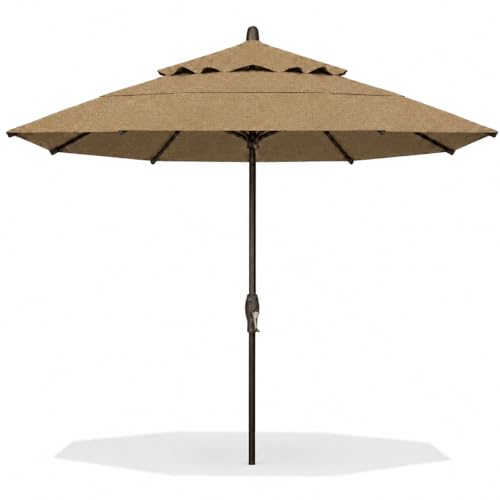
Treasure Garden is a specialist umbrella maker, and this 11-footer shows it: a bronze-finish aluminum frame, a double wind vent, and a deluxe auto-tilt that keeps tilting as you continue turning the crank, so there is no button to hold while you lean. In the configuration we checked, the canopy is Sunbrella — the benchmark solution-dyed acrylic — which is the fabric class hotels and restaurants buy when a canopy has to survive several seasons of daily sun.
Key specs: 11 ft canopy, Sunbrella fabric, deluxe auto-tilt, bronze aluminum frame, double wind vent.
Pros:
- 11-foot canopy shades a full dining setting with overhang to spare
- Sunbrella canopy in the checked configuration: the benchmark for fade and weather resistance
- Auto-tilt continues as you crank — no button to hold at head height
- Double wind vent and bronze aluminum frame from a specialist maker
Honest limitation: It wants a serious base — an 11-foot canopy freestanding needs heavy ballast, and through a table it still deserves a substantial base — and it sits at the top of this budget, so the base may push the total spend over. Plan the pair together.
Choose it if your yard hosts real gatherings and you are buying for many seasons. Skip it if your space is small or your budget must include the base with room to spare.
Grand Patio 10Ft Cantilever Umbrella with Cross Base — Best cantilever value
Who it suits: the backyard sectional, the pool deck, the lounger pair — anywhere a center pole would stand in the way and the shade needs to swing with the sun across a wide area.
This Grand Patio model hangs its 10-foot canopy from a side arm, so no pole stands in the middle of your seating. The mast rotates a full 360 degrees — you follow the sun by swinging the canopy rather than moving chairs — and the canopy tilts to block low morning or evening sun. It stands on a cross base, which is only a frame: it must be weighted with base weight plates or sand bags, sold separately, before the umbrella is safe to open.
Key specs: 10 ft offset canopy, 360-degree rotation, tilt adjustment, steel frame, cross base (weights sold separately).
Pros:
- 360-degree rotation: follow the sun without moving furniture
- 10-foot offset canopy with tilt for low evening sun
- No pole in the middle of the conversation or the pool steps
- Cross base frame included — add weight plates or sand bags
Honest limitation: The cross base is a frame, not ballast: fill it properly — cantilevers of this size typically need 150 lb or more of total weight — or do not open the umbrella. The canopy fabric is polyester, a class below the Treasure Garden’s Sunbrella.
Choose it if you want cantilever freedom and will ballast it like you mean it. Skip it if you want set-and-forget simplicity; a center-pole market umbrella is less demanding.
EliteShade USA 9Ft Market Patio Umbrella — Best fabric under the ceiling
Who it suits: the buyer who has watched two cheap canopies fade to grey-pink and wants the fabric problem solved, on a 9-foot frame that suits a standard patio dining set.
EliteShade builds this 9-footer around its fabric: a solution-dyed acrylic performance canopy that the maker backs with a 10-year non-fading claim and rates UPF 50+. Solution-dyed means the color runs through the fiber rather than sitting on the surface, which is why this class of fabric resists the chalky fade that cheap polyester shows after one hard summer. The frame is a commercial-grade build with crank lift, tilt, and a vented top.
Key specs: 9 ft canopy, solution-dyed acrylic performance fabric, UPF 50+, crank and tilt, vented top.
Pros:
- Solution-dyed performance fabric with the maker’s long non-fading claim
- UPF 50+ rated shade
- Commercial-grade frame with crank and tilt, vented top
- A fabric class usually found above this budget
Honest limitation: At 9 feet it will not cover a six-person table plus loungers the way the 11-footer does — it is a dining-set umbrella, not a whole-yard one.
Choose it if fabric longevity tops your list and your table seats four. Skip it if you need maximum coverage; go up in size, not fabric.
Blissun 9′ Outdoor Patio Umbrella — Best value table umbrella
Who it suits: the straightforward backyard dining table, especially as a second umbrella — one for the table while the budget’s balance goes to a cantilever for the loungers.
The Blissun is a classic center-pole market umbrella: a 9-foot octagonal polyester canopy on eight ribs, opened with a crank and angled with a push-button tilt. The pole is about 1.5 inches in diameter, so it drops through the umbrella hole of a standard patio table and into most universal bases. The canopy fabric is a solution-tinted polyester that sheds light rain and is treated for UV resistance; the vent at the peak lets hot air escape and reduces the sail effect in a breeze.
Key specs: 9 ft canopy, 8 ribs, push-button tilt, crank lift, polyester canopy, 1.5-inch pole.
Pros:
- Proven 9-foot format with crank and push-button tilt
- Standard pole fits tables and universal bases
- Vented peak, eight ribs, nothing exotic to break
- Leaves most of the budget for bases and a second shade source
Honest limitation: Polyester canopy and entry-tier hardware: fine for a table umbrella, not the umbrella to leave standing open through a gusty season.
Choose it if you need a solid table umbrella and would rather spread the budget across the yard. Skip it if this is your one and only umbrella and the yard is exposed.
PHI VILLA 10ft Cantilever Patio Umbrella — Best budget offset (prose)
Who it suits: the homeowner who wants to try the cantilever format — shade over a hot-tub edge or a reading chair — without committing specialist money to an experiment.
PHI VILLA’s cantilever hangs a 10-foot canopy off a side mast, with a crank to raise it and a cross base that needs separate weights. It is one of the common entry points into offset shade because the format — no center pole, shade you can park over a sectional or a lounger — usually costs far more from the specialist brands.
Key specs: 10 ft offset canopy, crank lift, cross base (weights sold separately) (maker listings).
Pros:
- Offset format at value positioning
- 10-foot canopy class with crank operation
- Cross base format — weights separate
- A low-risk way to learn whether cantilever life suits your yard
Honest limitation: Value-tier frame and fabric, and the same ballast discipline as any cantilever: the cross base must be fully weighted. This pick is prose-only because the exact listing variant could not be confirmed at review time — search the model name and verify size and configuration on the listing.
Choose it if you are cantilever-curious and careful with ballast. Skip it if you want a decade-long installation; save toward the specialist brands.
Check price on Amazon by searching the model name — we list this pick without a direct buy link because we could not confirm the exact listing variant at review time, and we would rather send you to search than to the wrong product page.
Abba Patio 9FT Lyon Outdoor Patio Umbrella — Best mid-price all-rounder
Who it suits: family backyards where the umbrella gets opened by everyone, closed by whoever remembers, and expected to survive both — a sturdier frame and heavier canopy at a mid-tier position.
The Lyon is Abba Patio’s mainstream 9-foot market umbrella: eight ribs, a crank lift, a push-button tilt, and a canopy the maker rates for UV protection and water resistance. The frame geometry is a touch sturdier than the very cheapest 9-footers, with a thicker feel to the rib arms, and the canopy fabric is a heavier polyester that holds its shape better in a breeze instead of fluttering at the edges.
Key specs: 9 ft canopy, 8 ribs, push-button tilt, crank lift, UV-protective waterproof canopy.
Pros:
- Eight-rib frame a step above entry tier
- Heavier canopy fabric holds shape in a breeze
- Crank lift and push-button tilt
- UV-protective, water-resistant finish
Honest limitation: Polyester fabric class, so multi-season fade is a matter of when, not if; and 9 feet is dining-set coverage, not whole-yard coverage.
Choose it if you want one dependable do-everything market umbrella. Skip it if coverage or fabric is your top priority — the picks above specialize in each.
Comparison Table
| Umbrella | Size | Type | Fabric class | Tilt | Base note |
|---|---|---|---|---|---|
| Treasure Garden 11ft Double Wind Vent Patio Umbrella | 11 ft | Center pole | Sunbrella | Auto-tilt | Heavy base required; sold separately |
| Grand Patio 10Ft Cantilever Umbrella with Cross Base | 10 ft | Cantilever | Polyester | Tilt + rotate | Cross frame included; 150 lb+ weights separate |
| EliteShade USA 9Ft Market Patio Umbrella | 9 ft | Center pole | Solution-dyed performance | Crank + tilt | Base sold separately |
| Blissun 9′ Outdoor Patio Umbrella | 9 ft | Center pole | Polyester | Push-button | Base sold separately |
| PHI VILLA 10ft Cantilever Patio Umbrella | 10 ft | Cantilever | Polyester | By variant | Cross base; weights separate |
| Abba Patio 9FT Lyon Outdoor Patio Umbrella | 9 ft | Center pole | Polyester, heavier weave | Push-button | Base sold separately |
Backyard Base Weights: The Working Numbers
Base weight is not a detail; on a big canopy it is the difference between shade and a claim on your homeowner’s insurance. Use these working minimums, then go heavier in exposed yards. A 9-foot market umbrella through a sturdy table: 30 to 50 lb. The same umbrella freestanding: 50 to 75 lb. A 10- to 11-foot market umbrella freestanding: 75 to 100 lb, and treat 100 as the starting point if the yard funnels wind between houses. Any cantilever in this guide: fill every plate of the cross base — typically 150 to 200 lb of sand or water in total — because the canopy’s leverage works against you all day, not just in gusts.
Sand beats water inside fillable bases: it is denser, it does not slosh, and it does not freeze-split a base left out in winter. If you use water for convenience, drain before the first freeze. On grass, a base sits unevenly and an umbrella that leans is an umbrella pre-loaded to tip — level a paver or a small gravel pad under the base and the whole setup gets calmer. In-ground sockets are the gold standard for a permanent dining spot in a yard you own: a sleeved socket set in a small concrete footing holds a market umbrella with no base footprint at all, and the umbrella lifts out for winter.
Whatever the base, the operating rule costs nothing: close the umbrella when the meal ends. Most backyard umbrella failures in the incident record are unattended open umbrellas in weather, not defective products — the wind does not care what you paid.
How to Choose a Backyard Patio Umbrella
Choose format by furniture. Dining table with an umbrella hole: market umbrella. Sectional, loungers, pool edge, hot tub: cantilever. Both, across a big yard: one of each beats one giant compromise.
Size to the setting plus overhang. The canopy should overhang the shaded setting by about two feet per side at noon angles. A six-person table wants 10 to 11 feet; a four-person set is happy at 9.
Spend on fabric if it lives outside. Solution-dyed acrylic (Sunbrella and its peers) is the multi-season choice; polyester is the budget choice and an honest one if the umbrella stores indoors and summers are short.
Tilt is not optional in a yard. Evening sun is low and yards are open to the west. Auto-tilt is the luxury version; any tilt is the requirement.
Price the base into the same decision. Umbrella plus correct ballast is the real product. A budget that only works with an under-weighted base is not a budget, it is a postponement.
Common Backyard Umbrella Mistakes
Under-ballasting the cantilever. The cross base looks substantial empty. It is not. Fill every plate, with sand if you can, before the first opening.
Leaving the big canopy open in a storm ‘because it’s heavy-duty.’ Heavy-duty describes the frame’s build, not a wind rating to ride out weather. Close it.
Buying polyester for a permanent outdoor installation. In full sun, budget polyester can fade visibly in a single season. If the umbrella never comes inside, buy the fabric class that matches that life.
Forgetting the west. Owners place the umbrella for noon and discover at 6 p.m. that dinner is in full glare. Check where the shade falls in the evening before fixing a socket or a heavy base position.
Skipping the winter plan. Canopies mildew folded wet and poles corrode in damp sheds. Clean, dry, cover, and store upright or hung — ten minutes in October buys seasons.
Final Recommendation
For most backyards under $300, the Treasure Garden 11ft is the buy: genuine specialist build, Sunbrella shade, auto-tilt, and coverage that ends the shade shuffle — paired with a base weighted for its size. If your yard’s social center is a sectional or pool deck rather than a table, the Grand Patio cantilever earns its place, ballasted fully. Fabric-first buyers on smaller sets should take the EliteShade, and everyone else will be well served by the Abba or the Blissun with the savings spent where backyards always need it: on weight.
Installing a Backyard Umbrella Properly: Bases, Sockets and Level Ground
A backyard gives you installation options a balcony never will, and using them is the difference between an umbrella that feels planted and one that feels borrowed. The simplest correct setup is the heavy freestanding base on a level pad: not on the lawn, where one leg sinks and the whole rig leans into its own tip-over, but on pavers, a deck, or a small gravel-and-paver pad you level once and forget. Set the base, fill it with sand rather than water if it is a fillable design — sand is denser, does not slosh, and will not freeze-split the shell if winter catches it — and seat the pole fully before locking it. A pole that sits two inches high in its socket because of grit in the bottom is a pole pre-loaded to wobble, so vacuum or rinse the socket first.
For a permanent dining spot, consider the in-ground socket: a sleeved tube set in a small concrete footing, flush with the patio or lawn edge, into which the umbrella drops and from which it lifts for winter. It eliminates the base footprint entirely, holds a market umbrella with a calm that no portable base quite matches, and costs less than a premium base. Its price is commitment — the shade is where the socket is — so live with the portable base for a season, mark where the umbrella actually spent its summer, and pour the footing there, not where the spring catalog photo suggested.
Cantilevers deserve their own paragraph because their installation is the one owners most often underdo. The cross base must sit on a level, hard surface — deck, pavers, concrete — and every plate must be filled to its working weight, which for the 10-foot class in this guide means planning on 150 lb or more in total. Half-filled plates are the single most common cause of cantilever tip-overs, ahead of wind itself. If the plates take water, sand still wins on density; if they take paving slabs, use the heaviest format that fits the frame. Once weighted, test the installation like an engineer: open the canopy fully, rotate it through its full swing, and push the mast gently at head height. Movement at the base is information — fix it now, on a quiet morning, rather than during the first barbecue.
Whichever system you choose, finish the installation with the operating kit: a canopy tie you will actually use, a cover that fits, and a storage spot decided before the first storm makes the decision for you.
Backyard Umbrella Care Across the Seasons
A backyard umbrella’s enemies are sun, storm and storage, in that order of total damage. Sun works daily and quietly: even good fabrics accumulate UV hours, and the cheapest protection is the closed canopy — an umbrella closed when unused roughly halves its fabric’s sun exposure across a season, which is why the crank you will actually use beats the pulley you will not. Rotate the umbrella in its base a quarter-turn every few weeks if it stands in one spot, so the same panel does not take the southern exposure all summer; on a market umbrella through a table this takes ten seconds and evens the fade across the canopy.
Storms work rarely and loudly. The rule is absolute: forecast wind means a closed umbrella, and a severe forecast means the umbrella comes inside or lies down in shelter, because an 11-foot canopy generates forces no residential base is designed to argue with. After any storm, inspect before reopening — rib tips seated in their pockets, tilt mechanism cycling cleanly, pole straight in its socket, base unmoved. Five minutes of inspection catches the bent rib that, left bent, tears the canopy at its pocket within the month.
Storage decides whether spring starts with shade or with shopping. Clean the canopy with mild soap and water, rinse it well, and let it dry fully open — a full day of breeze, not an hour of optimism — before folding. Treat any mildew spots with a vinegar solution before storage, never after, because storage is where mildew grows. Lubricate the crank and tilt hardware lightly with silicone, check every screw, and store the umbrella dry, covered with something breathable, off a damp floor. Drain water-filled bases before freezing weather; leave sand-filled ones full and dry. Do this, and the specialist picks in this guide will see their fifth summer looking like their second. Skip it, and the same money buys a familiar annual ritual: the faded, mildewed, storm-bent replacement, purchased in a hurry, at whatever the season’s prices happen to be.
Reading Umbrella Specifications Like a Buyer, Not a Browser
Backyard umbrella listings are dense with numbers, and a few of them decide the purchase while the rest decorate it. Canopy size is measured across the open canopy’s widest arc, rib tip to rib tip — not the flat fabric width — so two ’10-foot’ umbrellas from different makers can shade slightly different circles. Rib count matters more than rib material claims: eight ribs distribute wind load and hold canopy shape better than six, and on an 11-foot canopy eight is the minimum a buyer should accept. Pole diameter is the quiet specification: the standard is about 1.5 inches, and anything you buy should match it, because bases, tables and replacement parts across the whole market assume that standard. A thicker pole on a big canopy is a genuine strength upgrade; a thinner one is a warning.
Fabric specifications repay the closest reading. The honest signals are the fabric’s construction — solution-dyed acrylic names its process proudly — and its weight, expressed in grams per square meter or ounces per square yard, where heavier generally means denser and longer-lived within the same fiber class. Ultraviolet ratings such as UPF 50+ describe the shade’s protection for the people under it, which is a health feature worth having for a dining umbrella that hosts long lunches. Water language needs translating: ‘water-resistant’ means the fabric sheds showers and dries fast; nothing in this class is a rain shelter, and a canopy left open as a rain roof will drip through its seams and age its coating doing it.
Mechanism specifications separate the tiers cleanly. Push-button tilt gives fixed angles; collar tilt gives a friction range; auto-tilt gives continuous adjustment from the crank, and for an 11-foot dining umbrella it is the difference between adjusting the shade from your chair-side position and climbing to wrestle a button at height. Cantilever specifications add two more: rotation, ideally a full circle with positive stops, and the tilt range of the canopy arm, which decides whether the evening sun — the whole point of half your dinners — can actually be blocked.
Warranty language is the last specification and the most honest one in the listing. Makers who expect their fabric to last say so in years; makers who expect their frame to last separate its warranty from the fabric’s. Read the split: a long fabric warranty with a short frame warranty tells you exactly where that maker thinks the umbrella will die, and on a backyard flagship that is information worth the thirty seconds it takes to find.
Three Backyards, Three Right Answers
The dining yard
Six chairs, a table that hosts every birthday and most Sundays, a grill within serving distance: this yard’s social center is fixed, and its umbrella should be too. The Treasure Garden 11ft over the table — in a socket if the spot has proven itself for a season, in a serious base until then — is the complete answer, with auto-tilt carrying the shade from lunch into the long evening without a single chair moved. The budget’s remainder belongs to the base and to a cover, and the yard’s second shade problem, the cook’s station, solves itself later with a value market umbrella when the season’s sales arrive.
The pool and lounger yard
Water changes everything: no table with a hole, seating that migrates with the sun, and a premium on shade that can be swung rather than rebuilt. The Grand Patio cantilever is this yard’s umbrella — parked on the deck’s edge, ballasted like infrastructure, rotated across the loungers through the afternoon. Its honest partner is discipline: the cross base filled with sand, the canopy closed when the swimming ends, and a storage plan for the mast’s length in winter. Yards that skip the ballast step meet the cantilever’s one unforgiving lesson; yards that do it properly wonder why they ever dragged chairs around a fixed pole.
The big mixed yard
Table at one end, sectional at the other, kids everywhere: the mixed yard is two shade problems wearing one address, and the under $300 budget solves it best as a pair rather than a flagship. The Abba or Blissun over the table now, the cantilever next season — or the reverse, ordered by which zone hosts more hours. What the mixed yard must not do is split the budget into two mediocre umbrellas bought simultaneously; one good umbrella and a plan beats two compromises and a grievance. Sequence the purchases, weight both bases properly, and by the second summer the yard has the two-format coverage that single-umbrella yards envy.
Buying Timing, Warranties and the Five-Summer Ledger
Backyard umbrellas reward buyers who shop the calendar. Selection peaks in early spring, when the specialist models in this guide are stocked in every fabric and finish; prices soften at the season’s end, when a buyer flexible on canopy color can move up a fabric class for the same money. The purchase to avoid is the mid-summer replacement bought in a weekend panic after a storm failure, when stock is thin and urgency is total. If your current umbrella is in its late seasons — fading, creaking, a rib already bent — replace it on the calendar’s terms, not the weather’s, and let the old one serve as the spare for the grill zone rather than as a failure waiting for an audience.
Warranties in this class split into fabric and frame, and the split is the most honest sentence in any listing. A maker confident in its solution-dyed fabric warrants color for years; a maker confident in its frame says so separately, in its own number. Read both numbers for any umbrella you consider, and treat a long fabric warranty paired with a short frame warranty as a precise prediction of which half you will be replacing first. Keep the receipt, the model identifier and the fabric code photographed in one place; claims and replacement canopies both begin there, and the owners who sail through them are simply the owners who can produce three facts on demand.
The five-summer ledger settles the tier’s value question. Umbrella, proper base, cover — then either the quiet years of a specialist pick, serviced by a spring inspection and an occasional part, or the replacement cycle of a budget pick bought twice with a storm story in between. Across five summers the totals converge; the summers themselves do not. A backyard is a long-term room, and its shade should be bought like the rest of its furniture: once, properly, with the base priced in and the paperwork kept.
Final Checks Before You Click Buy
Before ordering, verify the listing the way an installer would. Confirm the canopy size from the specification table — measured rib tip to rib tip — and the pole diameter against your table’s hole and your base’s socket, because the standard exists precisely so that these parts agree, and any listing that departs from it should say so loudly. Confirm the fabric by name: if the canopy is Sunbrella or another solution-dyed material, the listing will say so in the specifications, not only in the photography. Confirm the tilt type in words — push-button, collar, or auto-tilt — because the difference decides how shade gets adjusted at your table for the next five summers, and confirm what the box contains, especially for cantilevers, where the cross base frame travels with the umbrella and the weights that make it safe do not.
Price the whole installation in one sitting: umbrella, base or plates at the full recommended weight, a cover that fits, and delivery of what will be two or three heavy boxes. A backyard flagship bought without its ballast is not a saving, it is an IOU written against the first windy weekend. And read the maker’s wind and storage guidance on the listing before the box arrives, so the household’s operating rules — close it when the meal ends, store it dry when the season ends — are agreed while they are still theoretical. Backyards forgive many things, but they collect on skipped ballast and skipped reading with complete reliability.
A Note on Color, Heat and the View From the Kitchen Window
Two backyard details deserve a host’s attention before the order, because both are lived with daily and changed never. The first is color as climate: a dark canopy casts the denser, cooler-feeling shade and hides a season of pollen between washings, while a light canopy keeps a small yard feeling open and shows every spot it collects. Neither is a mistake, but choose for your yard’s exposure — full-sun yards forgive dark colors their heat at the fabric because the vent carries it away, while yards under trees should expect leaf stain and choose the color that wears it gracefully. The second is the view from inside: a backyard umbrella is seen through the kitchen window more hours than it is sat under, open over the table in summer and tied in a corner all winter, and a canopy color that belongs to the house’s palette makes the yard look kept in both seasons. Buyers who choose color from the listing photograph alone are choosing for a studio; choose for your window instead, and the umbrella will look like it was always part of the yard — which, after five summers of lunches, it will have become.
FAQ
Does a patio umbrella come with a base?
Usually not. Most market and cantilever umbrellas on Amazon are sold as the umbrella only, and the product photos that show a handsome weighted base are showing an accessory you buy separately. Always check the listing’s ‘what is included’ line, and budget for the base before you compare umbrella prices, because a safe base can cost a meaningful share of the umbrella itself.
How heavy should an umbrella base be?
As a working rule, a 9-foot market umbrella used freestanding wants at least 50 lb of base weight, and more — 70 to 90 lb — if it stands alone in an exposed, breezy spot rather than through a heavy table. A 10- or 11-foot canopy needs more again, and a cantilever needs substantially more than a center-pole umbrella of the same size because the load hangs off to one side: plan on filling all four weight plates of a cross base, typically 150 lb or more of sand or water in total. When in doubt, go heavier; a base that is too heavy costs money once, while a base that is too light can cost an umbrella, a table, or worse.
Should I leave my patio umbrella open all the time?
No. Close it when you are not using it, and always close it ahead of wind. An open umbrella is a sail, and most umbrella damage — bent ribs, snapped poles, tipped bases — happens to umbrellas left open and unattended in gusts. Closing it also keeps the canopy cleaner and slows fabric fading, so the habit pays twice.
Is an 11 ft umbrella too big for a backyard dining table?
For a six-person table, 11 feet is the right size, not an indulgence: the canopy should overhang the table and chairs by roughly two feet on each side so that morning and afternoon sun, arriving at an angle, still leaves the seats shaded. For a four-person table it is more than you need, and a 9- or 10-foot canopy will look and behave better.
Cantilever or center-pole umbrella for a backyard?
Choose by furniture. A center-pole market umbrella is simpler, sturdier per dollar, and perfect through a dining table. A cantilever keeps the pole out of the way — better for sectionals, loungers, pool edges and hot tubs — and rotates to follow the sun, but costs more and demands far more base weight. Many larger yards end up with one of each, and this guide’s picks are chosen so a table umbrella and a cantilever from the list complement rather than duplicate each other.
Is Sunbrella worth paying for on a patio umbrella?
If the umbrella lives outdoors through the season, yes. Sunbrella is solution-dyed acrylic: the color is in the fiber, so it resists fading for years where polyester can wash out in one hard summer, and the fabric keeps its strength and water-shedding longer. If your umbrella stores indoors and comes out for weekends, polyester’s savings are honest. The dividing line is exposure hours, not taste.
Related Guides
- Best Patio Umbrella Under $300
- Best Patio Umbrella For Homeowners Under $300
- Best Patio Umbrella For Small Yards Under $300
- Best Patio Umbrella Under $500
- Best Patio Umbrella For Beginners Under $150


