Where to buy
Check the latest price, availability and delivery on Amazon. Orders are placed on Amazon. We may earn a commission from qualifying purchases.
- EAST OAK Pyramid 48,000 BTU — Check on Amazon
- Hykolity Pyramid 48,000 BTU — Check on Amazon
- Fire Sense Performance Series 63717 — Check on Amazon
- AZ Patio Heaters HLDS01-CG — Check on Amazon
See 2 more Amazon options
- Fire Sense Tabletop 60262 — Check on Amazon
- Cuisinart COH-514 Tabletop — Check on Amazon
Read the full guide ↓
Disclosure: As an Amazon Associate, dailyhomedecorating.com earns from qualifying purchases. Links to Amazon on this page are affiliate links; they cost you nothing extra. Listing details such as price and availability change often, so check the current Amazon listing before you buy.
Entertaining changes what the best patio heater for outdoor entertaining under $500 has to be. A heater bought for solitary evenings needs only to warm its owner; a heater bought for outdoor entertaining has to warm guests who did not dress for the weather, hold its own as part of the scene, light reliably in front of an audience, and keep working through the longest evenings of the season. Under $500 covers every serious candidate for that job — flame-tube pyramid heaters that double as the party’s centrepiece, polished mushroom heaters from the brands restaurants buy, and tabletop units that warm the dinner table from its centre — so this guide compares six of them on the criteria hosting actually imposes: presence, reliability, coverage of a seated group, and the small operational details that separate a host who is enjoying the party from a host who is servicing an appliance. Check the current price on Amazon for each pick; every one leaves budget over for the second heater, the spare tank or the lighting that completes the setup.
The entertaining heater’s first job is social physics. Guests cluster where warmth and light are, and they leave when either fails. A pyramid heater exploits this openly: its flame column is a hearth, and people arrange themselves around it without being asked, drinks in hand, in the circle where its heat actually reaches. A mushroom heater does the same job less theatrically and more effectively over a dining table, throwing heat down onto seated guests. Tabletop units perform the most intimate version of the trick, warming faces and hands across the table itself. The sophisticated entertaining setup often layers two of these — a mushroom heater over the dining set, a pyramid where people drift afterwards — and this budget, uniquely, allows exactly that pairing from this guide’s picks.
The second job is reliability under observation. A heater that takes nine clicks to light is a private annoyance and a public performance. Electronic ignition, a healthy pilot, a full tank checked before guests arrive — these unglamorous details are the difference between warmth as ambience and warmth as incident. So is the tank arithmetic of a long evening: a heater lit at seven for a party that ends at midnight consumes real fuel, and the spare tank stored by the seating area is the host’s insurance policy. The reviews below judge each model partly on these terms, and the how-to-choose section turns them into a pre-party checklist.
None of this suspends the rules in the safety section — if anything, entertaining raises the stakes, because guests include children, elderly relatives, people in flowing sleeves and people who have had a drink, all moving around tall, hot appliances in the dark. Clearances, supervision and the closing ritual of switching everything off belong in the host’s plan alongside the menu. Read the safety section as part of the party planning, not as an appendix.
In this guide
Quick picks: best patio heater for outdoor entertaining under $500
Two pyramids for the gathering circle, two mushroom heaters for the dining zone, and two tabletop units for the table itself — the six picks map onto the three places guests actually sit. The table summarises the casting; the reviews explain each performance.
| Pick | Type | Output | Best for | |
|---|---|---|---|---|
| EAST OAK Pyramid 48,000 BTU | Propane pyramid heater | 48,000 BTU | the centrepiece of the party patio | Check on Amazon |
| Hykolity Pyramid 48,000 BTU | Propane pyramid heater | 48,000 BTU | flame atmosphere at a friendlier spend | Check on Amazon |
| Fire Sense Performance Series 63717 | Propane mushroom heater | 46,000 BTU | the reliable workhorse for weekly hosting | Check on Amazon |
| AZ Patio Heaters HLDS01-CG | Propane mushroom heater | 48,000 BTU | dinner parties that run long | Check on Amazon |
| Fire Sense Tabletop 60262 | Propane tabletop heater | 10,000 BTU | the dining table itself, warmed from the centre | Check on Amazon |
| Cuisinart COH-514 Tabletop | Propane tabletop heater | 11,000 BTU | the dining table, with anti-tilt reassurance | Check on Amazon |
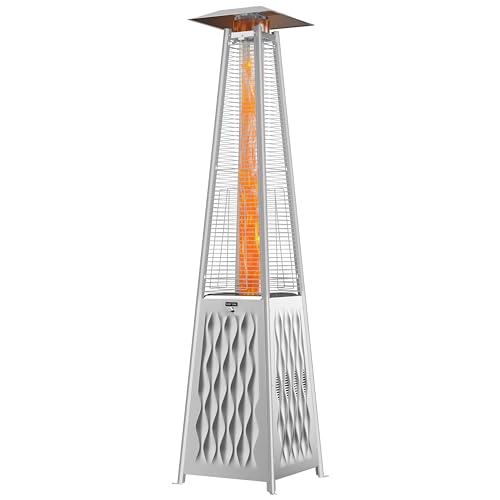
EAST OAK Pyramid 48,000 BTU — best for the centrepiece of the party patio. The centrepiece: an all-stainless pyramid whose flame gives the party a hearth. Guests gather to it uninvited, which is precisely the point.
Hykolity Pyramid 48,000 BTU — best for flame atmosphere at a friendlier spend. The atmosphere pick on a budget: the same flame-column trick in bronze, with a cover included — ideal as the second heater in a two-heater setup.
Fire Sense Performance Series 63717 — best for the reliable workhorse for weekly hosting. The host’s workhorse: electronic ignition that lights first time in front of guests, and a finish that looks intentional beside good furniture.
AZ Patio Heaters HLDS01-CG — best for dinner parties that run long. The dinner-party pick: 48,000 BTU over the table, a ring for drinks, and a slightly lower profile that suits pergola dining rooms.
Fire Sense Tabletop 60262 — best for the dining table itself, warmed from the centre. The table pick, classic version: a CSA-approved tabletop heater that warms the conversation from the centre of the table.
Cuisinart COH-514 Tabletop — best for the dining table, with anti-tilt reassurance. The table pick, reassuring version: 11,000 BTU with an anti-tilt switch, for tables where elbows and serving dishes are in constant motion.
How these picks were chosen
Entertaining imposed its own shortlist logic. Every pick had to pass the base tests first — specifications verified against the manufacturer’s published data, the exact listing cross-checked through Amazon’s Creators API before any link was added, and U.S. Consumer Product Safety Commission recall records checked for every brand and model, with any recalled product excluded entirely and unnamed in this guide. Safety systems were non-negotiable: tip-over or anti-tilt shut-off on every model, because parties are exactly where heaters get bumped.
On top of that base, we selected for hosting qualities. Ignition had to be quick and dignified — electronic where available, proven piezo designs otherwise. Presence counted: for the gathering-circle role we required the flame to be a genuine feature, which is why both pyramid picks are full-size glass-tube models rather than decorative novelties. Coverage was matched to entertaining geometry — a dining table, a drinks circle — rather than to headline area claims. And we favoured models a host can service mid-party without tools or drama: accessible tank doors, sensible controls, finishes that wipe clean after an evening’s splashes.
Excluded: heaters whose listings promise commercial output without verifiable specifications, any model with an unresolved recall question, and delicate designer pieces whose replacement glass or parts would end a season if a guest’s elbow found them. Entertaining is a contact sport; the picks are built for it.
Safety first: fire, carbon monoxide and tip-over
No heater in this guide is safe on autopilot, and the safety rules are not fine print — they decide where a heater may stand, what it may stand near, and whether it may be used at all. Read this section before the reviews, and read your chosen model’s manual after them; where the two differ, the manual and your local fire code win.
Clearance from anything that can burn. Mushroom and pyramid propane heaters need generous clear space above and around them — as a working rule, keep at least 3 feet from walls, furniture, curtains, umbrellas and overhanging branches on every side, and several feet of open air above the reflector, following the greater distance whenever the manual demands more. Never run a full-height propane heater under a low roof, tent, gazebo canopy or patio umbrella unless the manual explicitly allows the configuration and the clearances still fit. Tabletop units need a stable, heat-tolerant table and open air above them. Electric infrared heaters need the clearance their manuals specify from ceilings, walls and soft furnishings — radiant elements run far hotter than they look.
Carbon monoxide. Every propane heater in this guide burns fuel and produces carbon monoxide. That is why they are outdoor-only appliances: never use one in a garage, tent, enclosed porch, sunroom or any space with a roof and walls that trap air, and never use one indoors for any reason. A covered patio with open sides is the grey zone — if air cannot move freely through the space, treat it as enclosed and choose an electric heater instead. Know the early signs of carbon monoxide exposure — headache, dizziness, nausea, unusual tiredness — and if anyone feels them near a running heater, turn it off if you can do so safely, move everyone to fresh air and seek help. A battery carbon monoxide alarm in any semi-enclosed outdoor room is cheap insurance.
Tip-over and stability. Full-height heaters are tall, top-heavy machines standing in weather. Fill water-ballast bases, use sand or weights where the design allows, stand the heater on level paving rather than grass or decking boards that rock, and move it out of forecast storm winds. Tip-over shut-off switches and anti-tilt valves are backstops, not permissions: they cut the gas when a heater falls, but a falling heater is already an accident in progress. Keep children and pets from leaning, climbing or playing around the pole, and never leave a running heater unattended.
Fuel discipline. Check the hose and regulator for cracks and the connections for leaks with soapy water whenever you change a tank — bubbles mean gas is escaping, and the heater stays off until the connection is fixed. Store spare propane cylinders outdoors, upright, away from the heater and from ignition sources, never indoors and never in a hot car. Turn the cylinder valve off first when you finish for the night, let the burner consume the line gas, then turn the control off. Electric heaters have their own discipline: plug directly into a properly rated outlet, never run one from a lightweight indoor extension cord, keep cords dry and out of walkways, and give a 1,500 W heater a circuit that is not already feeding another heavy load.
Entertaining safely: guests, drinks and tall hot appliances
A party concentrates every patio-heater risk factor in one place: more people, more movement, more darkness, longer run times, and guests who do not know the appliance’s hot zones because it is not theirs. Plan for it. Position heaters where the seating is, not where the walking is — a heater belongs inside the circle of chairs or over the table, never beside the path to the kitchen or the drinks table, where shoulders and trays pass all evening. Keep the clearances in the main safety section even when the patio feels crowded; moving a chair is always cheaper than moving a burn.
Brief your guests with one sentence — ‘the heater’s hot, mind the top’ — and take special care with the two groups parties always include: children, who should be told plainly that the heater is a no-touch, no-climb appliance and kept in sight near it, and anyone in loose sleeves, scarves or costumes, who should not be seated with fabric drifting toward a pyramid’s glass or a tabletop’s screen. Assign the heater a owner for the night — usually the host — who lights it, adjusts it, checks the tank before the party rather than during it, and performs the closing ritual: cylinder valve off, control off, heater left to cool before any cover goes near it. If the evening involves real quantities of alcohol, that assignment matters more, not less. Carbon monoxide discipline is unchanged: gas heaters stay outdoors in open air however late and however cold the night becomes — moving a party into a closed garage around a propane heater is the single most dangerous improvisation in this entire category, and it is never the answer.
The six best patio heaters in detail
1. EAST OAK Pyramid 48,000 BTU
Who it suits. the host whose patio is the venue — drinks evenings, birthday gatherings, the standing Friday crowd. It suits a defined gathering circle on a terrace or garden room, arranged close around the flame.
Pyramid heaters trade the mushroom heater’s reflected heat for a visible flame column inside a quartz glass tube, and EAST OAK’s version is built in all stainless steel with a 48,000 BTU rating and a triple protection system that covers tip-over and flame-out shutoff. The flame is the point: it turns the heater into a light source and a focal point, which is why restaurants and event patios use this format. The honest trade is physics — a pyramid heats the people immediately around it well, but its warmth falls off faster with distance than a reflector heater’s does, because much of the energy goes into the spectacle. Wheels are included for moving it on hard surfaces.
A pyramid heater is partly furniture, and the EAST OAK’s all-stainless body is built for that role: it wipes clean, shrugs off weather that would freckle painted steel, and keeps the flame column as the visual centre of the patio. Lighting follows the standard pilot routine, after which the flame settles into the tube. Owners should expect the glass to need an occasional careful clean, and should move the unit by its wheels on paving rather than dragging it across decking.
Pros
- Visible flame column doubles as patio lighting and a focal point
- All-stainless construction resists weather better than painted steel
- Triple protection system with tip-over and flame-out shutoff
- 48,000 BTU rating matches mushroom heaters on paper
Honest limitation. Heat reach is shorter than the BTU figure suggests; plan seating within a few feet, and expect the quartz tube to need careful handling during moves.
Choose it if your parties gather around a focal point and you want the heater to be it. Skip it if your guests spread across a wide terrace — its heat is a close circle, not a blanket.
2. Hykolity Pyramid 48,000 BTU
Who it suits. hosts who entertain often enough to want the flame atmosphere but would rather fund the party than the appliance — and anyone building a two-heater setup, where this is the natural second unit.
Hykolity’s pyramid heater brings the glass-tube flame format down to a friendlier position in the budget, and it includes a fitted cover in the box — a small thing that matters, because pyramid heaters live outdoors and the quartz tube and pilot assembly last longer when they are kept dry and dust-free between uses. Output is rated at 48,000 BTU, the bronze finish warms up the look, and wheels are fitted for repositioning on paving. As with all pyramids, seat guests close: the flame show is generous, the heat radius is not.
The Hykolity pyramid is the accessible route into the flame-tube format, and the included cover removes the usual first accessory purchase. Assembly involves the glass tube, so work on a soft surface and keep the packaging until the unit is standing. Once lit, the bronze frame and the flame column do the entertaining; your job is seating placement, because guests beyond a few feet are watching the fire more than feeling it.
Pros
- Pyramid flame format at a value position in the range
- Fitted cover included in the box
- 48,000 BTU rating with wheels for repositioning
- Bronze finish suits warm-toned outdoor rooms
Honest limitation. The included cover is a basic one; in harsh winters the heater still belongs under a roof or in a shed, and the glass tube is the fragile part in any move.
Choose it if you want flame atmosphere at a spend that leaves room for a second heater. Skip it if your patio is windy; flame heat and glass tubes both dislike gusts.
3. Fire Sense Performance Series 63717
Who it suits. the frequent, organised host: weekly dinners, a heater lit several nights a week, and zero tolerance for ignition fumbling in front of guests. It suits the main dining zone of a well-kept patio.
Fire Sense’s Performance Series 63717 pairs a 46,000 BTU burner with electronic ignition, which replaces the push-and-hold piezo routine on cheaper heaters with a battery-powered spark that lights the burner more reliably in gloves and in wind. The espresso finish is a deep brown powder coat, and the heater rides on wheels with a weighted-style base designed around a standard 20 lb tank. Fire Sense sells this line at both residential and light commercial buyers, and the fit and finish — panel alignment, door latch, reflector gauge — reflects that.
Day to day, the electronic ignition is the feature you notice: press, spark, flame, without the repeated piezo clicking that cheaper heaters demand on cold mornings. The espresso finish is dark enough to recede visually against evening shadows, which some buyers prefer to bright stainless. Fire Sense publishes full documentation for this line, and the Performance Series naming reflects its position as the brand’s better-built residential tier rather than its entry level.
Pros
- Electronic ignition is easier and more reliable than basic piezo starters
- 46,000 BTU output sized for a six-person dining zone
- Espresso powder coat pairs well with dark wicker and teak
- Wheels and a tidy tank door make day-to-day use simple
Honest limitation. Electronic ignition means a battery to maintain; when it dies the heater will not light until it is replaced, so keep a spare with the patio supplies.
Choose it if you host often and want first-time ignition and a polished finish. Skip it if you host twice a year — the value picks serve rare parties just as well.
4. AZ Patio Heaters HLDS01-CG
Who it suits. dinner-party hosts, especially under a pergola or deep eave where its slightly lower profile helps, who want drinks resting on the table ring and 48,000 BTU over the seats.
The HLDS01-CG is AZ Patio Heaters’ 87-inch, 48,000 BTU mushroom heater in a hammered bronze finish, with the small accessory table around the pole that distinguishes the brand’s mid-range models. At 87 inches it stands a little shorter than the tallest heaters in this guide, which helps under deep eaves and pergola beams where a 91-inch unit would crowd the structure above it — though the clearance rules in the safety section still apply in full. The burner and emitter screen are stainless, the finish is powder coat, and the base hides a standard 20 lb propane tank.
The HLDS01-CG suits owners who want the table-ring design in a slightly shorter frame. Assembly follows the usual pattern — base, pole sections, burner head, reflector — and the hammered bronze hides the minor scuffs of seasonal storage well. The tank door gives straightforward access to a standard 20 lb cylinder. Because the brand sells through many outdoor retailers as well as online, finding a replacement reflector or a new hose and regulator is rarely a research project.
Pros
- 48,000 BTU output with a slightly lower 87-inch profile
- Accessory table ring included around the pole
- Hammered bronze finish suits traditional patio furniture
- Stainless burner and emitter screen resist heat discoloration
Honest limitation. The shorter profile is still far too tall for low covered structures, and the hammered finish shows pale dust more than smooth finishes do.
Choose it if your entertaining is seated dining and you want output plus the drink ring. Skip it if your entertaining is standing drinks rather than seated dining; a pyramid gathers people better.
5. Fire Sense Tabletop 60262
Who it suits. hosts whose entertaining is dinner itself — four to six people around one table for hours. It suits small patios where the table is the whole venue.
The Fire Sense 60262 is a tabletop propane heater: a compact 10,000 BTU unit designed to sit in the middle of an outdoor dining table and warm the people seated around it, rather than a whole patio. It carries CSA approval and an auto-shutoff valve, and its stainless steel body has been in the Fire Sense catalogue for years, which makes replacement parts and documentation easy to find. Output is deliberately modest — this is a shoulder-season, close-quarters heater for four people at a table, not a substitute for a full-height unit in mid-winter.
The 60262 lives on the table, so its ownership routine is tabletop-sized: it stores in a cupboard, comes out with the dinner things, and goes back inside afterwards. That portability is also its safety discipline — a tabletop heater should be set on a stable, heat-tolerant table, away from the table edge, and never under a low umbrella canopy. Within those rules it does one job beautifully: warm hands and faces across a dinner table on evenings that would otherwise end early.
Pros
- Sits on the table, warming faces and hands where people actually sit
- CSA approved with an auto-shutoff valve
- Compact enough to store on a shelf between uses
- Long-running model with easy-to-find documentation
Honest limitation. 10,000 BTU only works at table distance; it will not warm a seating area, and it must never be used under a low umbrella or canopy without the clearances in the manual.
Choose it if your parties are dinners at one table and space is at a premium. Skip it if your parties outgrow one table — it warms a table, not a patio.
6. Cuisinart COH-514 Tabletop
Who it suits. dinner hosts who want the tabletop format with the anti-tilt switch’s reassurance — families, lively tables, and anyone whose dinners involve reaching, passing and leaning.
Cuisinart’s COH-514 is a tabletop propane heater rated at 11,000 BTU with an anti-tilt safety switch, an adjustable heat control and a burner screen guard, in a grey finish. The maker rates its useful range at about 30 square feet, which matches its real job: the centre of a four-to-six-person dining table on a cool evening. The anti-tilt switch cuts the gas if the unit is knocked, a meaningful feature on a table where elbows, serving dishes and children are all in motion. It is a current model from a major kitchen and outdoor brand, with the dealer and parts network that implies.
Cuisinart’s tabletop unit is built for the same table-centre role with a little more output and the reassurance of the anti-tilt switch. The burner screen guard keeps curious fingers and stray napkins off the hot element. It suits hosts who eat outside often in the shoulder seasons: set it in the middle of the table, light it before guests sit down, and let it take the edge off the evening rather than trying to defeat the season.
Pros
- Anti-tilt safety switch suits busy dining tables
- 11,000 BTU is strong for the tabletop class
- Adjustable heat with a burner screen guard
- Major-brand support and documentation
Honest limitation. Like every tabletop unit it heats a table, not a patio, and the table surface beneath it must be heat-tolerant and completely stable.
Choose it if you want tabletop warmth with anti-tilt protection for a busy table. Skip it if you need area heat for a crowd; step up to a full-height model.
Comparison table
For entertaining, compare the picks by venue zone first — gathering circle, dining zone, or the table itself — and by output second. The table below adds the feature that matters most at a party and the trade-off to plan around.
| Model | Type | Output | Standout feature | Main trade-off |
|---|---|---|---|---|
| EAST OAK Pyramid 48,000 BTU | Propane pyramid heater | 48,000 BTU | All-stainless pyramid flame column | Close-range heat; glass needs care |
| Hykolity Pyramid 48,000 BTU | Propane pyramid heater | 48,000 BTU | Pyramid flame with cover included | Basic included cover; glass is fragile in moves |
| Fire Sense Performance Series 63717 | Propane mushroom heater | 46,000 BTU | Electronic ignition, espresso finish | Ignition battery needs replacing eventually |
| AZ Patio Heaters HLDS01-CG | Propane mushroom heater | 48,000 BTU | Table ring, 87-inch profile | Still needs full overhead clearance |
| Fire Sense Tabletop 60262 | Propane tabletop heater | 10,000 BTU | CSA approved, auto-shutoff valve | Warms one table only |
| Cuisinart COH-514 Tabletop | Propane tabletop heater | 11,000 BTU | Anti-tilt switch, 11,000 BTU tabletop | Warms one table only; needs a heat-tolerant table |
How to choose: best patio heater for outdoor entertaining under $500 explained
Step one: map the party. Sketch where guests will actually be: seated dining, standing drinks, a drift zone afterwards. Each zone is a heating assignment. Dining zones take mushroom or tabletop heaters; standing zones take pyramids, whose flame organises the crowd; drift zones are where the second heater earns its price. Most entertaining failures are mapping failures — one heater heroically centred between two zones and serving neither.
Step two: cast the formats. One dining table of six or fewer: a mushroom heater beside it, or a tabletop unit on it if the patio is small. Standing drinks for a dozen: a pyramid at the circle’s centre. Both, on a big night: both heaters, zoned. The budget in this guide is chosen so that the two-heater answer is realistic — two of these picks together can sit inside $500 total spend on the heaters in many combinations, leaving the rest of the party budget intact.
Step three: rehearse the operations. Light every heater the day before the party, not the hour. Check the tank with the only reliable gauge — a spare beside it — and swap early if in doubt. Confirm ignition batteries, clear the clearances that party furniture tends to invade, and run the heater for ten minutes to burn off dust before guests sit near it. A heater’s first lighting of the season should never have an audience.
Step four: place for people, then for safety. Seat the guests inside the heat’s real reach — a few feet for pyramids and tabletops, a table’s width for mushroom heaters — and keep walkways, the drinks run and the kitchen path out of the heater’s clearance zone. In the safety section’s terms: heaters inside the seating, never inside the traffic. Check overhead again with party furniture in place; the umbrella that was fine in May sits lower over the October table.
Step five: run the evening like a host. Light early so the zone is warm when guests arrive — infrared and reflector heat are fast, but furniture and people take time to feel settled. Turn down once the circle is full; bodies are heaters too. At the end, the host performs the closing ritual personally: valves off, controls off, no cover until the metal is cool, and a last look at the patio before bed. Entertaining well is mostly rituals like these, done without visible effort.
Common mistakes to avoid
One heater, two zones. The classic party layout error. A heater centred between the dining table and the drinks circle warms the empty paving between them. Zone the party, then heat the zones.
The empty-tank ambush. Tanks run out mid-party with metronomic reliability, because parties are the longest burns of the season. The spare tank, stored outdoors near the seating, is the cheapest insurance a host can buy — buy it before the first party, not after the first failure.
First lighting in front of guests. Dust, a sulky igniter, a spider’s web in the burner tube from storage — all discoverable the day before, all theatrical on the night. Rehearse the lighting like you taste the sauce.
Heater in the walkway. A heater beside the route to the kitchen collects bumps from trays, elbows and children all evening. Inside the seating circle is warmer and safer; in the traffic lane is neither.
Moving the party indoors around a gas heater. When the night turns cold, the dangerous improvisation is carrying the warmth into a garage or enclosed porch. Carbon monoxide makes that a hard no, always. The party moves indoors; the heater stays outside and goes off.
Covering a warm heater at midnight. The tidy-up instinct, applied too early, melts covers and worse. The closing ritual ends with cooling, not covering; the cover waits for morning.
The host’s calendar: a season of entertaining, heated
Entertaining is seasonal, and a host’s heater works a calendar rather than a thermostat. The season opens in early spring with the first dinner that tests the evening air — the heater’s job then is small and specific, an hour’s extension at the table, and tabletop and mushroom heaters at low settings do it best. It builds through the high season of long evenings, when the heater is lit before guests arrive as a matter of routine and the gathering circle around a pyramid becomes the party’s second room. And it peaks in autumn, when entertaining moves earlier, guests arrive in layers, and the heater graduates from accessory to necessity — the difference between a party that happens outdoors and one that retreats inside by eight.
Each phase makes different demands, and the picks in this guide map onto them. Spring dinners are tabletop and mushroom territory. Summer gatherings are pyramid territory, where the flame’s light matters as much as its heat on nights that barely need heating. Autumn is maximum-output territory, where the Fire Sense and AZ Patio mushroom heaters earn their ratings and where the two-heater household — dining zone and gathering circle both served — stops sounding like extravagance and starts sounding like the reason the party is still outside in October. A host who entertains across all three phases is really buying a small system, and this budget, unusually, prices that system within reach in a single season or two.
The calendar also imposes a maintenance rhythm that occasional users can skip and hosts cannot. Before the season: the full rehearsal — clean, leak-check, light, burn off. Monthly in season: a wipe of reflector or glass, a glance at the hose, a tank census so the spare is never theoretical. Before the biggest party of the year: everything, again, plus ignition batteries. Hosts learn that guests forgive ordinary food far more readily than a cold patio and a heater being dismantled by torchlight; the calendar exists so that the appliance is never the evening’s entertainment.
Budget the season, not the heater. Across a year of weekly entertaining, fuel is a real line item — several tank exchanges for a mushroom heater run generously — and the economics argue for the same discipline as the warmth does: heat the zones guests occupy, turn down when the circle is full and body-warm, and switch off at the evening’s end rather than letting the heater farewell the last guest alone. The hosts whose parties people describe as warm are not the ones with the largest heaters; they are the ones whose warmth was planned — zoned, rehearsed, fuelled and lit on time. Everything in this guide was chosen to make that planning easy, inside a $500 ceiling that leaves the rest of the party budget where it belongs: on the party.
There is also a social detail worth planning for: tell guests where the warmth is. People new to a patio hover at its edges, drinks in hand, politely cold, because nobody has shown them the evening’s geography. A host who steers the first arrivals into the heated circle — ‘sit here, it’s warm, I’ll bring your drink’ — sets the pattern every later guest follows, and the party organises itself around the heat without another word. Warmth, like music, works best when somebody has quietly arranged it in advance; the heater is only the instrument.
Keep a short note after each season’s biggest party — what ran out, what was bumped, where guests actually settled — and next year’s first rehearsal writes itself.
Final recommendation
If your entertaining has a centre, build it around the EAST OAK Pyramid: no other pick organises a party the way its flame does, and its stainless build suits a life lived outdoors. Budget-conscious hosts get the same trick from the Hykolity Pyramid, which doubles beautifully as the second heater in a zoned setup. For seated dining, the Fire Sense Performance Series is the host’s workhorse — first-time ignition, polished finish — with the AZ Patio Heaters HLDS01-CG as the pergola-dining alternative, while the Fire Sense tabletop and Cuisinart COH-514 warm the table itself on small patios and at intimate dinners. The strongest recommendation this guide can make, though, is structural: zone the party, keep a spare tank, rehearse the lighting, and check the current price on Amazon before the season’s first invitation goes out. Warmth, handled that way, stops being equipment and becomes hospitality.
Frequently asked questions
How many heaters do I need for a party of twelve?
It depends on the layout, not the headcount alone. Twelve people seated at one long dining arrangement can be served by one strong mushroom heater placed inside the arrangement plus, ideally, a tabletop unit at the far end. Twelve people standing in a drinks circle need one pyramid at the centre, with a second heater if the circle is wide or the night cold. The rule is one heater per zone where people settle — guests in motion between zones need less than guests seated for hours.
Pyramid or mushroom heater for entertaining?
Choose by the shape of the evening. Seated dining favours the mushroom heater, which throws heat down over a table. Standing, drifting, drinks-in-hand gatherings favour the pyramid, whose flame gathers people into its warm circle. Hosts who do both kinds of evening, in both zones, are the natural two-heater owners — and this budget accommodates that pairing.
How do I stop the tank running out mid-party?
You cannot gauge a propane tank by shaking it with any reliability, so plan instead: start important evenings on a tank you know is full, and keep a second full cylinder stored outdoors near the seating area. Swapping a tank takes two minutes in daylight-rehearsed hands. Hosts who entertain weekly often keep two tanks in permanent rotation — one in the heater, one full beside it.
Can guests stand close to a pyramid heater?
Close, yes; touching, no. The glass tube and its guards run hot enough to burn, and loose clothing should never rest against the unit. In practice the flame itself teaches distance — people settle where it is comfortable, which is the heater’s working radius anyway. The host’s job is placement: the pyramid inside the circle, with its clearance zone respected, and children briefed and supervised.
Are tabletop heaters enough for a dinner party?
For one table, in the shoulder seasons, yes — that is exactly their design brief. A tabletop unit warms the faces, hands and upper bodies of the people seated around its table. It will not warm a second table, standing guests or a large patio, and it should be paired with realistic dressing: it extends the dinner season, it does not abolish it.
What should I check the day before a party?
Light every heater and let it run for ten minutes. Confirm the tank situation and the spare. Check ignition batteries on electronic models. Restore the clearances that everyday furniture has invaded, especially overhead. Wipe the reflector or glass so the heater looks like part of the event. Then set the seating inside the heat’s reach. Ten minutes of rehearsal buys an evening without an appliance incident.


