Where to buy
Check the latest price, availability and delivery on Amazon. Orders are placed on Amazon. We may earn a commission from qualifying purchases.
- Best overall personal pick: Amazon Basics Ceramic Space Heater, 1500W (Black) — Check on Amazon
- Best for two seats: Amazon Basics Oscillating Ceramic Space Heater, 1500W (Black) — Check on Amazon
- Best value: GiveBest Portable Electric Space Heater, 1500W/750W — Check on Amazon
- Best looking: Lasko Small Space Heater, 16-Inch Tower, 1500W — Check on Amazon
- Best for one reader: Amazon Basics Ceramic Mini Heater, 500W (Black) — Check on Amazon
- Best true outdoor heat: Buyplus Propane Heater, 15,000 BTU (Tank-Top) — Check on Amazon
Read the full guide ↓
Disclosure: As an Amazon Associate, dailyhomedecorating.com earns from qualifying purchases. Links to Amazon on this page are affiliate links; they cost you nothing extra. Listing details such as price and availability change often, so check the current Amazon listing before you buy.
Searching for the best patio heater under $50 usually starts with a picture: a tall mushroom heater radiating warmth over a whole patio, the kind restaurants rent by the month. This guide has to begin by retiring that picture honestly. A new, full-size mushroom heater costs several times this budget, the tabletop propane models that shrink the format still land well above it, and no amount of comparison shopping changes that arithmetic. What $50 genuinely buys — verified listing by listing for this guide — is personal heat: compact electric ceramic heaters that warm one or two people at close range on a covered patio, one small tank-top propane unit that works in the open for ground-level yards, and nothing else that deserves your money. Every pick below is labelled with what it actually is, because the most common way to waste this budget is to buy a product whose name promises a patio and whose output warms a pair of ankles.
That reality check is not a counsel of despair. Personal heat, used knowingly, is exactly what most households need: the goal is rarely to make a whole patio feel like July, it is to make one reading chair, one porch swing or one morning-coffee seat comfortable for an extra hour in October. A 1,500-watt ceramic heater at chair-side distance does that job properly, costs little to run for an evening, stores in a cupboard, and asks nothing of you but a wall outlet and a dry, covered spot. This guide ranks the six honest ways to spend the budget, explains the safety rules that travel with each fuel type, and names the well-known models that sit above the budget so you can recognise them when a listing dresses them in under-$50 clothing.
One promise about method before the picks: prices in this category move constantly, so this guide never prints a fixed product price — every pick says check price on Amazon, and the budget test was applied at research time using the sellers’ own listings. Where a famous model failed that test, it appears as prose only, without a buy link, so you can learn from it without being sold it.
In this guide
Quick Picks
Short on time? Each row names a buyer type and the product that suits it. Every pick is labelled with what it actually is — at this budget, honest labels matter more than marketing names.
| Buyer type | Pick | What it actually is | Link |
|---|---|---|---|
| Best overall personal pick | Amazon Basics Ceramic Space Heater, 1500W (Black) | personal electric heater — not a mushroom heater | Check on Amazon |
| Best for two seats | Amazon Basics Oscillating Ceramic Space Heater, 1500W (Black) | personal electric heater — not a mushroom heater | Check on Amazon |
| Best value | GiveBest Portable Electric Space Heater, 1500W/750W | personal electric heater — not a mushroom heater | Check on Amazon |
| Best looking | Lasko Small Space Heater, 16-Inch Tower, 1500W | personal electric tower heater — not a mushroom heater | Check on Amazon |
| Best for one reader | Amazon Basics Ceramic Mini Heater, 500W (Black) | personal electric mini heater — not a mushroom heater | Check on Amazon |
| Best true outdoor heat | Buyplus Propane Heater, 15,000 BTU (Tank-Top) | tank-top propane heater — not a mushroom heater | Check on Amazon |
The Honest Math: What Under $50 Can and Cannot Buy
Three product families compete for this keyword, and only two of them fit the budget. Full-size mushroom heaters — 40,000-plus BTU propane towers — start at roughly three times this budget before the tank. Tabletop propane heaters, the 11,000 BTU units from makers such as Cuisinart (its COH-514 tabletop model) and BALI OUTDOORS, are the format most shoppers hope will squeeze under $50; at research time both sat well above it, so they are discussed here as prose-only context, not picks. The best-known personal propane heater, the Mr. Heater Little Buddy MH4B — 3,800 BTU, indoor-approved with an oxygen depletion sensor and tip-over shut-off, running about five and a half hours on a 1 lb cylinder — also priced above the $50 line when checked, which is why it earns an honourable mention in prose rather than a link. What remains, and what this guide ranks, is what actually clears the bar: 1,500-watt and 500-watt personal electric ceramic heaters for covered patios, and one 15,000 BTU tank-top propane heater for open ground-level spaces.
Understanding the electric picks requires one conversion: 1,500 watts is about 5,100 BTU, delivered as fan-blown warm air that feels strong within a few feet and fades fast beyond them, especially outdoors where air moves. Propane radiant heat at 11,000–15,000 BTU projects farther and tolerates wind, which is why the tank-top pick exists in this guide despite its stricter safety terms. Neither figure warms a whole patio; both warm people. Shop by the seat you want to save, not by the space you own, and this budget stops disappointing you.
How These Picks Were Chosen
The first filter was the budget itself, applied at research time to live listings: a pick had to be a real, orderable product whose checked price sat inside the under-$50 tier, or it was demoted to prose. The second filter was identity honesty — every product is labelled by what it is (personal electric heater, tank-top propane heater, tabletop unit) rather than by the marketing phrase on its box. The third was safety equipment: electric picks needed tip-over and overheat protection as a minimum, and the propane pick needed a safety shut-off valve and a maker who publishes real specifications. The fourth was recall screening: every candidate was checked against U.S. Consumer Product Safety Commission recall records, and any model under an active recall was excluded entirely — you will not find the recalled products named in this guide’s picks, and the safety section explains how to run the same check on anything you already own. Finally, we favoured established, high-volume models whose specifications could be verified against maker information, because at this price the difference between a bargain and a hazard is usually documentation.
Two standing rules shaped every line of the reviews that follow. No product price is printed anywhere in this guide, because prices in this category change constantly — where a product is linked, the listing itself is the price source, via check price on Amazon. And no fixed star ratings or review counts appear, for the same reason: those numbers move, and a guide that prints them is quietly going stale from the day it is published. What does not move is the hardware — output, safety systems, fuel, footprint — and that is what the reviews judge.
Detailed Reviews: Every Pick for Best patio heater under $50
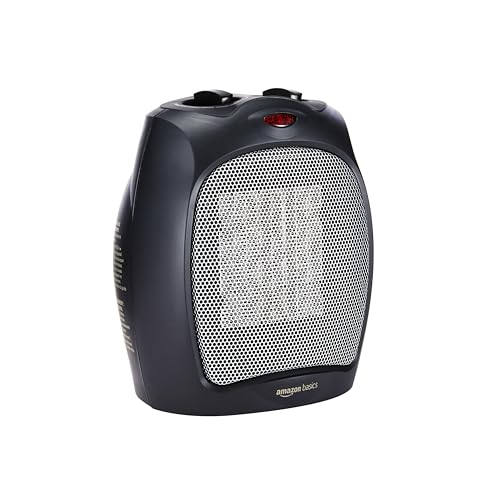
1. Amazon Basics Ceramic Space Heater, 1500W (Black) — personal electric heater — not a mushroom heater
Who it suits: one favourite covered-porch or balcony chair, occupied by one person who wants steady, direct warmth.
This is the heater most under-$50 patio shoppers actually end up using, and it is important to name what it is before praising it: a compact indoor ceramic fan heater, roughly the size of a shoebox stood on end, that earns its place on a covered patio because it puts a focused cone of warm air on one or two seated people sitting close to it. The maker rates it at 1,500 watts on high and 900 watts on low, with a fan-only mode, an adjustable thermostat, tip-over protection and overheat protection. It weighs a little over two pounds, so moving it from a desk to a porch chair takes one hand, and the housing stays cool enough to reposition by its body while it runs on low. On a covered patio, the honest way to use it is at chair-side distance: set it on a hard, level surface a couple of feet from your legs, angled slightly upward, and it takes the edge off a cool evening for the person in that chair. It will not warm a seating circle, it will not fight wind, and the moment the air around you is moving, most of its output is carried away. Within those limits it is genuinely effective, because radiant-and-fan personal heat is about proximity, not square footage.
The controls are as simple as this class gets: a mode dial and a thermostat dial, no remote, no timer, no display. That simplicity is a virtue outdoors, where a heater lives in dust, pollen and the occasional splash of rain under a cover, and where a membrane keypad would age badly. The thermostat does cycle the element to hold a rough temperature in a still, enclosed-ish space such as a screened porch; in open air it will simply run continuously on high, which is the setting nearly every patio user ends up choosing. The fan is audible — a steady whoosh that most people stop noticing after a few minutes but that will compete with very quiet conversation if the unit sits on the table beside you rather than on the ground.
In this guide’s terms: this is the default recommendation — the fixed-cone Amazon Basics is the heater to buy when one favourite chair is the whole project. Its lack of oscillation stops mattering when the audience is one person who can aim the unit once and forget it.
Pros:
- Full 1,500W output with a 900W low setting and fan-only mode
- Tip-over and overheat protection built in
- Featherweight at a little over two pounds — trivial to carry in and out
- Simple dials that tolerate dusty porch conditions better than touch panels
Honest limitation: It is an indoor-rated personal heater, so it belongs only on dry, covered patios, plugged directly into a wall outlet — never on an extension cord, never in rain, and never left running unattended. Its heat bubble is personal-sized: expect comfort for one chair, not a patio.
Choose it if the description above matches your seat and your space. Skip it if you need to warm a group, an open deck, or any space where the sitter is more than a few feet away.
2. Amazon Basics Oscillating Ceramic Space Heater, 1500W (Black) — personal electric heater — not a mushroom heater
Who it suits: two people sharing a bench, swing or loveseat who want one heater to serve them both in turn.
The oscillating sibling of the fixed Amazon Basics ceramic heater solves the one complaint the fixed model invites: a single narrow cone of heat that serves exactly one seat. This version keeps the same 1,500-watt ceramic element, the same high, low and fan-only settings, the same adjustable thermostat and the same tip-over and overheat protection, and adds a motorised oscillation that sweeps the warm air across a wider arc. On a covered patio that sweep matters more than the raw wattage suggests. Two people sharing a porch swing or a couple seated side by side on a bench both pass through the warm zone in turn, which feels far more generous than the same watts parked on one pair of knees. The trade is rhythm: instead of constant heat, each person gets waves of it, and on a cold, still evening some users prefer the fixed model’s unbroken stream.
Physically it is the same compact footprint, a little over two pounds, with the oscillation base adding a small amount of height and one more moving part to keep clean. Oscillation on a patio raises one placement point the fixed model does not: the unit needs a truly level, hard surface, because a wobbling base on deck boards or a rug edge makes the sweep uneven and can trip the tip-over switch mid-evening. Set it on a side table or a flat section of deck, give the sweep a clear arc with nothing flammable parked in front of it, and it behaves well. Like every electric pick in this guide, it is an indoor-rated appliance moonlighting outdoors: dry covered spaces only, direct wall outlet only, carried back inside when the evening ends.
In this guide’s terms: choose the oscillating version when the seat is shared. Couples on a porch swing and parents beside a child’s chair get more comfort per dollar from the sweep than from any other feature at this price.
Pros:
- Oscillation shares one heater between two adjacent seats
- Same 1,500W/900W/fan settings and thermostat as the fixed model
- Tip-over and overheat protection
- Same light, compact body — easy to store indoors between uses
Honest limitation: Oscillation delivers heat in waves rather than a constant stream, which some people find less satisfying on the coldest evenings, and the moving base needs a genuinely flat surface or the tip-over switch can cut in. Still indoor-rated and dry-covered-patio only.
Choose it if the description above matches your seat and your space. Skip it if you sit alone and want an unbroken stream of heat rather than a sweeping rhythm.
3. GiveBest Portable Electric Space Heater, 1500W/750W — personal electric heater — not a mushroom heater
Who it suits: mild evenings and older circuits, where a gentler low setting matters as much as maximum output.
The GiveBest is the value benchmark in small ceramic heaters: a 1,500-watt high setting, a 750-watt low setting that the Amazon Basics pair does not offer in quite the same way, a fan-only mode, an adjustable thermostat, and tip-over and overheat protection, in a compact body with a carry handle moulded into the top. The 750-watt setting is the detail that earns this heater its place in a patio guide. On a mild evening, when 1,500 watts aimed at your shins feels like too much and nothing feels like too little, the low setting lands in between — and it also halves the electrical load, which matters on older porch circuits shared with string lights or a speaker. The maker describes it as heating up to around 200 square feet in enclosed indoor spaces; treat that as an indoor figure, because outdoors its useful zone is the same chair-side bubble as every other pick here, but within that bubble the two-step output gives it finer manners than most.
The thermostat is a simple dial, the controls are mechanical, and the fan noise sits in the same noticeable-but-ignorable band as its rivals. GiveBest sells this heater in very large numbers, which cuts both ways: parts and replacements are a non-issue and the design is well proven, but you should do the same first-evening checks you would with any budget heater — run it supervised, confirm the tip-over switch cuts power when you tilt it, and make sure the plug and cord stay merely warm, never hot, after an hour on high. Used on a dry covered patio, at close range, plugged straight into the wall, it is one of the most sensible ways to spend this budget.
In this guide’s terms: the GiveBest is the connoisseur’s budget pick — its 750-watt setting is the feature you will actually use on the many evenings that are merely cool, and it is the kindest choice for older wiring.
Pros:
- 750W low setting is ideal for mild evenings and kinder to older circuits
- Thermostat, tip-over and overheat protection included
- Carry handle and compact footprint suit chair-side placement
- Fan-only mode earns its keep on warm nights too
Honest limitation: A budget-built unit: fit and finish are a step below the Lasko, and the thermostat is a coarse dial rather than a precise control. Indoor-rated, so dry covered patios only, no extension cords, and no unattended running.
Choose it if the description above matches your seat and your space. Skip it if you want premium fit and finish, or a precise digital thermostat.
4. Lasko Small Space Heater, 16-Inch Tower, 1500W — personal electric tower heater — not a mushroom heater
Who it suits: buyers who care how the porch looks and need full power from the smallest floor footprint.
The Lasko tower is the pick for people who find the shoebox-style heaters visually intrusive and audibly busy. Stretching the same 1,500 watts into a slim 16-inch tower with oscillation changes the character of the heat: instead of a knee-level blast, warm air leaves the tall grille across a vertical band, so a seated person’s legs and lap both sit in the stream, and the oscillation sweeps it across a loveseat or a pair of chairs. Lasko rates it with two quiet heat settings, an adjustable thermostat, overheat protection and a cool-touch exterior, and the tower format keeps the footprint to a dinner-plate circle — useful anywhere floor space is the scarcest resource. It is also the most finished-looking appliance in this guide, the one a design-conscious buyer can leave on a screened porch without feeling the space has been colonised by a workshop tool.
Two cautions come with the format. First, a tower’s height makes it the pick most sensitive to placement: on an uneven deck board or a thick outdoor rug it can rock, and while the safety systems are there to cut power if it falls, a heater that wobbles in a breeze is a heater placed wrong — it wants the flattest, hardest spot you have. Second, the taller grille tempts people to set it farther away and expect room-style coverage; resist that. It is still 1,500 watts, still a personal-zone heater outdoors, and it performs best at the same close chair-side distance as the others, just with a broader, gentler delivery. Dry, covered, supervised, straight into a wall outlet — the same rules as every electric pick here.
In this guide’s terms: the Lasko is the pick when the porch is also a visual space — a screened porch you entertain on, where a tower reads as furniture and a shoebox heater reads as clutter.
Pros:
- Tall oscillating grille warms legs and lap together, not just shins
- Smallest footprint of the 1,500W picks — a dinner-plate circle
- Two quiet settings and a cool-touch exterior
- The most porch-presentable design in this guide
Honest limitation: The tall body is the most placement-sensitive here: it needs a hard, level surface and dislikes thick rugs and uneven boards. It is also the easiest pick to over-trust at a distance — outdoors it remains a close-range personal heater.
Choose it if the description above matches your seat and your space. Skip it if your only spot is an uneven board run or a thick rug where a tower can rock.
5. Amazon Basics Ceramic Mini Heater, 500W (Black) — personal electric mini heater — not a mushroom heater
Who it suits: a single reader or worker in one chair, and anyone adding a second warm seat on a budget.
Five hundred watts sounds like a rounding error next to the 1,500-watt picks, and in a living room it would be. At the distance this little heater is designed for — on a side table beside one chair, or on the floor directly in front of one pair of feet — it is honestly sufficient on all but the coldest evenings, and it brings three advantages the bigger units cannot match. It weighs about a pound and a half and stands under six inches tall, so it disappears into a storage tote and perches on surfaces the towers cannot use. It draws roughly a third of the current, which makes it the safest electrical citizen on a circuit that is also running lights, a speaker or a second heater. And its single, simple job — one heat output, tip-over protection, a power indicator — leaves almost nothing to mis-set. Think of it as the heated-throw-blanket of this guide: not a room heater, not a patio heater in the mushroom sense, but a personal warmth appliance that does its small job reliably.
The limits are absolute and worth stating plainly. There is no thermostat to cycle it and no low/high choice to make; it is on, producing its modest stream of warm air, or it is off. Move it three feet away and you will barely feel it; add a breeze and you will not feel it at all. It earns a place in this guide for the tightly-defined jobs — one reader in one chair on a covered porch, one person at a small table — and for buyers whose electrical situation rules out a full 1,500-watt draw. If your evenings involve more than one person or genuinely cold air, step up to one of the 1,500-watt picks and treat this one as the second unit you add later for the far chair.
In this guide’s terms: the mini is the specialist: one reader, one chair, one small table. It is also the rational second purchase once a 1,500-watt unit already covers the main seat.
Pros:
- Tiny and featherweight — fits side tables and stores anywhere
- 500W draw is gentle on shared or older circuits
- Tip-over protection and the simplest possible controls
- The natural second heater for the far end of a seating pair
Honest limitation: No thermostat and a single heat setting, and its warmth reaches one close person only — a few feet of distance or any breeze defeats it. Indoor-rated: dry covered use, direct outlet, supervised only.
Choose it if the description above matches your seat and your space. Skip it if more than one person needs warming, or your evenings are properly cold rather than cool.
6. Buyplus Propane Heater, 15,000 BTU (Tank-Top) — tank-top propane heater — not a mushroom heater
Who it suits: open, ground-level outdoor spaces with room for a wide clearance ring and no need for an outlet.
This is the only pick in the guide that is a true outdoor propane heater in the traditional sense, and its format explains both its appeal and its demands. A tank-top heater mounts directly onto a standard 20-pound propane cylinder, which becomes its base, its fuel supply and most of its weight. The maker rates this unit at up to 15,000 BTU with three adjustable settings and a safety shut-off valve, and 15,000 BTU of radiant propane heat is a different species from 1,500 watts of fan-blown air: it throws warmth several feet, works in moving air that defeats the electric picks, needs no outlet, and can run for many hours on a tank. For an open, ground-level outdoor space where cords cannot reach, it is the only under-$50 format that behaves like the patio heaters people picture.
Now the demands, which are not footnotes. A tank-top unit is an open-flame appliance with a very hot radiant head at roughly knee-to-waist height once mounted. It needs a wide, disciplined clearance zone — the maker’s instructions govern, and as a working rule you keep it well away from furniture, cushions, deck rails, siding and foot traffic, on open ground where nothing can be knocked into it. It produces carbon monoxide as all propane combustion does, so it is for open outdoor air only, never a garage, tent, screened enclosure or covered balcony. It is absolutely not an apartment-balcony appliance. Assembly and the tank connection must be leak-checked with soapy water before the first lighting of the season, and the tank valve is closed whenever the heater is off. Respect those terms and it is a capable, honest tool; skip them and no bargain justifies it.
In this guide’s terms: the Buyplus is the exception that proves the guide’s rule — the one route to real outdoor radiant heat at this money, reserved for open ground-level spaces where its clearance and ventilation demands can be met without compromise.
Pros:
- Real radiant propane heat that works in wind and needs no outlet
- Three settings up to a maker-rated 15,000 BTU
- Runs for many hours on a standard 20 lb tank
- Safety shut-off valve fitted
Honest limitation: Open-flame combustion: open ground-level outdoor use only, wide clearances, carbon monoxide rules out any enclosed or covered space, and it is prohibited territory for apartment balconies. The 20 lb tank is bought separately and is part of the real cost and footprint.
Choose it if the description above matches your seat and your space. Skip it if your space is covered, enclosed, a balcony, or too small for a wide enforced clearance zone.
Comparison Table
| Pick | Fuel and output | Realistic coverage | Safety equipment | Best setting |
|---|---|---|---|---|
| Amazon Basics Ceramic 1500W (Black) | Electric, 1,500W/900W | One seat, fixed cone | Tip-over + overheat | Covered patio, chair-side |
| Amazon Basics Oscillating 1500W | Electric, 1,500W/900W | Two seats, sweeping | Tip-over + overheat | Covered patio, shared seat |
| GiveBest 1500W/750W | Electric, 1,500W/750W | One–two seats | Tip-over + overheat | Mild evenings, older circuits |
| Lasko 16-inch Tower 1500W | Electric, 1,500W | One–two seats, tall grille | Overheat protection, cool touch | Finished porches, tight floors |
| Amazon Basics Mini 500W | Electric, 500W | One seat, very close range | Tip-over protection | Single chair, side table |
| Buyplus Tank-Top 15,000 BTU | Propane, up to 15,000 BTU | Small open-air circle | Safety shut-off valve | Open ground-level yard only |
Coverage figures describe the zone in which a seated person actually feels warmth outdoors, not a maker’s enclosed-room rating. Every electric pick in this table is a personal electric heater — not a mushroom heater — and the propane pick is a tank-top unit, not a tabletop or tower model.
Safety: Fire, Carbon Monoxide, Clearances and Tip-Over
Every heater in this guide can hurt someone if it is placed or used carelessly, and the rules differ by fuel, so learn the set that matches your pick. For the electric models: keep at least three feet between the heater and anything that can burn — cushions, throws, curtains, paper, dried plants — and never drape anything over the unit. Plug directly into a wall outlet; extension cords and power strips are a leading cause of space-heater fires because a 1,500-watt draw overheats light cords. Never run an electric heater in rain or on a wet deck, never leave one running unattended or while you sleep, and let the tip-over and overheat systems do their job by placing the unit on a hard, level surface where they can. These are indoor-rated appliances: a dry, covered patio is their outdoor limit.
For the propane pick, the rules harden. Propane combustion produces carbon monoxide, an odourless gas that can kill in enclosed air, so the tank-top heater belongs in open outdoor air only — never in a garage, tent, screened porch or under a balcony ceiling. Keep its clearance zone wide and enforced: no furniture, fuel cans, or foot traffic near the radiant head, and children and pets kept back by rule, not by hope. Leak-check the tank connection with soapy water before each season’s first use, close the tank valve when the heater is off, and store cylinders outdoors, upright, away from heat. A specific warning belongs here because the accessory is widely sold: do not use refill adapters to refill disposable 1 lb propane cylinders from a larger tank. Those cylinders are not built or certified for refilling, the practice risks leaks and overfilling, and reputable makers warn against it — buy fresh certified cylinders or use a heater designed for a refillable tank. Finally, whatever you buy or already own, check the model against the CPSC recall database before the season starts; recalled heaters should be stopped, unplugged and handled exactly as the recall notice directs.
How to Choose the Best Patio Heater Under $50 for Your Space
Start with the seat, not the space. Count the people you actually need to warm and where they sit: one fixed chair points to the fixed Amazon Basics or the mini; two adjacent seats point to an oscillating model; an open yard with no outlet points to the tank-top propane unit and its stricter rules. Second, audit your power. A 1,500-watt heater draws about 12.5 amps, most of a standard household circuit, so a porch that also runs lights and a speaker may be happier with the GiveBest on its 750-watt setting or the 500-watt mini. Third, be honest about cover: no roof means no electric pick is suitable, full stop — electricity and weather do not mix, and every electric model here is indoor-rated. Fourth, think about storage and ritual: electric picks ask to be carried inside after use, which suits people who tidy; the propane unit lives on its tank outdoors, which suits people who will actually maintain clearances week after week. Fifth, check the safety specification before the style: tip-over and overheat protection on electrics, a shut-off valve and published BTU figures on propane. Buyers who work through those five questions in order almost never regret this purchase; buyers who start from a product photo usually do.
Common Mistakes With Budget Patio Heaters
The first mistake is buying for the photograph: ordering a heater whose listing shows it warming a dinner party when its output warms one chair, then concluding that all budget heaters are useless. The second is the extension cord — coiling a light indoor cord under a rug to reach a 1,500-watt heater is a fire scenario, not a workaround; if the outlet cannot reach, the answer is a different placement or the propane pick, not a cord. Third, shoppers place electric heaters on thick outdoor rugs or uneven boards, where tip-over switches either nuisance-trip all evening or, worse, cannot protect a unit that slides. Fourth, propane buyers underestimate clearance: a tank-top heater parked beside a resin chair or under a low branch is an incident rehearsing itself. Fifth, people leave heaters running while they go inside ‘for a minute’ — the minute stretches, and unattended operation is where the accident statistics live. Sixth, bargain hunters buy unbranded heaters with no published safety specifications at all; at this price, a maker who will not state tip-over protection has told you something important. Finally, many buyers skip the two-minute recall check on a heater they already own before pressing it back into service each autumn.
Final Recommendation
For most readers, the Amazon Basics 1500W ceramic heater is the right first buy: full-strength personal heat, both core safety protections, and a body you can carry in one hand, all comfortably inside the budget — with the oscillating version taking the crown instead whenever two people share the seat. Add the GiveBest if your wiring is old or your evenings are mostly mild, the Lasko if appearance matters, and the mini when one reader is the whole brief. Reserve the Buyplus tank-top for open, ground-level yards and only if its clearance and carbon-monoxide rules fit your habits without strain. And if your heart is set on a tabletop propane unit or the Mr. Heater Little Buddy, this guide’s honest advice is to wait and fund the higher tier rather than pretend a listing trick has repealed the arithmetic — the companion guides below cover those budgets properly.
Getting the Most From a Personal Heater: Placement Rituals That Work
Because this budget buys proximity rather than power, small placement decisions have outsized effects, and a week of evenings teaches them quickly. The first ritual is the pre-warm: switch the heater on five minutes before you sit down, aimed at the empty chair. Fabric and cushion foam that start warm feel dramatically better than a chair you warm with your own body heat while the heater catches up, and the habit costs almost nothing in electricity. The second is the angle: aim the stream slightly upward from low, so it crosses legs and lap rather than pooling at ankle height or blowing past at knee level. The third is the wind audit — before settling, notice where the air is moving; a personal heater placed upwind of its person loses, while the same unit sheltered by the chair itself, a wall corner or a planter keeps most of its value. Porch geometry rewards the observant.
Evening economics deserve a paragraph too, because they are the quiet reason this tier satisfies people who use it well. A 1,500-watt heater running flat out for three hours uses about four and a half kilowatt-hours — at typical residential electricity prices, well under a dollar an evening — and the low settings and the mini cut that further. Compare the propane alternative’s cylinder costs over a season and the electric picks look even better for daily, short-duration use, which is why so many households that begin with one personal heater end with two: the second unit is not an admission of failure but the moment the setup matches the household’s real seating. Buy the second one only after a month of evenings has shown you exactly which seat is cold; that seat, and not a catalogue, should choose the model.
Finally, build the end-of-evening habit that keeps these appliances safe for years: heater off, a minute to cool, carried inside, stored dry. It takes ninety seconds, it is the difference between a verified appliance and a weathered guess, and it is the single behaviour that most separates owners who love this tier from owners who have a story about it.
Frequently Asked Questions
Can a patio heater under $50 warm a whole patio?
No — and any listing implying otherwise is marketing. At this budget you are buying personal heat: a warm zone for one or two seated people at close range. Whole-patio warmth starts with full-size mushroom heaters at several times this budget.
Are electric space heaters safe to use on a patio?
Only within strict limits: a dry, covered patio, a hard level surface, three feet of clearance from anything flammable, plugged directly into a wall outlet, and only while you are present. They are indoor-rated appliances, so rain, wet decks and unattended running are all out.
Why is the Mr. Heater Little Buddy not a linked pick?
It is a genuinely good personal propane heater — 3,800 BTU with an oxygen depletion sensor and tip-over shut-off — but when its listing was checked for this guide it priced above the $50 tier, so it is discussed in prose rather than sold to you under an under-$50 headline.
Is a tank-top propane heater a good idea?
It is the only true outdoor radiant heat at this budget and it works in wind, but it is an open-flame appliance with carbon-monoxide and clearance rules that exclude covered, enclosed and balcony spaces entirely. It suits disciplined ground-level yard use only.
Should I use a refill adapter for 1 lb propane cylinders?
No. Disposable 1 lb cylinders are not designed or certified for refilling; adapters that transfer propane from a bulk tank risk leaks and overfilled cylinders. Use fresh certified cylinders, or choose a heater built for a refillable tank.
How do I check whether a heater I own has been recalled?
Find the brand and model number on the unit’s label and search the U.S. Consumer Product Safety Commission recall database at cpsc.gov before each season. If your model is listed, stop using it and follow the recall remedy exactly.
Related Guides
Keep researching with these guides from the same series:
- Best Patio Heater Under $75 — step up to the under-$75 tier, where tabletop propane starts to appear.
- Best Patio Heater Under $150 — see what the under-$150 tier adds, including proper tabletop models.
- Best Fire Pit Under $50 — compare flame-based warmth at the same budget.
- Best Outdoor Rug Under $50 — define the seating zone your heater will serve.
- Best Outdoor String Lights Under $50 — finish the evening setup once the warmth is sorted.