Where to buy
Check the latest price, availability and delivery on Amazon. Orders are placed on Amazon. We may earn a commission from qualifying purchases. Every product below is an accessory or personal warmer — none of them is a patio heater, and each is labelled with its true type.
- Best overall accessory: Easy-Going Patio Heater Cover, 89 in. H x 33 in. D x 19 in. B — Check on Amazon
- Best for tabletop heater owners: Classic Accessories Veranda Water-Resistant 21 Inch Round Table Top Patio Heater Cover — Check on Amazon
- Best efficiency upgrade for a heater you own: Heat Focusing Reflector Shield for Round Propane Patio Heaters, 10 Panels — Check on Amazon
- Best safety and planning accessory: DOZYANT Propane Tank Gauge Level Indicator with Leak Detector, QCC1 Type 1 — Check on Amazon
- Best repair part for a heater that will not stay lit: FD4 Thermocouple and Dump Switch Repair Kit for Propane Patio Heaters, 350 mm — Check on Amazon
- Best personal warmth under $20: Lerat Rechargeable Hand Warmers, 2 Pack, Electric Pocket Warmers — Check on Amazon
Read the full guide ↓
Disclosure: As an Amazon Associate, dailyhomedecorating.com earns from qualifying purchases. Links to Amazon on this page are affiliate links; they cost you nothing extra. Listing details such as price and availability change often, so check the current Amazon listing before you buy.
A small patio disciplines every purchase, and the first discipline is honesty about price. The search for the best patio heater for small patios under $20 cannot end in a heater: no genuine patio heater exists at or under $20 from any verifiable source, because the burner, valve, reflector and safety hardware of a real appliance cost more than that on their own. The second discipline is honesty about space, and it cuts in a surprising direction. A small patio is actually the easiest space to heat — a modest circle, a short distance from heater to chair — but the hardest space to heat safely, because clearances do not shrink with your patio. The manual’s three feet is three feet whether the patio is six feet wide or sixty. This guide holds both truths at once and spends your $20 where a small patio actually benefits.
What a small patio needs from this budget is compactness with purpose. Storage is the small patio’s permanent problem: every object stored on it is floor space lost, and a heater’s support kit must earn its footprint. That is why this guide’s picks are the flat, the small and the pocketable — a cover that folds into its own bag, a gauge that lives permanently on the cylinder and takes no space at all, a reflector that stores on the heater it serves, a repair kit the size of a paperback, and hand warmers that live in a coat pocket. Nothing here needs a shed. Nothing here colonizes the patio it serves.
The small patio also changes which heater you will eventually buy, and this guide looks ahead to that decision honestly. On a small patio, the standing mushroom heater is often the wrong appliance entirely — its dome diameter, its clearance demands and its heat radius are designed for larger circles — while a tabletop unit, correctly sited on a stable table with its own clearances respected, matches the scale. The tabletop cover in this guide exists for that future, and the how-to section explains the siting arithmetic that decides between formats. Small is not a lesser version of large; it is a different problem with its own right answers.
Until that future purchase, the small patio’s present tense is personal warmth and preparation — and on a patio that holds two chairs and a small table, personal warmth for two people is not a compromise. It is, head for head, the most completely warmable space in this entire guide series.
In this guide
Quick Picks
In a hurry? The table below matches each need to the one product in this guide that fits it. Read the type column with care — at this budget you are buying protection, repair, monitoring and personal warmth, not a heater, and knowing exactly what each object is will save you a wasted purchase.
| Buyer type | Pick | Type | Why it stands out | Link |
|---|---|---|---|---|
| Best overall accessory | Easy-Going Patio Heater Cover, 89 in. H x 33 in. D x 19 in. B | Cover — accessory, not a heater | Sized for the standard standing-heater silhouette, so it covers the reflector dome instead of stopping halfway down the pole | Check on Amazon |
| Best for tabletop heater owners | Classic Accessories Veranda Water-Resistant 21 Inch Round Table Top Patio Heater Cover | Tabletop cover — accessory, not a heater | Correct scale for tabletop units, so it does not pool, flap or drag the way an oversized cover does | Check on Amazon |
| Best efficiency upgrade for a heater you own | Heat Focusing Reflector Shield for Round Propane Patio Heaters, 10 Panels | Reflector — accessory, not a heater | Redirects heat that would otherwise be lost above the reflector toward the seating area | Check on Amazon |
| Best safety and planning accessory | DOZYANT Propane Tank Gauge Level Indicator with Leak Detector, QCC1 Type 1 | Gauge — accessory, not a heater | Color-coded dial readable at a glance, even in low evening light | Check on Amazon |
| Best repair part for a heater that will not stay lit | FD4 Thermocouple and Dump Switch Repair Kit for Propane Patio Heaters, 350 mm | Safety repair part — accessory, not a heater | Addresses the single most common patio-heater fault: a heater that lights but will not stay lit | Check on Amazon |
| Best personal warmth under $20 | Lerat Rechargeable Hand Warmers, 2 Pack, Electric Pocket Warmers | Personal warmer — accessory, not a patio heater | Real, immediate warmth for one or two people at a budget where area heating is impossible | Check on Amazon |
How These Picks Were Chosen
Small-patio picks were chosen by footprint first and function second — the reverse of the other variants, and deliberately so. Every pick had to store in negligible space: on the appliance it serves, in a drawer, or in a pocket. Within that filter, the base guide’s logic applied unchanged: protect, monitor, improve, repair, warm the person. Recall listings were checked for every product, every pick is a real verifiable listing, and nothing that encouraged squeezing a heater into clearances it does not fit was admitted — on a small patio that temptation is the whole safety battle, and this guide refuses it. The tabletop emphasis is also deliberate: small patios that heat at all, heat with tabletop-scale appliances, and the support kit here is weighted toward the format that fits the space.
The 6 Best Patio Heater Accessories for Small Patios Under $20: Best patio heater for small patios under $20
Each review follows the same honest structure: who the product suits, what it genuinely does well, its real limitation stated without varnish, a variant-specific note on how it earns its place in this version of the guide, and a clear choose-or-skip verdict.
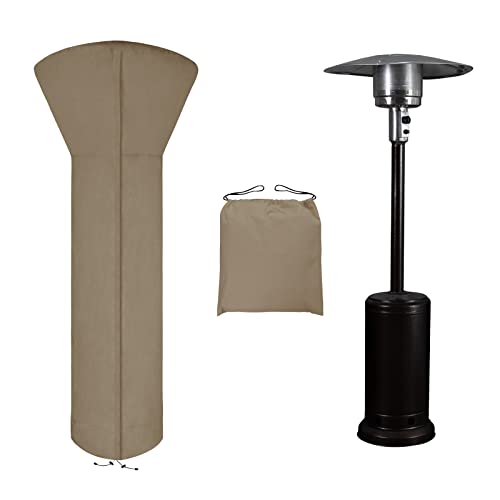
Easy-Going Patio Heater Cover, 89 in. H x 33 in. D x 19 in. B
Type: Cover — accessory, not a heater. This is a full-length cover sized for a standard mushroom-style standing heater: 89 inches tall, with a 33-inch dome diameter and a 19-inch base diameter in the listing title. It closes with a zipper, comes with a storage bag, and is described by the maker as waterproof and resistant to dust, UV and wind. A cover is the single highest-value purchase in this entire guide, because the heater you already own — or the heater you are saving toward — dies from the top down. Rain sits in the reflector, rust blooms across the emitter screen, spiders nest in the burner orifice, and by the second winter a heater that should have lasted a decade lights reluctantly or not at all. A cover that goes on in thirty seconds, every time, quietly prevents almost all of that.
Who it suits: On a small patio the standing cover earns its place only where a standing heater genuinely fits — and where it does, it also serves as the patio’s tidiness: a covered heater reads as a single calm object in a space where every object is in view. If your measurement says tabletop, read this pick as the principle — cover the heater you have, in its own size — and use the next pick as its practice.
Pros
- Sized for the standard standing-heater silhouette, so it covers the reflector dome instead of stopping halfway down the pole
- Zipper closure means one person can fit or remove it without lifting the whole cover over the dome
- Storage bag keeps the cover itself clean and findable in the off-season instead of balled up in a garage corner
- Protects the parts that actually fail first: reflector, emitter, burner and ignition area
Honest limitation: A cover protects a heater; it does not warm anyone, and it cannot rescue a heater that is already rusted through or mechanically faulty. It must also only ever go on a completely cold heater — covering a warm emitter traps heat against fabric and is a fire risk, so the routine is: heater off, heater cold, then cover. Finally, a cover is not a substitute for proper storage of the propane cylinder, which should be disconnected and stored outdoors, upright and away from ignition sources, exactly as the heater manual directs.
Choose it if the job it does is the job you have; skip it if you were hoping it was a heater — it is not, and nothing at this budget is. Check on Amazon
Classic Accessories Veranda Water-Resistant 21 Inch Round Table Top Patio Heater Cover
Type: Tabletop cover — accessory, not a heater. Tabletop heaters live a harder life than standing models: they sit at elbow height, catch every splash and gust, and are usually the first thing knocked when a table is cleared. This 21-inch round cover from Classic Accessories’ Veranda line is made for that smaller format. It is water-resistant rather than fully waterproof in the maker’s description — an honest distinction worth respecting — and it turns a tabletop heater from a permanently weather-exposed object into one that at least spends its idle hours dry. If your household already owns a tabletop unit, this is the purchase that keeps its reflector bright and its pilot assembly free of the grit and moisture that make small heaters temperamental.
Who it suits: This is the small patio’s natural cover: sized to the format that fits the space, small enough to store in a drawer, and protective of the appliance most likely to be your patio’s only heat source. On a small patio, a tabletop heater is not the budget option; it is the correct option — and keeping it dry, clean and ready is the highest-value habit this guide can sell you.
Pros
- Correct scale for tabletop units, so it does not pool, flap or drag the way an oversized cover does
- From an established outdoor-cover maker with a consistent sizing system across its lines
- Water-resistant shell sheds dew, drizzle and splashes — the everyday moisture that corrodes small burners
- Small and light enough that using it is a ten-second habit rather than a chore
Honest limitation: Water-resistant is not waterproof: in driving rain or a wet winter stored outdoors, moisture will eventually get through, so a covered tabletop heater still belongs under a roofline or in a shed for the off-season. And the same rule as every cover applies — cold heater only, never cover a unit that has run within the last hour. It also does nothing for a tabletop heater’s real weakness, which is its small fuel supply and modest heat radius; it preserves the heater, it does not improve it.
Choose it if the job it does is the job you have; skip it if you were hoping it was a heater — it is not, and nothing at this budget is. Check on Amazon
Heat Focusing Reflector Shield for Round Propane Patio Heaters, 10 Panels
Type: Reflector — accessory, not a heater. A standard mushroom heater throws a large share of its heat upward and outward into the night sky. A focusing reflector shield — this one a 10-panel design with a 12-inch height in the listing — clips around the existing reflector and bends more of that radiant energy down and out toward the people sitting around the heater. Owners fit these for two reasons: a seating circle that feels noticeably warmer at the same burner setting, and the option to run the burner lower for the same comfort, which stretches each propane cylinder further. Of everything in this guide, this is the pick that most changes how an evening feels — provided you already own the heater it attaches to.
Who it suits: Honesty suits a small patio: many small circles have no cold edge, because no seat is far enough from the heater to be cold. Fit a reflector only if your specific layout has one — a bench along the fence, a fourth chair at the table’s far end. Where that seat exists, the reflector rescues it; where it does not, this is the one pick a small patio may rightly skip, and the guide respects the measurement that tells you so.
Pros
- Redirects heat that would otherwise be lost above the reflector toward the seating area
- Can let you run a lower burner setting for similar comfort, saving propane across a season
- Panel design adapts to round natural-gas and propane heaters of the standard format
- No fuel, no power, no moving parts — fit it once and it simply works every night
Honest limitation: It is an attachment, not a heat source: with no heater to mount it on, it is a shaped piece of metal and nothing more. Fit must be checked carefully against your heater’s reflector diameter and mounting style before ordering, and like any part that lives above a burner it must be installed exactly per its instructions, on a cold heater, with every panel secure — a loose panel above a flame is unacceptable. It also cannot fix an undersized heater for a large space; it improves distribution, not total output.
Choose it if the job it does is the job you have; skip it if you were hoping it was a heater — it is not, and nothing at this budget is. Check on Amazon
DOZYANT Propane Tank Gauge Level Indicator with Leak Detector, QCC1 Type 1
Type: Gauge — accessory, not a heater. Running out of propane mid-evening is the most common patio-heater failure of all, and it is entirely preventable. This brass-bodied gauge screws between the cylinder valve and the heater’s regulator on standard QCC1 Type 1 connections, fits the 5- to 40-pound cylinders listed in its title, and shows a color-coded dial reading of how much fuel remains. It also incorporates a leak-detector function: if the dial drops abnormally with everything off, you have early warning of a leak worth investigating before the next lighting. It is a small, unglamorous object that removes the two worst surprises in propane heating — the silent empty tank and the silent leak.
Who it suits: Small patios frequently share one cylinder between grill and heater, or run a tabletop unit whose small fuel supply empties sooner than intuition says. The gauge’s glance replaces the lift-and-guess ritual — picking up a cylinder to judge its weight is unreliable and, mid-evening in the dark, miserable. On the connection, out of the way, taking no space: the gauge is the small patio’s ideal accessory shape.
Pros
- Color-coded dial readable at a glance, even in low evening light
- Fits the standard QCC1 Type 1 connection used by the great majority of patio heaters and grills
- Leak-detection behavior adds a genuine safety function, not just convenience
- Solid, simple, no batteries — it works by pressure and lasts for years
Honest limitation: A pressure-based gauge is an estimate, not a laboratory measurement: readings shift with temperature, and the dial is best treated as ‘plenty, getting low, swap soon’ rather than a precise percentage. It also only fits QCC1 Type 1 connections, so older POL-style fittings need a different solution. And a gauge never replaces the soapy-water leak test after every cylinder change — it complements that habit, it does not cancel it. Fit it hand-tight plus the maker’s specified turn, check for leaks, and only then light the heater.
Choose it if the job it does is the job you have; skip it if you were hoping it was a heater — it is not, and nothing at this budget is. Check on Amazon
FD4 Thermocouple and Dump Switch Repair Kit for Propane Patio Heaters, 350 mm
Type: Safety repair part — accessory, not a heater. Two small components decide whether a propane patio heater works at all. The thermocouple sits in the pilot flame and proves to the gas valve that a flame exists; when it fails, the heater lights, you release the knob, and it dies. The FD4 dump switch — the tilt switch — cuts the gas if the heater tips. This kit pairs a 350 mm thermocouple with an M8x1 valve thread and an FD4 dump switch, the combination that fits a wide range of standard propane patio heaters. If your heater’s only fault is the classic light-and-die pattern, this kit is very often the difference between a working heater and a scrapped one — for less than the cost of a single propane refill.
Who it suits: A small patio’s heater is usually its only heater, stored close, used often, and missed immediately when it fails. The repair kit’s drawer-sized footprint suits the space exactly, and its value is the same here as everywhere: the light-and-die fault, cured for the price of a takeaway. Verify your model’s thread and lead length when you buy the heater, and write both inside the kit’s box.
Pros
- Addresses the single most common patio-heater fault: a heater that lights but will not stay lit
- Includes the tilt/dump switch, so the tip-over safety function is renewed at the same time
- 350 mm lead length suits the standard tower format; M8x1 thread is the common valve fitting
- Far cheaper than a replacement control valve, let alone a replacement heater
Honest limitation: Fit is everything: the listing itself says to verify fit, and you must confirm your heater uses an M8x1 valve thread and a comparable thermocouple length before ordering — tower, tabletop and pyramid models differ. This is also gas-appliance work. If you are not confident testing for leaks with soapy water after reassembly, or your heater has any other fault — a cracked hose, a corroded valve, a damaged regulator — the correct purchase is a qualified technician’s time, not a parts kit. Never bypass or tape down a tilt switch to keep a heater running; that switch is the tip-over protection.
Choose it if the job it does is the job you have; skip it if you were hoping it was a heater — it is not, and nothing at this budget is. Check on Amazon
Lerat Rechargeable Hand Warmers, 2 Pack, Electric Pocket Warmers
Type: Personal warmer — accessory, not a patio heater. Everything else in this guide supports a heater. This pick takes a different, honest route: if the budget cannot buy area heat, it can still buy personal heat. This two-pack of slim rechargeable hand warmers — the listing gives a maximum temperature of 131 degrees Fahrenheit — puts warmth in a coat pocket or a pair of gloves, one unit per hand or one for each of two people. For a single person on a chilly patio, personal warmth is surprisingly effective, because cold hands are usually what send people indoors first. Rechargeable also means no disposable packets to keep buying: charge them with the evening’s dishes, drop them in your pockets, and the patio stays usable a little longer.
Who it suits: On a small patio the hand warmers graduate from fallback to co-headliner. Two chairs, two people, two pockets: the coverage is total in a way no large patio can match, and the warmers’ storage footprint is a coat pocket. If this guide’s other picks are preparation for a heater future, this one is the small patio’s present — bought today, used tonight.
Pros
- Real, immediate warmth for one or two people at a budget where area heating is impossible
- Slim pocket format works with gloves, coat pockets and laps under a blanket
- Rechargeable, so there is no ongoing cost in disposable warmers
- Useful far beyond the patio — commuting, dog walking, stadium seats, cold workshops
Honest limitation: Be precise about what this is: a hand warmer warms hands. It will not raise the temperature of a patio, a seating circle or a dinner party by a single degree, and it is not a patio heater in any sense. Battery care matters too — charge on a hard, non-flammable surface, never charge unattended overnight, stop using any unit that swells, overheats or is damaged, and check the exact model against current recall listings before buying, as some rechargeable hand warmers from other makers have been recalled for battery overheating. Runtime varies with heat level, so the highest setting is best saved for the coldest hour.
Choose it if the job it does is the job you have; skip it if you were hoping it was a heater — it is not, and nothing at this budget is. Check on Amazon
Comparison Table
| Pick | Type | Best for | Link |
|---|---|---|---|
| Easy-Going Patio Heater Cover, 89 in. H x 33 in. D x 19 in. B | Cover — accessory, not a heater | Best overall accessory | Check on Amazon |
| Classic Accessories Veranda Water-Resistant 21 Inch Round Table Top Patio Heater Cover | Tabletop cover — accessory, not a heater | Best for tabletop heater owners | Check on Amazon |
| Heat Focusing Reflector Shield for Round Propane Patio Heaters, 10 Panels | Reflector — accessory, not a heater | Best efficiency upgrade for a heater you own | Check on Amazon |
| DOZYANT Propane Tank Gauge Level Indicator with Leak Detector, QCC1 Type 1 | Gauge — accessory, not a heater | Best safety and planning accessory | Check on Amazon |
| FD4 Thermocouple and Dump Switch Repair Kit for Propane Patio Heaters, 350 mm | Safety repair part — accessory, not a heater | Best repair part for a heater that will not stay lit | Check on Amazon |
| Lerat Rechargeable Hand Warmers, 2 Pack, Electric Pocket Warmers | Personal warmer — accessory, not a patio heater | Best personal warmth under $20 | Check on Amazon |
Read the table as a toolkit, not a ranking: the right purchase is the one whose job matches your situation, and buying two picks that solve your two real problems beats buying the whole table.
Safety First: Fire, Carbon Monoxide, Clearance and Tip-Over Protection
Every patio heater manual opens with the same warnings, and they are repeated here because no budget changes them. A propane or natural-gas patio heater is a combustion appliance. It produces carbon monoxide, which has no smell and no color, and which can kill in an enclosed or poorly ventilated space. That is why these heaters are for outdoor use only — never in a garage with the door half open, never in a tent, a screened room with the screens down and still air, a conservatory, or any space that behaves like indoors. If anyone near a running heater develops a headache, dizziness, nausea or watery eyes, turn the heater off if it is safe to do so, move everyone into fresh air, and treat the symptoms as the emergency they may be.
Clearance is the second non-negotiable. Manufacturer manuals for standard mushroom heaters typically require at least three feet of clearance from combustible materials at the sides, and clear space above the reflector as the manual specifies — and those figures are minimums, not targets. Furniture cushions, throws, paper, cardboard, dry planting, curtains on an open door, and the fabric of a gazebo or umbrella all count as combustibles. The heater itself becomes extremely hot in use; the reflector and emitter can ignite material that touches or leans against them, and children and pets must be kept from contact. Site the heater on a firm, level, non-combustible surface where it cannot be knocked, and never leave a running heater unattended.
Tip-over protection is the third. Modern propane heaters include a tilt or dump switch that cuts the gas when the heater leans or falls, and a thermocouple that shuts the valve if the pilot flame goes out. These devices only protect you if they work: never bypass, tape down or defeat a tilt switch, test that a heater shuts down as its manual describes, and replace a faulty thermocouple or switch with the correct part — one of this guide’s picks exists for exactly that job. Finally, fuel discipline: connect and disconnect cylinders only with the heater cold and off, leak-test every new connection with soapy water, store cylinders outdoors, upright, away from heat and ignition sources, and never store a spare cylinder under or beside a running heater. If you smell gas at any point: shut off the gas at the cylinder if safe, extinguish open flames, move away, and call your gas supplier or fire department from a safe distance.
How to Choose for a Small Patio: Measure First, Then Buy Small
Begin with the tape measure, because a small patio is a geometry problem before it is a shopping problem. Mark the manual’s clearance — typically at least three feet at the sides, plus clear space above — around any heater position you are considering, and see what is left. On many small patios, a standing heater’s circle consumes the entire floor and leaves the chairs inside the clearance, which is the arithmetic telling you the format is wrong for the space. A tabletop unit changes the geometry: its clearances are smaller in absolute terms, its heat radius matches a two-to-four-person table, and its fuel is a small cylinder with its own storage rules. But ‘smaller’ is not ‘negligible’ — the tabletop manual’s clearances still apply in full, the table must be stable and non-combustible, and nothing may be stored beneath or beside the unit while it runs.
Then buy in the small patio’s order. If a lawful heater already lives on your patio, its cover comes first — on a small patio the cover does double duty, because a covered heater is also a tidier, less obtrusive object in a space where everything is visible. The gauge second, because small patios use small cylinders or shared grill cylinders that empty faster than owners expect. The reflector only if your specific heater accepts it and your circle genuinely has a cold edge — on the smallest patios, honestly, it may not, and skipping it is a legitimate conclusion of the measurement you did first. The repair kit when your heater’s age suggests it. And the hand warmers whenever you like, because on a two-chair patio they are not the backup plan; they are half the heating system.
Storage closes the loop. Every purchase here was chosen to disappear: the cover into its bag on a hook, the kit into a drawer, the warmers into the coat they serve. If a future purchase cannot disappear on your patio, it is the wrong purchase for your patio, whatever it costs.
Small Patio, Full Clearances: The Siting Arithmetic
It is worth stating the arithmetic plainly once, because small-patio owners are the readers most tempted to round it down. Clearances exist because the heater’s surfaces and heat plume ignite and damage what is too close, and physics does not offer a small-space discount. A cushion at two feet from a heater whose manual says three is not ‘nearly compliant’; it is inside the zone the manufacturer tested and rejected. The correct responses to a failed measurement are a smaller format with smaller stated clearances, a different position with genuinely clear space, or no combustion heater at all — with electric options considered only where outdoor-rated, properly outlet-fed and permitted, and personal warmth carrying the rest. What is never correct is the quiet squeeze: the heater tucked into the corner, the chair nudged closer, the throw draped near the pole. Small patios are intimate, forgiving spaces for almost everything except this.
The encouraging half of the arithmetic is warmth itself. Heat that would dissipate across a large patio concentrates in a small one: walls and fences return it, the distance from heater to chair is short, and two people under a throw with warm pockets are, measurably in comfort if not in degrees, the best-served readers of this entire guide series. A small patio does not need a big heater’s budget. It needs the right small decisions — which is what the $20 in this guide is actually for.
Two Chairs, One Table: A Small Patio Evening, Worked Through
Abstract advice becomes clearer in a single worked example, so consider the canonical small patio: two chairs, a small table, a door, a railing, and two people who want to finish the evening outside in October. The evening begins with position, not products. The chairs go where the building’s own walls break the wind — the corner the breeze reaches last — because on a small patio the difference between the windy seat and the sheltered seat is larger than any accessory in this guide can manufacture. The table sits between the chairs, close enough that a throw can cover two laps at once, which on a small patio is not a compromise but the entire design.
The warmth layer assembles itself from this guide’s smallest objects. Hand warmers go into coat pockets before sitting down, so the pockets are warm when hands arrive in them. The throw goes over legs — the body’s largest cold surface in a seated person — and a cushion under each sitter cuts the cold that conducts up through chair seats, a loss most people misattribute to the air. Hot drinks arrive in insulated mugs that keep their heat and warm the hands that hold them. None of this is heating the patio. All of it is heating the people, and on a two-person patio the distinction collapses: the people are the patio’s entire population, and warming them completely is a complete solution.
If this patio’s future includes a tabletop heater — lawfully sited, clearances measured and honored — the same evening gains its centerpiece without losing its logic: the personal layer remains for the seat at the circle’s edge, the cover keeps the little appliance ready between evenings, and the gauge watches the shared cylinder. The worked example’s lesson generalizes beyond its size. Small patios do not need scaled-down versions of large-patio spending; they need their own arithmetic, honestly done. At $20, that arithmetic is personal warmth plus preparation — and as this example shows, for the people a small patio actually holds, it is enough to change October from the month the patio closed to the month it was used most deliberately.
Common Buying Mistakes
Rounding down the clearances
Three feet means three feet on a small patio too. If the measurement fails, change the format or the position — never the arithmetic. The squeeze is how small-patio fires start.
Buying a standing heater for a tabletop space
A mushroom heater’s dome, clearances and heat radius are designed for larger circles. On a small patio it dominates the floor, overheats the center and still leaves its clearances breached. Match the format to the measured space.
Storing the support kit on the patio floor
Covers balled in corners, cylinders beside chairs, kits in planter boxes — small patios punish floor storage instantly. Every pick in this guide stores on its appliance, in a drawer or on a hook; keep it that way.
Draping throws and cushions near the heater
The textiles that make a small patio cozy are combustibles in the clearance zone. Keep soft furnishings outside the manual’s distance while the heater runs, and let them return when it is cold and off.
Assuming a tabletop heater needs no siting thought
Smaller clearances are still clearances, the table must be stable and non-combustible, and nothing stores under a running tabletop unit. Small format, full attention.
Skipping the cover because the patio is sheltered
Sheltered patios still dew nightly, and a heater under a roofline still gathers dust and insects in its burner. The cover routine matters most where the heater lives closest to the living space it serves.
Final Recommendation
For a small patio, buy the Classic Accessories tabletop heater cover if a tabletop unit is your format — present or planned — and the Lerat hand warmers today regardless, because on a two-chair patio personal warmth is half the system. Add the DOZYANT gauge when a cylinder enters your life. Measure before every future step, and let the higher-tier guides below show you the formats that genuinely fit a small footprint.
Frequently Asked Questions
What type of patio heater suits a small patio?
Usually a tabletop propane unit, sited on a stable, non-combustible table with its manual’s clearances fully respected — its heat radius matches a small seating group. Standing mushroom heaters are often too large in dome, clearance demand and output for genuinely small patios. Measure your space against the manual before choosing a format.
Can I reduce the clearance because my patio is small?
No. Clearances are set by the heater’s heat and surfaces, not by your floor plan, and they do not shrink with the patio. If a heater’s clearances do not fit, the correct answers are a smaller format, a different position, or no combustion heater — never a smaller clearance.
How can two people stay warm on a small patio without a heater?
Very effectively, because the space works for you: hand warmers in pockets, a shared throw, layered clothing, a position out of the wind, and hot drinks. Small patios concentrate warmth and shelter; for two people, the personal layer plus the space’s own shelter is a complete system at this budget.
Where do I store patio heater accessories in a small space?
On the appliances themselves and in drawers: the gauge lives on the cylinder connection, the reflector on the heater, the cover in its storage bag on a hook, the repair kit in a kitchen drawer, the hand warmers in coat pockets. Nothing in this guide needs floor space — that was a selection criterion.
Is a fire pit an option for a small patio?
Almost never a good one: open flame, ember management and clearance demands exceed most small patios, and many local rules set minimum distances from structures that small plots cannot meet. The linked fire pit guide covers its own budget honestly; for small patios, contained heat or personal warmth is the safer direction.
Should a small patio buy a cover before it owns a heater?
Only when the heater purchase is decided and imminent — a cover is model-format-specific, and a standing cover does not fit a tabletop future. The heater-independent purchase, valid today, is the hand warmers; the cover belongs in the same order as the heater it will protect.
Related Guides
For the formats that genuinely fit a small footprint, continue to Best Patio Heater For Small Patios Under $50 and Best Patio Heater Under $50, weigh the parallel options in Best Outdoor Heater For Small Patios Under $20 and Best Fire Pit For Small Patios Under $20, and use Best Patio Heater Under $150 as your reference for what full-size heating demands in space and budget.


