Where to buy
See the current price, stock and delivery estimate on Amazon before you order. All orders are placed on Amazon. We may earn a commission from qualifying purchases.
- Brightever 60FT LED Outdoor String Lights (S14 Edison, Plug-In) — Check on Amazon
- Brightown 52FT Solar String Lights with Remote (15+1 ST38 Bulbs) — Check on Amazon
- addlon 52FT Solar String Lights with Remote (16+1 Bulbs) — Check on Amazon
- Brightown 29FT G40 LED Outdoor String Lights (Plug-In) — Check on Amazon
- Minetom 40FT Solar Fairy String Lights (100 LED) — Check on Amazon
- Brightown 36FT Solar Crystal Globe String Lights (60 LED) — Check on Amazon
Read the full guide ↓
Disclosure: As an Amazon Associate, dailyhomedecorating.com earns from qualifying purchases. Links to Amazon on this page are affiliate links; they cost you nothing extra. Listing details such as price and availability change often, so check the current Amazon listing before you buy.
Choosing the best outdoor string lights for backyards under $20 is an exercise in distance. A backyard asks string lights to do what a patio never does: cross open air from house to tree, run along a fence line, reach the far corner where the gate and the garden are. At twenty dollars a string, no single box transforms a whole yard — and this guide will not pretend otherwise. What this budget does buy, spent well, is one properly chosen layer at a time: a long plug-in backbone near the house, solar runs where cords should never go, and fairy light to give the planting its outline after dark. Every pick below is a real product from a real maker, checked against this tier’s price when we researched it.
The backyard filter is coverage per dollar, measured honestly. Listings advertise total length, but a backyard cares about lit length: the feet that actually carry bulbs, after the lead wire is subtracted. It cares about spacing, because bulbs every three feet read as a designed run across a yard while bulbs every foot would bankrupt the budget. And it cares about structure, because a backyard span lives outdoors in wind, pulling at its anchors and swinging over the lawn. The reviews below therefore lead with lit length, spacing and hanging hardware, and they are blunt about which strings are zone lights and which are true yard-crossers.
Power planning shapes a backyard more than any other decision. The house end of the yard usually has an outlet; the far end never does. The strongest backyard schemes in this guide pair the two: a plug-in string doing bright, dependable work over the seating and cooking zone near the house, and solar strings — which need no trench, no cord and no electrician — carrying the glow to the fence, the tree and the gate. Extension cords stretched across a lawn are the thing to avoid: they are trip hazards, mower bait, and a code problem waiting for rain. The picks are ranked to build that layered scheme in order.
Backyard safety is electrical safety at scale. Plug-in strings belong on GFCI-protected outlets, full stop — a ground fault in a damp yard is precisely what that protection exists for. Cords must never run where a mower, trimmer or spade will find them, connections between strings must follow the maker’s stated maximum and no further, and every span should hang from a guide wire or solid anchors rather than from its own cord. Solar strings remove the mains risk from the far yard entirely, which is one more reason they rank so highly here. The full safety section below covers IP ratings, GFCI use and connection limits before you hang anything.
Who is this budget for? Homeowners dressing a yard in stages, parents who want the garden to feel magical for children without a contractor’s invoice, and anyone whose yard currently ends where the porch light gives up. Buy the backbone first, add the perimeter second, and detail with fairy light third, and a modest budget assembles, season by season, into the kind of yard people linger in. Start with the span you use most — usually the seating zone — and measure it before you order anything.
In this guide
Quick picks: the best outdoor string lights for backyards under $20 at a glance
| Pick | Best for | Type | Key fact | Link status |
|---|---|---|---|---|
| Brightever 60FT S14 (Plug-In) | The longest single plug-in run | Plug-in S14 Edison filament, 16 sockets | 60 ft total, 17 bulbs (1 spare), 2700K, lead wire just under 10 ft | Check price on Amazon |
| Brightown 52FT Solar (Remote) | Long runs with no outlet nearby | Solar + USB ST38 Edison, 15 sockets | 52 ft total with 9 ft lead wire, IP65, remote dimming and timer | Check price on Amazon |
| addlon 52FT Solar (Remote) | Timer control and fast USB charging | Solar + USB Edison, 16 sockets | 52 ft (48+4), 17 shatterproof PET bulbs, timers at 2/4/6/8 hours | Check price on Amazon |
| Brightown 29FT G40 (Plug-In) | Warm plug-in glow on a short run | Plug-in G40 globe, 12 sockets | 12 shatterproof 1W LED bulbs plus 1 spare, 2200K, IP65, E12 base | Check price on Amazon |
| Minetom 40FT Solar Fairy | Wrapping railings, fences and trees | Solar fairy wire, 100 LED | 40 ft total (33 ft lit, 7 ft lead), IP65, 8 modes, green wire | Check price on Amazon |
| Brightown 36FT Crystal Globe Solar | Dense sparkle and party modes | Solar crystal globe fairy, 60 LED | 36 ft, 60 small globes, 8 modes with memory, IP65 | Check price on Amazon |
How the picks were chosen for Best Outdoor String Lights for Backyards Under $20
Every string in this guide had to pass the same five tests, in this order. First, identity: the product had to be a real, current listing from an identifiable maker, with a model we could verify — no anonymous marketplace strings with invented specifications, however cheap. Second, tier honesty: the string had to be genuinely available inside this budget when checked, not priced here only in a size or configuration nobody would want. Third, outdoor credibility: an IP65 rating or better from the maker, LED bulbs throughout, and construction suited to living outside rather than visiting it.
Fourth, failure behavior. Cheap strings fail, so we judged how they fail: plug-in picks needed replaceable bulbs and fused plugs, so a failure is a two-minute fix; solar picks needed USB backup charging or a spare bulb in the box, so a failure is recoverable. A string whose first failure ends its life did not make this list, whatever its price. Fifth, fit for the guide’s purpose: each pick had to be the best answer to a real version of the question — the warm plug-in, the long run, the no-outlet run, the timer-controlled run, the sparkle layer, the wrapping wire — rather than six near-identical strings ranked by trivia.
We rejected more than we kept. Strings with only an IP44 rating were excluded from the main list because splash-proof is not weather-proof across a full season outdoors. Strings whose lit length was a small fraction of their advertised length, strings with fixed bulbs and no fuse protection, and strings whose listings hid their color temperature were all cut. So was every product with a recall or safety warning we could find in federal records: decorative light strings have a genuine recall history involving overheating, undersized wiring and accessible coin batteries in remotes and battery boxes, and no pick here matches any recalled product or pattern. Where a specification in this guide comes from the maker — a runtime, a lifespan, a connection limit — the text says so, because maker claims are ceilings measured in kind conditions, not promises.
Prices in this category move constantly with coupons and seasons, which is why this guide prints none: the body of every review says check price on Amazon, and the tier in the title is the budget we verified against, not a quote. If a pick has drifted above the tier when you shop, the honest move is to wait for its next coupon cycle or step to the next pick — at this end of the market, every one of these strings is discounted regularly, and patience is worth real money.
The picks in detail
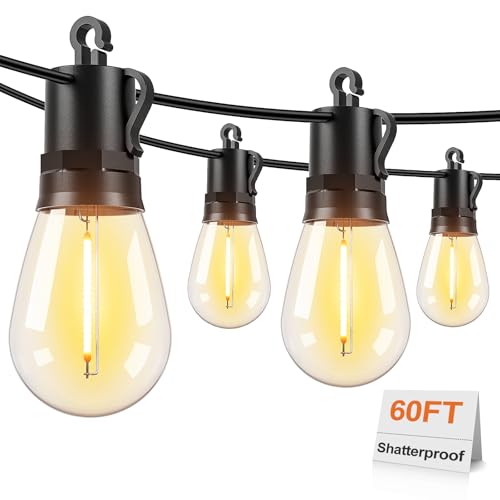
Brightever 60FT LED Outdoor String Lights (S14 Edison, Plug-In) — The longest single plug-in run
Who it suits: The longest single plug-in run. Check on Amazon
If your problem is sheer distance, this is the string built for it: 60 feet in total, with just under 10 feet of lead wire before the first bulb, then 16 sockets spaced about 3.3 feet apart holding S14 Edison filament bulbs, plus one spare. The 2700K warm white is a step less amber than the 2200K Brightown G40, closer to the light of an old household bulb, and the visible filament inside each clear bulb gives it the most convincingly vintage look in this guide when it is lit at dusk.
Brightever makes two practical claims worth noting. First, the bulbs are built on enlarged, widened socket bases that fit snugly against the bulb to keep dust and moisture out of the socket, which is the usual failure point on cheap strings left out all year. Second, the maker rates the LED filament bulbs for up to 30,000 hours of life and says each bulb works independently, so one failure does not darken the run. The string is dimmable on a compatible dimmer (not included) and connectable end to end, with the maker stating up to 30 strands as the ceiling; as always, that figure is a limit in the manual, not a suggestion, and a fused plug and sensible loading matter more than the headline number.
Installation help is unusually generous for the price: the sockets have double hooks and the box includes zip ties, so you can hook the string over a guide wire and then lock it down. You will want that guide wire. Sixty feet of cord with sixteen glass-look bulbs is a real span, and hanging it from the cord alone invites sag, swing and socket strain. Run a simple steel guide wire or a sturdy cord between your anchor points first, then clip the string to it every few sockets.
This is the backyard’s backbone string. A 60-foot run reaches from the house to a mid-yard tree, or across the back of most suburban plots in a single span, and the long lead wire means the plug can stay at the house outlet while the light starts where the yard actually begins. The Edison filament look suits the scale of a yard at dusk, reading clearly from the far fence in a way fairy light never will. The non-negotiables are structural: a guide wire between solid anchors, a GFCI-protected outlet, and a route that keeps the cord out of mower and trimmer paths where it drops to the plug.
Pros:
- The most lit length you can buy in this guide in a single box, with a long lead wire to reach a distant outlet
- 2700K filament bulbs give the most classic Edison look here, and each bulb works independently
- Double hooks and included zip ties make a tidy, secure hang much easier
Honest limitation: At roughly 3.3 feet between bulbs, the light is spaced for atmosphere over a big area, not for dense brightness over a small one, and on a short patio most of the string will be surplus you have to coil or double back. It is also the heaviest style of run here once hung, so weak anchor points and lightweight command hooks are not enough; it needs real fixings and a guide wire.
Choose it if its strengths match your space as described above; skip it if its limitation hits your exact situation — the next pick will fit better. Check on Amazon
Brightown 52FT Solar String Lights with Remote (15+1 ST38 Bulbs) — Long runs with no outlet nearby
Who it suits: Long runs with no outlet nearby. Check on Amazon
This is the long-reach solar option: 52 feet of cord in total, of which a generous 9 feet is plain lead wire running from the solar panel to the first bulb. That lead matters more than it sounds, because it lets the panel sit in full sun on a fence top or a sunny patch of ground while the bulbs themselves hang in the shade of a pergola or tree, which is where you actually want them. The 15 sockets are spaced 3 feet apart and hold ST38 Edison-style LED bulbs on E12 bases, plus one spare bulb in the box, all of them shatterproof.
Control is the other reason this string earns its place. The included remote offers four brightness levels, three light modes (steady on, a breathing fade, and flash), and automatic-off timers at six or eight hours, so you can set it at dusk and forget it. The panel charges from sunlight and can also be topped up over USB, which is the feature that saves solar strings in winter: after a run of grey days, a few hours on USB restores a full charge instead of leaving you dark for a weekend. The maker claims up to 30-plus hours of light from a full charge; read that as a best case measured in good conditions, and expect less in midwinter or under tree cover.
The string is rated IP65 against rain and dust, each bulb has its own hanging hook for quick clipping to a guide wire, branch or fence, and the panel angle adjusts up to 180 degrees so you can aim it at the sun’s path. There is no plug and no mains voltage anywhere in the run, which removes the whole GFCI question, but it replaces it with a discipline question: the panel must live somewhere genuinely sunny, and the first charge should be a full one with the switch on.
Backyards are where solar strings stop being a compromise and start being the sensible tool: the far fence, the garden gate, the tree at the bottom of the plot are all places extension cords should not go. This string’s panel can sit in the sunny middle of the yard while its bulbs work the shaded tree line, thanks to that long lead wire, and the remote timers mean the bottom of the garden lights itself every evening without you walking down to switch it. For a big yard, think of it as the perimeter layer, with a plug-in string doing the bright work near the house where power already exists.
Pros:
- The 9-foot lead wire solves the classic solar problem of panel in sun, lights in shade
- Remote dimming with four levels and two timer settings is rare at this price
- USB backup charging means a cloudy week does not leave you without light
Honest limitation: Runtime depends entirely on the charge the panel actually collected, so a shaded garden or a short winter day will dim it hours earlier than the maker’s best-case figure suggests. The ST38 bulbs are handsome but spaced 3 feet apart, so the light comes in distinct pools rather than an even wash, and there is no way to extend the run by connecting a second string.
Choose it if its strengths match your space as described above; skip it if its limitation hits your exact situation — the next pick will fit better. Check on Amazon
addlon 52FT Solar String Lights with Remote (16+1 Bulbs) — Timer control and fast USB charging
Who it suits: Timer control and fast USB charging. Check on Amazon
Addlon’s solar string covers 52 feet in total and carries 16 sockets with shatterproof Edison-style bulbs molded from PET plastic, with a seventeenth bulb in the box as a spare. The bulbs are noticeably light, which matters on long spans: less weight per socket means less sag and less strain on whatever the string is clipped to, and a dropped bulb bounces instead of shattering on paving.
Where this string separates itself is control and charging discipline. The remote offers three brightness levels, three light modes (constant, breathing and flashing), and four separate auto-off timers at two, four, six and eight hours, the widest timer choice in this guide. That makes it easy to match the light to the evening: two hours for a weeknight wind-down, eight for a party. Charging is dual: about eight hours of sunlight for a full solar charge, or about four hours over USB when the weather will not cooperate, and the maker claims more than 20 hours of light from a full charge. Treat that, as with every solar runtime claim here, as a fair-weather best case rather than a guarantee.
Addlon specifically advises a USB charge before first use so the battery starts full, which is good advice for every solar string in this guide. The set is built for year-round outdoor use against rain, snow and temperature swings. Like the Brightown solar, there is no mains cable in the run at all; the trade you are making is freedom from outlets in exchange for managing sunlight and charge.
The addlon’s backyard case rests on weight and weather discipline. A long run between trees moves in wind, and featherweight PET bulbs swing less violently, strain sockets less and survive the occasional branch knock or drop during takedown. The timer spread also fits yard life: run the far fence line for two hours on weeknights as a boundary glow, and eight hours when the yard is full of guests. If your yard’s sunny charging spot is limited, its faster USB top-up is the practical rescue after a stormy week, when a purely solar string would need days to recover.
Pros:
- Four timer settings and three brightness levels give the finest evening-by-evening control here
- USB charging in about four hours rescues the string after grey weather
- Featherweight PET bulbs reduce sag and survive drops onto hard ground
Honest limitation: Three brightness steps are coarser than the four on the Brightown solar remote, and up close the PET bulbs have a slightly less glass-like finish than filament bulbs. As with all solar strings, the panel needs an honestly sunny position; a north-facing or tree-covered spot will starve it no matter how good the battery is.
Choose it if its strengths match your space as described above; skip it if its limitation hits your exact situation — the next pick will fit better. Check on Amazon
Brightown 29FT G40 LED Outdoor String Lights (Plug-In) — Warm plug-in glow on a short run
Who it suits: Warm plug-in glow on a short run. Check on Amazon
This is the classic bistro string in its smallest sensible size: 29 feet of cord in total, 12 hanging sockets spaced 24 inches apart, and an 18-inch lead wire between the plug and the first socket. Each socket holds a G40 globe about an inch and a half across with an E12 candelabra base. The bulbs are shatterproof plastic rather than glass, and each one is a 1-watt LED, so the whole string draws very little power while giving off a distinctly amber 2200K warm white. That color temperature is the warmest in this guide, and it is a big part of why this string punches above its size: at dusk it reads as candlelight, not as a utility light.
Because the bulbs are real, replaceable screw-in bulbs, maintenance is simple. If one bulb fails, the rest of the string stays lit and you unscrew the dead bulb and fit a spare; the box includes one spare bulb, and the maker sells matching replacement bulbs separately. The plug carries a built-in spare fuse, which is the first thing to check if the whole string ever goes dark at once. Brightown rates the string IP65, which means dust-tight construction and resistance to water jets, and describes the string as UL588 certified for year-round outdoor use; as with any certification claim at this price, check that the tag on the cord of the set you receive matches what the listing promises.
The string is dimmable, so on a compatible dimmer (sold separately) you can drop it from full party brightness to a background glow. It is also connectable end to end, and the maker states a very generous maximum number of connected strands; treat that number as an absolute ceiling from the manual, not a target, and stay well under it. In practice, at this size, most people connect two or three strings at most. At well under a pound, it is also the easiest string here to hang, take down and store without a helper.
In a backyard, this string’s job is the defined zone: over the dining table, across the porch, along the deck rail where people actually gather. Its warm 2200K light is the most flattering in the guide for faces and food, and its replaceable bulbs suit a string you intend to leave up season after season, because a single failed bulb is a two-minute fix rather than a dead section. Where it cannot help you is distance: a backyard’s tree-to-tree spans will outrun its 24 lit feet quickly, which is why the longer strings rank above it here. Use it for the seating heart of the yard and let the solar strings handle the perimeter.
Pros:
- Warmest light in the guide at 2200K, with real replaceable G40 bulbs and a spare in the box
- IP65 sealing plus a fused plug with a spare fuse, so the common failures are fixable at home
- Light and short enough for one person to hang, move and store in minutes
Honest limitation: Only about 24 feet of the 29-foot cord actually carries bulbs once the lead wire is counted, so measure your span before you order. The 2200K glow is deliberately amber; if you want a brighter, cleaner white for reading or cooking, a 2700K string will suit you better, and the dimmer the listing mentions is not included in the box.
Choose it if its strengths match your space as described above; skip it if its limitation hits your exact situation — the next pick will fit better. Check on Amazon
Minetom 40FT Solar Fairy String Lights (100 LED) — Wrapping railings, fences and trees
Who it suits: Wrapping railings, fences and trees. Check on Amazon
The fairy option is a different tool from everything above it: 100 tiny warm-white LEDs carried on a thin, flexible green wire, 33 feet of it lit, with a 7-foot unlit lead running back to a small solar panel on a ground stake. There are no sockets and no bulbs to aim. Instead, the wire bends and stays bent, so you wrap it around a railing, spiral it up a small tree, weave it through a fence or outline a planter, and it holds the shape you give it.
The panel charges in about four to six hours of direct sun according to the maker, which claims more than ten hours of light from a full charge, and a light sensor switches the string on at dusk and off at dawn. Eight modes, from steady on to twinkle and slow fade, are selected on the panel. The string is rated IP65, so it can live outside through rain, and because the wire is green it largely disappears against hedges, shrubs and lawn edges during the day.
Set expectations correctly and this is the best value coverage in the guide: nothing else here decorates 33 feet of railing or fence for this little money. But fairy light is the dimmest light in this guide by a wide margin. It marks edges, outlines shapes and adds sparkle; it does not light a meal, a book or a barbecue. The thin wire also tangles enthusiastically in storage, so wind it around a piece of cardboard when you take it down, and note that the LEDs are fixed: the string is not connectable and individual lights cannot be replaced.
In a backyard, fairy light is a landscaping tool: it picks out the edge of a bed, wraps the trunk of the small tree you planted last year, and traces the fence so the yard’s shape survives after dark. The green wire disappears into planting by day, which matters in a garden in a way it never does on a deck. It is also the safest-feeling option around the far, damp corners of a yard because there is no mains cable and nothing to plug in — just a staked panel in a sunny patch. Keep it away from strimmer lines and mower edges, where a thin wire is easy to nick, and bring the panel’s stake line inside the bed, not across the lawn.
Pros:
- Wraps and holds any shape, so railings, trees and fences get decorated in minutes
- The green wire nearly vanishes against planting during the day
- The cheapest way in this guide to cover a long edge or fence line
Honest limitation: Purely decorative output: this is the dimmest pick here and cannot substitute for a socketed string over a table or seating area. The wire tangles in storage if you just bundle it, the green color looks out of place against pale painted railings, and with fixed LEDs and no end connector, a damaged section means replacing the whole string.
Choose it if its strengths match your space as described above; skip it if its limitation hits your exact situation — the next pick will fit better. Check on Amazon
Brightown 36FT Solar Crystal Globe String Lights (60 LED) — Dense sparkle and party modes
Who it suits: Dense sparkle and party modes. Check on Amazon
This string trades the big-bulb bistro look for density: 60 small crystal-textured globes spread along 36 feet, each one a tiny LED inside a faceted globe that scatters the light into a sparkle rather than a beam. The effect is closer to fireflies or fairy lights than to café lighting, and at a distance the whole run glitters, which is exactly what you want over a party table, along a hedge or woven through a trellis.
It is solar powered with an adjustable monocrystalline panel, a light sensor that turns the string on at dusk and off at dawn, and a built-in memory chip that restores your last mode each evening so you are not re-selecting it nightly. The eight modes run from steady on through waves, sequential, slow glow, chasing flash, slow fade and twinkle flash, all chosen from buttons on the panel rather than a remote. That is a deliberate simplicity: there is no remote to lose, but there is also no dimmer, so brightness is whatever the mode gives you.
The string is rated IP65, so rain and snow are not a concern, and with no sockets, no screw-in bulbs and no mains plug, there is almost nothing to maintain. What it will not do is light a space the way the socketed strings do. Sixty tiny LEDs produce decoration, not working light: you will see faces and glasses by it at a table, but you would not read, grill or play cards by it comfortably. Buy it as atmosphere layered over a space, ideally alongside one of the socketed strings if the space also needs to function after dark.
The crystal globes are the backyard’s party trick and its hedge decorator in one. Woven through a hedge or along a trellis they produce that scattered, firefly sparkle that photographs beautifully and makes an ordinary yard feel dressed for an occasion, and the flashing and fading modes exist precisely for the nights when the yard is a venue. They rank last here only because a backyard also needs working light — for the grill, the steps, the gate latch — and this string provides none of it. As the second layer over a plug-in or solar Edison run, though, nothing else in the guide adds as much atmosphere for as little effort.
Pros:
- Sixty points of light give the richest sparkle per foot of anything in this guide
- Eight modes with memory, and no remote to misplace
- Nothing to maintain: no bulbs to replace, no plug, no fuse
Honest limitation: This is accent light only, and the honest limitation is brightness: it decorates a space rather than illuminating it, so a dining or cooking area still needs a socketed string or another light source. Brightness cannot be dimmed, only switched between modes, and the small fixed LEDs cannot be replaced individually if one fails.
Choose it if its strengths match your space as described above; skip it if its limitation hits your exact situation — the next pick will fit better. Check on Amazon
Comparison table
| Pick | Power | Total length | Bulbs | Color | Standout feature |
|---|---|---|---|---|---|
| Brightever 60FT S14 (Plug-In) | Plug-in | 60 ft | 16 S14 + 1 spare | 2700K | Longest run, filament look |
| Brightown 52FT Solar (Remote) | Solar + USB | 52 ft | 15 ST38 + 1 spare | Warm white | Remote dimming, 9 ft lead wire |
| addlon 52FT Solar (Remote) | Solar + USB | 52 ft | 16 + 1 spare | Warm white | Four timer settings |
| Brightown 29FT G40 (Plug-In) | Plug-in | 29 ft | 12 G40 + 1 spare | 2200K | Replaceable bulbs, fused plug |
| Minetom 40FT Solar Fairy | Solar | 40 ft (33 ft lit) | 100 LED on wire | Warm white | Wraps any shape |
| Brightown 36FT Crystal Globe Solar | Solar | 36 ft | 60 crystal globes | Warm white | 8 modes with memory |
Every pick above is listed at check price on Amazon — confirm the live price sits inside the $20 budget before you order, because prices in this category move with coupons and seasons.
How to choose: Best Outdoor String Lights for Backyards Under $20
Start with the span, not the string. Measure the exact route — anchor to anchor, including the dip of each swag — and write down two numbers: the total route and the part of it you actually want lit. Then shop by lit length. Makers advertise total length, but lead wires of seven to ten feet are common and they light nothing. A string whose lit length matches your route within a couple of feet is the right string; one that leaves ten feet surplus will spend its life as an ugly coil.
Choose the power source by the outlet map, not by fashion. If a GFCI-protected outdoor outlet sits within the string’s lead length of your route, plug-in gives you the steadiest, brightest, most repairable light. If the route is nowhere near an outlet, solar is not a compromise — it is the correct tool — provided the panel can sit in genuine sun. If the route is far from an outlet and the panel spot is shaded, no string in this tier will serve you well, and the honest purchase is a shorter plug-in run where the outlet is.
Then choose the light itself. Bulb style sets the mood: G40 globes are soft and even, S14 filament bulbs are the classic café look, small crystal globes and fairy LEDs are sparkle rather than light. Color temperature sets the warmth: 2200K is candlelight-soft, 2700K is classic bulb warmth, and anything cooler will fight your garden at night. Spacing sets the density: two feet between bulbs glows continuously at close range, three feet and more reads as separate points of light across a distance.
Close with the ownership questions. Can bulbs be replaced, and is a spare in the box? Is the plug fused? If it is solar, can it charge by USB when the weather fails, and does it have a timer so it is not glowing at dawn? A string that answers those questions well will still be working in three seasons; a string that answers them badly is a one-summer purchase wearing a three-summer price. Buy the string whose failure modes you can live with, because at this price the difference between brands is rarely brightness — it is what happens in year two.
Outdoor electrical safety: read before you hang
Understand the IP rating first. IP65 — the rating every pick here carries — means dust-tight construction and protection against water jets, which covers rain, splashes and hose spray. It does not mean submersible, and it does not extend automatically to plugs, USB charging ports or remotes. Keep plugs and connections out of puddles and off saturated ground, keep USB port covers closed and pointed downward, and bring remotes indoors. A string rated IP44 is only splash-resistant; that is why no IP44 string made this guide’s main list.
Plug-in strings belong on a GFCI-protected outlet. A ground-fault circuit interrupter cuts power in milliseconds if current leaks — through damaged insulation, through water, through a person — and outdoors, in damp conditions, it is the single most important safety device in the whole installation. If your outdoor outlet is not GFCI-protected, have it upgraded or use a plug-in GFCI adapter rated for outdoor use. Test the GFCI with its own test button each season.
Respect connection limits and cords. Connect only strings the maker calls connectable, only the same model, and never beyond the maker’s stated maximum — that limit protects the fused plug and the cord’s wiring, and exceeding it is how strings overheat. Never pinch a cord through a door or window, never run one under a rug or mat, never staple through a cord, and inspect insulation before each season: a nicked cord is retired, not taped. Unplug a plug-in string before replacing a bulb, and replace a blown fuse only with the same rating.
Finally, hang and store with the same care. Support long spans on a guide wire so sockets are not strained, keep strings clear of gutters and standing water, and take down or secure them ahead of severe storms. Solar strings keep mains voltage out of the garden entirely, but their remotes and panels may contain small batteries: keep button-cell remotes away from small children, and if a battery compartment’s screw is missing, retire the remote. Those habits, more than any single product feature, are what make a twenty-dollar string a safe one.
Common mistakes when buying cheap string lights
Buying by total length. The headline length includes lead wire, tail wire and every unlit inch. Shoppers order a 40-foot string for a 35-foot span and discover 28 lit feet. Always compare lit length — total minus lead and tail — with your measured route, and remember that swags consume roughly a tenth more cord than the straight-line distance.
Stretching a string tight instead of hanging it. A string pulled straight between anchors puts constant tension on its sockets and cord, swings harder in wind, and looks worse than a gentle swag. Hang a guide wire, clip the string to it with slack, and let the swags be even and deliberate. The wire carries the load; the string just carries the light.
Ignoring color temperature until the first night. Listings photograph warm; specifications decide. A string bought without checking kelvin can turn a garden blue-white and clinical, and there is no fixing it afterward except dimming, which only helps a little. Stay at 2700K or below for outdoor living spaces, and treat a listing that hides its color temperature as a listing to skip.
Putting the solar panel where the lights look best. The panel has one job — collecting sun — and it does it where the sun is, not where the string is prettiest. Panels tucked under eaves, behind the pergola or on a shaded fence starve their strings, which then get blamed for dimness that was really a placement error. Use the lead wire: panel in the sun, bulbs in the shade, both doing their jobs.
Connecting beyond the limit, or mixing strings. End-to-end connection is limited by the maker for electrical reasons, and the limit is a ceiling, not a challenge. Mixing brands or bulb types on one run compounds the risk, because fusing and wiring differ. Stay with identical strings, stay under the stated maximum, and never connect a solar string to anything at all.
Judging fairy light by socketed-light standards. Fairy wire and crystal globes are decoration, and shoppers who expect them to light a dinner table conclude wrongly that they bought a bad product. They bought the right product for the wrong job. Decide before ordering whether the job is illumination or atmosphere, and let the socketed strings do the first while the fine lights do the second.
Final recommendation
Build the backyard in layers and this budget goes a long way. Start with the Brightever 60FT as the backbone if your main span is long, or the Brightown G40 over the seating zone if it is modest. Add the Brightown or addlon solar string for the far fence and trees, where cords do not belong. Finish with the Minetom fairy wire through the planting when you want the garden itself to glow.
Whatever order you buy in, hang every span on a guide wire between honest anchors, keep plug-in strings on GFCI protection, route cords where no mower will ever find them, and never connect beyond the maker’s limit. A backyard lit in layers, on a budget, with safe habits, will out-charm a single expensive string every time — because it lights the whole yard’s shape, not just one corner of it.
Start here: Brightever 60FT LED Outdoor String Lights (S14 Edison, Plug-In) — check price on Amazon.
Frequently asked questions
How do I hang string lights across a backyard with no trees?
Use poles. Purpose-made string light poles, or sturdy garden poles set firmly at the corners of your zone, give you anchor points anywhere. Run a steel guide wire between the poles (or between a pole and the house), then clip the string to the wire with its hooks or cable ties so the wire, not the cord, carries the tension. Keep spans modest — a sagging, over-long span swings in wind and strains every socket — and add a mid pole rather than stretching one heroic run.
Can string lights survive being left up in all weather?
Strings rated IP65, as all of these are, are built for rain and weather. Survival over years depends more on the hang than the rating: a string on a guide wire, with drip loops at connections and sockets kept upright, will outlast one slung from its own cord. Inspect each spring for cracked sockets and damaged insulation, keep solar panels clean, and accept that a solar string’s battery is a wear part that will shorten its runtime after a few seasons.
How do I power the far end of my yard safely?
With solar, not with a long extension cord. An extension cord across a lawn is a trip hazard, a mower hazard and a weather hazard, and it should never be a permanent installation. The 52-foot solar strings here were designed for exactly that far zone: panel in the sun, bulbs on the fence or tree, no mains voltage in the damp end of the garden at all. For a fixed seating zone far from the house that needs real brightness nightly, the honest answer is a properly installed outdoor outlet — a bigger job, but the right one.
How many strings do I need for an average backyard?
Think in zones, not totals. Most yards work with one backbone string over the main seating area, one solar string for the perimeter or a feature tree, and optionally a fairy string for planting detail. That is two to three strings for a layered result. Measure each zone’s run separately, remembering that swags add roughly 10 to 15 percent to the straight-line distance, and buy per zone rather than hoping one string will somehow cover everything.
Will string lights bother wildlife or attract insects?
Warm-colored LED light attracts noticeably fewer insects than cool white or ultraviolet-rich light, and the 2200K and 2700K strings here are a good choice around seating for that reason. Timers help wildlife as well as neighbors: set solar strings to switch off partway through the night rather than glowing until dawn, and avoid lighting a known nesting or roosting spot directly. Fairy light woven through planting is gentle, but keep it out of a pond’s surface zone where insects and amphibians gather.
What should I check before hanging lights for a party?
Charge or test everything the day before: solar strings get a full day of sun or a USB top-up, plug-in strings get plugged in and walked along bulb by bulb. Check the fused plug if a plug-in string is dark, confirm the guide wire and anchors are firm, and set timers before guests arrive. Keep a spare bulb — both plug-in picks and both solar Edison picks include one — in a kitchen drawer, because the only bulb that ever fails is the one that fails an hour before people arrive.