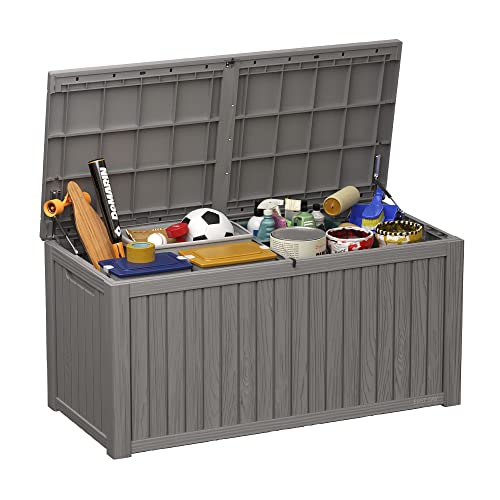
Where to buy
Check the latest price, availability and delivery on Amazon for the linked picks — orders for those are placed on Amazon, and we may earn a commission from qualifying purchases. Apartment rule for this guide: every pick is freestanding, needs no drilling, no anchoring and no landlord permission, and can leave with you when the lease ends. The Lifetime Horizontal is included as the honest exception — it only makes sense on a ground-floor patio or a rented house’s yard, and its review says so plainly.
- Best mid-large all-rounder: EAST OAK 180 Gallon Deck Box, Grey — Check on Amazon
- Best soft-close family pick: Suncast 200 Gallon Extra Large Deck Box, Dove Gray — Check on Amazon
- Best premium build: Keter Denali 200 Gallon Deck Box, Grey & Black — Check on Amazon
- Best big-box value: Keter Java 230 Gallon Deck Box, Grey — Check on Amazon
- Best maximum capacity: YITAHOME 320 Gallon Extra Large Deck Box — Check on Amazon
- Best shed-style capacity: Lifetime Horizontal Storage Box, 75 Cubic Feet (561 Gallon) — Check on Amazon
Read the full guide ↓
Disclosure: As an Amazon Associate, dailyhomedecorating.com earns from qualifying purchases. Links to Amazon on this page are affiliate links; they cost you nothing extra. Listing details such as price and availability change often, so check the current Amazon listing before you buy.
Finding the best outdoor storage box for apartments under $700 starts with a truth most roundups skip: apartment storage lives on a balcony or a small patio, under a lease, and the best box is the biggest one your building actually allows — not the biggest one your budget allows. Seven hundred dollars is more than any balcony needs to spend on a single chest, so this guide ranks the six premium options by apartment logic first: footprint, delivery and assembly through apartment doors and elevators, quiet lids that will not anger the neighbors below, and the freedom to take the box with you when you move.
The constraints are real and worth naming. Balconies have load limits and railings that lids must clear. Many leases and HOAs restrict what can sit on a balcony at all, and some ban storage that rises above the railing line. Boxes arrive as large flat packs that must fit an elevator or a stairwell turn. And an apartment box works double duty — it is storage, a plant stand, a side table and often extra seating, all in the same four square feet. Every pick below was judged against those jobs, not against a suburban deck’s easier standard.
The ranking reflects that. The EAST OAK 180 Gallon leads because it delivers genuine capacity in the smallest footprint here — the apartment sweet spot. The Suncast 200 Gallon follows for its soft-close lid, the quietest neighbor-friendly hardware on the page. The Keter Denali brings double-wall, paintable panels for renters who want the balcony to look designed rather than stored-on. The Keter Java and the YITAHOME serve the lucky minority with genuinely large patios or ground-floor terraces, and the Lifetime Horizontal closes the list as a ground-floor-only option for rented houses. If your budget is smaller, our Best Outdoor Storage Box For Apartments Under $500 guide covers the same brief one tier down.
A word on the budget itself: because no apartment should spend $700 on the box alone, the buying guide below treats the ceiling as a balcony system budget — box, lock, cushion bags, a plant-stand-worthy cover, and the delivery reality of getting a five-foot flat pack up three floors. Measure your elevator before you fall in love with the 230-gallon options; the reviews flag each pick’s packed and assembled footprint so you can plan the route from curb to balcony before you order.
In this guide
Quick Picks: The Best Outdoor Storage Box for Apartments Under $700 at a Glance
Each row names the job the purchase does best for this brief. Full reviews follow, with interior dimensions and honest limitations for every pick.
| Buyer type | Pick | Why it stands out | Link |
|---|---|---|---|
| Best mid-large all-rounder | EAST OAK 180 Gallon Deck Box, Grey | Real 180-gallon capacity in the smallest footprint here — the balcony sweet spot | Check on Amazon |
| Best soft-close family pick | Suncast 200 Gallon Extra Large Deck Box, Dove Gray | Soft-close lid: the quietest hardware for neighbors below | Check on Amazon |
| Best premium build | Keter Denali 200 Gallon Deck Box, Grey & Black | Paintable double-wall panels — storage that looks like furniture | Check on Amazon |
| Best big-box value | Keter Java 230 Gallon Deck Box, Grey | For large patios and terraces: maximum volume on pistons | Check on Amazon |
| Best maximum capacity | YITAHOME 320 Gallon Extra Large Deck Box | Ground-floor terraces only: 320 gallons with a divider | Check on Amazon |
| Best shed-style capacity | Lifetime Horizontal Storage Box, 75 Cubic Feet (561 Gallon) | Rented-house yards only: doors, bins and bikes behind a lock | Check on Amazon |
How the Picks Were Chosen for the Best Outdoor Storage Box for Apartments Under $700 Guide
Shortlisting for apartments started from the same premium field as our main guide — the largest, best-built chests from Keter, Lifetime, Suncast, EAST OAK and YITAHOME — then applied four apartment filters. The box had to be freestanding with no anchoring or drilling. Its assembled height had to sit plausibly below a typical balcony railing line, or the review had to flag the exception. Assembly had to be a realistic one-or-two-person job in a living room, with no power tools beyond a screwdriver. And the lid had to be controllable — pistons, soft-close or spring hardware — because a slamming lid on a balcony is a noise complaint with a hinge. Maker specifications were then checked for the numbers apartment buyers actually live with: exterior footprint, empty weight (you will move this box at least twice — in, and out at lease end), interior dimensions against standard cushion sizes, and whether the flat pack’s longest panel can plausibly turn a stairwell corner. Boxes that only make sense permanently installed were cut, and the one shed-scale unit that survived — the Lifetime — is labeled with its ground-floor condition rather than quietly recommended to a third-floor balcony. Prices were sanity-checked against the $700 ceiling as complete balcony systems, not bare boxes. Popularity played no part in the ranking; footprint, hardware and honest fit did.
Balcony Storage, Taken Seriously: The Apartment Deep Dive
The railing line is your real budget
Apartments ration storage by visibility and structure, not by money. The railing line decides what the building tolerates; the wall run decides what fits; the slab’s load path decides where the weight may sit. Work those three constraints in order and the right box usually chooses itself — which is why this guide’s leader is a mid-priced 180-gallon chest rather than the largest unit $700 can buy. Renters who internalize the railing-line rule also keep their deposit and their landlord’s goodwill, the two currencies that actually matter at lease end.
Double duty is an apartment specification
In a house, a storage box that only stores is fine. In an apartment it is a waste of the scarcest asset you own. The picks here were judged on their second jobs: a flat lid at side-table height for the morning coffee, a surface a planter can anchor, a top strong enough — within its maker’s rating — for a guest to perch on during a crowded balcony evening. When you compare candidates, price the second job too: a box that replaces a side table you no longer need to buy or store is cheaper than its tag, in money and in inches.
The move-out test
Every apartment purchase should pass one question: how does this leave? The EAST OAK empties, tips and carries like furniture. The Denali and Suncast move as two-person carries through standard doors. The terrace-class picks pass only where elevators and ground floors cooperate, and the Lifetime — a semi-permanent installation in spirit — fails the test anywhere above ground level, which is precisely why this guide flags it instead of quietly selling it. Buy for the tenancy you have, including its ending.
Assembly day in an apartment
Build the box where it will live if the balcony door allows the panels through — they will, panel by panel, even when the assembled box would not fit the turn. Work on a blanket to protect both the panels and your deposit, keep fasteners in a bowl (balcony gaps swallow screws permanently), and recruit the second pair of hands the big panels ask for rather than wrestling a five-foot wall solo beside a railing. Finish with the drainage check: pour a cup of water at the slab’s high side and watch it pass beneath the box, not pool against it.
The Best Outdoor Storage Box for Apartments Under $700 Picks in Detail
EAST OAK 180 Gallon Deck Box, Grey
Who it suits: apartment dwellers with a standard balcony — roughly five to eight feet of usable wall — who store a bistro set’s cushions, a folded drying rack, plant supplies and the miscellaneous clutter that otherwise migrates indoors. It is the only pick that asks nothing of your lease, your elevator or your neighbors.
A large resin chest in a clean grey finish: 180 gallons of lockable, waterproof, UV-resistant storage sized for cushion sets, gardening tools and pool accessories. EAST OAK builds this size as the step up from its popular smaller boxes, keeping the same straightforward panel assembly and a lid that takes a padlock. It is the smallest footprint on this page, which is exactly its role: big-box storage for households that cannot give a 200-plus-gallon chest a home.
The EAST OAK is the low-maintenance citizen of this guide. Assembly is the simplest here — panels and lid, no door alignment, no spring hardware — and most owners build it solo where it will stand. The resin needs nothing beyond a hose-down and an occasional wipe, the lockable lid covers the security basics, and the footprint forgives repositioning: at this size, changing your mind about placement is a two-minute job rather than a project. The one discipline it asks is lid courtesy — lower it by hand rather than dropping it, since there is no soft-close hardware — and in return it asks nothing else for years. For households graduating from a too-small first box, it is the calm, correct second purchase.
- Real capacity without the five-foot-plus footprint of the 200-gallon class
- Lockable, weather-sealed design from a brand whose smaller boxes are category staples
- The easiest assembly here — panels and lid, no door hardware or spring hinges to align
Honest limitation: No pistons or soft-close hardware — the lid is a manual lift and can drop if you let go of it mid-close, and 180 gallons fills fast once chaise cushions join the pile.
Choose it if the fit above sounds like your household; skip it if the limitation describes your space or habits — a smaller or simpler box below will serve you better. Check on Amazon
Suncast 200 Gallon Extra Large Deck Box, Dove Gray
Who it suits: renters on larger balconies and anyone whose patio sits above a neighbor’s bedroom. The soft-close lid is the whole argument: it cannot slam, at 7 a.m. or midnight, and the deep interior takes the cushions of a proper outdoor loveseat or lounge chair set.
Made in the USA from all-weather resin with a soft-close lid — the lid lowers itself the last stretch instead of dropping. Exterior is about 57.5 inches long, 31.5 inches deep and 32.75 inches tall; the interior runs about 54 by 27.5 by 30 inches, the deepest front-to-back interior among the chests here. Suncast documents a 300-pound lid capacity and a padlock-ready metal hasp, and the resin is UV protected.
The Suncast’s ownership story is its lid. The soft-close mechanism changes daily behavior more than any capacity figure: you stop bracing for the slam, children stop fearing the box, and the lid’s seal lands gently and completely every time — which is also why interiors stay dry, because a slammed lid eventually warps its own landing. The deep interior rewards a simple system: broad cushions flat at the base, back cushions on edge behind them, small items in one crate at the end. The resin wipes clean, the light finish reflects summer heat instead of absorbing it, and the reinforced lid holds its shape under its rated load year after year. Assembly is a straightforward panel build most owners finish solo in an unhurried session.
- Soft-close lid is the finger-safe choice around children and the quiet choice near bedroom windows
- Deepest interior here — broad seat cushions lie flat without curling at the edges
- US-made resin with a reinforced lid that doubles as occasional seating within its rating
Honest limitation: The soft-close hardware asks you to open the lid fully and let it work; forcing it down by hand fights the mechanism, and the light Dove Gray shows pollen and scuffs sooner than dark finishes.
Choose it if the fit above sounds like your household; skip it if the limitation describes your space or habits — a smaller or simpler box below will serve you better. Check on Amazon
Keter Denali 200 Gallon Deck Box, Grey & Black
Who it suits: design-led renters furnishing a balcony as an outdoor room. The paintable panels let the box match your railing or trim color, the double walls feel like furniture rather than a tote, and the tall interior stands cushions upright where they air better in a small, shaded space.
Duotech resin panels a full 20 mm thick — double-wall construction you can paint and drill, which no thin-wall box on this page allows. Exterior is about 59.7 inches long, 28.5 inches deep and 35.4 inches tall; the interior runs about 56.2 by 25 by 33.2 inches, so tall cushions stand rather than slump. The lid is lockable, the resin is UV protected, and Keter backs the box with a two-year limited warranty.
Ownership is where the Denali separates itself from the field. The 20 mm panels do not oil-can in summer heat or drum in hail the way thin walls do, the box stays square season after season — which keeps the lid sealing as designed — and the surface takes exterior paint properly, so a color refresh in year five is an afternoon’s work rather than a replacement decision. Assembly is a panel-and-fastener build that rewards patience: lay every panel out, keep fasteners finger-tight until the carcass is square, then torque in sequence. Inside, the tall interior suits standing cushions on edge with a slim crate at one end for tools and ties. Expect the pistons and hardware to be the only wear items worth a thought over a decade, and both are the kind of standard fittings a maker can supply long after purchase.
- Thickest, stiffest walls here — panels can be painted to match a house and drilled for hooks or dividers
- Tall interior swallows deep-seat and chaise cushions that shorter boxes force you to fold
- Lockable lid and a wood-look finish that reads as furniture, not as a plastic bin
Honest limitation: It is the deepest step up in this guide: you pay for wall thickness and finish, not for raw gallons, and at roughly sixty inches long it still needs a real wall run or deck edge to live against.
Choose it if the fit above sounds like your household; skip it if the limitation describes your space or habits — a smaller or simpler box below will serve you better. Check on Amazon
Keter Java 230 Gallon Deck Box, Grey
Who it suits: the fortunate minority: penthouse terraces, ground-floor patios and rented townhouses with real outdoor square footage. If your ‘apartment outdoor space’ fits a sectional, this is your box — measure the elevator and the patio door swing first.
Keter’s XXL chest in a rattan-look grey resin: about 57.5 inches long, 32.7 inches deep and 33.9 inches tall outside, with an interior around 51.9 by 28.3 by 31.1 inches and roughly 56 pounds of weight. Two hydraulic pistons lift the lid and hold it open, the lid is padlock compatible, and the resin panels carry a woven texture that hides dust better than smooth walls.
The Java is the box owners stop thinking about, which is the compliment big chests earn. The pistons hold the lid at working height through years of daily cycles, the rattan texture hides the dust film that makes smooth boxes look tired by July, and the sheer interior volume means the packing never has to be clever — sectional sets simply go in. Assembly is a snap-and-screw panel build, fastest with a second pair of hands for the long walls. Two ownership notes from the category’s experience: open the lid slowly after heavy rain so pooled water sheds outward rather than in, and keep the long walls out of direct reflected heat from south-facing glass, the one environment that ages any resin early.
- The most chest gallons per purchase on this page — full sectional cushion sets fit in one box
- Pistons hold the lid open hands-free while you load with both arms full
- Rattan texture shrugs off the dusty, chalky look that plagues smooth dark resin
Honest limitation: Single-wall panels flex more than the Denali’s double walls, the long lid can take on rain that runs in as you open it after a storm, and the footprint is a commitment on anything but a full-size deck.
Choose it if the fit above sounds like your household; skip it if the limitation describes your space or habits — a smaller or simpler box below will serve you better. Check on Amazon
YITAHOME 320 Gallon Extra Large Deck Box
Who it suits: ground-floor renters with terraces, and households splitting storage with a patio-sharing arrangement — the divider lets two categories of clutter (or two roommates’ gear) coexist in one footprint. It is not a balcony pick and does not pretend to be.
The capacity champion here: 320 gallons of double-wall resin with a flexible divider, so cushions can live on one side and pool or sports gear on the other. The maker rates the structure for a 1000-pound load, the lid is lockable, and the box is built as one long run — plan on roughly sixty-eight inches of wall. Double-wall panels and the divider are the two features that separate it from the generic oversize chests it competes with.
A 320-gallon box is a logistics decision before it is a storage one. It arrives as a large, heavy flat pack; plan the carry, the assembly space and the final position before the delivery day, and assemble it in place — a finished box this size does not love being dragged. In service, the divider is the feature owners praise: it converts one cavern into two rooms, and the double-wall panels keep the long spans from flexing when the box is loaded unevenly. The structure’s heavy load rating makes the lid a genuine gathering bench, though a cushion or runner keeps the finish kind. Keep the interior aired on dry mornings in humid climates; very large sealed volumes hold still air, and still air is what mildew eats.
- Largest capacity in this guide, with a divider that keeps wet pool gear off dry cushions
- Double-wall build and a heavy load rating make the lid usable as a gathering bench
- One box replaces the two mid-size boxes many households end up buying anyway
Honest limitation: It ships as a very large, heavy flat pack and the assembled box is a two-person move; measure gates and deck stairs before ordering, because returning an assembled 320-gallon box is nobody’s idea of fun.
Choose it if the fit above sounds like your household; skip it if the limitation describes your space or habits — a smaller or simpler box below will serve you better. Check on Amazon
Lifetime Horizontal Storage Box, 75 Cubic Feet (561 Gallon)
Who it suits: renters of houses and duplexes with a yard or driveway pad: the household whose lease comes with bins to hide, a mower to shelter and bikes to lock. On any balcony above ground floor, skip it entirely — the other five picks exist for you.
This is the one pick that stops being a chest and starts being a small horizontal shed: about 75.2 inches long, 42.5 inches deep and 52 inches tall outside, with an interior around 71.2 by 38.75 by 47 to 48 inches — 75 cubic feet in total. Dual-wall high-density polyethylene panels are steel reinforced, the front doors are lockable with an external latch, the lid rides on a controlled spring hinge, and Lifetime covers it with a five-year limited warranty. It is sized to hold two large wheeled bins, a mower, or bikes.
Owning the Lifetime is closer to owning a small building than a box. Assembly is the price of admission — a methodical two-person build with many panels, steel supports and door hardware to align — and it pays to assemble it exactly where it will live, on its level base, because moving the finished unit is a four-hand carry. Once built, daily life is doors and a lid that both open wide and latch positively; bins roll in and out without lifting, and the spring hinge keeps the heavy lid from ever dropping. The HDPE floor shrugs off bin drips and mower grime and hoses clean each spring. The five-year warranty is the longest in this guide, and the steel-reinforced dual walls are why: this is the pick least likely to be replaced for structural reasons.
- Front doors plus a lifting lid — you walk items in instead of hoisting them over a chest wall
- Steel-reinforced dual-wall HDPE and the longest warranty on this page
- Hides two full-size trash and recycling bins completely, which no chest here can do
Honest limitation: Assembly is a genuine two-person project measured in hours, it needs a level pad or deck section, and at about 52 inches tall it is far too big for balconies and most small patios.
Choose it if the fit above sounds like your household; skip it if the limitation describes your space or habits — a smaller or simpler box below will serve you better. Check on Amazon
Comparison Table
Capacities and dimensions are the makers’ published figures; where a maker publishes no lid rating or exact dimension, the table says so rather than guessing.
| Pick | Capacity | Exterior size | Construction | Lid and lock | Warranty |
|---|---|---|---|---|---|
| EAST OAK 180 Gallon Deck Box, Grey | 180 gal | Compact for its class | Resin | Lockable lid | Maker limited |
| Suncast 200 Gallon Extra Large Deck Box, Dove Gray | 200 gal | 57.5 x 31.5 x 32.75 in | All-weather resin | Soft-close, padlock-ready hasp | Maker limited |
| Keter Denali 200 Gallon Deck Box, Grey & Black | 200 gal | 59.7 x 28.5 x 35.4 in | Duotech resin, 20 mm double-wall | Lockable lid | 2-year limited |
| Keter Java 230 Gallon Deck Box, Grey | 230 gal | 57.5 x 32.7 x 33.9 in | Resin, rattan look | Hydraulic pistons, padlock compatible | Maker limited |
| YITAHOME 320 Gallon Extra Large Deck Box | 320 gal | About 68 in long | Double-wall resin | Lockable lid, flexible divider | Maker limited |
| Lifetime Horizontal Storage Box, 75 Cubic Feet (561 Gallon) | 75 cu ft / 561 gal | 75.2 x 42.5 x 52 in | Dual-wall HDPE, steel reinforced | Lockable doors + spring-hinge lid | 5-year limited |
How to Choose the Best Outdoor Storage Box for Apartments Under $700
Check the lease and the railing first
Before measuring cushions, measure your permissions. Many buildings cap balcony storage height at the railing, ban items visible from the street, or prohibit storage altogether on upper balconies. Note your railing height and keep the box below it where rules require; every chest here except the Lifetime sits at or under about 35 inches. A five-minute email to your landlord or HOA beats a violation notice in month two.
Plan the delivery route like a mover
Apartment boxes fail at the elevator, not the balcony. Check the flat pack’s longest dimension against your elevator door and stairwell turns, confirm the delivery point (lobby, lockers, or door), and remember the assembled box — up to five feet long for the big Keter and YITAHOME — must pass your patio door at an angle. The EAST OAK and Denali assemble most forgivingly in tight indoor space.
Respect balcony load and water
Balconies are engineered for people and furniture, not unlimited cargo: a loaded 230-gallon box concentrates serious weight in four small feet. Keep big boxes against the building wall where the structure is strongest, never at the railing edge, and lift any box on small risers so balcony drainage keeps flowing beneath it — trapped water under a box stains concrete and annoys the neighbor below. Renters furnishing from scratch will find the matching scale guidance in our Best Patio Furniture Set For Apartments Under $700 guide.
Make the box earn its square feet
On a balcony, single-purpose furniture is a luxury. Choose a box whose flat, load-respecting lid can host a tray, a planter or a lantern; store vertically inside with bags hung from the rim; and keep the lock on — balcony theft is rare but opportunistic, and a locked lid also keeps wind from lifting it in a storm. Pair the box with the right rug scale using our Best Outdoor Rug For Apartments Under $700 guide and the whole balcony reads as a room, not a storage unit.
Common Mistakes to Avoid
- Ordering the biggest box the budget allows and discovering the flat pack cannot turn the stairwell corner — or the assembled box cannot pass the patio door.
- Ignoring the lease: a beautiful box removed under an HOA order in month two is the most expensive outcome on this page.
- Blocking balcony drainage. A box sitting in the drainage path dams water against your door threshold and drips onto the balcony below.
- Letting a lid slam. On hard balcony surfaces, an unassisted lid is a daily noise event for the household beneath you — piston, soft-close or spring hardware is an apartment necessity, not a luxury.
- Storing the box against the railing for the view. Weight belongs at the wall; the railing edge is the weakest and most visible place a box can sit.
- Forgetting the exit. You will move out: favor boxes one person can empty, tip and carry — another reason the ground-floor-only picks are flagged honestly. For the deck-first version of this category, see the Best Deck Box For Apartments Under $700 guide.
The Apartment Load: A Balcony’s Whole Inventory
What a balcony actually stores
The apartment load is smaller and stranger than a house’s: a bistro or loveseat cushion set, a folded drying rack, the watering can and plant food, a compact broom, string-light spares, a folded camping chair for the extra guest, and the seasonal items — a small fan, a door wreath — that would otherwise colonize the coat closet. Listed honestly, it fills 100 to 180 gallons, which is why this guide’s leader is the size it is: the load, not the budget, sets the box. Anything beyond the list is a sign the box is becoming the apartment’s junk drawer, and on a balcony that drawer has a landlord.
Vertical packing for small interiors
Apartment boxes earn their footprint by packing in three dimensions. Cushions stand on edge along one wall — better for airing in a shaded space — with the crate of tools and ties at the end, bags of textiles hung from the rim hooks or stacked on the flat base layer, and the tall, thin items (drying rack, broom) laid along the back. Keep a hand’s width of air at the top: a balcony box opened daily in humid weather needs its contents to breathe, and a lid that must be forced shut is a lid whose seal is being spent.
What must never move in
Leases and safety agree on the exclusions: no fuel, no solvents, no pool or cleaning chemicals beyond a sealed hand spray, nothing the building’s rules name, and nothing scented enough to interest the pigeons. Also excluded by wisdom rather than rule: anything you would be devastated to lose to a once-a-decade storm, since a balcony is the most exposed room you own. The box is for the durable and the replaceable — which, honestly inventoried, is almost everything a balcony owns.
Sharing the box with the balcony’s second life
Because the apartment box doubles as furniture, load it like furniture: the items you reach for weekly — cushions, the throw, the watering can — live at the top and the door side; the seasonal deep storage sinks to the bottom and the far end. A tray that lives on the lid should lift away in one motion without unpacking the surface. Hosts on balconies learn this choreography fast: the box that opens, serves and closes without displacing a single guest is the box that was loaded with the evening in mind.
The second-apartment test
Renters move, and the best apartment box is the one that works at the next address too: a footprint common to most balconies, a finish neutral enough for any building, an assembly that survives being undone and redone. The leaders here pass that test; the terrace-class picks pass it only between similar homes. When you buy, keep the instructions and a small bag of spare fasteners taped inside the lid — future you, in a new living room surrounded by panels, will be grateful, and the box’s second installation will be as true as its first.
Care, Placement and Longevity
Apartment care is neighbor care. Keep the box on its risers or mat so balcony drainage runs free and the base never drums on concrete; wipe the exterior when you water the plants, since a clean box is the difference between storage a landlord tolerates and clutter one cites. Air the interior on dry mornings — shaded balconies dry slowly, and still air is mildew’s ally — and keep textiles in breathable bags. Once a season, check that the lid still closes softly and completely, test the lock, and confirm nothing has migrated against the drainage path. When the lease ends, the same routine in reverse — empty, hose, dry, carry — returns the box to service at the next home with its deposit-friendly reputation intact.
One last apartment habit separates boxes that thrive from boxes that merely survive: the quarterly re-audit. Every three months, open the box with the list from the load section in hand and evict whatever has migrated in without earning its place — the dead plant’s pot, the predecessor’s cushions, the tool that belongs in the kitchen drawer. Balconies accumulate quietly because every object arrives with a reason; the audit is where reasons expire. Five minutes, four times a year, and the box stays sized to the balcony’s actual life — which is the entire discipline this guide has been describing, compressed into a calendar entry.
Final Recommendation
For most apartments, the answer is the EAST OAK 180: real capacity, the smallest footprint, no drama with elevators, leases or neighbors. Step to the Suncast if your balcony is large and your downstairs neighbor is close; choose the Denali if the balcony is a designed room and you want storage that disappears into it. Treat the Keter Java, YITAHOME and Lifetime as what they are — excellent boxes for terraces, ground floors and rented houses — and spend the generous change from $700 on the lock, the bags and the plants that make a balcony worth sitting on.
Frequently Asked Questions
Can I put a storage box on my apartment balcony at all?
Usually, yes — with conditions. Most leases and HOAs regulate size, height and visibility rather than banning storage outright: keep the box below the railing line, against the wall, and off the drainage path, and you satisfy the common rules. Ground-floor patios are freer; upper balconies in strict buildings may limit you to the smallest pick here. When in doubt, ask in writing before you buy — approval by email is a renter’s best friend.
What is the biggest box a normal balcony can handle?
For a typical balcony with five to eight feet of usable wall, the 180-to-200-gallon class is the practical ceiling — the EAST OAK or the Suncast. The 230-gallon Keter needs a genuinely large balcony or terrace, and the 320-gallon YITAHOME and the Lifetime belong at ground level. Weight matters as much as size: keep loaded big boxes at the wall, where balcony structure is strongest.
Will a big flat pack fit in my elevator?
Most chests here ship as panels whose longest side roughly matches the box’s length — plan around five feet for the large models, less for the EAST OAK. Measure your elevator door height and the diagonal of any stairwell turn before ordering the Keter Java or YITAHOME; the EAST OAK, Suncast and Denali are progressively safer bets as access gets tighter.
How do I keep a balcony box quiet?
Choose assisted lids — soft-close (Suncast), pistons (Keter Java) or the Denali’s controlled hardware — and set the box on a thin outdoor mat or riser feet so the base does not drum on concrete. Close the lid by guiding it the last few inches even with soft-close hardware, and keep the lock latched in storms so wind cannot lift and drop the lid at night.
What should I actually store in an apartment storage box?
The high-value list is short: furniture cushions, a folded balcony cleaning kit, plant food and hand tools, a watering can, string-light spares and the seasonal items that otherwise eat closet space. Keep chemicals and anything flammable out — many leases prohibit them on balconies regardless of the box — and keep textiles in breathable bags so a small, shaded balcony’s humidity does not turn to mildew.
Is the Lifetime Horizontal ever right for an apartment?
Only at ground level: a rented house, a duplex with a yard, or a ground-floor patio with a level pad and a landlord who approves in writing. Its doors make it the best bin-and-bike storage here, but its size, weight and assembly rule it out for balconies. Apartment readers comparing shed-scale options should start from our Best Outdoor Storage Box Under $1500 guide’s smaller siblings rather than forcing this unit upstairs.
What if my building bans balcony storage boxes?
Then the honest options are indoor breathable bags for cushions and a conversation with management about a below-railing, wall-side unit — some bans target visibility, not storage itself, and the EAST OAK’s profile is the easiest approval to win. Never install first and argue later: removal orders mid-lease are the expensive outcome this guide’s lease-check section exists to prevent. Ground-floor renters should ask about patio placement in the same email; approvals are often broader at ground level.
Can a balcony box hold a small grill or balcony garden supplies?
Garden hand tools, plant food in sealed containers and a watering can are natural tenants. A grill itself — even a small one — belongs outside the box: fuel, grease and heat residue have no place in a sealed resin interior, and most leases restrict balcony grills separately anyway. Store the grill’s tools and cover inside; keep the appliance itself under its own cover beside the box.
Do I need to tell my landlord about a storage box?
For a freestanding, below-railing box, many leases already allow it under general balcony-furniture terms — but a short email with the box’s dimensions costs nothing and converts a possible violation into a documented approval. Include the footprint and height, note that it is freestanding with no fixings, and keep the reply. Renters who ask first almost always hear yes; renters who are discovered first sometimes hear remove it. The five minutes is the cheapest insurance in this entire guide.


