Where to buy
Check the latest price, availability and delivery on Amazon. Orders are placed on Amazon. We may earn a commission from qualifying purchases.
- Best overall for backyard cooking: Ooni Karu 12 Multi-Fuel Outdoor Pizza Oven — Check on Amazon
- Ooni Koda 12 Gas Pizza Oven — Check on Amazon
- BIG HORN OUTDOORS 12-Inch Wood Pellet Pizza Oven (SRPG18003) — Check on Amazon
See more options in the full reviews below
- PIZZELLO 12-Inch 2-Layer Wood-Fired Pizza Oven (UK50008) — Check on Amazon
- Ooni Fyra 12 Wood Pellet Pizza Oven — prose-only pick in this guide (see its review below for why)
- Gozney Roccbox Portable Pizza Oven — prose-only pick in this guide (see its review below for why)
Read the full guide ↓
Disclosure: As an Amazon Associate, dailyhomedecorating.com earns from qualifying purchases. Links to Amazon on this page are affiliate links; they cost you nothing extra. Listing details such as price and availability change often, so check the current Amazon listing before you buy.
The best outdoor pizza oven for backyards under $300 is not simply the best pizza oven that happens to be outdoors — a backyard changes the equation in ways a balcony or a campsite never does. Your oven here is not visiting; it is taking up residence. It will live outside through a season, stand in one chosen spot with a proper surface under it, cook for your household on Fridays and for a yard full of people on the Saturday you did not fully plan for, and face wind, weather and storage realities that portable-first thinking ignores. This guide was built for that life. Every pick was verified the same way as in our main under-$300 roundup — manufacturer specifications, current Amazon listings, a dated price sighting inside the budget for every linked oven, and a federal recall screen that removes any model under an active safety recall entirely — but the judging here weights what a backyard rewards: recovery between pizzas, a setup that can stay set up, and honest behavior when the cooking moves from two pizzas to ten.
The good news is that $300, spent in a backyard, goes further than it does anywhere else. You do not need to pay the portability tax in weight engineering, and you do not need to fold your oven into a closet — so the budget concentrates on the cooking core: stone, fire and steel. The field splits by fuel, as always. Gas gives you the dial-and-dinner weeknight machine. Wood and charcoal give you the ritual and the flavor, with a fire to tend as part of the entertainment. Pellets split the difference with a hopper doing half the tending. And two famous names sit in this guide as prose-only picks — one leaving the US market, one priced above the line — because a backyard buyer comparing seriously will meet both, and deserves straight answers about each.
One backyard truth before the picks: placement is a decision you make once and live with all season. These ovens run stones at roughly double a kitchen oven’s heat, breathe real fire, and drop ash, embers and heat exactly where you put them. The safety section below covers surfaces, clearances and fuel storage in backyard terms — read it before you choose the spot, because the right spot makes every cook easier and the wrong one makes every cook a negotiation. Get the placement right, and an under-$300 oven in a backyard is not a compromise purchase. It is the center of the yard’s social life from the first warm Friday to the last cool one.
In this guide
Quick Picks
| Product | Best for | Link |
|---|---|---|
| Ooni Karu 12 Multi-Fuel Outdoor Pizza Oven | Live-fire centerpiece with a gas upgrade path | Check on Amazon |
| Ooni Koda 12 Gas Pizza Oven | Weeknight gas speed, light enough to move around the yard | Check on Amazon |
| BIG HORN OUTDOORS 12-Inch Wood Pellet Pizza Oven (SRPG18003) | Pellet value for a permanent budget corner | Check on Amazon |
| PIZZELLO 12-Inch 2-Layer Wood-Fired Pizza Oven (UK50008) | Two-level capacity for family pizza production | Check on Amazon |
| Ooni Fyra 12 Wood Pellet Pizza Oven | Pellet specialist — prose-only, see review | Prose-only — no link (see review) |
| Gozney Roccbox Portable Pizza Oven | Insulation for long sessions — prose-only, see review | Prose-only — no link (see review) |
How These Picks Were Chosen
Our method is the series standard: build the candidate list from manufacturer specification sheets, record identical fields for every oven — fuel and what the box actually includes, maximum pizza size, maker-rated top temperature, preheat time, weight, leg and storage design, stone material — then verify each exact variant on its Amazon listing and record a dated price sighting. Only sightings at or below the $300 line earned a link. We screened current federal recall lists for pizza ovens and outdoor cooking appliances, and any model under an active recall was excluded outright; in a category whose hazards are fire and burns, that screen is the price of admission, not a footnote.
The backyard weighting then went to work. Recovery — how fast the stone returns to temperature after a pizza leaves it — matters more across a ten-pizza evening than across a two-pizza one, so insulation and stone mass earned real points, and the prose-only premium pick’s presence in this guide is largely a recovery story. Semi-permanent living mattered too: we favored ovens that sit happily on a stand or table under a cover all season, with controls and fuel connections that tolerate being part of the yard’s furniture. And we scored the honest box: an oven badged multi-fuel that ships with one burner was judged as the single-fuel oven it is until you buy the rest, because your budget experiences the box, not the badge.
A word on the temperature figures you will see below. They are the makers’ published ratings — the only comparable numbers available — and they describe ceilings reached on the stone after a full preheat in good conditions. A backyard adds a variable no laboratory figure includes: wind. A breezy corner will tax a thin-walled oven’s recovery all evening, which is why this guide keeps returning to placement, preheat discipline and the short rest between pizzas. Judge the picks by those behaviors, and the headline numbers will take care of themselves.
Fire Safety Comes First: Surfaces, Clearance and Fuel
A backyard gives you room to do this properly, so do it properly. The oven stands outdoors on a stable, level, heat-resistant surface — a metal or stone-topped stand or table made for the job — with the full clearance its manual specifies from fences, siding, deck railings, overhangs, eaves, stored fuel and anything else that can scorch, melt or burn. Keep it out from under patio umbrellas and string lights, away from the firewood stack and the propane storage, and never in a garage, shed or under a covered roof: gas and wood fires produce carbon monoxide, and enclosed and semi-enclosed spaces concentrate it. On a wooden deck, the oven belongs on a proper heat-resistant surface with clearance treated generously, and many owners sensibly move the whole operation to a paved or gravel corner of the yard and keep it there.
Backyard fuel storage has its own rules. Propane tanks live outdoors, upright, in the shade, connected or stored exactly as the manual describes, with hoses and regulators inspected each season — the soapy-water bubble test on connections remains the classic leak check. Pellets and firewood stay dry and at a distance from the oven; a lidded bin near the house, not a heap beside the fire. Ash from wood, charcoal and pellet cooking goes into a lidded metal container that lives outdoors away from structures, and it stays there until completely cold — ash holds live heat far longer than it looks, and a yard offers the space to respect that, so use it. Keep an extinguisher rated for grease and ordinary combustibles within reach of the cooking corner, set a clear boundary that keeps children and pets out of the hot zone, and never leave a lit oven unattended: the backyard’s whole advantage is that someone can always be there, drink in hand, watching the fire — make that someone you.
Best Outdoor Pizza Oven for Backyards Under $300: The 6 Picks in Detail
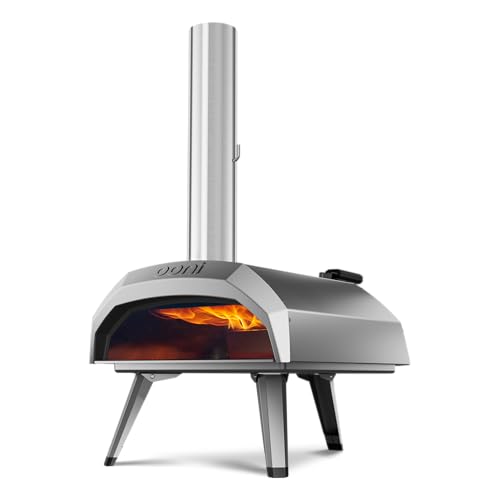
Ooni Karu 12 Multi-Fuel Outdoor Pizza Oven
Key specs: 12-inch pizzas; maker-rated up to 950 degrees F; ready in about 15 minutes; about 26.5 pounds; folding legs; cordierite stone included; gas burner sold separately.
Who it suits: Backyard cooks who want the oven to be an event. The Karu’s wood and charcoal fire gives the yard a focal point — flame rolling across the oven roof, smoke in the evening air, guests drifting toward the cook — while its folding legs and sane weight mean it can still live on a stand under a cover or move to the garage for winter. It is the best pizza-maker in this guide and the best backyard theatre, and its optional gas burner means the same oven can quietly become the weeknight machine in a later season without a second purchase.
- Real wood and charcoal fire with the flavor and ceremony gas cannot imitate
- Maker-rated to full pizza heat with a preheat that suits an evening’s rhythm
- Folding legs and moderate weight — permanent on a stand, portable when needed
- Optional propane burner grows it into a dual-fuel setup over time
Honest limitation: Fire-tending is the deal: you will feed the tray, manage the flame and turn pizzas by feel, and on a long session that is a job someone owns. The gas burner that removes the job is a separate purchase, so a dual-fuel Karu is a two-step budget, not a one-box price.
Choose it if your backyard pizza nights are occasions and you want the best cooking in this guide. Skip it if your yard’s reality is thirty-minute weeknight dinners — the Koda below was built for exactly that life.
Ooni Koda 12 Gas Pizza Oven
Key specs: 12-inch pizzas; maker-rated up to 950 degrees F; ready in about 15 to 20 minutes; about 20.4 pounds; instant ignition; folding legs; connects to a standard propane tank.
Who it suits: Households whose backyard oven must earn its keep on weeknights. The Koda lights with a dial, climbs to pizza heat while dough is stretched, and cooks with a steadiness that makes Tuesday pizza a routine instead of a project. In a backyard it has a second virtue: at about twenty pounds it is the oven you can reposition freely — chase the shade, dodge the wind, move it from the patio table to a stand by the fence — where heavier ovens commit you to one spot. No ash, no fuel runs, no fire to watch: just gas, stone and dinner.
- Instant ignition and one control dial — the fastest setup in this guide
- Lightest linked pick; reposition around the yard as wind and shade demand
- Maker-rated to full Neapolitan heat with an evening-friendly preheat
- No ash or fuel cleanup after the cook
Honest limitation: It is in this guide on a sale sighting — its everyday price sits above the budget, so check the current listing and be willing to wait for its promotional pricing. Gas-only also caps the romance: the pizza is excellent and clean-flavored, but the wood-fire ceremony belongs to its sibling above, and a backyard with room for a fire may miss it.
Choose it if frequency matters more than ritual and you want the oven your household actually uses weekly. Skip it if the fire is the point of your backyard evenings, or if the listing is at full everyday price when you shop.
BIG HORN OUTDOORS 12-Inch Wood Pellet Pizza Oven (SRPG18003)
Key specs: 12-inch pizzas on a 12 by 12 inch stone; maker-rated very high maximum heat; ready in about 18 to 20 minutes; about 25 pounds; stainless steel body; folding legs.
Who it suits: The budget corner of the yard: a permanent, inexpensive pellet station that turns out wood-fired pizza for the lowest verified price in this guide. Pellets suit backyard living beautifully — a lidded bin of fuel by the stand, no tank swaps, no firewood splitting — and the compact stainless oven asks little of the yard: a small footprint, folding legs if it ever travels, and optional gas or electric attachments if your cooking changes. For a first backyard oven, or a second oven beside a grill, it is the easiest yes in this guide.
- Lowest verified price in this guide by a wide margin — check price on Amazon
- Pellet fuel stores dry in a bin and feeds a real wood-fired flame
- Compact footprint suits a dedicated corner without dominating the yard
- Optional burner attachments extend it beyond pellets later
Honest limitation: Treat the maker’s maximum-temperature claim as an optimistic ceiling rather than a working promise, give the oven its full preheat, and expect a small firebox’s pace on long sessions — feeding a crowd means planning a rhythm, not rushing the stone. Fit and finish are honest for the price, a step below the Ooni pair.
Choose it if you want a real backyard pizza setup at the lowest real cost in this guide. Skip it if your typical session is eight-plus pizzas for a crowd — throughput, not quality, is its limit.
PIZZELLO 12-Inch 2-Layer Wood-Fired Pizza Oven (UK50008)
Key specs: Two cooking levels with about 288 square inches of interior space; 12-inch stone; stainless peel, cooking grate and waterproof cover included; about 27 pounds; removable middle rack.
Who it suits: Families and hosts, the backyard’s natural producers. The PIZZELLO’s second cooking level is a throughput feature disguised as a design quirk: one pizza on the stone, a second dish — or a second pizza, with practice — on the rack above, and a production line becomes plausible for the first time at this budget. The included kit matters in a backyard too: stone, peel, grate and cover in the box means the oven is a complete station the day it arrives, cover included for the life it will live outside. It burns wood, so it joins the yard’s fire culture rather than its appliance culture.
- Two cooking levels — the best throughput story in this guide
- Stone, peel, grate and cover included; a complete station in one box
- Removable rack converts it for roasts, pans and larger items
- Verified price sighting comfortably inside this budget — check price on Amazon
Honest limitation: Wood-only means a fire to build and feed through the session, and the upper level cooks on its own terms — expect to rotate food between levels while you learn it. It is also the bulkiest oven here; in a backyard that is a placement decision rather than a storage crisis, but measure its spot all the same.
Choose it if your yard feeds groups and you want capacity plus a complete kit at a budget price. Skip it if your sessions are two pizzas and a quiet evening — the simpler ovens above serve that life with less to manage.
Ooni Fyra 12 Wood Pellet Pizza Oven
Key specs: 12-inch pizzas; maker-rated up to 950 degrees F; ready in about 15 minutes; about 22 pounds; gravity-fed pellet hopper; powder-coated carbon steel shell.
Who it suits: Pellet devotees with a backyard to give it a home. The Fyra’s gravity-fed hopper is the most elegant fuel system in this guide — fill it, light it, and the fire feeds itself in a steady stream while you work the dough — in the lightest body here, on an oven rated to full pizza heat. Backyard owners who already have one cook happily on it all season. It is reviewed here because pellet shoppers will find it everywhere, and because its buying story has changed in a way a guide should state plainly.
- Gravity-fed pellet hopper — the steadiest fire-tending in this guide
- Lightest oven here, yet fully at home on a permanent stand
- Maker-rated to full pizza heat with a fast preheat
- Simple, focused design with very little to assemble
Honest limitation: The maker has wound this model down in the US market, its list price sat above this budget, and no current Amazon offer inside the tier could be verified during our research — hence no link. For a backyard appliance expected to serve for years, a fading model’s parts and support picture deserves weight in the decision, not just its specification sheet.
Choose it if you find a verified new unit at a price you accept, knowing the model’s status. Skip it if you are equipping a backyard for the long term today — the Karu and the BIG HORN cover its ground with live listings inside the budget.
Prose-only pick: there is no Amazon link for this oven in this guide — the review below explains why, and what to check if you shop for it elsewhere.
Gozney Roccbox Portable Pizza Oven
Key specs: 12-inch pizzas; maker-rated up to 950 degrees F; about 44 pounds; thick insulated body with a silicone jacket; detachable gas burner; professional peel included; underfloor thermometer.
Who it suits: The backyard perfectionist’s reference point. The Roccbox’s dense insulation and thick stone floor exist for one backyard scenario above all: the long session, pizza after pizza, where lesser ovens fade and the stone needs its recovery minute after every pie. Its stone holds the line, its gas burner and professional peel arrive in the box, and its underfloor thermometer tells you the truth about the stone all evening. It is here so you can see precisely what the money above this budget buys — and it buys recovery, the thing a busy backyard feels most.
- Class-leading insulation: stone temperature holds across long sessions
- Gas burner and professional peel included — nothing to add on day one
- Built-in underfloor thermometer for honest stone temperatures
- Retractable legs and detachable burner, should it ever travel
Honest limitation: Its list price and every Amazon sighting we verified sit above this guide’s budget, so it carries no link — that is the whole story, told straight. At about 44 pounds it is also the heaviest oven here, which a backyard forgives more easily than a staircase does, but repositioning it remains a two-handed decision.
Choose it if you read this guide, recognize your long-session cooking in its strengths, and decide to leave the budget deliberately. Skip it if $300 is the plan — inside it, the Karu makes the better pizza story and the Koda the faster week.
Prose-only pick: there is no Amazon link for this oven in this guide — the review below explains why, and what to check if you shop for it elsewhere.
Comparison Table
| Product | Fuel | Best use | Link |
|---|---|---|---|
| Ooni Karu 12 Multi-Fuel Outdoor Pizza Oven | Wood and charcoal included; propane with an optional burner | Occasion cooking with live fire at the center | Check on Amazon |
| Ooni Koda 12 Gas Pizza Oven | Propane only | Weekly weeknight pizza, moved around the yard | Check on Amazon |
| BIG HORN OUTDOORS 12-Inch Wood Pellet Pizza Oven (SRPG18003) | Hardwood pellets included; optional gas and electric burners sold separately | A permanent budget pellet corner | Check on Amazon |
| PIZZELLO 12-Inch 2-Layer Wood-Fired Pizza Oven (UK50008) | Wood fired | Family production with two levels | Check on Amazon |
| Ooni Fyra 12 Wood Pellet Pizza Oven | Hardwood pellets only | Pellet ease — check model status carefully | Prose-only — no link (see review) |
| Gozney Roccbox Portable Pizza Oven | Propane included; optional wood burner sold separately | Long-session recovery if you stretch the budget | Prose-only — no link (see review) |
What $300 Buys in a Backyard — and What It Does Not
In a backyard, $300 buys a complete, honest cooking station: a 12-inch oven from a verified brand, a cordierite stone, full pizza heat, and — with the PIZZELLO — even the accessories and cover in the same box. Because the yard absorbs the storage and placement problems that tax other settings, nearly all of the budget reaches the cooking itself. What it does not buy is mass: the insulation and stone thickness that let premium ovens shrug off wind and fire pizza after pizza without pause. You will feel that difference on exactly two occasions — a breezy evening, and a long line of pizzas — and this guide’s advice for both is technique, not money: shelter the oven’s spot, preheat fully, rest the stone briefly between pies.
It also does not buy a 16-inch oven, a natural-gas conversion for the portable picks, or freedom from the fuel decision. Every oven here is a commitment to gas, pellets or fire, with the multi-fuel asterisk — second burner sold separately — applying wherever it appears. Backyard buyers who accept those three facts tend to be delighted; the category’s disappointed owners are usually those who expected the budget oven to impersonate the premium one on the one night a year the difference shows. Buy for your ordinary Fridays and your ordinary Saturdays, and the oven will fit your yard like it was made for it — because, chosen this way, it was.
How to Choose an Outdoor Pizza Oven for Backyards Under $300
Pick the spot before the oven. Walk the yard with the safety rules in hand: a level, heat-resistant station, generous clearance from fences, siding and overhangs, shelter from the prevailing wind, and a sensible distance from where children play and guests gather — close enough to be social, far enough to be safe. The spot decides practical questions the listings cannot: whether a tall oven fits, whether smoke drifts toward your own windows, whether the cook stands in the evening sun. Choose the spot, then choose the oven that suits it.
Match the fuel to your backyard’s social pattern. If pizza night is a performance with an audience, wood’s fire-tending is part of the show and the Karu is your oven. If it is dinner that happens to be excellent, gas’s dial is the honest tool. Pellets suit the host who wants flame flavor without surrendering the evening to the firebox. There is no wrong answer — there is only the answer that matches the yard you actually have and the evenings you actually host.
Plan throughput like a host, not a shopper. Count your real session: household Fridays might be three pizzas; the famous Saturday might be ten. Any pick here handles the Friday. The Saturday rewards either the PIZZELLO’s second level or a production rhythm — dough stretched ahead, toppings in bowls, one pizza in, one being built, one being eaten — on a well-preheated oven whose stone gets its short recovery while you work. Practice the rhythm once on a small night and the big night runs itself.
Budget the station, not the box. The oven plus a stand or suitable table, a launching peel, a turning peel, an infrared thermometer, a cover and the first season’s fuel is the true purchase. The PIZZELLO’s included kit and the Roccbox’s included peel change their real prices in opposite directions from their badges. Price the whole station for each candidate and the comparison becomes honest — and usually stays inside the same $300 neighborhood for the linked picks, accessories watched carefully.
Think in seasons. A backyard oven lives outside: rain, sun, pollen and winter all vote. A cover is not optional for a resident oven, drainage and a dry storage plan for fuel matter, and the end-of-season routine — full cool, brush-out, cold ash dealt with, stone stored dry — decides whether spring’s first pizza tastes like last summer’s best or like a restoration project. Choose the oven whose care routine you will actually perform in November.
Common Buying Mistakes
Placing the oven where it photographs best. Against the fence, under the pergola, beside the firewood — the photogenic spots are usually the wrong ones. Clearance, wind and surface decide placement; the camera can walk to wherever the oven safely is.
Skipping the stand and improvising. A wobbling garden table or a plastic surface under a 900-degree appliance is how backyards get scorched. The stand is part of the oven purchase. Stable, level, heat-resistant — every cook, including the quick test burn.
Judging by the first pizza. First pizzas are tuition on every oven ever made — the stone was underheated, the launch hesitated, the turn came late. Owners who judge at pizza one return good ovens; owners who judge at pizza five own great ones. Give any pick in this guide its honest learning curve.
Forgetting that wind is an ingredient. A breezy yard taxes thin-walled ovens all evening. If your spot is exposed, shelter it or favor the ovens whose preheat and recovery behavior this guide describes most strongly — and never read a calm-day performance as a promise for a windy one.
Leaving the oven out uncovered all winter. The season-end routine takes twenty minutes and buys years. The ovens that die young in backyards are rarely cooked to death; they are weathered to death, one uncovered winter at a time.
Your First Backyard Cook: A Simple Plan That Works
Set the station up completely before any fire: oven on its stand, fuel ready, peels and thermometer at hand, toppings in bowls, extinguisher placed, the hot zone’s boundary obvious to everyone in the yard. Run the maker’s seasoning burn and watch how your oven behaves in your spot — where the wind hits it, where the smoke goes, how the stone’s temperature builds. Then cook in the production rhythm from the start: one pizza in the oven, one being topped, spare dough waiting, because the rhythm teaches faster than any single careful pizza. Turn early and often, rest the stone briefly between pies, and keep notes the way backyard cooks have always kept them — in your head, in the form of next time the preheat runs longer, next time the dough is proofed softer. When the session ends, the oven cools in place while the yard enjoys the evening; ash, fuel and cover all wait for cold. That unhurried sequence is the backyard’s whole advantage — use it, and the second cook is already planned before the first one is cleared away.
Running Costs and Living With the Oven
Fuel is the small, predictable cost: propane by the tank for gas, pellets by the bag for the pellet ovens, wood or charcoal by the bundle for the fire ovens — all modest per pizza, all cheaper than the takeaway habit this oven replaces. The real running costs of backyard ownership are care items: a cover when the sun finishes the old one, a brush for the stone, a replacement stone only if thermal shock or a drop claims one, and the occasional hose or regulator check on gas setups. Build the twenty-minute routines — after cooks, at season’s end — and an under-$300 oven is a multi-season appliance. The owners who replace these ovens early are almost never the ones who cooked them hard; they are the ones who stored them wet, covered them hot or let a winter sit on them unprotected.
Setting Up a Backyard Pizza Station That Lasts
The difference between a pizza oven and a pizza station is everything around the oven, and a backyard is the one setting with room to build it properly. Start with the surface decision: a dedicated stand at a comfortable working height, on a paved, stone or gravel patch if your yard offers one, positioned with the safety clearances as the first measurement and the evening sun as the second. Beside it, a small side surface for the work itself — dough, toppings in bowls, the launching peel resting, the turning peel in reach — because pizza making is an assembly line and the cook should never have to choose between holding a peel and opening a sauce jar. A lidded bin for fuel lives within a few steps but never beside the oven; the ash container has its own outdoor spot; the extinguisher hangs or stands where everyone in the household could find it in the dark.
Then think about the audience, because a backyard station is a social machine. Guests gather where the fire is, so give them a place to gather that is near the theatre and out of the hot zone — a bench, a low wall, the edge of the patio — with the eating surface close enough that a pizza travels ten steps, not fifty. Lighting matters more than any accessory after the thermometer: the cook needs to see crust color clearly at dusk, which is when most sessions peak. And plan the station’s winter face from the first day: what gets covered, what comes indoors, where the stone sleeps. None of this requires money worth mentioning beyond the station basics already counted in this guide — it requires an afternoon of honest measuring, arranging and rearranging before the first fire is ever lit in it. A station designed this way — once, deliberately, with the cook’s real movements walked through in advance — is why some backyards cook on the same under-$300 oven for season after season while others churn through gear. The oven is the heart of it, but the station is the habit, and habits are what get used.
Final Recommendation
For the backyard this guide imagines — a real spot, a real season, a household that cooks — the Ooni Karu 12 is the pick: the best pizza in this guide, the full live-fire ceremony, folding legs for winter storage, and a gas burner waiting as an upgrade when a future season wants one. If your yard’s truth is weeknight speed, the Ooni Koda 12 at its sale pricing is the oven that will actually be used weekly, and frequency beats ceremony in every long run. The BIG HORN builds the budget pellet corner for the least money here, and the PIZZELLO serves the producing family better than anything else at the price. The Fyra and the Roccbox remain the two honest edges — one leaving the market, one waiting above the budget with the recovery your longest sessions would love. Choose by your spot and your Fridays, set the station up safely once, and your backyard will do the rest: there is a reason pizza ovens become the center of the yard, and it only takes one good evening to find out. Give the oven its season, learn its moods the way you learned your grill’s, and the appliance you bought on a budget becomes the piece of the yard your household plans its summer around — which is, in the end, the only metric any of these ovens is really being judged by, whatever the specification sheets, the temperature ratings and the marketing photographs may claim at the moment of purchase each spring.
Frequently Asked Questions
How many pizzas can these ovens cook in an evening?
Far more than most households need. At full heat each pizza takes roughly one to two minutes in the oven, so the limit is never the bake — it is stone recovery, dough supply and the cook’s rhythm. With a full preheat, brief rests between pizzas and a simple production line, any linked pick here sustains a family evening comfortably; the PIZZELLO’s second level and the better-insulated ovens stretch the pace further. Plan dough generously and the oven will not be the bottleneck.
Can I leave my pizza oven outside all season?
Yes, with the ordinary disciplines of outdoor appliances: a fitted cover, a dry and level spot, fuel stored separately and dry, and a proper cool-down and brush-out after cooks. What an oven cannot survive gracefully is being covered while warm, sitting in pooled water, or spending a winter uncovered. Treat it like the grill beside it — covered, cleaned and respected — and a season outdoors is its natural life; treat winter as a season too, and store it dry when the cooking year ends.
Wood-fired or gas for a backyard — which do most owners prefer long-term?
The ones who keep cooking are the ones whose fuel matched their evenings. Wood owners who love the fire describe the tending as the best part years later; gas owners describe still making pizza every week years later, which is its own verdict. Pellets sit happily between. The regret pattern is consistent: buyers who chose the fuel they admired rather than the fuel their schedule supports. This guide’s reviews are written to help you hear which one is yours.
Do I need a special table or stand?
You need a stable, level, heat-resistant surface with the clearances the manual specifies — a purpose-made oven stand or a metal or stone-topped outdoor table are the standard answers. What you must not use is a plastic table, a wobbly surface, or direct placement on a wooden deck or synthetic rug. Many owners dedicate a paved or gravel corner of the yard to the station, which solves surface, clearance and storage in one decision.
How do I keep the stone from cracking?
Respect thermal shock: the stone goes in before the oven heats, never into a hot oven cold; it never meets water while hot, and it is cleaned by brushing when cool, not by soaking or soap. Keep it dry in storage, handle it like the ceramic it is when moving the oven, and let the oven’s own heat burn off residue during a preheat rather than scrubbing. Stones treated this way last for years; most cracked stones trace back to one cold-into-hot moment.
Can I cook in the rain or in winter?
Light weather, yes, with sense: the oven itself works in cold air — in fact a still winter evening can be superb cooking weather once the longer preheat is respected — but rain on a hot stone’s surroundings, wet fuel and a soaked cook help nobody. Pellets and wood must stay dry to burn properly, gas connections should be kept clean and checked, and the cook needs light and footing more than the oven needs shelter. What you must never do is move the operation under a roof, into a garage or beneath an overhang to escape weather; if the evening is truly hostile, the oven’s night off is the correct call, and pizza night becomes an indoor one.
How long should I preheat before the first pizza?
Give the oven its full manufacturer preheat — roughly fifteen to thirty minutes across this guide’s picks — and judge readiness by the stone, not the clock or the air. An infrared thermometer pointed at the stone’s center is the honest test, and on breezy evenings expect the full time or a little beyond it, especially from the lighter ovens. The first pizza launched onto a properly soaked stone cooks evenly and releases cleanly; the one launched five minutes early teaches the same lesson with a pale, sticking base. Preheat patience is the cheapest skill in this entire category.
Is a pizza oven worth it if I already own a good grill?
For most backyard households, yes — they do different work. A grill cooks with moderate heat across a wide grate; a pizza oven concentrates far higher heat around a stone, which is what produces the blistered crust, spotted base and ninety-second bake that a grill, even a hot one, approximates but does not match. Owners typically find the grill keeps its job — burgers, sausages, vegetables — while the oven takes over pizza nights and high-heat searing entirely. If your grill already satisfies your pizza ambitions honestly, save the money; if pizza is the thing you keep chasing, the oven is the tool that ends the chase.
What should I cook besides pizza to get more from the oven?
Almost anything that loves fierce heat: flatbreads and naan in seconds, vegetables blistered in a cast-iron pan, steaks and chops with a serious sear, whole fish, and desserts from skillet cookies to baked fruit. The PIZZELLO’s second level and removable rack widen the repertoire further. A cast-iron pan that fits your oven is the accessory that turns a pizza appliance into a backyard kitchen — preheat it with the oven and respect it like the heat source it becomes.


