Where to buy
Check the latest price, availability and delivery on Amazon. Orders are placed on Amazon. We may earn a commission from qualifying purchases.
- Best overall: Ooni Karu 12 Multi-Fuel Outdoor Pizza Oven — Check on Amazon
- Ooni Koda 12 Gas Pizza Oven — Check on Amazon
- BIG HORN OUTDOORS 12-Inch Wood Pellet Pizza Oven (SRPG18003) — Check on Amazon
See more options in the full reviews below
- PIZZELLO 12-Inch 2-Layer Wood-Fired Pizza Oven (UK50008) — Check on Amazon
- Ooni Fyra 12 Wood Pellet Pizza Oven — prose-only pick in this guide (see its review below for why)
- Gozney Roccbox Portable Pizza Oven — prose-only pick in this guide (see its review below for why)
Read the full guide ↓
Disclosure: As an Amazon Associate, dailyhomedecorating.com earns from qualifying purchases. Links to Amazon on this page are affiliate links; they cost you nothing extra. Listing details such as price and availability change often, so check the current Amazon listing before you buy.
Finding the best outdoor pizza oven under $300 starts with an honest admission about what this budget can and cannot do. It cannot buy the thick-insulated, restaurant-style ovens that sit in the premium tier, and it cannot buy a 16-inch oven from a major brand without help from a sale. What it can buy — and this is the genuinely good news — is a real, high-heat, stone-floored oven that cooks a 12-inch pizza in about a minute to ninety seconds, with leopard-spotted crust and properly blistered cheese, on your patio this weekend. Every oven in this guide was checked against its maker’s published specifications and its current Amazon listing during our research, and every linked pick had a verified price sighting inside this budget. Two well-known ovens appear as prose-only picks because their honest prices sit above the line; we would rather explain that than pretend a sale price is the price.
Under $300, the market splits into four fuel camps, and your first decision is really a fuel decision. Gas ovens light with a dial, hold a steady temperature and ask almost nothing of you between pizzas, which is why they dominate weeknight cooking. Wood and charcoal ovens demand fire-tending — feeding small pieces of fuel, watching the flame, turning the pizza on instinct — and repay you with flavor and theatre that gas cannot imitate. Pellet ovens sit between the two: a hopper feeds the fire semi-automatically, so the flavor is real but the babysitting is lighter. Multi-fuel ovens try to give you both worlds, though as the reviews below show, the second fuel usually costs extra. None of these is the correct answer for everyone. The correct answer is the one whose daily habits match yours, because an oven that fits your routine gets used fifty times a year, and an oven that fights it gets used four times and then lives under a cover.
One more thing before the picks: heat and safety shape everything in this category. These ovens run their stones at temperatures roughly double what a home kitchen oven reaches, their outer shells get dangerously hot, and they burn real fuel outdoors. Every review below therefore covers not just how the pizza tastes but where the oven can safely stand, what surface it needs, and how much clearance it wants from anything that can burn. Read the safety section even if you skip everything else. A pizza oven is the most enjoyable appliance most patios ever host, and it deserves the same respect you would give a campfire — because in the wood-fired cases, that is very nearly what it is.
In this guide
Quick Picks
| Product | Best for | Link |
|---|---|---|
| Ooni Karu 12 Multi-Fuel Outdoor Pizza Oven | Live-fire flavor, folding legs, optional gas upgrade | Check on Amazon |
| Ooni Koda 12 Gas Pizza Oven | Gas-only ease for fast weeknight pizza | Check on Amazon |
| BIG HORN OUTDOORS 12-Inch Wood Pellet Pizza Oven (SRPG18003) | Pellet-fired value with a tiny footprint | Check on Amazon |
| PIZZELLO 12-Inch 2-Layer Wood-Fired Pizza Oven (UK50008) | Two pizzas at once, full kit included | Check on Amazon |
| Ooni Fyra 12 Wood Pellet Pizza Oven | Pellet specialist — prose-only, see review | Prose-only — no link (see review) |
| Gozney Roccbox Portable Pizza Oven | Premium insulation — prose-only, see review | Prose-only — no link (see review) |
How These Picks Were Chosen
We built this list from manufacturer specification sheets and current Amazon listings, not from marketing roundups. For every candidate we recorded the same fields: fuel type and what is actually included in the box, maximum pizza size, the maker’s rated top temperature, preheat time, weight, whether the legs fold, and what the stone is made of and how thick the cooking surface is. We then checked each model’s Amazon listing to confirm the exact variant — several of these ovens are sold in multiple sizes and bundles under confusingly similar names — and recorded a dated price sighting. A pick only earned a link if that sighting sat at or below the $300 line for this guide. Picks that failed the price test but still matter to the decision, because readers will meet them in every search, stayed in the guide as prose-only entries with the reason stated plainly.
Three filters removed more candidates than any other. First, recall screening: we checked current federal safety recall lists for pizza ovens and outdoor cooking appliances, and any model under an active recall was excluded entirely — not demoted, not mentioned as a pick, gone. Fire and burn hazards are the recurring theme in this category’s recall history, so this screen is not a formality. Second, honesty about included parts: an oven advertised as multi-fuel that ships with only one burner was scored as a single-fuel oven with an accessory to buy, because that is what your budget experiences. Third, size realism: every pick here is a 12-inch oven, because that is what this budget buys from verified brands; listings promising oversized capacity from unknown sellers with unverifiable specifications were left out rather than repeated.
Finally, a note on temperatures. Maker ratings in this category are optimistic by tradition — a rated ceiling is reached on the stone, in good conditions, after a full preheat, and your third pizza on a windy evening will not always see it. We report the makers’ figures because they are the only comparable numbers available, but the how-to-choose section explains why stone temperature, recovery between pizzas and insulation matter more in practice than the headline number. Where a claim looked unusual — one budget pellet oven rates its ceiling far above the field — we say so in its review and tell you how to think about it.
Fire Safety Comes First: Surfaces, Clearance and Fuel
Every oven in this guide belongs outdoors, on a stable, level, heat-resistant surface, with clear space around and above it. A metal or stone-topped outdoor table is the standard home for a countertop pizza oven; a wooden table needs a heat-resistant mat or board under the oven, and the oven should never sit directly on a wooden deck, a plastic table, grass or a synthetic outdoor rug. Keep the oven well away from siding, fences, overhangs, patio umbrellas, string lights and stored fuel — the makers’ manuals specify clearances, and the sensible reading of all of them is: if something nearby could scorch, melt or catch, the oven is too close. Never use one of these ovens in a garage, under a covered patio roof or in any enclosed space, because gas and wood fires produce carbon monoxide as well as heat.
Fuel handling deserves the same care. Propane tanks stay outdoors, upright, connected or stored exactly as the oven manual describes, and the hose and regulator should be checked for cracks and leaks before the first cook of the season — a brush of soapy water on the connections, watching for bubbles, is the classic test. Wood pellets and firewood live somewhere dry and away from the oven itself, not in a heap beside a running fire. Ash from wood, charcoal and pellet ovens goes into a metal container with a lid, outdoors, and stays there until it is completely cold; ash can hold live heat far longer than it looks. Keep a fire extinguisher rated for grease and ordinary combustibles within reach of your cooking area, know where it is before you need it, and never leave a lit oven unattended — not for the doorbell, not for a quick trip inside. Children and pets get a clear boundary around the cooking zone, because these shells stay hot long after the pizza is done, and the cool-down is the part of the evening when everyone’s guard drops.
Best Outdoor Pizza Oven Under $300: The 6 Picks in Detail
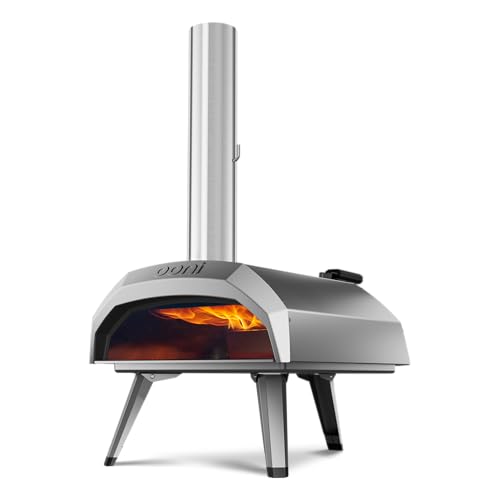
Ooni Karu 12 Multi-Fuel Outdoor Pizza Oven
Key specs: 12-inch pizzas; maker-rated up to 950 degrees F; ready in about 15 minutes; about 26.5 pounds; folding legs; cordierite stone included; gas burner sold separately.
Who it suits: Cooks who want the real live-fire ritual — the smell of wood smoke, the rolling flame across the oven roof, the slight char that only a wood fire gives — without giving up the option of gas later. The Karu 12 burns wood and charcoal in a deep fuel tray with strong airflow, folds flat enough to live in a garage corner or a car trunk, and carries the build quality and support network of the category’s biggest specialist brand. If your pizza nights are events rather than chores, this is the oven that makes them feel like events.
- Burns wood or charcoal out of the box, with an optional propane burner available when you want it
- Maker-rated to very high heat with a fast preheat, so back-to-back pizzas stay practical
- Folding legs and a removable chimney make it genuinely portable at under 30 pounds
- Thick cordierite stone included, with a large accessory and recipe ecosystem behind it
Honest limitation: The gas burner is a separate purchase, so the true cost of a dual-fuel setup is higher than the oven alone — budget for it honestly if gas is your plan. Wood and charcoal cooking also means real fire management: you will feed the tray, watch the flame and turn pizzas by feel for the first several cooks.
Choose it if live-fire flavor is the point and you want one oven that can grow from wood to gas. Skip it if you know you will only ever cook on gas — the Koda below does that job with less to buy and less to tend.
Ooni Koda 12 Gas Pizza Oven
Key specs: 12-inch pizzas; maker-rated up to 950 degrees F; ready in about 15 to 20 minutes; about 20.4 pounds; instant ignition; folding legs; connects to a standard propane tank.
Who it suits: Anyone whose pizza night has to fit between work and bedtime. The Koda 12 is propane-only and proud of it: unfold the legs, connect the tank, turn the dial, and the oven climbs toward pizza temperature while you stretch the dough. There is no ash, no fuel tray, no flame to feed — just a wide, controllable gas flame rolling over the stone. It is also the lightest serious oven in this guide, which makes it the easiest to carry to a friend’s yard, a campsite with a proper outdoor setup, or simply back into storage after every use.
- Instant ignition and a single control dial — the simplest operation in this guide
- Lightest pick here, with folding legs and a compact, hose-connected design
- Maker-rated to full Neapolitan heat with a preheat that fits a weeknight schedule
- No ash or fuel cleanup; wipe the stone area and close the lid
Honest limitation: It sits in this guide on a sale sighting — its everyday price is above the $300 line, so check the current listing carefully and be ready to wait for a promotion if it has moved. Gas-only also means no wood smoke in the crust, ever; the flavor is clean and excellent, but it is a different pizza from a wood-fired one.
Choose it if convenience decides whether pizza night happens at all. Skip it if your heart is set on wood-fired flavor, or if the listing is sitting at its full everyday price when you shop — at that point the Karu is the better value in this guide.
BIG HORN OUTDOORS 12-Inch Wood Pellet Pizza Oven (SRPG18003)
Key specs: 12-inch pizzas on a 12 by 12 inch stone; maker-rated very high maximum heat; ready in about 18 to 20 minutes; about 25 pounds; stainless steel body; folding legs.
Who it suits: Budget-first buyers who still want real wood-fired flavor. The BIG HORN burns hardwood pellets — cheap, widely available, easy to store in a sealed tub — in a compact stainless body that costs a fraction of the big-brand ovens while covering the same 12-inch pizza size. It is the oven we would hand to a first-time buyer who is curious about live-fire pizza but not ready to commit serious money, and to campers and tailgaters who want a self-contained fire oven that packs down small. Optional gas and electric burner attachments exist for it, which gives a cheap oven an unusual upgrade path.
- Lowest verified price in this guide by a wide margin — check price on Amazon
- Pellet fuel is inexpensive, clean to handle and easy to store between cooks
- Compact stainless body with folding legs suits camping and small storage spaces
- Optional burner attachments let it grow beyond pellets later
Honest limitation: The maker’s maximum-temperature rating is far above what most owners will measure on the stone, so treat the headline number as a ceiling claim rather than a promise, and give the oven its full preheat. Pellet fires also need hopper attention on long sessions, and the fit and finish, while honest for the price, is a step below the Ooni ovens here.
Choose it if you want wood-fired pizza at the lowest real entry cost in this guide. Skip it if you plan to cook many pizzas back-to-back for a crowd — its small firebox and recovery pace will make you the bottleneck.
PIZZELLO 12-Inch 2-Layer Wood-Fired Pizza Oven (UK50008)
Key specs: Two cooking levels with about 288 square inches of interior space; 12-inch stone; stainless peel, cooking grate and waterproof cover included; about 27 pounds; removable middle rack.
Who it suits: Hosts and families who measure pizza night in pizzas per hour. The PIZZELLO’s two-layer design puts a second cooking level inside the oven, so while one pizza bakes on the stone, another can cook — or garlic bread, wings or vegetables can roast — on the rack above. Just as unusually for this budget, the box is a starter kit rather than a bare oven: stone, stainless peel, cooking grate and a waterproof cover are included, which removes the accessory spending that quietly inflates the other picks. It burns wood, so it asks for fire-tending, but it gives back capacity nothing else here matches.
- Two cooking levels — roughly double the working space of a single-deck 12-inch oven
- Stone, peel, grate and cover included; very little left to buy before your first cook
- Removable middle rack converts it to a taller single chamber for roasts and pans
- Verified price sighting sits comfortably inside this budget — check price on Amazon
Honest limitation: Wood-only fuel means every cook is a small fire to build and feed, and the upper level cooks differently from the stone — expect a learning curve and some rotation between levels for even results. At about 27 pounds with a taller body, it is also the bulkiest oven here to store and carry.
Choose it if you regularly cook for a group and want capacity and a complete kit at a budget price. Skip it if you want dial-and-forget gas cooking, or your storage space is a small apartment closet.
Ooni Fyra 12 Wood Pellet Pizza Oven
Key specs: 12-inch pizzas; maker-rated up to 950 degrees F; ready in about 15 minutes; about 22 pounds; gravity-fed pellet hopper; powder-coated carbon steel shell.
Who it suits: Pellet loyalists who love the idea of a gravity-fed hopper: fill it, light it, and the Fyra feeds its own fire in a steady stream, delivering wood-fired heat with less tending than a wood tray and a shape that is the lightest in this entire guide. On specifications alone it would be an easy linked pick — fast preheat, full Neapolitan-rated heat, genuine portability. We include it because readers comparing pellet ovens will meet it in every search, and because owners who already have one can cook superb pizza on it.
- Gravity-fed pellet hopper keeps the fire fed with minimal attention
- The lightest oven in this guide — truly grab-and-go portable
- Maker-rated to full pizza heat with a fast preheat
- Simple, focused design with very little to assemble or adjust
Honest limitation: Availability is the problem, and it is decisive: the maker has wound down this model in the US market, current listings are inconsistent, and we could not verify a current Amazon offer inside this budget during our research — its list price also sat above the $300 line. That is exactly the situation our prose-only rule exists for.
Choose it if you find a verified new listing at a price you are comfortable with and pellet-only cooking is precisely what you want. Skip it if you are buying today at this budget — the BIG HORN gives you pellet-fired pizza now, with a live listing inside the tier.
Prose-only pick: there is no Amazon link for this oven in this guide — the review below explains why, and what to check if you shop for it elsewhere.
Gozney Roccbox Portable Pizza Oven
Key specs: 12-inch pizzas; maker-rated up to 950 degrees F; about 44 pounds; thick insulated body with a silicone jacket; detachable gas burner; professional peel included; underfloor thermometer.
Who it suits: Perfectionists who walk into this guide knowing the best-insulated portable oven in the class costs more than $300. The Roccbox wraps its stone floor in dense insulation and a safe-touch silicone jacket, arrives with its detachable gas burner and a professional peel in the box, and holds heat between pizzas better than anything else on this page — which is why restaurants and serious home cooks adopted it early. We review it here so you can see exactly what the extra money buys, and decide with open eyes whether to stretch or to stay in budget.
- Exceptional insulation: stone temperature recovers fast between back-to-back pizzas
- Gas burner and professional peel included — no accessory required to start
- Built-in underfloor thermometer takes the guesswork out of stone temperature
- Retractable legs, detachable burner and a carry strap for transport
Honest limitation: Price, plainly: its list price sits well above this guide’s budget and the Amazon sightings we verified during research were also above the line, so it earns no link here. It is also the heaviest oven on this page by a wide margin — portable in the sense that it can be moved, not in the sense that you will want to carry it far.
Choose it if you decide, after reading this guide, that insulation and recovery are worth leaving the budget for. Skip it if $300 is a real ceiling — the Karu and Koda above will make you very happy inside it.
Prose-only pick: there is no Amazon link for this oven in this guide — the review below explains why, and what to check if you shop for it elsewhere.
What $300 Buys in an Outdoor Pizza Oven — and What It Does Not
It helps to walk into this purchase knowing exactly where the money goes. At this budget, you are paying for a steel body, a cordierite stone, a burner or firebox and a set of folding legs — and from the verified brands, that combination is honestly built and genuinely capable of full pizza heat. What thins out as the price falls is everything around that core: insulation gets thinner, so the oven loses more heat to the evening air and recovers more slowly between pizzas; stones get thinner, so they hold less stored heat for the base of the third and fourth pizza; and the included extras shrink, which is why the accessory basket matters so much in the comparisons above. None of that prevents great pizza. It means your technique — full preheats, brief rests between pizzas, sheltering the oven from wind — carries more of the result than it would with a premium oven doing the work for you.
What $300 does not buy, from any brand we could verify, is a 16-inch cooking surface, a built-in stone thermometer on a linked pick, or insulation in the Roccbox’s class. It also does not buy freedom from the fuel decision: every oven here commits you to gas, pellets or fire, and the multi-fuel badges all come with an asterisk about a second burner sold separately. Knowing this in advance is what separates satisfied owners from disappointed ones. The buyers who love their under-$300 ovens are the ones who wanted a 12-inch, single-fuel-done-well oven and got exactly that. The buyers who regret it are the ones who secretly wanted the premium oven and hoped the budget one would impersonate it. This guide has tried to show you both honestly — the linked picks for what the budget does brilliantly, and the prose-only Roccbox for what waits above it.
Your First Cook: A Simple Plan That Works
Set the oven up in its permanent spot, on its proper surface, and run the first burn exactly as the manual describes — new stones and coatings benefit from a seasoning heat before food ever touches them, and you benefit from learning the controls with nothing at stake. While it heats, prepare more dough than you think you need; your first pizza is tuition, not dinner. Keep the first toppings light, because an overloaded pizza is the hardest pizza to launch and the slowest to cook, and dust the peel properly so the launch is a confident push-and-pull rather than a negotiation. Once the stone has had its full preheat, launch, close your mind to the urge to peek constantly, and start turning early — a quarter turn at a time, watching the edge nearest the flame. Pull the pizza when the base is spotted and the crust has color, then give the stone its short recovery while you top the next one. By the third pizza you will understand your oven’s hot spots, its pace and its personality, and by the fifth you will be cooking for an audience. That learning curve is not a defect of budget ovens; it is the craft itself, and it is most of the fun.
Comparison Table
| Product | Fuel | Best use | Link |
|---|---|---|---|
| Ooni Karu 12 Multi-Fuel Outdoor Pizza Oven | Wood and charcoal included; propane with an optional burner | Live-fire flavor with a gas upgrade path | Check on Amazon |
| Ooni Koda 12 Gas Pizza Oven | Propane only | Fast, simple gas pizza on weeknights | Check on Amazon |
| BIG HORN OUTDOORS 12-Inch Wood Pellet Pizza Oven (SRPG18003) | Hardwood pellets included; optional gas and electric burners sold separately | First pellet oven on a tight budget | Check on Amazon |
| PIZZELLO 12-Inch 2-Layer Wood-Fired Pizza Oven (UK50008) | Wood fired | Feeding a group, two levels at once | Check on Amazon |
| Ooni Fyra 12 Wood Pellet Pizza Oven | Hardwood pellets only | Pellet convenience — check availability carefully | Prose-only — no link (see review) |
| Gozney Roccbox Portable Pizza Oven | Propane included; optional wood burner sold separately | Maximum insulation if you stretch the budget | Prose-only — no link (see review) |
How to Choose an Outdoor Pizza Oven Under $300
Choose your fuel by your habits, not your fantasies. Be honest about a Tuesday evening. If pizza night must start at six and end by eight with minimal fuss, gas is your fuel — the Koda’s dial will make it happen weekly. If your pizza nights are Saturday rituals with a drink in hand and time to tend a fire, wood and charcoal will reward you every single time. Pellets suit the middle temperament: real flame, less feeding. The most common regret in this category is buying the romantic oven and living the busy life, so let your calendar vote first.
Count the true cost of the first cook. The oven’s price is not the setup’s price. A peel is essential, a turning peel quickly becomes essential, and an infrared thermometer removes the guesswork from stone temperature. Wood ovens may need fuel and firelighters; the Karu’s gas ambitions need a burner that is sold separately; the Roccbox includes its peel, and the PIZZELLO includes nearly everything. When you compare two ovens in this guide, compare the full first-month basket for each — the ranking can flip once accessories are honest.
Take stone temperature and recovery seriously. A pizza cooks from two directions: flame and hot air blister the top, while the stone crisps the base. A thin stone on a screaming-hot oven can still give you a pale base if the stone itself has not soaked up enough heat, and a small oven fired hard for one pizza may need a minute to recover before the next. Full preheats — not the moment the air feels hot, but the full time the maker recommends — and a minute of patience between pizzas are what separate leopard-spotted bases from limp ones. Insulation, the Roccbox’s whole argument, is really a recovery feature.
Measure your space and your storage before you fall in love. Every pick here cooks a 12-inch pizza, but their bodies differ: the PIZZELLO stands tall, the Roccbox is wide and heavy, the Koda and Fyra fold into genuinely small packages. Measure the table the oven will stand on, the shelf or corner it will live in, and the path between them. An oven that stores easily gets used; an oven that must be wrestled out of a crowded garage slowly becomes furniture.
Think about who is eating. One or two pizzas, eaten as they emerge, suits any oven here. A family of five or a standing crowd needs throughput: either the PIZZELLO’s second level, or a fast-recovery oven and a production line of stretched dough, with someone assigned to turning. Many hosts land on a rhythm — one pizza in the oven, one being topped, one being eaten — and any of the linked picks can sustain it once the team finds its pace.
Plan the safety setup as part of the purchase. A suitable stand, a heat-resistant surface, clearance from anything combustible, a home for the fuel and a plan for ash are not accessories; they are part of owning the oven. The safety section above is the checklist. If your only outdoor space cannot satisfy it — a small wooden balcony, for example — the honest answer is that this product category is not for that space, whatever the listings imply.
Common Buying Mistakes
Believing the headline temperature. A maker’s maximum rating describes a ceiling under ideal conditions, not your stone on a breezy evening. Buyers who chase the biggest number often end up with the thinnest insulation. Judge ovens by preheat discipline, stone quality and recovery — and use an infrared thermometer so you know your stone’s real temperature instead of guessing.
Forgetting the accessories budget. A bare oven plus no peel is a sculpture. The peel, turning peel, thermometer, cover and fuel that most setups need can quietly add a large fraction of the oven’s own price. Kits like the PIZZELLO’s, and included peels like the Roccbox’s, are worth real money in the comparison — price the whole basket, not the box.
Assuming multi-fuel means both burners are in the box. In this category it frequently means one burner is in the box and the other is a checkout away. The Karu cooks on wood and charcoal as shipped; its gas burner is separate. The BIG HORN cooks on pellets as shipped; its gas and electric options are separate. Read the box contents, not the badge.
Putting the oven on the wrong surface. A plastic folding table, a dry wooden deck without protection, or a spot under an overhang are the classic setups behind scorched furniture and worse. Heat-resistant, stable, level, clear of combustibles — every time, including the quick test cook you were not going to bother setting up properly for.
Buying for the crowd you host once a year. The twelve-person pizza party is real, but it is one evening. The oven you want is the one sized and fueled for your ordinary Friday — and if the big night matters, the PIZZELLO’s two levels handle it without forcing a bigger oven on the other fifty-one weeks.
Running Costs and Living With the Oven
Ownership costs in this category are refreshingly modest, but they are not zero, and they differ by fuel in ways worth knowing before you commit. A gas oven sips from a standard propane tank that also feeds many grills, and a tank lasts through many pizza nights; the ritual cost is remembering to keep a spare or a gauge so a Friday never dies mid-preheat. Pellets are the cheapest fuel per cook and store beautifully in a sealed container, but they must stay dry — a damp bag of pellets is a bag of frustration. Wood and charcoal cost the most attention rather than money: a supply of small, dry pieces sized for a compact firebox, somewhere sensible to keep them, and a metal ash can that lives outdoors. Across all fuels, the recurring purchases are the same short list: flour and ingredients you were buying anyway, a replacement stone only if one cracks from thermal shock or a drop, and the occasional cover when weather and sunlight finish the old one.
Day-to-day living matters just as much. These ovens cool with their stones inside, ask for a brush-out rather than a wash, and punish exactly one habit: putting them away hot or wet. Let the oven cool fully, brush the stone clean without soap or soaking, empty cold ash into its metal container, and store the oven dry — under its cover on the patio for the space-rich, or folded into a closet or garage for the space-poor. Do that and an under-$300 oven is a multi-year appliance. Skip it, and even the premium prose-only pick in this guide will age before its time. The owners who get a decade from this category are not the ones who bought the most expensive oven; they are the ones who built the small, boring routine around whichever oven they bought.
Final Recommendation
For most readers, the answer in this guide is the Ooni Karu 12. It is the most complete oven we could verify inside the budget: real wood and charcoal fire out of the box, a fast preheat, folding legs, a proper stone, and a gas burner waiting as an upgrade when — and only when — you decide you want it. It asks you to tend a fire, and in exchange it makes the best pizza in this guide and the most memorable evenings. If your life runs on weeknights, take the Ooni Koda 12 instead and do not apologize for it: gas convenience is what turns an oven into a habit, and its sale sightings put it inside this budget often enough to be worth watching. On a strict budget, the BIG HORN pellet oven is the honest entry point, and for hosts, the PIZZELLO’s two levels and full kit solve the throughput problem at a price that leaves room for ingredients. The Fyra and the Roccbox frame the edges of the decision — one fading from the market, one waiting above the budget — and both are worth understanding even though neither earns a link here. Whichever you choose, set it up safely, give it its full preheat, and turn the pizza early and often. The first great one changes what Friday night means.
Frequently Asked Questions
Can an outdoor pizza oven under $300 really cook Neapolitan-style pizza?
Yes, with the right expectations. True Neapolitan pizza needs a very hot stone and intense top heat, and the linked picks here are maker-rated to temperatures in that territory with preheats of roughly 15 to 30 minutes. What the budget does not buy is the insulation and recovery of premium ovens, so your pace between pizzas will be a little slower and windy evenings will test you more. The pizza itself — blistered, spotted, crisp-based — is genuinely achievable, and thousands of home cooks do it on ovens in exactly this class.
Gas, wood or pellets — which fuel should a beginner choose?
The fuel you will actually use. Gas is the most forgiving: light it, wait, cook, and the temperature holds itself. Pellets are the middle path, with real flame and a hopper doing part of the work. Wood and charcoal give the deepest flavor and the steepest learning curve, because you are the thermostat. A beginner who loves the ritual should start with wood and enjoy learning; a beginner who wants reliable results for Friday dinner should start with gas and never look back.
Do I need a 16-inch oven instead of a 12-inch?
For most households, no. A 12-inch pizza serves one hungry adult or two light eaters, and these ovens cook so fast that two 12-inch pizzas often beat one 16-inch pizza to the table. The 16-inch class also starts above this budget from verified brands. Choose 16 inches only if you regularly feed people who each expect a large pizza of their own, and expect to raise the budget to do it honestly.
What else do I need to buy with the oven?
At minimum: a launching peel, and very quickly a smaller turning peel and an infrared thermometer for the stone. Then fuel — a propane tank for gas ovens, pellets or wood for the fire ovens — plus a cover if the oven lives outdoors, and a heat-resistant stand or mat if your table needs one. The PIZZELLO includes most of its kit and the Roccbox includes its peel; the Ooni and BIG HORN setups should be budgeted with accessories included from the start.
How do I know when the stone is hot enough?
By measuring it, ideally — an inexpensive infrared thermometer pointed at the center of the stone removes all doubt, and it is the single most useful accessory in this category. Without one, use the maker’s full preheat time as your floor, not your target, and sacrifice a small test piece of dough if you are unsure: it should spring, spot and crisp quickly. Launching onto an underheated stone is the most common cause of the pale, floppy base that disappoints first-time owners.
How long do these ovens take to cool down, and how should I store one?
Longer than you expect — the stone holds heat well after the flame is out, which is exactly what it is designed to do. Plan on leaving the oven untouched in its cooking spot until it is fully cool to the touch, and never carry, cover or store a warm oven. Once cold, brush out the interior, deal with any ash as described in the safety section, and store the oven dry: under a cover in its outdoor spot, or folded away indoors if space demands it. The cool-down wait is not wasted time; it is when the meal gets eaten and the evening gets enjoyed, and building it into your routine is part of owning any high-heat oven safely.
Can I use one of these ovens on a balcony or covered patio?
Treat the answer as no unless your specific situation clearly allows it. These are outdoor appliances that produce open flame or intense heat and carbon monoxide; they do not belong under roofs, in garages or in enclosed spaces, and many apartment buildings and local fire codes prohibit fuel-fired cooking devices on balconies entirely. If you rent, your lease and building rules decide before any product manual does. The apartment-focused guide in this series covers that situation in full, including the questions to ask your landlord and fire code first.


