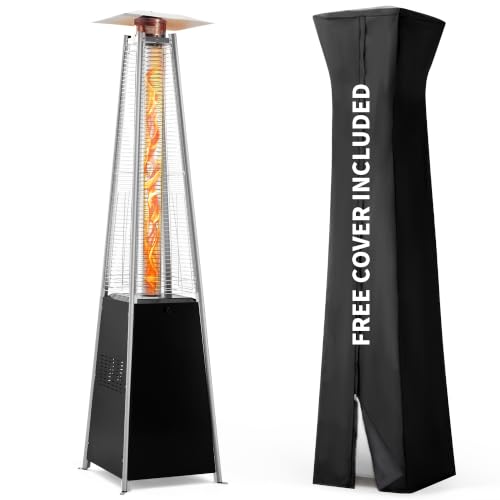
Where to buy
Check the latest price, availability and delivery on Amazon. Orders are placed on Amazon. We may earn a commission from qualifying purchases.
- Best for entertaining: Pamapic 89-Inch Pyramid Patio Heater, 48,000 BTU Quartz Glass Tube, with Wheels and Cover — Check on Amazon
- EAST OAK 50,000 BTU Patio Heater with Round Table Design, Bronze — Check on Amazon
- Amazon Basics 46,000 BTU Outdoor Propane Patio Heater with Wheels, Slate Gray — Check on Amazon
- Dr Infrared Heater DR-238 Carbon Infrared Patio Heater, 1500W, Wall or Ceiling Mount — Check on Amazon
See 2 more options reviewed in full below
- Hiland HLDS01-SSHST 48,000 BTU Propane Patio Heater with Wheels and Adjustable Table — reviewed below as a prose-only pick (see the sources note for why there is no link)
- Fire Sense Pyramid Flame Patio Heater, 40,000 BTU, Stainless Steel — reviewed below as a prose-only pick (see the sources note for why there is no link)
Read the full guide ↓
Disclosure: As an Amazon Associate, dailyhomedecorating.com earns from qualifying purchases. Links to Amazon on this page are affiliate links; they cost you nothing extra. Listing details such as price and availability change often, so check the current Amazon listing before you buy.
The best outdoor heater for outdoor entertaining under $500 is not simply the strongest heater — it is the heater that understands the evening. Entertaining heat has a social job: it decides where guests gather, how long they stay, and whether the party migrates indoors at nine or is still going at midnight. A heater that anchors a circle, gives standing guests a warm home base with somewhere to set a glass, and keeps the dining table inside the comfort zone without roasting the person seated nearest the pole — that is an entertaining heater. Raw output matters, but it ranks behind placement, heat pattern and the small hosting features — a table ring, a visible flame, silent operation where conversation happens — that separate a warm party from a party that happens to have a heater in it.
This guide applies that lens to the verified heaters from our main outdoor heater research. The pyramid comes first here, and it is not close: a real flame rising in a glass tube is the only heater that guests photograph, gather around unprompted, and remember — it does the campfire’s social work with propane’s manners. The strongest tower follows for hosts whose parties are big enough to need a true anchor zone, with a table built into its base for the drinks that otherwise end up on the ground. The value tower earns its place as the second station — at this tier’s prices, a $500 ceiling honestly covers a main anchor and a satellite heater for the dining table or the far seating group. The wall-mounted infrared bar covers the quiet zone: the covered porch where conversation happens, where a flame cannot go and where silent, windproof warmth keeps two or three people lingering after the main party thins. And because entertaining means guests — including other people’s children, guests in long coats, guests who have never read your heater’s manual — the safety section is written for hosting reality, not for a careful owner alone with the instructions.
A note on budget, because this tier invites overspending: the verified heaters in this guide cluster in the lower half of the $500 ceiling, and that is good news for hosts. The money the anchor heater does not consume is the money that makes the evening work — the second tank so the heat never dies mid-party, the cover that keeps the heater presentable, the second station for the far zone. Spend on the system, not on the single most expensive listing. The reviews below are ordered for hosts: centerpiece first, workhorses next, quiet zone last, with the two prose-only picks — verified as products, not linkable on the evidence we could gather — placed where their hosting virtues belong.
In this guide
Quick Picks: The Best Outdoor Heater for Outdoor Entertaining Under $500, by Hosting Style
Start from the party you actually throw. Each row names the hosting style and the heater that serves it.
| Hosting style | Pick | Why it fits | Link |
|---|---|---|---|
| The gathering-point party | Pamapic 89-Inch Pyramid Patio Heater, 48,000 BTU | A visible flame guests orbit; torso-height warmth in every direction; cover included for a presentable setup | Check on Amazon |
| The big anchor zone | EAST OAK 50,000 BTU Patio Heater, Bronze | The strongest verified tower; ballast for breezy evenings; a table on the base for drinks and phones | Check on Amazon |
| Two stations instead of one | Amazon Basics 46,000 BTU Outdoor Propane Patio Heater, Slate Gray | The value tower: priced so a second warm zone fits the same ceiling | Check on Amazon |
| The quiet conversation zone | Dr Infrared Heater DR-238 Carbon Infrared Patio Heater | Silent, flameless beam heat for the covered porch; remote control from the host’s chair | Check on Amazon |
| Standing drinks receptions | Hiland HLDS01-SSHST 48,000 BTU Patio Heater with Adjustable Table | The adjustable table ring is a standing party’s home base | Prose-only pick — see review |
| The designed garden party | Fire Sense Pyramid Flame Patio Heater, Stainless Steel | Full stainless flame pyramid that reads as part of the garden | Prose-only pick — see review |
How the picks were chosen
The verification base is our main guide’s: every linked pick has an Amazon listing confirmed through independent sources, with a price sighted inside this budget during research; the Hiland and Fire Sense appear in prose without links because we could verify the products but not a current in-tier Amazon price or ASIN respectively, with the details in the sources note. We checked the category against the CPSC recall record and excluded recalled brands entirely. The entertaining filter then re-ranked the six on hosting criteria: gathering power — does the heater create a place, or merely a temperature; heat pattern for mixed groups — seated circles, standing clusters, a dining table’s long rectangle; hosting hardware — tables, remotes, wheels for repositioning between the afternoon setup and the evening’s reality; guest-proofing — tip-over and flame-failure protection, stable ballast, surfaces and clearances that survive guests who do not know the rules; and presentability — finishes and covers that keep the equipment looking like part of the occasion. The pyramid wins the first criterion outright, which is why it leads a guide for hosts even though two towers out-rate it on paper.
The six heaters, reviewed for hosts
1. Pamapic 89-Inch Pyramid Patio Heater — the centerpiece
Who it suits. Hosts whose parties gather: the pyramid is for the evening that forms a circle and stays in it, where the heater is not background equipment but the reason the group is standing where it is standing.
The Pamapic raises a real flame inside a quartz glass tube at the center of an 89-inch pyramid, rated at 48,000 BTU in its manual, and the social physics are immediate: guests drift toward it the way they drift toward a fire, drinks in hand, and the circle self-organizes. Heat radiates along the tube in every direction, so the warmth arrives at torso height evenly around the circle — no hot pole-side and cold far-side, which is the tower pattern a host learns to apologize for. Its safety specification is the most complete we verified: gas shut-off if the unit tilts beyond 45 degrees, flameout protection, overheat protection — the guest-proofing a host should insist on, since guests lean, bump and set bags down in places owners never would. The fitted cover is included, which matters for entertaining more than for any other use: the heater that lives outdoors stays presentable for the next occasion instead of arriving at it weather-stained. At roughly 62 pounds on wheels and a 23-inch-square footprint, it repositions between setup and sunset willingly on hard surfaces.
Pros. The only pick that creates a gathering point by itself; even, torso-height radiation around the full circle; the strongest published safety package in the guide; cover included; strong output for its class.
Honest limitation. The quartz tube is fragile to impact, and a party is an impact-rich environment — position the pyramid where the games, the dancing and the enthusiastic dog are not, and brief no one; just site it wisely. It also needs its full overhead clearance and a level hard surface, and its comfort circle is a touch tighter than the big towers’.
Choose it if your entertaining style is the gathered circle and your space gives it a level, open-topped stage. Skip it if your parties are large and spread across zones — you need an anchor tower and a satellite, below — or if the only available spot sits in the traffic path between house and garden. Check on Amazon.
2. EAST OAK 50,000 BTU Patio Heater with Round Table — the anchor
Who it suits. Hosts of larger gatherings whose main zone must simply work: maximum verified warmth, stability in a breeze, and a table surface exactly where the standing guests are.
The EAST OAK is the strongest residential tower we verified — a 50,000 BTU maximum through a double-layer stainless burner — and entertaining exposes exactly the virtues that put it here. Its conical base takes a sand box and a fillable water tank, so the ballast that keeps a tall tower composed when the evening breeze rises (and when a guest steadies themselves on it) is built in rather than improvised. The triple protection system covers tip-over and flame failure. And the round stainless table on the tank housing is a hosting feature disguised as a design detail: standing guests orbit a warm tower and set glasses down on the nearest flat surface; giving them the table means the glasses are not on the ground, the heater’s base or your outdoor furniture’s arms. The maker claims heat spread up to a 20-foot diameter; plan the party’s core inside the comfortable inner zone and let the claim describe the warmth’s edge, not its heart.
Pros. Most output in the guide for the biggest zones; ballast built for breezy, busy evenings; the table serves the standing crowd; full protection system; wheels for the pre-party reposition.
Honest limitation. A tower’s heat pattern is a dome, not a circle of equals: the seats nearest the pole are warmest, and a host rotates guests or accepts the gradient. On a genuinely windy evening the comfort zone leans downwind — site the tower upwind of the main seating and let the heat come to the party.
Choose it if headcount and zone size are your constraints. Skip it if your parties are intimate circles where the pyramid’s flame is the better host, or your space is covered and low, where the infrared bar takes over. Check on Amazon.
3. Amazon Basics 46,000 BTU Outdoor Propane Patio Heater — the second station
Who it suits. Hosts whose space has two natural stations — drinks by the house, dinner at the far table — and who have learned that one warm zone means the other zone empties by nine.
The Amazon Basics tower is the proven formula at the value end: 46,000 BTU, adjustable knob, one-touch ignition, a published heat radius of up to nine feet, water-box ballast, a tank-securing chain and wheels, in a quiet slate gray. In an entertaining budget its price is a strategy: it is the pick that lets a $500 ceiling buy coverage instead of prestige — this tower at the dining end, the pyramid or EAST OAK anchoring the gathering end, each zone holding its guests because neither asks them to choose between company and warmth. As a sole heater it remains entirely respectable for a single-zone party. The ownership notes are the familiar ones: budget the cover, expect the piezo igniter to be the first service item after some seasons, and allow assembly time for the protective-film peeling owners always mention.
Pros. The price that turns one zone into two inside a single budget; published radius for honest station planning; simple ignition a host can delegate; quiet finish that does not compete with the occasion.
Honest limitation. Powder coat rather than stainless, and a step less output than the EAST OAK — as a sole anchor for a big, cold, exposed main zone, the premium pick earns its place. As a satellite, neither point matters much.
Choose it if you are covering a second station or hosting single-zone parties on a disciplined budget. Skip it if one exposed main zone in a cold climate is the whole brief. Check on Amazon.
4. Hiland HLDS01-SSHST 48,000 BTU Patio Heater with Adjustable Table — prose-only pick
Who it suits. Hosts of standing receptions: wine in hand, plates circulating, nobody seated for long. The Hiland’s adjustable table ring is the piece of furniture those evenings revolve around.
From the long-running HLDS01 line sold by AZ Patio Heaters, the SSHST pairs a 48,000 BTU listing rating and variable control with thermocouple and anti-tilt safety devices, wheels, a burner cover and regulator — and the table ring that adjusts in height around the pole. Set it at standing height in the middle of the reception zone and the heater becomes the bar’s annex: warm, lit, with a surface for every glass. The line’s deep parts channel suits a heater that will serve many seasons of occasions. It is prose-only because we verified the listing and specifications but could not capture a current Amazon price inside this budget during research — only older retail references — so check the live listing as your final step before building a party budget around it.
Pros. The table format perfected for standing gatherings; stainless in the weather-exposed parts; parts support measured in decades of model history; full safety baseline.
Honest limitation. The price-verification caveat above; and a table ring invites guests to cluster close, so the host owns the clearance discipline — no coats over the pole, no bags against the base, no exceptions for charm.
Choose it if standing format is your party’s shape and you will verify the live price. Skip it if you want the table idea in a fully verified listing — the EAST OAK.
5. Fire Sense Pyramid Flame Patio Heater, Stainless Steel — prose-only pick
Who it suits. Hosts whose garden is part of the entertainment: the stainless pyramid lit at the path’s end makes the outdoor room feel designed, and its flame gives the evening a second focal point away from the table.
Fire Sense’s pyramid — 40,000 BTU, stainless burners and heating grid in a full stainless frame, wheels, tip-over switch — is the specialist maker’s version of the form, and we verified its specifications and a retail price inside this budget at a national chain during research. It appears in prose because we could not verify a current Amazon ASIN for the exact model from accessible sources; this guide does not link on a guess. Against the Pamapic it trades a little output and the included cover for full stainless permanence and the maker’s deep parts catalog — the right trade for a host who sets the scene once and keeps it for years.
Pros. Full stainless build that stays presentable outdoors; specialist maker; the flame as garden architecture.
Honest limitation. No verified Amazon listing; gentlest output of the full-size picks; the glass tube wants a site protected from party traffic and games.
Choose it if permanence and design lead and retail buying suits you. Skip it if you want the pyramid fully verified with a cover in the box — the Pamapic, pick one.
6. Dr Infrared Heater DR-238 Carbon Infrared Patio Heater — the quiet zone
Who it suits. Hosts with a covered porch, pergola corner or deck roof where the evening’s second act happens — the two or three people still talking after the main party thins, in the place a flame cannot go.
The DR-238 is a 1,500-watt carbon infrared bar (with 900 and 1,200 watt settings) that mounts on a wall or ceiling, plugs into a standard outlet, and answers to a remote. For entertaining, its virtues are the ones the propane picks cannot offer: it is silent, so conversation stays at conversation level; it is flameless and exhaust-free, so it belongs under the roof where the quiet zone lives; its beam crosses a breeze untouched, warming the people on the porch swing directly; and the host runs it from a chair, remote in hand, without leaving the conversation to fuss with a valve. It also solves the end-of-evening problem — the main heaters go off with the party, and the porch stays warm for the stayers at the cost of a trickle of electricity.
Pros. Silent and flameless; the only pick for covered spaces; wind-immune beam; remote and timer; negligible running cost for the hours it actually serves.
Honest limitation. It warms a small group in its beam, not a zone — it is a porch-swing heater, not a party heater, and it draws close to a standard circuit’s capacity at full power. Its listing’s weather rating appears in two forms (IP55 in bullets, a lower splash rating in the detail modules), so keep it under cover as intended.
Choose it if your entertaining has a covered quiet zone worth keeping alive. Skip it if all your hosting happens in the open — the flame and the towers are your hosts there. Check on Amazon.
Comparison table
| Pick | Type | Output | Hosting strength | Watch out for |
|---|---|---|---|---|
| Pamapic 89-Inch Pyramid | Propane glass-tube pyramid | 48,000 BTU | Creates the gathering point; even torso-height warmth | Glass tube and party traffic need thoughtful siting |
| EAST OAK 50,000 BTU with Table | Propane mushroom tower | 50,000 BTU | Biggest anchor zone; drinks table on the base | Heat gradient around the pole; wind leans the zone |
| Amazon Basics 46,000 BTU | Propane mushroom tower | 46,000 BTU | Second station economics inside one budget | Powder coat; buy the cover |
| Hiland HLDS01-SSHST (prose-only) | Propane tower with table | 48,000 BTU (listing) | Standing-reception home base | Current Amazon price not verified in this research |
| Fire Sense Pyramid Flame (prose-only) | Propane glass-tube pyramid | 40,000 BTU | Permanent garden focal point | Amazon ASIN not verified; gentlest output here |
| Dr Infrared DR-238 | Electric carbon infrared bar | 900 / 1,200 / 1,500 W | Silent covered quiet zone; remote from your chair | Small group in the beam only |
Safety first: hosting with fire, fuel and guests
Entertaining multiplies the ordinary risks of patio heating by the number of guests who have never read the manual, so the host’s safety routine is part of the party plan. The foundations do not change: a propane heater is an outdoor appliance, never to be used in a garage, tent or enclosed porch, because it produces carbon monoxide — colorless, odorless and unforgiving; the CPSC record for this category includes tabletop propane heaters recalled for dangerous CO emissions, and a current recall covers certain natural-gas patio heaters sold online whose components could release gas, a brand that appears nowhere in this guide. Check any model you are considering, including ours, against the CPSC recall database by brand and model before the party, not after.
Clearances become crowd management. The manuals for these heaters typically require about three feet to the sides and two to three feet overhead, measured from the reflector or tube. At a party, that cylinder fills with exactly the wrong things: a coat draped over a chair back, a gift bag set down “for a second,” a guest who backs up mid-story toward the warmth. Site the heater where the clearance zone can stay genuinely empty — not in the path between house and garden, not beside the drinks table’s queue — fill the ballast the maker provides so a bumped tower stays a standing tower, and let the tip-over protection (the Pamapic cuts its gas at 45 degrees of tilt) remain the backup it is designed to be. Keep children in the supervised part of the evening and pets out of the clearance zone entirely; a glass tube at torso height and a running dog are a combination to design out at setup, not to manage at midnight. Fuel discipline is the host’s solo job: leak-test the tank connection with soapy water when you set up, keep the spare tank outdoors, upright and away from the gathering, close the valve when the heater goes off, and never refuel, move or adjust a lit or hot heater in front of an audience. The electric pick has its own shorter list — a GFCI outlet, no extension cord as a permanent installation, clearances from the element respected — and the same rule about never leaving it running for guests you are not with. Hosts who build this into setup discover it costs five minutes and buys the whole evening’s peace of mind.
How to choose for the parties you actually throw
Count zones, not guests. A party of twenty in one circle needs one anchor. A party of ten split between a dining table and a seating group needs two stations. Map where people will be at nine in the evening, and put the heat there — not where the afternoon barbecue happened.
Match the pattern to the furniture. A circle wants radiation in every direction — pyramid or tower at its center. A dining rectangle wants a tower at its midpoint or a station at each end. A covered porch wants the infrared beam. Buying the pattern that fits the furniture beats buying the biggest number on the box.
Plan the gradient. Every propane heater is warmest close in. Rotate the good seats socially, place the host’s working spot at the warm edge you will keep leaving, and site towers slightly upwind of the main seating so the comfort zone leans toward your guests.
Budget the evening, not the appliance. Inside $500, the entertaining allocation is: anchor heater, its cover, a second tank so the heat never dies at the party’s peak, and — at this tier’s verified prices — frequently the second station itself. The allocation that fails is one premium listing and an empty tank at ten o’clock.
Rehearse the logistics. Assemble and test-light the heater days before, not hours. Confirm the tank is full, the spare is on site, the wheels’ route from storage to stage is clear, and the remote for the quiet zone has batteries. Entertaining heaters fail socially long before they fail mechanically: they fail by being unready.
Common mistakes to avoid
One heater, two zones. The classic entertaining error. The far group drifts indoors by nine and the host blames the weather. Two modest stations hold a party; one hero heater holds a circle.
Siting the heater in the traffic path. Between the kitchen door and the garden is where clearance zones go to die. Stage the heater where guests gather, not where they pass.
Letting the tank run dry at the peak. A tower at full output empties a 20 lb tank in roughly eight to ten hours — one long party, or two ordinary ones. The spare tank is not an accessory; for a host it is the difference between a pause and an ending.
Draping and leaning. Coats over chair backs inside the clearance zone, guests leaning on the pole, bags against the base. Brief the space, not the guests: arrange furniture so the clear zone is obviously empty and stays that way.
Moving a hot heater mid-party. If the zone must move, the heater cools first. A lit or hot tower carried through a crowd is the single worst idea available at a garden party.
Forgetting the quiet zone. Parties end in layers. The covered corner with silent infrared warmth is where your favorite conversations will happen; equipping it costs the least in this guide and returns the most per hour.
The host’s timeline: setup to last guest
Days before. Assemble the heater now, not on party day — every tower and pyramid in this guide is an hour or two of bolts and panels, and assembly day is when you discover the missing washer while the seller can still help. Test-light it, run it for fifteen minutes, confirm the tip-over switch cuts the flame when the unit is tilted as the manual describes, and learn the control’s feel. Check the tank by weight, order the spare, and walk the wheels’ route from storage to stage: gates, thresholds, the lawn crossing you will not attempt with a lit or hot heater.
The afternoon of. Site the heater before the furniture, not after: clearance cylinder first, chairs arranged in the warmth ring second, traffic paths routed outside the zone third. Fill the ballast if the weekend’s forecast has any breeze in it. Set the pyramid or tower slightly upwind of the main seating. Put the quiet-zone infrared bar on its timer’s schedule in your head — it goes on when the party moves to the porch, not before. Do the fuel tasks now, solo: leak-test the connection with soapy water, stage the spare tank outdoors in its lawful spot, close nothing yet.
During the party. Light the anchor thirty minutes before guests arrive so the zone is warm when the first circle forms — a heater lit in front of arriving guests reads as equipment; a warm zone reads as hospitality. Run at the output the evening needs rather than the maximum the dial offers; most gatherings settle at partial output once bodies and blankets join the physics. The host owns the clearance zone all evening: coats get a designated chair away from the heater, bags land on the bench you placed for them, and the one guest who backs toward the warmth mid-story gets a friendly redirect and a better spot in the ring.
The last hour. This is where the system earns its design. The main heater goes off when the party thins — valve closed, by the host, not delegated — and the gathering’s remnant migrates to the covered quiet zone, where the infrared bar has been waiting at the press of a remote. The pyramid’s glass and the towers’ reflectors cool untouched; covers go on tomorrow, cold and dry, never tonight onto warm metal. The spare tank means none of this was rationed. Guests remember two things about outdoor evenings: whether they were warm, and whether the end felt abrupt. A staged system like this one is how the answers come out right.
Pairing heat with light, seating and service
A heater does not entertain alone, and the hosts whose evenings work treat warmth as one layer of a small system. Light is the second layer: the pyramid’s flame is itself a light source, which is part of its gathering power, while tower zones want low, warm lighting at seating height so faces stay lit and the heater’s glow is not asked to do a job it cannot. Keep cords and string-light runs outside the clearance cylinder and never draped where heat rises. Seating is the third layer: arrange the ring so every seat is inside the comfort radius and no seat is inside the clearance zone — a narrower ring of well-placed chairs beats a wide ring of hopeful ones, and a bench on the ring’s cold side is a bench guests will abandon. Service is the fourth: drinks and food stations belong at the warm zone’s edge, close enough that guests stay in the warmth’s social field, far enough that queues and reaching arms stay out of the clearance cylinder — the EAST OAK’s and Hiland’s table rings exist because this is where glasses naturally land. Get the four layers agreeing and the heater disappears into the evening, which is the highest compliment entertaining equipment can earn.
Matching the heater to the menu: dinner, drinks and the long evening
Different parties tax a heater differently, and hosts who entertain often will recognize their format here. The seated dinner is the most demanding format thermally: guests sit still for two hours, stillness makes people cold, and the table’s rectangle fits no heater’s circle. The working solutions are a tower at the table’s midpoint with the near seats rotated at the course change, or — better — the pyramid at the table’s end, radiating along its length at torso height while its flame gives the table a hearth. Either way, light the heater before the first course, not when someone first shivers; a dinner party’s warmth must be ambient by the time the food lands. The standing reception is the easiest format: guests circulate, circulation generates warmth, and the heater’s job reduces to being a home base — which is why the table-ring Hiland and the table-topped EAST OAK exist, and why a single anchor serves a headcount that would chill a seated format.
The long, unstructured evening — friends, no schedule, the party that ends when it ends — is where the two-station system proves itself. Early hours belong to the anchor zone and its flame or tower; late hours contract to the covered quiet zone and the infrared bar, and the host who planned the contraction never has to announce it. One more format deserves a sentence: the shoulder-season afternoon, where the heater’s job is not warmth but permission — ten minutes of tower heat at the garden party’s start tells guests the outdoors is open for the day, and the heater can idle at its lowest setting thereafter as a standing invitation. Output, in that format, is nearly irrelevant; presence is everything, and it is the cheapest entertainment upgrade in this guide.
Final recommendation
For most hosts, buy the Pamapic pyramid and let the flame host with you — no other pick creates the gathering it warms. If your parties are big, anchor with the EAST OAK and spend the ceiling’s remainder on the Amazon Basics as a second station and the spare tank that keeps both alive. Add the DR-238 over the porch seats when the budget allows, and your entertaining is covered at every scale this side of a wedding — comfortably inside $500, with the safety routine built into setup.
Frequently asked questions
How many heaters do I need for a backyard party? One per zone where guests will spend real time. A single gathered circle needs one anchor; a party split between dining and seating areas needs two stations. Headcount matters less than geography — twenty people in one circle are one heater’s job.
Which heater do guests actually gather around? The pyramid flame, by a wide margin. A visible flame in a glass tube does the campfire’s social work — people orbit it, face inward and stay — while radiating real warmth at torso height around the full circle. Towers warm a zone; the pyramid creates a place.
Can I put a patio heater under a pergola or party tent? Only with the full clearances the manual specifies — typically about three feet to the sides and two to three feet above the reflector or tube — genuine open-air ventilation, and nothing combustible inside that cylinder. Party tents and enclosed canopies are exactly the semi-enclosed spaces where carbon monoxide and clearance rules bite; when the geometry does not honestly fit, use the electric infrared pick for that spot or move the heater into the open.
How do I keep guests safe around a patio heater? Site it out of traffic paths with its clearance zone kept visibly empty, fill the ballast, choose models with tip-over and flame-failure shut-offs, keep children supervised and pets out of the zone, and handle all fuel tasks yourself, before or after the party — never on a lit heater in front of a crowd.
Will one tank last a whole party? At full output a 20 lb tank runs a tower in this class roughly eight to ten hours; most hosts drop to partial output once the zone is warm, stretching it further. For a long event, a full spare tank on site is the professional move — swapping takes two minutes between courses, running dry ends the evening’s outdoor chapter.
Is the electric heater worth it if I already have propane? For the covered quiet zone, yes — it does the one job propane must not do, under a roof, silently, at the press of a remote. Entertaining systems in this guide are combinations, and the infrared bar is the piece that completes them.
How far in advance should I set up for a party? Assemble and test the heater days ahead; site and light it on the day, about thirty minutes before guests arrive. The thirty minutes is not superstition — a tower or pyramid takes a few minutes to reach its steady pattern, the zone’s furniture and guests’ expectations settle around a warmth that already exists, and any surprise (a low tank, a tired igniter battery) surfaces while it is still a private problem with a private solution, not a performance in front of an audience.
What do I do with the heater between parties? Cover it where it stands if the site is its home, or wheel it — cold, valve closed — to its storage spot along the route you rehearsed. Wipe the reflector or tube when it is cool, check the tank’s remaining weight by lifting rather than guessing, and leave the spare tank staged lawfully for the next event. Hosts who keep this five-minute ritual find the heater reads as part of the garden’s furniture; hosts who skip it find, by the third season, that they own garden equipment instead — the difference is entirely the ritual, not the product.
What if rain or a cold snap threatens the party? Move the format, not the flame. A propane heater never migrates under a tent, canopy or roofline to escape weather — that is precisely the semi-enclosed geometry its clearances and its carbon monoxide profile forbid. The host’s real options are the covered zone you already own (where the infrared bar was installed for exactly this evening), a smaller party compressed into the anchor’s circle in the open while the shower passes, or the graceful retreat indoors with the outdoor system shut down properly — valve closed, by the host, before the first tray is carried in. Parties survive weather; they do not survive improvisation with combustion.
How do I keep the heater looking party-ready? The cover is the whole secret, plus a two-minute wipe of the reflector or tube when cool and a seasonal check of the hose and burner for nests and cracks. Stainless finishes forgive the most; powder coats ask for chips to be touched up before the wet season finds them. A heater that lives covered and wiped arrives at each party looking like furniture; one that lives exposed arrives looking like a chore — and guests can tell the difference before they feel the warmth.
Should I buy the heater or rent for a one-off event? For a single large event — a wedding reception at home, a milestone birthday — rental yards supply commercial towers by the day, and renting the extra units while owning one anchor is the professional pattern: your own heater covers the core zone every week of the year, and the rentals stretch coverage for the one night the headcount doubles. Buying a second tower for a single evening strands capital and storage for a decade; buying none and renting none leaves the far zone cold. Own the anchor, rent the exception.
Related guides
Start from the full research in the Best Outdoor Heater Under $500, compare the same hosts’ picks at the Best Outdoor Heater For Outdoor Entertaining Under $300, and round out the party with the Best Fire Pit For Outdoor Entertaining Under $500, the Best Patio Dining Set Under $500 and the Best Outdoor String Lights Under $75 for the light above the warmth.


