Where to buy
Check the latest price, availability and delivery on Amazon. Orders are placed on Amazon. We may earn a commission from qualifying purchases.
- Best overall for backyards: RTIC 52 Quart Ultra-Light Wheeled Cooler — Check on Amazon
- Best value backyard station: Lifetime 55 Quart High Performance Cooler (90820) — Check on Amazon
- Best rotomolded workhorse: RTIC 45 QT Ultra-Tough Cooler — Check on Amazon
- Best for big backyard crowds: Coleman Classic Series 65-Quart Wheeled Cooler — Check on Amazon
- Best second cooler for drinks: YETI Roadie 24 Hard Cooler — Check on Amazon
One further pick, the Pelican 50QT Elite, is reviewed in prose below: its pricing straddles this guide’s ceiling, so it is not linked as an under-$300 buy. Read the full guide ↓
Disclosure: As an Amazon Associate, dailyhomedecorating.com earns from qualifying purchases. Links to Amazon on this page are affiliate links; they cost you nothing extra. Listing details such as price and availability change often, so check the current Amazon listing before you buy.
The best outdoor cooler for backyards under $300 is not a camping cooler that happens to be in a yard — it is a piece of backyard infrastructure, and it should be shopped like one. A backyard cooler lives outdoors or near it: it rolls from the garage to the patio, parks beside the grill for the season, gets opened fifty times a cookout by guests with plates in their hands, gets hosed down rather than hand-washed, and sits in sun that a campsite cooler, tucked under trees, never faces. Its enemies are not bears. They are ultraviolet light, afternoon heat radiating off pavers, muddy wheels, kids using the lid as a diving platform into the evening, and the slow creep of a gasket left compressed and dirty from June to September.
That job description rearranges the usual rankings. Wheels stop being a luxury and become the difference between a cooler stationed where the party is and a cooler abandoned where the car was unloaded. A lid strong enough to be a bench matters, because in a backyard every flat surface is seating. A drain you can aim at a garden bed matters. And capacity planning changes: the backyard is where the two-cooler system — one big tub for drinks, one sealed box for food — turns a good host into a calm one. This guide’s six picks cover that system end to end: RTIC’s wheeled Ultra-Light 52 as the all-round backyard station, Lifetime’s 55 as the value anchor, RTIC’s rotomolded Ultra-Tough 45 as the workhorse, Coleman’s wheeled 65 as the crowd tub, YETI’s Roadie 24 as the premium drinks cooler, and Pelican’s 50QT Elite in prose as the lifetime-warranty tank whose price straddles the line. Smaller budgets are covered honestly in Best Outdoor Cooler For Backyards Under $150; this tier is for yards that host often and host well.
In this guide
Quick Picks
Short on time, or comparing several options at once? Each row below names a backyard job and the cooler that suits it, with a link to the listing.
| Backyard job | Pick | Why it stands out | Link |
|---|---|---|---|
| Best overall | RTIC 52 Quart Ultra-Light Wheeled Cooler | 52 quarts that roll over grass in a shell about 30% lighter than rotomolded | Check on Amazon |
| Best value station | Lifetime 55 Quart High Performance Cooler | Multi-day ice claims and a bear-certified build at the lowest tier here — check price on Amazon | Check on Amazon |
| Best rotomolded workhorse | RTIC 45 QT Ultra-Tough Cooler | One-piece rotomolded shell, freezer gasket, seat-strength lid | Check on Amazon |
| Best for big crowds | Coleman Classic Series 65-Quart Wheeled Cooler | The biggest tub in the guide, on wheels, with lid cup holders — at a budget tier | Check on Amazon |
| Best drinks cooler | YETI Roadie 24 Hard Cooler | Tall rotomolded drinks box — wine bottles upright, one-handed latch | Check on Amazon |
| Tank with lifetime warranty (prose only) | Pelican 50QT Elite | Press-and-pull latches and a lifetime warranty — priced across this ceiling, so no link | See review below |
How These Picks Were Chosen
Backyard fitness came first. We weighted: wheels and handles that work on grass and pavers, not just showroom floors; lids rated to sit and stand on, because backyard coolers are furniture; drains that empty a full melt without tipping a heavy box; and shells and hardware that tolerate sun, hose-downs and a season of guest abuse. Ice retention still mattered — a backyard cooler in July sun works harder than a camping cooler in forest shade — but we weighted verifiable construction (shell type, gasket, latch design) above headline ice claims, which are maker numbers earned in pre-chilled, unopened, laboratory manners.
The budget rule was applied strictly: a pick is linked only if its Amazon listing has recent sightings at or under $300, cross-checked against a price-history tracker, the maker’s store or a second retailer during research in November 2026. The Pelican 50QT Elite fails that test by straddling — its list price has sat at the ceiling while maker and retailer pricing runs above it — so it is reviewed in prose, unlinked, with the reasoning stated in its review. No fixed price is printed for any cooler in this guide, because this category’s prices move weekly; check price on Amazon before judging any pick. Safety was checked the same way: we searched CPSC recall records for coolers before finalizing the list. A major 90-quart rolling-cooler line from a big brand was recalled in 2025 over a tow-handle pinch hazard; nothing from that line appears in this guide, it is not named in these reviews, and no pick here had a CPSC recall we could find as of writing. We did not buy or test these coolers ourselves — these reviews synthesize manufacturer specifications, retailer listings and independent review coverage, and maker claims are labeled as such wherever they appear.
Finally, a note on system thinking, because backyards reward it. Almost every experienced host ends with two coolers: a big drinks tub that guests churn, and a smaller sealed box for food that opens six times a day instead of sixty. This list is built to be bought that way — any big pick plus the Roadie — and the how-to-choose section below plans the pairing. The rest of the backyard system lives in the neighboring guides: Best Adirondack Chair For Backyards Under $300 for the seats around the cooler, Best Outdoor String Lights For Backyards Under $300 for the hours after sunset, and Best Deck Box For Backyards Under $300 for where the cushions, hoses and cooler accessories sleep between parties.
Best Outdoor Cooler for Backyards Under $300: The 6 Picks in Detail
RTIC 52 Quart Ultra-Light Wheeled Cooler
Who it suits: Backyard hosts whose cooler travels — garage to patio, patio to lawn, house to the neighbor’s yard — and who want full-party capacity without a two-person carry at either end.
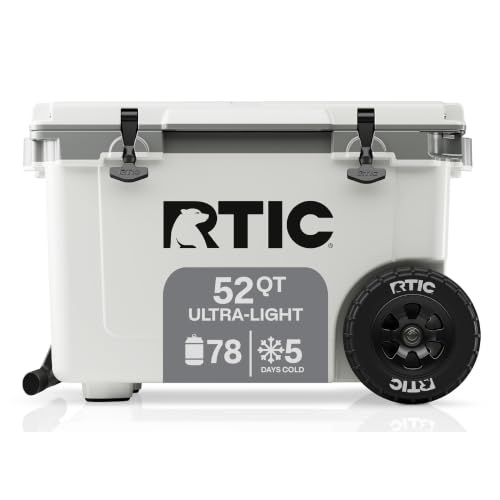
The Ultra-Light Wheeled earns the lead spot in a backyard guide on a single insight: the cooler that gets positioned correctly is the cooler that performs. A 52-quart box loaded with ice and drinks weighs 60 to 80 pounds; carried, it gets set down at the first flat spot and stays there, usually in the sun, usually in the traffic path. Rolled on this RTIC’s heavy-duty wheels behind its telescoping handle, it goes exactly where a host wants it — the shade line, beside the grill, at the patio’s edge — and moves again when the sun moves. The shell makes the rolling easier: injection-molded with thick foam insulation, it is more than 30 percent lighter than rotomolded coolers of the same size by RTIC’s rating, and independent testing still credits the line with multi-day ice retention. The maker rates it at 78 cans; plan on drinks for a dozen with proper ice.
Backyard details are properly thought through. The lid is flat and strong — a bench for two kids, a step to reach the string lights, a landing pad for the platter. The freezer-style gasket and latches seal against the constant opening of a party, the drain empties meltwater onto the garden bed in minutes at cleanup, and the treaded wheels track over grass and gravel instead of digging in. The trade is known and stated: an injection-molded shell is not rotomolded armor, and in extreme heat it gives back roughly a day of ice against the best thick-walled boxes. In a backyard, where ice is a hose-length from the freezer and the party is the point, that trade buys mobility you will use every single weekend. It sits near the top of this budget — check price on Amazon.
- 52 quarts (maker-rated 78 cans) on heavy-duty wheels with a telescoping handle.
- Shell about 30% lighter than rotomolded rivals — a loaded roll, not a carry.
- Multi-day ice in independent testing; freezer-style gasket; seat-strength lid.
- Rapid drain for hose-down backyard cleanup — check price on Amazon.
Honest limitation: Not rotomolded: expect less indifference to drops and a day less ice in brutal heat, and the wheeled version costs more than the same shell without wheels.
Choose it if your cooler changes position more than twice a season. Skip it if it will live permanently in one shady corner — the Lifetime below gives you more cooler for less money in a fixed station.
Lifetime 55 Quart High Performance Cooler (90820)
Who it suits: Backyard hosts who want a semi-permanent cold station — one big, tough, inexpensive tub that lives by the grill all season and shrugs off the life.
The Lifetime 55 is the cooler equivalent of a good cast-iron pan: unfashionable, over-built for its price, and still working when prettier things have retired. Its 55-quart blow-molded body carries up to seven days of ice retention as a maker claim, a certified bear-resistant build (the Interagency Grizzly Bear Committee certification, with lock points — overkill for a backyard, but a fair proxy for shell toughness), rope handles with foam grips, a stainless hinge rod, grippy feet that keep it planted on a deck, and a built-in bottle opener that will be used ten thousand times. Independent review coverage has repeatedly found its real-world ice life competitive with rotomolded coolers at twice the price. Its price history is the friendliest in this guide — it has lived far below this ceiling for years — so check price on Amazon and expect the value end of the tier.
As a backyard station it has two quiet virtues. The tall, rectangular shape takes 2-liters and wine upright and slides flat against a garage or shed wall in winter. And its feet and weight make it the cooler that stays where you put it: no skating across the deck when a guest leans, no tipping when a kid climbs. Set it in shade beside the grill in May, keep it stocked, and it becomes the house’s cold pantry until September. The honest debits are cosmetic and tactile: blow-molded walls scuff, the latches are good rather than delightful, and it looks like equipment. Backyards run on equipment. This is the pick we would buy with our own money for a fixed station, and it is not close.
- 55 quarts; up to 7-day ice retention as a maker claim; bear-certified build.
- Grippy feet and a planted stance — the fixed-station cooler.
- Rope handles, stainless hinge, built-in bottle opener.
- Price history far below the ceiling — check price on Amazon.
Honest limitation: No wheels, so its station is chosen once and kept; blow-molded finish scuffs and the styling is purely utilitarian.
Choose it if the cooler has a permanent home by the grill and value is king. Skip it if the cooler must follow the party around the yard — that is the wheeled RTIC above.
RTIC 45 QT Ultra-Tough Cooler
Who it suits: Backyard households that also camp, fish and tailgate — the cooler leaves the yard as often as it hosts in it, and must be expedition-tough in both lives.
If the Lifetime is the station and the wheeled RTIC is the mover, the Ultra-Tough is the athlete. Its one-piece rotomolded shell, up to three inches of insulation, freezer-style gasket and heavy rubber T-latches are the classic premium formula, at a mid-tier price — check price on Amazon. RTIC rates it for 48 cans plus ice. The lid seats adults and stands as a step without a creak of protest, the non-slip feet plant it on wet decking, and the rapid-flow drain is the best cleanup experience in this guide: open the spigot, walk away, come back to an empty box. In the yard it is the cooler you lend to nobody and worry about never; out of the yard it is the cooler that survives the truck bed, the boat deck and the campsite for a decade.
The backyard-specific caveats are mobility and scale. At roughly 29 pounds empty and well over 60 loaded, with no wheels, it moves around a yard the way a piano moves around a house — rarely, and with planning. And at 45 quarts it is a family-plus-friends cooler, not a crowd cooler: a twenty-person cookout will empty it of drinks by mid-afternoon unless the Coleman below stands beside it as the drinks tub. Bought as the tough heart of a two-cooler system, or as the dual-life single cooler for a smaller household, it is exactly right. Bought as a party’s only cold storage, it will be the bottleneck with the best build quality in the yard.
- True rotomolded shell, up to 3 inches of insulation, freezer-style gasket.
- Seat- and step-strength lid; rapid-flow drain; non-slip feet.
- 45 quarts (maker-rated 48 cans plus ice) — the dual-life workhorse.
- Mid-tier price in this budget — check price on Amazon.
Honest limitation: Heavy and wheel-less, and 45 quarts runs dry at big gatherings; it is a workhorse, not a crowd tub.
Choose it if one cooler must host at home and travel hard. Skip it if it will never leave the yard — the Lifetime gives you ten more quarts for less, in place.
Coleman Classic Series 65-Quart Wheeled Cooler
Who it suits: Backyard hosts with big headcounts — the annual Fourth of July, the team party, the graduation cookout — who need a drinks ocean on wheels and refuse to spend infrastructure money on it.
Every backyard that hosts crowds ends up needing this cooler, and the smart hosts buy it before the party, cheaply, instead of after, desperately. The Classic 65 is the largest tub in this guide at 65 quarts, riding on wheels behind a telescoping tow handle, weighing about 14.5 pounds empty — half the rotomolded RTIC in a bigger box — with four cup holders molded into the lid and insulation Coleman rates to keep ice up to four days in 90-degree heat as a maker claim. For a party day that begins with cold drinks and fresh ice, that is all the performance the event will ever test. The rest of the budget — and it is most of the budget, check price on Amazon — goes to what goes inside it.
Its backyard role is specific and honorable: the drinks tub. Guests churn it hourly, and its thin walls do not care, because fresh ice is steps away and the event is measured in hours. The food stays sealed in your better cooler; the Coleman takes the traffic. The lid’s cup holders turn it into the yard’s side table, and its wheels cross a lawn adequately for occasional moves (they are patio-first wheels, and mud season will expose that). The honest debits: hinges and latches are functional, not lifetime; a four-day heatwave campsite is beyond it; and it will not double as a casting platform. As the second cooler in a backyard system — or the only cooler for a household that hosts twice a year — it is the most rational money in this guide.
- 65 quarts on wheels — the crowd drinks tub.
- About 14.5 lb empty; four cup holders molded into the lid.
- Maker-rated ice up to four days in 90°F heat.
- A small fraction of this budget — check price on Amazon.
Honest limitation: Thin-wall build and party-grade hardware; wheels are pavement-first; not a multi-day expedition cooler.
Choose it if headcount is your problem and budget is your constraint. Skip it if it would be your only cooler for camping weekends in heat — pair it with, or step up to, the rotomolded picks.
YETI Roadie 24 Hard Cooler
Who it suits: Backyard hosts building the two-cooler system — and small yards where the only cooler must be a compact one that punches far above its footprint.
The Roadie’s backyard job is specialization. As the drinks cooler in a two-cooler system, its tall rotomolded body does what the big tubs cannot: it keeps wine bottles and 2-liters upright and visible, opens one-handed via its QuickLatch while your other hand holds the tongs, and seals with a freezer-style ColdLock gasket through an evening of constant guest traffic. YETI rates it around 18 cans at a 2:1 ice ratio — a drinks station for the inner circle, parked at the grill or the patio table, while the big cooler handles volume at the yard’s edge. Its footprint, roughly 16.5 by 14.5 inches, fits the corner of a deck, the space between two chairs, or the end of the outdoor kitchen counter where no 45-quart box could live.
It is also, not incidentally, the best small-yard answer in the guide: households whose “backyard” is a compact patio-yard hybrid get genuine rotomolded performance at a size that leaves room for the chairs. Build quality is the YETI standard — PermaFrost insulation, the NeverFail hinge, tie-down slots — backed by a five-year warranty. The original version linked here has no drain plug, which in a yard is a minor note: a cooler this size tips into the garden bed in one motion, and the absence of a plug is the absence of a leak path across your deck. Check price on Amazon; its list price sits inside this budget, and sale colors are a backyard-season ritual.
- Tall body: wine and 2-liters upright, visible, reachable.
- One-handed QuickLatch; ColdLock gasket; rotomolded build.
- The two-cooler system’s drinks specialist; five-year warranty.
- Compact deck footprint — check price on Amazon.
Honest limitation: Around 18 cans with ice cannot carry a party alone, and per quart it is the priciest cold storage here.
Choose it if you are pairing it with a big tub, or your yard is small and your standards are not. Skip it if it must be your only cooler for gatherings over six people.
Pelican 50QT Elite (Prose Only — Priced Across the Ceiling)
Who it suits: Backyard buyers who keep equipment for decades and are drawn to the toughest hardware in the class — and who find it on sale or accept stretching the budget.
Pelican built its name on cases that protect cameras through combat zones, and the Elite coolers apply the same religion: a rotomolded shell, a freezer-grade gasket, and press-and-pull latches that are arguably the best closures in the cooler world — positive, mechanical, operable with gloves, and backed by a lifetime warranty that is the strongest promise in this guide. The 50QT size is the family sweet spot, with molded handles, non-slip feet, a sloped drain and a lid that takes a padlock for certified bear resistance. Owners keep these for decades, and the backyard case writes itself: buy the tank once, hose it down forever.
So why prose, in a guide that links five other coolers? Because its price lives on both sides of this guide’s line. The 50QT Elite’s list price has sat right at the ceiling while maker-direct and typical retailer pricing runs above it, with occasional retailer sightings below — the definition of a straddle. This guide links only clear in-budget sightings. If you find the Elite under $300 at a retailer you trust, the honest review is the paragraph above: it is a superb, lifetime-warranted cooler and you should buy it. At its usual over-ceiling price, the RTIC Ultra-Tough delivers the rotomolded formula within budget, and the Lifetime delivers the value. Readers who decide the stretch is the point will find the tier above mapped in Best Outdoor Cooler For Backyards Under $500.
- Rotomolded shell with press-and-pull latches — the best closures here.
- Lifetime warranty, the strongest backing in this guide.
- Freezer-grade gasket; lockable, bear-resistant lid; sloped drain.
- Prose only: pricing straddles the ceiling — list at it, typical above it.
Honest limitation: Beyond the price straddle, it is heavy for its capacity and its latches, while excellent, stick out where slim coolers slide past obstacles.
Choose it if you catch it under the ceiling, or lifetime warranty tops your criteria and the budget bends. Skip it if the $300 line is firm — two linked picks above cover its jobs within it.
Comparison Table
| Product | Capacity | Construction | Wheels | Backyard role | Link |
|---|---|---|---|---|---|
| RTIC 52 Ultra-Light Wheeled | 52 qt | Injection-molded | Yes | The mobile station | Check on Amazon |
| Lifetime 55 High Performance | 55 qt | Blow-molded, bear-certified | No | The fixed value station | Check on Amazon |
| RTIC 45 Ultra-Tough | 45 qt | Rotomolded | No | The dual-life workhorse | Check on Amazon |
| Coleman Classic 65 Wheeled | 65 qt | Thin-wall insulated | Yes | The crowd drinks tub | Check on Amazon |
| YETI Roadie 24 | 24 qt class | Rotomolded | No | The drinks specialist | Check on Amazon |
| Pelican 50QT Elite | 50 qt | Rotomolded | No | The lifetime tank — over ceiling | Prose only |
How to Choose an Outdoor Cooler for Your Backyard
Plan the system, not the cooler. Backyard cold storage works best as a pair: a drinks tub guests can churn without consequence, and a food cooler that stays sealed. Decide which role you are buying for. A 52–65 quart drinks tub plus a 24–45 quart food box outperforms any single giant cooler at the same total money, because the food box’s ice survives the party instead of melting into it.
Follow the sun before you follow the specs. A backyard cooler’s worst enemy is its own placement. Pavers and decks radiate heat; a cooler parked in full afternoon sun fights physics all day. Choose the station first — the shade line, the north side of the grill, under the table — and then choose the cooler that can get there: wheels if the shade moves, a fixed value tank if the shade is permanent. Position is worth more ice than a tier of price.
Match wheels to terrain. Patio-only routes forgive small wheels. Grass, gravel and garden paths demand large, treaded wheels and a wide stance, like the lead pick here, or the cooler will dig in exactly when it is heaviest. If the route includes steps or a raised deck, wheels stop helping and weight becomes the whole question — buy the lighter shell or the smaller box.
Interrogate the lid. In a backyard, the lid is a bench, a step, a table and a kid magnet. Ask whether it is rated to sit and stand on, whether it is flat enough to hold a platter, and whether its latches can be worked one-handed by a guest holding a plate. Cup holders molded into a lid sound like a gimmick until the first party, when they become the yard’s most contested real estate.
Think in seasons, not parties. A backyard cooler gets hosed, baked, frozen and stored. Favor shells without fabric or foam exteriors to mildew, drains that fully empty (standing water breeds mosquitoes and winter cracks), and gaskets you can remove and wash. Store it dry with the lid cracked; store accessories, cushions and the hose in the deck box beside it, and the whole station wakes up clean each spring.
Plan for the guests who help themselves. A backyard cooler is operated mostly by people who did not buy it: guests, kids, the neighbor who arrived with potato salad. Hardware that survives that public is a selection criterion, not a detail. Latches should close with an obvious, positive action a stranger gets right the first time; lids should not require a technique; the drain should not be discoverable by a curious six-year-old mid-party. When you read the reviews in this guide, the picks that score on guest-proofing — the wheeled RTIC’s positive latches, the Roadie’s one-handed QuickLatch, the Coleman’s sheer simplicity — are scoring on the thing that decides whether your cooler still seals in year three.
Spend on the seal, save on the story. Bear certification and ten-day expedition ice claims are fine things that a backyard rarely cashes. A freezer-style gasket, latches that compress it, thick walls and your own shade discipline decide real backyard performance. Let the budget follow those, and let the expedition features be a bonus rather than the brief.
Common Mistakes When Buying a Backyard Cooler
Parking it in the sun because that is where it landed. The single most expensive habit in backyard cooling. A cooler in full sun can lose a day of ice to its own placement. Move it to shade — this is the entire argument for wheels — or throw a light-colored towel over the lid.
One cooler, two jobs. Drinks and food in one box means the food rides a rollercoaster of warm air every time a guest wants a soda. Split the jobs; even a cheap second cooler transforms the main one’s performance.
Draining the meltwater at noon. It looks tidy and it sabotages the afternoon: the ice-cold water bath around the remaining ice is insulation and thermal mass. Drain at cleanup, not during the party.
Loading warm drinks into a hot cooler. A cooler that sat in a sunny garage starts the day as an oven with ambitions. Pre-chill it in the shade with frozen bottles while you prep, load everything fridge-cold, and top with ice last.
Forgetting that the station needs a power-free plan for ice runs. Backyard parties consume ice on a curve nobody predicts, and the host who must drive for a bag at hour three leaves the grill unattended at the worst moment. The fix is embarrassingly simple: one extra bag lives in the freezer from June to September, permanently, replaced each time it is used. It costs a freezer corner and saves a party every single summer — the cheapest insurance in this guide, and the one experienced hosts never skip.
Leaving it outside, sealed, all winter. Standing water cracks drains in a freeze, sealed damp interiors mildew, and UV ages shells and gaskets. Wash it, dry it fully, store it in the garage or shed with the lid cracked.
Buying capacity for the biggest party of the decade. The twenty-person cookout happens twice a year; the eight-person evening happens twenty times. Size the resident cooler for the twenty, and cover the two with the budget wheeled tub — which is why it is in this guide.
Setting Up a Backyard Cooler Station That Works All Season
Pick the station by the afternoon sun, not the morning. Walk your yard at 4 p.m. on a sunny day and note where the shade actually lives at party hour — the fence line, the north side of the house, the tree’s late shadow. That is the station. Morning shade is a liar; it moves off the patio by lunch and leaves the cooler to bake through the exact hours it works hardest. If no natural shade reaches a workable spot, manufacture it: the station under a patio umbrella or a shade sail gains hours of ice for the price of a fabric triangle, and it makes the drinks corner the place guests drift toward anyway.
Build the station as a triangle: cooler, surface, trash. Every backyard gathering generates the same three needs within arm’s reach — cold drinks, somewhere to set things down, and somewhere to put the empties. Hosts who arrange all three get a station that runs itself; hosts who arrange only the cooler get a traffic jam of guests holding bottles and looking for a bin. The cooler anchors one corner (its lid is the surface if it is flat and strong — one reason this guide weights lid quality), a small side table or the cooler’s own top takes the opener, the cups and the bowl of citrus, and a bin or bucket takes empties before they colonize the lawn. Put a towel over the station’s edge for wet hands and a tethered opener on the cooler handle, and the station needs no host at all.
Give the station a floor. A cooler parked directly on grass kills the grass beneath it by Sunday and sits in the damp that follows every watering. A paver, a deck corner, a rubber mat or a simple platform of bricks keeps the cooler level, the drain functional and the lawn alive. Level matters more than it looks: a tilted cooler pools its meltwater against one wall, stresses its gasket unevenly and makes the lid a slope that sheds glasses. Two minutes with a level at setup is the cheapest performance upgrade in this entire guide.
Run the water like you planned it. A backyard station produces meltwater on a schedule — at cleanup, ideally into the garden bed or the tree ring that needs it most, through the drain spigot the better picks here provide. During the season, never let a drained cooler sit in its own puddle: standing water under a station breeds mosquitoes in a week of summer. The end-of-party ritual — drain to the garden, rinse with the hose, lid open to dry while you finish the dishes — takes four minutes and is the entire difference between a station that smells like a garden and one that smells like a swamp by August.
Defend the station from its fans. Backyard coolers are climbed on, sat on, stood on and used as home base in games whose rules no adult will ever learn. The picks in this guide were chosen partly for lids that accept this career, but two habits extend every cooler’s life: keep the lid closed when it is a bench (an open cooler being sat beside becomes a cooler being sat in), and move the station out of the goal line when the yard turns into a pitch. Gaskets deserve the same respect monthly: a wiped-clean gasket seals; a gasket full of grass clippings and sauce does not, and no insulation figure survives a seal that leaks.
Winterize the station, not just the cooler. When the season ends, the ritual is short: wash the cooler inside and out, dry it fully in the sun, check the drain and latches, and store it dry with the lid cracked in the garage or shed. The station’s other residents — cushions, the side table’s accessories, the hose — go to the deck box in the same hour, and the yard hands its square footage back to winter. Come spring, the whole station wakes up in one trip because it was put to bed in one. That is what buying backyard infrastructure, rather than a camping cooler, actually means — and it is why this guide ranks stations above specs, every single time.
Final Recommendation
For most backyards, start with the RTIC 52 Ultra-Light Wheeled: it is the cooler that actually ends up in the right place — shaded, central, open — because moving it costs nothing, and its ice performance covers every realistic backyard weekend; check price on Amazon. If your cooler has a permanent station and value rules, the Lifetime 55 is the finest cold-storage bargain in this guide and the pick we would buy for a fixed spot by the grill. Add the Roadie 24 as the drinks specialist and you own the two-cooler system that makes hosting look easy. The RTIC Ultra-Tough is the buy for yards that share their cooler with campsites, and the Coleman is the crowd tub every big-party yard eventually needs. The Pelican is the lifetime tank — catch it under the ceiling or admire it from inside the budget. Either way, put the cooler in the shade, keep the food box closed, and let the yard do the rest.
Frequently Asked Questions
What size cooler does a backyard actually need?
For regular gatherings of six to twelve, a 45–55 quart main cooler is the comfortable heart of the system, ideally paired with a smaller drinks or food box. Solo big parties justify a 65-quart drinks tub. Beyond capacity, placement and the two-cooler split matter more than raw quarts: a shaded 45 keeps food colder than a sunny 65 by Sunday.
Can I leave a premium cooler outside all season?
During the season, the rotomolded and molded picks here tolerate a shaded outdoor station well — hose them down, keep gaskets clean, and drain them after use. Over winter, bring them under cover, dry and with lids cracked. Sun and freeze-thaw, not use, are what age a cooler; a garage corner doubles its service life.
Are wheels worth it for a backyard cooler?
If the cooler moves between storage and station, or follows the shade across the yard, yes — decisively. A loaded 50-quart cooler is a 60–80 pound object, and wheels convert its placement from a decision you make once, badly, into an adjustment you make hourly. For a truly permanent station, wheels are money spent on nothing; the fixed value pick covers that life.
Why is the Pelican 50QT Elite not linked?
Its pricing straddles this guide’s ceiling: list price at the line, maker and typical retailer pricing above it, occasional sightings below. This guide links only picks with clear in-budget sightings and reviews straddlers in prose. Found under $300 at a retailer you trust, the Elite is a superb lifetime-warranty cooler — its review above is the honest summary.
How do I stop my backyard cooler smelling by August?
Wash it after big events with warm water and a little baking soda, dry it completely in the sun with the lid open, and store it with the lid cracked so air moves. Never store it sealed and damp. A gasket wiped clean monthly keeps the seal — and the smell — honest all season.
Is bear certification relevant for a backyard?
Only as a toughness proxy — and, in genuine bear country, as a real feature when the cooler is locked as directed. For most yards it simply signals a shell and latch set built beyond backyard needs, which is why the certified Lifetime reads as such a value at its tier.
How long will ice last at a backyard party?
For a party day, every pick here is sufficient with cold contents and a pre-chilled box. Across a full weekend in shade, the rotomolded and Ultra-Light picks hold ice comfortably; the thin-wall Coleman is a party-day performer that wants fresh ice for day two. Shade, pre-chilling and keeping the food cooler closed move the number more than brand choice does.
How do I keep animals and pests out of a backyard cooler?
Three habits cover nearly everything. First, never leave food residue on the lid or latches overnight — a wipedown at cleanup removes the invitation. Second, store the cooler empty, clean and with the lid cracked indoors or under cover; a sealed cooler with last weekend’s smell is a beacon. Third, in genuine bear or raccoon country, treat the yard like a campsite: food coolers come inside at night, or choose a certified bear-resistant model — two picks in this guide carry that certification — and lock it as the maker directs. Raccoons, specifically, are latch critics: they defeat gravity lids and simple friction closures with embarrassing ease, which is one more argument for the positive T-latches and locking points on the premium picks here. Ants and wasps, the more common backyard raiders, are defeated by the cleanup ritual alone: no residue, no standing meltwater, no scouts reporting back to the colony.