Where to buy
Check the latest price, availability and delivery on Amazon. Orders are placed on Amazon. We may earn a commission from qualifying purchases.
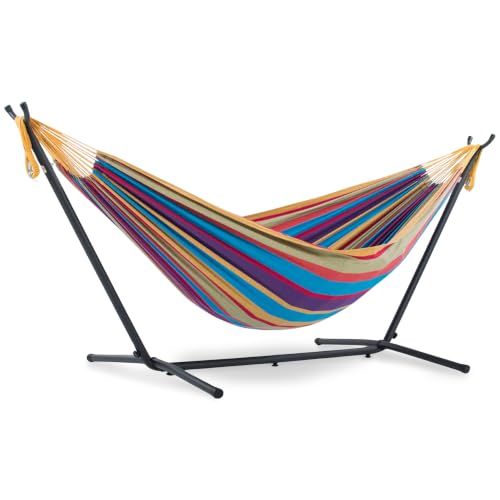
- Best overall for small patios: Vivere Double Cotton Hammock with Space-Saving Steel Stand — Check on Amazon
- Wise Owl Outfitters DoubleOwl Hammock — Check on Amazon
- Best Choice Products 2-Person Brazilian-Style Double Hammock with Steel Stand — Check on Amazon
- Sunnydaze Double Brazilian Hammock with Stand and Carry Bag — Check on Amazon
- ENO DoubleNest Hammock — Check on Amazon
One more option worth knowing about
- Kootek Camping Hammock (double size) — the drawer-sized budget kit; its Amazon listing mixes sizes in a way we could not pin to one verified configuration, so it is reviewed below without a buying link.
Read the full guide ↓
Disclosure: As an Amazon Associate, dailyhomedecorating.com earns from qualifying purchases. Links to Amazon on this page are affiliate links; they cost you nothing extra. Listing details such as price and availability change often, so check the current Amazon listing before you buy.
The best hammock for small patios under $150 is, before anything else, a measurement problem. A classic hammock stand runs twelve to fifteen feet long — longer than many patios are in any direction — and the internet is full of small-patio owners who discovered this with a tape measure in one hand and a return label in the other. But small does not have to mean no hammock. It means choosing from the two families that respect tight geometry: the compact stand class, which folds a full double bed onto a nine-foot frame, and the hanging hammocks, which need no floor at all when they are up and almost no storage when they are down. On a small patio, the question is never just “does it fit” — it is “does it fit, can I still walk past it, can I get it out of the way when the patio has to be a patio again, and does it leave room for the chair, the plant and the person I share the space with.”
This guide judges the verified under-$150 field — the same specification-checked, recall-screened pool as our main roundup, Best Hammock Under $150 — entirely on small-space criteria. Footprint leads, and we give real numbers: frame lengths, the clear run each setup actually needs once a body is in the bed, and the swing clearance that brochures forget. Storage footprint counts almost as much, because on a small patio a hammock that cannot disappear will dominate the space it was meant to decorate. Setup flexibility follows: compact stands that break into bags, hanging kits that rig between a post and a pergola upright, and beds that swap between a stand and the trees. Comfort is not traded away — every bed below is a genuine double — but it is comfort in its compact form, and each review is explicit about the space its pick needs, so you can measure once and buy once.
The short answer depends on your patio’s longest clear run. At ten feet or more, the Vivere’s compact stand set is the answer: the smallest serious stand made, a full cotton double bed, and a bag it all folds into. Under ten feet — or on a patio that must return to empty on demand — hanging wins, and the Wise Owl DoubleOwl is the small-patio champion: a complete kit that stores in a shoebox and rigs in minutes, with the ENO DoubleNest as the premium fabric upgrade. The Best Choice Products and Sunnydaze sets give stand buyers two more compact options at friendlier prices, and the Kootek is the minimum-cost, minimum-space experiment. Measure your patio’s diagonal before you fall in love with any of them — on small patios, the diagonal is often the dimension that saves you.
In this guide
Quick Picks
| Pick | Best for | Clear space needed | Capacity | Storage | |
|---|---|---|---|---|---|
| Vivere Double Cotton Hammock with Space-Saving Steel Stand | Best overall for small patios | ~10 ft run | 450 lb | Carry bag | Check on Amazon |
| Wise Owl Outfitters DoubleOwl Hammock | Patios under 10 ft | Two anchors 10–15 ft apart | 500 lb | ~30 oz stuff sack | Check on Amazon |
| Best Choice Products 2-Person Brazilian-Style Double Hammock with Steel Stand | Budget compact stand | ~10 ft run | 450 lb | Carrying bag, ~30 lb | Check on Amazon |
| Sunnydaze Double Brazilian Hammock with Stand and Carry Bag | Compact napping corner | ~10 ft run | 400 lb | Carrying case | Check on Amazon |
| ENO DoubleNest Hammock | Premium pack-away hammock | Two anchors or compact stand | 400 lb | 19 oz stuff sack | Check on Amazon |
| Kootek Camping Hammock, double | Smallest budget kit | Two anchors or compact stand | 500 lb (maker) | ~2 lb stuff sack | Prose-only — see review |
How These Picks Were Chosen
We began with the verified under-$150 pool used across this batch — specifications confirmed from maker data, listing configurations matched to the products reviewed, and every candidate screened against federal recall records — then applied the small-patio filters. The first was absolute: any stand longer than the compact nine-to-ten-foot class was excluded, however good its hammock, because a stand that does not fit is not a deal at any price. The second was the loaded footprint test: a setup had to leave a walkable path on a typical small patio, counting the bed’s swing and sag, not just the frame’s brochure dimensions. The third was disappearance: every pick had to break down into a bag or sack that a small home can actually store, because on a small patio the hammock’s stored size is a design feature, not an afterthought.
Within those filters we weighted the small-space virtues: tool-free assembly that can be repeated weekly without resentment, stand feet that sit kindly on decking and pavers, beds wide enough that compact never means cramped, and honest capacities for the two-person lounging that small patios host surprisingly often. One well-known budget hammock is covered prose-only because its multi-size Amazon listing could not be pinned to a single verified configuration — on a small patio, where ordering the wrong size is the most common failure of all, we were not willing to link a guess.
Best Hammock for Small Patios Under $150: The 6 Picks
Vivere Double Cotton Hammock with Space-Saving Steel Stand
Who it suits. The small-patio owner with one good run of about ten feet — along the railing line, across the back wall, on the diagonal — who wants a real double hammock that lives on the patio full-time without annexing it.
The Vivere is the reference design for this entire category, because its stand was engineered backwards from the space problem: instead of stretching a bed across a twelve-to-fifteen-foot arc frame, it holds a full double cotton bed — 94 by 63 inches, woven cotton on polyester end strings — on a nine-foot zinc-coated steel base, at a slightly steeper geometry. In practice the set needs roughly ten clear feet once the bed is loaded, plus a swing margin, which puts it within reach of patios that no classic stand can serve. It assembles without tools, the frame’s feet are compact rather than sprawling, and the whole set breaks down into its carry bag, so the patio can be reclaimed for a dinner party in fifteen minutes and the hammock stored in a closet until Sunday. The published capacity is 450 lb, so compact never means solo: two adults share this bed properly.
Pros. The smallest footprint of any complete double stand set we recommend; a genuinely full-size cotton bed — no comfort tax for the compact frame; tool-free setup and bag storage; movable enough to chase shade across a small patio through the day.
Honest limitation. Ten feet is the floor, not a suggestion: patios shorter than that in every direction, including the diagonal, cannot host this set, and forcing it means a stand foot in the walkway forever. The cotton bed must come in or be covered when rain settles over a small uncovered patio — there is no “far corner” to drag it to — and the assembled set, while movable, is a deliberate two-handed carry, so daily repositioning is a chore you will do weekly at most.
Choose it if your patio has the ten-foot run and you want the hammock to be a resident. Skip it if every dimension of your space is under ten feet — the hanging picks below were chosen for exactly that patio. Check on Amazon
Wise Owl Outfitters DoubleOwl Hammock
Who it suits. The genuinely tiny patio: the Juliet balcony’s bigger sibling, the narrow terrace, the courtyard corner — any space where a stand is impossible but two anchor points exist, or where the hammock must vanish completely between uses.
The DoubleOwl reframes the small-patio problem: instead of asking how small a stand can be, it asks why there is a stand at all. The hammock is a gathered-end double in parachute nylon — 10 feet by 6 feet 6 inches of bed, 500 lb published capacity — that arrives with nine-foot tree straps and carabiners in the box and stores, all-in, in a sewn-on stuff sack of about 30 ounces. Rigged between a pergola post and a wall-side upright, between two posts, or on a compact stand from Best Hammock Stand For Small Patios Under $150, it occupies air, not floor: the patio beneath stays walkable, the chair and the plant keep their places, and when the space is needed the whole hammock is in a drawer in two minutes. The wide bed lies flat on the diagonal, so the lounging is full-size even though the storage is not, and the nylon shrugs off the weather swings an exposed small patio delivers.
Pros. Zero storage problem — the smallest stored footprint in this guide alongside the ENO; complete kit with straps, nothing else to buy; highest capacity here; deploys and disappears in minutes, so the patio stays multi-purpose; doubles as the camping and park hammock.
Honest limitation. It needs two legal anchor points at a workable distance, and some small patios simply do not have them — railings are never anchors, and drilling into a rental’s structure is its own problem (our apartment guide, Best Hammock For Apartments Under $150, works through the lease-safe options). The loop-style straps also offer fewer fine adjustments, which matters more, not less, in tight geometries where the anchor spacing is whatever the architecture gave you.
Choose it if your patio is under ten feet or must return to empty on demand. Skip it if you have no anchors and no room for even a compact stand — in that case a good patio chair serves the space better than any hammock. Check on Amazon
Best Choice Products 2-Person Brazilian-Style Double Hammock with Steel Stand
Who it suits. The small-patio buyer on a strict budget who still wants a stand set: complete, compact-class, bag-stored, and light enough to shuffle around a tight space as the day changes.
Best Choice Products’ set hangs a Brazilian-style cotton-blend bed, 76 by 57 inches, on a tempered steel stand with an overall footprint of about 118 by 48 inches — call it a ten-foot run — with a 450 lb published capacity. On a small patio, its virtues are practical ones. At roughly 30 lb it is the lightest stand set here, which in a tight space translates directly into use: it is the set you will actually drag two feet to catch the shade or free the doorway. The hand-tightened assembly snugs down joint by joint, which forgives the slightly uneven pavers and decking that small patios specialise in. And it folds into its carrying bag, so the winter patio and the summer patio can be different places. The woven-in stripes keep it looking like patio furniture rather than camping overflow.
Pros. Lowest-priced complete compact set in this guide; lightest stand set — the easiest to reposition in tight quarters; 450 lb capacity; bag storage; forgiving assembly on uneven small-patio surfaces.
Honest limitation. The bed is the smallest here — 76 by 57 inches is a comfortable double for most, but tall users and sprawling nappers will feel the difference against the Vivere’s bed, and the cotton blend stretches over a season so the hang wants re-tensioning. The frame finish is also the thinnest in the guide; on a small patio where the stand lives close to planters and watering cans, wipe the feet and joints or expect cosmetic rust early.
Choose it if budget leads and your patio fits the ten-foot class. Skip it if you are tall, or want the bed to be the best part — the Vivere’s extra size is exactly what its higher price buys. Check on Amazon
Sunnydaze Double Brazilian Hammock with Stand and Carry Bag
Who it suits. The small patio with a designated quiet corner: one spot, kept for one purpose — a nap and reading retreat that does not need to seat the whole household to justify its footprint.
Sunnydaze’s set weaves an 80 by 60 inch bed of colourfast cotton in the deep Brazilian style and hangs it on a powder-coated steel stand in the same compact class as the leaders here, with a carrying case included. On a small patio the deep drape is a spatial virtue as well as a comfort one: the bed wraps its occupant and hangs more vertically than flatter beds, so the lived footprint feels smaller than the frame’s measurements, and the corner it occupies reads as a cocoon rather than a construction. The colourfast cotton matters in tight quarters too — on a small patio the hammock is always in view from indoors, and a bed that holds its colour holds the whole space’s look together. Published capacity is 400 lb, assembly is tool-free, and Sunnydaze’s one-year warranty and available replacement beds suit a long-term corner installation.
Pros. Deep, private-feeling bed that suits a dedicated corner; compact-class stand; colourfast cotton stays presentable in a highly visible spot; breaks down into its case if the corner is ever reclaimed.
Honest limitation. The 400 lb capacity makes it the solo-plus-one hammock of the stand sets — fine for its corner role, wrong as the patio’s only two-adult seat. The first assembly is the fiddliest here, and on a small patio you will assemble it in the space it will occupy, so clear the corner first. Cotton care rules apply in full: in or covered when it rains, dry for storage.
Choose it if your small patio has a corner to dedicate to napping. Skip it if two adults are the main use, or the patio has no single spot it can keep. Check on Amazon
ENO DoubleNest Hammock
Who it suits. The small-patio owner who refuses to give the space to any single purpose: the hammock appears for the evening, sleeps a guest on the weekend, and spends the rest of its life in a drawer — while also being the best-made hammock in this guide.
The DoubleNest’s small-patio credential is its stored size: 19 ounces in its own stuff sack, against the bag-of-golf-clubs a stand set needs. The bed itself is full-size — 9 feet 6 inches by 6 feet 4 inches of FreeWave 70-denier nylon taffeta, 400 lb capacity, triple-stitched, with aluminium carabiners — and wide enough for the flat diagonal lay that makes a gathered hammock a real bed. On a small patio it rigs between posts or a pergola, or onto a compact stand when anchors are absent, and it comes down in a minute when the patio has to be a dining room again. For renters and small-home owners it also moonlights as the travel hammock, which is how a 19-ounce object earns its drawer space twelve months a year. Straps are a separate purchase — budget for them, and the complete setup still sits inside this guide’s ceiling; the cheaper end of the same idea is covered in Best Hammock For Small Patios Under $75.
Pros. The smallest stored size of any serious hammock; best fabric and hardware here; full-size comfort when deployed; multi-purpose across patio, guest bed and travel; quick to rig and quicker to clear.
Honest limitation. No straps in the box, as with all ENO hammocks, so the working price is the hammock plus suspension. The 400 lb capacity is the joint-lowest here. And a hammock that lives in a drawer has a subtle failure mode of its own: if rigging it feels like a project, it will be rigged rarely — owners who know they want zero-friction daily use should buy the stand set and give it the corner.
Choose it if storage is your scarcest resource and quality your first criterion. Skip it if you want the hammock permanently up — a resident stand set is the honest answer. Check on Amazon
Kootek Camping Hammock, Double Size
Who it suits. The smallest budgets in the smallest spaces: a first hammock for a tiny patio, bought to test whether hammock life fits the space before real money follows. It is reviewed without a buying link because its Amazon listing bundles several sizes on one page and the displayed data does not cleanly match the double we researched — on a small patio, ordering the wrong size is the classic disaster, and we will not link a page where that mistake is easy. It is findable by name in seconds.
The double Kootek is a gathered-end parachute-nylon hammock of about 120 by 78 inches with a maker-stated 500 lb capacity, triple interlocking stitching and an attached stuff sack, packing to a little over two pounds with its straps and carabiners. Its standout feature for tight spaces is the straps: an unusually long run of adjustment loops per strap, which is exactly what awkward small-patio anchor spacings demand — when the posts are where they are, fine adjustment is the difference between a good hang and a abandoned one. As a complete working kit it sits at the very bottom of this budget, which also makes it the natural partner to a compact stand bought separately: hammock plus stand, both small-space chosen, inside the tier.
Pros. The cheapest complete kit here; drawer-size storage; the many-loop straps excel at odd anchor spacings; wide bed on paper; painless to replace if a move or a season claims it.
Honest limitation. Basic nylon, basic hardware, and quality control that varies more than the branded picks — inspect seams and carabiners on arrival and test the hang low. The listing ambiguity that made it prose-only is also a shopping warning: if you buy it, triple-check the size selector, because the single and double share a page and the small patio forgives no sizing errors.
Choose it if you are testing small-patio hammock life at minimum cost. Skip it if this is a long-term purchase — the Wise Owl is the better-made version of the same idea, cleanly listed.
Comparison Table
| Hammock | Space it needs | Bed size | Capacity | Stored size | Best for |
|---|---|---|---|---|---|
| Vivere Double Cotton with Stand | ~10 ft run, no anchors | 94 × 63 in | 450 lb | Carry bag | Best overall for small patios |
| Wise Owl DoubleOwl | Two anchors or stand | 10 ft × 6 ft 6 in | 500 lb | ~30 oz stuff sack | Patios under 10 ft |
| Best Choice Products Brazilian Double with Stand | ~10 ft run, no anchors | 76 × 57 in | 450 lb | Carrying bag, ~30 lb | Budget compact stand |
| Sunnydaze Double Brazilian with Stand | ~10 ft run, no anchors | 80 × 60 in | 400 lb | Carrying case | Compact napping corner |
| ENO DoubleNest | Two anchors or stand | 9 ft 6 in × 6 ft 4 in | 400 lb | 19 oz stuff sack | Premium pack-away hammock |
| Kootek Camping Hammock, double | Two anchors or stand | ~120 × 78 in | 500 lb (maker) | ~2 lb stuff sack | Smallest budget kit |
How to Choose a Hammock for a Small Patio
Measure three dimensions, not one. Length along the wall, length across, and the diagonal — small patios regularly fit a nine-foot stand diagonally that they cannot fit straight, and diagonal placement often leaves the better walkway. Then add the loaded reality: a hung bed needs about a foot of swing clearance beyond the frame at each end and a body’s width of clear floor beside it for entry. If the diagonal fails too, your patio is a hanging-hammock patio, full stop.
Decide resident or visitor. A resident hammock — stand set, always up — must justify its square footage daily, and earns it by being the patio’s main seat. A visitor hammock — hanging kit, drawer-stored — keeps the patio multi-purpose and asks two minutes of setup per use. Neither is better; the wrong match is what disappoints. Small patios that host dinners need visitors; small patios that host one reader need a resident.
Mind the floor as much as the footprint. Stand feet concentrate weight on small points: on decking and pavers that is fine, on soft surfaces they settle, and on smooth tile they can creep as you climb in. A rug from Best Outdoor Rug For Small Patios Under $150 under the setup solves the creep, protects the surface, and visually zones the hammock corner so the small patio reads as designed rather than crowded. Keep stand feet off delicate tiles’ edges, where point loads crack what distributed loads cannot.
Use the vertical and the edges. Small patios reward thinking in layers: the hammock along the longest edge, seating like the compact chairs in Best Adirondack Chair For Small Patios Under $100 at the short ends, light above from Best Outdoor String Lights For Small Patios Under $150 rather than on precious floor. The hammock should be the room’s longest line, not its centre obstacle — placed at the edge, it reads as a daybed against the wall; placed in the middle, it reads as a roadblock.
Protect the swing path and the neighbours. A hammock swings wider than new owners expect, and on a small patio the swing path is where the plant, the railing and the sliding door live. Site the setup so the loaded swing clears all three, keep the entry side toward the open floor, and if the patio is a balcony, remember the railing rule: railings are never anchor points, whatever the geometry tempts you to do.
Small Patio Layouts That Work: Three Floor Plans
The long-edge layout. The most reliable plan for a rectangular patio: the hammock runs along the longest wall or railing line, entry side facing the open floor, with the rest of the furniture grouped at the far end. The hammock reads as a daybed built into the room’s edge, the centre stays clear for walking and dining, and a stand set in the compact class — nine feet of frame — fits patios that measure twelve feet or more along that edge with room to spare. This is the layout that makes a small patio feel furnished rather than occupied.
The diagonal. When no straight run reaches ten feet, measure corner to corner: a patio that is eight by eight feet has a diagonal past eleven, and a compact stand placed on that diagonal often fits where the tape measure first said no. Diagonal placement has a second virtue — it breaks the grid, making a boxy small patio feel designed — and a cost: the stand’s ends land in two corners, so plan the planting and storage around them rather than discovering the conflict with a full watering can. Hanging hammocks love the diagonal too, since corner-to-corner anchor distances are the longest a small space offers.
The corner cocoon. For the patio that can spare only one corner, the deep-drape Brazilian sets were made: the bed hangs more vertically than flatter styles, the occupant is wrapped rather than spread, and the lived footprint shrinks to the corner itself. Pair it with a small side table and a plant screen and the corner becomes the patio’s destination instead of its leftover. The honest limit of this plan is capacity and company — it is a one-person retreat that occasionally hosts two — so patios that must entertain should run the long-edge layout and let the whole space socialise.
Making a Small Patio Feel Bigger Around a Hammock
The hammock is the largest object the small patio will hold, so everything around it should argue for air. Keep the palette quiet: a woven bed in a natural or single colour recedes, while a loud pattern in a tiny space shouts from every indoor window. Zone with a rug rather than furniture — a rug under the hammock corner defines it without consuming a single inch of floor, and it solves the stand-creep problem in the same gesture. Grow upwards, not outwards: wall planters, a railing box (decorative only — never an anchor) and one tall plant in the dead corner give the greenery a small patio craves without competing for the floor the hammock needs.
Light belongs overhead for the same reason: string lights and a lantern on a hook lift the eye and leave the floor empty, and they make the hammock corner the evening’s natural seat. Finally, edit ruthlessly. A small patio with a hammock, one chair, a side table and plants feels like a resort corner; the same patio with a hammock, four chairs, a storage box and a grill feels like a storage unit with ambitions. The hammock is the luxury — let it be the only big thing, and the space will feel twice its measured size.
Renting With a Small Patio: Rules and Reversibility
Many small patios belong to rentals, and the renter’s version of this purchase has one extra test: everything must reverse. The good news is that this entire guide passes it — stand sets touch nothing, hanging kits strap to posts and come off without a mark, and every pick stores in a bag or a drawer, so the patio you hand back can be the patio you received. The checks worth making are the building’s, not the hammock’s: some leases restrict what may be kept on balconies and patios, some homeowner associations govern visible items and colours, and some buildings prohibit anything attached to exterior structure — a rule the strap-on-post setups honour and railing-hung anything violates. Read the clause before the box arrives, and when the rules are ambiguous, the stand set is the answer that argues with nobody.
Reversibility also means planning the exit the day you buy. Keep the carry bag — it is the moving plan. Photograph the patio’s condition at setup if you are placing a steel stand on a delicate surface, and use the rug that this guide keeps recommending: it is simultaneously the stand’s anti-creep device, the floor’s protection and the deposit’s insurance. At moving time the calculus of the small-patio hammock proves itself: the stand sets break down in minutes and ride in the car, the hanging kits ride in a drawer box, and nothing — no patched holes, no repainted wall, no abandoned fifteen-foot frame in a side yard — stays behind to be negotiated over. For a renter, that clean exit is not a side benefit of the compact class; it is the reason the compact class exists.
Owners of small patios have the wider menu — a set post in a patio corner, a pergola upright used as a designed anchor — but even for them the reversible setups in this guide are the sensible first purchase: live with the compact hammock for a season, learn where the sun and the household actually want it, and only then consider making anything permanent.
The Two-Person Test: Sharing a Hammock in a Small Space
Small patios host couples more than crowds, so the honest test of every pick here is two people, one hammock, limited room to manoeuvre. Sharing well is a technique before it is a specification. The first person enters seated, settles deep and slightly to one side; the second enters from the same side, seated, and slides in alongside rather than climbing across — a choreography that takes ten seconds and works in every gathered and Brazilian bed in this guide. Once aboard, the pair lies slightly angled rather than parallel-spooned, which keeps shoulders out of each other’s faces and the conversation natural. On a small patio, add one spatial courtesy: enter from the open-floor side, always, so nobody is stepping over the stand’s feet or the planter to board.
The specifications that matter for sharing are bed width and capacity margin, in that order. Width is what two bodies actually negotiate — the beds here run from the high fifties of inches to the Vivere’s sixty-three, and the difference is felt in shoulders, not brochures. Capacity is the safety envelope: the 450 and 500 lb picks carry two average adults with margin for the dynamics of entry, while the 400 lb Sunnydaze asks the pair to be honest about their combined weight. And the small patio adds a final, underrated variable — exit dignity. In a space where the hammock is the room, a bed you can leave gracefully, one foot planted on clear floor, matters more than in a yard with room to roll out onto the grass. The stand sets, with the frame as a handhold and predictable bed height, win the exit test; deep-drape beds ask for a practised rock-and-rise that couples should rehearse before the guests, or the grandparents, arrive.
Common Buying Mistakes
Ordering a classic full-size stand. The twelve-to-fifteen-foot stand is the most returned product in this category, bought by owners who measured the hammock bed instead of the frame. The compact class exists because of those returns. Measure the frame’s space, buy the frame’s class.
Measuring the frame and forgetting the swing. A stand that fits on paper can still put a swinging occupant’s heels through the planter. Add clearance for the loaded bed’s movement, or choose the corner where the swing travels over open floor.
Anchoring to the railing. On small patios the railing is always temptingly at the right distance. It is also never an anchor: railings are not built for hammock loads, and the failure mode is a fall. Posts, pergola uprights or a stand — those are the options.
Buying a hammock with nowhere to store it. If the patio is small, the home is probably small, and a stand set without a storage plan becomes permanent patio furniture by default. Decide where the bag lives before the box arrives — or buy the hammock that lives in a drawer.
Sacrificing bed size to save inches. Compact should describe the frame, not the lounging. The picks here keep double beds on compact geometry; the no-name “mini” hammocks that save space by shrinking the bed are uncomfortable for exactly the adults who buy them.
Final Recommendation
If your patio offers a ten-foot run, buy the Vivere Double Cotton Hammock with Space-Saving Steel Stand and let it be the patio’s main seat — it is the most comfort ever fitted onto this footprint, and it bags away when the space must change. If your patio is smaller, or must empty on demand, the Wise Owl DoubleOwl is the pick: a complete, capacious hammock that stores in a shoebox, with the ENO DoubleNest as the premium version of the same idea. The Best Choice Products set holds the budget line for stand buyers, the Sunnydaze owns the napping corner, and the Kootek is the low-cost experiment. Measure the diagonal, respect the swing path, and a small patio turns out to be exactly big enough.
Frequently Asked Questions
What size hammock stand fits a small patio?
The compact class: frames around nine feet long, like the Vivere’s, which hold a full double bed on a footprint that fits patios with roughly a ten-foot clear run — including diagonally. Classic twelve-to-fifteen-foot stands do not fit small patios in any orientation and are the category’s most common return. Always shop by frame length, not bed length.
My patio is only 8 feet wide. Can I still have a hammock?
Yes — but not a stand set. At that size the answer is a hanging hammock rigged between two solid anchor points (posts, pergola uprights, a wall structure you are permitted to use) or on a compact stand only if its full footprint genuinely fits your longest dimension. Measure the diagonal first; many eight-foot patios have a ten-foot diagonal, which reopens the compact-stand option.
Is a hanging hammock or a stand better for a small patio?
A stand is better if the hammock will live out full-time and you have the ten-foot run — it is zero-friction every day. A hanging hammock is better if the patio must stay multi-purpose, because it stores in a drawer and the floor is yours again in minutes. The deciding factor is not comfort — both families here use full double beds — but how the space spends its week.
How do I stop a hammock stand from sliding on a smooth patio?
Put a rug or rubber pads under the feet. The small movements of climbing in and out walk a steel stand across tile and smooth decking over days; a rug stops the creep, protects the surface, and defines the hammock zone visually. It is the standard fix and the cheapest one.
Can two people use a hammock on a small patio?
Yes — compact refers to the frame, not the bed. The stand sets and hanging doubles here carry published capacities of 400 to 500 lb and beds around five feet wide, which share properly between two adults. What a small patio changes is the choreography: one person in first, seated, then the second — and a clear swing path matters more, not less, with two aboard.
Where do I store a hammock stand in a small home?
The compact sets here break down into carry bags roughly the size of a golf bag, which stand in a closet corner, slide behind a sofa in some layouts, or live in a storage bench on the patio itself. If none of those exist in your home, that is the signal to buy a hanging hammock instead — its storage requirement is a single drawer.
Can a hammock stand damage a small patio’s surface?
It can mark soft or delicate surfaces if it is left to shift under load — steel feet concentrate the weight of frame, bed and occupants onto four small points. The standard protection is simple and total: a rug or rubber pads under the feet, which stops both the pressure marks and the slow creep across smooth finishes. On decking and pavers a stand sits kindly with no help at all. Check under the feet once a season; a small patio’s surface is close to your living space, and any wear is far easier to prevent than to repair.
What is the smallest patio that can fit a hammock?
For a stand set, the working minimum is a clear run of about ten feet — straight or diagonal — plus swing clearance; below that, stands stop being honest options. For a hanging hammock, the patio needs two solid anchor points at a workable distance and enough width for the bed’s sag, which can fit genuinely tiny spaces, including narrow terraces, provided the anchors are structural and legal. Below even that, the space is telling you its truth: a compact lounge chair will serve it better than any hammock, and the hammock budget is better saved for the next home.