Where to buy
Check the latest price, availability and delivery on Amazon. Orders are placed on Amazon. We may earn a commission from qualifying purchases.
- Best overall for apartments: Vivere Double Cotton Hammock with Space-Saving Steel Stand — Check on Amazon
- Wise Owl Outfitters DoubleOwl Hammock — Check on Amazon
- Sunnydaze Double Brazilian Hammock with Stand and Carry Bag — Check on Amazon
- Best Choice Products 2-Person Brazilian-Style Double Hammock with Steel Stand — Check on Amazon
- ENO DoubleNest Hammock — Check on Amazon
One more option worth knowing about
- Kootek Camping Hammock (double size) — the smallest-packing budget hammock we found; its Amazon listing mixes sizes in a way we could not pin to one verified configuration, so it is reviewed below without a buying link.
Read the full guide ↓
Disclosure: As an Amazon Associate, dailyhomedecorating.com earns from qualifying purchases. Links to Amazon on this page are affiliate links; they cost you nothing extra. Listing details such as price and availability change often, so check the current Amazon listing before you buy.
Searching for the best hammock for apartments under $150 runs into a problem that backyard shoppers never face: the hammock is the easy part, and the apartment is the hard part. A lease that forbids drilling rules out wall anchors. A balcony with a railing you are not allowed to load rules out the classic two-point hang. A living room that is also your dining room and your office cannot surrender fifteen feet of floor to a traditional arc stand. And whatever you buy has to come up the stairs or in the elevator, fit through a standard door, store in a closet you share with everything else you own, and leave with you — deposit intact — when the lease ends. Judge hammocks by backyard standards and you will buy a beautiful product that spends its life in the bag it came in.
So this guide judges the same under-$150 field through an apartment lens, and the criteria change accordingly. Footprint comes first: the stand sets below were chosen because they use the compact nine-foot class of frame rather than the twelve-to-fifteen-foot frames of classic patio sets, and the hanging hammocks were chosen because they pack to almost nothing when the space has to go back to being a room. Lease safety comes second: nothing in the top picks requires a screw, a hook in a stud, or any load on a balcony railing. Storage and moving come third — every pick here breaks down into a bag or a stuff sack, because an apartment hammock that cannot be stored will not be kept. Comfort still matters, and it is not sacrificed: the beds below are the same wide cotton and nylon doubles from our main roundup, Best Hammock Under $150, re-ranked for small-space life rather than replaced with flimsier “apartment” versions.
The short answer is that apartment dwellers split into two camps. If you have one stable spot — a living-room corner, a balcony with about ten clear feet — a compact stand set is the answer, and the Vivere is the best of them: the smallest serious footprint, tool-free assembly, and a bag it all folds back into. If your space changes shape by the hour, or your balcony is genuinely small, a hanging hammock that lives in a closet and deploys in minutes is the smarter buy, and the Wise Owl DoubleOwl is the value champion there, with the ENO DoubleNest as the premium fabric upgrade. The Best Choice Products and Sunnydaze sets give you two more stand options at friendlier prices, and the Kootek is the ultra-budget, ultra-compact wildcard. Each review below is explicit about the space it needs, so measure first and buy once.
In this guide
Quick Picks
| Pick | Best for | Needs | Capacity | Packs down to | |
|---|---|---|---|---|---|
| Vivere Double Cotton Hammock with Space-Saving Steel Stand | Best overall for apartments | ~9 ft of floor | 450 lb | Carry bag (stand + bed) | Check on Amazon |
| Wise Owl Outfitters DoubleOwl Hammock | Small balconies, tight storage | Two anchor points | 500 lb | ~30 oz stuff sack | Check on Amazon |
| Sunnydaze Double Brazilian Hammock with Stand and Carry Bag | Napping indoors | ~10 ft of floor | 400 lb | Carrying case | Check on Amazon |
| Best Choice Products 2-Person Brazilian-Style Double Hammock with Steel Stand | Budget stand set | ~10 ft of floor | 450 lb | Carrying bag, ~30 lb | Check on Amazon |
| ENO DoubleNest Hammock | Premium portable hammock | Two anchor points or a stand | 400 lb | 19 oz stuff sack | Check on Amazon |
| Kootek Camping Hammock, double | Cheapest compact kit | Two anchor points | 500 lb (maker) | ~2 lb stuff sack | Prose-only — see review |
How These Picks Were Chosen
We began with the verified under-$150 hammock field from our main guide — the same recall-screened, specification-checked pool, with every buying link matched to a listing whose configuration matches the review — and re-filtered it for apartment realities. The first filter was footprint: any stand longer than the compact nine-to-ten-foot class was cut, however good the hammock, because a stand that does not fit gets returned or resold. The second filter was lease safety: picks had to work with zero drilling and zero load on railings, so wall-anchor-dependent setups were excluded and hanging picks had to be usable with straps on posts, beams or a stand. The third filter was storage volume and setup time, because apartment research is unambiguous on one point — leisure gear that takes more than a few minutes to deploy in a small home stops being used. A hammock that lives in a 30-ounce stuff sack beats a better hammock that lives in a hallway.
We also weighted two things apartment buyers underrate. The first is floor protection and noise: steel stand feet on hardwood or laminate need pads, and a stand that creaks will be heard by the neighbour below you, so frame rigidity counted. The second is dual-purpose value. In a small home, a hammock that doubles as a guest bed, a reading chair and a balcony lounger earns its storage space in a way a single-purpose product cannot, so versatile beds ranked above one-trick designs. Where a well-known budget product’s Amazon listing could not be pinned to one verified size and configuration — a real problem with multi-size hammock listings — the product was kept as a prose-only pick rather than linked on a guess.
Best Hammock for Apartments Under $150: The 6 Picks
Vivere Double Cotton Hammock with Space-Saving Steel Stand
Who it suits. The apartment dweller with one dependable spot — a living-room corner, a wide balcony, a spare-room wall — who wants a real hammock, set up once, with no holes in anything and no landlord conversation at all.
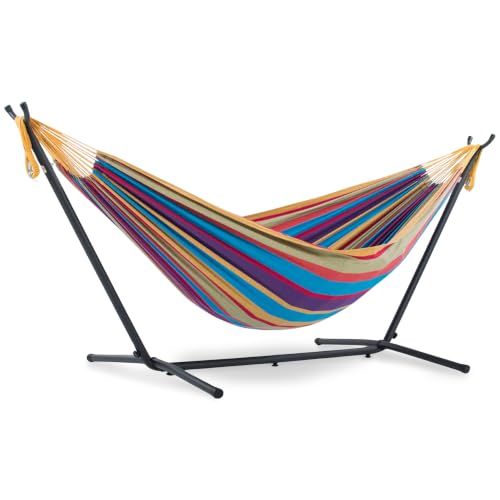
The Vivere’s stand is the reason it leads this guide. Classic hammock stands run twelve to fifteen feet; this zinc-coated steel frame holds its double cotton bed on a nine-foot base, which is the difference between “fits along a balcony” and “does not fit, full stop.” Measure your space against roughly ten clear feet to allow for the loaded bed, and against the width of a double bed, and you have the whole spatial cost. Assembly is tool-free push-together steel with spring pins — fifteen unhurried minutes the first time, faster after — and the entire set, stand included, breaks down into the included carry bag, so it can live in a closet between seasons and travel to your next apartment in one trip. The bed itself is the comfort benchmark of this guide: 94 by 63 inches of woven cotton, soft and breathable in a way nylon never is, on polyester end strings, with a 450 lb published capacity.
Pros. Smallest footprint of any full stand set we recommend; zero drilling, zero railing load, fully lease-safe; genuinely comfortable double cotton bed; packs into its own bag for storage and moving; quiet, rigid frame once settled — important with neighbours below.
Honest limitation. Nine feet is compact for a stand, but it is still nine feet: in a studio, this is a furniture commitment, not an accessory, and it will dominate a small room. The cotton bed also has to come in off an open balcony when it rains — cotton that stays damp mildews — so balcony owners without cover should plan the habit or choose nylon. And while the bag makes it movable, the steel stand makes the bag heavy enough that “portable” means car-portable, not carry-it-to-the-park portable.
Choose it if you have ten clear feet and want the set-and-forget apartment hammock. Skip it if your space is a studio where every piece of furniture must earn a second job daily, or your balcony is under about ten feet — the hanging picks below exist for you. Check on Amazon
Wise Owl Outfitters DoubleOwl Hammock
Who it suits. Renters whose hammock has to appear and disappear: balcony readers who hang between a post and a wall bracket they are allowed to use, living-room loungers with a stand, and anyone whose storage is one closet shelf.
The DoubleOwl is a gathered-end double in parachute nylon — 10 feet by 6 feet 6 inches of bed, 500 lb published capacity — that arrives with everything needed to hang it: two nine-foot tree straps and carabiners in the box. The whole kit measures about 30 ounces in its sewn-on stuff sack, which is the apartment-relevant number: this hammock stores in less space than a pair of shoes and deploys in about two minutes once you know your anchor points. For apartment use the anchor question is everything. Straps work on balcony posts, pergola uprights, exposed beams and sturdy door frames rated for the load — never on railings, which are not built for the sideways forces a hammock applies, and never on anything screwed into a wall you do not own without permission. Paired with a compact stand (the frames in Best Hammock Stand For Apartments Under $150 are sized for exactly this), it becomes a no-anchor indoor setup that folds away completely.
Pros. Stores in almost no space; straps included, so the listing price is the working price; fast to hang and faster to take down; the wide bed lies flat on the diagonal, so it works as a genuine nap bed and an emergency guest bed; doubles as your park and camping hammock, earning its keep outside the apartment too.
Honest limitation. It is only as good as your anchors, and many apartments simply do not have two legal ones — in which case you are buying a stand as well, and the value gap to the stand sets narrows. The loop-style straps offer fewer fine adjustments than premium daisy chains, the nylon is audibly crinkly for very light sleepers, and a nylon bed indoors will never feel as cosy as the cotton sets.
Choose it if storage space is your scarcest resource and you have posts, beams or a stand to hang from. Skip it if you have no anchor points and no room for a stand — no hammock solves that, and a good floor chair will serve you better. Check on Amazon
Sunnydaze Double Brazilian Hammock with Stand and Carry Bag
Who it suits. The indoor napper: someone whose hammock will live in a bedroom, a reading corner or a covered balcony, who values the deep, wrapped feeling of a Brazilian bed above all other qualities.
Sunnydaze’s combo wraps an 80 by 60 inch bed of tightly woven, colourfast cotton on a powder-coated steel stand in the same compact class as the Vivere’s, with a carrying case for breakdown and storage. The Brazilian weave drapes deeper than the Vivere’s bed — the fabric rises around your body — and for indoor napping that cocoon is the point: it is the hammock in this guide that most feels like being held, and the least like lying on something. The published capacity is 400 lb, the stand assembles without tools, and Sunnydaze’s one-year warranty and easy replacement-bed availability suit a product whose cotton bed is a consumable over years of use.
Pros. The best napping shape in this guide; compact stand footprint for indoor corners; colourfast cotton keeps a tidy appearance in a visible room; breaks down into its case for closet storage; replacement beds are easy to source when the cotton eventually tires.
Honest limitation. The 400 lb capacity is a genuine ceiling for two adults — fine for one plus a child, or two smaller adults, but not a rating to test. The deep drape that makes it a great nap bed makes it a mediocre social seat: two people sit in it awkwardly, and getting out of the cocoon gracefully takes practice. First assembly of the stand is also the fiddliest here; budget a second pair of hands for the final pin.
Choose it if the hammock is mainly your solo nap and reading spot indoors. Skip it if two adults will share it regularly, or if it must live on an uncovered balcony — cotton and weather are enemies. Check on Amazon
Best Choice Products 2-Person Brazilian-Style Double Hammock with Steel Stand
Who it suits. The first-apartment buyer furnishing on a real budget: someone who wants the complete stand-set experience — nothing else to buy, nothing to drill — at the lowest price in this guide, and who will move it between rooms and, eventually, to the next apartment.
The Best Choice Products set puts a Brazilian-style cotton-blend bed, 76 by 57 inches, on a tempered steel stand with an overall footprint of about 118 by 48 inches and a 450 lb published capacity — a number that beats the Sunnydaze and matches the Vivere at a much gentler price. At roughly 30 lb all-in it is the lightest stand set here, and it folds into its carrying bag, which in apartment terms means it stores on a closet floor instead of colonising a corner. The hand-tightened assembly is forgiving of the slightly-out-of-square floors older buildings specialise in, because you can snug the hardware down in sequence rather than fighting spring pins.
Pros. The cheapest complete, lease-safe setup in this guide; 450 lb capacity; lightest stand set, so it actually gets moved room to room; bag storage; woven-in stripes keep it looking decent in a living room rather than like camping gear.
Honest limitation. The cotton-blend bed is stiffer and less breathable than the pure-cotton Vivere and Sunnydaze beds, and it stretches over a season, so expect to re-tension the hang occasionally. The steel finish is the thinnest here: on a damp balcony, wipe the joints and feet, or expect cosmetic rust by the second year. It is a good first hammock, honestly priced — not a buy-it-for-a-decade piece.
Choose it if budget is the binding constraint and you want a stand set anyway. Skip it if you can stretch to the Vivere — in a visible living room, the fabric and finish difference is one you will see and feel daily. Check on Amazon
ENO DoubleNest Hammock
Who it suits. The apartment dweller who travels, camps or moves often, and wants one hammock that is best-in-class everywhere it goes — balcony today, campsite next month, next city’s apartment next year.
The DoubleNest packs the strongest fabric story in this guide into the smallest stored volume: 19 ounces in its own stuff sack, roughly the size of a large grapefruit’s bigger cousin. The bed — 9 feet 6 inches by 6 feet 4 inches of FreeWave 70-denier nylon taffeta, 400 lb capacity — is wide enough for a genuinely flat diagonal lay, which is what makes it a real sleep system and not just a lounger; more than a few apartment dwellers use one as a guest bed. Indoors it hangs from a compact stand or from permitted anchor points; on a balcony it rigs between posts with straps in minutes and comes down just as fast when the weather turns or the space is needed. The aluminium carabiners and triple-stitched seams are the details that separate it from budget nylon, and they show after years, not weeks.
Pros. Smallest, lightest serious hammock here — moving-day friendly in the extreme; best fabric feel among the nylon picks; proven design with a long track record; doubles as travel and camping gear, so it earns its storage space year-round.
Honest limitation. It ships with carabiners but no straps, so the working setup costs more than the hammock’s own listing — still within this budget, but budget for it. And like every hanging hammock, it is useless in a space with no legal anchors and no room for a stand; in a small studio, measure for a stand before assuming the 19-ounce pack size solves everything. Apartment shoppers with a little more room to spare should also compare the setups in Best Hammock For Small Patios Under $150, where this same hammock is judged on balcony geometry rather than storage.
Choose it if you want one premium hammock for home and travel. Skip it if you want everything in a single box at a single price — that is the Wise Owl, straps included. Check on Amazon
Kootek Camping Hammock, Double Size
Who it suits. The renter on the tightest budget, or the student in a first studio, who wants a hammock that costs very little, stores in a drawer, and can be replaced without pain if a move or a roommate claims it. We are reviewing it without a buying link: its Amazon listing bundles several sizes under one page, and the size data shown for the listing does not cleanly match the double configuration we researched, so we will not send you to a link we cannot stand behind. It is findable by name in seconds if it wins you over.
The double Kootek is a gathered-end parachute-nylon hammock of about 120 by 78 inches with a maker-stated 500 lb capacity, triple interlocking stitching, and — its standout feature — tree straps with an unusually generous run of adjustment loops, which makes dialling in the sag between awkwardly spaced posts far easier than with basic loop straps. The packed weight is a little over two pounds with straps and carabiners, the stuff sack is attached, and as a complete working kit it sits at the very bottom of this budget, leaving most of the $150 untouched for a stand if you need one.
Pros. The cheapest complete hanging kit we found from a recognisable maker; the many-loop straps genuinely help in odd apartment geometries; packs to drawer size; wide bed on paper, matching the biggest nylon picks.
Honest limitation. Everything about it is adequate rather than refined: the nylon is basic, the packed weight is the heaviest of the nylon kits here despite the budget positioning, and quality control varies more at this price — inspect seams and carabiners on arrival. The listing ambiguity that made it prose-only is also a shopping hazard: double-check the size selector before ordering, because the single and double share a page.
Choose it if you want to test apartment hammock life at minimal cost. Skip it if this is a long-term purchase — the Wise Owl costs a little more and is the better-made version of the same idea, with a listing we could verify cleanly.
Comparison Table
| Hammock | Space it needs | Bed size | Capacity | Storage | Best for |
|---|---|---|---|---|---|
| Vivere Double Cotton with Stand | ~9 ft floor, no anchors | 94 × 63 in | 450 lb | Carry bag | Best overall for apartments |
| Wise Owl DoubleOwl | Two anchors or a stand | 10 ft × 6 ft 6 in | 500 lb | ~30 oz stuff sack | Small balconies, tight storage |
| Sunnydaze Double Brazilian with Stand | ~10 ft floor, no anchors | 80 × 60 in | 400 lb | Carrying case | Napping indoors |
| Best Choice Products Brazilian Double with Stand | ~10 ft floor, no anchors | 76 × 57 in | 450 lb | Carrying bag, ~30 lb | Budget stand set |
| ENO DoubleNest | Two anchors or a stand | 9 ft 6 in × 6 ft 4 in | 400 lb | 19 oz stuff sack | Premium portable hammock |
| Kootek Camping Hammock, double | Two anchors or a stand | ~120 × 78 in | 500 lb (maker) | ~2 lb stuff sack | Cheapest compact kit |
How to Choose a Hammock for an Apartment
Measure the space, then measure it again loaded. A stand’s footprint is its frame size, but a hammock bed sags and swings beyond it. Give a compact stand set about ten feet of clear length and three feet of swing clearance on each side, and check the diagonal too — many balconies fit a nine-foot stand corner-to-corner that they cannot fit straight. If your balcony is under ten feet in every direction, stop shopping for stands and shop for anchors; our Best Hammock For Apartments Under $75 guide covers the even cheaper end of the same trade-off.
Know your lease before your hammock. Three rules cover most rentals. No drilling means no wall or ceiling anchors, period — a stand or strap-on-post setup is the compliant answer. No railing loads: balcony railings are designed for leaning forces, not the multiplied sideways pull of an occupied hammock, and many leases and building rules prohibit attaching anything to them. And check balcony rules specifically: some buildings restrict what can be visible from outside or stored on balconies, which is another argument for a hammock that packs into a closet. When in doubt, the stand sets in this guide keep you legal by default.
Protect the floor and the neighbours. Steel feet on hardwood want felt pads or a rug underneath — which also stops a stand creeping across smooth floors as you climb in. If your unit has downstairs neighbours, frame rigidity matters: the tighter-built stands here settle silently, while a flexing frame announces every movement. A rug under the setup is the cheapest silence you can buy.
Plan the storage before the purchase. Decide where the hammock lives in February. Stand sets need a closet floor or a corner for a bag roughly the size of a golf bag; hanging hammocks need a shelf. If neither exists, the hammock will live assembled, and you should buy it as furniture — which pushes you back to the cotton stand sets and away from camping nylon.
Dress the corner, not just the hammock. An apartment hammock corner usually wants light and a place for a drink more than it wants more hammock. The evening setups in Best Outdoor String Lights For Apartments Under $150 are sized for balconies, and a chair from Best Adirondack Chair For Apartments Under $100 gives guests somewhere to sit that is not your bed — small-space outdoor living is a system, and the hammock is only its centrepiece.
Indoor Hanging Without a Stand: What Is Actually Safe
Some apartment readers will look at the stand sets and ask the obvious question: can the hammock just hang from the walls or ceiling? The honest answer is “sometimes, with engineering, and rarely for renters.” A hanging hammock loads its anchors with far more than body weight — at a shallow hang angle the tension at each end multiplies, which is why a proper 30-degree sag matters — and those loads must land in structural timber: wall studs or ceiling joists, found with a stud finder and confirmed, never in drywall, plaster or brick veneer alone. Hardware must be rated for the load and installed into the centre of the stud. Done correctly by a homeowner, it is a legitimate and lovely setup. Done into the wrong material, it fails by pulling out, suddenly, under a sleeping person.
For renters, the analysis is shorter: it requires drilling into structure, which requires written permission that most landlords will not give for exactly the load reasons above, and an unpermitted installation risks both the deposit and the sleeper. Door-frame hanging products exist and deserve scepticism — frames and their trim are not rated for hammock loads in most buildings. This is why this guide’s apartment recommendations are stands and strap-on-post setups: they deliver the same hammock with none of the structural questions, and they leave with you. If you own your apartment and want the floating look, hire the anchor installation out or verify studs twice — this is the one part of hammock ownership where confidence must be earned by measurement, not enthusiasm.
The Hammock as Apartment Furniture
The strongest argument for an apartment hammock is that, unlike most leisure gear, it moonlights. As a guest bed it outperforms the air mattress it replaces: no pump, no slow leak at 3 a.m., no floor-level sleeping, and it stores in a bag instead of a closet shelf of bedding. Guests who have slept in a wide double hung with a deep sag routinely report sleeping well; the trick is the diagonal lay and a blanket beneath the sleeper, because a hammock loses heat from below even indoors. As a reading chair it replaces the accent chair many small living rooms cannot fit, with the stand sets sliding into the corner the chair would have taken. As overflow seating when friends visit, a hammock absorbs two people who would otherwise be on the floor.
Styling it as furniture rather than camping gear is mostly about the bed and the corner. Cotton beds in woven colours read as textiles; nylon reads as equipment, which is why the stand sets lead this guide for living rooms and the nylon picks lead for balconies and travel. A folded throw at the head end, a small side table, and a plant to soften the stand’s industrial lines complete the disguise. The apartment hammock that gets used daily is the one that looks like it belongs in the room — plan the corner, not just the purchase, and the most space-efficient seat in your home will also be the most fought-over.
Balcony Hammocks: Rules, Loads and Being a Good Neighbour
The balcony is where most apartment hammocks actually live, and it has its own physics and politics. Start with the structure. A balcony is engineered for distributed loads — people, planters, furniture spread across the slab — and a hammock stand concentrates its load on four small feet, while a hanging setup concentrates far larger forces on its two anchor points. The stand sets in this guide spread a household load across a frame designed for it, which is why they are the default balcony answer; hanging from balcony structure belongs only to posts and beams that are plainly structural, rigged with straps, and never — this bears repeating in every apartment context — to the railing, whose job is to stop a leaning person, not to hold a swinging one.
Then the politics, which decide whether the hammock survives the season. Many leases and building rules govern balconies specifically: what may be stored on them, what may be visible from the street, and what may be attached to anything. A hammock that packs into a closet is the diplomatic solution to all three — it is furniture when up and nothing at all when the inspection letter arrives. Noise travels down as faithfully as it travels up: a stand that creaks or feet that tap on a hard balcony floor will introduce you to your downstairs neighbours, so felt pads and a rug are courtesies as much as protections. Water is the third diplomacy: a cotton bed dripping after rain, or a planter perched above the hammock, will find the balcony below. Keep the bed’s drip line over your own slab, and your hammock will be the neighbour everyone’s fine with.
Wind is the balcony’s private weather. Above the first floor, a light nylon hammock left rigged becomes a sail and a slapping noise machine; take hanging hammocks down when you come in, which their two-minute setup makes painless. Cotton beds on stands ride out gusts better but should still be bagged ahead of real storms. None of this is a reason to skip the balcony hammock — a suspended seat above the street, in the evening air, is one of apartment life’s genuine luxuries — it is simply the operating manual that keeps the luxury welcome in the building.
Winter, Moving Day and the Long Game
An apartment hammock has two appointments a backyard hammock never faces: the off-season in a home with no spare space, and the move. Winter first. The stand sets break into their bags, and the bag’s dimensions decide where the hammock spends the cold months — measure your closet’s floor run or the under-bed clearance before assuming either works, because a bag that fits nowhere becomes a bag that lives in the hallway and a hammock that gets sold in February. The cotton bed itself should be washed, dried completely and stored loose with the bag, never sealed damp in plastic. Hanging hammocks have no such negotiation: a stuff sack in a drawer is the entire winter plan, which is the deepest structural advantage of the nylon picks in this guide and the reason frequent movers should weight it heavily.
Moving day sharpens the same point. Everything you own is suddenly measured in trips, boxes and elevator loads, and leisure gear is judged without mercy. A hanging hammock is a rounding error in that arithmetic. A stand set is one long bag — manageable, but a deliberate item on the list, and in a walk-up building it is a two-person carry that you will remember on the stairs. Neither is a reason not to buy; both are reasons to buy the size of hammock your actual life, not your aspirational one, will transport. The apartment dwellers who keep their hammocks for a decade are the ones who bought the version that survived three leases: light enough to move, compact enough to store, and comfortable enough that it was never a candidate for the donation pile. Choose with the third apartment in mind, and the hammock becomes one of the few pieces of furniture that has been with you everywhere.
Common Buying Mistakes
Hanging from the balcony railing. The most dangerous mistake in this category. Railings are not anchors; the lateral force of a hammock at working sag multiplies body weight, and railing failures drop people from height. Use posts, beams or a stand — never the railing.
Drilling first and reading the lease later. A pair of eye-bolts feels harmless until the deposit deduction arrives. Everything recommended here works without holes; if your heart is set on wall anchors, get written permission and hit studs, or do not do it.
Buying a full-size stand for a small balcony. Classic twelve-to-fifteen-foot stands are the most returned hammocks in the apartment market. The compact class exists precisely because of those returns — measure, and buy the nine-foot class or go hanging.
Forgetting the hammock has to come through the door. Stand sets ship in long boxes and assemble in place, which is fine; what is not fine is discovering the assembled set cannot move between rooms in a railroad apartment. If you will rearrange often, the lightest set or a hanging hammock is the honest choice.
Leaving cotton on an open balcony. Rain plus cotton plus time equals mildew and weakened fabric. Bring the bed in, use a cover, or choose nylon — but do not ignore the equation.
Final Recommendation
If you have one good spot and want the problem solved, buy the Vivere Double Cotton Hammock with Space-Saving Steel Stand: the most apartment-shaped stand set made, comfortable enough to be furniture, and bagged for the day you move. If your apartment cannot spare the floor, the Wise Owl DoubleOwl is the pick — a complete hanging kit that stores in a shoebox’s worth of space — with the ENO DoubleNest as the upgrade for fabric and travel, and the Best Choice Products set holding the budget line for stand buyers. The Sunnydaze is the nap specialist, and the Kootek the minimal-cost experiment. Measure your space, respect your lease, and the hammock will be the best-used square footage in the apartment.
Frequently Asked Questions
Can I put a hammock in an apartment without drilling?
Yes — that is exactly what the stand sets in this guide are for. A compact hammock stand holds the bed with no wall contact at all, and hanging hammocks can also be used indoors on a stand. Wall and ceiling anchors are the only setups that need drilling, and they are the ones renters should avoid without written landlord permission.
Will a hammock stand fit on a small balcony?
The compact nine-foot class of stand — the Vivere and its peers here — needs roughly ten feet of clear length once the bed is loaded, plus swing room. Many apartment balconies meet that along their long axis or diagonal; many do not. Measure the longest clear run, including the diagonal, before ordering, and if you are under ten feet, switch to a hanging hammock on posts or a smaller setup rather than forcing a stand.
Is it safe to hang a hammock from a balcony railing?
No. Railings are built for vertical and light leaning loads, not the strong sideways pull an occupied hammock generates, and a railing failure on a balcony is a fall from height. Hang from structural posts or beams with wide straps, or use a stand. This is the one rule in apartment hammock use with no exceptions.
Can a hammock work as a guest bed in an apartment?
A wide gathered-end or Brazilian double, hung with a deep sag so the lay is flat on the diagonal, sleeps one adult comfortably — the ENO DoubleNest and the cotton stand sets here are all used this way. It is a genuinely good small-apartment trick: the guest bed stores in a bag instead of occupying a room. Add a light blanket underneath the sleeper in cool rooms, since a hammock loses heat from below in a way a mattress does not.
How do I store a hammock in a small apartment?
Stand sets break down into their carry bags — plan on a footprint about the size of a golf bag in a closet or under a bed if the bag is slim enough. Hanging hammocks compress into their stuff sacks and need only a shelf or drawer. Either way, store the bed clean and fully dry; a cotton bed put away damp will mildew in storage just as it would on the balcony.
Will a hammock damage hardwood floors?
A stand’s steel feet can scratch or dent soft flooring under a shifting load. Felt pads or furniture glides under each foot, or a rug under the whole setup, prevent it — and a rug has the side benefits of stopping the stand creeping and muffling sound for the neighbours below.
What if my apartment has no balcony at all?
Then the hammock becomes indoor furniture, and the stand sets in this guide are built for exactly that: they stand on any flat floor, ask nothing of the walls, and turn a living-room corner or a spare-room wall into the seat everyone fights over. Pair the setup with a rug to protect the floor and quiet the frame, keep the swing path clear of the coffee table, and the indoor hammock is not a compromise — in winter it is arguably the best version of the product, because the weather variable disappears entirely.
How loud is a hammock stand in an apartment?
A well-built stand, assembled snugly, is close to silent in use: the sounds owners report come from loose hardware, unpadded feet on hard floors, and beds’ hardware clicking against the frame. All three are fixable in minutes — re-snug the joints, add felt pads or a rug, and check that hooks and chains are seated as the maker intends. If your building’s floors are thin, the rug matters twice: it silences your stand and keeps the peace with the neighbours below, which in apartment hammock ownership is a feature, not a courtesy.