Where to buy
Check the latest price, availability and delivery on Amazon. Orders are placed on Amazon. We may earn a commission from qualifying purchases.
- Best overall for backyards: Breeo X Series 30 Smokeless Fire Pit (Corten Steel) — Check on Amazon
- Best for frequent big fires: Solo Stove Yukon 2.0 Smokeless Fire Pit — Check on Amazon
- Best for medium yards and cooking: Breeo X Series 24 Smokeless Fire Pit (Corten Steel) — Check on Amazon
- Best complete kit for families: TIKI Brand Reunion 27.5-Inch Smokeless Fire Pit — Check on Amazon
- Best propane option for the deck zone: Outland Living Series 403 Fire Table — Check on Amazon
- The Blue Rooster Prairie Fire Chiminea — prose-only pick, see the review below for why this guide does not link it
Read the full guide ↓
Disclosure: As an Amazon Associate, dailyhomedecorating.com earns from qualifying purchases. Links to Amazon on this page are affiliate links; they cost you nothing extra. Listing details such as price and availability change often, so check the current Amazon listing before you buy.
The best fire pit for backyards under $1500 is a different purchase from the best fire pit for a patio, and the difference is freedom. A backyard gives a fire what a patio cannot: room. Room for a genuinely large bowl and the clearance circle it demands, room for eight chairs instead of four, room for a woodpile, room for sparks to land on gravel instead of furniture, and room for the fire to be the destination of the yard rather than a guest on the deck. This guide spends the budget the way backyards reward: on fire size first, then on the build quality that survives being left out in weather, then on the cleanup and cooking features that decide whether a big pit gets used weekly or becomes a rusting monument to one good summer. If your yard is mostly lawn with a seating area, a gravel fire zone, or a lower patio that opens onto grass, you are exactly the reader this ranking was built for.
That freedom also reorders the usual advice. On a patio, propane’s manners often win; in a backyard, wood’s radiant heat and scale usually should, because the smoke has somewhere to go and the circle is wide enough that a smokeless pit’s secondary burn can keep every seat pleasant. So the top of this list is wood, big, and heavy: the Breeo X Series 30, a 34.5-inch corten pit that uses nearly the whole budget and seats eight or more; the Solo Stove Yukon 2.0, the lighter stainless rival with the class’s easiest ash cleanup; and the Breeo X Series 24, the medium-yard answer with the best live-fire cooking rim in the business. The TIKI Reunion covers families who want the complete kit in one box, the Outland Living Series 403 fire table serves the deck-and-dining zone that most big backyards also have, and the Blue Rooster Prairie Fire — covered in prose because its maker currently sells it direct — is the traditional chiminea for the garden corner. Every pick was verified against manufacturer specifications and a current listing or maker page, and every pick burns wood or propane. As in all our fire pit guides, open-reservoir alcohol tabletop pits are excluded entirely: federal regulators have recalled them in large numbers and issued a standing stop-use warning after flame-jetting deaths and serious burns, and a backyard deserves better than that hazard class at any price.
The short version: most backyard buyers should go straight to the Breeo X Series 30 if the yard and the chair count justify it — check price on Amazon — or the Solo Stove Yukon 2.0 if weekly use and easy cleanup matter more than ultimate heft. Medium yards belong to the Breeo X24, family buyers to the TIKI Reunion, and mixed deck-and-lawn properties should seriously consider giving the propane table the deck while a wood pit owns the lawn. Whatever you choose, read the placement and safety section before the first burn: backyards forgive a lot, but fences, dry grass and overhanging trees still write rules that no budget overrides.
In this guide
Quick Picks
Short on time, or comparing several options at once? Each row below names a buyer type and the product that suits it, with a link to the listing where we verified one.
| Buyer type | Pick | Why it stands out | Link |
|---|---|---|---|
| Best overall for backyards | Breeo X Series 30 (Corten Steel) | A 34.5-inch, 94-pound corten pit rated for eight or more chairs, built to live outside permanently; check price on Amazon | Check on Amazon |
| Best for frequent fires | Solo Stove Yukon 2.0 | The big smokeless pit with a removable ash pan and the longest tested burns in its class | Check on Amazon |
| Best for medium yards | Breeo X Series 24 (Corten Steel) | The same corten build and cooking rim at a 27.5-inch scale that fits more yards | Check on Amazon |
| Best for families | TIKI Brand Reunion 27.5-Inch | Cover, stand and ash pan in the box — nothing left to buy before the first fire | Check on Amazon |
| Best for the deck zone | Outland Living Series 403 Fire Table | Certified propane table for the dining end of the yard — instant flame, no ash, drinks on top | Check on Amazon |
| Best traditional garden corner | The Blue Rooster Prairie Fire Chiminea | Cast aluminum that never rusts, with a chimney that lifts smoke above the seating | Prose-only — see review |
How we chose the best fire pit for backyards under $1500 picks
Backyard criteria start with the fire itself. We weighted true bowl size and heat radius first — the ability to warm a full circle of chairs on a cold evening — using bowl diameters and log specifications rather than headline rim sizes, because this tier’s marketing inflates the latter. Second came permanence: a backyard pit lives outdoors through weather, so we favored thick corten, cast aluminum and properly warranted stainless over thin painted steel, and checked what each warranty actually covers, especially rust-through. Third, cleanup at scale: big pits make big ash, so ash pans, included covers and sensible emptying routines scored heavily. Fourth, cooking: a backyard fire earns its keep on grill nights, so rim and accessory systems were compared as real features, not bullet points. Fifth, placement flexibility across lawn, gravel and patio surfaces, including what each maker says about the surface beneath. Finally, verification discipline: every linked pick resolves to a checked Amazon listing for a specific model; the one pick currently sold only by its maker is covered in prose with the reason stated. All picks were checked against recall records — none is subject to a CPSC recall — and the recalled open-reservoir alcohol category is excluded as a class.
A note on what we deliberately did not do: we did not fill this list with built-in kits, masonry or plumbed gas features. Those are construction projects with contractor pricing, not products a guide can verify a listing for, and this budget’s honest sweet spot is the top of the freestanding market — pits you can place this weekend and take with you if you move.
Detailed reviews
1. Breeo X Series 30 (Corten Steel) — best overall for backyards
Who it suits. The X30 is for the backyard that hosts: eight chairs around the fire, kids drifting in and out of the warmth, a grill grate working while the circle talks. If your yard has a natural fire zone — the far patio, the gravel circle, the flat spot under open sky — this is the pit that turns it into the property’s main room.
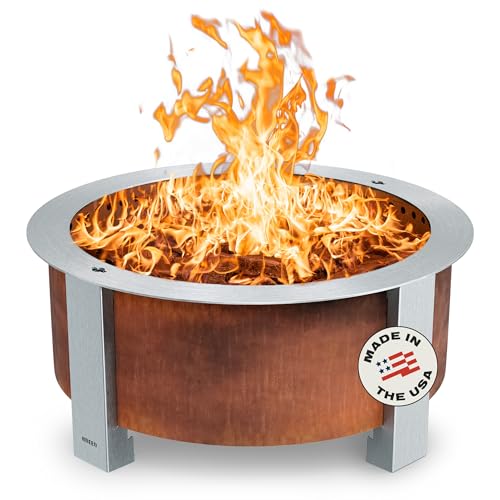
What it is. Breeo’s largest mainstream X Series pit stretches the formula to 34.5 inches outside diameter and 94 pounds of corten steel, built in Lancaster, Pennsylvania. The bowl scales with the rim, so the fire is genuinely bigger — a wide log lay that radiates heat outward to a big circle instead of sending it straight up in a narrow column. The X Airflow base feeds the burn, the double wall reburns smoke at the rim once the fire is established, and the flat rim accepts Breeo’s Outpost grill, griddle and other live-fire cooking accessories, which at this size stop being novelties and become a second outdoor kitchen. The maker’s list pricing for the Corten X30 sits near the top of this tier, and the Amazon offer we verified for the exact model is a marketplace offer rather than the maker’s own storefront — our sources note documents this, and the review repeats it because at this price the seller’s identity is part of the purchase. Confirm size and seller on the listing; the X Series is sold in four sizes with similar pages.
Pros. Scale done properly: more heat at chair distance, longer fires from bigger loads, and room to cook for the whole circle. The construction matches the money — thick corten that shrugs off weather and seasons, a patina that needs no cover and no cosmetic care, and warranty terms with limited lifetime structural coverage plus a defined rust-through period. Permanence is a feature here: at 94 pounds it will not blow over, wander, or be casually borrowed by weather.
Honest limitation. Permanence is also the limitation. You will place this pit once, carefully, because moving it is a two-person planned operation. It drinks wood — a long evening can burn what a mid-size pit burns in a weekend — so fuel storage and budget grow accordingly. It has no ash pan, so ash is shoveled, and the corten patina can stain light stone beneath it during the first wet season; on pale patios, set it on a pad or choose gravel, where it looks best anyway.
Choose it if your yard has the clear space, your gatherings run large, and you want the biggest freestanding wood fire this budget buys. Skip it if your yard is modest, your circle is four, or the pit must move seasonally — the X24 below is the same quality at a friendlier scale. Check on Amazon
2. Solo Stove Yukon 2.0 — best for frequent big fires
Who it suits. The Yukon is for the household that burns two or three nights a week and knows that the romance of a fire pit dies in its cleanup. If your last pit fell out of use because emptying it was a filthy chore, this is the corrective — at full backyard scale.
What it is. A 27-inch diameter smokeless pit in 304 stainless steel, about 19.8 inches tall on its stand and just 38 pounds in the configuration on the listing we verified — a remarkable figure next to the 62- and 94-pound Breeos, and the reason one person can wheel the Yukon from patio to lawn fire zone as the season changes. The 2.0 design’s removable ash pan and base plate lift out for emptying, which is the single most-used feature any owner will touch. The 360° Airflow system delivers the secondary burn that keeps a wide circle largely smoke-free on dry wood, and independent timed tests have credited the Yukon with the longest burns in the large smokeless class — fewer interruptions to feed the fire mid-conversation. Solo Stove’s lifetime warranty (through authorized sellers) and the category’s widest accessory catalog stand behind it.
Pros. Cleanup and mobility at a size that usually forbids both. The stainless finish suits yards where corten’s rust palette would fight the house’s style, the burn time is genuinely long, and the ecosystem — surrounds, lids, cooking tops, pellet adapters — lets the pit evolve with your use instead of being replaced by it.
Honest limitation. Light stainless dents: check the pit on delivery and expect the upper walls to heat-tint permanently, which owners either call character or chase with polish in vain. The inner fire measures roughly 23 to 24 inches across despite the 27-inch headline, and the maker is conservative about surfaces — the stand is not declared sufficient protection for decking, so lawn and stone placements should still use common-sense heat management on grass (a pit will scorch a dry lawn ring beneath it over a long burn).
Choose it if you burn often, host six or more, and want the big fire without the big cleanup or the fixed placement. Skip it if you want a pit that can be ignored for a decade without a cosmetic thought — corten forgives more. Check on Amazon
3. Breeo X Series 24 (Corten Steel) — best for medium yards and cooking
Who it suits. The X24 is the backyard sweet spot for the majority of yards: big enough for six chairs and a real fire, sized for the suburban lot where a 34.5-inch pit plus its clearance circle would crowd the fence line. It is also the cook’s pick — the one for households where the fire pit doubles as the grill.
What it is. The same Lancaster-built corten formula at 27.5 inches outside diameter with a fire bowl of about 23.5 inches, weighing 62 pounds. That bowl figure is the quiet headline: it is nearly the Yukon’s true fire size in a pit with substantially thicker steel, and the recommended 16-to-18-inch logs are a sensible match for standard firewood once split to length. The wide rim is the cooking story — it is engineered as a stable platform for Breeo’s Outpost grill system, griddle and kettle accessories, so searing over the same fire you sit around is a designed behavior, not a balancing act. The corten patina forms over the first season and then simply is the finish, protective and maintenance-free.
Pros. The best strength-to-size ratio in this guide, the best cooking ecosystem, and a warranty structure with real rust-through terms. In a medium yard it also leaves room for the rest of backyard life — the pit anchors a zone instead of consuming it. Independent testers rank it at or near the top of the large smokeless class year after year, which at this price is the closest thing to a consensus pick the category has.
Honest limitation. No ash pan — the shovel routine again — and the same corten caveats about staining pale surfaces and a patina that takes a season to even out. Six chairs is its honest circle; hosts of eight will feel the squeeze that the X30 exists to relieve. And while 62 pounds is movable by two people, nobody will enjoy doing it weekly.
Choose it if your yard is medium, your circle is four to six, and cooking over the fire is part of the plan. Skip it if you need eight seats (X30), weekly repositioning (Yukon), or a pit that disappears into storage (none of the premium wood pits do this well — see the apartment guide’s Bonfire instead). Check on Amazon
4. TIKI Brand Reunion 27.5-Inch — best complete kit for families
Who it suits. The Reunion is for family backyards where the fire pit is shared infrastructure: used by different people, cleaned by whoever drew the short straw, and expected to survive being everyone’s and therefore no one’s. The complete box and the easy emptying are designed for exactly that social reality.
What it is. TIKI’s largest pit is a 27.5-inch smokeless design in 16-gauge stainless steel with a black powder-coated finish, weighing about 60 pounds. The fire bowl inside measures roughly 19.6 inches across — the smallest of this guide’s three big wood pits, a fact we keep visible in the comparison table because headline diameters hide it — and the maker specifies logs under 16 inches. What the Reunion returns for that concession is completeness: a weather-resistant cover and a stand are in the box rather than on an accessory receipt, and the removable ash pan is rated by independent testers as the easiest to empty in the class. TIKI’s airflow design uses a ring of vents to feed the secondary burn, and the pit also accepts the brand’s pellet and pack fuel options for nights when splitting logs is not happening.
Pros. One purchase, everything included, and the morning-after routine is a two-minute job — the combination that keeps a family pit in weekly use. The black finish disappears into most backyard furniture schemes, and the backing is a large established outdoor brand with a real support operation and a two-year limited warranty.
Honest limitation. That warranty is the shortest here and includes no rust-through clause, so the included cover should actually be used — a family pit left bare through wet winters is testing the one weak term in its paperwork. The smaller bowl means a slightly less grand fire and shorter logs than the Breeos take, and the powder coat near the rim will show heat wear over seasons in a way bare corten and stainless simply absorb.
Choose it if the pit serves a family, the box contents matter, and easy emptying will decide whether it gets used. Skip it if you want the biggest fire, a lifetime warranty, or serious live-fire cooking kit. Check on Amazon
5. Outland Living Series 403 Fire Table — best for the deck zone
Who it suits. Most real backyards have two fire territories: the lawn circle and the deck or patio where dinner happens. The Series 403 owns the second one — for the household that wants flame at the dining end of the yard, lit between courses and off before dessert plates are cleared.
What it is. A 44-by-32-inch propane fire table, 24 inches tall, with an aluminum frame, resin wicker panels and a tempered-glass top. Its stainless burner is rated at 50,000 BTU and CSA certified, with push-button spark ignition and a manual flame valve; a 20 lb tank (not included) hides in the base, and the burner bed arrives dressed with Arctic Ice glass rocks. The listing states its placement terms plainly — generous clearance above, clear space at the sides, non-combustible floors only — which in backyard terms means: this is a patio and deck-zone appliance, not a lawn piece, and it should be placed with the same care as the wood pits even though its manners are better.
Pros. Instant, adjustable, smoke-free flame exactly where people eat and sit; a glass top that works as a table all day; no ash ever; and no smoke drifting across a dinner. For households splitting time between a wood pit’s theater and a table’s convenience, it is the natural second fire — and for households that will only buy one, it is the one that gets used on weeknights.
Honest limitation. Propane heat is a local warmth, not the radiant wash of a big wood bowl; on a cold night the far chairs will know the difference. The wicker look suits suburban decks better than rustic yards, and the tank is a recurring errand. It also cannot follow the party to the lawn — it lives where its clearances and floor requirements are met.
Choose it if your backyard life centers on a deck or dining patio and you want flame with furniture manners. Skip it if the lawn fire circle is your whole plan, or if only a wood fire will do. Check on Amazon
6. The Blue Rooster Prairie Fire Chiminea — best traditional garden corner (prose-only)
Who it suits. The Prairie Fire is for the backyard with a garden corner that wants a fireplace rather than a fire ring: a fixed seat or two, a wall of plantings behind, and a traditional silhouette that looks like it has always been there.
What it is. The Blue Rooster Company casts this chiminea in solid aluminum — about 44 inches tall and roughly 18 inches wide in its medium form — with a cast-iron burning grate, rain lid, spark-arrestor insert, mesh mouth screen and a small grill insert. The enclosed belly and chimney duct smoke upward instead of across the seating, and the mouth throws heat directionally at the chairs in front of it, which is the chiminea bargain: less circle, more focus. Cast aluminum is the material story — it cannot rust, needs no cover, and the maker backs its castings with a lifetime warranty. We cover it in prose because it is currently sold direct by the maker rather than on Amazon; our sources note records the direct-sale pricing, inside this tier.
Pros. Permanence without maintenance, the best spark containment of any wood pick here, and a footprint that fits corners and narrow garden rooms where round pits cannot keep their clearances. In a planted backyard it also simply looks right in a way stainless cylinders do not.
Honest limitation. The firebox takes short wood — roughly 12-to-14-inch logs per the maker — so a standard cord needs cutting down, and the fire is a hearth-sized glow rather than a bonfire. Heat goes one direction; arrange the seating wrong and half the group is watching the chimney’s back. Output suits a huddle of two to four, not a party.
Choose it if you have a defined garden corner, sit in a fixed small group, and want a set-and-forget traditional fireplace. Skip it if you host crowds, burn long logs, or want to order through Amazon. Buy it from the maker’s own store.
Side-by-side comparison
Backyard shoppers should read the bowl column first and the warranty column second — those two decide the next decade of evenings.
| Pick | Fuel | Size (outside / fire bowl) | Weight | Cleanup | Best for |
|---|---|---|---|---|---|
| Breeo X Series 30 | Wood | 34.5 in / scaled bowl | 94 lb | Shovel-out bowl | Big yards, 8+ chairs |
| Solo Stove Yukon 2.0 | Wood | 27 in / about 23–24 in | 38 lb (listing configuration) | Removable ash pan | Frequent fires, movable |
| Breeo X Series 24 | Wood | 27.5 in / about 23.5 in | 62 lb | Shovel-out bowl | Medium yards, cooking |
| TIKI Reunion | Wood | 27.5 in / about 19.6 in | About 60 lb | Removable ash pan; cover included | Families, complete kit |
| Outland Living Series 403 | Propane, 50,000 BTU | 44 × 32 in table | About 96 lb | None — no ash | Deck and dining zone |
| Blue Rooster Prairie Fire | Wood, chiminea | About 18 in wide, 44 in tall | Moderate | Grate and ash from the belly | Garden corners |
How to choose a fire pit for a backyard
Zone the yard before you shop. Walk the property and decide where fire actually belongs: far enough from the house, fences and the neighbor’s windows; under open sky, not under the oak you love; on a surface that can take heat — an existing patio, a gravel or stone circle you are willing to build, or a lawn spot you accept will be sacrificed to a permanent fire ring area. The zone’s size then dictates the pit: measure the clear circle you can honestly keep and subtract the clearance margins before falling for a 34.5-inch bowl.
Count chairs, then buy the bowl that warms them. Four chairs need a bowl around 19 to 20 inches; six need 23 to 24; eight or more need the X30’s class. Oversizing for a fantasy party wastes wood every ordinary evening; undersizing leaves the outer chairs cold at the party you actually throw twice a year. Buy for the eighty-percent evening and add a second smaller fire — or the propane table — for the exceptions.
Choose permanence or mobility honestly. Corten pits are landscape: place once, enjoy for a decade, never store. The Yukon’s lightness is a different philosophy — follow the season, store for winter, take it to the lake house. Neither is better; the mistake is buying 94 pounds of permanence for a yard you are still landscaping, or a featherweight pit for a wind-exposed permanent circle.
Plan the wood economy. Big backyard pits burn big wood. A serious season can run through a cord or more, which needs a dry, covered, off-ground store near the pit and a splitting routine for pits that take shorter logs. If that infrastructure sounds like a chore rather than a pleasure, that is useful information — it is the propane table’s strongest argument.
Think about the second season, not the first night. Covers, spark screens for windy or dry areas, a metal ash can, a fire poker set, and a seating circle that keeps every chair at the same distance — these are the purchases that separate a backyard feature from a backyard object. The TIKI’s included kit and the Breeos’ accessory depth are in this guide precisely because season two is where cheap pits go to die.
Setting up the backyard fire zone
The surface. Give the pit a foundation it deserves: a circle or square of pavers, poured concrete, or compacted gravel over landscape fabric, sized to the pit plus the clearance you will actually respect. Gravel is the forgiving budget choice — sparks land harmlessly, corten runoff stains nothing anyone can see, and re-leveling is a rake’s work. Pavers look sharper and make chair legs behave. Either beats the scorched lawn ring that an unplanned season leaves behind, and either can be built in a weekend for less than the price difference between the pits in this guide.
The seating geometry. Chairs belong in a circle at a consistent distance — close enough that every seat feels the heat on a cold night, far enough that knees are comfortable on a mild one. In practice that means placing the ring, sitting in it during a test burn, and adjusting once, rather than trusting a tape measure. Leave one gap in the circle on the prevailing-wind side: it is where the fire-tender works, where the wood comes in, and where a late guest can join without climbing past knees. A low bench or two in the ring earns its place for kids and for the dog-adjacent sprawl that chairs discourage.
The support kit. A backyard fire zone runs on unglamorous equipment: a metal ash can with a lid, stored on stone away from the woodpile; long-handled poker and tongs; a spark screen sized to the pit for dry and windy nights; fire gloves for grate work; and a wood store — covered, off the ground, close enough to feed the fire and far enough to be safe from it. If cooking is part of the plan, add a side table for trays and a thermometer, and keep them in a deck box at the zone rather than trekking to the kitchen. None of this is expensive; all of it is the difference between a fire zone and a fire pit sitting in a yard.
The seasonal rhythm. Stainless pits benefit from a cover in leaf-fall and pollen season even though they can survive without one; corten asks for nothing but an annual ash-out and a check that drainage holes are clear; chimineas want their rain lids on. Propane tables want a tank check and a burner-bed once-over each spring, and their covers used in winter. Build these ten-minute rituals into the season changes and the pit you bought for a decade will look like it.
Fire safety and clearance rules for backyard fires
A backyard is the most forgiving place to burn and the place where people get careless, so the rules deserve the same respect as anywhere. Site the pit on a level, non-combustible surface — stone, concrete, pavers or a prepared gravel bed. Grass under and around a pit will scorch and die back, and in dry conditions a lawn placement becomes a genuine ignition risk; if you burn on grass at all, use the maker’s stand or a proper pad, soak the surrounding area in dry weather, and never burn during local fire-danger or burn-ban periods. Keep generous clearance on all sides from fences, sheds, play equipment, woodpiles and plantings, and a fully open sky above — no tree canopy, no pergola, no string-light catenary sagging over the bowl. Many municipalities set the rules numerically, including minimum distances from structures for recreational fires and the requirement that a competent adult attend the fire with a means to extinguish it; look yours up once and place the pit accordingly forever.
Wind is the backyard variable: a smokeless pit still throws sparks when a gust hits during loading, so keep a spark screen for breezy nights, position the pit so prevailing wind carries smoke away from your own and your neighbors’ windows, and skip the fire entirely on high-wind or red-flag days. Keep water, a hose or an extinguisher within reach, supervise children and dogs as if the bowl were a stove — because it is one — and let fires die down rather than dousing a hot corten or cast pit with cold water, which stresses hot metal. Ash waits until it is fully cold, days not hours, and goes into a metal container stored away from the house and the woodpile. Propane tables follow their own listing rules — the Outland specifies its top and side clearances and non-combustible floors — and tanks live upright outdoors with valves closed. Finally, the standing exclusion of this site: no open-reservoir alcohol tabletop pits anywhere in the yard either; federal regulators have recalled that category repeatedly after flame-jetting deaths and severe burns, and a backyard’s size does not dilute that hazard.
Common mistakes backyard buyers make
Placing the pit for the photo, not the wind. The prettiest spot is often the smokiest seat in the county. Spend one breezy evening observing where air actually moves across your yard before committing 94 pounds to a location.
Forgetting the neighbors’ windows. Smoke that clears your fence can pool in the yard beyond it. Smokeless pits, dry wood and reasonable hours are the diplomacy; a conversation before the first big burn is the insurance.
Buying the party size for everyday life. An X30 lit for two people is a hungry, wasteful fire. Match the bowl to your typical circle and let the twice-a-year crowd pull chairs closer.
Skipping the spark screen in dry country. If your region has a dry season, the screen is not an accessory; it is the difference between a fire pit and a fire report. Several makers sell theirs separately — budget for it at purchase.
Storing wood against the house. A cord stacked by the back door is a pest bridge and, near a fire feature, a fuel arrangement you did not intend. Keep the woodpile at a sensible distance from both the house and the pit.
A note on built-in and DIY backyard fire pits
Every large backyard eventually attracts the same suggestion: why not build a permanent pit — a stone ring, a block surround, a kit of retaining-wall bricks — for less than these manufactured prices? The honest answer is that a well-built DIY pit is a legitimate rival on cost and permanence, and a badly built one is a cracked, smoking liability that no warranty will ever rescue. If you build, the manufactured pits in this guide still teach the design rules: a bowl sized to your chair count, a non-combustible base that extends well beyond the ring, drainage so the pit is not a pond by November, and steel thickness where the heat lives — which is why so many good DIY builds quietly become a manufactured insert (a smokeless ring dropped into a block surround) rather than a pure masonry fire. Readers who want the project should treat it as construction, with local fire-distance rules checked first. Readers who want a fire this weekend should buy from the list above; that is the entire case, and it is a fair one.
Final recommendation
For the classic backyard brief — a big wood fire, a wide circle, a pit that outlasts the patio furniture — the Breeo X Series 30 is this tier’s peak and worth its place near the top of the budget: check price on Amazon. If your burning is weekly and your patience for cleanup is not, the Solo Stove Yukon 2.0 is the smarter daily driver. Medium yards should take the Breeo X24 and its cooking rim without a second thought, families should take the TIKI Reunion’s complete box, and two-zone properties should let the Outland Living Series 403 table civilize the deck while wood owns the lawn. The Blue Rooster Prairie Fire, bought direct, remains the connoisseur’s garden-corner answer. Place it on stone, respect the wind, and any of these will still be the center of your yard long after the price is forgotten.
Planning the rest of the yard around the fire? Compare the full tier in Best Fire Pit Under $1500, the smaller-patio ranking in Best Fire Pit For Small Patios Under $1500, the gas-only list in Best Propane Fire Pit For Backyards Under $1500, and seating at matching scale in Best Patio Dining Set For Backyards Under $1500 and Best Outdoor Sectional For Backyards Under $1500.
Frequently asked questions
Can I put a fire pit directly on my lawn?
You can, and the lawn will show it: heat scorches a dead ring, and in dry conditions the risk stops being cosmetic. A stone, paver or gravel pad is the right foundation for a permanent backyard pit, with the maker’s stand or a heat pad as the minimum for occasional placements. Check local rules too — some jurisdictions require a non-combustible base explicitly.
How far should a backyard fire pit be from the house and fence?
Follow your local code first — many municipalities specify a minimum distance from structures for recreational fires — and your model’s manual second. In practice, plan for a generous clear radius on all sides and open sky above; if your only available spot crowds a fence line or sits under branches, a smaller pit or the propane table is the honest answer.
Which of these pits is best for cooking?
The Breeos, by design: their rims are built as platforms for the maker’s grill and griddle system, so the pit and the cooktop are one engineered object. The Yukon cooks well with its add-on tops, and the Prairie Fire’s small grill insert handles a couple of steaks or a kettle — but for regular live-fire cooking, the X24 and X30 lead.
Will a smokeless pit keep smoke out of my neighbors’ yard?
It will reduce it a great deal once the fire is hot and the wood is dry — that is the technology working as intended. It will not eliminate startup smoke or the smell of wood fire, and wind can carry both over a fence. Dry hardwood, a fire built below the rim vents, and a heads-up to the neighbors remain part of the package.
Why is the chiminea not linked to Amazon?
Because The Blue Rooster currently sells the Prairie Fire through its own store and the model was unavailable on Amazon when we verified this guide. It is a current, supported product with maker-direct pricing inside this tier, so we covered it in prose rather than dropping a genuinely suitable pick or linking an unverified listing.
What about a fire pit insert for an existing brick ring?
It is a legitimate backyard path — a quality smokeless insert dropped into a sound masonry ring combines a built look with engineered airflow, and several makers in this guide sell insert formats of their pits. Judge it by the same rules as the freestanding picks: bowl diameter, steel thickness, drainage beneath, and clearance from the ring to anything combustible. If the existing ring is cracked, too small for the insert’s clearances, or built against a fence, rebuild first and insert second.
How much wood will a big backyard pit actually use?
More than new owners expect. A long evening in a 30-inch-class pit can consume what a small pit burns across a weekend, and a full season of weekly fires adds up to a substantial fraction of a cord. Budget the wood store — dry, covered, off the ground — as part of the purchase, or let that arithmetic argue for the propane table.