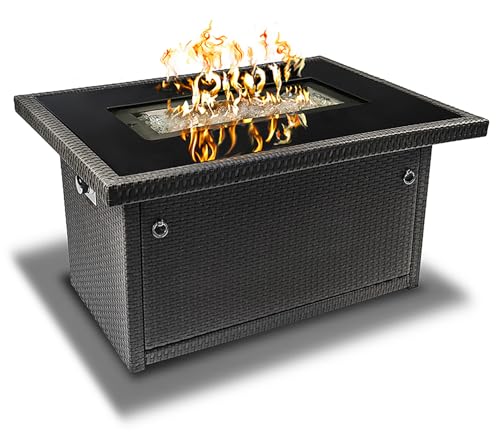
Where to buy
Check the latest price, availability and delivery on Amazon. Orders are placed on Amazon. We may earn a commission from qualifying purchases.
- Best if your lease allows gas on a ground patio: Outland Living Series 403 Fire Table — Check on Amazon
- Best small wood pit where wood fires are permitted: Solo Stove Bonfire 2.0 with Stand — Check on Amazon
- Elementi Manchester 42-Inch Concrete Fire Table — prose-only pick, see the review below for why this guide does not link it
- Real Flame Aegean 36-Inch Round Fire Table — prose-only pick, see the review below for why this guide does not link it
- Breeo X Series 19 Smokeless Fire Pit — prose-only pick, see the review below for why this guide does not link it
- The Blue Rooster Prairie Fire Chiminea — prose-only pick, see the review below for why this guide does not link it
Read the full guide ↓
Disclosure: As an Amazon Associate, dailyhomedecorating.com earns from qualifying purchases. Links to Amazon on this page are affiliate links; they cost you nothing extra. Listing details such as price and availability change often, so check the current Amazon listing before you buy.
Before any product talk, this guide on the best fire pit for apartments under $1500 has to start with the fact that decides the whole purchase: on most apartment balconies, a real-flame fire pit is not allowed — at any price, of any size, burning any fuel. Most leases ban open flames on balconies outright. Many local fire codes go further, prohibiting open-flame cooking and heating devices on the balconies of multi-family buildings and within a set distance of combustible construction, with narrow exceptions that vary by city. Building insurers dislike balcony flames for the same reason firefighters do: a balcony fire sits directly below the upstairs neighbor’s balcony, beside siding and stored belongings, with no safe clearance in any direction. A $1500 budget does not change one word of this. No fire pit in this guide — not the smallest, not the cleanest-burning, not the propane ones with instant shutoff — should be bought for a balcony until you have read your lease’s fire clause and your local code and found, in writing, that the use is permitted. If it is not permitted, the honest recommendation of this entire article is: do not buy a fire pit for the balcony. Spend the budget on the ground-floor patio if your unit has one and the rules allow it there, on a shared courtyard setup your landlord approves in writing, or on flameless ambience instead.
So who is this guide actually for? Apartment dwellers whose situation is one of the legal ones: a ground-level private patio on a townhouse or garden-style unit where the lease permits a gas or wood appliance with proper clearances; a rented house or duplex being searched as an “apartment”; or a condo owner whose association rules allow a certified propane unit on a non-combustible patio. For those readers, the apartment lens changes the ranking completely compared with a backyard guide. Instant shutoff becomes the top safety feature, which pushes propane ahead of wood. Absence of sparks and embers matters more than raw heat. Footprint matters because the patio is small and shared walls are close. Storability matters because many renters must be able to move the unit for inspections or at lease end. And smoke discipline matters because your smoke is your neighbor’s smoke, at a distance of feet, not yards. The six picks below are ranked by exactly those criteria, and every review states plainly which living situations the product does and does not fit. One more filter applies to this whole category and we applied it before ranking: no tabletop alcohol fire pits appear here. Federal regulators have recalled those open-reservoir liquid-fuel products in large numbers and issued a standing stop-use warning after flame-jetting deaths and severe burns; a small footprint is not worth that hazard profile, and apartment proximity would make it worse.
The short version: where a certified propane appliance is permitted on a ground-level, non-combustible patio, the Outland Living Series 403 fire table is the strongest apartment pick in this tier — a real table, a concealed tank, a flame that dies the second you turn the knob — check price on Amazon. Where wood fires are genuinely permitted and you want the smallest serious wood pit, the Solo Stove Bonfire 2.0 with stand is the one. The Elementi Manchester and Real Flame Aegean, both covered in prose for reasons their reviews explain, are the design-led propane alternatives. The Breeo X Series 19 and Blue Rooster Prairie Fire round out the list for ground patios with room and permission for wood. Read the permission and safety sections before the reviews if you are in any doubt about your situation — in this category, the rules are the review.
In this guide
Quick Picks
Short on time, or comparing several options at once? Each row below names a buyer type and the product that suits it, with a link to the listing where we verified one. Every row assumes the use is permitted where you live — see the warning above the table in the intro if you skipped it.
| Buyer type | Pick | Why it stands out | Link |
|---|---|---|---|
| Best where gas is permitted | Outland Living Series 403 Fire Table | CSA-certified propane, instant shutoff, no embers, tank concealed in the base; check price on Amazon | Check on Amazon |
| Best small wood pit | Solo Stove Bonfire 2.0 with Stand | A 19.5-inch smokeless pit at about 25 pounds with stand — the easiest wood fire to place, move and store | Check on Amazon |
| Best designer propane | Elementi Manchester 42-Inch | Cast-concrete fire table with a certified burner, bought through specialty dealers | Prose-only — see review |
| Best compact round propane | Real Flame Aegean 36-Inch Round | A smaller round footprint with push-button ignition and a natural-gas conversion kit in the box | Prose-only — see review |
| Best small premium wood pit | Breeo X Series 19 | The compact corten Breeo for a ground patio with permission for wood and room to keep clearances | Prose-only — see review |
| Best directional wood heat | The Blue Rooster Prairie Fire Chiminea | An 18-inch-wide cast-aluminum footprint that throws heat forward and sends smoke up a chimney | Prose-only — see review |
How we chose the best fire pit for apartments under $1500 picks
We ranked this list by apartment reality, not backyard ideals. The first criterion was permission fit: we favored fuel types and form factors that have any plausible path to being allowed — certified propane appliances with instant shutoff ahead of open wood fires, and wood picks only where their size and containment suit a ground patio with genuine clearances. The second was hazard shape: no sparks, no embers, no ash handling and no pooled fuel scored highest, which is also why the recalled category of open-reservoir alcohol tabletop pits is excluded entirely, as it is across this site. The third was footprint and storability: every pick had to fit a small patio’s geometry and, for renters, be movable without a truck and a crew. The fourth was smoke discipline, because in attached housing your smoke output is a neighbor-relations issue measured in feet. The fifth was verification discipline: linked picks resolve to specific Amazon listings we checked; picks whose listings we could not verify an offer on — or which are currently sold direct by their makers — are covered in prose with the reason stated, never linked on a guess. Finally, we checked every pick against recall records; none of the products in this guide is subject to a CPSC recall.
One consequence of those criteria deserves emphasis, because it inverts the usual advice: at this budget, apartment shoppers often assume a bigger, more expensive pit is a better pit. Here the opposite holds. The premium features that matter in attached housing are shutoff speed, certification, containment and size discipline — several of which peak in the middle of this tier, not at its top. Spending the whole budget is optional; spending it on the wrong form factor is the mistake this guide exists to prevent.
Detailed reviews
1. Outland Living Series 403 Fire Table — best where gas is permitted
Who it suits. The Series 403 suits the apartment or townhouse dweller with a ground-level, non-combustible patio and a lease or association rule that permits a certified propane appliance — the single most common legal path to a real flame in attached housing. If your permission is gas-only, this is effectively the shortlist’s head and tail.
What it is. A 44-by-32-inch rectangular fire table, 24 inches tall, on an aluminum frame with resin wicker panels and a tempered-glass top. The stainless burner produces 50,000 BTU, carries CSA certification, and lights with a push-button spark ignition with a manual valve for flame height — and, critically for this use case, it shuts off completely and immediately when you close the valve, with no embers, no cooldown and no ash. A standard 20 lb propane tank (not included) hides inside the base on a pre-attached hose, and the burner bed is dressed with the maker’s Arctic Ice glass rocks. The listing itself prints the placement rules: a large clear volume above, clear space at the sides, non-combustible floors only, and no enclosed areas.
Pros. Every apartment-relevant virtue is present: instant off, zero sparks, zero smoke to drift into a neighbor’s window, a table surface that earns its footprint between burns, and certification paperwork you can show a landlord or association when asking permission — that last point is underrated, because “CSA-certified appliance with a shutoff valve” is a conversation a property manager can actually say yes to. The concealed tank keeps a small patio visually calm.
Honest limitation. Forty-four inches is a real footprint: on a small patio it becomes the dominant object, and the required clearances shrink the usable configurations further — measure with the clearance numbers, not the table’s edges. It is also propane heat, which is gentler and more directional than a wood fire’s radiant wash. And none of this overrides the threshold question: if your lease bans gas appliances on patios too, this pick is not for you, and no review should pretend otherwise.
Choose it if you have written permission for a certified gas appliance on a non-combustible ground patio and want flame plus function in one footprint. Skip it if your permission is unclear (get it in writing first), your patio cannot meet the clearances, or your rules allow wood but not stored propane tanks, which some associations restrict separately. Check on Amazon
2. Solo Stove Bonfire 2.0 with Stand — best small wood pit where wood is permitted
Who it suits. The Bonfire suits the renter in a house, duplex or garden unit whose lease permits wood fires on a ground patio and who needs the fire to be small, movable and storable. It is the wood pick for people whose living situation might change at the next lease renewal — it moves with you in one trip.
What it is. Solo Stove’s mid-size smokeless pit: a 19.5-inch diameter double-wall cylinder in 304 stainless steel, about 16.75 inches tall and roughly 25 pounds in the with-stand configuration on the listing we verified. The 360° Airflow design reburns smoke at the rim once the fire is hot, and the 2.0 update adds a removable ash pan and base plate, so cleanup is a lift-out rather than a tip-over. The included stand raises the pit off the ground — helpful, though as the safety section explains, a stand is not a magic permission slip for heat-sensitive surfaces, and the maker’s own guidance is conservative about decks. A nylon carry case is part of the package, which is how a fire pit becomes apartment-compatible: it can live in a closet between uses.
Pros. Size and weight are the pros — this is the only wood pick here one person can carry upstairs-free to storage, reposition to suit the wind, or take to a friend’s permitted yard. The smokeless burn, once established with dry wood, is the most neighbor-considerate wood fire available at any size. Cleanup is genuinely easy, and the lifetime warranty from an authorized purchase protects a renter’s investment across moves.
Honest limitation. It is still a wood fire: sparks at loading, smoke at startup, ash to dispose of cold, and a hard no in the many leases and codes that ban wood-burning on any part of an apartment property. The 19.5-inch fire also serves four people comfortably rather than a crowd, and the thin stainless dents if it is knocked around in storage. Do not let its tidiness talk you into balcony use — it does not belong on one, full stop.
Choose it if wood is permitted on your ground patio, your group is small, and storability matters as much as the fire. Skip it if your permission is gas-only, your patio is a balcony (always skip, for every pick), or you need heat for six or more. Check on Amazon
3. Elementi Manchester 42-Inch Concrete Fire Table — best designer propane (prose-only)
Who it suits. The Manchester suits the condo or townhouse owner — more often an owner than a renter, given its weight and permanence — whose association permits a gas fire table and who wants the patio to look designed rather than equipped.
What it is. A 42-inch round fire table hand-cast from glass-fiber reinforced concrete by Elementi, a maker whose entire catalog is fire tables. The propane burner is rated at 45,000 BTU with electronic ignition, lava rock is included, and the model carries CSA and CE certification; a natural-gas variant exists for owners with a plumbed line, which is the one configuration in this guide an apartment-adjacent buyer might genuinely have in a townhouse. We cover it in prose because its Amazon listing showed no featured offer we could verify at checking time; it is sold through specialty outdoor retailers and dealers, and our sources note records the in-tier sighting we found through that channel.
Pros. The concrete body will not rust, dent or heat-tint, and its visual weight makes a small patio feel intentional. Propane manners — instant on, instant off, no smoke — are the apartment-correct ones, and the round format seats a circle without a head-of-table hierarchy. Specialist-maker support is a real plus for a plumbed or long-term installation.
Honest limitation. This is the least renter-friendly object in the guide: concrete is effectively permanent once delivered, freight-style delivery to an apartment address can be an adventure, and finish variants price very differently — some list above this tier, so confirm the exact variant before ordering. Association approval for something this permanent should be documented before purchase, not assumed.
Choose it if you own your unit, have documented gas permission, and want the design-led option. Skip it if you rent, move often, or need Amazon’s checkout and returns. Buy through a specialty dealer and confirm the fuel variant — propane and natural gas are different SKUs.
4. Real Flame Aegean 36-Inch Round Fire Table — best compact round propane (prose-only)
Who it suits. The Aegean suits the permitted-gas patio that cannot fit the Outland’s rectangle: a round 36-inch table tucks into a corner seating arrangement more gracefully, and its dual-fuel flexibility suits owners who might plumb a gas line later.
What it is. Real Flame’s Aegean in its 36-inch round form is a powder-coated steel propane fire table rated at 50,000 BTU, with a stainless burner, push-button ignition and adjustable flame. The box is unusually complete for the class: burner lid, lava rock filler, leveling feet, an 8-foot LP hose with regulator, a tank seat, a storage cover — and a natural-gas conversion kit, which is why owners like it: run it on a 20 lb tank now, convert it if a line arrives. Real Flame’s gas pits are CSA certified. We could not verify a standard Amazon listing ASIN for this exact model during research — it is sold through big-box and specialty retailers — so it is covered in prose, with the retailer sighting we found recorded in our sources note.
Pros. The footprint is the friendliest of the propane tables here, the conversion kit removes the fuel-lock-in problem, and the included cover matters for a unit that will live on an exposed patio. Round tables also keep every seat at equal distance from the flame, which suits two-to-four-person apartment patios better than a long rectangle.
Honest limitation. On this 36-inch model the propane tank does not hide inside the base — it sits outside the table on the included tank seat, which costs visual tidiness and a little floor space, and the hose run needs planning so nobody trips over it in the dark. Powder-coated steel also asks for the cover to be used; left bare through wet winters it will age faster than the Outland’s aluminum or the Elementi’s concrete.
Choose it if you have gas permission, a smaller or corner-shaped patio, and value the natural-gas conversion path. Skip it if the external tank breaks your layout, or if you need the one-click Amazon purchase the linked picks offer.
5. Breeo X Series 19 — best small premium wood pit (prose-only)
Who it suits. The X19 suits the ground-patio household with explicit permission for wood fires, a non-combustible surface with real clearance around it, and a preference for buying a pit once: it is the compact member of the heaviest-built family in this guide.
What it is. Breeo’s smallest X Series pit measures 22 inches across the outside, weighs about 47 pounds, and is built in Pennsylvania from the same corten steel as its larger siblings, with the same X Airflow base ventilation, smoke-reburning double wall and accessory-ready cooking rim. The maker positions it for two or more chairs and small spaces, and it takes the same grills and lids as the bigger models. We cover it in prose because we could not verify a clean Amazon ASIN for the X19 configuration during research — Breeo sells heavily through its own store, and our sources note records the maker’s list positioning for the Corten version, comfortably inside this tier.
Pros. Build quality per inch is the best in this guide: thick corten that lives outside permanently, a cooking rim that turns a two-person fire into a two-person grill night, and the family’s warranty structure behind it. For a small ground patio it delivers the premium wood experience without the 27-inch pits’ clearance appetite.
Honest limitation. Forty-seven pounds is not storable in any practical renter sense — this is a leave-it-in-place pit, and its corten patina can stain pale patio surfaces as it weathers, so placement on a small light-colored patio needs a pad and forethought. It is also unambiguously a wood fire, with wood’s full permission problem in attached housing: if your lease’s answer on wood is no, this pit’s quality is irrelevant.
Choose it if wood is permitted on your ground patio, you burn for two to four people, and permanence is a feature. Skip it if you need to store the pit between uses (take the Bonfire), or your surface cannot take corten runoff.
6. The Blue Rooster Prairie Fire Chiminea — best directional wood heat (prose-only)
Who it suits. The Prairie Fire suits the permitted ground patio that is long and narrow, where a round pit’s clearances do not fit but a slim footprint against a wall line does — and where directing heat forward, at seated people, beats radiating it in all directions.
What it is. A traditional chiminea cast in solid aluminum by The Blue Rooster Company: about 44 inches tall and only about 18 inches wide in its medium form, with a cast-iron burning grate, a rain lid, a spark-arrestor insert and a mesh mouth screen, plus a small grill insert for cooking. The chimney shape is the functional point: smoke is ducted up and away from seated guests rather than washing across the patio, and the enclosed belly contains the fire more completely than an open bowl. The maker sells direct with a lifetime warranty on its castings. We cover it in prose because it is currently unavailable on Amazon — the maker is the channel — and our sources note records its direct-sale pricing, inside this tier.
Pros. The footprint is the smallest in this guide, cast aluminum cannot rust, and the spark containment and upward smoke path are genuinely apartment-adjacent virtues on a permitted ground patio. It also reads as a fireplace, which some associations and landlords view more kindly than an open bowl — though that is an impression to test in writing, not to rely on.
Honest limitation. The firebox is small and takes short logs — the maker lists roughly 12-to-14-inch wood — so standard splits need cutting, and heat output suits a huddle, not a party. The mouth radiates in one direction, so seating must arrange itself in front. And it remains a wood-burning appliance with the full permission burden that carries in attached housing.
Choose it if your permitted patio is narrow, you sit in a fixed arrangement, and you want contained, directional heat. Skip it if you seat a circle, burn standard-length logs, or need to buy through Amazon.
Side-by-side comparison
Read this table through the apartment lens: the columns that decide your purchase are permission fit and footprint, not raw fire size.
| Pick | Fuel | Footprint | Shutoff / containment | Storable? | Best for |
|---|---|---|---|---|---|
| Outland Living Series 403 | Propane, 50,000 BTU, CSA | 44 × 32 in | Instant valve shutoff; no embers | No — furniture | Permitted gas patios |
| Solo Stove Bonfire 2.0 + Stand | Wood, smokeless | 19.5 in round | Open fire; burns down | Yes — about 25 lb, carry case | Permitted wood, small groups |
| Elementi Manchester | Propane (NG variant), 45,000 BTU, CSA | 42 in round | Instant shutoff; electronic ignition | No — cast concrete | Owners, design-led patios |
| Real Flame Aegean 36 | Propane, 50,000 BTU, CSA; NG kit included | 36 in round | Instant shutoff; tank sits outside base | No | Compact corners, future NG |
| Breeo X Series 19 | Wood, smokeless | 22 in round | Open fire; heavy corten bowl | No — about 47 lb | Permitted wood, permanent spot |
| Blue Rooster Prairie Fire | Wood, chiminea | About 18 in wide | Enclosed belly, spark screen, chimney | Semi — two-person move | Narrow patios, directional heat |
How to choose a fire pit for an apartment
Start with the permission, then the patio, then the product — in that order. Most apartment fire pit purchases fail before the box arrives because the order was reversed: a pit chosen online meets a lease that forbids it. So step one is documentary, not commercial. Find your lease’s clauses on open flames, grills and balcony or patio use; email your landlord or association a specific question naming a fuel type (“a CSA-certified propane fire table with a 20 lb tank, used on our ground-floor concrete patio”) rather than a vague one (“a fire pit?”), because specific questions get usable answers; and check your city’s fire code summary, which most municipalities publish in plain language. Keep the written yes. If the answer set is no, stop here with our blessing — the flameless route in the safety section is a genuinely good evening, not a consolation prize.
Match the fuel to the permission you actually obtained. Permissions in attached housing usually come in three shapes: gas-only (the most common yes), wood-allowed-on-ground-patios (typical of rented houses and duplexes), and nothing at all. Gas-only means the propane picks — Outland, Elementi, Aegean — and it also means checking the separate question of tank storage, which some buildings regulate even when use is allowed. Wood-allowed opens the Bonfire, the Breeo X19 and the Prairie Fire, and obliges you to think about smoke travel and ash disposal in a way a detached-house owner never has to. Nothing-at-all means flameless, and no product feature changes that.
Measure the patio with clearances included. The usable footprint of a fire appliance is the product’s dimensions plus the manufacturer’s clearance on every side plus your seating — and on a small patio that math eliminates products that “fit” on paper. A 44-inch table with clear space required at its sides is really a six-foot commitment. Chimineas and round pits shrink the footprint by pushing the fire’s center into a corner or against a permitted wall line; propane tables grow it by demanding ventilation volume above. Do this arithmetic with your actual tape measurements before ordering, and photograph the spot to compare against listing photos with fresh eyes.
Weight the exit plan as a renter. Owners buy permanence; renters should buy reversibility. Ask of every pick: can I move it alone or with one friend, does it store in a closet or car, and would I take it to the next home? The Bonfire answers yes to all three, which is why it outranks heavier, objectively finer pits for many apartment readers. The concrete and corten picks answer no — wonderful if you own the patio, a liability if your lease ends in fourteen months. Neither answer is wrong; mismatching the answer to your tenure is.
Budget the whole installation, not the sticker. At this tier the pit is rarely the only cost: a propane pick needs its first tank and eventually a spare; a wood pick needs a dry fuel supply, a metal ash can and possibly a heat pad; any pick on a finished patio may need a rated surface protector. Renters should also price the un-buying — freight items are expensive to return — which is one more argument for the verified Amazon listings where they exist.
Fire safety, leases and clearance rules — read this before the reviews
The permission stack comes first. For an apartment fire pit, four separate authorities can say no, and any one of them outranks a product listing: your lease (open-flame and balcony clauses), your landlord or association (written rules and insurance conditions), your municipal fire code (many cities prohibit open flames on multi-family balconies and near combustible walls, and regulate patio use at ground level too), and your local burn rules (seasonal and air-quality restrictions). The correct order of operations is: read the lease, ask the landlord or association in writing, check the city code, and only then shop. If any layer says no, believe it — a violation can cost a deposit, a lease, or far worse, and “the website recommended it” is not a defense we would ever want a reader to need. This guide will not help you find a loophole, because there isn’t a safe one: small size, smokeless design and propane fuel reduce specific hazards, but none of them converts a prohibited flame into a permitted one.
If you are permitted, the physical rules are these. Use the appliance only outdoors, on a level non-combustible surface — concrete, stone or pavers — never on a balcony, and never under a roof, awning, umbrella or the balcony above yours. Keep the clearances the manufacturer specifies on every side and above; the propane table in this guide prints its own (a large volume above, clear space at the sides, non-combustible floors only), and wood pits need at least as much discipline, plus distance from siding, fences and stored items. Never leave any flame unattended, keep an extinguisher or water source at hand, and for propane, leak-test the hose connections each season and store the tank upright, outdoors, with the valve closed. For wood, dispose of ash only after it has cooled completely — days, in a metal container, away from the building. And one product category is banned from this guide altogether: tabletop pits that burn pooled alcohol or other liquid fuel. Federal regulators have recalled them repeatedly and warn against the entire type after flame-jetting deaths and severe burns; in attached housing, that hazard would endanger neighbors as well as you. If a balcony is your only outdoor space, the safe and honest options are flameless — LED flame lighting, an electric heater where permitted, warm textiles — and a fire-pit budget saved for a home where a fire is allowed.
Common mistakes apartment buyers make
Assuming a small pit is an allowed pit. Prohibitions are written about flames, not diameters. A tabletop unit can be simultaneously the most prohibited and — in the alcohol category — the most dangerous option on the market.
Asking forgiveness instead of permission. A fire pit is not concealable in use: smoke, light and heat announce it. One neighbor complaint to a landlord ends the experiment and possibly the deposit. Written permission first is not bureaucracy; it is the purchase.
Buying wood when the permission is gas-shaped. Many landlords who ban “fire pits” will approve a certified propane appliance with a shutoff valve. Match the product to the permission you can actually get, which is why the propane picks lead this ranking.
Ignoring the upstairs. On a ground patio beneath balconies, your smoke and heat rise into your neighbor’s living space. Smokeless designs, chiminea ducting and propane all reduce the impact; none eliminates the need for a considerate conversation before the first burn.
Forgetting the exit plan. Renters move. A 96-pound table or a cast-concrete piece you cannot take with you is a donation to the next tenant. If your lease has under two years to run, weight and storability deserve a bigger vote than they get in backyard guides.
If flame is not allowed: spending the budget well anyway
Because this guide’s honest answer for many apartment readers is “not yet,” it owes those readers a useful alternative rather than a shrug. A balcony or patio without flame can still become the best room of the apartment. Electric radiant heaters — the kind permitted in many leases precisely because they have no flame — take the chill off a seating area in the same radius a small fire would, and they switch off with the same finality as propane. LED flame-effect lanterns and pillar candles have become convincing enough at conversational distance to supply the visual warmth people actually miss; grouped at the center of a low table, they anchor seating the way a fire does. Layer in the unglamorous comforts — outdoor rug underfoot, cushions that live in a deck box, a throw per chair, warm-white string lighting at eye level rather than overhead glare — and the space delivers most of what a fire pit evening feels like, at a fraction of this tier’s budget, with zero permission risk. Bank the difference. Apartment tenancies end; the household that saved its fire budget buys the Breeo the month it signs for a house with a yard, and buys it with this guide’s rankings already read.
One more scenario deserves a direct answer: the shared courtyard or roof deck. Do not buy a personal fire pit for a common area on the assumption that possession equals permission. If the building offers an approved amenity fire feature, use it and enjoy the lack of maintenance. If it does not, a proposal to the association — naming a certified propane model, a fixed non-combustible location and a shutoff protocol — occasionally succeeds where a balcony request would not, and it succeeds precisely because it is specific, insured-friendly and reversible. Bring the certification paperwork, not a product photo.
Final recommendation
If your situation permits a real flame at all, let the permission choose the product. Gas permitted on a ground patio: the Outland Living Series 403 is the apartment pick of this tier — certified, instantly off, and useful as a table every day of the year — check price on Amazon, with the Elementi Manchester as the design upgrade for owners and the Real Flame Aegean for tighter corners. Wood permitted and space modest: the Solo Stove Bonfire 2.0 with stand is the movable, storable choice, and the Breeo X19 or Blue Rooster Prairie Fire serve permanent ground patios with more specific shapes. And if your lease and code say no — as they do for most balconies — the correct purchase is no purchase: bank the budget, enjoy the flameless alternatives, and let the first real fire happen somewhere it is welcome. That restraint is not a failed shopping trip; it is the whole point of reading a guide before buying.
Comparing across the wider patio project? See the full tier in Best Fire Pit Under $1500, the gas-only shortlist in Best Propane Fire Pit For Apartments Under $1500, the step-down options in Best Fire Pit For Apartments Under $700, and — if your patio is small as well as rented — Best Fire Pit For Small Patios Under $1500. For seating that fits the same footprint, Best Patio Dining Set For Apartments Under $500 is worth a look.
Frequently asked questions
Can I use a fire pit on my apartment balcony if it is small or smokeless?
Almost certainly not. Most leases ban balcony open flames outright, and many fire codes prohibit them on multi-family balconies regardless of size or fuel. Smokeless and tabletop designs do not create an exception — and tabletop alcohol pits carry a federal stop-use warning besides. Treat the balcony as a no-flame zone unless you hold written permission that explicitly covers it, which is rare.
Are propane fire pits allowed in apartments?
Sometimes, and they are the most commonly permitted real-flame option: a certified propane appliance with an instant shutoff, used on a ground-level non-combustible patio, is the configuration landlords and associations most often approve. “Sometimes” still requires your lease, your landlord’s written answer and your local code to agree — and some properties restrict propane tank storage separately.
What is the safest fire pit type for attached housing?
Among real flames, a CSA-certified propane table or bowl: no sparks, no embers, no ash, no smoke, and a flame that ends the instant the valve closes. Among all options, flameless electric ambience is safer still and is the right answer wherever flame permission is doubtful.
Will a smokeless fire pit keep my neighbors happy?
It reduces smoke dramatically once burning hot with dry wood, but startup smoke and the smell of a wood fire still travel a few feet easily. On a ground patio under other homes, warn the neighbors, burn dry wood, and keep sessions reasonable — or choose propane and remove the issue almost entirely.
Why are several picks in this guide not linked to Amazon?
Each prose-only pick has its reason stated in its review: the Elementi’s Amazon listing had no verifiable featured offer when checked, the Real Flame model had no standard Amazon listing we could verify, the Breeo X19 sells mainly through the maker’s store without a clean ASIN we could confirm, and the Blue Rooster chiminea is currently sold direct by its maker. We would rather explain a missing link than send you to an unverified one.
What if my lease allows a grill but does not mention fire pits?
Treat silence as a question, not a yes. Grill clauses usually exist because a grill is a cooking appliance with a lid and a shutoff; landlords who wrote them often extend the same logic to a certified propane fire table and refuse it to open wood pits — but “often” is not a permission. Ask specifically, in writing, naming the fuel and the product type, and keep the answer with your lease. The five minutes that email takes is the cheapest insurance in this entire guide.
Does a bigger budget change the balcony rules?
No, and it is worth saying plainly because premium marketing implies otherwise. Certification, smokeless design and price all reduce specific risks; none of them amends a lease or a fire code. The most expensive pick in this guide is exactly as prohibited on a banned balcony as the cheapest — the rules govern the flame’s location, not its quality.
My landlord said yes verbally. Is that enough?
Get it in writing — an email is fine — specifying the fuel type and location. Verbal permission has a way of evaporating after a neighbor complains, and the written version protects your deposit and your right to keep using the patio.


