Where to buy
Check the latest price, availability and delivery on Amazon. Orders are placed on Amazon. We may earn a commission from qualifying purchases.
- Best for most hosts: Keter Westwood 150 Gallon Deck Box, Brown — Check on Amazon
- Keter Brightwood 120 Gallon Deck Box, Brown — Check on Amazon
- Keter Java XXL 230 Gallon Deck Box, Dark Grey — Check on Amazon
- Lifetime 60012 Extra Large Deck Box, 130 Gallon, Desert Sand/Brown — Check on Amazon
- Suncast 99 Gallon Resin Wicker Deck Box, Mocha (DBW9200) — Check on Amazon
- Keter Denali 200 Gallon Deck Box, Grey & Black — covered in prose below; see the review notes before searching for a listing
Read the full guide ↓
Disclosure: As an Amazon Associate, dailyhomedecorating.com earns from qualifying purchases. Links to Amazon on this page are affiliate links; they cost you nothing extra. Listing details such as price and availability change often, so check the current Amazon listing before you buy.
The best deck box for outdoor entertaining under $300 is doing three jobs at once, and only one of them is storage. Job one is the ten-minute transformation: the scattered evidence of everyday outdoor life — pool towels, kids’ gear, the hose nozzle, yesterday’s gardening — disappears behind a lid before guests arrive. Job two is seating: every serious host runs out of chairs, and a bench-rated deck box is two extra seats that were hiding in plain sight. Job three is the party supply closet: the outdoor serveware, string lights, citronella, lawn games, extra throws and the cushion set itself, all living where the party happens instead of in a garage you have to cross the yard to reach. At this budget the verified field is genuinely good — five linked picks with confirmed Amazon listings and price sightings under the ceiling, plus one premium prose-only option — and this guide ranks them as entertaining equipment first: bench ratings where makers publish them, lids that open quietly mid-conversation, finishes that flatter a set table, and capacity matched to what hosts actually store.
Let us be honest about what entertaining storage really holds, because it is not what the catalog photos show. It is the cushion set, yes — but also the outdoor rug rolled for winter, the unbreakable dinnerware set, drink tubs, a tablecloth that only fits the big table, extension cords for the lights, the speaker’s charging cable, bug spray, sunscreen, a lighter with a long neck, and the lawn games that come out three times a summer and occupy a closet shelf for the other forty-nine weeks. Sized honestly, that list runs 120 to 200 gallons for an active host, which is why this ranking favors the bench-rated mid-sizes and keeps one true maximum-capacity box — the Java — for hosts whose entertaining is sectional-scale. It is also why the smallest pick, the wicker Suncast, appears as a dedicated entertaining-supplies chest rather than a cushion box: a party closet by the door beats a bigger box by the fence.
Two entertaining-specific cautions before the picks. First, a deck box is not a cooler and not food storage: resin boxes heat up in sun, they are not insulated or food-safe, and drinks, ice and anything perishable belong in a real cooler — the box’s job is everything around the food, not the food. Second, seating claims deserve respect in both directions: where a maker publishes a bench rating, as Keter does for the Westwood and Brightwood and Lifetime for its spring-hinged lid, the lid is a legitimate seat for your guests; where no rating is published, a flat lid is a surface, not a chair, and this guide flags the difference rather than letting a photograph imply otherwise. Hosts get sued over less, but more practically, hosts get embarrassed over a flexing lid at dinner — buy the rating, not the implication.
Finally, think about the guest’s-eye view. The box will sit in your entertaining photos for a decade. Wood-look and wicker finishes exist in this guide because they disappear into a styled patio in a way utility plastic does not, and the Denali’s paintable panels exist because some hosts want storage that matches the house exactly. None of that makes a box store better — but entertaining is the one use case where looks are a legitimate feature, and this ranking treats them as such without letting them outrank lids, locks and honest capacity.
In this guide
Quick Picks
Short on time? Each row names a hosting style and the box that suits it. Five picks link to verified Amazon listings; the Denali is covered in prose because its Amazon offers sit under shifting listings.
| Hosting style | Pick | Capacity | Why it stands out | Link |
|---|---|---|---|---|
| Most hosts: storage + real extra seating | Keter Westwood 150 Gallon Deck Box, Brown | 150 gallons | Maker-rated two-person bench, quiet piston lid, full cushion capacity | Check on Amazon |
| Bench-first patios and fire-pit nights | Keter Brightwood 120 Gallon Deck Box, Brown | 120 gallons | Maker-published 804 lb bench capacity in a furniture-grade profile | Check on Amazon |
| Sectional-scale entertaining | Keter Java XXL 230 Gallon Deck Box, Dark Grey | 230 gallons | The whole sectional set plus party gear, behind one controlled lid | Check on Amazon |
| Heavy-use, rental and event-proof duty | Lifetime 60012 Extra Large Deck Box, Desert Sand/Brown | 130 gallons | Dual-wall HDPE, steel hinges, published lid load rating | Check on Amazon |
| Dedicated party-supplies chest | Suncast 99 Gallon Resin Wicker Deck Box, Mocha | 99 gallons | Wicker styling that belongs at a set table; right-sized for supplies | Check on Amazon |
| Color-matched, premium installations | Keter Denali 200 Gallon Deck Box, Grey & Black | 200 gallons | Paintable DUOTECH panels — prose only, see review | See review notes |
How the picks were chosen
Every candidate was verified before it was ranked: manufacturer model, capacity, dimensions and lid mechanism from maker material, then a matched Amazon listing with ASIN and a price sighting recorded in this article’s source notes. Five picks have one stable ASIN each with sightings at or under $300 and carry links. The Keter Denali 200 Gallon is verified as a model with published dimensions and sub-ceiling Amazon sightings, but its offers rotate across listings, so it appears in prose — we do not pin links we cannot verify. No pick has a current CPSC recall.
Entertaining criteria then set the order. Bench ratings counted only where the maker publishes them. Lid behavior counted heavily — pistons and spring hinges open and close quietly, one-handed, mid-party, without the slam that interrupts a toast. Finishes were judged as guests see them. Capacity was matched to a host’s real inventory — cushions plus supplies — rather than to pool fleets or tool collections, which is why this variant’s order differs from our backyard ranking of the same verified boxes. And we kept one discipline throughout: no box is presented as a cooler, a food store or an unrated bench, however convenient that would be for the pitch.
Best deck box for outdoor entertaining under $300 — the six picks in detail
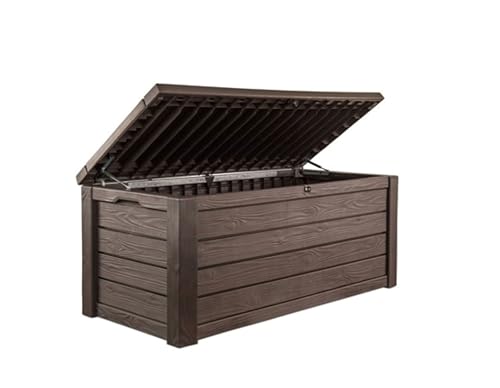
1. Keter Westwood 150 Gallon Deck Box, Brown — best for most hosts
Who it suits. The regular host with a four-to-six-seat set and a standing problem: two more guests than chairs, every single time. The Westwood solves the host’s whole triangle in one purchase — the cushion set stores inside, the lid is a maker-rated two-person bench when the party expands, and the piston mechanism means you can open it one-handed holding a tray without a slam or a spill. If you entertain monthly or more, this is the center of gravity of this guide.
What you get. A 150-gallon resin box with a wood-plank look in brown: enough honest volume for the full cushion set, the outdoor rug in the off-season, and the entertaining kit — serveware, lights, throws — layered on top where you can reach it. The easy-lift pistons hold the lid open while both hands work, the top locks with your padlock between parties, and built-in handles make the seasonal shuffle easy. The wood-look finish photographs like furniture and hides the dust film that settles between gatherings.
Pros. Rated seating plus real capacity plus the quietest lid manners here — the complete host package. The size hits the entertaining sweet spot: big enough for the full kit, not so big it annexes the patio. A long-running Keter model with strong parts availability. The finish flatters a set table rather than apologizing for itself.
Honest limitation. Brown resin warms in full sun, so site it where the afternoon shade falls if your party hour is golden hour — and never treat it as drink or food storage; it is not insulated. In wind-driven rain the lid seam can admit a little water, as with every pick here, so keep the good throws in breathable bags inside. Sectional hosts will find 150 gallons a ceiling, not a cushion.
Choose it if you host often and run short of seats. Skip it if your entertaining centers on a deep-seat sectional — the Java below is your box — or if your patio is small enough that the Brightwood’s bench profile fits better. Check on Amazon.
2. Keter Brightwood 120 Gallon Deck Box, Brown — best bench-first pick
Who it suits. Hosts whose patio plan is built around a fire pit, a conversation corner or a dining bench — anywhere a seat with storage underneath earns double rent. The Brightwood’s maker-published 804 lb bench capacity is the strongest seating figure in this guide, and its profile — about 57 by 27.5 by 23.7 inches — is literally bench-shaped, so it sits where a bench was already going to go and simply adds 120 gallons underneath.
What you get. Wood-panel-look resin with an assisted-opening lid that lifts easily and stays up, side handles, a lockable top, and a ventilated interior that keeps stored throws and cushions fresher in humid climates. Inside, 120 gallons covers a loveseat-scale cushion set plus the entertaining layer — blankets for cool evenings, citronella, the games box — arranged for grab-and-go access during a party.
Pros. The published bench rating lets you seat guests on it with a clear conscience. Ventilation suits textile-heavy entertaining storage. The most furniture-like silhouette in this guide at its size. Repositionable by one person when the party layout changes.
Honest limitation. Capacity is the trade: a full six-seat cushion set plus supplies will test 120 gallons, and deep cushions may stand on edge. The linked listing is the brown variant — the white showed no featured Amazon offer in our checks — so confirm the color on the page. And while the lid is a rated bench, it is not a serving counter for hot dishes; use a tray table for anything with heat or weight concentrated in one spot.
Choose it if seating geometry drives your patio. Skip it if storage volume outranks seating — step up to the Westwood or Java. Check on Amazon.
3. Keter Java XXL 230 Gallon Deck Box, Dark Grey — best for sectional-scale entertaining
Who it suits. The sectional host. When the furniture is a deep-seat outdoor sofa with a chaise, the cushion set alone defeats ordinary boxes, and the pre-party tidy becomes a negotiation. The Java ends the negotiation: 230 gallons, tall enough to stack the whole set without folding, with room left for the entertaining inventory — and a piston lid that keeps the operation quiet and one-handed while guests are already arriving.
What you get. Keter’s rattan-look resin box in dark grey, about 57.5 by 32.7 by 33.9 inches outside and 51.9 by 28.3 by 31.1 inches inside. The height stores the rolled rug upright and the games boxes flat; the lockable piston lid is a safety feature at this size, not a luxury. The rattan texture reads as a deliberate furniture choice in a styled outdoor room.
Pros. Capacity that swallows the sectional era whole. Controlled lid at a scale where control matters. A finish that holds its own in designed spaces. Interior dimensions that honestly back the headline number.
Honest limitation. It is a large object in your entertaining sightlines — place it as deliberately as furniture, because that is what it is. The rattan weave traps pollen and wants a brush-down before big gatherings to look its best. Its lid is not the rated bench the Westwood and Brightwood offer; for extra seating at sectional scale, plan chairs, not the Java’s top.
Choose it if your cushion set has outgrown everything else. Skip it if your set is standard-size — the Westwood gives you the bench this one lacks. Check on Amazon.
4. Lifetime 60012 Extra Large Deck Box, 130 Gallon — best for heavy-use hosting
Who it suits. Hosts whose parties are not gentle: rental properties, community and club spaces, big family gatherings where the box will be opened a hundred times a weekend and sat on by whoever finds it. The 60012 is the durability answer — dual-wall HDPE, steel hinges, a controlled spring hinge, and a published heavy load rating for the lid — in a guide where most picks ask to be treated nicely.
What you get. A 130-gallon box, about 5 feet by 2 feet by 26.5 inches, in desert sand with a brown lid. The spring hinge holds the lid open against breezes and prevents the slam cycle entirely, which at a loud party is both a safety and a sanity feature. The interior takes a standard cushion set or a serious entertaining kit — games, serveware, supplies — and the whole unit hoses clean after the weekend it hosted.
Pros. Toughest build and hardware in this guide. The spring hinge is the best anti-slam mechanism here for busy events. Published lid rating supports confident extra seating. UV-protected, fade-proof, and supported by Lifetime’s US parts network for the long haul.
Honest limitation. The utility styling is the least dressed-up finish in this guide; in a styled entertaining space, site it at the edge or dress the corner with planting. At 130 gallons it is mid-capacity — sectional sets overflow it — and its sturdiness comes with the heaviest carry in the guide at setup time.
Choose it if your hosting is frequent, boisterous or commercial-adjacent. Skip it if your entertaining is intimate and styled — the Keter finishes will make you happier nightly. Check on Amazon.
5. Suncast 99 Gallon Resin Wicker Deck Box, Mocha (DBW9200) — best party-supplies chest
Who it suits. Hosts who already have cushion storage solved — or whose furniture is cushion-light — and need the party closet itself: the serveware, drink tubs (empty, stored, never chilled in the box), string lights, extension cords, games, citronella and throws, living by the door where parties actually happen. At 99 gallons and about 50 inches wide, the wicker DBW9200 is the right size for that dedicated job, and its styling is the most at home beside a set table of any pick here.
What you get. Suncast’s US-made resin wicker chest in mocha with a stay-up hinged lid and integrated handles. The simple hinge is quiet enough and has nothing to wear out; the wicker texture shrugs off dust and blends with the rattan and wicker furniture it usually serves. Placed by the door or at the patio’s edge, it turns the pre-party scramble into a single trip.
Pros. Entertaining-appropriate looks at the value end of this guide’s linked picks. Right-sized for a supplies-only role, which keeps it organized instead of cavernous. Simple, durable mechanism. Easy to hose out after a season of parties.
Honest limitation. Suncast publishes no headline bench rating for this model, so it is a supplies chest, not a seat — do not let guests discover that experimentally. Ninety-nine gallons will not take a full cushion set as well as the supplies; hosts needing both in one box should step up to the Westwood. And repeat the mantra: storage, not a cooler — ice and drinks live elsewhere.
Choose it if your entertaining kit needs a home of its own. Skip it if you need one box for cushions and supplies together. Check on Amazon.
6. Keter Denali 200 Gallon Deck Box, Grey & Black — the color-matched premium option (prose only)
Who it suits. Design-led hosts building a finished outdoor room, for whom storage that clashes is storage that fails. The Denali’s DUOTECH double-wall panels — about 20mm thick with a wood-like finish — are described by Keter as paintable and drillable, so the box can match the house color exactly and even carry mounted hooks for the host’s tools. At 200 gallons it covers sectional-scale cushion storage for the main entertaining space.
What you get. A tall, rigid box, roughly 59.7 by 28.5 by 35.4 inches, with a lockable piston lid and the most cabinet-like walls in this guide. The interior height stacks deep cushions properly, and the stock grey-and-black finish is handsome unpainted if your palette already runs modern.
Pros. Paintability is unique in this guide and genuinely useful for cohesive outdoor rooms. Panel stiffness you can feel. Near-maximum capacity without the Java’s full XXL footprint.
Honest limitation — and why there is no link. We verified the model, dimensions and sub-$300 Amazon sightings, but its offers rotate across listings without one stable ASIN to pin responsibly. Search Amazon for “Keter Denali 200 Gallon” and confirm the DUOTECH double-wall description and the dimensions above before buying. Painting is a project, not a feature, until you do it — budget the weekend if the match matters.
Choose it if the outdoor room’s design coherence is a real priority. Skip it if you want a verified pinned link — the Westwood is the host’s default for a reason.
Comparison table
The six picks side by side, judged as entertaining equipment: bench ratings only where makers publish them, lids judged on party manners.
| Pick | Capacity | Finish | Lid | Bench rating | Best hosting role |
|---|---|---|---|---|---|
| Keter Westwood | 150 gal | Wood-plank look resin | Piston easy-lift | Two adults, per maker | All-round host box + seats |
| Keter Brightwood | 120 gal | Wood-panel look resin | Assisted opening | 804 lb per maker listing | Bench corners, fire pit |
| Keter Java XXL | 230 gal | Rattan-look resin | Piston-assisted | Not the design focus | Sectional-scale sets |
| Lifetime 60012 | 130 gal | Dual-wall HDPE, utility | Spring hinge | Published heavy rating | Heavy-use hosting |
| Suncast DBW9200 | 99 gal | Wicker-look resin | Stay-up hinge | No headline rating | Party-supplies chest |
| Keter Denali | 200 gal | DUOTECH, paintable | Piston-assisted | Not the design focus | Color-matched rooms |
How to choose a deck box for entertaining
Count your seats before your gallons. The host’s scarcest resource is seating, and a bench-rated box is two seats you already own the floor space for. If your gatherings regularly overflow your chairs, weight the Westwood and Brightwood — the picks with maker-published ratings — ahead of raw capacity. If you never run short of chairs, capacity and finish can lead instead.
Inventory the entertaining kit honestly. List what actually migrates at party time: serveware, lights, cords, games, throws, citronella, the rug. That kit plus the cushion set is your true volume — most hosts land between 120 and 200 gallons. Buying for the cushions alone leaves the kit in the garage; buying for an imaginary inventory buys an empty cave.
Site it on the party route. The box should stand where the pre-party tidy and the mid-party grab actually happen — at the patio edge near the door, not across the yard. Every extra trip is a small tax on hosting, and hosts who pay it stop hosting as often. Check the lid’s swing against the dining layout while you are at it.
Demand quiet lid manners. Pistons and spring hinges are entertaining features: they open one-handed while you carry a tray, hold themselves open while you dig, and close without announcing it to the whole table. If your parties run late and your neighbors run close, this is the spec that protects the evening.
Style is a feature here — within limits. Entertaining is the one brief where finish legitimately ranks: wood-look, wicker and paintable panels all earn their place in a designed space. But let looks break ties between boxes that already pass on lid, lock and capacity — never let a pretty finish excuse a slamming lid or an unrated seat.
Keep food and drink out of the plan. No deck box is a cooler. Plan the box for everything around the refreshments and give ice and perishables a real insulated home; a sun-warmed resin box is the opposite of food storage, and saying so plainly is part of honest hosting advice.
Common mistakes hosts make
Seating guests on unrated lids. A flat lid invites it; only published ratings permit it. The flex, the creak, the embarrassment — all avoidable by buying the rating or providing chairs.
Using the box as a cooler. Warm, uninsulated and not food-safe. Drinks in a deck box are a disappointment with a lid.
Hiding the clutter but not the box. A utility-finish box parked center-frame in every party photo is its own kind of clutter. Site and finish are hosting decisions.
Forgetting the mid-party opening. If the box can only be reached by moving two chairs and a guest, it will not be opened — and the cushions will spend the party on the lawn. Test the route with the furniture in party position.
Storing the kit damp after the party. Dew-wet throws sealed in at midnight are musty by the next gathering. Dry first, even if it means the box waits until morning.
Skipping the lock between parties. The lock keeps the lid shut in the storm the week after the party — the one that would otherwise rain into your stored kit for six days unnoticed.
Final recommendation
Most hosts should buy the Keter Westwood 150 Gallon: rated bench seating, a quiet piston lid, honest capacity for cushions plus the full entertaining kit, and a finish that belongs in the photos. Bench-driven patios belong to the Brightwood, sectional hosts to the Java, and heavy-use or rental hosting to the Lifetime 60012. If your cushions are already homed, the Suncast wicker chest is the party closet your door-side has been waiting for, and the Denali is the design-led premium for hosts willing to verify a rotating listing. Count seats first, inventory honestly, site on the party route — then enjoy the ten-minute transformation every time the doorbell rings.
Frequently asked questions
Can guests really sit on a deck box? On the rated ones, yes. Keter publishes a two-adult bench rating for the Westwood and an 804 lb figure for the Brightwood in its listing material; Lifetime publishes a heavy load rating for the 60012’s lid. Where no rating is published — the Suncast in this guide — treat the lid as a surface, not a seat.
Can I store drinks or use a deck box as a cooler? No. Deck boxes are uninsulated resin or HDPE storage; they warm in the sun and are not food-safe. Store the entertaining kit — serveware, lights, games, throws — in the box, and keep ice, drinks and food in a proper cooler.
What size deck box does a host need? Cushions plus the entertaining kit runs 120–200 gallons for most hosts. Standard sets with a modest kit fit the 120–150 gallon picks; sectional sets push to the 200-gallon class. A supplies-only chest can be as small as the 99-gallon Suncast if cushions live elsewhere.
Which deck box looks best in an entertaining space? The wood-look Keter finishes and the Suncast’s wicker read as furniture; the Denali goes further with paintable panels you can match to the house. The Lifetime is the honest utility outlier — durable first, styled second — and is best sited at a space’s edge.
How do I keep the pre-party tidy fast? Site the box on the party route, keep the entertaining kit layered on top of the cushions inside, and choose a piston or spring-hinged lid you can work one-handed. The system — right box, right place, right lid — is what makes ten minutes enough.
Why does the Denali have no Amazon link? Its model, DUOTECH specifications and sub-$300 Amazon sightings are verified, but its offers rotate across listings without a single stable ASIN. We cover it in prose with the exact name and dimensions to check on the listing rather than pin a link we cannot verify.
The host’s playbook: before, during and after the party
Before guests arrive, the box runs the transformation in a set order that experienced hosts learn once and reuse forever. First, the scatter goes in: the everyday evidence — pool towels, garden tools left mid-project, the kids’ migration of objects — disappears in one pass, because a deck box’s first entertaining talent is making a lived-in yard look intentional in ten minutes. Second, the cushions come out: the set that lives in the box goes onto the furniture, which is the moment the box’s storage role visibly pays for itself — cushions that slept dry and clean make furniture look new in a way no amount of last-minute fluffing achieves. Third, the entertaining layer surfaces: serveware, lights, throws and games, stored on top inside the box precisely so this moment takes one trip. A box organized in that layered order is a host’s mise en place; a box packed at random is a treasure hunt with guests at the door.
During the party, the box keeps working in ways guests never notice, which is the point. The rated lids — Westwood, Brightwood, Lifetime — absorb the overflow seating that every gathering eventually needs, without a host calculation about who can safely sit where. The piston and spring lids open one-handed around trays and close without punctuation marks in the conversation. And the box becomes the party’s lost-and-found and staging point: phone chargers and sunscreen on top in a tray, the next round of throws inside within reach when the temperature drops after dark. Hosts who think of the box as a crew member rather than a container place it accordingly — on the route between kitchen door and seating, never exiled across the yard where every retrieval is an expedition.
After the party is where deck boxes earn their reputations quietly. The temptation at midnight is to throw everything in and deal with it tomorrow; the system that works is nearly as fast and much kinder: cushions shaken out and confirmed dry (or left under cover until morning if dew has taken them), textiles in their bags, the kit back in its layer, lid latched and locked against whatever the week’s weather is planning. Ten unhurried minutes, or five at the practiced pace. The payoff arrives at the next gathering, when everything emerges clean, dry and findable — and at the gathering after a storm, when the locked lid is the reason the kit survived the week untouched. Entertaining well is mostly logistics performed in advance; the deck box is simply the largest, most forgiving piece of logistics a host owns.
Styling the box into the outdoor room
Because an entertaining box lives in the sightlines — and the photographs — its corner deserves the same design attention as the seating it serves. The simplest integration is repetition: the Keter wood-look finishes echo decking and fencing tones, the Suncast’s wicker echoes the furniture it usually accompanies, and the Denali’s paintable panels exist for hosts who want the match to be exact rather than approximate. A box that repeats a material or color already present stops reading as storage and starts reading as part of the room’s furniture plan, which is the entire trick.
Planting softens what finish cannot. A box backed by a hedge, flanked by large planters, or fronted by a low bed loses its appliance outline and gains a setting; just keep foliage clear of the lid’s swing and the latch, and keep watering cans honest — planters that drip onto the lid daily are a sprinkler problem wearing a prettier outfit. Lighting helps at party hour: a box in the path of string-light glow looks deliberate, and a box in darkness looks like an obstacle, which on a practical level it also becomes. Site it in the light or light its corner, and guests will use its bench without ever being told it is one.
One styling discipline protects all the others: keep the top clear in ordinary life. A deck box whose lid becomes the household’s default surface — tools, pots, packages — cannot transform at party time, because the transformation begins with moving the pile. The hosts whose patios photograph well are not tidier people; they simply defend the lid. Everything in this guide stores better with its top empty and its contents inside, and the entertaining brief, more than any other in this lot, rewards that small act of discipline every single weekend.
Entertaining scenarios: matching the box to the party
The dinner party for eight is the Westwood’s home fixture: cushions out, kit on top, two overflow seats on a rated lid, and a piston mechanism that never interrupts the conversation it serves. Its 150 gallons hold the full working inventory of a seated dinner outdoors — cushions, throws for after dark, the table’s linens and serveware — with the lid closing on a tidy patio when the last guest leaves. The fire-pit evening belongs to the Brightwood: a rated bench pulled into the circle, blankets and the games box inside, citronella at hand, and a profile that looks like it was always part of the seating plan. Hosts who entertain around fire also appreciate its ventilation — blankets stored beside a fire pit absorb the evening’s smoke perfume, and a ventilated box airs them between gatherings better than a sealed one.
The pool party is a two-box scenario wearing a one-box budget, and it is worth handling honestly: the cushions and the entertaining kit live in the main box — Java for sectional households, Westwood for standard sets — while the wet rotation of towels, floats and toys wants its own satellite by the water, which is the Suncast’s finest hour in this variant as well as the backyard one. If only one box is possible, choose the main box and give the wet gear a mesh bag and a hook for the season; do not seal dripping textiles into the cushion box at the party’s end and expect gratitude in the morning. The big family gathering — the reunion, the graduation, the holiday weekend — is the Lifetime’s scenario: maximum openings, maximum sitting, maximum indifference to gentle treatment, and a hose-down afterward that returns it to innocence in minutes.
The quiet scenarios matter too. The two-person evening on a small patio runs on the Brightwood or the Suncast and asks nothing of capacity at all — only that the box look like furniture and open without ceremony. The rental-property and event-space scenario runs on the Lifetime’s durability and the lock’s discretion between bookings. And the design-showcase scenario — the outdoor room that appears in the listing photos — is the Denali’s, paint-matched and panel-stiff, for hosts whose entertaining includes the space itself as part of the hospitality. Every scenario in this section is served by a verified pick in this guide; the host’s only real task is recognizing which party is actually theirs.
What hosts store that nobody talks about
Every entertaining household accumulates a shadow inventory that never appears in the furniture catalogs, and sizing a deck box honestly means counting it. There is the extension cord that exists only for the string lights, and the second one that exists because the first is always missing. There are the outdoor candles and their glass hurricanes, the unbreakable plates that come out when the good set stays in, the drink tub that spends forty-nine weeks a year being in the way. There is the speaker and its cable, the folding side table, the stack of outdoor games with one piece missing from each, the citronella in three formats, the sunscreen and bug spray that live outside because they are only ever needed outside, and the throws that transform a cool evening from an ending into a second act. None of it is heavy; all of it is bulky, awkward and homeless by default — which is to say, all of it is precisely deck-box cargo, and together it routinely equals the cushion set it shares the box with. Hosts who inventory the shadow collection before ordering buy the right size the first time; hosts who count only cushions meet the shadow inventory again at the first party, usually while holding it. The mid-size picks in this guide — the Westwood above all — were ranked with the shadow inventory included, and the supplies-chest role assigned to the Suncast exists because some households prefer to give the shadow collection a home of its own by the door, separate from the cushions entirely. Either architecture works. What never works is pretending the collection does not exist.
The morning after: resetting the outdoor room
Hosts judge themselves the morning after, when the outdoor room either resets in fifteen minutes or lingers in party aftermath until the weekend. The deck box is the reset’s engine, and its design details decide the timing. A lid that opens with one hand while the other carries a tray of glasses; an interior layered so that everything has a known stratum rather than a negotiable pile; a bench top that returns to seating the moment its cargo goes back inside — these are the mechanics of a fast reset, and they are the same mechanics this guide ranked on. The reset also includes the checks that protect the next party: textiles confirmed dry before the lid closes for the week, the lock fitted against the storm that always seems to arrive on a Tuesday, and a glance inside the box for the borrowed item, the lost earring, the phone charger that a guest is already missing. Hosts who run this small liturgy find that entertaining stops feeling like a production with a cleanup debt attached — the room simply closes, like a restaurant kitchen, ready to open again. That feeling, repeated over a season, is what turns occasional hosts into regular ones, and it is purchased less by any single box than by the fit between the box, its place on the party route, and the habits around it. The picks in this guide were chosen to make that fit easy to achieve and easier to keep.
A note on rentals, venues and borrowed spaces
Hosts who entertain in rented homes, club spaces or borrowed yards face a variant of the brief worth one paragraph: the box must travel, assemble without tools beyond a screwdriver, and leave no trace. Panel-built resin boxes are the natural answer — they flat-pack into a vehicle, rebuild on site in under an hour, and depart without a mark — and the Lifetime’s durability makes it the pick most often chosen for spaces that host strangers weekly. If the entertaining in your life happens in spaces you do not own, weight portability and toughness above finish, fit the lock from day one, and treat the box as event equipment rather than furniture; it will serve more parties that way than any stationary piece ever could.
The bottom line for hosts
Strip the guide to its essentials and three sentences remain. Count seats before gallons, because guests sit more often than they admire storage. Site the box on the party route and defend its lid, because a host’s storage only works at the speed of the evening. And buy the bench rating in writing from the maker, never from a photograph. The Westwood embodies all three for most hosts, which is why it leads this ranking — and why hosts who follow the sentences with any pick here will feel the difference at the very next gathering.