Where to buy
Check the latest price, availability and delivery on Amazon. Orders are placed on Amazon. We may earn a commission from qualifying purchases.
- Best for most backyards: Keter Java XXL 230 Gallon Deck Box, Dark Grey — Check on Amazon
- Lifetime 60012 Extra Large Deck Box, 130 Gallon, Desert Sand/Brown — Check on Amazon
- Keter Westwood 150 Gallon Deck Box, Brown — Check on Amazon
- Keter Brightwood 120 Gallon Deck Box, Brown — Check on Amazon
- Suncast 99 Gallon Resin Wicker Deck Box, Mocha (DBW9200) — Check on Amazon
- Keter Denali 200 Gallon Deck Box, Grey & Black — covered in prose below; see the review notes before searching for a listing
Read the full guide ↓
Disclosure: As an Amazon Associate, dailyhomedecorating.com earns from qualifying purchases. Links to Amazon on this page are affiliate links; they cost you nothing extra. Listing details such as price and availability change often, so check the current Amazon listing before you buy.
The best deck box for backyards under $300 has a different job from its patio cousins. A backyard box is a yard worker: it swallows pool floats and skimmer nets, cornhole boards and croquet sets, muddy sports gear, the garden tools that never made it back to the garage, and — in the houses where it earns its keep most — the entire cushion set of the furniture by the fire pit. Backyard duty also means backyard conditions: full sun on grass or pavers rather than a sheltered deck, sprinklers hitting the same side every morning, kids treating the lid as a stage, and raccoons auditing your security. At this budget, the verified field is strong — five linked picks with confirmed Amazon listings and sightings under the ceiling, plus one premium prose-only option — and this guide ranks them for yard work first: capacity for bulky gear, toughness under sun and knocks, lids that survive enthusiastic use, and placement that does not turn into a mud project by October.
Capacity math changes in a backyard. Patio cushions pack flat and predictable; backyard cargo is awkward — a pool noodle is four feet of nothing, a skimmer pole is six feet of thin, and a cornhole board is a rigid rectangle that fits or does not. That is why this guide leads with interior dimensions and height rather than gallon headlines, and why the 230-gallon Java tops the ranking: its tall interior takes upright noodles, stacked floats and a sectional’s cushions in one load. It is also why two-box thinking is respectable in a yard in a way it is not on a balcony: one large box by the patio for cushions, one smaller box by the pool gate or the play area for the daily-scatter items, beats one heroic box sited badly for both jobs. The Suncast’s presence at the end of this list is deliberate — as a satellite box, it may be the most-used purchase in the whole guide.
Placement deserves a paragraph before the picks, because backyards punish lazy siting. A deck box on bare grass sits in a damp microclimate: the base stays wet, the underside grows mildew, and the box rocks on soft ground until its seams misalign and its lid latch sulks. Four pavers or a simple gravel pad — an hour of work — gives every box in this guide a level, drained footing that keeps seals honest and lids closing true. Keep the box out of the sprinkler line if you can; resin shrugs off water, but daily soaking tests lid seams in a way rain alone does not. And think about the path: the box you open daily should sit where the daily route runs — patio edge for cushions, pool fence for pool gear — because a backyard box fifty feet from its cargo is a box that stops being used, and unused storage is just yard sculpture with a lid.
Security and wildlife are the last backyard specifics. Every pick here is lockable or padlock-ready, and in a yard that matters less for theft than for the two forces that actually open boxes: wind, which pops unlatched lids in storms and then rains into them all night, and animals, for whom an unlatched box of pool toys is a puzzle feeder. A basic padlock through the hasp solves both, and it also settles the question of toddlers treating the box as a hiding place — a latched, locked lid on a box that is never a toy is the household rule worth stating out loud. With those ground rules set, here is the verified field, ranked for the yard.
In this guide
Quick Picks
Short on time? Each row names a backyard job and the box that suits it. Five picks link to verified Amazon listings; the Denali is covered in prose because its Amazon offers sit under shifting listings.
| Backyard job | Pick | Capacity | Why it stands out | Link |
|---|---|---|---|---|
| All-round yard storage, pool households | Keter Java XXL 230 Gallon Deck Box, Dark Grey | 230 gallons | Tall, huge interior — sectional cushions, floats and games in one box | Check on Amazon |
| Tools, exposed sites, decade-long duty | Lifetime 60012 Extra Large Deck Box, Desert Sand/Brown | 130 gallons | Dual-wall HDPE, steel hinges, spring lid — the toughness pick | Check on Amazon |
| Patio-edge cushion storage plus seating | Keter Westwood 150 Gallon Deck Box, Brown | 150 gallons | Piston lid, lockable, two-person bench rating | Check on Amazon |
| Bench by the fire pit or garden | Keter Brightwood 120 Gallon Deck Box, Brown | 120 gallons | Maker-published 804 lb bench capacity, ventilated interior | Check on Amazon |
| Satellite box by the pool gate or play area | Suncast 99 Gallon Resin Wicker Deck Box, Mocha | 99 gallons | Compact, good-looking, right-sized for daily-scatter gear | Check on Amazon |
| Premium panels, paintable to match the house | Keter Denali 200 Gallon Deck Box, Grey & Black | 200 gallons | Thick DUOTECH double-wall panels — prose only, see review | See review notes |
How the picks were chosen
Verification came first, as in all our deck box guides: manufacturer model, capacity, dimensions and lid mechanism confirmed from maker material, then matched to an Amazon listing with the ASIN and a price sighting recorded in this article’s source notes. Five picks have a single stable ASIN and sightings at or under $300 and carry links. The Keter Denali 200 Gallon is a verified current model with published dimensions and sub-ceiling Amazon sightings, but its offers rotate across listings, so it is covered in prose rather than pinned to a link we cannot stand behind. Nothing with a current CPSC recall is included, and no unverifiable marketplace-only product was considered.
Backyard ranking then applied yard criteria: interior height and length for awkward cargo (poles, boards, noodles) ahead of raw gallons; panel toughness and hardware for full-sun, unsheltered placement; lid mechanisms that survive kids and gusts; lockability for wind and wildlife; and honest satellite sizing, because the second-box role is a real backyard pattern. Bench ratings are reported only where the maker publishes them — Keter for the Westwood and Brightwood, Lifetime for the 60012 — and we flag the Suncast as unrated rather than letting a flat lid imply a seat.
Best deck box for backyards under $300 — the six picks in detail
1. Keter Java XXL 230 Gallon Deck Box, Dark Grey — best all-round backyard box
Who it suits. The backyard generalist with a mixed, bulky load: a sectional or deep-seat set by the patio, a pool’s worth of floats and noodles, lawn games, and the seasonal pile that currently migrates between garage corners. If your yard’s storage problem has defeated one ordinary box already, the Java is the verified answer at this tier — the largest interior in this guide, and tall with it.
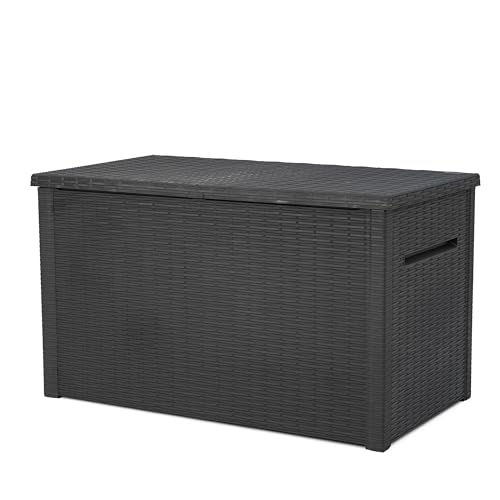
What you get. Keter’s rattan-look resin box in dark grey: roughly 57.5 by 32.7 by 33.9 inches outside, 51.9 by 28.3 by 31.1 inches inside, 230 gallons in total. The height is the working advantage — pool noodles and skimmer poles lean upright, floats stack without folding, and deep cushions pile without the lid pressing down. The piston-assisted lid opens with control despite its size and locks with your padlock; the resin body is weather-resistant, UV-stable and hose-it-off maintenance-free. At about 56 pounds empty, place it with a helper on its paver pad and it stays put through storm seasons.
Pros. Capacity with the dimensions to back it — the only pick here that takes a full sectional set plus pool gear in one load. Piston lid control at a size where it genuinely matters. Rattan texture hides yard dust and pollen better than smooth finishes. Tall interior doubles as the games closet: cornhole boards and folded chairs fit the profile better than in low, wide boxes.
Honest limitation. The rattan weave traps grime and wants a brush-down a few times a season, especially under trees. Its size makes the paver-pad advice non-optional — a box this wide on soft grass will settle unevenly. And it is still a resin box in a storm: level, latched and locked is the system, with prized cushions in breathable bags inside for belt and braces.
Choose it if your yard load is genuinely mixed and bulky. Skip it if your storage is cushions only for a standard set — the Westwood does that job smaller and adds a rated bench. Check on Amazon.
2. Lifetime 60012 Extra Large Deck Box, 130 Gallon — best for tools and exposed sites
Who it suits. The working yard: garden tools, hose reels, sports equipment, and the box that lives at the far end of the property in full weather rather than under the eaves. The 60012 is the pick for buyers who have watched thinner boxes oil-can, fade and crack, and who would rather buy the overbuilt one once. Its desert-sand utility styling looks entirely at home by a shed, fence line or pool equipment pad.
What you get. Dual-wall high-density polyethylene construction — shed-grade thinking — with weather-resistant steel hinges, a controlled spring hinge that holds the lid open and defeats casual slamming, and a lockable lid with a published heavy load rating. The box runs about 5 feet long by 2 feet wide by 26.5 inches high, with roughly 57 by 20.75 by 23.75 inches of interior and 130 gallons of capacity: long enough for tool handles and skimmer poles laid flat, deep enough for a standard cushion set when the yard furniture needs it.
Pros. The toughest build in this guide, with hardware to match — steel where others use plastic. The spring hinge is the best lid here for windy, exposed placements. UV-protected HDPE does not fade, peel or rust, and Lifetime’s US parts support is the long-game advantage. The two-foot depth tucks against fences without eating the yard.
Honest limitation. Utility looks: it will not flatter a styled patio corner the way the Keter finishes do, so site it where work happens rather than where dinner happens. At 130 gallons it is mid-capacity — pool-float fleets should look at the Java — and its weight makes the initial placement a two-person job.
Choose it if the box will live exposed and work hard for a decade. Skip it if your priority is a furniture-look box by the seating area — that is the Westwood’s or Brightwood’s brief. Check on Amazon.
3. Keter Westwood 150 Gallon Deck Box, Brown — best patio-edge cushion box
Who it suits. Yards where the storage problem is really a patio problem: a four-to-six-seat set whose cushions need a home at the patio’s edge, with the box doubling as overflow seating when the yard fills for a barbecue. The Westwood is the social box in this guide — furniture-finished, piston-lidded, and rated by its maker as a two-person bench.
What you get. A 150-gallon resin box with a wood-plank look in brown, easy-lift pistons for quiet, controlled opening, a lockable lid, and built-in handles for seasonal repositioning. The capacity honestly covers a standard cushion set plus throws, a folded rug and the outdoor entertaining extras, and the finish shrugs off the dust film that backyard boxes collect.
Pros. The best balance of capacity, lid manners and looks for a patio-edge siting. Piston closing is kid-finger and conversation friendly. Bench rating turns storage into seating at gatherings. A long-running model with deep availability and owner knowledge.
Honest limitation. Brown resin runs warm in full afternoon sun — site it at the patio edge with some shade if you can, and do not store anything heat-sensitive inside. In wind-driven rain the lid seam can admit a little water, as with all picks here; cushion bags remain the professional move. Sectional owners will outgrow 150 gallons.
Choose it if cushions and company are the main events in your yard. Skip it if your load is tools and pool gear first — the Lifetime and Java split that job better. Check on Amazon.
4. Keter Brightwood 120 Gallon Deck Box, Brown — best bench for fire pit and garden corners
Who it suits. Yards that need a seat with a secret: by the fire pit, at the end of the garden path, beside the raised beds. The Brightwood’s maker-published 804 lb bench capacity is the strongest seating claim in this guide, and its 120 gallons underneath hold the fire-pit blankets, garden kneeler and hand tools, or a loveseat set’s cushions, depending on which corner of the yard it serves.
What you get. Wood-panel-look resin, about 57 by 27.5 by 23.7 inches outside, with an assisted-opening lid, side handles, lockable top, and a ventilated interior that suits garden-side storage of textiles. Assembly is simple panel work; the finished box moves easily around the yard as seasons and projects change, which the bigger picks do not.
Pros. Published bench strength that anchors a seating corner. Ventilation for cushion and blanket storage in humid yards. The most repositionable full-size pick here. Furniture looks that sit comfortably in planted, styled parts of the yard.
Honest limitation. Capacity is the compromise: 120 gallons will not take a sectional set or a float fleet. The linked listing is the brown variant — the white variant showed no featured Amazon offer in our checks — so confirm color on the listing page. As a garden-corner box it will collect leaf litter on the lid; a monthly brush-off keeps it smart.
Choose it if a yard corner needs seating and storage in one footprint. Skip it if it would be your only box and your load is large — pair it with the Java or start with the Westwood instead. Check on Amazon.
5. Suncast 99 Gallon Resin Wicker Deck Box, Mocha (DBW9200) — best satellite box
Who it suits. The two-box yard. Sited by the pool gate it takes towels, floats-in-rotation, sunscreen and the dive toys; sited by the play area it corrals balls, bats and the sandbox diaspora; sited by the front fence it holds delivery packages’ worth of garden clutter. At 99 gallons and about 50 inches wide, the DBW9200 is sized for the daily scatter that a main box, however large, never quite reaches.
What you get. Suncast’s US-made wicker-look resin chest in mocha, with a stay-up hinged lid and integrated handles. The wicker styling is the most garden-appropriate finish in this guide — it disappears into planted settings — and the simple hinge has nothing to wear out, which suits a box opened twenty times a day by small hands.
Pros. Right-sized for satellite duty, attractive in garden settings, simple and durable mechanism, and the value end of this guide’s linked picks — which matters when it is the second box, not the first. Easy to hose clean inside and out after a season of pool towels.
Honest limitation. As a sole box for a cushion-heavy yard it is undersized; buy it as a satellite or for genuinely modest loads. Suncast publishes no headline bench rating for this model, so it is storage, not seating — do not let the flat lid host the party. The latch takes a padlock, which you should fit if it sits by an unfenced pool gate.
Choose it if your yard’s clutter is distributed and daily. Skip it if you need one box to do everything — start with the Java or Westwood and add this later if the pattern proves out. Check on Amazon.
6. Keter Denali 200 Gallon Deck Box, Grey & Black — premium panels for the main patio (prose only)
Who it suits. Yard owners building a finished outdoor room who want the main storage piece to look intentional: the Denali’s DUOTECH double-wall panels — about 20mm thick, wood-finished, and described by Keter as paintable and drillable — let you match the box to the house or fence color and mount hooks for the tools that otherwise lean. At 200 gallons it covers sectional-scale storage for the primary patio.
What you get. A tall, rigid box, roughly 59.7 by 28.5 by 35.4 inches, with a lockable piston lid and the stiffest walls in this guide. The interior height stacks deep cushions properly, and the panel feel is cabinet-like compared with single-wall resin.
Pros. Panel rigidity and customization no other pick offers. Near-Java capacity with a more tailored footprint. Paintability solves the “storage that clashes” problem permanently.
Honest limitation — and why there is no link. The model, specs and sub-$300 Amazon sightings are verified, but its offers rotate across listings without one stable ASIN we could responsibly pin. Search Amazon for “Keter Denali 200 Gallon” and confirm the DUOTECH double-wall description and dimensions above on the listing before buying. Premium panels also deserve the paver-pad treatment; do not sit a cabinet-grade box in mud.
Choose it if finish quality leads your list and you will verify the listing yourself. Skip it if you prefer a pinned link — the Java and Westwood split its jobs between them.
Comparison table
The six picks side by side. Capacities and dimensions are makers’ published figures; bench ratings appear only where the maker publishes one.
| Pick | Capacity | Build | Lid | Bench rating | Best backyard role |
|---|---|---|---|---|---|
| Keter Java XXL | 230 gal | Resin, rattan look | Piston-assisted | Not the design focus | Main box: cushions + pool + games |
| Lifetime 60012 | 130 gal | Dual-wall HDPE, steel hinges | Spring hinge | Published heavy rating | Tools, exposed sites |
| Keter Westwood | 150 gal | Resin, wood-plank look | Piston easy-lift | Two adults, per maker | Patio-edge cushions + seating |
| Keter Brightwood | 120 gal | Resin, wood-panel look | Assisted opening | 804 lb per maker listing | Bench corners, fire pit |
| Suncast DBW9200 | 99 gal | Resin, wicker look | Stay-up hinge | No headline rating | Satellite box |
| Keter Denali | 200 gal | DUOTECH double-wall | Piston-assisted | Not the design focus | Premium main patio |
How to choose a deck box for a backyard
Inventory the awkward items first. Backyard loads fail on shape, not volume. Lay out the longest and bulkiest things you own — skimmer pole, cornhole boards, folded loungers, the cushion stack — and measure them. Interior length and height from our reviews are the numbers to match; gallons are the tiebreaker, never the brief.
Build the pad before the box arrives. Four pavers or a gravel square, leveled, transforms how any of these boxes ages: lids close true, seams shed water as designed, and the base stays dry and mildew-free. It is the cheapest performance upgrade in this entire guide and the one most often skipped.
Site by route, not by looks. The box belongs where its cargo’s daily path runs — cushions at the patio edge, pool gear inside the pool fence, games near the lawn. A beautiful box in the wrong corner becomes a box nobody opens, and its contents migrate back to the garage floor within a month.
Match toughness to exposure. Under eaves on a deck, any pick here thrives. In full sun at the yard’s far end, weight the Lifetime’s dual-wall HDPE and steel hardware, or the Denali’s thick panels, more heavily — UV and knocks are the long-term enemies, and both builds are the guide’s answers to them. Keep boxes out of direct sprinkler lines where possible; daily soaking is a harsher test than weather.
Lock it, for wind and wildlife. A padlock’s real jobs in a backyard are keeping the lid shut through storm gusts and keeping raccoons and curious toddlers out. Every pick here accepts one. Fit it the day the box is placed, not after the first storm teaches the lesson.
Consider the two-box system honestly. If your yard has two centers of gravity — patio and pool, lawn and garden — one large box plus one satellite often outperforms one enormous box, at a similar total spend. The Java-plus-Suncast and Westwood-plus-Suncast pairings in this guide exist because that pattern is how backyards actually behave.
Common mistakes to avoid in backyard storage
Siting on bare grass. Damp bases, rocking boxes, misaligned lids and mildew — all from skipping a one-hour paver pad.
Buying gallons and ignoring the pole test. If the skimmer pole or cornhole board does not fit the interior dimensions, the capacity figure is fiction for your load.
Leaving the lid unlatched “just for today.” One storm night fills an open box with rain and leaves. Latch always; lock if the yard is open.
Storing pool-wet textiles sealed. Wet towels and floats sealed into any box grow mildew fast. Dry first, store second, crack the lid on sunny days.
Parking the box in the sprinkler arc. Daily direct soaking finds lid seams that rain never would. Move the box or adjust the sprinkler head.
Letting kids treat lids as stages. Only maker-rated lids are benches; none is a trampoline. State the rule early, especially for the tall boxes.
Final recommendation
For most backyards, buy the Keter Java XXL 230 Gallon and a set of pavers: it is the one box here sized for the way yards actually accumulate — cushions, pool gear and games in a single tall interior, behind a controlled piston lid. Working yards and exposed sites belong to the Lifetime 60012, whose build quality is the guide’s benchmark. Patio-focused yards should take the Westwood’s cushion-plus-bench balance, garden corners the Brightwood’s rated seat, and any yard with a pool gate or play area will quietly get the most daily use from the Suncast as a satellite. The Denali is the premium finish option for buyers happy to verify a rotating listing. Measure the awkward items, build the pad, site by route — then order once.
Frequently asked questions
What size deck box does a backyard with a pool need? Pool households generate the bulkiest light cargo — floats, noodles, towels, toys. A 200-gallon-class box like the Java takes the fleet plus cushions; smaller yards often do better with a 150-gallon main box and a 99-gallon satellite by the pool gate. Measure the longest item — usually the skimmer pole — against interior dimensions.
Can a deck box sit on grass? It can, but it should not. Bare grass keeps the base damp, lets the box settle unevenly and misaligns the lid over time. A leveled pad of pavers or gravel is a one-hour fix that protects the box and everything in it.
How do I keep raccoons and kids out of a deck box? Use the lockable hasp with a basic padlock — every pick in this guide is lockable or padlock-ready. The same lock keeps lids shut in storm winds. Never let children play in or on boxes that lack a maker-published bench rating.
Which deck box lasts longest in full sun? UV-protected dual-wall HDPE (the Lifetime 60012) and thick double-wall panels (the Denali) are the toughest builds here for exposed sites. All the resin picks are UV-stable and maintenance-free, but panel thickness and steel hardware are what separate a decade of service from a few seasons.
Are backyard deck boxes waterproof? They are weather-resistant, not sealed vaults. Level placement, a latched lid and breathable bags for prized cushions keep contents dry through ordinary weather; wind-driven rain can push small amounts past any lid seam, and sprinkler arcs should be kept off the box.
Why does the Denali have no Amazon link? The model, its DUOTECH specifications and its sub-$300 Amazon sightings are verified, but its offers rotate across listings with no single stable ASIN to pin. We cover it in prose with the exact model name and dimensions to verify on the listing, rather than guess a link.
A backyard box through the four seasons
Spring is the audit. The box gets emptied, hosed and dried in the sun; cushions come out for inspection before they go back to the furniture; anything that went in damp in autumn announces itself now, which is information, not just bad news — it tells you which corner of the box takes wind-driven rain and whether your pad has settled out of level. Re-level in spring and the box behaves all year. Spring is also when the satellite logic proves itself: the Suncast by the pool gate takes the season’s first towels and toys before the scatter pattern establishes itself across the lawn.
Summer is peak traffic, and the box’s job is rhythm, not storage theory. Cushions in before dew or rain, out again for the evening; pool gear cycling daily through the satellite box; the main box opened by whoever is nearest, including kids, which is why lid control — the Java’s and Westwood’s pistons, the Lifetime’s spring hinge — graduates from brochure feature to household safety equipment in July. Summer is also when the lock earns its keep against the season’s real intruders: raccoons investigating anything that smells of sunscreen and snacks, and storm cells that arrive at 3 a.m. and test every unlatched lid in the neighborhood.
Autumn is the deep store, and it is where capacity honesty pays. The full cushion set, washed and fully dry, goes in with its breathable bags; the rug follows, rolled not folded; the games consolidate; the pool gear, cleaned and dried, takes its layer. A box sized honestly in spring swallows autumn without the traditional overflow into the garage. Crack the lid on dry autumn days when you pass — thirty seconds of airflow is the cheapest mildew insurance in this entire guide — and check after the first big storm that the pad drainage you built is doing its job.
Winter is the box’s own test. Latched and locked, it shrugs off the season; the main courtesies are brushing heavy snow off the largest flat lids after storms and resisting the urge to store winter’s heavy things — salt bags, firewood overflow — in a box whose job is light and bulky. Firewood in particular belongs elsewhere: it is heavy, it brings insects, and it turns a cushion box into a woodpile with a lid. Come spring, the cycle closes with the audit, and a box that was sited on a pad, loaded dry and locked through storms comes through it looking like what it is: the yard’s hardest-working piece of furniture.
Backyard security and wildlife, taken seriously
It is worth expanding the lock conversation, because backyard boxes sit at the intersection of weather, wildlife and childhood, and the padlock addresses all three. Weather first: the most common way a deck box fills with water is not a leaking seam but a lid lifted by a gust and left open through a night of rain. A latched lid resists; a locked lid cannot be lifted by wind at all. Wildlife second: raccoons are dexterous, persistent and entirely capable of flipping an unlatched lightweight lid, and a box of pool toys and sunscreen is worth their evening. A basic padlock ends the investigation in seconds. Childhood third, and most important: a large empty box is a hiding place in every child’s imagination, and the household rule — the box is never a toy, and its lid stays latched — is a rule to state out loud and enforce without exception, with the lock as the enforcement that does not depend on memory.
Placement supports security in quieter ways. A box inside the pool fence, rather than outside it, keeps its contents — and its lid — on the supervised side of the barrier. A box visible from the house is a box whose open lid gets noticed before the rain does. And a box on a level pad latches the way its maker intended, which is the unglamorous foundation under every other security measure: most “the lock failed” stories are really “the box rocked on soft ground until the hasp misaligned” stories. Build the pad, fit the lock, state the rule — the backyard system is that simple, and it works for every pick in this guide.
What to store where: a backyard zoning plan
Backyards work better when storage is zoned the way the yard itself is zoned, and the picks in this guide map onto those zones almost one to one. The patio zone — cushions, throws, the entertaining kit — belongs to the box at the patio’s edge: the Westwood for most households, the Java when the furniture is sectional-scale, the Denali when the outdoor room is a designed space. The water zone — pool and sprinkler-country gear, towels, floats in rotation — belongs inside the pool fence if you have one, in a satellite box sized for daily traffic: the Suncast was practically designed for the pool-gate post. The work zone — garden tools, hoses, sports equipment, the honest clutter of maintaining a yard — belongs to the toughest box in the least precious location: the Lifetime by the fence, the shed or the equipment pad, where its utility finish and steel hardware are features rather than compromises.
Zoning pays in a currency hosts and gardeners both understand: steps. Every item stored in its zone is an item retrieved in seconds and returned without negotiation; every item stored across the yard from its life is an item that migrates, piles and eventually lives on the patio table instead. The two-box and three-box systems this implies sound extravagant until they are priced against the alternative most yards actually choose by default — one oversized box in the wrong place, plus a garage corner, plus a pile. Measured honestly, a main box plus a satellite is often the same money as the single heroic box, spent where the yard’s geography says it works. Start with the zone that frustrates you most — for most households that is the patio zone — buy that box well, and let a season of use tell you whether a satellite earns its place. That staged approach, rather than a single maximal purchase, is how the backyards that look effortlessly tidy actually got that way: one honest zone at a time.
Deck box or small shed? An honest boundary
Some backyard readers arrive here with a load that is quietly a shed’s job, and the kindest service this guide can offer is the boundary line. A deck box is the right tool for light, bulky, frequently accessed things: cushions, textiles, pool gear, games, hand tools, the hose. A small shed earns its footprint when the load turns heavy, sharp, fuel-bearing or tall — mowers and trimmers, fuel cans, ladders, bicycles, bagged soil and compost in working quantities. The tells are simple: if it has an engine, if it would hurt the box’s floor in a pile, if it needs to stand upright and be walked to rather than reached for, it belongs in a shed. Everything else in the modern backyard — and it is a surprising majority of the clutter — belongs in a box like the six verified here, closer to the house, opened daily, and emptied by hand without a ramp. Households that draw this line honestly end up with a box they love and, often, no shed at all; households that blur it end up with a box crushed under a mower’s expectations and a shed they resented buying. If your inventory sits on the boundary, buy for the daily 90 percent — the cushions and gear — and let the exceptional 10 percent keep its garage corner with a clear conscience. That is the allocation every well-run backyard in this guide’s research eventually converged on, whatever it bought first.
Keeping the yard box clean, inside and out
Backyard boxes live rougher than patio boxes, and a light cleaning rhythm keeps them from aging in dog years. The exterior wants a hose-down whenever the yard gets one — pollen film, sprinkler scale and tree sap all surrender more easily monthly than annually — with a soft brush for the Java’s rattan weave and the Suncast’s wicker texture, where grime settles into the pattern. The interior wants the twice-yearly empty-and-dry ritual from the seasons section, plus a standing rule that nothing goes in wet: pool textiles wrung and aired, tools wiped, games shaken free of lawn clippings. Lids and latches want a glance each season — grit in a hinge is the enemy of every mechanism in this guide, and a wipe with a damp cloth is the entire countermeasure. None of this exceeds an hour a year in total, and the return on it is the difference between a box that looks two years old at year six and one that looks six years old at year two. In a backyard, where the box is seen from the house every day, that difference is the ownership experience — and it is bought with a hose, a brush and a habit, not with money.
A word on kids, lids and backyard safety
Backyards are children’s territory, and a large box with a lid deserves one explicit safety paragraph in any honest guide. The rules are few and absolute. The box is never a hiding place and never a toy; children do not climb inside it, sit inside it, or play on lids that carry no maker-published bench rating — and even rated lids are benches, not stages or trampolines. Lids stay latched when the box is not actively being loaded, and the padlock recommended throughout this guide doubles as the guarantee that the latch rule survives adult forgetfulness. The piston and spring-hinged lids ranked highly here earn part of that ranking honestly: a lid that holds itself open cannot fall on small hands, and a lid that closes in a controlled way cannot slam. Site the box where adults can see it from the house, keep its surroundings clear of climbable staging, and state the rules once, early, in the same tone as the pool rules — because in a backyard with water, wheels and heights, the deck box should be the most boring object in the safety conversation, and with these habits, it is.
The bottom line for yard buyers
If this guide’s detail ever blurs, keep three sentences. Measure the awkward items, not the yard’s optimism. Build the pad before the box arrives, and lock the lid the same day. Buy the box for the zone it will serve — patio, pool or work — and let a satellite join it later if the yard asks. Every pick ranked above honors those sentences; every backyard storage disappointment we encountered in research broke at least one of them. The yard will do the rest.