Where to buy
Check the latest price, availability and delivery on Amazon. Orders are placed on Amazon. We may earn a commission from qualifying purchases.
- Best for small patios overall: Kamado Joe Joe Jr. 13.5-Inch Ceramic Charcoal Grill, Model KJ13RH — Check on Amazon
- Best storable pick: Char-Griller AKORN Jr. Portable Kamado Charcoal Grill and Smoker, Model E86714 — Check on Amazon
- Best capacity per square foot: Weber Smokey Mountain Cooker, 18-Inch, Model 721001 — Check on Amazon
- Best full-size option that still fits: Char-Griller AKORN Kamado Charcoal Grill and Smoker, Model E16620 — Check on Amazon
- Best for a generous patio: Weber Performer Deluxe Charcoal Grill, 22-Inch, Black — Check on Amazon
- The rust-proof upgrade above this tier: PK360 Grill & Smoker — covered in prose below; the maker’s price sits above this guide’s ceiling, so it carries no purchase link here
Read the full guide ↓
Disclosure: As an Amazon Associate, dailyhomedecorating.com earns from qualifying purchases. Links to Amazon on this page are affiliate links; they cost you nothing extra. Listing details such as price and availability change often, so check the current Amazon listing before you buy.
Finding the best charcoal grill for small patios under $700 is a geometry problem before it is a cooking problem. A small patio — a townhouse slab, a condo terrace, the paved corner behind a city house — has to hold the grill, the cook, a small table, maybe two chairs, and the door’s swing, all at once, and the grill is the only item on that list that is hot, smoky and hungry for clearance on every side. So this guide ranks by footprint first and cooking second, which inverts the usual order and produces a different winner: the cooker that leads here is a compact ceramic kamado on a stand, because it delivers the finest cooking in the tier from the smallest permanent footprint, and the big cart station that leads other versions of this shortlist appears here last, honestly labeled as the pick for patios at the generous end of small.
Three measurement ideas run through everything below, and they are worth learning before the table. First, footprint is not the grill’s width — it is the grill plus its working clearances: room to open the lid, room to stand with tongs, room for the ash can, and a safe distance from the railing, the siding and the chair cushions. Second, storage is a footprint too: a grill that locks shut and lives in a closet or a storage bench has a patio footprint of zero on the six days a week it is not cooking, which is the smallest number in this guide. Third, vertical is the small patio’s cheat code: cookers that stack their capacity upward — the water smoker above all — deliver family-sized cooking from a circle of patio barely wider than a dinner plate’s ambitions. Readers whose small patio sits behind an apartment lease, with building rules in play, should read this alongside Best Charcoal Grill For Apartments Under $700, which handles the permission side in full; this guide assumes charcoal is permitted and solves the space.
The budget framing also flips on a small patio. The $700 ceiling buys far more grill than a small patio can park, so the leading picks here sit well under it, and the leftover is not savings — it is the rest of the patio: the storage bench the grill lives in, the small table, the cover, the ash can, the good chairs. A small patio done well is a system, and this guide treats the grill as its centerpiece rather than its entirety. The unconstrained version of the shortlist is Best Charcoal Grill Under $700; what follows is the same tier, measured.
In this guide
Quick Picks: The Best Charcoal Grill for Small Patios Under $700 at a Glance
Match your patio’s reality to a row. Every linked pick goes straight to its Amazon listing so you can confirm the live price and configuration.
| Small-patio situation | Pick | Why it stands out | Link |
|---|---|---|---|
| Best overall for small patios | Kamado Joe Joe Jr., 13.5-Inch | True ceramic kamado on an included stand: the finest cooking in the tier from the smallest resident footprint, with a lifetime warranty on ceramics | Check on Amazon |
| Best storable pick | Char-Griller AKORN Jr., Model E86714 | Locks shut and carries away — a real insulated kamado whose patio footprint is zero between cooks | Check on Amazon |
| Best capacity per square foot | Weber Smokey Mountain Cooker, 18-Inch | 481 sq. in. on two stacked grates inside an 18-inch circle — and it stores in sections | Check on Amazon |
| Best full-size option that still fits | Char-Griller AKORN Kamado, Model E16620 | A complete kamado station on a cart for patios that can spare one parking spot | Check on Amazon |
| Best for a generous patio | Weber Performer Deluxe Charcoal Grill, 22-Inch | The full kettle station — table, bin, gas ignition — for patios at the large end of small | Check on Amazon |
| The rust-proof upgrade above this tier | PK360 Grill & Smoker | A cast-aluminum capsule that never rusts and lifts off its stand — but the maker’s price is above this guide’s ceiling, so it is covered without a link | Prose only — see review below |
How These Picks Were Chosen
Small-patio ranking starts with measured reality. Each pick was assessed on its working footprint — the cooker plus lid swing plus the cook’s standing room — rather than its catalogue dimensions, and on its storage story: where does it live in February, and what does the patio look like when it is not cooking? Containment counted heavily, because a small patio puts the fire close to everything: enclosed fireboxes, enclosed ash systems and locking lids scored ahead of open pans and loose lids. Smoke behavior counted too — in a small, often enclosed-feeling space, a settled kamado’s thin smoke is a different experience from an open kettle’s lighting plume, and the ranking reflects it. Capacity was judged per square foot of patio, not in absolute inches, which is how a two-grate vertical smoker outranks horizontal grills with bigger grates. The standing rules of this series applied throughout: a verifiable Amazon listing for the exact model at or under $700 at research time — the PK360 fails that gate on price and is covered in prose — specifications from maker and listing data cross-checked where they disagreed, and no pick subject to a CPSC recall we could find. Check price on Amazon when you order; small-grill prices move with the season more than most.
The Six Picks in Detail
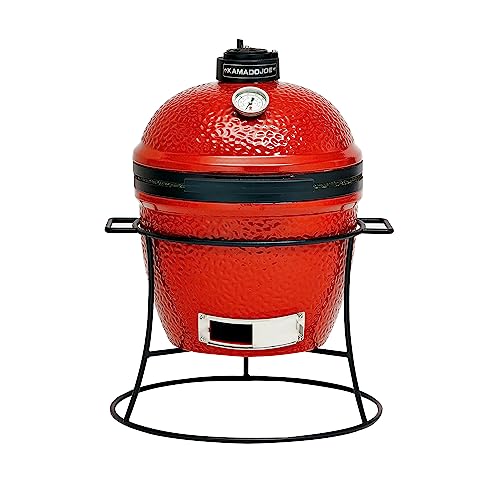
Kamado Joe Joe Jr. 13.5-Inch Ceramic Charcoal Grill, Model KJ13RH — Best for Small Patios Overall
Who it suits. The small-patio cook who refuses to let square footage set the quality of dinner. The Joe Jr. leads this guide because it is the rare compact that is not a compromise: a true ceramic kamado — the same material, the same cooking behavior and the same lifetime warranty on ceramics as the flagship line — whose entire patio claim is a stand-mounted circle not much wider than the cooker itself.
Think about how it lives. The included cast iron stand holds it at working height on a sturdy patio table, a low purpose-built stand or a solid corner of the slab; its lid opens within its own silhouette; its fire is fully enclosed in thick ceramic, so the space around it stays calmer and cleaner than around any open cooker; and its roughly 150 square inches of stainless grate cook dinner for two in full — four burgers, a spatchcocked chicken, two steaks with vegetables — or for three with a side from the kitchen. The heat deflector in the box makes it a genuine smoker for a small shoulder or a chicken. The vents meter air precisely, so once it settles, it produces the least smoke of any format here — a real consideration when the patio is small and the neighbors are close. It sips lump charcoal, and a small bag stores in a bench or a closet without dominating either. At roughly 76 pounds by the Amazon detail table it is not a carry-away grill; it is a resident, but a resident with the manners of a guest.
Pros. The finest build and warranty in this guide in the smallest resident footprint; enclosed ceramic fire with precise, low-smoke cooking; deflector and stand included; superb fuel economy keeps charcoal storage tiny; cooks far above its size class.
Honest limitation. The grate cooks for two or three, and no arrangement changes that — households that regularly feed five from the patio should read the smoker and full-size reviews below instead. Ceramic is fragile against a drop or a hard knock, so its spot should be a settled one, out of the path of bikes and bins. And while it is compact, it is not storable in the AKORN Jr.’s sense: it wants its stand, its cover and its corner, permanently.
Choose it if your patio is small, your household is smaller, and you want the best cooker rather than the biggest. Skip it if the grill must disappear between cooks, or if four-plus covers are your normal service. Check price on Amazon — it is frequently discounted from the maker’s list, which is part of how it fits this tier.
Char-Griller AKORN Jr. Portable Kamado, Model E86714 — Best Storable Pick
Who it suits. The smallest patios of all — the ones where a resident grill of any size would consume the space it is meant to serve. The AKORN Jr.’s answer is radical and correct: do not live on the patio at all. It is a genuine insulated kamado that locks shut, carries by hand, and stores in a closet, a storage bench or a garage corner, so its patio footprint on non-cooking days is exactly zero, and on cooking days it is a 155-square-inch grate on a compact body that can sit on a sturdy table or its own small stand of patio.
Do not mistake the portability for a toy specification. The body is triple-wall insulated steel, the grate is cast iron, the vents are numbered and precise, and the cooking is the full kamado repertoire in miniature: settle it low and it smokes a halved rack of ribs or a small chicken; open it up and it sears two steaks properly; shut it down and the remaining lump waits for next week. For a small patio, its behavioral virtues compound the storage virtue: an enclosed, insulated fire is a tidy fire, the ash pan dumps in seconds into your metal ash can, and its appetite for charcoal is so small that the fuel supply lives in a lidded bin the size of a shoebox. Its price — a small fraction of this guide’s ceiling — completes the small-patio logic: the grill is cheap enough that the budget can fund the storage bench, the little table and the chairs that make the patio a room.
Pros. Zero footprint between cooks; real kamado cooking that locks, carries and stores anywhere; cast iron grate; enclosed ash handling; priced to leave the patio budget alive for furniture and storage.
Honest limitation. Dinner for two or three per batch is the ceiling, and a four-person patio dinner means sequencing — cook the dense items first, hold them warm, and let the last items be the fast ones. Its street price is the most volatile in this guide, with a documented history of jumping well above its usual level, so check price on Amazon rather than assuming. And a grill that lives indoors must go indoors clean and cold: the carry-it-away life requires the discipline of cooling fully and emptying ash before it crosses the threshold.
Choose it if your patio must return to being a patio after every cook. Skip it if you have a permanent corner and cook for four — the resident picks will serve you better. The furniture that completes a small-patio setup is covered in Best Patio Furniture Set For Small Patios Under $700.
Weber Smokey Mountain Cooker, 18-Inch, Model 721001 — Best Capacity per Square Foot
Who it suits. The small-patio cook with big barbecue ambitions: the household that wants ribs for six and a shoulder for the freezer from a patio that measures its spare space in inches. The Smokey Mountain is the vertical answer — a water smoker that stacks two cooking grates inside an 18-inch circle, delivering 481 square inches of cooking area from a patio footprint that horizontal grills with half its capacity cannot match.
The stack is the whole idea. A charcoal base; a middle section with a porcelain-enameled water pan that steadies the temperature for hours; two plated steel grates, one above the other; a lid with a thermometer and a probe grommet; and a fuel door in the side that lets you add charcoal and wood without unstacking a loaded cooker. On a small patio the geometry keeps giving: the fire’s footprint is the cooker’s footprint, the cook stands in one place, and when the season ends the whole thing breaks into sections that store in a closet or a bench far more gracefully than any cart. At about 39 pounds in pieces, no single lift is heavy. Its cooking tempo is the patio-friendly one, too — a settled smoker at a low temperature is a calm presence, though it makes honest wood smoke for hours and small patios with close neighbors should schedule long smokes with the same consideration the apartment guide in this series describes.
Pros. Unmatched cooking capacity per square foot of patio; purpose-built low-and-slow stability; sectional storage; fuel door for calm long cooks; light in pieces and easy to move.
Honest limitation. It is a smoker, not a grill — the weeknight burger is a workaround on its base, not a use case, so households whose patio cooking is mostly fast grilling should choose a kamado and visit barbecue at friends’ houses. It is also tall: check the full stacked height against low overhangs, pergolas and the door swing, because vertical storage math cuts both ways. And the water pan’s greasy cleanup is a real chore to plan for where patio space for a wash-down is limited.
Choose it if barbecue is your patio’s purpose and space is its constraint. Skip it if your cooking is grill-first, or if a tall cooker crowds your only door. Check price on Amazon, and confirm the 18-inch listing — the 22-inch version is wider, taller and hungrier, and on a small patio those differences matter.
Char-Griller AKORN Kamado, Model E16620 — Best Full-Size Option That Still Fits
Who it suits. The patio at the larger end of small — the townhouse slab or terrace that can dedicate one parking spot to a complete cooking station and wants no compromises inside it. The full-size AKORN is this guide’s resident heavyweight: a triple-wall insulated steel kamado on a wheeled cart, with 445 square inches of total cooking area including the warming rack, over a roughly 20-inch cast iron main grate.
What the parking spot buys is range. This one cooker grills the weeknight dinner, sears at high heat, roasts with indirect setups and smokes for hours on a modest load of lump — the full charcoal repertoire without a second appliance, which on a small patio is itself a space strategy: one station instead of two. The cart’s folding side shelves give the cook a working surface that folds away when the patio returns to being a sitting room; the wheels let it roll to the shed side for winter or out of the way for a gathering; the lid locks; the EasyDump ash pan keeps the small space free of the ash scatter that open systems spread. Its mid-tier price also respects the patio budget, leaving room for the cover it should live under and the deflector stone that completes its indirect cooking.
Pros. The complete charcoal repertoire in one station — no second cooker needed; insulated efficiency and calm temperature control; folding shelves respect the space; cart mobility for a patio that reconfigures; strong value leaves budget for the rest of the patio.
Honest limitation. It is a resident with a real footprint: measure the parking spot, including the cook’s standing room and the lid’s swing, before ordering, and be honest if the answer is no — the compacts above exist for that patio. Painted steel wants its cover and occasional touch-up to stay ahead of rust. And a full-size kamado’s presence dominates a small patio visually as well as physically; if the patio is primarily a sitting room that occasionally cooks, the storable pick is the better citizen.
Choose it if your patio can spare one true parking spot and you want a single, complete station. Skip it if the tape measure says otherwise. Check price on Amazon; its street price moves with sales, usually helpfully. Patio cooks whose space also has to satisfy a lease should cross-check the rules discussion in the apartment guide of this series before ordering.
Weber Performer Deluxe Charcoal Grill, 22-Inch, Black — Best for a Generous Patio
Who it suits. The generous end of small: the wide terrace, the deep townhouse patio, the paved garden room that can give a full station its corner and still seat four. For that patio, the Performer Deluxe is the most convenient charcoal life in this tier — the 22-inch Weber kettle with its 363 square inches of grate, set in a cart with a broad work table, a weather-protected charcoal storage bin, and push-button gas ignition for the coals.
Its small-patio virtues are workflow virtues. The work table means the patio does not need a separate prep surface crowding the chairs; the charcoal bin means fuel storage is inside the station rather than in a bag by the door; the enclosed ash catcher, fed by the One-Touch sweeping system, means the paved surface stays clean — no open ash pan scattering across the stones every time the grill moves. The ignition removes the chimney from the patio’s limited counter space entirely. And the kettle itself is the known quantity: porcelain enamel that tolerates weather, a hinged grate, a lid thermometer, and the deepest parts support in charcoal for a station that will live in its corner for years. It is ranked last among the linked picks here not because it is the least capable — in the base guide it leads — but because its footprint is the largest claim on the resource this guide exists to protect.
Pros. A self-contained station: prep surface, fuel storage and ignition all inside one footprint; enclosed ash keeps paving clean; enamel durability and unmatched parts support; the full 22-inch kettle cooking experience.
Honest limitation. The footprint is the story: cart, table and working room together claim the most patio of any pick here, and on a genuinely small patio it will crowd out the sitting it was bought to serve. Measure with the cook standing at it, not just the cart’s outline. The premium also buys convenience rather than different food, and the station is a park-it-forever piece — renters and rearrangers should weigh the compacts first.
Choose it if your patio is small-but-generous and you grill often. Skip it if the tape measure is even slightly doubtful — a grill that fits is a better grill than a finer one that does not. Check price on Amazon, and confirm the Deluxe with gas ignition rather than the plainer Performer cart. If the footprint fails, the same budget buys a very different patio in Best Charcoal Grill Under $500.
PK360 Grill & Smoker — The Rust-Proof Upgrade Above This Tier (Prose Only)
Who it suits. The small-patio cook who thinks about weather and decades. The PK360 is a capsule of thick cast aluminum — a body that cannot rust, conducts heat evenly, and shrugs off the damp corners and uncovered winters that eat steel — with a four-vent airflow system that makes two-zone cooking unusually precise, on a stand from which the capsule lifts for moving and storage. On a small patio exposed to weather, that rust-proof body is not a luxury; it is the difference between a cooker that ages and one that merely gets rained on.
It is covered without a purchase link because the maker’s price sits above this guide’s $700 ceiling and no in-tier Amazon offer for the exact model could be verified at research time — stated plainly rather than stretched quietly. What the premium buys is the capsule and its control: the most weatherproof cooker body in charcoal, a genuinely distinctive two-zone instrument, and a design with generations of production behind it. What it does not buy is a small footprint by compact standards — the stand claims real patio — or capacity beyond a small household’s needs. Small-patio buyers should weigh it as the durability-first alternative to the Joe Jr.’s ceramic-first proposition, at a price this guide’s ceiling honestly excludes.
Pros. Cast aluminum that cannot rust — the lowest-maintenance body in charcoal; precise four-vent two-zone control; capsule detaches from its stand; a proven, long-lived design.
Honest limitation. Above this guide’s budget at the maker’s price. The stand’s footprint is a real patio claim, and its cooking area suits small households rather than gatherings.
Choose it if — outside this guide’s frame — weatherproof durability outranks the ceiling. Skip it if the budget is real: the Joe Jr. gives you a lifetime-warrantied ceramic cooker inside the tier, in less space. The gas alternative for patios where charcoal is impractical is Best Gas Grill For Small Patios Under $700.
Comparison Table
| Pick | Format | Cooking area | Small-patio strength | Watch out for |
|---|---|---|---|---|
| Kamado Joe Joe Jr. | Ceramic kamado on stand | ~150 sq. in. | Finest cooking from the smallest resident footprint | Cooks for two or three; fragile if dropped |
| Char-Griller AKORN Jr. | Compact steel kamado | 155 sq. in. | Zero footprint between cooks; stores anywhere | Batch cooking for more than three; price is volatile |
| Weber Smokey Mountain 18″ | Vertical water smoker | 481 sq. in. on two grates | Most capacity per square foot; stores in sections | A smoker, not a grill; check height clearance |
| Char-Griller AKORN E16620 | Kamado on cart | 445 sq. in. total incl. warming rack | One complete station; shelves fold away | Needs a true parking spot; steel needs cover |
| Weber Performer Deluxe 22″ | Kettle on cart | 363 sq. in. | Self-contained station for generous patios | Largest footprint in this guide |
| PK360 | Cast-aluminum capsule | Compact capsule class | Cannot rust; lifts off its stand | Above this guide’s ceiling — prose only |
How to Choose the Right Charcoal Grill for a Small Patio
Measure the patio, then measure the grill’s life on it. Tape out the cooker’s footprint plus a standing zone in front and safe clearance on every side — away from siding, railings, cushions and anything that burns — and live with the tape outline for a day before ordering. Then measure the storage: the closet, bench or corner where a storable pick will live, or the parking spot a resident pick will claim through winter. Small-patio purchases fail on the second measurement more often than the first.
Decide resident versus visitor. A resident grill (Joe Jr., AKORN, Performer) is always ready and always present; a visitor (AKORN Jr., and the Smokey Mountain in its stored sections) appears for cooks and vanishes after. Neither is better — but they suit different patios, and the honest question is how the space feels on the six days a week nobody is grilling. If the patio is your outdoor living room, the visitor model protects it; if it is primarily a cooking yard, the resident’s readiness wins.
Go vertical when capacity matters. The water smoker’s stacked grates are the standing refutation of “small patio, small cooking.” If your household is four-plus and your patio is small, vertical capacity or batch discipline are the two honest answers, and the smoker provides the first while the compacts demand the second.
Keep the fire’s manners in proportion to the space. Enclosed, insulated cookers burn cleaner and steadier, scatter nothing, and cool inside a sealed body — virtues that scale in importance as the space shrinks. Whatever you choose, keep the ash routine strict: fully cold (at least 48 hours), wetted, into a lidded metal can stored on the non-combustible surface, never near the cushions or the fence line.
Spend the headroom on the room. The leading picks leave much of the $700 for the storage bench, the small table, the cover, the ash can and two good chairs — the difference between a grill parked on a slab and a patio that functions as a room. If a fire feature is part of the same small-space plan, Best Fire Pit For Small Patios Under $700 applies the same footprint discipline to that purchase.
Common Mistakes When Buying a Grill for a Small Patio
Measuring the grill and forgetting the cook. The catalogue footprint is the machine at rest. Add the lid swing, the standing room, the tray table you will improvise if the grill lacks one, and the clearance from anything combustible — and many “fits” become “crowds.” Tape it out.
Buying a cart for a patio that needed a closet. The most common small-patio regret: a station that cooks beautifully and lives terribly, consuming the sitting space it was bought to serve. If the patio must be a living room six days a week, buy the storable pick and accept batch cooking.
Ignoring the neighbors’ geometry. On a small patio, your grill is close to your fence and their window. Settled kamado cooking, modest fires and sane hours are not just courtesy — they are how small-patio grilling privileges survive. The loudest cooks in a small space are the ones who light a full chimney at nine at night.
Storing charcoal and ash carelessly in a tight space. Charcoal belongs in a sealed, dry bin; ash belongs in a lidded metal can, treated as hot for at least 48 hours, kept on the non-combustible surface away from furniture. In a small patio everything is near everything else, which is exactly why the routine matters more here than in a big yard.
Cleaning with a wire-bristle brush. Loose bristles are a documented ingestion hazard and such brushes have been recalled; on a small patio where the grill sits beside the dining chairs, the case for a bristle-free brush, a wooden scraper or a foil scrub is stronger still.
Getting the Most From a Small Patio Grill: Fire, Space and Upkeep
Cook in the cooker’s rhythm. Compacts reward sequencing: dense items first, held warm and wrapped; fast items last; sides shared with the kitchen, which on a small patio is steps away. A 150-square-inch grate with a plan feeds four people happily; the same grate without one feeds two people and an argument.
Let insulation do the work. Small kamados come up to temperature on small fires — light modestly, let the body heat-soak, and cook on the stored heat rather than a roaring fire. You will use less charcoal (less to store), make less smoke (better manners), and hold steadier temperatures (better food) in a single decision.
Keep the patio’s reset ritual short. Grate brushed hot, ash out when cold, cover on or cooker carried in, cushions and chairs back in place. The small patios that stay pleasant are the ones whose reset takes five minutes; design your setup — storage bench by the door, ash can on its slab corner, cover that fits without a fight — so that yours does.
Three Small Patios, Planned on Paper
The townhouse slab, about 8 by 10 feet. The resident corner takes the Joe Jr. on its stand against the wall, with the ash can on the slab beside it and a small storage bench along the fence holding charcoal, gloves and the cover. Two chairs and a side table occupy the opposite corner; the door swing stays clear; the cook works in the triangle between grill, bench and door. Nothing on this patio is large, and everything on it earns its place — which is the definition of a small patio done right. On cooking nights the bench becomes the staging surface; on every other night the patio reads as a sitting room that happens to hide a superb grill.
The condo terrace that must reset. Here the AKORN Jr. is the whole strategy: it cooks from a sturdy low table or the terrace’s solid corner, then cools, locks, and goes into the storage bench or the hall closet, and the terrace returns to chairs and plants without a trace of the evening’s dinner. The discipline this layout demands is real — the cooker crosses the threshold only when fully cold and emptied — and the payoff is a terrace that is never dominated by its grill. Hosts of four should plan the batch sequence on paper the first few times; by the third cook it is reflex.
The paved garden room, about 10 by 12 feet. This is the small patio that can think like a backyard. The AKORN claims its parking spot along the wall — or the Smokey Mountain takes the corner if barbecue is the household’s religion — with a real little table for staging, four chairs, and string lights doing the atmosphere. The measurement that makes or breaks this layout is the cook’s working corridor: grill frontage plus standing room plus a passing lane behind. Give the corridor its width first and fit the furniture to what remains, and the room works for both cooking nights and sitting nights. Crowd it the other way and it works for neither.
Small Patio, Full Menu: Cooking Bigger Than the Footprint
The persistent myth of small-patio cooking is that the menu shrinks with the grate. In practice the menu shrinks only if the cook insists on cooking everything at once, at the same temperature, on the same surface. Sequence instead. The dense, forgiving items — sausages, chicken thighs, thick chops — go first and hold beautifully wrapped and warm. The vegetables take the middle shift, in the zones the meat vacated. The fast, theatrical items — steaks, shrimp, scallops, the good bread — cook last, in minutes, in front of the guests. A compact kamado running that sequence serves a four-person menu that a careless cook could not match on a grill three times its size, because the limiting factor was never the grate; it was the plan. Add the indoor kitchen — steps away in any small-patio home — as the official holding and sides station, and the patio’s size stops appearing in the dinner conversation entirely. Buy the cooker that fits the space, and let technique supply the capacity.
Final Recommendation
For most small patios, the Kamado Joe Joe Jr. is the answer: the best-built, best-warrantied cooker in this tier, cooking genuine ceramic kamado food from the smallest resident footprint on the page. If the patio must empty between cooks, the AKORN Jr. is the storable champion and the budget’s best friend. Barbecue households should go vertical with the Smokey Mountain; patios with one true parking spot should fill it with the AKORN; and only the genuinely generous small patio should host the Performer Deluxe. Measure first, check price on Amazon second, and spend what is left on the patio itself.
FAQ
What size grill is right for a small patio?
The one whose working footprint — cooker, lid swing, your standing room, safe clearance — leaves the patio usable for its other purposes. In practice that means a compact kamado for most small patios, a vertical smoker where capacity matters, and a cart station only where the patio is small-but-generous. Tape the outline on the ground before you buy; the tape never lies.
Can a small patio handle a full-size kamado?
Some can — the deciding factors are one honest parking spot with clearances, room for the cook to work, and a patio life that tolerates a permanent station. The full-size AKORN in this guide is the test case: measure its spot with you standing in it. If the answer is no, the compact kamados cook the same repertoire at a smaller scale rather than a lesser quality.
How do I store a charcoal grill when the patio is tiny?
Choose a cooker designed for it: a locking-lid compact that carries indoors, or a sectional smoker that stacks into a closet or bench. Store it clean and fully cold, charcoal in a sealed dry bin, ash only ever in a lidded metal container. A storage bench that doubles as seating is the classic small-patio solution — it hides the grill and hosts the guests.
Is charcoal safe on a small patio?
With the standard disciplines, yes: a non-combustible surface, clearance from siding, railings and furniture, a settled fire rather than a flaring one, strict ash handling, and never under a roof or in an enclosed space, where carbon monoxide collects. Small spaces concentrate both heat and consequences, so the disciplines matter more — and if your patio belongs to a lease or a condo, the rules check in the apartment guide of this series comes before everything else.
What else should a small-patio setup include?
A fitted cover or a storage home, a lidded metal ash can, a sealed charcoal bin, heat-resistant gloves and an instant-read thermometer — and, if the patio doubles as seating, furniture chosen with the same footprint discipline as the grill. The picks in this guide leave budget for all of it, which is part of their design.


