Where to buy
Every linked pick in this guide to the best charcoal grill for backyards under $100 is sold on Amazon — check the latest price, availability and delivery there before you buy. Orders are placed on Amazon. We may earn a commission from qualifying purchases. One pick below is covered in prose only, with the reason stated in its review, because its current Amazon pricing sits outside this budget tier.
- Best for backyards: Weber Jumbo Joe Charcoal Grill, 18-Inch, Black — Check on Amazon
- Char-Griller Patio Pro Charcoal Grill and Smoker, Model E1515 — prose only, see its review below for why
- Weber Smokey Joe Portable Charcoal Grill, 14-Inch, Black — Check on Amazon
- Weber Go-Anywhere Charcoal Grill — Check on Amazon
- Cuisinart 14-Inch Portable Charcoal Grill (CCG-190RB, Red) — Check on Amazon
- Gas One 14-Inch Portable Barbecue Grill (CG-14) — Check on Amazon
Read the full guide ↓
Disclosure: As an Amazon Associate, dailyhomedecorating.com earns from qualifying purchases. Links to Amazon on this page are affiliate links; they cost you nothing extra. Listing details such as price and availability change often, so check the current Amazon listing before you buy.
A backyard changes what the best charcoal grill under $100 needs to be. On a balcony or in a park, portability rules; in a backyard, the grill gets a home — a corner of the patio, a spot on the deck, a patch by the fence — and it gets a job description written by family life: weeknight burgers for four, chicken for Sunday, sausages when the neighbours’ kids materialise, and the occasional ambitious cook when someone brings home a whole chicken and a plan. Under this ceiling, no grill is a full-size fixture with a side table and a warming rack, so the backyard question becomes a practical one: which compact grill cooks most like a real backyard grill, survives living outdoors, and does not make every cookout feel like a camping exercise?
The honest shape of the tier is this. One pick — Weber’s Jumbo Joe — is a genuine kettle bowl with family-sized capacity that happens to be portable, and it is our headline answer for most backyards. One pick, the Char-Griller Patio Pro, is the only true backyard-format grill in the class — a standing cart with a shelf and cast-iron grates — but its current Amazon pricing has drifted above this guide’s ceiling, so it is covered in prose, with the situation explained, for readers who find it on promotion or decide the format is worth watching. The remaining picks are the compact kettles and tabletops, and in a backyard they earn their place differently than they do on the road: as the everyday two-person grill for couples, as a second grill beside a bigger cooker, as the starter grill a teenager learns on, or as the low-spend answer for a yard that hosts three cookouts a year.
Backyard ownership also adds two tests that portable guides skip. The first is weather: a backyard grill lives outside, under a cover if it is lucky, in rain and sun and frost, so enamel quality, rust behaviour and storage routine decide whether it is a five-year appliance or a two-season one. The second is the yard itself — where the grill stands relative to the house, the fence, the deck boards and the lawn, and where its ash goes when the cooking is done. This guide treats both tests as part of the purchase, with a placement and care section written for yards rather than campsites. If your outdoor space is smaller than a backyard — a patio slab rather than a lawn — our companion guide to the Best Charcoal Grill For Small Patios Under $100 applies the same shortlist to tighter quarters, and readers furnishing the whole yard at this ceiling may also want the Best Adirondack Chair Under $100 roundup for the seats around the fire.
In this guide
Quick Picks
In a hurry? This table matches each grill to the backyard job it does best.
| Buyer type | Pick | Why it stands out | Link |
|---|---|---|---|
| Best for backyards | Weber Jumbo Joe Charcoal Grill, 18-Inch | 240 square inches of real kettle cooking; enamel build that lives outdoors well | Check on Amazon |
| Best standing format | Char-Griller Patio Pro E1515 | Wheeled cart, side shelf and cast-iron grates — but currently priced above this tier on Amazon | Prose only — see review |
| Best for couples and second-grill duty | Weber Smokey Joe, 14-Inch | The classic small kettle: enamel, light, fuel-sipping, ideal beside a bigger cooker | Check on Amazon |
| Best yard-to-car flexibility | Weber Go-Anywhere Charcoal Grill | Lives on the patio table all summer, packs flat for the lake in seconds | Check on Amazon |
| Best budget backyard starter | Cuisinart 14-Inch Portable Charcoal Grill (CCG-190RB) | Dual vents and a locking lid for a fraction of the Weber money | Check on Amazon |
| Cheapest honest option | Gas One 14-Inch Portable Barbecue Grill (CG-14) | Locking lid, dual vents and ash catcher for very occasional yard duty | Check on Amazon |
How These Picks Were Chosen
Backyard criteria put cooking and durability ahead of packed size. Capacity was judged in family terms — burgers in one load, chicken pieces with room to move, a whole chicken under the lid — and the 18-inch class separated itself immediately: it is the smallest format that runs a true two-zone fire with a working cool zone, which is the technique backyard cooking is built on. Venting quality came next, because a grill that lives in one place gets asked to hold temperatures for chicken and roasts, not merely to sear and serve. Build and finish were judged as outdoor-living qualities: porcelain enamel over painted steel, dampers that will not rust stiff, grates with replacement paths through the maker’s parts network.
Every specification in this guide was verified against manufacturer data, and every linked pick had a price sighting at or under the tier ceiling on its exact Amazon listing at research time; the sightings are kept in the notes that accompany this guide, and readers should recheck the listing before buying because grill pricing moves with the season. The Patio Pro failed that price test — its current Amazon and maker-store pricing sit above the ceiling — so it appears without a link, explained rather than hidden, because it is the format many backyard shoppers are actually looking for. Two other familiar names were excluded on price: the 18-inch Weber Original Kettle and a large budget barrel grill, both currently priced into the next tier, where our Best Charcoal Grill Under $200 guide takes over. We also checked for CPSC recalls covering these grill models and found none for any grill reviewed here; recent category recalls concern accessories such as wire-bristle brushes, hence this guide’s standing advice to clean grates with a bristle-free brush.
Finally, we weighted the ownership details that backyard life exposes: how ash is emptied when the grill never travels, whether a cover exists in the maker’s range, whether the grill can be left out in a wet week without punishment, and how much assembly stands between the box and the first cookout. A grill can win a specification table and lose a backyard; the reviews below try to judge the backyard.
The 6 Best Charcoal Grill for Backyards Under $100 — Reviewed
1. Weber Jumbo Joe Charcoal Grill, 18-Inch, Black — Best for Backyards
Who it suits: Families and couples whose backyard cooking is the week’s rhythm — two to four people most nights, six at a stretch — and who want one grill under the ceiling that behaves like the kettle their parents owned.
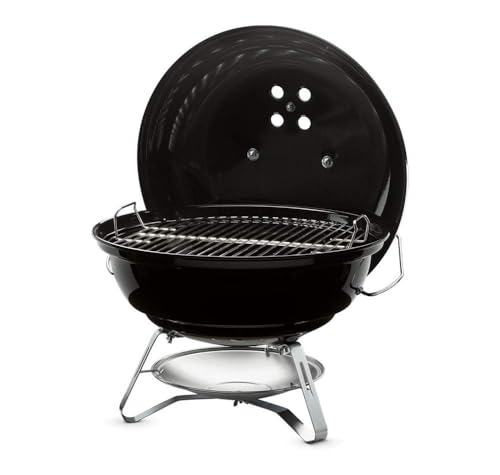
The Jumbo Joe is the cooking bowl of Weber’s 18-inch kettle family on short legs, and in a backyard that is precisely the right trade. You keep the porcelain-enamelled bowl and lid, the 240 square inches of plated-steel grate, and the two-damper control that makes kettle cooking what it is; you give up the tall stand, and in exchange the grill sits on the patio table, moves to the lawn on a stand, stores in the shed over winter, and still fits the car when the cookout moves to the lake. Cooking capacity is the argument: eight burgers without crowding, a spatchcocked chicken with room to spare, two zones with a genuine cool side for finishing chicken and resting steaks. The Tuck-N-Carry lid lock, designed for travel, turns out to be a backyard feature too — the lid stays clipped against wind and curious dogs, and hooks onto the bowl while you work. Living outdoors, the enamel shrugs off the weather that punishes painted steel, and when a grate eventually tires, Weber’s parts network has another one.
Pros: family capacity in one load; true two-zone kettle cooking; enamel longevity outdoors; parts and accessory support in the 18-inch format. Honest limitation: it cooks at table height, not standing height — you provide the sturdy, heat-safe table or stand, and that surface is part of the setup. The plated grate also rewards a brush-and-oil routine after cooking; ignored under a damp cover, it will eventually show it.
Choose it if one grill must run the backyard. Skip it if you will not cook without a standing cart and side shelf — that format, honestly priced today, is the prose-only pick below or the next tier up. Check on Amazon
2. Char-Griller Patio Pro Charcoal Grill and Smoker, Model E1515 — Prose Only
Who it suits: Backyard owners who want the classic fixture format — standing height, wheels, a shelf for the plate and the tongs, cast-iron grates — and who are patient shoppers.
The Patio Pro is in this guide because it is the grill backyard shoppers picture, and it is unlinked because of this guide’s price promise: at verification, Amazon’s pricing for the model sat above the under-$100 ceiling, and the maker’s own store was above the ceiling too. It spent years inside this tier, which is why older roundups recommend it as a budget buy; today, treat it as a promotion-watch item — check price on Amazon, and if you find it inside the tier from a seller you trust, the specification justifies the excitement. The barrel body carries 250 square inches of cast-iron grate, the grate material that sears hardest and seasons like a skillet. A wooden side shelf solves the kettle’s one ergonomic gap, the plate-landing problem. A slide-out ash pan, a lower storage rack, dual dampers and a lid gauge complete a package designed to live in one spot and be ready — the grill as patio furniture, in the good sense.
Pros: cast-iron searing; standing height and a real shelf; ash pan convenience; the largest stated cooking area here. Honest limitation: today’s pricing, first of all. Beyond that, the powder-coated body wants chips touched up before rust starts, assembly is the longest in this guide, and at around fifty pounds it is a roll-it-around-the-yard grill, not a take-it-anywhere one.
Choose it if you catch it in tier and want a permanent backyard fixture. Skip it if the listing in front of you is above the ceiling — at that money, compare it against the full-size kettles in the Best Charcoal Grill Under $300 guide before spending.
3. Weber Smokey Joe Portable Charcoal Grill, 14-Inch, Black — Best for Couples and Second-Grill Duty
Who it suits: Couples in their first backyard, and established backyard cooks who want a small kettle beside a bigger grill — for the corn while the main grill holds chicken, for two steaks on a Tuesday without firing the big bowl, or for teaching a kid to grill on equipment sized for learning.
Everything the Smokey Joe is in a park, it is in a backyard, with the yard adding one virtue: permanence makes its economy shine. A small chimney of briquettes — a fraction of a big kettle’s fuel — cooks a couple’s dinner, and the fire is lit, cooked over and snuffed in the time a large grill takes to get interesting. The 14-inch enamel bowl gives 147 square inches: four burgers, two steaks with room to breathe, skewers for four as a starter. Current production’s Tuck-N-Carry lid lock keeps the lid honest in a breeze and lets the grill hang or stand in a shed corner all winter without shedding its grate. As a second grill it is genuinely strategic: vegetables and vegetarian mains cook unhurried beside the meat grill, appetizers come off in waves while guests arrive, and dessert — grilled peaches, pineapple — gets its own clean fire.
Pros: enamel build and Weber support; fuel economy; tiny storage footprint; the best learning grill in the guide. Honest limitation: it will not cater the family reunion — four-person cooking is batch cooking, and a whole chicken is a squeeze. Ash is the tip-it-out kind, so the backyard routine needs a metal ash bin kept nearby, emptied only when fully cold.
Choose it if you cook for two, or want a specialist beside a bigger grill. Skip it if it must be the only grill for a family of four — the Jumbo Joe exists for that. Check on Amazon
4. Weber Go-Anywhere Charcoal Grill — Best Yard-to-Car Flexibility
Who it suits: Backyard households whose grilling refuses to stay in the backyard — the lake house weekends, the tailgates, the in-laws’ patio — and who want one quality grill that holds a home station and travels without a second thought.
On the patio table the Go-Anywhere is a composed little cooker: about 160 square inches of rectangular grate that takes skewers, sausages, corn and fish fillets in the rows they naturally form, twin lid dampers to steer the heat, and an enamelled body that wipes down and resists the seasons. Then the legs fold, the lid locks, and the grill is a flat case that slides into the car or stands on a shed shelf — the only pick here whose storage shape is genuinely furniture-like. In the backyard specifically, its rectangular fire rewards the cook who thinks in lines: a bank of coals at one end, a gradient across the grate, delicate food parked at the cool end under the closed lid. Owners store the chimney and tools inside the body, so the backyard kit and the travel kit are the same kit.
Pros: enamel durability at home and away; flat storage; a grate shape that suits skewers and fish; one kit for yard and road. Honest limitation: the low lid caps tall food — beer-can chicken is not happening — and the single-level fire gives less low-and-slow flexibility than a kettle bowl. It also sits at the top of the tier’s pricing, buying format and build rather than area.
Choose it if your grill splits its life between yard and road. Skip it if it will never leave the yard — the Jumbo Joe’s extra area serves a stationary life better. Check on Amazon
5. Cuisinart 14-Inch Portable Charcoal Grill, CCG-190RB — Best Budget Backyard Starter
Who it suits: First backyards and first grills: new homeowners furnishing a yard on a budget, renters with a garden, and anyone who wants a season of charcoal cooking to decide whether the hobby sticks before Weber money is spent.
The little red Cuisinart understands its assignment. Dual vents — lid and base — deliver the airflow control that defines whether charcoal cooking is a pleasure or a smoky argument, and many grills at this price omit one of them. The 14-inch chrome-plated grate handles the weeknight repertoire for two, the three lid latches make it the easiest grill here to pick up and move around the yard — from patio to lawn shade to garage — and the ash catcher plate keeps the patio tidier than most tabletops manage. The maker’s stated area flatters the grate’s diameter a little; judged honestly it is a 14-inch grill, cooking in the direct style, and at that job it is entirely competent. In a backyard it also plays a second role well: the kids’-table grill, the appetizer grill, the one that comes out when two extra friends stay for dinner and the main grill is full.
Pros: dual-vent control at the lowest sensible price; latching lid for moving and storage; very light; ash catcher included. Honest limitation: thin steel — modest heat retention, a finish that will not age like enamel, and a realistic life measured in seasons, extended by the empty-dry-covered routine and shortened sharply by neglect.
Choose it if the yard is new, the budget is shared with everything else a new home needs, or the hobby is on trial. Skip it if you are already sure — the Smokey Joe is the same size with a decade in it. Check on Amazon
6. Gas One 14-Inch Portable Barbecue Grill, CG-14 — Cheapest Honest Option
Who it suits: Backyards that host a cookout a few times a year rather than a few times a week — holiday weekends, the occasional birthday — where a serious grill would spend its life as garden furniture.
The CG-14 covers the fundamentals with a completeness its price does not promise: a three-point locking lid that seals for storage in the shed, dual venting for actual fire control, and an ash catcher under the firebox. The maker states about 150 square inches around the 14-inch grate — two people’s dinner in one load, four in batches — and it cooks hot and direct, the way small tabletops do. For the occasional-use yard, the economics are hard to argue with: the grill costs less than the food at a single family cookout, stores on a shelf, and asks nothing of its owner between events except to be put away dry. Treat it as a seasonal appliance, rinse the ash out after each use, and it will cover those few events a year for years.
Pros: the lowest price here by far; locking lid and ash catcher; dual vents; shelf-sized storage. Honest limitation: light-gauge construction throughout — the weakest heat retention in the guide, hardware built to a price, and no path to a decade of weekly service. Occasional use is not a consolation role for this grill; it is the design brief.
Choose it if your backyard grilling is a few events a year. Skip it if the grill will work weekly — step to the Cuisinart at minimum, and preferably to a Weber. Check on Amazon
Comparison Table
| Grill | Format | Cooking area | Grate | Backyard role | Watch out for |
|---|---|---|---|---|---|
| Weber Jumbo Joe 18-Inch | Tabletop kettle | 240 sq in | Plated steel | The main family grill | Needs a heat-safe table or stand |
| Char-Griller Patio Pro E1515 | Barrel on wheeled cart | 250 sq in | Cast iron | The permanent fixture | Currently above this tier on Amazon — prose only |
| Weber Smokey Joe 14-Inch | Tabletop kettle | 147 sq in | Plated steel | Couples’ grill / second grill | Batch cooking beyond two people |
| Weber Go-Anywhere | Rectangular portable | About 160 sq in | Plated steel | Yard grill that also travels | Low lid; top-of-tier price |
| Cuisinart CCG-190RB | Tabletop | 14-inch grate | Chrome-plated | Starter and overflow grill | Thin steel, seasonal lifespan |
| Gas One CG-14 | Tabletop | About 150 sq in (maker-stated) | Chrome-finished | Few-events-a-year grill | Light-gauge build |
Placing a Charcoal Grill in a Backyard: The Setup That Works
Give it a station, not a spot
The backyard grills that get used weekly have a station: a level, non-combustible base — paving, concrete, a patio slab — a surface beside the grill for plates and tools, and the charcoal, chimney and brush stored within a few steps. Tabletop picks need their table chosen with the same care as the grill: metal or stone tops shrug off the heat radiating downward, wooden tables want a heatproof mat or stand beneath the grill, and plastic folding tables are never acceptable under a lit charcoal grill. Keep the station a sensible distance from the house siding, fences, play equipment and overhanging branches, and out of the yard’s traffic lanes — most backyard grill accidents are trips and bumps, not fires.
Think about wind before the first cook
Wind is a backyard grill’s invisible hand: it fans coals hotter, blows ash, and pushes smoke where it wants. A station sheltered from the prevailing breeze — but never tucked under an eave, a pergola roof or a tree canopy, where heat and sparks rise into trouble — cooks more evenly and keeps smoke out of the house’s open windows. On genuinely windy days, the lidded kettles here earn their keep; an open tabletop in a gale is a lesson in humility, and postponing is a legitimate technique.
Ash, lawns and decks
Hot ash scars deck boards and kills lawn patches, and cold ash is a garden resource only in small, fully cold quantities — the safe routine is simpler: coals cool completely in the closed grill, ash goes into a metal container with a lid kept on the patio, and the container is emptied to household waste only when days cold. Never tip a grill out onto the lawn to empty it, and never store the ash container against the house or beside the charcoal bag.
How to Choose the Best Charcoal Grill for Backyards Under $100
Count your regulars, not your parties
Size the grill for the four Tuesdays a month, not the one Saturday a year. Two regulars: any 14-inch pick cooks happily. Three to four regulars: the Jumbo Joe’s 18-inch grate is the honest minimum for single-load cooking. The big annual party is a batch-cooking and borrow-a-second-grill problem — which is one reason the small picks here make such good second grills later, when a bigger cooker eventually joins the yard.
Decide whether the grill is furniture or equipment
A fixture grill lives outside, ready, and asks for enamel or touch-up discipline and a cover. Equipment lives in the shed and comes out to cook, and asks for a locking lid and a shape your storage welcomes. The Patio Pro is furniture; everything linked here is equipment that can moonlight as furniture under a cover. Neither life is better — but buying furniture features for an equipment life, or the reverse, is how money gets wasted in this tier.
Plan the table before the grill arrives
Every linked pick is a tabletop format. If your yard has no suitable table or stand, that purchase is part of this one — a sturdy metal patio table, a purpose-built grill stand, or a masonry surface. Readers setting up the whole cooking corner at once can pair this guide with the Best Patio Dining Set Under $200 roundup to keep the yard’s budget in one view.
Buy the fire you will actually manage
All six picks burn the same charcoal, but they manage it differently: kettle bowls give the deepest fire and the best two-zone control, the Go-Anywhere’s shallow box gives a fast, flat fire for direct cooking, and the barrel gives width for rows of food. Match that to your menu — roasts and chicken pieces point to kettles, skewers and sausages point anywhere, and a household that grills mostly burgers should buy grate area and stop overthinking.
Common Buying Mistakes
Leaving a budget grill out in the weather with ash inside
This is the tier’s number-one killer. Damp ash against steel is corrosive, rain enters vents, and a painted or thin-steel grill can go from sound to scabbed in one wet season. The defence costs two minutes per cook: ash out when cold, grate brushed, cover on, or better, the grill under a roof. Enamel Webers forgive lapses; nothing forgives a winter of them.
Siting the grill under the eaves “for shelter”
Heat, smoke and the occasional spark rise. Under-eave and under-pergola grilling stains and scorches overhead structures and, in the worst cases, starts the fires that make the news. Shelter from wind belongs at the sides — a fence line, a hedge — never above the lid.
Buying the giant thin kettle for the big diameter
Unbranded oversize kettles crowd this tier’s listings, all diameter and no substance: foil steel, vague vents, wobbling legs. A smaller branded grill cooks better immediately and exists in five years with parts available. In backyards especially, where the grill is a fixture of family life, build beats size at this money every time.
Forgetting the landing zone
Raw food goes out on a plate; cooked food must come back to a clean one, and tongs, thermometers and resting trays all need somewhere to be. Kettles have no shelf, so the station needs a side table — the Patio Pro’s wooden shelf is its quiet masterpiece, and replicating that landing zone beside a kettle is the cheapest upgrade in backyard grilling.
Using a wire-bristle brush because it came free with something
Shed bristles end up in food, and regulators have recalled wire grill brushes by the million across brands in recent years. A coiled bristle-free brush, a wooden scraper or foil in tongs does the same job without the risk — an easy swap, made once, for every grill in this guide.
The Backyard Cookout Playbook: Feeding a Crowd from a Compact Grill
A compact grill feeds a backyard gathering the way a good kitchen feeds a dinner party — in sequence, not all at once. The method that works on every pick in this guide starts with the fire: one full chimney, banked for two zones, lit early enough that the grill is calm and ashed-over before the first guest wants food. First over the coals go the foods that hold well — sausages and chicken pieces — which then rest in the cool zone or a low oven indoors, freeing the hot zone for the foods that must be eaten the moment they are done: burgers, steaks, corn in its final char. Vegetables and bread fill the grate’s edges throughout, because a backyard crowd eats with its eyes while it waits, and a grill that always has something on it never looks overwhelmed. The second chimney is the host’s insurance: lit twenty minutes before it is needed, it refreshes the fire between rounds without a pause in service. None of this requires a bigger grill. It requires the host to think like a short-order cook — and it is exactly the cooking these grills, with lids that hold heat and zones that hold finished food, are quietly good at.
Winter, Rain and the Long Life of a Backyard Grill
A backyard grill’s lifespan is decided in the months nobody grills. The enemies are always the same three: standing water, damp ash and ultraviolet. The defence is a five-minute end-of-season routine. Burn the grill clean and hot one last time, let it cool for a full day, then empty every trace of ash from the bowl — including the grit in the damper tracks — brush the grate, oil it lightly, and wipe the exterior. Check enamel and paint for chips while the grill is clean; a chip touched up in autumn is a panel saved by spring, and on powder-coated steel it is the difference between a cosmetic mark and a rust bloom under the coating. Store the grill under a fitted cover in the driest spot the yard offers — a shed or garage if one exists, against a wall under an eave if not — with the vents closed and, for tabletops, the chimney and tools nested inside or in the charcoal bin beside it. Charcoal itself goes into a sealed bin off the floor; briquettes that spend winter in a damp bag will light like gravel in spring. Do this, and the enamel picks in this guide will start their fifth season looking like appliances. Skip it, and even good grills age a year per winter. The routine is the cheapest accessory in backyard grilling, and the only one that cannot be bought later.
The Backyard Accessory Kit That Actually Gets Used
Backyard accessories divide into the ones that live by the grill and the ones that live in a drawer, and the difference is whether they solve a problem that occurs every single cook. The chimney starter is the first kind: it ends lighter fluid forever and makes fire-building a fifteen-minute certainty. Long tongs and a wide spatula are the first kind — backyard cooking is reaching across a hot grate with a plate in the other hand, and short kitchen tools make that a burn ritual. An instant-read thermometer is the first kind, because chicken and burgers for a family are not foods to judge by vibes. A heatproof mat or stand under a tabletop grill protects the deck every cook, and a fitted cover protects the grill every day it is not cooking — both qualify easily. The ash bin, metal with a lid, is unglamorous and indispensable. What belongs in the drawer category for most households: elaborate tool sets with six near-identical implements, novelty presses and baskets bought for one recipe, and any brush with wire bristles, which should not be bought at all. Buy the short list, keep it at the station, and a compact grill cooks like a much more expensive setup — because in practice, it is the setup, not the firebox, that guests experience.
Teaching the Next Griller: Why a Compact Grill Is the Right Classroom
Many backyards acquire a compact grill the year a teenager gets interested, and the format turns out to be a feature. A 14- or 18-inch kettle teaches the complete grammar of charcoal — building a chimney fire, banking two zones, reading vents, resting meat — at a scale where a mistake costs four burgers rather than a brisket, and where the whole apparatus can be supervised from one patio chair. The Smokey Joe and the Jumbo Joe are the natural teachers here precisely because they are real kettles: nothing learned on them needs unlearning when the student graduates to a full-size grill, and the enamel build survives the learning curve, including the forgotten ash and the one rainstorm nobody covered for. Households that start this way tend to keep the small grill forever as the second grill — which is how a teaching purchase becomes the most-used grill in the yard. If that is your household’s story, buy the better small grill the first time; the curriculum lasts longer than the student expects.
Your First Four Backyard Cooks, in Order
Cook one: burgers and corn. A full chimney, spread fairly evenly, lid working between flips. This cook teaches the basics — how long your grill takes to ash over, where its hot spots live, how the lid vent changes the fire’s mood — on food that forgives everything. Note how long the fire stays usefully hot after the food is done; that number plans every later cook. Cook two: chicken pieces, two zones. Bank the coals hard to one side. Sear skin over the fire, finish beside it with the lid down, and learn the single most valuable backyard skill: moving food instead of fighting flare-ups. This is the cook where the Jumbo Joe’s area, or any kettle’s bowl depth, proves itself against a shallow tabletop. Cook three: a whole spatchcocked chicken or a thick steak. The confidence cook. The chicken wants the two-zone fire and patience; the steak wants the hottest fire you can build and a rest as long as its time over the coals. Either one, done well, is the moment a budget grill stops feeling like a compromise. Cook four: a mixed grill for guests. Sausages first to hold, vegetables at the edges, the hero food last over a refreshed fire — the playbook from the cookout section above, run for real. After these four cooks you will know your grill’s lighting time, its hot side, its vent settings for holding heat, and its honest capacity for your household. No review can give you that knowledge; these four evenings can, and every grill in this guide is capable of teaching them.
A Backyard Grilling Calendar: What Each Season Asks of the Grill
Spring asks for the inspection: dampers freed, grate scrubbed back to life, the winter’s cover taken off and the station swept out — and the first easy cook, burgers, to remind everyone why the grill survived the winter. Summer is the workload season, when the two-zone fire and the second chimney earn their keep and the grill cooks three or four times a week; this is when the ash bin’s rhythm and the covered, dry storage between cooks pay their dividend in a firebox that never smells stale. Autumn is arguably charcoal’s finest season in a backyard — cooler air, earlier evenings, food with smoke in it — and the season when a small kettle beside a fire pit becomes the yard’s centre of gravity; it is also the last easy chance to touch up paint chips and oil the grate before the cold. Winter divides households: some grill on, valuing a kettle’s ability to hold a fire in cold air with the vents a touch more open and the cook a touch more patient, while others put the grill through its end-of-season routine and store it dry until March. Either answer is respectable. The disrespectable answer — the one this calendar exists to prevent — is the grill discovered in April exactly as it was abandoned in October, full of wet ash, its season decided before it began.
Final Recommendation
For most backyards, buy the Weber Jumbo Joe and build its station properly: a heat-safe table on a level slab, a metal ash bin, a cover, and a side surface for plates. It cooks family dinners like a true kettle, lives outdoors like enamel should, and still travels when the cookout moves. Watch the Char-Griller Patio Pro’s pricing if what you really want is a standing fixture with a shelf — inside this tier it is a headline buy; above it, step up a tier rather than overpay. Couples should save money and fuel with the Smokey Joe, road-minded households should take the Go-Anywhere, and new yards on tight budgets should start with the Cuisinart, knowing the Gas One covers the few-events-a-year yard for the least money possible. Whichever arrives, give it the two-minute ash-and-cover routine after every cook — in a backyard, that routine, more than any specification, is what separates the five-year grill from the two-season one.
Frequently Asked Questions
What size charcoal grill does a backyard family of four need?
An 18-inch grate — 240 square inches in the Jumbo Joe’s case — is the comfortable single-load size for four: burgers for everyone at once, or chicken pieces with a working cool zone. A 14-inch grill feeds four in batches, which suits some households and frustrates others; be honest about which yours is.
Can I leave a charcoal grill outside all year?
Yes, with the routine: ash emptied, grate brushed and oiled, cover on, and ideally a roof or eave nearby — not above the grill while cooking, but over it in storage is fine. Porcelain enamel handles outdoor life best; powder-coated and painted finishes need chips touched up and benefit from winter shed storage.
Is a tabletop grill practical as a permanent backyard grill?
Entirely — it is what most of this tier is. The practicalities are a proper table or stand that tolerates heat, a landing surface beside it, and storage for charcoal nearby. Set up as a station, a tabletop kettle cooks indistinguishably from its tall-legged siblings.
How far should a charcoal grill be from the house?
Follow the grill maker’s manual and your local fire guidance, keep it well clear of siding, fences and anything combustible, never under eaves or roofs while lit, and on a level non-combustible surface. When in doubt, further into the open yard is always the safer direction.
What is the best second grill for a backyard that already has a big cooker?
A 14-inch kettle — the Smokey Joe in this guide. It lights fast on a fraction of the fuel for small jobs, cooks vegetables and vegetarian mains separately, and gives appetizers their own fire during parties. Many experienced backyard cooks use the small grill more often than the big one.
Why is the standing cart grill in this guide not linked?
Because at verification its Amazon pricing sat above this guide’s ceiling. Rather than break the budget promise or pretend the grill does not exist, it is reviewed in prose with the situation explained — check its price on Amazon, and if it is inside the tier when you shop, it is a legitimate headline option.