Where to buy
Every linked pick in this guide to the best charcoal grill under $100 is sold on Amazon — check the latest price, availability and delivery there before you buy. Orders are placed on Amazon. We may earn a commission from qualifying purchases. One pick below is covered in prose only, with the reason stated plainly in its review, because its current Amazon pricing sits outside this budget tier.
- Best overall: Weber Jumbo Joe Charcoal Grill, 18-Inch, Black — Check on Amazon
- Char-Griller Patio Pro Charcoal Grill and Smoker, Model E1515 — prose only, see its review below for why
- Weber Go-Anywhere Charcoal Grill — Check on Amazon
- Weber Smokey Joe Portable Charcoal Grill, 14-Inch, Black — Check on Amazon
- Cuisinart 14-Inch Portable Charcoal Grill (CCG-190RB, Red) — Check on Amazon
- Gas One 14-Inch Portable Barbecue Grill (CG-14) — Check on Amazon
Read the full guide ↓
Disclosure: As an Amazon Associate, dailyhomedecorating.com earns from qualifying purchases. Links to Amazon on this page are affiliate links; they cost you nothing extra. Listing details such as price and availability change often, so check the current Amazon listing before you buy.
Finding the best charcoal grill under $100 starts with an honest admission about what this budget can and cannot buy. It cannot buy a full-size 22-inch kettle from a major brand, a ceramic kamado, or a heavy barrel smoker with an offset firebox — those live in higher tiers, and any guide that pretends otherwise is setting you up for a disappointing delivery. What this budget can buy, genuinely, is a well-made portable or compact charcoal grill that cooks real food properly: burgers with a hard sear, chicken thighs with crisp skin, corn, peppers, kebabs, and even a small spatchcocked chicken if you set the fire up with care. The six grills in this guide are the ones that earn that description.
The shape of the under-$100 field is simple once you see it. At the top of the tier sit two 18-inch-class Webers that carry the brand’s porcelain-enamel build into portable formats. In the middle sit the classic 14-inch kettles and tabletops that have fed couples and small families for decades. At the bottom sit the true budget tabletops, which cost very little, cook honestly for one or two people, and ask you to accept thinner steel and shorter lifespans in exchange. One further grill — a standing barrel model that many shoppers expect to find in this tier — is covered here in prose only, because when we verified its current Amazon pricing it sat above the ceiling this guide promises. We would rather tell you that than quietly link you to a grill that breaks the budget in the guide’s own title.
Our headline answer for most people is the Weber Jumbo Joe, because it is the only grill in this tier that behaves like a real backyard kettle — same bowl shape, same damper logic, enough grate to cook for four — while still lifting into a car boot or a storage cupboard. But “most people” is doing work in that sentence. If your grill will live on a table and travel to parks, the Go-Anywhere packs flatter. If you cook for two and storage is a shelf, the Smokey Joe is the classic answer. If the budget is truly tight, the Cuisinart and Gas One tabletops cost a fraction of the Webers and still put charcoal flavour on the table. The reviews below argue each case on its merits, including the limitations, so you can match the grill to your actual life rather than to a ranking.
Two wider guides are worth opening alongside this one. If you are also weighing fuel types, our roundup of the Best Gas Grill Under $100 covers the push-button alternative at the same ceiling, and if portability is the whole point of the purchase, the Best Portable Grill Under $100 guide compares carry formats across fuels. Readers who already know they want to step up a tier should look at the Best Charcoal Grill Under $200, where full-size kettles enter the picture.
In this guide
Quick Picks
In a hurry? This table matches each grill to the job it does best in this tier.
| Buyer type | Pick | Why it stands out | Link |
|---|---|---|---|
| Best overall | Weber Jumbo Joe Charcoal Grill, 18-Inch | A real 18-inch kettle — 240 square inches, porcelain-enamel bowl and lid, lid lock for carrying | Check on Amazon |
| Most cooking space | Char-Griller Patio Pro E1515 | 250 square inches of cast-iron grate on a wheeled cart with a side shelf — but currently priced above this tier on Amazon | Prose only — see review |
| Best for travel | Weber Go-Anywhere Charcoal Grill | Rectangular body packs flat, legs fold and lock the lid, about 160 square inches | Check on Amazon |
| Best small kettle | Weber Smokey Joe, 14-Inch | The classic compact kettle: 147 square inches, enamel build, light enough to carry one-handed | Check on Amazon |
| Best budget tabletop | Cuisinart 14-Inch Portable Charcoal Grill (CCG-190RB) | Dual vents, three lid locks and a chrome-plated grate at a fraction of the Weber money | Check on Amazon |
| Cheapest honest option | Gas One 14-Inch Portable Barbecue Grill (CG-14) | Three-point locking lid, dual venting and an ash catcher for very little money | Check on Amazon |
How These Picks Were Chosen
We built the shortlist from manufacturer specifications first and marketing claims second. For every candidate we verified the model number, the cooking area the maker actually states, the grate and body materials, the venting arrangement, and the weight — because at this end of the market, listings routinely borrow specifications from bigger siblings. Each linked pick’s Amazon listing was checked against the manufacturer’s own page so the grill you read about is the grill the link leads to. Where a manufacturer’s stated cooking area does not match the geometry of the grate — a known habit with small round grills, whose makers sometimes count surfaces creatively — we say so in the review and work from the grate diameter, which cannot be spun.
Price verification mattered as much as specification verification, because this guide’s promise is a ceiling. Every linked pick had a sighting at or under the tier ceiling on its exact Amazon listing at research time; those sightings are recorded in the research notes that accompany this guide, and the listings themselves should be rechecked before you buy, because grill pricing moves with the season. One well-known model failed that test despite fitting the tier in older roundups: the Char-Griller Patio Pro, whose current Amazon pricing sits above the ceiling. Rather than drop a grill many readers will be comparing anyway, we kept it as a prose-only entry with the situation explained. Two other familiar names were excluded entirely: the 18-inch Weber Original Kettle, a fine grill whose current pricing belongs to the next tier up, and a large budget barrel grill whose pricing has likewise drifted above this ceiling. If your budget stretches, both belong on the next tier’s shortlist rather than this one.
Safety screening was part of the process. We checked for CPSC recalls covering these grill models and found none for any of the six grills reviewed here; the grill-related recalls that do exist in this category concern accessories such as wire-bristle grill brushes, which is one reason the care section below recommends a bristle-free cleaning method for every grill in this guide regardless of brand. We also weighed venting design heavily, because temperature control is what separates a charcoal grill from a charcoal bonfire: every pick here has at least one lid vent and one bowl or body vent, or a damper arrangement that lets you starve and feed the fire deliberately. Grills with a single fixed vent and no way to shut the fire down were cut, however cheap they were.
Finally, we judged each grill against the cooking it will actually be asked to do. Under-$100 charcoal cooking is weeknight cooking: a pack of burgers, four chicken breasts, sausages for the family, vegetables in a basket, the occasional steak cooked with intent. Capacity claims were translated into those terms — how many burgers fit without crowding, whether a whole chicken fits under the lid, whether two heat zones are realistic — because square inches alone flatter small grills. A 14-inch grate is a two-person grill that can stretch to four with batch cooking; an 18-inch grate is a genuine four-person grill. The reviews keep that translation visible so the numbers never have to be taken on faith.
The 6 Best Charcoal Grill Under $100 — Reviewed
1. Weber Jumbo Joe Charcoal Grill, 18-Inch, Black — Best Overall
Who it suits: Anyone who wants one grill in this tier that does not feel like a compromise — couples and small families who cook on a patio or in a backyard most weeks, and who still want to take the same grill to a park, a campsite or a tailgate a few times a year. If you can only buy one charcoal grill under the ceiling, this is the one shaped like the answer.
The Jumbo Joe is, in essence, the cooking half of Weber’s 18-inch kettle line with the tall legs removed. You get the same porcelain-enamelled bowl and lid, the same 240 square inches of plated-steel cooking grate, and the same damper logic — rust-resistant aluminium vents in the lid and bowl — in a body that stands about twenty inches tall and weighs roughly eighteen pounds. The Tuck-N-Carry lid lock does double duty: it clips the lid down for carrying by the handle, and it props the lid at an angle while you cook, which matters more than it sounds when your other hand holds tongs and there is no side table. Heat control is the real story. With a full chimney of charcoal banked to one side, the Jumbo Joe runs a genuine two-zone fire — searing heat over the coals, a cooler harbour beside them — and the dome lid gives enough headroom for a small chicken or a thick bone-in chop with the lid down.
Pros: the largest grate of any linked pick here, with enamel build quality that shrugs off seasons of use; dampers that actually control temperature rather than merely decorating the lid; a lid lock that makes the grill honestly portable; and the deep bench of Weber accessories and replacement grates sized for the 18-inch format, which extends the grill’s useful life well beyond the budget tier’s usual span.
Honest limitation: it needs a surface. The Jumbo Joe is a tabletop-format kettle with short legs, so at home you will cook on a sturdy table, a stand or a low wall — it does not stand at comfortable working height on its own, and the surface under it must tolerate heat. The plated-steel cooking grate is also the standard Weber finish rather than stainless or cast iron, so it rewards a brush and a light oil after cooking if you want it to stay bright.
Choose it if you want the most capable all-round charcoal cooking this budget allows. Skip it if you need a grill that stands on its own legs at hip height — that format, honestly built, starts above this tier. Check on Amazon
2. Char-Griller Patio Pro Charcoal Grill and Smoker, Model E1515 — Prose Only
Who it suits: Patio and backyard cooks who want a standing cart grill — working height, wheels, a side shelf for plates and tools — and the heaviest grates in this class, and who are willing to shop around or wait for pricing to come back into the tier.
We are covering the Patio Pro without an Amazon link, and the reason is simple: when we verified this guide, the model’s Amazon pricing sat above the under-$100 ceiling, and its maker’s own store pricing was above the ceiling too. Older roundups list it as a budget pick because it spent years inside this tier, but a guide that promises a ceiling has to honour it at the time of writing. It stays in this guide because it is the grill many readers will cross-shop, and because if you catch it on promotion it becomes arguably the most complete backyard package in the class — but check price on Amazon yourself before assuming it fits the budget, and treat any listing priced inside the tier with the normal caution about which seller is offering it.
On specifications, the appeal is clear. The Patio Pro is a compact barrel grill on a wheeled tubular cart, with 250 square inches of cast-iron cooking grate — cast iron being the grate material that sears hardest and, seasoned with use, releases food best. A wooden side shelf gives you the landing zone the kettles lack, a lower rack holds the charcoal bag off the ground, dual dampers and a lid-mounted temperature gauge help you run the fire, and an ash pan slides out for emptying rather than asking you to tip the whole grill. At around fifty pounds it is a stay-at-home grill, but the wheels make it a genuine roll-it-out, roll-it-away patio appliance rather than a fixture.
Pros: cast-iron grates, a real side shelf, standing working height, and the largest stated cooking area in this guide. Honest limitation: beyond the pricing problem, the powder-coated steel body is not enamelled like the Webers, so chips and scratches want touching up before they become rust, and assembly is the longest in this guide — a cart, a barrel, a shelf and wheels is simply more parts than a kettle that arrives nearly whole.
Choose it if you find it priced inside the tier from a seller you trust and you want a stationary patio grill. Skip it if the listing in front of you is above the ceiling — at that money, the next tier’s full-size kettles are the better buy, and our Best Charcoal Grill Under $300 guide covers that step up.
3. Weber Go-Anywhere Charcoal Grill — Best for Travel
Who it suits: Campers, road-trippers, boaters and tailgaters — anyone whose grill spends as much time in a vehicle as it does cooking, and anyone storing a grill in a flat space: a camper van cupboard, a narrow shed shelf, the side of a garage.
The Go-Anywhere abandons the kettle shape entirely, and that is its genius. The rectangular porcelain-enamelled body, roughly twenty-one inches long, gives about 160 square inches of cooking area in a footprint that packs like a toolbox. The plated-steel legs pivot up and lock the lid in place for carrying, then fold down to hold the grill steady on a table or the ground. Two rust-resistant aluminium dampers — one at each end of the lid — let you steer heat across the grate, which suits the long, low shape: coals banked at one end, food at the other, is a natural arrangement here, and the shape takes a row of sausages, skewers or corn more gracefully than a small round grate does. Inside, a separate charcoal grate keeps coals off the enamel floor and the airflow honest. Experienced owners famously store the chimney starter and tools inside the body for transport; the box swallows more than its dimensions suggest.
Pros: the flattest-packing quality grill in this guide; enamel build and Weber parts support; a shape that suits skewers, sausages and fish fillets; legs that double as the lid lock, so there is nothing separate to lose. Honest limitation: the shallow rectangular firebox is not a low-and-slow smoker and does not pretend to be — tall food is limited by the low lid, and the single-level charcoal grate gives you less fire-building flexibility than a kettle bowl. It also sits at the very top of this tier’s pricing, so you are paying for the format and the build, not for cooking area.
Choose it if transport and storage shape decide your purchase. Skip it if the grill will live in one place — the Jumbo Joe gives you half again the cooking area for similar money. Check on Amazon
4. Weber Smokey Joe Portable Charcoal Grill, 14-Inch, Black — Best Small Kettle
Who it suits: Couples, solo cooks, picnic devotees and anyone whose grilling is two burgers, two steaks, a few skewers — cooked properly, without heating a big grill to do it. It is also the natural second grill beside a larger cooker, for the vegetarian food, the appetizers or the extra batch.
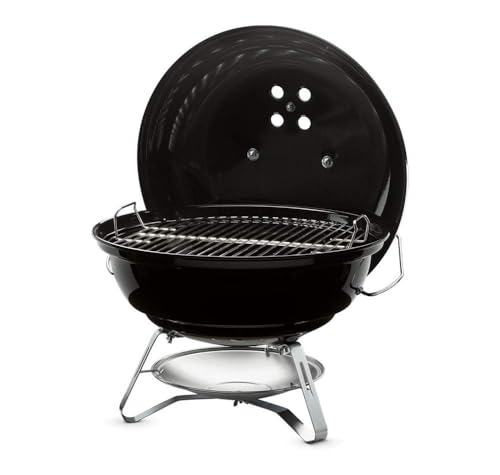
The Smokey Joe is the kettle idea at its smallest honest size: a 14-inch porcelain-enamelled bowl and lid, 147 square inches of plated-steel grate, aluminium dampers, and a weight light enough — under nine pounds in current specification — to carry to a picnic spot in one hand with the cooler’s handle in the other. Current production carries the Tuck-N-Carry lid lock, which earlier generations lacked, and it transforms the grill’s manners: the lid stays put in transit and hooks onto the bowl’s edge while you cook. Do not let the size fool you about capability. The kettle shape concentrates heat, the dampers give real control, and the grill will sear a steak as fiercely as its big siblings; it simply does it for two people at a time. For a couple learning charcoal, there is no cheaper classroom with this build quality — every lesson about banking coals, reading vents and resting meat transfers directly to any kettle you buy later.
Pros: genuine Weber enamel and parts support at the tier’s middle pricing; featherweight and compact; a lid lock on current models; fuel-sipping — a small chimney of charcoal cooks a whole meal. Honest limitation: capacity is the ceiling — four burgers is a crowd, a spatchcocked chicken is a squeeze, and batch cooking for guests means planning waves rather than one grand load. Ash management is the simple kind: let it cool, tip it out carefully. There is no ash pan, and on a windy day the open bowl demands a sheltered spot.
Choose it if you cook for one or two and value build over size. Skip it if four-person weeknight cooking is your normal — step up to the Jumbo Joe. Check on Amazon
5. Cuisinart 14-Inch Portable Charcoal Grill, CCG-190RB — Best Budget Tabletop
Who it suits: First-time charcoal buyers testing whether they enjoy the ritual before spending more, students and renters furnishing a first outdoor space, and anyone who wants a park-and-picnic grill they do not have to be precious about.
Cuisinart’s little red tabletop is the value benchmark of this class. The firebox is enamelled steel, the 14-inch cooking grate is chrome-plated, and the design details are smarter than the price suggests: dual vents — one in the lid, one in the base — give you the airflow control that the cheapest grills omit, and three lid latches lock the top down so the grill carries by its handle without shedding ash or its grate. The maker states a generous cooking area for the size; measured by grate diameter it is a 14-inch grill like the Smokey Joe, and we judge it on that basis — room for about four burgers, cooked in the direct way tabletops cook best. It is very light, a few pounds, which cuts both ways: delightful to carry to the park, but a grill this light wants a stable, level surface and respect on windy days.
Pros: dual-vent control at a budget price; locking lid for clean transport; light enough for anyone to carry; an ash catcher plate under the firebox that keeps the surface below cleaner than most tabletops manage. Honest limitation: the steel is thin. Heat retention is modest, the finish will not age like Weber enamel, and this is realistically a grill you enjoy for a few seasons rather than a decade. The chrome grate also wants prompt cleaning — leave it dirty and wet, and it will show it.
Choose it if the budget is firm and low, or as a deliberate trial grill. Skip it if you already know charcoal is your thing — the Smokey Joe costs more and repays it in longevity. Check on Amazon
6. Gas One 14-Inch Portable Barbecue Grill, CG-14 — Cheapest Honest Option
Who it suits: The strictly budget-bound: occasional grillers, festival and beach cooks, boat owners, and anyone who needs a charcoal grill for a specific trip or season and would rather spend the savings on the food.
Gas One’s CG-14 covers the fundamentals with unusual completeness for the bottom of the market. The 14-inch body carries a three-point locking lid — the lid genuinely seals for carrying and for heat retention while cooking — a dual venting system, and an ash catcher, a trio of features that many slightly pricier no-name grills skip. The maker states about 150 square inches of cooking surface, consistent with its 14-inch grate. It cooks the way every 14-inch tabletop cooks: hot and direct, best for burgers, dogs, skewers and thin cuts, in batches when the group is bigger than two. Build is light-gauge enamelled steel with a chrome-finished grate; treat it as a consumable-grade appliance and it will meet you more than halfway — owners who rinse the ash out, dry it and store it under cover get several seasons from a grill that costs less than the charcoal some people burn in a summer.
Pros: the lowest price in this guide by a wide margin; a locking lid and dual vents that cheap rivals omit; an ash catcher that keeps patios and picnic tables cleaner; light and simple, with nothing to assemble beyond legs and handles. Honest limitation: thin materials and basic hardware — hinges, latches and legs are built to a price, heat retention is the weakest here, and high-heat searing fades fastest as coals shrink because the small firebox has little thermal mass. This is not the grill for a winter of weekly use.
Choose it if price is the first criterion and use will be occasional. Skip it if you will grill weekly — the Cuisinart above is the smarter budget step, and the Webers are the smarter still. Check on Amazon
Comparison Table
| Grill | Format | Cooking area | Grate | Standout trait | Watch out for |
|---|---|---|---|---|---|
| Weber Jumbo Joe 18-Inch | Tabletop kettle | 240 sq in | Plated steel | Real-kettle cooking, still portable | Needs a heat-safe surface to stand on |
| Char-Griller Patio Pro E1515 | Barrel on wheeled cart | 250 sq in | Cast iron | Side shelf and standing height | Currently priced above this tier on Amazon — prose only |
| Weber Go-Anywhere | Rectangular portable | About 160 sq in | Plated steel | Packs flat; legs lock the lid | Low lid limits tall food |
| Weber Smokey Joe 14-Inch | Tabletop kettle | 147 sq in | Plated steel | Enamel build, featherweight | Two-person capacity |
| Cuisinart CCG-190RB 14-Inch | Tabletop | 14-inch grate | Chrome-plated | Dual vents, locking lid, low price | Thin steel, shorter lifespan |
| Gas One CG-14 14-Inch | Tabletop | About 150 sq in (maker-stated) | Chrome-finished | Cheapest; locking lid and ash catcher | Light-gauge build throughout |
How to Choose the Best Charcoal Grill Under $100
Start with the grate, not the grill
Cooking area decides what your evenings look like. A 14-inch grate cooks for two comfortably and four in batches; an 18-inch grate cooks for four in one load and gives you a genuine two-zone fire with room to spare. Translate every claim into food: burgers need elbow room to be flipped without stacking, chicken pieces scorch if they are crowded over the coals, and a whole chicken needs both width and lid height. If a listing’s stated area seems large for its diameter, trust the diameter — it is the one number that cannot be inflated.
Match the format to where the grill will live
Every linked grill in this guide is a tabletop or portable format, because standing cart grills built honestly start above this ceiling. That means your real choice is about surfaces and storage. A kettle needs a sturdy, heat-tolerant table or stand and a cupboard, shed corner or cover for storage. The Go-Anywhere needs only a flat shelf. A cart grill like the prose-only Patio Pro needs floor space and a dry corner, and repays it by always being ready. Measure your storage before you order; a grill that lives indoors gets used for years, and a grill left out uncovered in the rain gives its life to the weather instead.
Vents are the thermostat
Charcoal has no dial, so the vents are the controls. You want, at minimum, a vent you can adjust in the lid and one in the body or bowl, so you can feed the fire to build heat and starve it to hold or kill heat. Every pick here clears that bar. Learn the basic grammar on your first cooks: vents open to light and to sear, lid vent half-closed to settle a cooking temperature, everything closed at the end to snuff the coals so they can sometimes be shaken and reused. A grill whose vents are fixed or decorative will frustrate you by the third cookout.
Grate material sets the maintenance rhythm
Cast iron, on the Patio Pro, sears hardest and improves with seasoning but rusts if it is stored wet. Plated and chrome-finished steel grates, on the Webers, Cuisinart and Gas One, ask for less — a brush while warm, a wipe of oil — but their finish is a coating with a lifespan, so aggressive scraping shortens it. Neither is wrong; choose the rhythm you will actually keep. The same logic applies to bodies: porcelain enamel is the long-life finish, powder coat is respectable if chips are touched up, and thin painted steel is a budget material to be kept dry.
Budget for the second purchase
The grill is not the whole spend. A chimney starter — the single most useful charcoal accessory — plus a bag of briquettes or lump, a heatproof surface or stand for a tabletop grill, a cover if it lives outside, and a bristle-free grate brush belong in the real budget. None of that changes which grill to choose, but planning it now prevents the classic outcome: a good grill used twice and abandoned because lighting it was a lighter-fluid struggle. If the whole outdoor space is being furnished at once, see the wider patio picture in the Best Patio Dining Set Under $200 roundup alongside this one.
Common Buying Mistakes
Buying a 22-inch no-name kettle because the diameter looked generous
Listings in this tier include large, thin, unbranded kettles whose diameter flatters them. The steel is foil-light, the vents are vague, the legs wobble, and the enamel is paint. A smaller grill from a maker with parts support — every linked pick here — will cook better in its first summer and still exist in its fifth. Diameter is a specification; build is the product.
Using lighter fluid and blaming the grill for the taste
Petroleum starter flavours food and teaches bad fire habits. A chimney starter with a couple of sheets of newspaper or a few starter cubes lights any grill in this guide evenly and cleanly, and costs little. If a grill in this class seems to cook unevenly, the cause is usually a scattered, half-lit fire rather than the firebox.
Grilling on a surface that cannot take the heat
Tabletop grills radiate serious heat downward. Plastic folding tables soften, wooden decks scorch and dry grass underneath a low grill is a fire risk. Use a metal or stone surface, a purpose-made stand, or paving — and keep any grill a sensible distance from siding, fences and overhangs, with the local fire rules for your building checked before the first cook, not after a neighbour complains.
Closing the vents and walking away from “dead” coals
Coals can hold heat for many hours after they look grey and harmless. Empty ash only when it is completely cold — a full day later is the safe habit — into a metal container, never into a plastic bin or a cardboard box. This single routine prevents most of the fires charcoal grilling ever causes.
Cleaning the grate with a worn wire brush
Wire-bristle brushes shed bristles, and a bristle on a grate can end up in food; regulators have recalled millions of such brushes across brands in recent years. Use a coiled bristle-free brush, a wooden scraper or a ball of foil held in tongs instead. It costs nothing to make the switch and removes a risk that has nothing to do with how carefully you cook.
Charcoal Basics That Make a Budget Grill Cook Like a Bigger One
Build two zones, even on a small grate. Bank the lit coals over one half to two-thirds of the charcoal grate. Sear over the coals, finish beside them. On a 14-inch grill the zones are small, but the principle still rescues chicken skin and thick burgers from the scorch-or-raw trap. Let the fire finish lighting. Cook over coals that are fully ashed over and glowing evenly; black-edged briquettes smoke harshly and cook unevenly. Use the lid. Lid-down cooking turns any of these grills into a small oven — it is how chicken cooks through, how cheese melts, and how flare-ups are starved. Lift it to work, then put it back. Preheat the grate and oil the food, not the grate. A hot, brushed grate plus lightly oiled food is the reliable non-stick system at this level; oil on a ripping-hot grate mostly burns off before the food arrives. Rest the meat and bank the savings. When the food comes off, close every vent. Snuffed briquettes that are still whole can be shaken free of ash and relit next time — a budget grill should be cheap to run as well as cheap to buy.
Final Recommendation
Buy the Weber Jumbo Joe if one grill must do everything: it is the only pick here that cooks like a full member of the kettle family while still travelling, and its enamel build makes it the longest-lived purchase in the tier. Choose the Go-Anywhere instead when the grill’s home is a vehicle or a flat storage shelf, and the Smokey Joe when two-person cooking and Weber quality matter more than capacity. On a firm budget, the Cuisinart CCG-190RB is the thinking person’s cheap grill, and the Gas One CG-14 is the honest minimum — both cook real food today rather than promising quality they cannot deliver. Keep an eye on the Char-Griller Patio Pro’s pricing if a standing cart grill is what you truly want; inside this tier it would be a headline pick, and above it, the full-size kettles in the next tier are waiting. Whichever you choose, add a chimney starter to the same order — it is the difference between a grill that gets used weekly and one that becomes patio furniture.
Still deciding between formats? The seating around the grill matters too — our guide to the Best Adirondack Chair Under $100 covers the classic fireside chair at the same ceiling.
Frequently Asked Questions
Can a charcoal grill under $100 actually sear a steak properly?
Yes. Searing is about coal temperature and proximity, not grill price. Any pick here, loaded with a fully lit chimney of briquettes banked under one zone, will put a hard crust on a steak. What the budget costs you is area and thermal mass — you will sear in batches and the fire will fade sooner — not peak heat.
How many people can a 14-inch charcoal grill feed?
Two people comfortably in one load, four with simple batch planning — burgers and sausages first, held warm at the grate’s edge or in a low oven, then the next round. If four-person single-load cooking is your weekly norm, choose the 18-inch Jumbo Joe instead.
Briquettes or lump charcoal for a small grill?
Briquettes burn longer and more evenly, which suits small fireboxes and longer cooks; lump lights faster, burns hotter and suits quick searing, but its uneven pieces can choke airflow in a tiny bowl. Most owners of grills this size settle on briquettes for predictability and keep lump for steak nights.
Do I need a chimney starter with a grill this small?
It is the single best accessory purchase. A small or standard chimney lights a full load evenly without lighter fluid, and every grill in this guide is sized to a chimney load. It also doubles as a measure: one chimney is the right fire for almost everything these grills cook.
Can I smoke on a grill in this tier?
Short, gentle smoking — yes, with a small banked fire, a handful of wood chunks and patience: chicken pieces, sausages and fish take smoke beautifully in a lidded kettle. Long brisket-style smoking asks for fuel capacity and airtight control that this tier does not honestly offer; that is a job for the next tiers up.
How long will a budget charcoal grill last?
The porcelain-enamel Webers are decade-class appliances with basic care. The budget tabletops are multi-season appliances if they are cleaned, dried and stored under cover — and short-lived if they are left out full of wet ash, which is the single most corrosive thing you can do to any charcoal grill at any price.
What This Tier Honestly Cannot Do
Three expectations should be retired before you order anything in this guide. First, none of these grills is a set-and-forget cooker: charcoal at any price asks you to build the fire, watch the vents and move food between zones, and a smaller firebox asks slightly more often, because a small fuel load fades sooner. Second, none of them will serve a twelve-person party in one load; they serve parties in waves, which experienced hosts plan for — appetizers and sausages first, mains in two rounds, everything held warm at the grate’s cool edge. Third, none of them replaces a smoker for long, low cooks; they borrow the technique for an hour or two at a time, beautifully, and that is the honest limit. Naming those limits is not a criticism of the tier. It is what makes the tier satisfying: a grill whose real abilities — fast, flavourful cooking for a household, anywhere — match the job it is actually given gets used for years, while a grill bought for imaginary parties gets sold by August.
Setting Up and Looking After a Budget Charcoal Grill
Assembly in this tier ranges from almost nothing to an honest hour. The tabletops — Cuisinart and Gas One — ask you to fit legs, handles and vents, a kitchen-table job with a screwdriver. The Webers arrive closer to whole: legs or leg frames, dampers and handles, with the Jumbo Joe’s lid-lock hardware the only fiddly moment. The Patio Pro, as the lone cart grill, is the long build — barrel, cart, shelf and wheels — and rewards a second pair of hands and a refusal to fully tighten any bolt until the frame sits square. Whatever you buy, do the first burn empty: a hot, food-free fire for half an hour burns off manufacturing oils and teaches you the vent positions while nothing edible is at stake. Season a cast-iron grate, if you chose the Patio Pro, with a thin film of high-heat oil during that first burn, and repeat lightly after cooks until it darkens and slicks.
Storage decides lifespan more than build does. Ash is the enemy twice over — it holds moisture against steel, and damp ash turns mildly corrosive — so the rhythm that saves every grill in this guide is the same: coals fully cold, ash out, grate brushed and lightly oiled, grill dry before the cover goes on or the cupboard door closes. Enamel Webers forgive a forgotten week; thin-steel tabletops do not, and their owners should treat the empty-and-dry routine as part of cooking rather than as housekeeping. Keep a cover on anything stored outdoors, store the budget tabletops indoors if a shelf exists, and put one shelf or hook aside for the chimney, brush and charcoal so the whole kit lives together. A grill that is clean, dry and reachable gets used; that, in the end, is what the money was for.