Where to buy
Check the latest price, availability and delivery on Amazon. Orders are placed on Amazon. We may earn a commission from qualifying purchases.
- Best overall for small spaces: Furinno TURN-S-TUBE 3-Tier TV Stand, French Oak Grey — Check on Amazon
- Best shallow stand for tight walls: Bestier LED Tall TV Stand, 55 Inch, Carbon Fiber Black — Check on Amazon
- Best compact full-capability console: Yaheetech Industrial TV Stand for TVs up to 65 Inch, 55 Inch, Grey — Check on Amazon
- Best for power in tight corners: VASAGLE TV Stand with Power Outlets and LED Lights (ULTV118K01) (covered in the review below; no link, see the note in that review)
- Best closed storage for small rooms: VASAGLE Farmhouse TV Stand for TVs up to 65 Inches, Rustic White and Honey Brown (ULTV535W01) — Check on Amazon
- Best for small-but-settled rooms: JUMMICO Farmhouse TV Stand for 65 Inch TV, Grey — Check on Amazon
Read the full guide ↓
Disclosure: As an Amazon Associate, dailyhomedecorating.com earns from qualifying purchases. Links to Amazon on this page are affiliate links; they cost you nothing extra. Listing details such as price and availability change often, so check the current Amazon listing before you buy.
The hunt for the best tv stand for small spaces under $150 is won or lost on a tape measure. A small space — the spare room turned media den, the bedroom corner, the narrow living room in an older house, the nook under the stairs that became a viewing spot — does not forgive approximate furniture. Where a large room absorbs a stand that is a few inches off, a small space turns those inches into a blocked doorway, a bruised shin path, or a screen parked so close it fills your whole field of view like the front row of a cinema. The stand for a small space must be sized like it was tailored: shallow enough to keep the floor’s paths open, wide enough for the television’s feet and not an inch more theatrical than that, and storage-hardworking enough to justify every cubic inch it occupies.
This guide re-judges the proven under-$150 field — the same six stands as our general roundup in Best Tv Stand Under $150 — purely by small-space criteria: depth before width, footprint before features, and storage density before style, though style gets its say once the measurements pass. Readers will notice this list leads with the smallest serious furniture in the budget and treats the full-size cabinets as special cases for small-but-settled rooms, which is the honest order for the brief. One pick is covered without a link, for a pricing reason explained in its review.
Our short answer: the Furinno is the small-space default — under four square feet, under a foot deep, hand-assembled, priced at the budget’s floor — for televisions up to 50 inches, which is the size class most small spaces should honestly be running. Tight walls with bigger screens get the Bestier’s shallow depth or the Yaheetech’s compact capability; the power-outlet VASAGLE solves the corner with one socket; and the two farmhouse cabinets serve the small rooms that are settled enough to trade floor for storage. Measurements, layout rules and the mistakes small-space buyers make are below — in this guide, they are the main event.
In this guide
Quick Picks
In a hurry with a tape measure in hand? This table matches each stand to the small-space problem it solves.
| Buyer type | Pick | Why it stands out | Link |
|---|---|---|---|
| Best overall for small spaces | Furinno TURN-S-TUBE 3-Tier TV Stand, French Oak Grey | 43.8 x 11.7 inches — under four square feet, the tailored fit for tight rooms | Check on Amazon |
| Best shallow stand for tight walls | Bestier LED Tall TV Stand, 55 Inch, Carbon Fiber Black | 13.31-inch depth stores vertically where floor is scarcest | Check on Amazon |
| Best compact full-capability console | Yaheetech Industrial TV Stand for TVs up to 65 Inch, 55 Inch, Grey | A real 55-inch console with a 110 lb top for small rooms with big TVs | Check on Amazon |
| Best for power in tight corners | VASAGLE TV Stand with Power Outlets and LED Lights (ULTV118K01) | Built-in outlets for the corner with one socket — covered prose-only, see its review | See review below |
| Best closed storage for small rooms | VASAGLE Farmhouse TV Stand for TVs up to 65 Inches, Rustic White and Honey Brown (ULTV535W01) | Doors calm a small room’s only wall — where the footprint allows | Check on Amazon |
| Best for small-but-settled rooms | JUMMICO Farmhouse TV Stand for 65 Inch TV, Grey | Maximum storage for the small room that will not change for years | Check on Amazon |
How These Picks Were Chosen
Budget discipline first, as throughout this series: each linked pick had a verified Amazon listing and a price sighting inside the under-$150 tier at research time — check the current price on Amazon before you buy, because furniture pricing moves. One pick, the VASAGLE power-outlet model, appears prose-only because a current in-budget price could not be verified for it. Small-space shoppers working below this ceiling will find the tighter field in Best Tv Stand For Small Spaces Under $100.
We did not hands-on test these stands. We compared them on the numbers that govern small spaces: depth in inches, because projection from the wall is what tight rooms feel; footprint in square feet, because that is the rent the stand pays; height, because a small room’s screen must sit lower than a large room’s to keep viewing comfortable at short distances; and storage density — how much equipment and clutter each square foot of stand absorbs. The engineering floor from the main guide applies underneath every judgment: top width against the television’s real foot span, load rating against real panel weight, shelf depth against real components.
We also scored reversibility. Small spaces change purpose — the den becomes a nursery, the nook becomes a desk — so a stand that assembles without tools, moves without help and fits a second room afterward outranks an equal stand that does none of those things. Where a pick fails that test deliberately, in exchange for storage or permanence, its review says so and names the buyer who should choose it anyway.
The 6 Best TV Stands for Small Spaces Under $150
Furinno TURN-S-TUBE 3-Tier TV Stand, French Oak Grey
Who it suits: The default small-space brief: televisions up to 50 inches in spare rooms, bedroom corners, dens and nooks where every inch of floor is already employed.
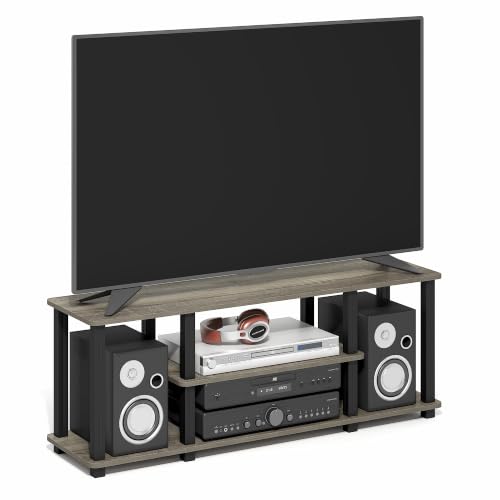
Start with the tape-measure facts, because they are the whole review: 43.8 inches wide, 11.7 inches deep, three open tiers, a top rated to 80 lb, and assembly by hand — the square tubes twist together with no tools. The footprint is under four square feet, and the depth is the shallowest in this guide, which in a small space is the specification that decides whether the room still works. A stand projecting under twelve inches leaves the floor’s paths intact: the route to the door, the swing of that door, the space a chair needs to pull out. Deeper stands do not merely occupy those paths; in a small room they abolish them.
Within its size class the Furinno is complete. The tiers take the streaming box and the console, the open back lets cables drop straight to the outlet — no small consideration in rooms where the outlet is wherever the original builder left it — and the low profile keeps a screen at the right height for the short viewing distances small spaces impose. It costs the least in this guide by a wide margin (check the current price on Amazon), moves rooms in one person’s arms, and asks nothing of walls or floors. For the spare-room television, the bedroom set, the den that seats two, it is not the budget option; it is simply the correctly sized one.
Its limits draw the map of this whole guide. Over 50 inches of television, a receiver, or a wide soundbar each disqualify it — the picks below exist for those briefs. It hides no cables, though in a small space the cable run is short and one covered strip solves it. And its lightness demands the anti-tip anchor where children climb. Sized honestly, it is the stand against which every other small-space option must justify its extra inches.
- Shallowest depth in the guide (11.7 in) — floor paths survive it.
- Under four square feet of footprint; assembles by hand, moves in one trip.
- The lowest price here — correctly sized and cheap are a rare pair.
Honest limitation: Strictly for TVs up to 50 inches with no receiver or wide soundbar, and its lightness makes the wall anchor non-negotiable around children.
Choose it if your space and screen are genuinely small. Skip it if either is not — forcing this stand past its size class helps nobody.
Bestier LED Tall TV Stand, 55 Inch, Carbon Fiber Black
Who it suits: Tight walls with a modern setup — small living rooms and dens where depth is the constraint but the screen and console are full-size.
The Bestier solves the small-space problem along the other axis: not smaller, but shallower and taller. At 13.31 inches deep it hugs a wall nearly as closely as the Furinno while standing 55.12 inches wide and 24.29 inches tall — a full-size console whose storage goes vertical: an LED-lit bay with an adjustable glass shelf for the console, shelving for the stack, a cabinet below. In a narrow room, that trade — two fewer inches of projection in exchange for height the room was not using — is often the difference between a walkway and an obstacle course, and the LED wash gives a small room an evening light layer it would otherwise need a lamp’s floor space to achieve.
The constraints are the honest ones for this design. The depth is console depth: streaming devices, consoles and soundbars fit, AV receivers do not. It is marketed for 55- to 65-inch televisions, but in a small space the wiser reading is 55 to 60 inches — at short viewing distances a 65-inch screen overwhelms, and its feet sit near the top’s edges besides. Assembly is the longest build among the linked picks, and the glass shelf suits homes without toddlers. It sits in the upper part of the budget — check the current price on Amazon — and for the small modern room with a gaming habit, it buys more function per inch of depth than anything else here.
One small-space virtue deserves emphasis: proportion. A tall, shallow, black unit against the wall reads in a small room as part of the wall itself, especially with the screen above it, where a deep pale console reads as an object in the room competing for the same floor as the people. Small spaces reward furniture that visually recedes, and after dark — LED low, screen lit — the Bestier recedes to a glow and a silhouette.
- 13.31-inch depth: full-size storage that hugs the wall.
- Vertical layout plus LED light — function per inch of floor is the best here.
- Visually recedes in small rooms; reads as part of the wall after dark.
Honest limitation: Console-depth only (no receivers), the longest assembly among linked picks, and a glass shelf that suits child-free homes.
Choose it if depth is your constraint and your setup is console-based. Skip it if a receiver must fit or toddlers share the room.
Yaheetech Industrial TV Stand for TVs up to 65 Inch, 55 Inch, Grey
Who it suits: Small rooms with an honestly big television — the compact console for a 55- to 65-inch screen and a full equipment stack in a room that seats three, not eight.
Some small spaces are small because the house is old, not because the ambitions are. A narrow Victorian living room or a compact den may still host a 65-inch screen and the full stack beneath it, and for those rooms the Yaheetech is the compact answer: a 55-inch console — 16 inches deep, 24.5 inches tall — with a top rated to 110 lb and four open compartments that organize everything without a wasted inch. The open industrial frame is the small-space trick: black tube and grey board read lighter than a solid cabinet of identical dimensions, because the eye travels through the structure instead of stopping at a face.
Depth is the number to interrogate before ordering — sixteen inches is the deepest projection among the top picks, and in a truly narrow room it must be measured against the walkway, not assumed. Where it fits, the return is capability no shallower stand matches: receivers fit, consoles ventilate, shelves rated 33 lb and end cabinets at 22 lb absorb the stack that small rooms otherwise spread across the floor. The 24.5-inch height also suits short viewing distances, keeping a big screen’s center near seated eye level instead of looming. It sits mid-budget — check the current price on Amazon.
Assembly is a standard flat-pack build producing a unit two people can move at rearrangement time — small spaces rearrange often, and this stand tolerates it. Route cables tight to the rear frame (in a small room every cord is visible from somewhere) and anchor it where children climb. It is the pick for the small room that refuses to downsize its screen, and it earns that place on specifications, not sentiment.
- Full capability in a compact frame: 110 lb top, receiver depth, TVs to 65 inches.
- Open structure reads lighter than a solid cabinet of the same size.
- Storage density ends the floor-spread of equipment in small rooms.
Honest limitation: The 16-inch depth is the deepest here — in the narrowest rooms the walkway must be measured, not assumed.
Choose it if your small room runs a big screen and a real stack. Skip it if the walkway cannot spare sixteen inches — the Bestier’s shallowness serves you better.
VASAGLE TV Stand with Power Outlets and LED Lights (ULTV118K01)
Who it suits: Small corners and nooks with exactly one reachable outlet — the stand that brings its own power to the tightest spot in the house.
Small spaces have small infrastructure: one outlet, possibly behind where the stand must go, expected to serve the television, the console, the streaming box and the lamp the corner also needs. This VASAGLE is the only pick that treats power as part of the furniture. Its 63-inch open console — 13.8 inches deep, a low 20 inches tall, rustic brown and ink black, for televisions up to 65 inches — builds in three AC outlets and two USB-A ports on a 4.9-foot cord, so the whole stack plugs into the stand and a single cord makes the journey to the wall. In a corner or nook, that single cord is the difference between a setup and a snarl, and the LED shelf light replaces the lamp the corner has no floor for.
The catch is stated as plainly in this guide as anywhere: the pick carries no purchase link, because we could verify the product, its specification and its Amazon listing but not a current price inside the under-$150 budget. It may be within it when you check — prices move weekly — and if your small space’s binding constraint is power, checking the live listing is worth the minute. Judge that day’s price against your budget; the design case needs no help from us.
Fit notes for tight spots: the 63-inch length is the dimension to measure — it is the longest console here, suited to a wide nook or a long low wall rather than a narrow corner — and the 13.8-inch depth is console depth, not receiver depth. A surge protector between the stand’s cord and an older home’s wall outlet is cheap wisdom. Within those bounds, no other pick solves the one-outlet corner as completely.
- Built-in power (3 AC + 2 USB-A) — one cord to the wall from a tight corner.
- Low 20-inch height and LED light suit nooks and under-stair setups.
- Open shelving ventilates the stack in unventilated corners.
Honest limitation: Presented without a link because a current in-budget price could not be verified; at 63 inches it is also the longest console here, so narrow corners must measure width first.
Choose it if power is your small space’s binding constraint and the live price fits. Skip it if the corner is narrow or the price that day is not.
VASAGLE Farmhouse TV Stand for TVs up to 65 Inches, Rustic White and Honey Brown (ULTV535W01)
Who it suits: Small living rooms that are also the whole home’s living space — where closed storage calms the one room that does everything.
A small room that must be living room, office corner and guest space in rotation has one overriding need: the ability to look tidy on demand. The VASAGLE farmhouse provides it with doors. At 58 inches wide, 16 inches deep and 24 inches tall, it is a full-size cabinet — this guide does not pretend otherwise — whose two sliding barn doors close over the entire media stack, leaving a rustic white and honey-brown front that lets the small room be a room again. For televisions up to 65 inches, with real component depth behind the doors, it is the stand for the small space whose problem is not inches but roles.
The footprint must be earned, and the review should say when it is: if the room’s wall takes 58 inches while keeping its door swing and walkway, the cabinet repays its floor by absorbing storage the small home has nowhere else to put — the games, the blankets, the router, the cable drawer — so the net object count of the room falls even as the stand’s size rises. VASAGLE’s numbered flat-pack build is a manageable solo project, and the price sits in the upper-middle of the budget; check the current price on Amazon. Consoles behind doors need their working section left exposable for long sessions, as with any closed stand.
If the wall cannot spare the width or the walkway cannot spare the depth, this is not your pick and the Furinno is — small-space honesty cuts both ways. But for the small, settled, multi-role room, a cabinet that makes the media wall disappear behind farmhouse doors is worth every inch it occupies, because it returns the rest of the room to its other lives.
- Doors let a multi-role small room look tidy on demand.
- Closed storage absorbs household overflow, lowering the room’s total clutter.
- Full-size capability: TVs up to 65 inches, real component depth.
Honest limitation: A full-size 58 x 16 inch footprint — small rooms must verify wall, door swing and walkway before choosing it.
Choose it if your small room works several jobs and needs its media wall to vanish. Skip it if floor inches are scarcer than tidiness — they usually are, and the Furinno knows it.
JUMMICO Farmhouse TV Stand for 65 Inch TV, Grey
Who it suits: Small but settled rooms — the compact house or cottage living room that will keep its layout for years and needs storage more than it needs flexibility.
The JUMMICO closes this guide as the deliberate exception: a 58-inch farmhouse cabinet, 15.75 inches deep, 23.9 inches tall, roughly 75 lb, its top rated to a 175 lb weight limit. In most small-space advice that is too much furniture, and for temporary small spaces it is. But the settled small room — the cottage living room, the compact house’s one main room, arranged once and kept — has the opposite problem: not too much furniture, but too little storage, forever. For that room, one substantial cabinet with sliding barn doors and an adjustable shelf ends the storage shortage permanently, and its weight becomes the virtue of a piece that will not be moved, bumped out of square or replaced.
The conditions are explicit. The wall must take 58 inches with the room’s paths intact; the build is a two-person project; and the room’s layout should be genuinely settled, because this stand will anchor it. Its grey farmhouse finish suits the neutral, texture-warm palettes compact houses favor. It sits in the upper-middle of this budget on the sightings verified for this model line — check the current price on Amazon, and see the sources note on how its price was verified. Anchor it, designate an adults-only section behind those easy-sliding doors if children visit, and it will out-serve lighter furniture for as long as the room keeps its shape.
Readers whose small space is temporary — a rental year, a room awaiting renovation — should take the hint from its presence at the end of this list: it is the right stand for a minority of small spaces, included so that minority is served honestly rather than sold something light they will curse monthly. Permanence is a legitimate brief. It is simply not the default one.
- Maximum closed storage for the small room whose layout is permanent.
- 175 lb top rating; a planted build that stays square for years.
- Grey farmhouse finish suits compact-house palettes.
Honest limitation: The heaviest build here and a two-person assembly — wrong for temporary small spaces, rentals and any room still changing.
Choose it if your small room is settled and storage-starved. Skip it if the space is temporary — every lighter pick above respects that better.
Comparison Table
In small spaces the ranking follows the tape measure: depth and footprint first, features second — the table is ordered the way a small room experiences a stand.
| Product | Type | Best use | Link |
|---|---|---|---|
| Furinno TURN-S-TUBE 3-Tier TV Stand, French Oak Grey | Open 3-tier mini stand | Genuinely small spaces; TVs up to 50 inches | Check on Amazon |
| Bestier LED Tall TV Stand, 55 Inch, Carbon Fiber Black | LED gaming console | Tight walls; shallow depth, vertical storage | Check on Amazon |
| Yaheetech Industrial TV Stand for TVs up to 65 Inch, 55 Inch, Grey | Open industrial console | Small rooms with big TVs and full stacks | Check on Amazon |
| VASAGLE TV Stand with Power Outlets and LED Lights (ULTV118K01) | Open console with power | One-outlet corners and nooks (prose-only) | See review below |
| VASAGLE Farmhouse TV Stand for TVs up to 65 Inches, Rustic White and Honey Brown (ULTV535W01) | Farmhouse cabinet, barn doors | Multi-role small rooms needing calm | Check on Amazon |
| JUMMICO Farmhouse TV Stand for 65 Inch TV, Grey | Farmhouse cabinet, heavy build | Settled small rooms needing storage | Check on Amazon |
How to Choose a TV Stand for a Small Space
- Measure depth before anything. In a small space, projection from the wall is destiny: under 12 inches preserves paths, 13 to 14 inches is the modern console compromise, and 16 inches must be justified by a receiver. Write your room’s number down before shopping.
- Size the television to the viewing distance. Small spaces sit close — often five to seven feet — where a 43- to 55-inch screen is immersive rather than small. A stand bought for an oversized screen wastes floor twice: in its own width and in the seating pushed back to compensate.
- Measure the feet, not the diagonal. The stand’s top must cover your set’s foot span with margin. On the largest sets paired with 55-inch stands in this guide, that check is the difference between stable and sorry.
- Count footprint in square feet and demand rent. Every square foot of stand should return storage, not just support. If a stand holds only a television in a small space, it is underemployed furniture.
- Keep screen height low. Short viewing distances punish high screens. Stands around 20 to 25 inches keep a small space’s screen center near seated eye level; measure from your actual chair.
- Plan the cable route in the corner you have. Small spaces put outlets in odd places. A stand whose back is open, or whose power is built in, turns the corner’s one socket into a system instead of a snarl.
- Favor reversible furniture in changeable rooms. Toolless assembly, one-person weight and a second room it could serve later — small spaces change purpose more often than large ones, and the stand should survive the change.
- Anchor regardless of size. Small rooms put people close to furniture; children climb, adults bump. The anti-tip strap matters more, not less, where the stand is within everyone’s reach.
- Leave the last inch empty. A stand that exactly fills its wall or nook leaves no room for the remote basket, the plant, or the hand that cleans behind it. Small spaces need margins more than large ones do.
Layout Rules for Watching in a Small Space
Three rules govern small-space viewing comfort. The first is distance discipline: the sofa or chairs should sit as far from the screen as the room allows, which usually means seating against the opposite wall and the stand as shallow as the setup permits — every inch saved in stand depth is an inch of viewing distance gained, which is why this guide ranks depth above almost everything. The second is height discipline: at short distances the eye’s natural line falls slightly downward, so the low end of stand heights is a comfort feature, not a compromise. The third is path discipline: the route through the room should never pass between the seating and the screen at shin height of a protruding stand corner — arrange the stand fully against its wall and let the path go around the seating instead.
The companion pieces for a small room’s viewing wall, at the same budget discipline, are in Best End Table For Small Spaces Under $150 and Best Coffee Table For Small Spaces Under $150 — both chosen for the shallow clearances small rooms impose. Furnish the small space as one measured system and it stops feeling like a reduced version of a big room; it becomes what it should be, a room tailored to its own dimensions.
When Even the Smallest Stand Is Too Big
Honesty requires a section for the small spaces where nothing in this guide is the right answer, because they exist: the box room where a 43-inch stand still blocks the door’s swing, the under-stair nook whose wall is shorter than any console, the bedroom where the only television wall is also the wardrobe wall. In those spaces the correct purchase may not be a stand at all, and a guide that pretends otherwise would rather sell you furniture than solve your room. Three alternatives deserve a fair hearing, with their costs stated as plainly as the picks above.
The first is the wall mount. It consumes zero floor, and in an owned home with a suitable wall it is often the small space’s best answer outright. Its costs are the ones renters already know — holes, studs, a landlord conversation — plus one buyers forget: a mounted television still needs its devices somewhere, and a streaming stick solves that while a console does not. The second is the pedestal floor stand: a central column on a small base that carries the screen like a sign. It fits corners and impossibly narrow walls, swivels to serve two seating positions, and stores absolutely nothing; in a space where the equipment is a single streaming device, that trade can be exactly right. The third is furniture you already own — a dresser or a low bookcase of the right height, checked honestly for depth and stability, anchored like any stand, and judged by the same tape-measure rules this guide applies to its picks.
Notice what all three alternatives share with the stands above: they succeed or fail on the same measurements — the screen’s height at your viewing distance, the stability of what carries it, the route of its cables, the survival of the room’s paths. That is the real content of this guide, and it transfers. If your small space defeats every console here, take the tape measure and the rules with you to whichever alternative you choose; if it does not, the picks above are ordered by exactly the discipline your room demands. Either way, the space gets a considered answer rather than a hopeful one — which is all good furniture buying ever is.
Common Buying Mistakes
- Buying a stand by width alone and discovering its depth abolishes the walkway. In small spaces depth is the first measurement, not the third.
- Oversizing the television, then the stand, then pushing the seating back — until the small room is all screen and no space. Size the screen to the distance first.
- Filling the footprint exactly. A stand with zero margin cannot be cleaned behind, cabled comfortably or nudged true; small spaces need the spare inch most.
- Choosing a deep cabinet for a console-only setup. Depth you do not use is floor you have donated; match the stand’s depth to the deepest component you actually own.
- Ignoring the door swing and the drawer arcs of the room itself. A stand that fits the wall but blocks the door’s last twenty degrees will be cursed daily.
- Letting cables cross the floor to the far outlet. In a small space that cord is a trip line across the only path; route along the wall or choose built-in power.
- Skipping the anchor because the stand is small. Small stands under televisions are exactly the tip-risk profile; the strap takes minutes.
- Buying heavy permanence for a temporary room. A settled-room cabinet in a space that changes next year becomes the obstacle every plan routes around.
- Judging by the empty room. Small spaces reveal their truth furnished and lived in for a week; keep packaging until the paths have been walked a few dozen times.
Fitting Sound Into a Small Space
Small spaces change the audio question as much as the furniture one, and the stand sits at the center of it. A television’s own speakers fire downward or backward in most modern sets, which in a large room is merely disappointing and in a small room — close walls, close seating, hard surfaces near the screen — can turn dialogue into a negotiation with the volume button. The soundbar is the small space’s natural answer, and choosing the stand and the bar together is the difference between a setup that sounds designed and one that sounds apologetic. The bar needs a flat, centered home: on the stand’s top in front of the television’s feet, or on an upper shelf whose width takes its full length, always below the screen’s lower edge and clear of its remote sensor.
The stands here divide by that test in ways the reviews flag individually. The wide farmhouse cabinets and the Yaheetech offer generous top surfaces where a full-length bar sits naturally. The shallow modern picks suit compact bars — which is honest pairing, because a small space rarely needs a long bar’s output and never needs its width. The Furinno, sized for smaller televisions, pairs with the smallest bars or with none at all; in a bedroom or den at six feet, a good television’s speakers plus a small bar on the middle tier is a complete and proportionate system. What no small space should do is add a separate subwoofer without a plan: bass in a small room pools in corners and travels through shared walls, and the considerate small-space setup keeps its low end modest and its neighbors unconsulted.
One more small-space audio habit costs nothing and pays nightly: keep the devices that click, whir and blink where the stand’s design puts them, not on the surface beside the screen. A small room’s seating is close enough to hear a hard drive and see every standby light, and the difference between a den that feels like a cinema and one that feels like an office is often just those small noises, shelved and darkened. The stands in this guide were chosen with shelves and doors enough to absorb them. Use that capacity, and the small space’s closeness — its supposed flaw — becomes its virtue: a room where the screen, the sound and the seat are all exactly where they should be, because there was never room for them to be anywhere else.
Final Recommendation
- Most small spaces: Furinno TURN-S-TUBE 3-Tier TV Stand.
- Tight walls, modern setups: Bestier LED Tall TV Stand, 55 Inch.
- Small rooms with big TVs: Yaheetech Industrial TV Stand, 55 Inch.
- One-outlet corners: VASAGLE TV Stand with Power Outlets (prose-only pick — check its live price).
- Multi-role small rooms: VASAGLE Farmhouse TV Stand (ULTV535W01).
- Settled small rooms needing storage: JUMMICO Farmhouse TV Stand.
Our top two for small spaces are the Furinno — the stand that treats inches as the budget they are — and the Bestier, for small rooms whose setups are modern enough to need its shallow, vertical, lit design. Measure depth first, feet second and width third, check the live price and finish, and leave the last inch empty. A small space furnished with that discipline does not feel small; it feels exact.
Frequently Asked Questions
What is the best TV size for a small space?
Match the screen to your viewing distance: at five to seven feet, a 43- to 55-inch television is immersive without overwhelming, and it pairs with the shallow stands small spaces need. Larger screens belong to the small rooms that can still seat viewers seven or more feet back.
How deep should a TV stand be in a small room?
As shallow as your deepest component allows. Streaming boxes and consoles fit stands of 12 to 14 inches; only an AV receiver justifies 16 inches. Every inch of depth is an inch taken from the room’s paths and viewing distance.
Can a small space handle a 65-inch TV stand?
A settled small room with the wall for it can — two picks here are full 58-inch cabinets — but measure the walkway and door swing first, and be honest about whether the room is settled. Most small spaces are better served by the compact picks that lead this guide.
Are floor TV stands with mounts better for small spaces?
They save depth but give up all storage, and in a small space the stand’s shelves are usually doing necessary work. A compact console that stores the stack beats a pedestal that stores nothing, unless the equipment lives elsewhere entirely.
How do I keep cables tidy in a small corner setup?
Keep runs short and vertical: devices stacked in the stand, cords dropped straight behind it, one covered strip on the lowest shelf. If the corner’s outlet is far from the stand, a model with built-in power — covered prose-only in this guide — reduces the whole problem to a single cord along the wall.
Why does one pick in this guide have no link?
The VASAGLE power-outlet model fits the small-space brief unusually well, but we could not verify a current price inside the under-$150 budget this guide promises, so it is covered prose-only rather than linked on a hope. Check its live price; if it fits your budget that day, its power design earns its place.
Can I put a TV stand in front of a window or radiator in a small space?
A window, cautiously: a low stand under a window line works if glare is managed with curtains and the screen does not sit in direct sun, which ages panels and washes out daytime viewing. A radiator or heat vent, no — heat rising through electronics shortens their lives, dries engineered-wood finishes unevenly, and in the case of a blocked vent, steals the room’s warmth to warm the back of a console. In a small space the temptation is real because walls are few, but heat is the one placement rule with no good exception; find the stand another wall, or choose a shallower stand that lets the vent breathe.