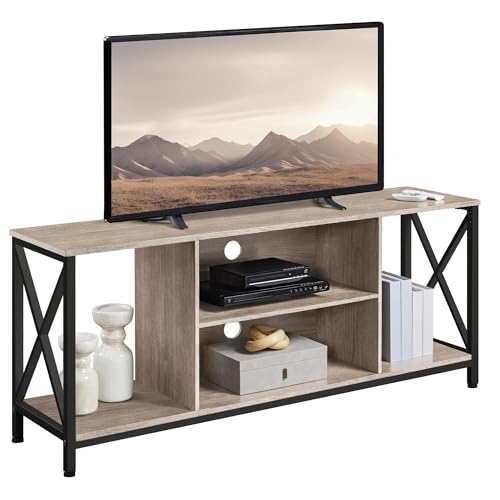
Where to buy
Check the latest price, availability and delivery on Amazon. Orders are placed on Amazon. We may earn a commission from qualifying purchases.
- Best overall for most living rooms: Yaheetech Industrial TV Stand, 55-Inch, Gray — Check on Amazon
- Best compact pick with real storage: Yaheetech Industrial TV Stand, 47-Inch, Gray — Check on Amazon
- Best closed-storage option: Furinno JAYA Large TV Stand for TVs up to 55 Inch, French Oak Grey/Black — Check on Amazon
See 3 more Amazon options
- Furinno JAYA TV Stand, French Oak Grey/Black — Check on Amazon
- Furinno Turn-N-Tube 4-Tier Wide Shelf TV Stand, Espresso/Black — Check on Amazon
- Furinno TURN-S-TUBE 3-Tier Toolless TV Stand, French Oak Grey — Check on Amazon
Read the full guide ↓
Disclosure: As an Amazon Associate, dailyhomedecorating.com earns from qualifying purchases. Links to Amazon on this page are affiliate links; they cost you nothing extra. Listing details such as price and availability change often, so check the current Amazon listing before you buy.
The search for the best tv stand for modern homes under $100 starts with a tension: modern interiors run on clean lines, hidden clutter and negative space, while budget TV stands run on visible screws, chunky panels and finishes that imitate wood the way a photocopy imitates a photograph. The good news is that the gap has narrowed. Low, wide consoles with steel frames and matte grey or pale oak finishes now exist at this price, and a modern room forgives a lot when the silhouette is right: long horizontal lines, legs or frames that lift the body off the floor, and storage that either disappears behind doors or organises itself into calm, open grids. This guide judges six verified under-$100 stands purely on how they behave in a modern interior.
Our modern shortlist logic: the Yaheetech stands earn their place with an industrial-modern frame — black steel, clean rectangles, open compartments that style well with baskets and books. The Furinno JAYA models in French Oak Grey bring the Scandinavian end of modern: pale two-tone finishes and doors that let the front read as one quiet surface. The Turn-N-Tube stands are the honest budget end of modern — their tube frames will not fool anyone into thinking ‘designer’, but in the right finish and styled sparsely, they hold a smaller TV in a minimal room without visual noise. What none of them can do is fake premium materials, so this guide is frank about where each one stops looking modern: dust on open shelves, cables on display, and laminate edges all get called out.
Modern rooms also punish clutter physics more than other styles. A soundbar slightly too deep, a router’s antenna forest, one visible cable drop — in a traditional room these disappear into the general busyness; in a modern room they are the only thing you see. So the reviews below weigh cable behaviour and styling headroom as heavily as structure, and the how-to-choose section covers the modern specifics: proportion against low sofas, finish pairing with pale floors and grey upholstery, and the basket-and-raceway tricks that keep an open stand looking intentional. Under $100 will not buy you a designer console. It will, chosen carefully, buy you a stand that a modern room can absorb without apology.
In this guide
Quick Picks: best tv stand for modern homes under $100
Six stands, six different answers to the same budget. The table is the short version; the detailed reviews below explain who each one actually suits and where each one honestly falls short.
| Pick | Best for | Standout trait | Link |
|---|---|---|---|
| Yaheetech Industrial TV Stand, 55-Inch, Gray | Best overall for most living rooms | Widest top and four open compartments | Check on Amazon |
| Yaheetech Industrial TV Stand, 47-Inch, Gray | Best compact pick with real storage | Compact width, full shelf layout | Check on Amazon |
| Furinno JAYA Large TV Stand for TVs up to 55 Inch, French Oak Grey/Black | Best closed-storage option | Doors plus cable holes hide clutter | Check on Amazon |
| Furinno JAYA TV Stand, French Oak Grey/Black | Best mid-size value | Two-tone finish, mixed storage | Check on Amazon |
| Furinno Turn-N-Tube 4-Tier Wide Shelf TV Stand, Espresso/Black | Best for maximum shelf tiers | Four open tiers, tool-free build | Check on Amazon |
| Furinno TURN-S-TUBE 3-Tier Toolless TV Stand, French Oak Grey | Best ultra-budget starter stand | Lowest cost, three open tiers | Check on Amazon |
How the picks were chosen
We built this shortlist the way a careful shopper with a tape measure would. First, every candidate had to be a real, current Amazon listing from a furniture brand with a verifiable model and dimensions, and it had to be sighted selling under the $100 ceiling of this guide at research time — not at a hoped-for sale price, but at a price a real price tracker or retailer listing actually showed. Listings we could not verify were left out rather than guessed at, which is why this guide has six picks instead of a padded ten. Second, we checked the maker’s own stated dimensions and TV-size claims and then discounted the claims the way you should: a stand listed for a 65-inch TV but only 55 inches wide is treated here as a 55-inch stand, because foot span, not marketing, decides the fit.
Third, we spread the six picks across the ways people actually use a cheap stand: open steel-framed consoles for gear-heavy setups, doored cabinets for households that want clutter hidden, and tool-free shelf stands for the tightest budgets and the easiest moves. Within each style we favoured stands whose construction suits their job — steel where loads and wobble matter, doors where hiding matters, light panels where moving matters. Finally, we read the recurring owner complaints for each style of stand (wobble, chipped laminate, shelves too short for receivers, feet near edges) and wrote the honest limitation of each pick from those patterns rather than from the box copy. Prices on Amazon move constantly, which is why this guide prints no fixed prices: every pick says check price on Amazon, and the under-$100 framing is the budget you set, not a promise about today’s tag.
The best tv stand for modern homes under $100 picks in detail
1. Yaheetech Industrial TV Stand, 55-Inch, Gray — Best overall for most living rooms
Who it suits: Living rooms running a 50- to 55-inch TV with a soundbar, a console and a streaming box that all need a home.
Key specs (from the maker’s listing): 55 x 16 x 24.5 inches (L x W x H); engineered wood top with a steel frame; four open compartments; listed for TVs up to 65 inches by screen diagonal, though the 55-inch top suits 55-inch-class TVs most honestly.
This is the modern anchor pick: a long, low rectangle on a black steel frame, with open compartments that style into a calm grid — console in one, a woven basket in the next, a short stack of art books in a third. The grey finish sits comfortably against pale floors and light upholstery, and the width gives the wall the horizontal emphasis modern rooms are built on.
Pros:
- The widest top in this roundup, so a 55-inch TV’s feet sit comfortably inside the edges instead of perching on them
- Four open compartments swallow a game console, a cable box, a router and a stack of games without doors trapping heat
- The steel frame and cross supports feel noticeably steadier than all-particleboard stands at this price once the feet are levelled
Honest limitation: The open design hides nothing: every cable, dust bunny and blinking router light stays on display unless you add baskets or a cable raceway.
Choose it if: Choose it if your TV is 50 inches or larger and you want the most usable shelf space this budget allows.
Skip it if: Skip it if you need doors to hide clutter, or if your wall is shorter than about five feet of clear run.
2. Yaheetech Industrial TV Stand, 47-Inch, Gray — Best compact pick with real storage
Who it suits: Smaller living rooms and first apartments running a 43- to 50-inch TV.
Key specs (from the maker’s listing): 47 x 16 x 24 inches (L x W x H); engineered wood and steel frame; four open storage compartments; sized by the maker for TVs up to 55 inches.
For a modern room with a shorter wall — a city flat’s living area, a minimal bedroom — this narrower version keeps the same frame language and finish. Proportion is the modern virtue it serves: a stand that fits its wall with breathing room on both sides looks more expensive than a wider stand squeezed edge to edge.
Pros:
- Same four-compartment layout as its bigger sibling in a footprint roughly eight inches narrower
- The 24-inch height keeps the screen centre close to seated eye level on a standard sofa
- Steel frame parts are labelled and the build is a one-person job with the included hardware
Honest limitation: A 55-inch TV overhangs the spirit of this stand even if the listing allows it: wide-spaced TV feet can land uncomfortably close to the front and back edges.
Choose it if: Choose it if your TV is 43 to 50 inches and wall space, not shelf space, is your tightest constraint.
Skip it if: Skip it if you plan to upsize the TV soon; buy the 55-inch version instead and save a second purchase.
3. Furinno JAYA Large TV Stand for TVs up to 55 Inch, French Oak Grey/Black — Best closed-storage option
Who it suits: Anyone who wants the media clutter behind doors instead of on show.
Key specs (from the maker’s listing): 47.63 inches wide; model 15119GYW/BK/BK; engineered wood; open shelf plus closed compartments with doors; cable management holes at the back; listed for TVs up to 55 inches.
Doors are the modern cheat code, and this JAYA wears them in a pale French oak grey that pairs with the light, warm minimalism most current interiors favour. Closed, the front is one quiet surface; the cable holes keep the back honest. It is the pick for modern rooms where the TV wall is also the room’s focal wall and visual silence matters.
Pros:
- Doors hide the router, the spare controllers and the cable tangle that open stands put on display
- Cable holes in the back panel keep cords dropping straight down instead of snaking around the sides
- The French oak grey finish reads warmer and less ‘flat-pack black’ than most stands at this price
Honest limitation: Closed compartments trap heat around a hard-working game console, so leave the door open during long sessions or choose an open stand for a hot-running console.
Choose it if: Choose it if a tidy front matters more to you than maximum airflow and shelf count.
Skip it if: Skip it if your console runs hot for hours at a time and you do not want to manage door-open gaming.
4. Furinno JAYA TV Stand, French Oak Grey/Black — Best mid-size value
Who it suits: Bedrooms, dens and second living spaces with a mid-size TV.
Key specs (from the maker’s listing): Model 15118GYWBK; engineered wood in French Oak Grey with black accents; a mix of open shelving and closed storage; sized for mid-size TVs in the 43- to 50-inch class.
This mid-size JAYA suits modern bedrooms and dens where the full console would dominate. The two-tone finish bridges grey textiles and warm wood floors, which is the exact junction most modern schemes sit on. Style the open section with one object, not five, and it reads intentional rather than budget.
Pros:
- The two-tone finish pairs with both grey upholstery and warm wood floors, which makes it easy to place
- Closed sections keep spare remotes, chargers and game cases out of sight between uses
- Feet and panels are light enough that one person can build it and slide it into place alone
Honest limitation: Shelf heights are fixed, so a tall AV receiver or a chunky centre-channel speaker may not fit the openings; measure your tallest component before ordering.
Choose it if: Choose it if your setup is a TV, one box and a few accessories, and you want some of it hidden.
Skip it if: Skip it if you run a tall AV receiver or plan a centre-channel speaker; the open Yaheetech shelves fit those better.
5. Furinno Turn-N-Tube 4-Tier Wide Shelf TV Stand, Espresso/Black — Best for maximum shelf tiers
Who it suits: Media collectors who would rather have another shelf than a door.
Key specs (from the maker’s listing): Model 18074EX/BK; engineered wood shelves on plastic tube posts; four tiers of open shelving; tool-free Turn-N-Tube assembly; wide format for mid-size TVs.
Judged purely on looks, the four tiers are this stand’s challenge and opportunity: more shelves invite more objects, and modern styling is subtraction. Used with discipline — TV, one box, books laid flat, one plant — the open grid works in a loft-leaning room. Filled to capacity, it stops looking modern quickly. Buy it for storage, style it with restraint.
Pros:
- Four tiers is the most shelving in this roundup: TV on top, then boxes, games and decor each get a level
- Assembly is genuinely tool-free: the tubes twist together by hand, which renters and first-timers appreciate
- The open back makes plugging, unplugging and cable swapping painless compared with closed cabinets
Honest limitation: The tube-and-panel construction flexes more than a steel frame if you lean on it, and the per-shelf weight limits are modest, so heavy AV receivers belong elsewhere.
Choose it if: Choose it if you have lots of light gear and media to spread out and you value easy assembly over rigidity.
Skip it if: Skip it if your gear includes a heavy receiver or you need a stand that feels furniture-solid when bumped.
6. Furinno TURN-S-TUBE 3-Tier Toolless TV Stand, French Oak Grey — Best ultra-budget starter stand
Who it suits: First apartments, dorm-adjacent setups, guest rooms and anyone furnishing on the tightest budget.
Key specs (from the maker’s listing): Engineered wood shelves on Turn-N-Tube posts; three open tiers; tool-free assembly; French Oak Grey finish; compact format for smaller TVs.
The honest minimal-budget modern pick: in French Oak Grey, kept nearly bare, it disappears under a smaller TV in a spare room or a first minimal flat. It will not anchor a design-led living room, and this guide will not pretend otherwise — but as a quiet, light, low-cost platform it respects the modern brief of less, but better arranged.
Pros:
- The lowest-cost way in this roundup to get a TV off the floor and boxes onto shelves
- Three tiers still separate the TV, a streaming box and a console or books cleanly
- Hand assembly and light parts make it the easiest stand here to move between rooms or homes
Honest limitation: It is the smallest and lightest stand in this guide, so it suits smaller TVs; a big, heavy panel deserves the wider, steel-framed picks above.
Choose it if: Choose it if the budget is firm, the TV is modest, and simple open shelving covers your needs.
Skip it if: Skip it if your TV is 55 inches or larger, or if you want closed storage; step up to the JAYA or the 55-inch Yaheetech.
Comparison table
| Stand | Format | Storage style | Assembly |
|---|---|---|---|
| Yaheetech Industrial TV Stand, 55-Inch, Gray | 55-inch wide console | 4 open compartments | Screw-together steel frame |
| Yaheetech Industrial TV Stand, 47-Inch, Gray | 47-inch wide console | 4 open compartments | Screw-together steel frame |
| Furinno JAYA Large TV Stand for TVs up to 55 Inch, French Oak Grey/Black | 47.6-inch wide console | Open shelf + doored sections | Panel-and-cam cabinet build |
| Furinno JAYA TV Stand, French Oak Grey/Black | Mid-size console | Open + closed mix | Panel-and-cam cabinet build |
| Furinno Turn-N-Tube 4-Tier Wide Shelf TV Stand, Espresso/Black | Wide 4-tier shelf stand | 4 open tiers | Tool-free twist tubes |
| Furinno TURN-S-TUBE 3-Tier Toolless TV Stand, French Oak Grey | Compact 3-tier shelf stand | 3 open tiers | Tool-free twist tubes |
Read the table as a structure chart, not a ranking: the right column for you depends on whether your priority is width, hidden storage, shelf count or the smallest possible footprint and bill. The detailed reviews above attach the honest limitation to each row.
How to choose the tv stand for modern homes under $100
Start with width, not the diagonal on the box. A TV’s advertised size is its diagonal, but what decides whether it sits safely on a stand is the distance between its feet and the stand’s top surface. A 55-inch TV is roughly 48 to 49 inches wide, and on most models the feet sit close to the ends of that width. The stand’s top should be at least as wide as the foot span, and ideally a couple of inches wider on each side, so a bumped stand does not put a foot over the edge. That is why the 55-inch Yaheetech anchors this guide: its top gives a 55-inch TV real margin. The 47-inch stands suit 43- to 50-inch TVs best, whatever the headline size claim says. Measure your TV’s actual foot span with a tape before you order; it takes thirty seconds and prevents the most common return in this category.
Height decides comfort more than looks. For seated viewing, the centre of the screen should sit close to your eye level on the sofa, which for most setups lands the TV’s bottom edge somewhere around two feet off the floor. The stands here are 24 to 24.5 inches tall where the maker states a height, which puts a typical 55-inch screen’s centre in a comfortable zone for standard sofa seat heights. Much taller stands push the screen into neck-tilting territory; much lower ones leave you looking down at the picture. If your sofa is unusually low or high, do the simple maths: seat height plus roughly 20 inches to seated eye level, minus half the TV’s height, gives the stand height you want.
Depth and shelf openings matter for gear. A stand around 16 inches deep, like both Yaheetech models, takes a soundbar in front of the TV and full-size consoles on the shelves. Check shelf opening heights against your tallest component: AV receivers and centre-channel speakers are the usual casualties. Open shelves forgive odd sizes; fixed cabinet openings do not. Also leave an inch or two behind the stand for cables and plugs rather than pushing it flush to the wall and bending every connector.
What under $100 actually buys. Every stand in this guide is engineered wood — particleboard or MDF with a laminate finish — combined with either a steel frame or plastic/metal tube posts. That is not a flaw at this price; it is the category. What separates the picks is how the structure carries load. The Yaheetech stands put the boards on a tubular steel frame, which resists racking (the side-to-side wobble that loosens cheap furniture) better than boards screwed to boards. The Furinno JAYA models are panel-built cabinets: fine for a TV and light boxes, with the bonus of doors. The Turn-N-Tube stands trade rigidity for genuinely tool-free assembly; their shelves are honest light-duty surfaces, so respect the per-shelf limits and keep heavy receivers off them.
Finishes and daily wear. Laminate finishes wipe clean with a damp cloth and shrug off the dust that open shelves collect, but they chip if you drag a console across them and they dislike standing water from plant pots or cold drinks. Use coasters, lift rather than slide gear, and dust open shelves weekly — an open stand in a busy room shows a week’s dust honestly. The grey and French oak finishes in this roundup hide dust better than gloss black, which is worth knowing if cleaning is not your hobby.
Cable management on a budget. None of these stands has a built-in cable channel, so plan a ten-minute fix: a stick-on cable raceway or a fabric cable box on the floor behind the stand hides the power strip, and two or three velcro ties turn the drop from the TV into one tidy bundle. Open stands like the Yaheetech and Turn-N-Tube models make this easy because you can reach everything from the front. The JAYA’s rear cable holes help, but route cables before you load the shelves, not after. Leave slack loops for the console you pull out to swap discs, and keep the power strip off the carpet if your room layout allows it.
Safety: anchor it. Any stand carrying a TV should be stable enough that a bumped corner does not rock the screen. Level the feet on hard floors, use the adjustable feet on the steel-framed stands to kill wobble on uneven boards, and if your household includes climbing children or large dogs, use the TV’s anti-tip strap or a furniture anchor into a wall stud. It is a small job that matters more than any feature in this guide.
Proportion is the modern skill. Modern sofas sit low, so a stand around 24 inches tall keeps the screen in the room’s horizontal band instead of floating above it. Width should relate to the wall, not just the TV: leave visible wall on both sides of the stand where you can. And keep the top disciplined — TV centred, soundbar centred, nothing else. The fastest way to make a budget stand look designed is to put less on it.
Finish pairing. Grey and French oak finishes are the modern-safe choices in this roundup because they sit between the two poles of current interiors: cool grey upholstery and warm pale wood floors. Espresso reads traditional by comparison; choose it only if your room already leans warm and dark. Whatever you choose, repeat the finish once elsewhere in the room — a frame, a side table, a basket tone — and the stand looks chosen rather than landed.
The cable rule. In a modern room, cable management is not a finishing touch; it is half the product. Budget for a raceway or cable box with the stand, bundle the TV drop into a single line, and let open compartments hold one styled object per bay alongside the gear. Do this and a budget stand photographs like a considered purchase; skip it and a far pricier stand would not save the wall.
The ten-minute pre-buy checklist. Before you order any stand in this guide, run through this list with a tape measure and your phone’s notes app. One: the distance between your TV’s feet, in inches, compared against the stand’s top width — you want margin, not equality. Two: your TV’s weight plus the stand’s stated capacity, remembering that a soundbar and consoles add load to shelves, not the top. Three: the height and depth of your tallest and deepest component against the shelf openings, especially on the doored JAYA models. Four: the wall run, measured at skirting-board level where it is honest, plus the door swings and walkways discussed above. Five: the route the box travels — front door, hallway turn, stairwell, lift — because a stand you cannot get into the room is a return, not a purchase. Six: your cable plan, even if it is only ‘raceway and a cable box, ordered with the stand’. Seven: the floor — hard floors want felt pads, thick carpet wants a stand whose feet will not sink and tilt. Work through those seven and the stand that arrives will be the stand you keep, which at this budget is the whole game: the cheapest stand is the one you buy once.
Living with a budget stand: care, cleaning and rearranging
The ownership difference between a budget stand that looks good for five years and one that looks tired in one is almost entirely housekeeping. Laminate finishes — which is to say, every finish in this guide — want three things: dust removed before it becomes abrasive grit, liquid wiped up when it happens rather than when it is noticed, and nothing dragged across them. A microfibre cloth, slightly damp, is the whole cleaning kit; sprays and polishes add nothing on laminate except streaks. Coasters under drinks and felt pads under consoles sound fussy until the first ring mark or scratch teaches the lesson at full price. Open shelves collect visible dust on a weekly cycle in most homes, so fold the wipe into whatever cleaning rhythm already exists rather than inventing a new one.
Rearranging deserves a paragraph because budget stands get rearranged more than expensive ones — they are light enough to invite it. The rules: empty the stand completely before moving it, including the TV; lift, do not drag, especially the panel-built JAYA models whose cam joints dislike being racked sideways; and re-level at the new spot rather than assuming the floor is the same. Steel frames tolerate moves best, tube stands come apart and rebuild in minutes, and panel cabinets should be moved the fewest times and the most carefully. If your life involves a move every year or two, that hierarchy is a genuine buying criterion, and it is priced into the recommendations in this guide.
Finally, the upgrade path. A stand under $100 is often not the last stand a household buys, and that is fine — the picks here hold their usefulness as bedroom, den and playroom furniture long after the main room upgrades, because a 47-inch console with shelves is useful in any room with a screen or a pile of media. Buying the right size now, rather than the fashionable one, is what gives a budget stand that second life; a stand that fits its second room is a stand that was never really a compromise at all.
What we left out, and why
A shortlist is also a set of exclusions, and this guide’s exclusions follow the verification rule stated at the top: if we could not confirm a real listing, a real model and a sighting under the ceiling, the stand did not get in — however often it appears in other roundups. Several familiar names failed that test this time. Some widely recommended consoles were sighted comfortably above $100 at research time, whatever their historical sale prices; a guide titled under $100 does not get to spend your money on a hoped-for discount. Some import and marketplace brands offer striking designs at this price but with dimensions, capacities or even model identities that shift between listings, which makes honest reviewing impossible. And a number of very cheap no-name stands duplicate the Furinno tube design with thinner panels and no verifiable maker behind them; when the verified original costs about the same, recommending the copy would be a disservice. What remains — the six picks above — is shorter than many lists and, we would argue, more useful: every stand in it can be checked, priced and, if it disappoints, returned through a normal Amazon listing.
Assembly and the first week of ownership
Budget stands live or die on assembly, because a badly built flat-pack stand wobbles no matter how good its design is. The two steel-framed Yaheetech consoles go together as a frame first, then boards: build the frame fully, finger-tighten everything, stand it up, check it is square and level, and only then tighten in a criss-cross pattern the way you would a wheel. The Furinno JAYA cabinets are panel builds with cam locks and screws; the discipline that matters there is sorting every fitting before you start and not forcing a cam that has not seated — a cracked cam housing is the one assembly injury these cabinets do not forgive. The Turn-N-Tube stands are the opposite experience: tubes twist into panels by hand, the whole build takes minutes, and the only real rule is to push each tube fully home so the tiers sit at even heights.
Whichever stand you choose, build it where it will live, on a blanket or the flattened box to protect both floor and finish, and keep the Allen key and spare fittings in a labelled bag taped to the back of the stand. In the first week, expect a settling-in period: panels and frames relax into their loaded shape, and a stand that was silent on day one can develop a small rock by day seven. Re-check the feet, re-tighten the frame bolts a quarter turn if the design allows, and re-level before you blame the product. Also in the first week, do the cable job properly while everything is still easy to reach, and fit the anti-tip strap while the stand is empty enough to move. Owners who do these small jobs in week one are, anecdotally and consistently, the owners still happy with a budget stand in year three.
A note on instructions and missing parts, because it comes up in this category: count the hardware against the parts list before you begin, not halfway through with a half-built cabinet on the carpet. All four brands in this guide sell in volume and support their listings through Amazon’s messaging, and a missing cam or foot is a message-and-wait problem, not a disaster — but only if you catch it before the TV is on top. Finally, keep the box until the stand has survived its first week; returns in this category are almost always decided in the first days, and the original box is the difference between a simple return and a wrestling match with bubble wrap.
Common mistakes to avoid
Filling every open shelf. Modern styling is subtraction. An open stand crammed with every device, disc and ornament you own reads as storage, not design. Edit to one object per bay plus the gear that must live there.
Choosing gloss black in a matte room. Gloss black shows every fingerprint and dust line and fights the matte palette of most modern schemes. Grey and pale oak finishes blend; black has to be a deliberate accent to work.
Letting the router live on top. Antenna forests on the stand’s top destroy the horizontal line. Routers work fine on a lower open shelf; keep the top for the TV and soundbar only.
Matching nothing. A stand whose finish appears nowhere else in the room looks temporary. Repeat its tone once — a basket, a frame, a cushion — and it settles in.
Forgetting dust is a design material. Open shelves in a modern room show dust because there is nothing else to look at. Pale finishes hide it longer; a weekly wipe keeps the illusion intact.
Stand, wall mount, or no stand at all?
It is worth asking, before any of these picks, whether a stand is even the right furniture. A wall mount frees the floor entirely and suits rooms where the TV wall is permanent and the lease allows drilling — but it leaves consoles, boxes and cables with nowhere to live, which is why mount owners so often end up buying a small console anyway. A stand earns its floor space precisely by being the home for everything that is not the screen: the console, the soundbar, the router, the games, the chargers. If your setup is a TV and nothing else — a bedroom screen fed by its own smart apps — a low, simple stand or even a media shelf may be all you need, and the TURN-S-TUBE in this guide covers that case at the lowest cost here. If your setup has three or more boxes, the stand is not optional furniture; it is the system that keeps the system usable, and the open-compartment picks are the ones that will serve it best.
There is also the second-hand question, and honesty requires mentioning it: used solid-wood consoles exist at this money in most cities. What they rarely offer is the right width for a modern wide TV, shelves sized for consoles, or any certainty about their history — and they are heavy to move and impossible to return. The flat-pack picks in this guide trade material romance for correct modern dimensions, a returns window, and a weight one person can manage. For most buyers under $100, that trade is the right one; if you have the transport, the patience and a tape measure, the used market is the one alternative worth a weekend look.
A last check before you check out. Read your chosen stand’s listing once more with fresh eyes, specifically the dimensions line and the parts diagram, and picture your own TV, your own boxes and your own cables in it. Listings in this category sometimes carry several sizes under one page, so confirm the size selector shows the exact model reviewed here before ordering — the width in the title of the variant you click is the width that arrives. If the delivered stand differs from the listing, Amazon’s return window is your friend, but the ten minutes of checking is cheaper than the return. Buy once, buy measured, and the stand disappears into daily life the way good budget furniture should: unnoticed, because it simply works.
Final recommendation
For a modern living room, buy the 55-inch Yaheetech and style it like you mean it: gear in two bays, a basket and books in the others, cables in a raceway, nothing on top but the TV and soundbar. Shorter walls take the 47-inch version with the same discipline. If your modern scheme is the pale, quiet, Scandinavian kind, the Furinno JAYA Large behind its doors is the calmer front, and the mid-size JAYA does the same job in bedrooms and dens. The Turn-N-Tube stands serve spare rooms and first flats honestly at light duty. Modern on a budget is mostly editing; pick the stand that gives you the cleanest lines to edit with, and check price on Amazon before you buy.
Frequently asked questions
What TV stand style suits a modern living room?
Low, wide consoles with clean rectangular lines, matte grey or pale oak finishes, and either doors or disciplined open compartments. The Yaheetech and French-oak JAYA picks in this guide are built in exactly that language.
How do I hide cables in a modern setup without a built-in channel?
Bundle the TV’s cables into one drop with velcro ties, run a stick-on raceway down the stand’s back leg or the wall, and put the power strip in a floor cable box. On open stands, a basket in one compartment hides the remaining slack.
Is grey or oak better for a modern room?
Both work; match your room’s existing pole. Grey suits cool schemes with grey upholstery and white walls; French oak grey bridges warm wood floors and light textiles. Avoid espresso unless the room already leans dark and traditional.
Can a stand under $100 really look modern?
The silhouette and finish can, yes — what gives budget stands away is clutter, cables and dust, all of which are styling problems you control. Structured picks plus editing beat an expensive stand styled badly.
How wide should a TV stand be in a modern room?
At least the TV’s foot span, with a few inches of margin, and ideally with visible wall left on both sides. A stand that fills the wall edge to edge looks squeezed; proportion and breathing room read as design.
How long do budget TV stands last?
Looked after, the steel-framed stands in this guide should give years of ordinary service; panel cabinets last well if they are not repeatedly disassembled and moved, and tube stands last longest in light-duty roles. The killers are water left standing on laminate, overloaded shelves, and moves done with the stand still loaded — empty it, and it will survive the move.
Can I put a soundbar on these stands?
Yes — a soundbar sits on the top in front of the TV on the wider picks, or on an open shelf on the narrower ones. Check the soundbar’s depth against the stand’s top depth (16 inches on the Yaheetech models) and keep its drivers clear of the TV’s bottom bezel.
Related guides on this site
- Best Tv Stand Under $100
- Best Tv Stand For Small Apartments Under $100
- Best Console Table Under $100
- Best Tv Stand Under $150
- Best End Table Under $100
Every guide above applies the same rules as this one: verified listings, no invented prices, and the budget in the title treated as a ceiling the picks were actually sighted under.


