Where to buy
Check the latest price, availability and delivery on Amazon. Orders are placed on Amazon. We may earn a commission from qualifying purchases.
- Best overall for small apartments: Furinno Turn-N-Tube No Tools 3-Tier Entertainment Center TV Stand for TVs up to 32 Inch, Espresso/Black — Check on Amazon
- Furinno JAYA Simple Design Corner TV Stand, Espresso/Black — Check on Amazon
- Furinno Turn-N-Tube No Tools 3D 3-Tier Entertainment TV Stand for TVs up to 50 Inch, Dark Brown/Black — Check on Amazon
- FITUEYES Universal TV Stand, Table Top TV Stand for 27-55 Inch TVs — Check on Amazon
- PERLESMITH Universal TV Stand, Table Top TV Stand for 32-60 Inch TVs, PSTVS04 — Check on Amazon
Read the full guide ↓
Disclosure: As an Amazon Associate, dailyhomedecorating.com earns from qualifying purchases. Links to Amazon on this page are affiliate links; they cost you nothing extra. Listing details such as price and availability change often, so check the current Amazon listing before you buy.
The best tv stand for small apartments under $50 is not really chosen by the standards of furniture shopping, because a small apartment changes what a TV stand is for. Floor space in a small apartment is not an abstraction — it is the difference between a walkway and an obstacle course, between a sofa that fits and a sofa that dominates — and every inch of footprint a stand takes is an inch rented monthly and used for nothing else. At the same time, most small apartments are rented, which adds three constraints no house imposes: you probably cannot drill for a wall mount or even, in strict leases, for an anti-tip anchor; everything you buy must eventually leave through the same stairwell, elevator or narrow door it entered by; and the room the TV lives in is usually also the room you work, eat and host in, so the stand competes with a desk, a dining table and a sofa for the same few square meters. A good apartment TV stand is therefore small in footprint, honest about the TV size it serves, buildable and un-buildable without tools or a hardware bag, and cheap enough that leaving it behind at the end of a lease is an annoyance rather than a loss. Under $50, happily, is exactly where that kind of stand lives.
There is a second apartment truth that shapes this whole guide: in a small flat, the TV is rarely the 65-inch anchor of a dedicated media room. It is a 32-inch set in a studio, a 43-inch in a one-bedroom’s living corner, a 50-inch at the very most — and those are precisely the sizes this budget tier serves honestly. The verified field under $50 divides into three apartment-friendly shapes. There are compact tube-frame stands, light enough to carry upstairs in one trip and narrow enough for a bedroom wall. There is a corner stand that colonizes the one patch of floor no other furniture wants. And there are tabletop bases that bolt to the TV and stand on a desk, dresser or storage unit you already own, adding zero footprint — the ultimate apartment move, since the cheapest square footage is the square footage you never give up. The picks below cover all three shapes, sized and judged for rented, compact, multi-use rooms.
Our short answer: most small-apartment readers should start with the compact Furinno 3-Tier Entertainment Center if the TV is 32 inches or under — it is tall rather than wide, deep enough for an older set, and light enough to move between rooms as the flat’s layout evolves. Studios with a free corner should look hard at the JAYA, which holds a TV up to 46 inches in floor space that was doing nothing. One-bedrooms with a 43-to-50-inch TV should take the slim 3D 3-Tier, whose 11.7-inch depth hugs a wall like it was designed for rental floor plans — because it effectively was. And any renter who already owns a sturdy desk, dresser or storage cube should skip furniture entirely: the FITUEYES and PERLESMITH bases put the TV on top of what you have, cost no floor at all, and leave with you in a shoebox. If the flat later grows, Best Tv Stand Under $100 is the next rung; this guide stays under $50 and under apartment discipline.
In this guide
Quick Picks: best tv stand for small apartments under $50
Judged on footprint, movability and renter-friendliness first, capacity second.
| Apartment situation | Pick | Why it stands out | Link |
|---|---|---|---|
| Best overall for small apartments | Furinno Turn-N-Tube 3-Tier Entertainment Center, Espresso/Black | Tall, narrow 31.5-inch footprint for TVs up to 32 inches; raised height suits beds and desks | Check on Amazon |
| Best for studio corners | Furinno JAYA Simple Design Corner TV Stand, Espresso/Black | Turns dead corner floor into the TV spot; TVs up to 46 inches | Check on Amazon |
| Best for a 43–50 inch TV in a one-bedroom | Furinno Turn-N-Tube No Tools 3D 3-Tier, Dark Brown/Black | Only 11.7 inches deep — hugs rental walls; stepped shelf for a soundbar | Check on Amazon |
| Best zero-footprint option | FITUEYES Universal TV Stand for 27-55 Inch TVs | Bolts to the TV and stands on furniture you own; height adjustable | Check on Amazon |
| Best for a desk or dresser setup | PERLESMITH Universal TV Stand PSTVS04 | Strong glass-and-steel base for 32–60 inch TVs; wire management in the spine | Check on Amazon |
| Best full media console | No verified pick under $50 — see the honest note in the reviews | Wide doored consoles do not fit this budget or, frankly, most small flats; slot is prose-only | Prose only — no link |
How we chose these picks — the apartment rules
The batch rules applied first: verifiable Amazon listings from identifiable brands, manufacturer dimensions and TV ratings cross-checked against second sources, and a genuine price sighting under $50 for every linked pick; this article prints no static prices, so check the live listing before you buy. Then came the apartment filter. Footprint was measured in two directions, not one: width against the wall and depth into the room, because in a small flat the depth is usually the expensive direction — a stand that projects 16 inches into a 10-foot room takes a sixth of its width. Weight was judged as a moving cost: anything one person cannot carry up stairs alone lost points. Assembly was judged as a lease cost: tool-free designs that come apart without a bag of screws beat hardware builds for renters, with the single exception of the tabletop bases, whose hardware is the product and whose packed size is a shoebox. And every pick had to respect the no-drill reality — nothing here requires a wall mount, and where we recommend securing a TV we say how renters actually do it, with straps to the stand or furniture rather than into studs where a lease forbids holes.
One more apartment-specific honesty note. Several listings in this category market themselves to dorms and apartments while being rated for TVs far larger than their panels can sensibly hold. We re-checked every pick’s TV rating against its actual top-panel width, and the picks below are the ones whose ratings survive that arithmetic for typical modern TVs — with the standing warning that your TV’s foot span, not its diagonal, is the number that decides fit.
The picks in detail
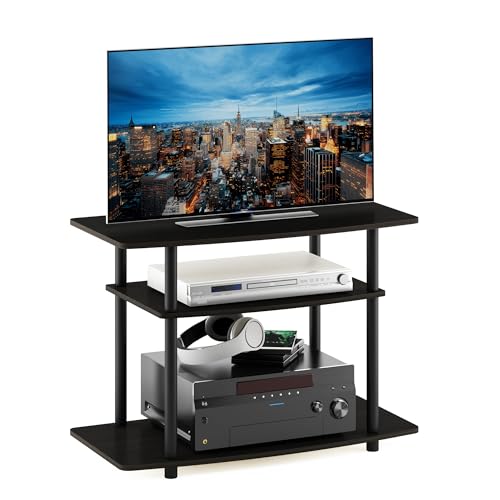
Furinno Turn-N-Tube No Tools 3-Tier Entertainment Center, Espresso/Black — best overall for small apartments
Who it suits: Renters with a TV of 32 inches or under — the studio and bedroom standard — who need the stand to occupy wall width as if it were priced by the inch, because in their flat, it effectively is.
The shape is the argument: 31.5 inches wide, 15.79 inches deep and 23.31 inches high. Where the living-room stands in our other guides sprawl low and wide, this unit goes up instead of out, stacking three tiers of storage in the footprint of a bedside table. In a studio, that verticality is worth more than any finish: the same wall run that holds this stand and a 32-inch TV would hold nothing else useful, while a wide console would consume the only wall the sofa also needs. The height earns its keep twice over. Watched from a bed or a futon — the two most common small-apartment viewing positions — a screen on this stand’s raised top sits far closer to eye level than one on a low living-room unit, and in a studio where the bed is the sofa, that is the difference between watching comfortably and watching with a cushion wedged behind your neck. The 15.79-inch depth, deep for its class, swallows an older or deeper small TV and gives the lower tiers real utility: a console, a router, a stack of books, the router’s blinking banished to a lower shelf where it does not light the room at night.
Renter mechanics are this stand’s home turf. It assembles by hand-twisting its plastic tubes into the particleboard shelves — no tools, no screws, nothing to lose — and it disassembles the same way into a flat bundle one person can carry down any stairwell. At under twenty pounds it is not a moving-day decision at all. Two honest cautions belong in an apartment review. First, availability on this long-running listing fluctuates, and at times it shows no featured offer while third-party sellers rotate; buy it when the offer looks normal, or take the French Oak Grey variant of the same stand. Second, a tall narrow unit wants a wall behind it — in a studio’s open floor it should stand against the wall it serves, not as a room divider, and the TV should be strapped to the stand if the flat has children or large dogs visiting. Within those, for the classic small-apartment TV, nothing under $50 is better shaped.
Pros: Smallest wall footprint of any full stand here; height suits bed and futon viewing; deep tiers hide a router and console; tool-free build and teardown; light enough for one-person moves.
Honest limitation: Strictly for TVs up to 32 inches. Listing availability fluctuates — check the seller looks legitimate before ordering. Tall and narrow means wall placement, not open-floor placement.
Choose it if your TV is 32 inches or under and wall width is your scarcest resource. Skip it if your TV is bigger or the current listing offers look dubious. Check the live page: Check on Amazon.
Furinno JAYA Simple Design Corner TV Stand, Espresso/Black — best for studio corners
Who it suits: Studio and one-bedroom renters whose floor plan has one genuinely free corner — and in a small flat, a free corner is the only free floor there is.
Corner logic is apartment logic. Every other piece of furniture in a small flat wants flat wall and rectangular floor; the corner is the leftover geometry, usually occupied by a lamp, a plant or nothing. The JAYA converts that leftover into the media center: corner-cut shelves 42.04 inches across the front, 15.55 inches deep and 22.75 inches high, rated for TVs up to 46 inches — a meaningfully larger screen than the compact tower above holds, bought entirely with floor that was earning nothing. The viewing geometry of a small flat often cooperates: in a studio, the bed, the sofa and the desk frequently all face, at some angle, the same corner, and a corner TV can serve two of those positions acceptably where a flat-wall TV serves one. The open shelves below take a console and a streaming box on separate levels, and every cable drops into the corner void, which in a small flat doubles as the place cables were going to be hidden anyway.
The renter details hold up: hand-twist tube assembly with no tools, a unit light enough to reposition solo when the flat’s layout changes — and small-flat layouts change constantly, which is the JAYA’s one structural risk. A corner stand is a commitment to that corner; if your lease or your whims move the TV wall twice a year, a rectangular stand forgives more. Rounded panel edges, a JAYA line feature, matter in small flats for a mundane reason: you walk closer to your furniture than house-dwellers do, and the stand’s front corners live in your circulation path. Keep the TV pushed back toward the corner, the heaviest component on the bottom shelf, and the setup is as stable as this tier gets without an anchor — and if your lease permits a single discreet anchor point, the corner gives you two walls to choose from.
Pros: Uses floor nothing else can use; holds up to a 46-inch TV; serves multi-angle studio seating; cables vanish into the corner; rounded edges for tight circulation paths.
Honest limitation: Locks the flat’s layout to that corner. Usable top width is less than the headline figure after the corner cut — measure your TV’s foot span against the front of the panel. Not the pick for chronic rearrangers.
Choose it if your flat has a free corner and a TV up to 46 inches. Skip it if you rearrange often or the TV is larger. See it here: Check on Amazon.
Furinno Turn-N-Tube No Tools 3D 3-Tier Entertainment TV Stand, Dark Brown/Black — best for a 43–50 inch TV in a one-bedroom
Who it suits: One-bedroom renters whose TV has grown to 43–50 inches — the point where the compact tower stops working — but whose living room wall has not grown with it.
Depth is this stand’s whole story: at 11.7 inches deep, it is the shallowest full stand we could verify under $50, and in a rental living room, depth is the dimension that decides whether the coffee table fits, whether the walkway survives, whether the room feels furnished or stored. The frame is 43.8 inches wide and 16 inches high, rated by Furinno for TVs up to 50 inches, with a stepped three-tier layout whose raised center section gives a soundbar a fixed home — in a small flat, the soundbar is not a luxury, it is how dialogue stays intelligible at the low volumes thin walls impose, so a stand that houses it properly is solving an apartment problem, not a hi-fi one. The Dark Brown/Black finish pairs with the black bezels and black electronics that dominate small setups, making the whole stack read as one dark, quiet object against a rental-white wall.
The cautions are the honest ones for a shallow stand. Eleven-point-seven inches of depth leaves little panel in front of or behind a large TV’s feet, so measure the foot span and foot depth of your exact set, center it with care, and secure it — a strap to the stand itself is the renter-feasible version, and on this stand it is not optional with a 50-inch set. The lower tiers’ heights are set by the step, so check a tall console standing vertically will fit, or lay it flat. Assembly is the family-standard hand-twist tube build, and the unit’s light weight keeps it inside the one-person moving rule. For the renter whose TV outgrew the bedroom but whose flat did not, this is the stand that respects both facts.
Pros: Shallowest verified depth — preserves walkways and room feel; sized for the 43–50 inch class; stepped shelf houses the apartment-essential soundbar; tool-free, light, moving-friendly.
Honest limitation: Shallow depth demands precise TV placement and a securing strap with larger sets. Lower-tier height limits tall components. Lower shelves are light-duty only.
Choose it if your TV is up to 50 inches and your living room is narrow. Skip it if your TV’s feet are unusually deep or you cannot secure the set. Check the listing: Check on Amazon.
FITUEYES Universal TV Stand for 27-55 Inch TVs — best zero-footprint option
Who it suits: Renters who already own any sturdy horizontal surface — a dresser, a storage unit, a solid desk — and refuse to give a TV stand any floor of its own. In a small apartment, that refusal is arithmetic, not stubbornness.
The FITUEYES is a tabletop base: a steel pillar on a tempered glass foot that bolts to your TV’s VESA holes, covering TVs from 27 to 55 inches, VESA patterns from 100x100mm to 400x400mm, and rated to hold up to 88 lbs — a rating that embarrasses every furniture stand in this guide, as steel hardware should. The apartment magic is what it does not consume. It stands on furniture that is already in the flat, already paid for in floor space: the dresser in the bedroom, the storage cubes in the studio, the sideboard hand-me-down. The TV’s footprint becomes the base’s small glass rectangle, the drawers and shelves underneath stay fully usable, and the total new floor committed to television is zero inches — the only figure that truly respects a small lease. Height adjustment adds the second apartment gift: on a low storage unit the screen can be raised to clear a soundbar or to sit at bed-viewing height, tuning furniture you own into furniture at the right height.
Moving day is where this pick quietly wins the whole guide. The base breaks down into a flat, light bundle that packs in a box with the cables; there is no particleboard furniture to wrap, carry or abandon. Renters who have ever paid a deposit penalty for a discarded TV stand — or carried one down four flights to a curb — will price that correctly. The conditions are the standard base conditions, stated plainly: your TV needs VESA holes (check the pattern in its manual), and the furniture beneath must be genuinely sturdy, level and wide enough for the base, because the base concentrates the TV’s weight centrally rather than spreading it to wide feet. A wobbly storage cube stays wobbly with a TV on it; choose the dresser. Given that, this is the smartest fifty dollars in the small-apartment category.
Pros: Zero new floor footprint; strongest rating here (up to 88 lbs); height adjustment adapts furniture you own; packs flat and light at moving time; wide 27–55 inch range grows with your TV.
Honest limitation: Provides no storage of its own and depends entirely on the sturdiness of your existing furniture. Requires VESA compatibility. The glass base shows dust, and in a tiny flat everything is close enough to notice.
Choose it if a solid dresser or unit already stands where the TV should go. Skip it if you own no suitable surface — buy one of the furniture picks instead. Check the listing: Check on Amazon.
PERLESMITH Universal TV Stand PSTVS04 — best for a desk or dresser setup
Who it suits: Renters whose TV lives on a desk or dresser by necessity — the studio work-from-home corner, the bedroom dresser — and whose factory TV feet are too wide, too low or simply lost in the last move.
The PSTVS04 is the established name in tabletop bases: tempered glass base, steel spine with wire management built in, height adjustment, VESA support up to 400x400mm, TVs from 32 to 60 inches, and a rating of up to 88 lbs. Its apartment virtues are specific. On a desk, height adjustment lifts the screen above a laptop’s lid line and over a soundbar, turning a compromised work-and-watch corner into a deliberate one. On a dresser, it centers the TV’s weight mid-top instead of at two feet near the front edge, where dresser tops are weakest and where the set otherwise creeps toward the room. The wire management in the spine matters disproportionately in small flats, where the TV’s cables are never more than a few feet from where you eat, work and sleep — one bundled drop behind the furniture is the difference between a studio that feels calm and one that feels wired.
Setup is a screwdriver job of about twenty minutes with real hardware — the one pick here that asks for a tool — and the result is the most planted-feeling TV in this guide. Renters should note the base’s own footprint on the furniture: the glass base is wide enough to be stable and small enough to leave the dresser’s top usable on both sides, which in a small bedroom is the difference between a TV that replaced your dresser and a TV that shares it. As with the FITUEYES: VESA check first, sturdy surface required, no storage provided, and at moving time it packs into almost nothing. If the flat’s only TV surface is a desk or dresser, this is the pick.
Pros: Purpose-built for desks and dressers; strong 88 lb rating for 32–60 inch TVs; spine wire management keeps tiny rooms calm; height adjustment clears laptops and soundbars; packs flat for moves.
Honest limitation: The only pick needing a screwdriver. No storage. On a desk it raises the screen, so check total height against shelves or a hutch above the desk before ordering.
Choose it if the TV’s home is a desk or dresser top. Skip it if there is no surface at all. Check compatibility and price: Check on Amazon.
The full media console — the pick we cannot honestly make under $50
Who it suits: Renters picturing a wide, doored console anchoring the living area. In a small apartment the picture has two problems, and only one of them is money.
The money problem is the familiar one: no doored console from a brand that states its dimensions and weight ratings could be verified under $50; the shape’s costs — thicker panels, hinges, backs — start a tier up, and the anonymous listings that fake it state no ratings at all. The space problem is the apartment-specific one: a full-width console is usually the wrong object for a small flat even when it is affordable. It commits the longest wall entirely to television, in rooms where that wall must also hold a desk, a dining surface or the sofa itself. The households that furnish small flats well tend to converge on what this guide recommends instead — a compact or corner stand, or no stand at all with the TV based on storage furniture — and put the media clutter inside a closed Best Bookcase Under $50 or a lidded unit that can live anywhere. If a console is truly the plan, the honest path is to save toward the next tier (our Best Tv Stand Under $75 guide continues this search) and measure the wall twice, because in a small apartment a console is a floor-plan decision, not a furniture purchase.
Pros of waiting: A real console, bought at the right tier and the right size, serves a flat for a whole lease and beyond. Honest limitation of this slot: no link, no product — deliberately, and doubly justified in small spaces.
Choose this route if the flat is a long lease with a true TV wall. Skip it if the flat is small, short-let or still changing shape — which is most small apartments.
Comparison table
| Pick | Type | TV size rating | Apartment-relevant notes | Link |
|---|---|---|---|---|
| Furinno Turn-N-Tube 3-Tier Entertainment Center | Tall compact stand | Up to 32 inch | 31.5 x 15.79 x 23.31 in; vertical storage; under 20 lbs to move | Check on Amazon |
| Furinno JAYA Corner | Corner stand | Up to 46 inch | 42.04 x 15.55 x 22.75 in; uses dead corner floor; rounded edges | Check on Amazon |
| Furinno Turn-N-Tube 3D 3-Tier | Slim open stand | Up to 50 inch | 43.8 x 11.7 x 16 in; shallowest depth; soundbar step | Check on Amazon |
| FITUEYES Universal TV Stand | Tabletop base | 27–55 inch | Zero new footprint; VESA 100×100–400x400mm; up to 88 lbs | Check on Amazon |
| PERLESMITH PSTVS04 | Tabletop base | 32–60 inch | Desk/dresser specialist; spine cable management; up to 88 lbs | Check on Amazon |
| Full media console | Prose only | — | No verified option under $50; see the review above | — |
How to choose a TV stand for a small apartment under $50
Measure the room before the TV. Note the wall length available, the walkway that must survive, and the depth you can spend into the room. In small flats the stand is chosen by the room’s leftovers, not the TV’s ambitions — then check the TV’s foot span and weight against the stand those leftovers allow.
Count the floor twice: footprint and future. A stand that fits today but blocks the desk chair, the radiator or the door swing costs comfort daily. Tape the stand’s footprint on the floor with painter’s tape and live with the outline for a day before ordering; small-flat mistakes are almost always visible at tape stage and expensive at furniture stage.
Prefer vertical and corner geometry. Height and corners are the small flat’s free dimensions. A tall compact stand or a corner unit stores the same gear in floor that was otherwise wasted — the same logic that makes a Best Console Table Under $50 work as a hallway catch-all in these flats.
Interrogate your existing furniture first. If a sturdy dresser, desk or storage unit already stands in the TV’s spot, a tabletop base converts it for less money, zero floor and a shoebox-sized moving footprint. Buying furniture to stand next to furniture is the classic small-flat error.
Plan the exit. If the lease ends within a year or two, weight and disassembly are features, not afterthoughts: tool-free stands and flat-packing bases leave cheaply and cleanly; a heavy console leaves with a fee, a friend with a van, or a deposit deduction. Furnish the lease you have, and let the room breathe — a small Best End Table Under $50 beside the sofa will serve the remotes better than a bigger TV unit ever will.
Common small-apartment mistakes
Buying the stand for the TV you want, not the flat you have. A 55-inch-ready console in a studio eats the room to serve a screen that may never arrive. Size the stand to this flat and this TV.
Ignoring depth. Width gets measured; depth gets discovered — usually by a shin, at night, in the walkway the stand now occupies. The shallow picks exist for a reason.
Wall-mount envy. Renters drill, lose deposits, or mount into plaster that cannot hold the set. A stand or base solves the same sightline legally. If the lease forbids holes, it forbids holes.
Blocking the heat and the light. A stand pushed over a radiator or baseboard heater cooks its own shelves’ contents and the room’s heating bill; a TV corner that steals the window wall darkens everything else. Check both before the tape comes off the floor.
Forgetting the router. In a small flat the TV stand usually becomes the network closet. Open tiers ventilate a router properly; a closed box — or a stand with no shelf at all — leaves it cooking on the floor. Plan its shelf when you plan the TV’s.
Working the TV into a multi-use small flat
The small apartment’s defining condition is that no room has one job, and the TV setup has to survive sharing its square meters with work, eating, exercise and guests. Plan for the collisions explicitly. If the living area doubles as a home office, the TV wall and the desk wall compete for the same outlets and the same sightlines; a tabletop base on the desk or a low unit lets one surface serve both masters, and a screen that can serve as a second monitor by day earns its footprint twice. If the flat hosts — a sofa bed, an air mattress, friends on the floor — the TV’s viewing geometry should be tested from the floor as well as the sofa, which favors the lower stands and tilting bases over tall furniture; the compact tower, for all its virtues, is a bed-and-sofa stand, not a floor-audience one. If the flat exercises — a mat unrolled in front of the TV for workouts — the stand’s depth decides whether the mat fits, which is one more vote for the 11.7-inch 3D stand or a corner arrangement that leaves the room’s center empty.
Sound deserves its own paragraph in a rented flat, because thin walls make the neighbors stakeholders in your TV setup. Dialogue at low volume is the apartment use case, and it is a speaker problem before it is a TV problem: a soundbar at seated ear height, close to the seating, delivers clarity at levels a TV’s rear-firing speakers only reach by getting loud. Every pick in this guide either houses a soundbar on a step or a tier or lifts the screen above one, and that is not an accident of the product pool — in a small flat, the stand that cannot place a soundbar properly has failed at the flat’s most common viewing condition, the late-night film at conversation volume. Place the bar, bundle its cable with the rest, and keep the subwoofer — if there is one — off shared walls and off the stand itself, on the floor in a corner, where its energy goes into the room rather than into the structure.
And a final apartment ritual worth adopting: the quarterly re-plan. Small flats evolve faster than houses — a new job changes the desk, a partner changes the seating, a hobby changes the floor — and the furnishings that survive are the ones that can be re-decided cheaply. Everything in this guide can be unbolted, untwisted, carried and re-placed by one person in under an hour, which means the TV setup can follow the flat’s life instead of freezing it. That adaptability, more than any single dimension, is what makes this price tier the natural furniture of rented small spaces: it assumes change, and it prices change at nearly nothing. A household that expects to re-plan its flat twice a year should no more buy permanent TV furniture than it should buy a fitted wardrobe for a rented room — the stand that untwists, unbolts and carries out in one trip is not the cheap option here, it is the correct one, and the fact that it is also the cheapest is simply the tier being honest about who it serves.
Deposit-safe setup: securing a TV in a rented flat
Because so many small apartments are rented, the securing question deserves its own short treatment, separate from the general advice. The hierarchy of renter-safe options runs from zero holes to one. At zero holes: place the stand in a corner or flat against the wall, keep the TV’s weight low and back, put the heaviest gear on the bottom shelf, and strap the TV to the stand itself or to the heavy furniture it stands on — furniture straps and anti-tip kits that clamp or strap to the stand exist precisely for this lease situation and leave nothing behind. A bolted tabletop base on a heavy dresser is the strongest zero-hole architecture, because the TV, base and dresser become one low, wide, heavy system. At one hole — where the lease permits picture hooks or a single anchor, as many do — a proper wall strap to a stud outperforms every furniture trick and takes ten minutes. What never to do is split the difference with adhesive mounts or plaster anchors asked to hold a television: they are rated for pictures, and a TV is not a picture. Read the lease’s actual words before assuming — “no nails” clauses often still permit the small anchor a strap needs, and a landlord asked politely about a safety anchor for a television is a landlord who has usually said yes. Document whichever route you choose with a photo at setup; if a deposit conversation ever happens, the picture of a secured, undamaged installation is worth more than the argument.
Final recommendation
For most small apartments, the best tv stand for small apartments under $50 is the compact Furinno 3-Tier Entertainment Center — vertical, light, tool-free and shaped for the 32-inch reality of studio and bedroom TVs — provided its listing’s current offers look normal when you order. Studios with a corner should take the JAYA and its 46-inch capacity; one-bedrooms with a bigger screen should take the slim 3D stand; and every renter with a sturdy dresser or desk should seriously consider skipping furniture altogether for the FITUEYES or PERLESMITH base, the only options here that cost no floor at all. What this budget and this floor plan agree on is that a full console is the wrong purchase — save that ambition for a bigger flat and the under-$100 tier.
FAQ
What size TV stand fits a studio apartment? Work from the wall, not the screen: most studios do best with a stand 32–44 inches wide and as shallow as possible, or with a corner unit. The picks here span a 31.5-inch compact tower, a 42-inch corner stand and a 43.8-inch slim stand only 11.7 inches deep — tape the footprint on your floor before choosing.
Can I put a TV on a dresser instead of buying a stand? Yes, and in a small apartment it is often the best answer — with a tabletop base that bolts to the TV’s VESA holes rather than the TV’s own feet alone. The base centers and secures the set, raises it to a better height, and costs no extra floor. The dresser must be sturdy and level.
How do I secure a TV without drilling into a rented wall? Use an anti-tip strap that connects the TV to the stand or to heavy furniture rather than to the wall, keep the stand low or in a corner, and put the heaviest components on the bottom shelf. A bolted tabletop base on a solid dresser is the most secure no-drill architecture of all.
Is a corner TV stand good in a small apartment? Often the best option in a studio: it uses floor no other furniture can use and can serve both a bed and a sofa at angles. Confirm your main seat gets an acceptable viewing angle, and remember the stand commits you to that corner.
What should I do with the stand when I move out? That is the quiet virtue of this tier: the tube stands disassemble by hand into a light flat bundle, and the bases pack into a small box. If a stand cannot make the move, its low cost makes donating or leaving it a minor loss rather than a deposit dispute — but plan to take it; landlords charge for abandoned furniture.
Why is there no full console in the picks? No doored console could be verified under $50 from a brand stating dimensions and load ratings — and in a small apartment a full console is usually the wrong shape anyway. The honest alternatives are in the review above.
How much floor does a TV stand actually cost in a small flat? Run the comparison in the units the flat charges you: a wide console at roughly 47 by 13 inches claims a little over four square feet of the room’s most contested wall; the compact tower claims about three and a half square feet but stacks its storage vertically; the corner stand claims a triangle no other furniture could use; and a tabletop base claims nothing. None of those figures decides the question alone — the right stand is the one whose shape matches the floor your flat can actually spare — but every small-apartment buyer should know which of the four bargains they are striking before they strike it.
My TV is 43 inches. Which pick fits a small apartment? At 43 inches you are between the tower (too small) and the wide stands (more floor than you may want to spend). The honest shortlist is the JAYA in a corner, rated to 46 inches, or a tabletop base on furniture you own — and, if the living wall is genuinely free, the slim 3D stand, whose rating runs to 50 inches and whose depth is the kindest here. Measure the TV’s foot span against each before deciding; at this size, feet decide more than screens do.


