Where to buy
Check the latest price, availability and delivery on Amazon. Orders are placed on Amazon. We may earn a commission from qualifying purchases.
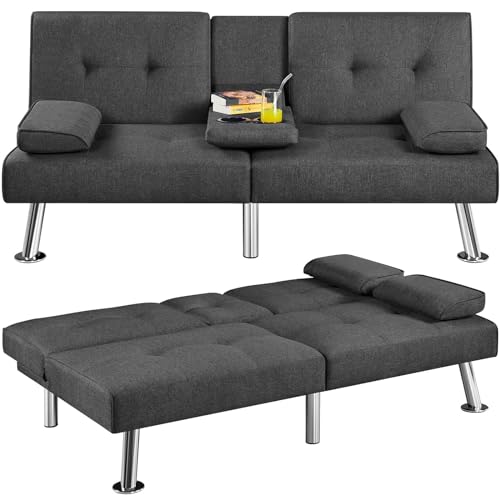
- Best overall: Yaheetech Convertible Sofa Bed, Dark Gray Fabric — Check on Amazon
- DHP Emily Futon Sofa Bed, Black Faux Leather — Check on Amazon
- Best Choice Products Linen Modern Folding Futon, Brown — Check on Amazon
See 3 more Amazon options
- Best Choice Products Faux Leather Convertible Futon, Gray — Check on Amazon
- Yaheetech Adjustable Convertible Futon Sleeper Bed, Gray Linen — Check on Amazon
- Novogratz Brittany Sofa Futon, Blue Linen — Check on Amazon
Read the full guide ↓
Disclosure: As an Amazon Associate, dailyhomedecorating.com earns from qualifying purchases. Links to Amazon on this page are affiliate links; they cost you nothing extra. Listing details such as price and availability change often, so check the current Amazon listing before you buy.
Looking for the best sleeper sofa for small spaces under $300 usually means furnishing a space that is not a room at all: a corner of a studio, a landing, a box room, a home office that must surrender to guests, a den measured in feet rather than metres. Here is the fact this whole guide is built on, stated plainly: a traditional pull-out sleeper sofa — a sofa with a folding metal mechanism and a separate thin mattress hidden inside the seat — is essentially not sold new under a $300 ceiling by any maker whose specifications can be verified. The mechanism, the mattress and a frame strong enough to carry both cost more than that before upholstery is added. What genuinely exists under $300, from real brands with published dimensions, is the convertible family: futons, sofa beds and click-clack designs where the seat and back themselves fold flat into the sleep surface. That is not a bait-and-switch. A well-chosen click-clack gives a guest a flat, supported, full-length surface tonight, in a room that still has a sofa tomorrow — it simply asks you to accept a firmer sleep surface and a visible fold line in exchange for a price a pull-out mechanism cannot meet. Every pick below is labelled for what it actually is, carries only specifications its maker publishes, and is linked only where the model and its tier could be verified. Where the honest answer is that a body type or a use case outruns this budget, the guide says so and points at the tier where the real product starts.
Small-space buying is footprint buying, so this guide is organised by the space each piece truly consumes. The leader is the Yaheetech Convertible Sofa Bed: 62.5 inches wide as a sofa, only 37 inches deep when flat, with a seat height of 14 inches that keeps sightlines low in a cramped room, and — improbably for the smallest piece here — the highest maker-listed capacity in the guide, up to 772 lb; check price on Amazon for its current figure. The DHP Emily follows for a different small-space reason: it is armless, so none of its 71 inches is wasted on arms, and its split back lets a corner be half bed and half seat. The two 65.25-inch Best Choice Products platforms, in linen and in wipe-clean faux leather, cover the movable-furniture case at roughly 61 to 63 lb each. The final two picks are labelled exceptions for small spaces with one long dimension — the 78-inch Yaheetech and the 81.5-inch Brittany — included because some small spaces are corridors and lofts, not boxes. Every review states both footprints, sofa and flat, because in a small space the second footprint is the one that decides. As always here, no fixed prices are printed — check the current price on Amazon against the $300 ceiling.
In this guide
Quick Picks
Short on time, or comparing several options at once? Each row below names a buyer type and the convertible sleeper that suits it, with a link to the listing. Every pick here is a futon, sofa bed or click-clack design — the honest shape of this budget, for reasons the introduction explains.
| Buyer type | Pick | Why it stands out | Link |
|---|---|---|---|
| Best overall click-clack | Yaheetech Convertible Sofa Bed, Dark Gray Fabric | 62.5-inch footprint, 37-inch flat depth — the smallest honest bed here | Check on Amazon |
| Best split-back design | DHP Emily Futon Sofa Bed, Black Faux Leather | Armless 71-inch split-back — no arms wasting sleep width in a tight room | Check on Amazon |
| Best fabric finish under the ceiling | Best Choice Products Linen Modern Folding Futon, Brown | 65.25-inch linen platform, light enough to move when the room changes jobs | Check on Amazon |
| Best wipe-clean pick | Best Choice Products Faux Leather Convertible Futon, Gray | Wipe-clean twin of the platform — for the spare corner that also stores everything else | Check on Amazon |
| Roomiest sleep surface | Yaheetech Adjustable Convertible Futon Sleeper Bed, Gray Linen | The long exception — for a small space that is long, not wide | Check on Amazon |
| Best sofa-first looks | Novogratz Brittany Sofa Futon, Blue Linen | The wide exception — only for a shallow room with one long wall | Check on Amazon |
How These Picks Were Chosen
The small-spaces filter measured everything twice. First, the closed footprint: width, depth and height as a sofa, with a preference for low profiles — seat heights around 14 to 16 inches — that keep a small room’s sightlines open. Second, the open footprint: the full rectangle the piece claims as a bed, including rear clearance for the folding back. Picks were ranked on the ratio between the two: how much bed appears per unit of sofa. The Yaheetech’s 62.5-by-37-inch bed from a 62.5-inch sofa leads this guide because that ratio is the whole game in a small space.
The second filter was dead-space honesty. Arms, thick frames and decorative bulk consume width that a sleeper could be sleeping on; the armless Emily, whose flat surface runs close to its full width, scores accordingly. The third filter was mobility: in multipurpose spaces furniture moves weekly, so weight counted heavily — the platform picks at roughly 61 to 63 lb can be shifted by one person, and the two heavy exceptions are flagged rather than hidden. The fourth filter was the batch’s verification standard, unchanged: real Amazon US listings with cross-checked ASINs, dimensions and materials; makers’ published figures only; capacities quoted where published and marked unverified where not; nothing invented to fill a table cell. The fifth filter was tier truth — linked models normally sell within the under-$300 framing, with live prices left for you to check, as this guide prints none. The result is a guide that treats “small space” as an engineering constraint, not a style word.
Detailed Reviews
Six convertible sleepers, reviewed one at a time: who each suits, what it does well, the honest limitation, and a straight choose-or-skip verdict.
Yaheetech Convertible Sofa Bed, Dark Gray Fabric
Who it suits: Apartment and guest-room buyers who want one honest, measurable piece that seats two by day and sleeps one guest at night, and who would rather have a published capacity figure than marketing adjectives.
Every dimension of this piece is a small-space argument. Sixty-two and a half inches is the width of the leftover wall in most rooms; 37 inches flat is a bed that opens without relocating the room; a 14-inch seat height keeps the piece below window sills and sightlines; 8 inches of ground clearance lets a vacuum and stored items pass underneath. Add the guide’s highest published capacity and the drop-down platform that replaces a side table, and it is the most space-literate design in the tier. Its one extravagance is none at all — which is the point.
Verified specifications: Sofa 62.5 in wide x 31.5 in deep x 28 in high; flat bed 62.5 x 37 in; seat depth 19 in; seat height 14 in; three back angles (105, 140 and 180 degrees); polyester fabric over an engineered wood frame with foam-wrapped sinuous springs; chrome-plated metal legs; drop-down centre platform with two cup holders; removable armrest pillows; maker-listed capacity up to 772 lb. As with every pick in this guide, the article prints no fixed price for it — check price on Amazon for the current figure before you decide.
What it does well
- The highest maker-listed capacity in this guide, on an engineered wood frame with sinuous spring support under the foam
- Three positive-locking back angles, so it works as sofa, lounger and flat bed without tools or a separate mattress
- The drop-down cup-holder platform is genuinely useful for movie nights and for guests who need a nightstand substitute
- Compact 62.5-inch width fits walls that a standard three-seat sofa would overwhelm
Honest limitation: The flat bed is 62.5 inches long, so anyone much over six feet tall will sleep diagonally or with bent knees, and the 37-inch width is a single sleeper’s surface, not a couple’s.
Choose it if the fit described above sounds like your household. Skip it if that limitation is the exact problem you are trying to solve — another pick in this guide handles it better. Check on Amazon
DHP Emily Futon Sofa Bed, Black Faux Leather
Who it suits: Design-led buyers and couples with different bedtimes — one sleeps, one sits — who want the widest single sleep surface this budget allows.
Arms are a luxury of large rooms. The Emily spends its entire 71 inches on seat and sleep surface — about 43.5 inches of flat width, the most in this guide — because nothing is carved away for armrests. In a small space that arithmetic is decisive: the bed is wide where the sleeper is. The split back adds the second small-space trick, letting the piece be half-converted in a room that cannot afford a full conversion footprint at that moment. Chrome legs keep it visually light on the floor it occupies.
Verified specifications: 71 in wide; sleeping surface about 70.5 x 43.5 in; seat height 16 in; seat depth 23 in; split-back design so each half reclines independently; tufted faux leather upholstery; sturdy wood frame with chrome metal legs; armless profile; model 2007009. As with every pick in this guide, the article prints no fixed price for it — check price on Amazon for the current figure before you decide.
What it does well
- The split back is the real differentiator: one side lies flat for a sleeper while the other stays upright for someone still watching television
- The widest flat surface in this guide at about 43.5 inches, which is the difference between a cot and a comfortable single bed
- An armless, tufted, mid-century profile that stylists have used for years precisely because it does not look like a futon
- A long-established model from a major furniture maker, with replacement-part and manual support behind it
Honest limitation: Armless means no head support at the ends when it is flat, and the faux leather is only in darker, dressier colours that show dust and pet hair quickly.
Choose it if the fit described above sounds like your household. Skip it if that limitation is the exact problem you are trying to solve — another pick in this guide handles it better. Check on Amazon
Best Choice Products Linen Modern Folding Futon, Brown
Who it suits: Renters and first-apartment buyers who want the futon to disappear into a normal living room by day and only reveal the bed at night.
Small spaces change jobs — office by day, guest room by night, nursery next year — and furniture in them must be movable by the person who lives there. At about 61.5 lb, this linen platform is the piece one person can carry to the next room and the next life stage. The linen finish suits the calm, pale rooms small spaces usually are, and at 65.25 inches it is the largest size that still behaves like movable furniture rather than a fixture.
Verified specifications: 65.25 in long x 32 in deep x 29 in high as a sofa; seat height 14 in; linen upholstery over foam; three adjustable back positions; fold-down centre armrest with two cup holders; removable armrests; chrome metal legs; maker-listed capacity 500 lb; product weight about 61.5 lb. As with every pick in this guide, the article prints no fixed price for it — check price on Amazon for the current figure before you decide.
What it does well
- Real fabric hand-feel instead of vinyl, so it sits and sleeps cooler than the faux leather version of the same platform
- The same proven 65.25-inch click-clack platform, three positions and cup-holder armrest as its faux leather sibling
- Light at about 61.5 lb, and the flat-pack format suits walk-up apartments
- Brown linen hides everyday lint and pet hair better than the pale fabrics in this price tier
Honest limitation: Fabric is slower to rescue after a spill than faux leather — it needs blotting and drying time, so it is the weaker choice for toddler-and-juice-box duty.
Choose it if the fit described above sounds like your household. Skip it if that limitation is the exact problem you are trying to solve — another pick in this guide handles it better. Check on Amazon
Best Choice Products Faux Leather Convertible Futon, Gray
Who it suits: Families and pet owners who expect spills and want a guest bed that can be wiped down between the sofa hours and the sleep hours.
The faux leather platform is for the small space that is also the everything space: the spare corner that stores the ironing board, hosts the guest and seats the overflow at dinner. Wipe-clean upholstery survives that triple duty, and the fold-down cup-holder armrest removes the need for a side table the corner does not have. It is the same movable 65.25-inch platform as the linen pick; choose it when the corner’s life is messier than it is calm.
Verified specifications: About 65.25 in long in sofa form; seat height 14 in; tufted faux leather (PU) upholstery over foam with a sinuous spring base; three backrest positions; fold-down centre armrest with two cup holders; removable armrest pillows; four chrome metal legs; maker-listed capacity 500 lb; product weight about 63 lb. As with every pick in this guide, the article prints no fixed price for it — check price on Amazon for the current figure before you decide.
What it does well
- Faux leather wipes clean in seconds, which is the decisive advantage for homes with kids, pets or snack-heavy movie nights
- A fold-down cup-holder armrest and removable arm pillows are included rather than sold as accessories
- At about 63 lb it is light enough for one person to shift for cleaning or rearranging
- The tufted, low-profile shape looks deliberate in a media room or den rather than borrowed from a dorm
Honest limitation: Faux leather sleeps warm and can feel sticky in an un-air-conditioned room, and PU surfaces are the first in this guide to show wear at the fold line over years of nightly folding.
Choose it if the fit described above sounds like your household. Skip it if that limitation is the exact problem you are trying to solve — another pick in this guide handles it better. Check on Amazon
Yaheetech Adjustable Convertible Futon Sleeper Bed, Gray Linen
Who it suits: Buyers with a full-size wall to spare whose priority is the guest’s night rather than the room’s footprint — the closest thing in this tier to a full-length bed.
A small space can be long. A narrow through-room, a converted corridor, a loft’s sleeping end — these have no width to give but metres of length, and for them this 78-inch Yaheetech converts the liability into the guide’s longest bed. It is included with its condition printed on it: measure the length honestly, because in a merely ordinary small room this piece is not a solution but an occupation. Where it fits, nothing else here sleeps a tall guest as well.
Verified specifications: Sofa about 78.3 in wide x 33.3 in deep x 36.6 in high; seat depth 20 in; seat height about 15 to 16.5 in depending on the maker’s table; linen-look fabric over foam on an engineered wood, wood and metal frame; adjustable folding backrest with removable armrests; six metal legs; maker-listed capacity up to 772 lb. As with every pick in this guide, the article prints no fixed price for it — check price on Amazon for the current figure before you decide.
What it does well
- The longest sleep surface in this guide — at roughly 78 inches flat, a tall guest can actually stretch out
- A taller back and deeper seat than the compact click-clacks, so it reads as a real sofa in the room rather than a dorm futon
- Linen-look fabric suits living rooms where faux leather would look out of place
- The same high published capacity figure as its smaller sibling, which matters when two adults share the seat daily
Honest limitation: At over 78 inches wide plus packaging, it is the hardest pick here to get up narrow stairs and through tight apartment doors, and it needs the most wall clearance to fold flat.
Choose it if the fit described above sounds like your household. Skip it if that limitation is the exact problem you are trying to solve — another pick in this guide handles it better. Check on Amazon
Novogratz Brittany Sofa Futon, Blue Linen
Who it suits: Style-first buyers furnishing a living room that occasionally hosts a guest, who will accept a firmer, sofa-grade sleep surface in exchange for daytime looks.
The Brittany tests whether your small space is shallow rather than narrow. At 34.5 inches deep it stands closer to the wall than many ordinary sofas, and a wide, shallow room — a studio’s long wall, a loft edge — can take its 81.5 inches where a boxy room cannot. Its hidden support legs also keep the flat bed level without extra parts stored in the space. But it is 90 lb and immovable in practice: in a small space that changes jobs, that is a real cost, stated here rather than discovered later.
Verified specifications: 81.5 in wide x 34.5 in deep x 31.5 in high; seat depth 23.5 in; seat height 16 in; item weight 90 lb; ribbed channel-tufted back; curved padded armrests; split-back conversion with concealed fold-out support legs in rear zippered pockets; plywood frame with no-sag spring backing; four slanted solid wood legs with felt liners plus two centre legs; linen upholstery. As with every pick in this guide, the article prints no fixed price for it — check price on Amazon for the current figure before you decide.
What it does well
- The most sofa-like silhouette here — channel tufting, curved arms and slanted solid wood legs read as furniture, not equipment
- Concealed fold-out support legs in zippered back pockets solve the classic futon problem of the flat back tipping or sagging
- A deep 23.5-inch seat and padded arms make it the best daytime seat in the guide, full stop
- Solid wood legs with felt liners are kinder to hardwood floors than the chrome feet on the value picks
Honest limitation: At 81.5 inches wide and 90 lb it is the biggest commitment in the guide — measure the door, the hallway turn and the wall before ordering, because returns of assembled futons are miserable.
Choose it if the fit described above sounds like your household. Skip it if that limitation is the exact problem you are trying to solve — another pick in this guide handles it better. Check on Amazon
Comparison Table
The numbers below are the makers’ published figures for the exact models linked. Where a maker does not publish a figure in a form we could verify, the cell says so instead of guessing.
| Pick | Sofa width | Flat sleep surface | Conversion | Capacity | Best for | Link |
|---|---|---|---|---|---|---|
| Yaheetech Convertible Sofa Bed, Dark Gray Fabric | 62.5 in | 62.5 x 37 in | Click-clack, 3 angles | 772 lb (maker-listed) | One guest, compact rooms | Check on Amazon |
| DHP Emily Futon Sofa Bed, Black Faux Leather | 71 in | 70.5 x 43.5 in | Split-back, independent halves | See listing | Widest single surface | Check on Amazon |
| Best Choice Products Linen Modern Folding Futon, Brown | 65.25 in | 65.25 in long flat | 3-position backrest | 500 lb (maker-listed) | Fabric finish, renters | Check on Amazon |
| Best Choice Products Faux Leather Convertible Futon, Gray | 65.25 in | 65.25 in long flat | 3-position backrest | 500 lb (maker-listed) | Wipe-clean family use | Check on Amazon |
| Yaheetech Adjustable Convertible Futon Sleeper Bed, Gray Linen | 78.3 in | About 78 in long flat | Folding backrest | 772 lb (maker-listed) | Tall guests, longest bed | Check on Amazon |
| Novogratz Brittany Sofa Futon, Blue Linen | 81.5 in | 81.5 in long flat | Split-back with support legs | See listing | Sofa-first living rooms | Check on Amazon |
How to Choose the Best Sleeper Sofa for Small Spaces Under $300
Measure the space in both configurations. Draw the room to scale on paper — graph paper and five minutes — and draw the sofa twice: closed, and flat with its clearance. Small-space failures are almost never about the closed size, which everyone measures; they are about the open rectangle nobody drew. The reviews print both footprints for every pick so the drawing takes minutes.
Buy the bed-to-sofa ratio, not the sofa. Divide flat sleep width by overall width in your head. Armless and slim-arm designs return most of their width as bed; heavily armed, thick-framed designs return the least. In a small space you cannot afford to store width in armrests — the Emily’s armless arithmetic is the model to copy whichever pick you choose.
Keep the profile low. Seat heights of 14 to 16 inches and low backs preserve sightlines across a small room, which is most of what makes it feel bigger. Tall, high-backed pieces shrink rooms twice: once in floor area, once in visual volume. The leaders here are all low for exactly this reason.
Exploit the underneath and the in-between. Ground clearance around 8 inches, as on the leading Yaheetech, is storage: flat boxes, the topper, the guest’s bag. A drop-down cup-holder platform replaces a side table. In a small space, every feature that deletes another piece of furniture is worth more than upholstery upgrades.
Choose mobility unless the space is permanent. If the room changes jobs — and small spaces usually do — stay in the low-60s lb class where one person can move the piece. Commit to a heavy pick only when the layout is settled for years. Flexibility is a feature; weight is its price list.
Plan the guest’s whole rectangle. A bed is not just its surface: the guest needs a step-out strip, a place for a bag, and a path to the door. If the flat footprint plus that strip exceeds the room, choose the smaller pick and a happier guest over the larger bed and an obstacle course.
Common Mistakes to Avoid
Measuring only the closed sofa. The bed’s rectangle — plus rear clearance for the folding back — is the true size of the purchase. Tape both outlines on the floor before ordering; in a small space there is no spare room to absorb a surprise.
Paying for arms with sleep width. Wide padded arms on a small sleeper can consume a fifth of the piece’s width while contributing nothing at night. In tight rooms, slim or armless designs convert the same footprint into a materially wider bed.
Blocking the only path. A bed that opens across the room’s single walkway — to the bathroom, the door, the kitchen — turns a night’s sleep into a household incident. Check the open outline against the paths people walk at night, not just the walls.
Buying a fixture for a flexible room. A 90 lb sofa in a room that rearranges monthly will simply stop the rearranging — and then stop the bed being opened. Match the piece’s weight to the room’s rate of change.
Forgetting vertical reality. Tall backs and high seats crowd small rooms visually even when the footprint fits. If the room already feels low-ceilinged, a low-profile pick is not a style preference but a spatial correction.
Leaving nowhere for the bedding. In a small space the topper and sheets need a designed home — under the frame, behind the back, in the ottoman. Bedding stored in another room is bedding that will not be fetched, and the guest will sleep on the bare fold line.
Frequently Asked Questions
What is the smallest real sofa bed worth buying?
In this tier, the 62.5-inch class — represented here by the Yaheetech convertible — is the smallest size that still seats two adults daily and sleeps one properly, with a published capacity figure behind it. Smaller pieces exist, but they give up either the seat or the structure.
How much clearance does a folding sofa bed need?
Enough behind the back for it to travel flat — check the figure on the listing for your model, and leave a hand’s width at the sides. The open footprint, including that clearance, is the number to tape on your floor before ordering.
Is an armless futon better for a small space?
For sleeping, usually yes: the full width becomes sleep surface, which is why the armless Emily offers the widest flat bed in this guide. For sitting all evening, arms are comfort. Small spaces that host often should take the width; small spaces that lounge nightly may prefer slim arms.
Can a small-space sleeper be comfortable for a tall guest?
Only the long picks manage it — the roughly 78-inch Yaheetech in this guide. Compact beds of 62 to 65 inches will leave a tall guest’s feet over the end. If tall guests are regular, buy length even at the cost of room dominance, or be honest and offer a different arrangement.
Where does the bedding go in a tiny room?
Flat and close: a folding topper under the frame where clearance allows, sheets behind the backrest, or both inside a storage ottoman that serves as the room’s table. The rule is that making the bed must not require leaving the room.
Should I choose the lightest model I can find?
Light is valuable — the low-60s lb platforms here move with one person — but not at the cost of structure. Prefer a light model that still publishes a capacity figure and names its frame materials, as the picks in this guide do.
Small Spaces, Worked Through One by One
“Small space” is a family of different problems wearing one label. This section takes the commonest of them in turn, with the pick and the measurement that decides each — because in a small space, the right answer is always a number before it is a product.
The box room. A room that fits a single bed and a door swing, asked to also be a guest room and a study. The sleeper replaces the bed entirely: closed, it is the study’s seat; open, it is the guest’s bed, and its flat rectangle must leave the door swing clear. The 62.5-inch Yaheetech, flat depth 37 inches, is the usual answer — draw the door’s arc on your floor plan and check the open outline against it, because that arc is the measurement everyone forgets.
The home-office corner. The space is a corner of a larger room, defined by a rug and a desk. The sleeper must not annex the room when open. A low, compact click-clack under a window line works — seat height around 14 inches keeps it below the sill and out of the room’s sightlines — and its bed opens within the rug’s rectangle if the rug was sized for it. Size the rug to the open bed, not the closed sofa, and the corner reads as designed in both lives.
The landing and the alcove. Dead architectural space with exact dimensions and no forgiveness. Measure width between the skirting boards, not the walls, and depth to the first obstruction. Alcoves reward armless designs — the Emily’s full-width surface uses inches that arms would waste — and punish anything whose folding back needs rear clearance the alcove cannot give. Where clearance is zero, choose a design whose conversion pulls forward, and verify that claim on the listing before ordering.
The narrow through-room. Long, thin, and walked through constantly. Here length is the free dimension and width is rationed, which inverts the usual advice: the 78-inch Yaheetech along the long wall can be the right pick in a genuinely small total area, provided its flat opening does not sever the through-path. Tape the open outline and walk the route at night, in the dark, before committing — the path test is the whole decision.
The multipurpose spare corner. Gym corner on weekdays, guest bed on weekends, storage always. Mobility is the specification: the low-60s lb platforms move aside for the mat and back again without a second person or a bad mood. Wipe-clean faux leather suits the corner’s storage life; linen suits its calm one. What the corner cannot host is a 90 lb fixture, however fine a sofa it is — the room’s other lives will vote it out.
Making a Small Sleep Space Feel Generous
Light the bed, not just the room. A small lamp or wall light the guest controls, within reach of the flat bed, transforms a corner into a room. It costs almost nothing, stores in a drawer, and is the single highest-value accessory after the topper. Guests forgive a firm bed in a lit, considered corner; they remember a perfect bed in a space that felt like storage.
Give the surface a proper dressing. A fitted sheet over the topper, a real pillow, and a blanket with some weight make a 37-inch bed feel intentional. Undressed, the same surface reads as an apology. The kit folds into the space behind or beneath the piece — in a small space, the dressing’s storage is part of the purchase decision, so choose pieces whose clearance you have measured.
Protect the sleeper’s territory. A curtain, a screen, or even the back of the opened sofa arranged as a divider tells the household the corner is occupied. Small-space hosting is mostly etiquette made physical: a defined rectangle, a light, a surface for a phone and a glass of water — the drop-down cup-holder platforms in this guide exist because that surface is otherwise the floor.
Ventilate and air. Small spaces concentrate warmth and moisture; a guest night leaves both in the foam. Open the piece out the next morning, let it air while the room is used, and fold it away dry. It is a two-minute habit that keeps upholstery fresh in a space with no spare air to dilute neglect.
Accept the space’s terms. A small space will not host like a guest suite, and the picks here do not pretend otherwise. What they offer — a real, flat, measured bed appearing inside a footprint the room can spare — is the honest maximum of the category. Hosts who present it confidently, dressed and lit, find guests sleep exactly as well as the arithmetic said they would.
Is a Sleeper Sofa Under $300 Worth It in a Small Space?
A small space prices furniture in a currency larger homes ignore: the other uses of the same floor. A fixed bed in a box room costs the study; a fixed desk costs the guest room. The convertible sleeper is the rare purchase that refunds the floor daily — seat by day, bed by night, nothing stored, nothing dragged from a cupboard — and in a small space that refund, compounded over years, dwarfs the purchase price. The relevant comparison is never the sleeper against a bigger home’s guest suite; it is the sleeper against the space’s next best use of the same rectangle, and by that test a well-measured convertible wins almost every small room it fits.
The conditions are strict, and this guide enforced them in print: both footprints measured, the open outline taped and walked, arms taxed for the width they consume, weight matched to how often the room changes jobs. A convertible that fails those tests is not a small-space product whatever its listing claims, and the two heavy, wide exceptions here are labelled with their conditions rather than sold as universals. The leaders — compact, low, light, with storage underneath and a table built in — are what the category looks like when it is designed for the constraint instead of merely shrunk toward it.
Worth it, then, precisely where the space is smallest — provided the buying is done with the floor plan open on the table. In a small space, measurement is not preparation for the purchase; it is the purchase, and the product is simply the part that arrives in a box.
One last check before you order. Open the listing of the pick you have chosen and confirm four things against this guide: the flat length, the flat width, the maker’s capacity figure where one is published, and the packaged dimensions for your door and route. Listings are revised, colours rotate, and a model name can cover small specification changes across seasons, so the live page is the final authority — if a figure there differs from the one printed here, believe the listing and choose accordingly. Then confirm the current price sits inside your ceiling, because this guide deliberately prints none and prices in this category move weekly. That two-minute audit, done once, is the difference between a sleeper that serves for years and a return that costs a Saturday. It is also the habit that makes every future furniture purchase in this tier easier: measure the flat form, read the maker’s own numbers, distrust any claim the maker will not print, and let the room — its wall, its route, its actual guests — make the final decision between the six honest options above.
Final Recommendation
For a genuinely small space, the Yaheetech Convertible Sofa Bed is the disciplined choice: the least floor consumed, the most bed returned, storage underneath, a side table built in, and the strongest published structure in the guide. If your small space wastes nothing and hosts a wide-awake sleeper, the armless Emily’s flat width is the alternative argument. Measure both outlines, and let the floor plan — not the photograph — sign the decision.
Start with the Yaheetech Convertible Sofa Bed, Dark Gray Fabric if you want the safest all-round answer, and look seriously at the DHP Emily Futon Sofa Bed, Black Faux Leather if your room or your guest points that way. Check price on Amazon for whichever you choose, confirm the flat length against your guest’s height, and measure the door before the box arrives – those three checks prevent almost every return in this category.
Related Guides
If your budget or your room changes, these companion guides on this site cover the neighbouring decisions: