Where to buy
Check the latest price, availability and delivery on Amazon. Orders are placed on Amazon. We may earn a commission from qualifying purchases.
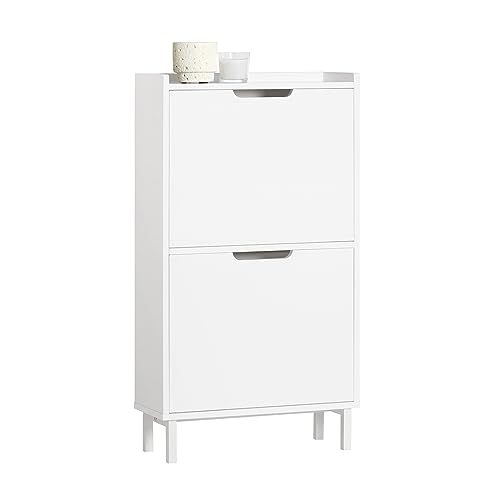
- Best for small spaces overall: Haotian Slim Shoe Cabinet with 2 Flip Drawers, FSR151 — Check on Amazon
- Best for corners and short walls: IRONCK Shoe Cabinet with 2 Flip Drawers, Rattan Doors, Oak — Check on Amazon
- Best tall-and-slim zoning: Sscaktu Shoe Storage Cabinet with 3 Flip Drawers, Fluted, Natural — Check on Amazon
- Best wide-and-shallow run: Maupvit Shoe Storage Cabinet with 2 Flip Drawers, Rustic Brown — Check on Amazon
- Best for alcoves with depth: VASAGLE LIRY Collection Shoe Cabinet, 3-Tier with Hinged Doors — Check on Amazon
- IKEA HEMNES Shoe Cabinet with 4 Compartments — prose-only pick, sold by IKEA directly; it must be wall-fixed, see the review below
Read the full guide ↓
Disclosure: As an Amazon Associate, dailyhomedecorating.com earns from qualifying purchases. Links to Amazon on this page are affiliate links; they cost you nothing extra. Listing details such as price and availability change often, so check the current Amazon listing before you buy.
The best shoe cabinet for small spaces under $1000 is not found by shopping smaller — it is found by measuring the exact awkward place your shoes have colonized and matching a cabinet to its geometry. Small spaces are specific: the nine inches behind the front door’s swing, the short wall under the stairs, the alcove too shallow for a wardrobe, the hallway pinch point where every protruding inch gets clipped by a passing shoulder. A cabinet that ignores that specificity is just a smaller problem. This guide works the other way round: six verified closed cabinets, each mapped to the small-space shape it genuinely fits — slimmest for pinch points, compact for corners and short walls, tall for vertical dead space, wide-and-shallow for under-stair runs, and one deep alcove specialist — with the measurements stated honestly enough for you to rule picks out, which is the real service a guide can do a small space.
Two rules frame everything. First, cabinet, not rack: in a small space, open storage does not merely look untidy, it visually shrinks the very volume you are trying to protect, and it surrenders the top surface — often the only new horizontal surface the space will ever get. Closed cabinets, with flip drawers or hinged doors, keep the volume calm and the top usable. Second, the budget is a solved problem before we start: every linked pick was sighted at a small fraction of the $1000 ceiling, so this guide spends its entire attention on geometry — depth, width, height, opening clearance and fixing — because in a small space those are the only currencies that matter.
A word on method, because small-space buying is where marketing does its worst work. Pair counts are close to meaningless here; what matters is the cabinet’s outside dimensions against your measured space, and the inside geometry against your largest pair of shoes. So the reviews lead with dimensions, state realistic capacities conservatively, and flag the placement each pick was born for — including the placements to avoid. One pick is a famous benchmark that must be wall-fixed to stand at all; in some small spaces that is a feature, in others a disqualification, and we treat it as both. Below: quick picks by space shape, the selection reasoning, full reviews, a depth-sorted comparison table, a measuring protocol, the mistakes that waste small spaces, and an FAQ for tight corners everywhere.
In this guide
Quick Picks: Best Shoe Cabinet for Small Spaces Under $1000
Each row matches a small-space shape to its cabinet. Use check price on Amazon to confirm the live listing before you buy; prices move with coupons and seasonal sales.
| Small-space shape | Pick | Why it stands out | Link |
|---|---|---|---|
| Best for small spaces overall | Haotian Slim Shoe Cabinet, FSR151 | About 7.5 inches deep — fits pinch points and behind-door walls nothing else can | Check on Amazon |
| Best for corners and short walls | IRONCK Shoe Cabinet, Rattan Doors, Oak | 23.6-inch width, raised legs, woven fronts that ventilate in enclosed nooks | Check on Amazon |
| Best tall-and-slim zoning | Sscaktu Shoe Storage Cabinet, 3 Flip Drawers | Three drawers trade width for height — storage grows up, not out | Check on Amazon |
| Best wide-and-shallow run | Maupvit Shoe Storage Cabinet, 2 Flip Drawers | Slim flip depth in a wide, low run — the under-stair and long-wall shape | Check on Amazon |
| Best for alcoves with depth | VASAGLE LIRY Collection Shoe Cabinet | Hinged doors and adjustable shelves fill a deep alcove completely | Check on Amazon |
| Best benchmark run — fixing required | IKEA HEMNES Shoe Cabinet, 4 Compartments | About 8.6 inches deep across 42 inches — covered prose-only, sold by IKEA | See review |
How These Picks Were Chosen
Geometry was the first, second and third filter. A pick had to close fully — open racks and towers were excluded because in a small space concealment is volume — and it had to claim a defensible small-space shape: a depth under ten inches, a width under about thirty-two inches, a height that exploits vertical dead space, or a wide-shallow profile for runs where height is capped by stairs or counters. It also had to be verifiable: a real Amazon listing with a confirmable ASIN, specifications cross-checked against maker manuals or independent coverage, and a dated price sighting far under the $1000 ceiling. Check price on Amazon before ordering; a sighting establishes the tier, never today’s figure.
Fixing and clearance were audited per pick, because small spaces punish assumptions: a flip drawer needs standing room to tip, a hinged door needs its arc, and a tall slim cabinet needs its anti-tip kit — or, in the HEMNES case, a wall fixing without which it cannot stand. Where maker material documented the hardware, the review says so; where a listing’s own dimensions contradicted themselves, the product was dropped rather than guessed at, because a guessed dimension in a small space is a returned parcel.
We did not use these cabinets ourselves. Capacities were derated to the conservative figures the sources support and expressed as rotations, because in a small space the working set — not the archive — is what the cabinet exists for. One pick is prose-only on principle: IKEA sells the HEMNES directly, Amazon carries only third-party resellers at markups, and its mandatory wall-fixing is stated in full so a small-space buyer can judge it against their own walls. If your small space is specifically a small apartment, our Best Shoe Cabinet For Small Apartments Under $1000 guide adds the renter’s layer — tenancy, landlords and move-out — to this same geometry.
Detailed Reviews
Haotian Slim Shoe Cabinet, FSR151 — Best for Small Spaces Overall
Who it suits: Anyone whose available space is measured in single-digit inches: behind the front door, along a corridor wall, in the strip between a wardrobe and a door frame. At about 7.5 inches deep, the Haotian FSR151 is the slimmest fully closed shoe cabinet we could verify, and in small-space work the slimmest honest cabinet is usually the correct one.
The full footprint: about 7.5 inches deep, 19.7 inches wide, 35.8 inches high. Two flip drawers in engineered wood, an adjustable shelf detail, a raised bottom, and hollowed-out handles that keep the front perfectly flush — in a pinch point, the absence of protruding hardware is not a style note, it is the difference between a cabinet you pass a thousand times and one you catch a hip on daily. Independent apartment coverage put realistic capacity at about six pairs: a working rotation for one person, or the overflow zone for a couple whose main storage lives elsewhere. A taller three-drawer sibling in the same range keeps the same shallow depth while growing upward, which is the correct direction of growth in every small space. The raised bottom lets a mop or vacuum pass beneath, so the cabinet does not create a permanent uncleanable strip — a detail that matters disproportionately in small homes, where every strip is visible.
Pros: The depth champion of this entire series — it fits spaces the other picks must decline. Compact width suits wall stubs and behind-door strips. Flush front, easy-clean surfaces, and a sighted price so modest that buying it for a single awkward wall is an easy decision. Light enough to reposition as the room’s use evolves, which in small homes it always does.
Honest limitation: Six pairs is a rotation, full stop. The shallow buckets squeeze the largest men’s sizes and exclude tall boots. And the tall-slim-light profile makes the anti-tip fixing a genuine requirement — in a small space with children, fit it before the first shoe goes in, or choose a lower, wider pick.
Choose it if your space is a pinch point and your rotation is disciplined. Skip it if you need archive capacity or wear the largest sizes. Check price on Amazon — the most affordable linked pick in this guide.
IRONCK Shoe Cabinet with 2 Flip Drawers, Rattan Doors — Best for Corners and Short Walls
Who it suits: The corner by the door, the short wall at a hallway’s turn, the nook beside a fireplace — the compact squarish patches that long cabinets cannot use. At 23.6 inches wide, the IRONCK Shoe Cabinet is the narrowest standard pick here after the Haotian, and its proportions — taller than wide — are the corner’s natural shape.
Dimensions: about 9.25 inches deep, 23.6 inches wide, 39.6 inches high, roughly 45 pounds, on metal legs. Two flip drawers carry hand-woven rattan fronts in an oak finish, and in an enclosed nook the weave does quiet functional work: it ventilates, so shoes stored in a still-air corner dry instead of sealing in damp. Each drawer’s center panel adjusts or removes entirely — a tall space for ankle boots or two shallow ones for flats — and the wider sibling in the range is specified for men’s sizes up to 11.5 without removing the panel, with three panel positions. The raised legs matter in corners specifically: light and air pass beneath, the corner reads less stuffed, and cleaning reaches the angle where dust otherwise retires permanently. An anti-tipping device is included; the brand’s manuals put two-person assembly well under an hour.
Pros: The corner-and-stub footprint, with ventilation woven in. Adjustable panels give it footwear range beyond its size. Raised stance lightens enclosed nooks and simplifies cleaning. Warm rattan-and-oak turns a dead corner into a styled one — in a small space, every visible thing should be doing two jobs, and this does three.
Honest limitation: Capacity is compact — a rotation for one or two, not a household archive. Rattan tone varies slightly and pets may scratch at it. At 39.6 inches tall on a 23.6-inch base it is the most tip-interested shape here after the Haotian, so the included fixing is not optional décor.
Choose it if your space is a corner, a stub or a nook that needs air. Skip it if you need width, maximum pairs, or a flat minimal front. Check price on Amazon to confirm the current listing.
Sscaktu Shoe Storage Cabinet with 3 Flip Drawers — Best Tall-and-Slim Zoning
Who it suits: Small spaces with vertical dead room: the tall blank beside the door, the landing wall, the slice of bedroom wall above where a low dresser would waste the height. The Sscaktu Shoe Storage Cabinet grows the correct direction — three flip drawers stacked in a 31.5-inch-wide fluted natural front, at slim flip depth.
Three drawers, two levels each, is the most zoned storage in this guide relative to footprint: a drawer per person for two people plus a shared third, or daily, sports and seasonal in one column of wall. In small spaces zoning is not an organizational luxury; it is what stops a compact cabinet from becoming a compact jumble, because a small interior searched daily in frustration will be abandoned for the floor within a month. The fluted front — real reeding, with shadow and texture — keeps a tall piece from reading as a storage tower, which is the aesthetic risk of all vertical storage: at eye level, in a room you live in, it presents as furniture. The cabinet is sold through the Raysom Home storefront on Amazon, in a fluted range with a larger hinged-door sibling for a future, bigger room.
Pros: Maximum zones per square foot of floor. Vertical growth preserves circulation in tight rooms. A front with genuine texture at the exact height where flat fronts look cheapest. The wide top still lands keys, post and a lamp — vertical storage that does not surrender the landing strip.
Honest limitation: Height plus slim depth is the anti-tip profile in its purest form: fit the fixing, into a stud or proper anchor, before loading the top drawer. Flip limits on tall boots and the largest sizes apply per drawer. The fluted front wants a soft brush for dusting, and at 31.5 inches wide it still needs a genuine wall section — stubs under that width belong to the IRONCK or Haotian.
Choose it if your space offers height and your household needs zones. Skip it if your wall is a stub or your ceiling line is broken by stairs. Check price on Amazon — sightings sit far below this guide’s ceiling.
Maupvit Shoe Storage Cabinet with 2 Flip Drawers — Best Wide-and-Shallow Run
Who it suits: The long, low, height-capped runs small homes specialize in: under the stairs’ upper flight, along a hallway wall beneath a picture rail, under a window. Where the Sscaktu grows up, the Maupvit Shoe Storage Cabinet spreads out — wide, low and shallow, which is a different and equally valid small-space geometry.
Two flip drawers with two levels each sit in an MDF body about 9.45 inches deep, on metal legs. The run format buys two things a tall cabinet cannot: a long top surface at sitting-adjacent height — the landing strip, the plant row, the place a small home stages everything — and inherent stability, because low and wide is the shape that does not tip. The rustic brown finish is the small-space pragmatist’s choice along a traffic route: it does not record every passing scuff the way pale finishes do, and the metal legs tolerate the mop-and-puddle reality of a hallway floor. Independent long-term coverage measured the same shallow depth class and found the drawers happiest with the everyday rotation — trainers, loafers, flats, school shoes — which is precisely the traffic a hallway run exists to absorb.
Pros: The under-stair and long-wall shape, with a top surface that works as the home’s staging area. Low, wide and stable. Scuff-forgiving finish on the exact route where scuffs happen. Slim depth preserves hallway circulation while the width absorbs a household’s daily pairs.
Honest limitation: A run needs run-length wall; in a stub or corner it simply does not fit, and its two drawers, while wide, will not zone a large household by person. Flip limits on tall boots and largest sizes apply. Rustic register will not suit a cool minimal scheme.
Choose it if your space is long, low and trafficked. Skip it if your free wall is short or vertical. Check price on Amazon for the live figure. Runs like this pair naturally with the Best Console Table For Small Spaces Under $300 picks when the wall continues past the cabinet.
VASAGLE LIRY Collection Shoe Cabinet — Best for Alcoves with Depth
Who it suits: The deep alcove: under-stair cupboards’ outer walls, chimney-breast recesses, the entry alcove in older houses — small spaces with the one thing small spaces usually lack, depth. Every other pick in this guide treats depth as a cost. The VASAGLE LIRY treats it as the opportunity it is in an alcove, filling the recess with the most capable storage format there is.
At about 13.8 inches deep, 31.5 inches wide and 27.6 inches high, it sits inside an alcove’s depth instead of protruding from a flat wall — the crucial distinction. Two hinged doors open onto three flat tiers, the upper shelf adjustable through five holes about 1.2 inches apart, so the footwear that defeats every flip cabinet — boots, high-tops, the largest sizes — stores flat and visible, a whole row at a time. VASAGLE’s manual rates nine to twelve pairs and a 165-pound maximum static load, with an anti-tip kit and elevated base included. In an alcove the deep top becomes a contained styling surface, lit by the recess’s own shadow line: the closest a shoe cabinet comes to a built-in, at a fraction of a built-in’s cost and none of its permanence.
Pros: Converts dead alcove depth into the best storage in the guide. Adjustable shelves absorb seasonal change. Doors reveal full rows — no excavation in a dark recess. Low, wide, stable, with fixing hardware included. Reads as a built-in when the alcove frames it.
Honest limitation: Outside an alcove, its depth is a liability in any small space — do not place it on a flat corridor wall and call the protrusion character. The doors need swing clearance within or in front of the recess. It is also the least movable pick here once placed.
Choose it if you have a recess with real depth and footwear that needs flat storage. Skip it if your small space is shallow — most are, and the other five picks exist for them. Check price on Amazon before buying.
IKEA HEMNES Shoe Cabinet with 4 Compartments — The Wide Benchmark (Prose-Only)
Who it suits: Small spaces shaped as a wide, shallow run with a fixable wall: the long hallway, the under-window wall, the landing. The HEMNES four-compartment cabinet — about 42.1 inches wide, 8.6 inches deep and 39.8 inches high — spreads four tipping compartments along the wall at a depth only the Haotian beats, and its decades of service in real small homes are why it benchmarks this guide. IKEA’s buying-guide dimensions and independent measurements agree on the footprint; realistic capacity is around eight pairs.
Two facts govern it, both stated plainly. It must be wall-fixed: the HEMNES stands on two front legs and is not freestanding, so in a small space without a fixable wall — some rentals, some stud-free partitions — it is disqualified, and the Haotian is your cabinet instead. And it is prose-only because IKEA sells it directly while Amazon carries only third-party resellers at markups without IKEA’s support; buy it from IKEA, where it has been sighted at a modest price.
Pros: The wide-shallow run perfected: four zones, console-height top, genuine slimness with substance. Longevity and spare parts for a piece that may serve three homes. Instructions and hardware that respect a first-time builder working in a small room.
Honest limitation: The fixing requirement, restated because it decides: no fixable wall, no HEMNES. Eight pairs is a rotation. The flip compartments limit tall and very large footwear, and 42 inches of width is its own demand — measure the run before the dream.
Choose it if your small space is a wide shallow run with a wall you may fix to. Skip it if either condition fails — the alternatives above were chosen to cover exactly those failures.
Comparison Table
Sorted by depth — in small spaces, depth is the first sort that matters. Capacities are conservative rotation figures. Prices are never printed; use check price on Amazon on each review’s link.
| Pick | Format | Dimensions (D × W × H) | Rotation capacity | Space shape it fits |
|---|---|---|---|---|
| Haotian FSR151 | 2 flip drawers | ~7.5 × 19.7 × 35.8 in | ~6 pairs | Pinch points, behind-door walls |
| IKEA HEMNES 4 | 4 flip compartments | ~8.6 × 42.1 × 39.8 in | ~8 pairs | Wide shallow runs — fixing required |
| IRONCK Rattan | 2 flip drawers | ~9.25 × 23.6 × 39.6 in | Compact rotation | Corners, stubs, nooks |
| Maupvit 2-Flip | 2 flip drawers | ~9.45 in deep class | Household daily rotation | Long low runs, under-stair walls |
| Sscaktu 3-Flip | 3 flip drawers | Slim class; 31.5 in wide | Three zoned drawers | Tall blank walls, landings |
| VASAGLE LIRY | Hinged doors, flat shelves | ~13.8 × 31.5 × 27.6 in | 9–12 pairs (maker figure) | Deep alcoves and recesses |
The small-space reading is shape-first. Name your space before you name a cabinet: pinch point, corner, tall blank, long run, wide shallow run, or deep alcove. The table then makes the decision almost by itself — and just as usefully, it eliminates: the VASAGLE leaves every shallow conversation, the HEMNES leaves every unfixable one, the Haotian leaves every archive-sized ambition. What remains is the pick whose geometry was already your space’s geometry. If the space in question is a whole small home rather than one awkward spot, our Best Shoe Cabinet Under $1000 base guide ranks the same pool without the small-space constraints.
How to Choose a Shoe Cabinet for a Small Space: The Measuring Protocol
Measure the space three ways. First the wall: width and height of the exact patch, noting sockets, radiators, skirting and door frames. Second the depth: from wall to the nearest obstruction or traffic line — in a hallway, that line is where shoulders pass, not where the opposite wall sits. Third the opening: tape on the floor the arc a hinged door would sweep or the stance a flip drawer needs, and walk through it carrying something. Most small-space returns are third-measurement failures.
Measure your largest pair, not your average pair. Length, height and bulk of the biggest footwear that must live in the cabinet — usually a man’s trainer or an ankle boot. Flip buckets are governed by that pair: if it does not fit on paper against the cabinet’s depth class, it will not fit in fact, and the honest answers are a removable-divider model like the IRONCK, the flat shelves of the VASAGLE in an alcove, or a rotation that keeps the big pair elsewhere.
Exploit the vertical, respect the fixing. Small spaces almost always have more height than floor. Tall picks — the three-drawer Sscaktu, the 39.6-inch IRONCK — convert that height, but every inch of height on a slim base increases the need for the anti-tip fixing. Fit it into a stud or a proper anchor, and treat the HEMNES rule as universal guidance: if a cabinet’s stability story is unclear, it is not a small-space pick.
Assign the top surface a job. In a small space the cabinet top is found square footage: landing strip, plant ledge, or the base of a mirror composition. Decide the job before delivery, tray the small things, and the cabinet adds a surface instead of merely occupying a wall. The wide runs — Maupvit, HEMNES — give the most surface; the Haotian’s ledge gives the least and still earns its place.
Leave the cleaning gap. Raised legs and bottoms — IRONCK, Maupvit, Haotian — let mops and robot vacuums pass, which in a small home prevents the permanent dust frontier that plinth cabinets create. If your pick sits flush, plan how you will clean behind and beneath it before it is loaded and fixed, not after.
Common Mistakes in Small Spaces
Shopping by pair count. In a small space, pair counts are the least useful number on the listing — inflated, and irrelevant next to whether the cabinet fits the wall and the wall fits the room. Dimensions first, conservative rotation figures second, marketing last.
Measuring the wall but not the walk-past. A cabinet can fit its wall perfectly and still fail the space, by narrowing a hallway below comfortable passage or meeting a swinging door. The tape-on-the-floor test takes four minutes and prevents the most common small-space return.
Ignoring the fixing until assembly. Discovering at the final step that your tall slim pick needs a wall fixing your wall cannot take converts a good cabinet into a bad week. Read the fixing requirement in the review before you order — it is printed there for exactly this reason.
Filling vertical space without zoning it. A tall unzoned cabinet becomes a tall unsearchable one. Drawers, compartments or levels assigned by person or purpose are what make vertical storage usable daily rather than theoretically.
Sealing shoes into an unventilated nook. Corners and under-stair spaces have still air; daily shoes sealed into them stay damp. Ventilated fronts like the IRONCK’s rattan, or a dry-before-storing habit, keep the nook from developing the smell that gives small-space storage a bad name.
Buying depth you do not have for capacity you do not need. The deep cabinet is always tempting — more pairs, more shelves. In a shallow space it is simply a protrusion with doors. The rotation doctrine — working set in the cabinet, archive in the wardrobe — is the small space’s founding rule, and every pick here was chosen to serve it. The same doctrine at a lower tier is applied in our Best Shoe Cabinet For Small Spaces Under $400 guide.
A Placement Atlas: Six Small Spaces, Worked Through
General rules become decisions when they meet specific rooms. Here are the six small spaces readers describe most, each worked through with this guide’s geometry — the pick, the placement, and the trap to avoid.
The behind-door strip. The wall the front door opens against offers a strip often no deeper than eight inches once the door’s handle clearance is counted. Only one pick lives here honestly: the Haotian, at about 7.5 inches deep with a flush front that presents nothing for the door or its handle to strike. Place it so its top sits below the handle’s swing, fit the anti-tip fixing, and the deadest strip in the house becomes a six-pair rotation station. The trap: measuring the strip’s depth at the skirting but not at handle height, where the true clearance is smaller.
The under-stair slope. Two geometries share this space: the low run along the upper flight, and the tall pocket where the slope begins. The low run takes the Maupvit — wide, shallow, stable, its top becoming the hallway’s staging surface. The tall pocket, if its width allows, takes the Sscaktu, growing into the height the slope grants at its start. The trap is the diagonal itself: measure the cabinet’s top corner against the slope line, on paper, before ordering — under-stair fits are decided at the corner, never at the floor.
The hallway pinch point. Where a hallway narrows — at a bathroom door, a radiator, a turn — the governing measurement is the walk-past: an adult carrying a laundry basket needs a clear corridor that a tape measure alone will overestimate. The Haotian again, or nothing: at pinch points the honest alternatives are the slimmest cabinet or a cabinet in a different room, and choosing the second is a success, not a surrender. The trap: a nine-inch cabinet that “fits” while taxing every passage, every day, forever.
The bedroom corner. Overflow rotations and guest shoes often belong in the bedroom, where the corner beside the wardrobe is the classic dead zone. The IRONCK fits it — compact, raised, ventilating — and its rattan front keeps a bedroom from reading as storage. The trap: an unventilated sealed cabinet in a warm bedroom corner; the woven front is the functional answer, not merely the pretty one.
The alcove. Recesses beside chimney breasts and in older entries are the one small space with depth to spend, and the VASAGLE is their pick: flat shelves for the footwear flips reject, doors that open within the recess’s frame, a top the alcove’s shadow line turns into a display shelf. The trap: centering the cabinet in the alcove and wasting the side inches; push it to one side and the remaining slot takes umbrellas or a plant, using the recess completely.
The landing. Upstairs landings collect the household’s second rotation — slippers, spare trainers, the shoes between floors. A tall slim pick, the Sscaktu, or the wide HEMNES run where the wall and fixing allow, converts the landing from a corridor with shoes into a station with a system. The trap is safety, doubled: landings are where children run and where a tipped cabinet meets a staircase, so on a landing the anti-tip fixing is not a recommendation in this guide’s voice — it is the condition on which the placement is offered at all.
Read across the six and the pattern is the guide in miniature: every space already knows its cabinet’s shape, the measurements merely confirm it, and the failures all come from forcing a favorite product into a geometry that voted otherwise.
The Vertical Math: What a Wall Section Can Really Hold
Small-space buyers are quoted pair counts; they should be quoted wall sections. A wall section — the rectangle of wall a cabinet occupies — is the true unit of small-space storage, and thinking in sections exposes what the pair counts hide. Consider the standard section beside a front door: roughly thirty-two inches wide and seven feet tall. Filled by a tall three-drawer cabinet, that section holds three zoned drawers of two levels each — a working rotation for two people, with the top surface still free at landing height. Filled by a wide low cabinet, the same width holds two drawers and surrenders everything above forty inches to a mirror or artwork — a legitimate choice, but a choice: the section’s upper half has been spent on composition rather than capacity. Neither answer is wrong. What is wrong is buying without knowing which half of the section you are spending.
The math sharpens at the extremes. The Haotian’s section is barely twenty inches wide — a section most homes do not even count as available — and it returns a full one-person rotation for it, the highest yield per inch in this guide. The HEMNES section is the widest here at forty-two inches, returning four zones and a console-length top; its yield per inch is lower than the Haotian’s, but its yield per section, in a home that has the wide shallow wall and nothing else planned for it, is the benchmark it has always been. The IRONCK’s section is the squarest — twenty-four by forty — which is why it fits the corners and stubs the rectangular sections cannot: yield is meaningless if the section does not exist in your home’s geometry.
Height deserves the same honesty as depth. A cabinet that reaches toward the ceiling in a small room changes the room’s proportions as surely as its storage: tall pieces draw the eye up and can make a low room feel taller, but a tall cabinet in a dark finish, in a small dim hallway, reads as a monolith at the exact point of arrival. Pale and natural finishes carry height gracefully; dark finishes spend it. Match the finish’s weight to the room’s light before you match the cabinet to the wall, because in a small space you will see the decision every single day.
Run the math on your own smallest wall before you shop:
width times usable height, minus the obstructions, is your section; the rotation you must house is your requirement; the picks in this guide are the verified ways of matching the two. Buyers who do this once, with a tape and ten minutes, almost never return a cabinet. Buyers who shop by pair counts do so at the category’s well-documented rate. In small spaces, arithmetic is not pedantry — it is the entire discipline, and it costs nothing but honesty about the wall you actually have.
When the Space Fights Back: Radiators, Sockets and Slopes
A final protocol for the obstructions every real small space contains. Radiators disqualify the wall section they occupy for any cabinet with a back panel and shoes that dislike heat — leather dries and cracks in sustained warmth — so measure from the radiator’s outer edge, not its pipe, and leave a genuine air gap rather than a hopeful inch. Sockets and switches inside a cabinet’s footprint are not automatically fatal: a cabinet placed over a socket you never use is fine, but one that buries the hallway’s only socket will be resented weekly, and tall cabinets should never be worked around a socket you need daily. Slopes — under stairs, in eaves bedrooms, against chimney breasts that lean — are decided at the cabinet’s top corner, as the atlas said, and the honest tool is a cardboard template of the cabinet’s profile held against the actual wall: two minutes of cardboard have saved more small-space purchases than any review, including this one. Where the template fails, believe it, and take the space’s second choice. Small spaces reward the buyer who negotiates with them and punish, with returns and resentment, the one who issues orders.
Final Recommendation
Start with the Haotian FSR151 unless your space’s shape says otherwise: it is the slimmest honest cabinet in this series and the default answer to pinch points. Let the shape overrule it where it should — IRONCK for corners and nooks that need air, Sscaktu for tall blanks that need zones, Maupvit for long low runs, VASAGLE for the rare deep alcove, and the HEMNES, from IKEA and wall-fixed, for the wide shallow run it was born for. Measure three ways, fix what needs fixing, and the smallest space in the house becomes the most considered one.
FAQ
What is the smallest closed shoe cabinet worth buying? The Haotian FSR151 — about 7.5 inches deep and 19.7 inches wide, holding a working rotation of about six pairs. Below that footprint, products calling themselves cabinets are generally open racks or fabric organizers, which surrender the concealment that makes small-space storage work.
How do I fit shoe storage under the stairs? Match the shape: a wide, low, shallow run like the Maupvit along the upper flight’s wall, or a tall slim pick like the Sscaktu where the ceiling line allows. Measure the sloping line, not just the floor — under-stair spaces are governed by their diagonal, and the cabinet’s top corner is where the fit is decided.
Can a shoe cabinet go in a closet or wardrobe instead? Yes, and it is a good small-space move: a compact closed cabinet like the IRONCK inside a wardrobe keeps footwear dust-separated from clothing and uses the closet’s depth honestly. Measure the interior, not the room, and leave the door swing or drawer tip room inside the closet’s own geometry.
Do tall slim cabinets really need wall fixing? Yes. Height on a narrow, shallow base is front-heavy the moment a loaded drawer tips open. Every tall pick here includes or specifies anti-tip hardware; fit it. The HEMNES goes further — it cannot stand unfixed at all — which is stated in its review rather than discovered in its manual.
How many pairs can a small-space cabinet realistically hold? A working rotation: about six pairs in the slimmest cabinet, eight in the wide benchmark, nine to twelve in the deep alcove cabinet. Treat larger listing claims as counting exercises, and plan the wardrobe as the archive — that division is what makes small-space storage succeed.
What about the space on top of a tall cabinet? Treat it as display, not storage. The top of a tall slim cabinet is the worst storage in the house — unreachable without a step, invisible, and an invitation to overload the exact piece whose stability depends on a low center of gravity. Keep tall tops to a plant or nothing, keep the weight in the lower drawers, and let the landing surface at hand height — a wide cabinet’s top, a console beside it — do the daily work. In small spaces, the discipline of what not to store is half the system.
Is it worth spending up to $1000 on small-space storage? Not on one cabinet — every pick here was sighted far below the ceiling. In small spaces the correct spend is precision, not price: the cabinet whose geometry is exactly your space’s, properly fixed, with its top surface assigned a job. That precision is available at every tier in this guide, which is the real luxury the budget buys.


