Where to buy
Check the latest price, availability and delivery on Amazon. Orders are placed on Amazon. We may earn a commission from qualifying purchases.
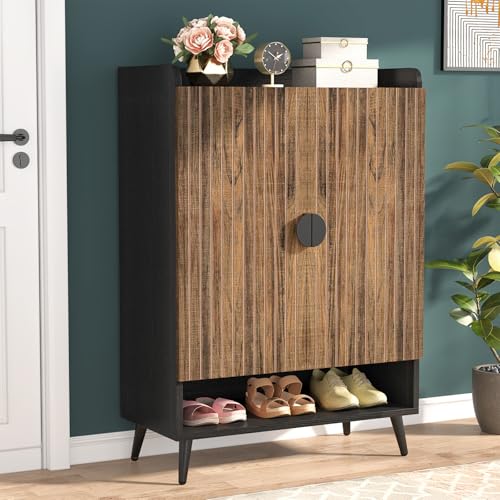
- Best overall closed cabinet: Tribesigns Shoe Cabinet with Doors, 7-Tier (Rustic Brown) — Check on Amazon
- VASAGLE LIRY Collection Shoe Cabinet with 3 Flip Drawers (Rustic White, UHSC301W02) — Check on Amazon
- Nicetree Shoe Storage Cabinet with 2 Flip Drawers (White) — Check on Amazon
See 3 more Amazon options
- Maupvit Shoe Storage Cabinet with 3 Flip Louvered Doors (Noble Blue Gray) — Check on Amazon
- YIKEHOME Shoe Cabinet with 2 Rattan Flip Drawers — Check on Amazon
- VASAGLE 10-Tier Shoe Storage Cabinet (White, ULBS273T14) — open-tier format — Check on Amazon
Read the full guide ↓
Disclosure: As an Amazon Associate, dailyhomedecorating.com earns from qualifying purchases. Links to Amazon on this page are affiliate links; they cost you nothing extra. Listing details such as price and availability change often, so check price on Amazon before you buy.
The best shoe cabinet for small spaces under $400 is a geometry problem before it is a shopping problem. Small spaces — the narrow hall, the under-stairs wedge, the studio corner, the landing that doubles as an entry — punish the wrong dimensions absolutely: a cabinet two inches too deep blocks the passage, two inches too wide defeats the wall, and the wrong format turns a tight spot into an unusable one. So this guide leads with measurements. The heroes here are the sub-ten-inch flip-drawer cabinets that line a wall like panelling, but small spaces are not all hallways, so the six picks also include a deeper door cabinet for the small-but-square nook, a rattan piece for the small living room where the entry is imaginary, and a tall open-tier organizer — labelled open, as always in this series — that converts a closet’s vertical dead space into the hardest-working storage in a small home.
Think in volumes, not footprints. A small space usually has one underused dimension: height. Tall slim cabinets and the 73-inch open organizer exploit it; long low flip cabinets exploit the wall under windows and radiators where nothing else fits. The other underused volume is the top surface — in a small home, a cabinet top that works as a shelf, a plant stand or a key station is not a bonus, it is the rent the cabinet pays for its footprint. The reviews below therefore report depth, height and top usability as headline facts, alongside the standing honesty rules of this series: closed picks really close, capacity claims are translated into realistic mixed-collection numbers, and the one open format is never disguised as a cabinet.
The budget deserves a small-space translation too. Under $400 is ample — the constraint in a small home is never money, it is cubic inches, and overspending on a bigger cabinet is actively harmful. Spend instead on the qualities that make a small cabinet liveable: adjustable dividers that let one drawer serve boots and flats, metal hinges that survive daily use in the home’s busiest corridor, legs that let you clean underneath without moving the piece. The how-to-choose section gives you the measuring routine — space first, shoes second, door swing always — that prevents the classic small-space outcome: a beautiful cabinet, a blocked hallway, and a return label.
In this guide
Quick picks: best shoe cabinet for small spaces under $400 at a glance
Six picks, five genuinely closed cabinets and one honestly labelled open organizer. Prices are not printed in this guide — check price on Amazon for the live figure in the finish you choose.
| Pick | Best for | Key specs | Price |
|---|---|---|---|
| Tribesigns Shoe Cabinet with Doors, 7-Tier (Rustic Brown) | Best overall closed cabinet | Closed hinged doors; 7 tiers with adjustable shelves; engineered wood; freestanding floor cabinet; raised metal legs keep the base off damp floors; top surface usable for keys, bags and decor. | Check price on Amazon |
| VASAGLE LIRY Collection Shoe Cabinet with 3 Flip Drawers (Rustic White, UHSC301W02) | Best flip-drawer cabinet | 3 tilt-out flip drawers; farmhouse rustic white finish; interior shelves adjust between 3 positions; fits 18 to 24 pairs and shoes up to US size 14 per the maker; anti-tip kit included; freestanding. | Check price on Amazon |
| Nicetree Shoe Storage Cabinet with 2 Flip Drawers (White) | Best for very narrow hallways | Only 9.45 inches deep; 2 flip drawers with adjustable panels; metal legs; anti-tipping design; freestanding; maker describes capacity of 24 to 32 pairs across the two double-layer drawers. | Check price on Amazon |
| Maupvit Shoe Storage Cabinet with 3 Flip Louvered Doors (Noble Blue Gray) | Best ventilated flip cabinet | 3 flip drawers with louvered fronts for airflow; third drawer extended to 15.75 inches for larger shoes; metal flip hinges; 9.35 inches deep; anti-tipping device included; maker describes 24 to 32 pairs across three double-layer drawers. | Check price on Amazon |
| YIKEHOME Shoe Cabinet with 2 Rattan Flip Drawers | Best rattan / natural-texture pick | 2 rattan-front flip drawers; adjustable shelves inside the drawers; woven rattan panels allow airflow; engineered wood frame; freestanding entryway cabinet. | Check price on Amazon |
| VASAGLE 10-Tier Shoe Storage Cabinet (White, ULBS273T14) — open-tier format | Best open-tier tall organizer (not a closed cabinet) | 10 open tiers; 12.6 x 24.8 x 73.6 inches; holds up to 30 pairs per the maker; anti-tip kit included; freestanding; open shelves — shoes remain visible. | Check price on Amazon |
One more design deserves a mention without a link: the IKEA BISSA-style two-compartment tilt-out cabinet is a long-running small-entry favourite sold through IKEA’s own stores and site. No verified Amazon US listing could be confirmed for it at the time of writing, so it appears here as prose only — if you have an IKEA nearby it is worth a look as a budget-tier, mid-range-positioned alternative, and if you do not, every pick above is orderable today.
How the picks were chosen
Small-space judging was measurement-led. Depth came first — sub-ten-inch designs scored highest for halls and landings — with height and top-surface usability close behind, because vertical volume and a working top are how a cabinet pays rent in a small home. Format honesty was enforced as strictly as in every guide in this series: five picks close fully, one is an openly labelled open-tier organizer for closets. Every linked pick is a real model from a named maker, verified against its listing for dimensions, drawer or tier counts, adjustability and anti-tip provision before it earned a link; familiar designs that could not be verified on Amazon US appear as prose only. Prices are not printed — check the current Amazon listing for the live figure in the finish and size you choose, since small-space models are frequently promoted.
One rule ran through every decision in this guide: no invented numbers. There are no star ratings and no review counts anywhere in these reviews, because those figures change constantly on Amazon and printing them would mislead you within weeks. There are no static product prices either, for the same reason. What you get instead is what does not change: the format, the dimensions the maker publishes, the adjustability, the hardware, and an honest account of who each cabinet suits and who it will frustrate.
Detailed reviews
Tribesigns Shoe Cabinet with Doors, 7-Tier (Rustic Brown)
Who it suits: Best overall closed cabinet. Maker positions it as a large-capacity 7-tier cabinet; the matching wood-and-gold version is rated by the maker for up to 30 pairs.
This is the pick that behaves most like a real piece of entryway furniture rather than a rack with a cover on it. Two hinged doors close over seven tiers, so the whole shoe pile disappears behind a flat, calm front, and the shelves inside adjust, which matters more than the tier count suggests: one shelf comes out and a pair of ankle boots stands upright instead of lying crushed under a fixed divider. The raised legs lift the cabinet off the floor, so mop water and entryway slush do not wick straight into the bottom panel, and the space underneath swallows a pair of slippers or the shoes you kicked off ten seconds ago. The top is a genuine landing strip — wide enough for a key bowl, a plant and the bag you always put down in the same place. Assembly is flat-pack work with a lot of panels, so budget an unhurried hour and a second pair of hands for the door-hanging step, and anchor it to the wall if children or large dogs will lean on it.
In small-space terms this is the nook cabinet: too deep for a passage, perfect for the square alcove or under-stairs recess where its capacity finally fits the geometry.
Pros:
- Fully closed doors hide the entire shoe pile
- Adjustable shelves adapt to boots and heels, not just flats
- Raised legs protect the base from wet entryway floors
- Usable top surface works as a console
Honest limitation: The honest limitation is assembly and material: it is engineered wood, not solid timber, and the door alignment takes patience — a slightly rushed build shows up as a door gap you will see every day.
Choose it if: Choose it if you want one cabinet that ends the entryway shoe problem in a single purchase and looks like furniture doing it.
Skip it if: Skip it if your entryway is narrower than the cabinet is deep with the doors open, or if you need boot storage for tall winter boots in every tier.
VASAGLE LIRY Collection Shoe Cabinet with 3 Flip Drawers (Rustic White, UHSC301W02)
Who it suits: Best flip-drawer cabinet. Maker-rated for 18 to 24 pairs, up to US size 14.
Flip drawers solve a different problem than doors do. A hinged door needs swing clearance and shows you every shelf at once; a flip drawer tilts toward you, presents two rows of shoes, and closes with a push, so the cabinet can be genuinely slim without feeling flimsy. VASAGLE’s LIRY version leans farmhouse — rustic white panels, simple metal handles — and the working details are right: the divider inside each drawer moves between three positions, so one drawer can be all sneakers while another swallows ankle boots with the divider removed. The maker rates it for shoes up to US size 14, which is unusually honest sizing for this category, where many slim cabinets quietly stop fitting at a men’s 10. The top surface is narrow but real, enough for keys and mail, and an open bottom slot takes slippers. An anti-tip kit is in the box and it is not optional decoration on a tall, narrow, front-heavy piece like this — use it.
The small-space all-rounder — slim profile, three calm fronts, and a top that works as the landing strip a tiny hall has no other surface for.
Pros:
- Slim tilt-out design needs almost no swing clearance
- Adjustable dividers handle boots as well as flats
- Maker-rated up to US size 14 shoes
- Anti-tip kit included and genuinely needed
Honest limitation: The honest limitation is depth physics: very bulky high-tops and chunky trainers can stop a flip drawer closing flush, so the biggest shoes in the house may still live elsewhere.
Choose it if: Choose it if your hallway is narrow, your style leans farmhouse, and you want shoes hidden without giving up floor depth.
Skip it if: Skip it if most of your footwear is oversized trail shoes or work boots — a deeper shelved cabinet will serve you better.
Nicetree Shoe Storage Cabinet with 2 Flip Drawers (White)
Who it suits: Best for very narrow hallways. Maker describes 24 to 32 pairs across two double-layer flip drawers — treat the top of that range as smaller shoe sizes.
At 9.45 inches deep, this is the cabinet for the hallway where every other cabinet is a trip hazard. Most shoe cabinets run 13 to 15 inches deep; the Nicetree gives back nearly half a foot of passage while still hiding shoes behind two flip fronts, each with two layers of storage and an adjustable panel you can move or remove for heels and ankle boots. The metal legs raise it enough that a robot vacuum can pass underneath and mopping does not mean moving furniture. Because it is tall, slim and front-loaded, the anti-tip fitting matters — the maker builds anti-tipping into the design, and you should still fix it to the wall as instructed, especially in a rental hallway where a falling cabinet would take paint with it. The white farmhouse front is deliberately plain, which is the point in a small space: it reads as wall, not as storage, and the eye slides past it.
The extreme-depth answer: at 9.45 inches it fits the walls other cabinets cannot use at all, turning dead hallway into closed storage.
Pros:
- Shallowest footprint here at 9.45 inches deep
- Double-layer flip drawers keep capacity respectable despite the slim depth
- Raised on metal legs for cleaning underneath
- Plain front visually disappears in tight spaces
Honest limitation: The honest limitation is shoe size: slim flip cabinets trade depth for fit, and large men’s shoes sit at an angle or not at all in the tighter layer — measure your biggest pair before ordering.
Choose it if: Choose it if your hallway or apartment entry is genuinely narrow and every inch of passage matters.
Skip it if: Skip it if you wear larger than about a US men’s 11 in bulky styles, or if you need open quick-grab storage for daily runners.
Maupvit Shoe Storage Cabinet with 3 Flip Louvered Doors (Noble Blue Gray)
Who it suits: Best ventilated flip cabinet. Maker describes 24 to 32 pairs; the extended third drawer is the one sized for larger shoes.
Most closed shoe cabinets have an unspoken flaw: they seal shoes in a box. The Maupvit’s louvered flip fronts are the fix — the slats let air move through the cabinet, so the pair you wore in the rain does not spend the week fermenting in a sealed compartment. There are three flip drawers, each double-layered, and the detail that earns this cabinet its place is the extended third drawer, which reaches 15.75 inches so larger shoes get a home instead of being exiled to the floor beside the cabinet. The flip hinges are metal rather than plastic, which is the part of a flip cabinet that actually wears out, and the whole unit is only 9.35 inches deep, so it belongs to the same slim family as the Nicetree. The noble blue gray finish is a deliberate colour rather than a safe white or brown, and in the right hallway that is a feature: it reads as a painted furniture piece, not as storage apologising for itself. An anti-tipping device is included — fit it.
At 9.35 inches deep with an extended drawer, it is the slim pick that does not surrender large shoes — rare in this size class.
Pros:
- Louvered fronts ventilate shoes instead of sealing in odour
- Extended third drawer fits larger shoes that defeat other slim cabinets
- Metal flip hinges outlast plastic pivots
- Slim 9.35-inch depth suits narrow entries
Honest limitation: The honest limitation is the colour commitment and the louvers themselves: slatted fronts show dust in the grooves and need a brush-down now and then, and blue gray does not blend into every scheme.
Choose it if: Choose it if damp-climate shoes, gym trainers or work footwear make ventilation a real requirement, not a nicety.
Skip it if: Skip it if you want the lowest-maintenance front possible — flat doors wipe clean faster than louvers.
YIKEHOME Shoe Cabinet with 2 Rattan Flip Drawers
Who it suits: Best rattan / natural-texture pick. Two double-duty flip drawers sized for everyday family footwear; adjustable shelves let one drawer convert for taller shoes.
Rattan is doing two jobs in this cabinet. Visually, the woven fronts warm up an entryway in a way flat laminate never does — this is the pick that suits boho, coastal and Scandinavian-leaning rooms, and it photographs like decor rather than storage. Functionally, woven rattan breathes: air passes through the front, so shoes dry instead of stewing, the same ventilation argument as the louvered Maupvit but delivered with texture instead of slats. Inside, each flip drawer carries adjustable shelving, so the divider comes out for ankle boots and goes back in for two rows of flats. The frame is engineered wood with a wood-look finish, and the cabinet is sized as an entryway piece rather than a whole-house shoe warehouse — think the daily rotation for a household, with overflow living in bedroom closets. Treat the rattan kindly: it is a natural woven material, and dragging gritty soles across the inside of the front will fray it faster than the frame will ever wear out.
For the small living room with no hall at all, this is the disguise strategy: a pretty rattan piece by the door that happens to contain the shoes.
Pros:
- Woven rattan fronts add real texture and warmth
- Natural airflow through the fronts helps shoes dry
- Adjustable drawer shelves convert for boots
- Looks like decor, not storage furniture
Honest limitation: The honest limitation is capacity and delicacy: two drawers will not swallow a large collection, and woven rattan needs gentler handling than a flat laminate door.
Choose it if: Choose it if the entryway is on show — open-plan living, guests arriving through the front door — and you want storage that earns its place visually.
Skip it if: Skip it if you need maximum pairs per dollar, or if muddy boots are the main cargo.
VASAGLE 10-Tier Shoe Storage Cabinet (White, ULBS273T14) — open-tier format
Who it suits: Best open-tier tall organizer (not a closed cabinet). Maker-rated for up to 30 pairs across 10 tiers.
This pick is included deliberately as the honest contrast, and it is labelled as what it is: an open-tier organizer, not a closed cabinet. Ten shelves stack up to 73.6 inches tall on a footprint just 24.8 inches wide, holding up to 30 pairs with every pair visible and grabbable in one motion — no drawer to tilt, no door to swing, nothing between you and the shoes on a rushed morning. Taller shelves in the stack take boots and high-tops that defeat slim flip drawers. What you give up is exactly what the other five picks exist to provide: concealment and dust protection. Shoes on open tiers are on display, they gather dust, and a muddy pair looks muddy. So the right home for this unit is a closet, a bedroom corner or a utility space where access speed beats appearance — or a household that has made peace with seeing its shoes. An anti-tip kit is included; at over six feet tall, anchoring is mandatory, not advisory.
The closet-volume play: 73.6 inches tall on a 24.8-inch width is the best pairs-per-square-foot ratio in this guide, behind a closet door.
Pros:
- Fastest access of any pick — everything visible at a glance
- Tall tiers accept boots that slim cabinets reject
- Narrow 24.8-inch width uses vertical space well
- Simple, sturdy, easy assembly
Honest limitation: The honest limitation is fundamental: it hides nothing. If your goal is a calm, closed entryway, this is the wrong format no matter how good the shelves are.
Choose it if: Choose it for a closet, bedroom or back hallway where speed and capacity matter more than concealment.
Skip it if: Skip it for a front entryway you want to look tidy for guests — pick any of the five closed designs instead.
Comparison table
| Pick | Best for | Format and key specs |
|---|---|---|
| Tribesigns Shoe Cabinet with Doors, 7-Tier (Rustic Brown) | Best overall closed cabinet | Closed hinged doors; 7 tiers with adjustable shelves; engineered wood; freestanding floor cabinet; raised metal legs keep the base off damp floors; top surface usable for keys, bags and decor. |
| VASAGLE LIRY Collection Shoe Cabinet with 3 Flip Drawers (Rustic White, UHSC301W02) | Best flip-drawer cabinet | 3 tilt-out flip drawers; farmhouse rustic white finish; interior shelves adjust between 3 positions; fits 18 to 24 pairs and shoes up to US size 14 per the maker; anti-tip kit included; freestanding. |
| Nicetree Shoe Storage Cabinet with 2 Flip Drawers (White) | Best for very narrow hallways | Only 9.45 inches deep; 2 flip drawers with adjustable panels; metal legs; anti-tipping design; freestanding; maker describes capacity of 24 to 32 pairs across the two double-layer drawers. |
| Maupvit Shoe Storage Cabinet with 3 Flip Louvered Doors (Noble Blue Gray) | Best ventilated flip cabinet | 3 flip drawers with louvered fronts for airflow; third drawer extended to 15.75 inches for larger shoes; metal flip hinges; 9.35 inches deep; anti-tipping device included; maker describes 24 to 32 pairs across three double-layer drawers. |
| YIKEHOME Shoe Cabinet with 2 Rattan Flip Drawers | Best rattan / natural-texture pick | 2 rattan-front flip drawers; adjustable shelves inside the drawers; woven rattan panels allow airflow; engineered wood frame; freestanding entryway cabinet. |
| VASAGLE 10-Tier Shoe Storage Cabinet (White, ULBS273T14) — open-tier format | Best open-tier tall organizer (not a closed cabinet) | 10 open tiers; 12.6 x 24.8 x 73.6 inches; holds up to 30 pairs per the maker; anti-tip kit included; freestanding; open shelves — shoes remain visible. |
Read the format column carefully: five of these six designs close fully, and one — the tall VASAGLE — is open shelving. That single distinction predicts satisfaction better than any capacity figure.
How to choose the right shoe cabinet for your home
Measure in three directions, then measure the swing
Record wall length, floor depth and ceiling height — small spaces usually have height to spare. Then map the arcs: front door swing, room door swing, and your own passage with bags in hand. The cabinet must fit the wall, miss every arc and leave a walkable gap. Write the three numbers down and shop against them; in a small space, a dimension remembered wrong is a return arranged.
Exploit the dimension your space wastes
Narrow hall? Go tall and slim — vertical volume is free. Low wall under a window or radiator? Go long and low with flip drawers. Alcove or under-stairs wedge? That is the one place a deeper door cabinet belongs. Closet with dead height? The open-tier organizer. Every small space has exactly one generous dimension; the right cabinet is the one shaped like it.
Size for the rotation and exile the rest
Small spaces cannot host a whole collection at the door. Keep the weekly rotation — usually four to eight pairs — in the entry cabinet, and put everything else in the closet volume. Adjustable dividers matter disproportionately here: in a tiny cabinet, one removable shelf is the difference between boots stored and boots on the floor.
Make every surface work twice
The cabinet top is a shelf, a key station, a plant stand. Raised legs create a slipper garage and cleaning access. A front calm enough to face the living area lets the cabinet live where the space is, not where storage ‘should’ go. In a small home, single-purpose furniture is a luxury; choose the piece that does two jobs and the room feels bigger twice over.
Common mistakes to avoid
- Shopping by photos instead of dimensions. Listing photos are shot in big rooms; the same cabinet in your hall is a different object. Your three measurements are the only honest catalogue.
- Blocking the passage to gain storage. A cabinet that stores twenty pairs but makes the hallway a sideways shuffle has made the home smaller, not tidier.
- Ignoring door swings — yours and the cabinet’s. Hinged doors need their arc; if the space cannot give it, flip drawers are the format, full stop.
- Filling the entry with the whole collection. Overflow in a small space is instant chaos; the rotation lives at the door, the rest lives in the closet.
- Leaving a tall slim cabinet unanchored. Small spaces mean close contact — bumps, bags, children, dogs. Fit the anti-tip kit; in a tight hall you will lean on this furniture, literally.
Final recommendation
Start with the Nicetree if depth is your binding constraint, the Maupvit if it is depth plus large shoes, and the VASAGLE flip cabinet if you want the balanced all-rounder with a working top. Give the Tribesigns the alcove, the YIKEHOME the hall-less living room, and the open VASAGLE 10-tier the closet’s vertical dead space. Measure three dimensions and one door swing before you order, anchor what you buy, and keep only the rotation at the door — in a small space, that discipline, more than any cabinet, is what tidy actually is.
Frequently asked questions
What is the slimmest shoe cabinet type?
Flip-drawer cabinets are the slimmest closed format — the picks here run 9.35 to 9.45 inches deep, roughly two-thirds the depth of a standard door cabinet. They trade some shoe-size capacity for that profile, so check your largest pair against the maker’s guidance.
How do I store shoes in a space with no entryway at all?
Create the entry: one slim or pretty closed cabinet — the rattan pick here is designed for exactly this — placed where you naturally drop shoes, with a small mat beside it. A defined zone, even an imaginary-walled one, stops shoes colonising the room.
Tall or wide: which suits a small space better?
Whichever matches your wasted dimension. Tall slim cabinets suit narrow walls and high ceilings; long low cabinets suit walls under windows. Measure first — the space itself tells you the shape.
Can a small-space cabinet hold boots?
Only with adjustability: a removable divider or an extended drawer. The Maupvit’s extended third drawer and the removable panels in several picks here exist for this. Fixed slim drawers and tall boots do not mix.
Is open storage ever right for a small space?
Yes — inside a closet, where the door provides the concealment and the open tiers provide the access and the pairs-per-footprint. The tall organizer in this guide is a closet tool; in an open room it just relocates the visual clutter.
Working the awkward spots: under stairs, landings and corners
Every small home has a spot that defeats standard furniture, and those spots are where this category earns its keep. Under-stairs wedges suit low, long flip cabinets, whose horizontal lines follow the stair slope and whose top becomes a shelf the wedge could never otherwise hold — measure the height at the cabinet’s back edge, not the front, since the slope is the constraint. Landings suit tall slim cabinets: the wall is short, the ceiling is full height, and a sub-ten-inch depth keeps the stair traffic flowing past. Corners suit nothing rectangular perfectly, but a slim cabinet on the longer wall, ending before the corner, beats a corner unit that wastes its own interior in the angle. In each case the routine is identical: three measurements, one door-swing check, and the discipline to leave a hand’s width of clearance so the cabinet can be cleaned around and does not visually jam against the architecture.
The hall-less small home — the studio, the cottage, the flat entered straight into its living room — needs a different trick: zoning by suggestion. Place the cabinet where shoes naturally come off, put a washable mat in front of it, and let those two objects declare an entry that the floor plan forgot. A pretty front matters here more than anywhere, because the cabinet is living-room furniture whether you planned it or not; that is the entire case for the rattan pick in this guide. Add a hook or two above for the coat and bag, and the corner performs as a hall in everything but square footage.
Maintenance in miniature: keeping a small cabinet working hard
Small cabinets work at higher occupancy than big ones, so their maintenance rhythm is tighter. Grit is the main enemy: it migrates from soles to shelves to the floor of the compartment, where it grinds finishes and jams flip pivots. A monthly wipe of interiors and a shake-out of the entry mat keep the whole system ahead of it. Check flip pivots and door hinges at the same time — in a small home the cabinet is opened within arm’s reach of where you stand putting the kettle on, and a quarter-turn on a loose screw is a ten-second job that prevents the wobble that becomes a failure.
Capacity creep is the second enemy. A small cabinet at exactly full is a cabinet about to overflow, so keep one compartment deliberately under-filled as the system’s surge capacity — for guests’ shoes, the new pair, the wet pair drying’s worth of slack. When the surge space starts living full, that is the signal for the seasonal audit: archive something to the closet, and restore the slack. Small-space tidiness is not a state, it is that small recurring act of restoration — and a well-chosen cabinet makes it a five-minute act instead of a weekend.
The pre-purchase checklist for tight spots
Small-space buying is measurement with consequences, so the list is strict. One: take the three dimensions of the spot — length, depth, height — and write them on one line; shop only against that line. Two: add the swing check — every door, including the front door and the cabinet’s own doors if it has them — and mark the arcs. Three: measure your largest shoes and tallest boots; in a small cabinet there is no spare compartment to forgive a misfit. Four: decide which wasted dimension the cabinet exploits — height, low wall, alcove depth, closet volume — and let that decision pick the format before brands enter the conversation. Five: confirm adjustability, because in a small interior one removable shelf is a large percentage of total flexibility. Six: confirm the anti-tip kit; small spaces mean the cabinet will be brushed, bumped and leaned on. Seven: check the live price on Amazon in your chosen finish. Eight: rehearse the delivery route — hall, stairs, doorway turns — because a cabinet that cannot reach its spot is a sculpture in the wrong room.
Value inside the ceiling when space, not money, is scarce
When cubic inches are the constraint, the tiers inside the under-$400 framing buy different kinds of fit. The lower tier buys the slim format itself — closed storage under ten inches deep — which for many small spaces is the entire problem solved. The middle tier buys refinement of fit: adjustable dividers, extended drawers for larger shoes, ventilated fronts, legs that return cleaning space and a slipper garage underneath. The upper tier buys the alcove-filling door cabinet and furniture-grade fronts for the small living room. Notice what is absent from every tier: bigger. In a small home, the largest cabinet is rarely the best cabinet, and money spent on capacity you must exile shoes to reach is money spent against yourself. Spend on the fit, the adjustability and the hardware, in that order.
Cost per year still applies, with a small-space twist: a cabinet that fits perfectly tends to stay for a decade, because replacing it means solving the geometry puzzle again. That longevity makes the mid-tier hardware argument stronger here than anywhere — buy the pivots and hinges that will still be tight when the spot has long since stopped feeling small and started feeling like home.
Decision shortcuts for awkward floor plans
Decide by naming your space honestly. The passage — a hall whose width is the whole problem — takes the Nicetree, or the Maupvit if large shoes share that hall. The low wall — under a window, beneath the stair slope — takes the VASAGLE flip cabinet, long and calm. The alcove — the one spot with real depth — takes the Tribesigns, the only pick that can spend depth on capacity. The imaginary entry — the studio corner, the cottage door into the living room — takes the YIKEHOME, pretty enough to be furniture and closed enough to be a boundary. The closet — the small home’s secret warehouse — takes the open VASAGLE tower and turns dead height into the hardest-working storage you own. Most small homes have two of these spots, and the mature solution is usually two modest pieces, each shaped like its space, rather than one heroic cabinet shaped like none of them.
The small-space tie-breakers are clearance and adjustability. Between two cabinets that fit the measurements, choose the one that leaves the passage kinder and the door swings freer — you will feel that difference twice a day, long after you have forgotten the capacity figures. And between two that clear equally, choose the adjustable interior, because in a small cabinet flexibility is capacity. Measure once more, order once, anchor it, and let the tightest spot in your home become the one that works hardest — that transformation, more than any single product, is what this guide has been selling.
Care and cleaning by front type
Flat laminate and painted fronts — most of the cabinets in this guide — want the least: a damp cloth for the outside, a dry brush for interior grit, and no abrasive pads anywhere near the finish. Louvered fronts collect dust in their grooves, so add a monthly pass with a soft brush or the vacuum’s brush attachment; the slats that ventilate your shoes will otherwise slowly fur with household dust. Rattan wants to stay dry — dust it with a soft brush, wipe spills immediately, and never soak it, because natural fibres swell and stain in ways engineered finishes do not. Flip pivots and door hinges across every design benefit from a twice-yearly check: open each drawer and door fully, confirm the movement is smooth, and tighten any screw that has worked a quarter-turn loose before the looseness becomes wear. The floor beneath and behind the cabinet deserves the same rhythm — grit migrates, and a cabinet standing in its own dust line ages faster at the base than anywhere else. None of this takes more than ten minutes a month, and it is the entire difference between a cabinet that looks bought last year and one that looks bought last decade.
One last habit protects every format equally: never store a genuinely wet pair inside a closed cabinet overnight. Use the mat, let the pair dry in the open, and file it away dry the next morning. Closed storage is for dry shoes; treat that as the constitution of the entryway and odour, mildew and finish damage simply never get started — whatever cabinet, at whatever tier, you chose from this guide.
What if no standard cabinet fits my space?
Then split the job. Two slim cabinets on two short walls, or one slim cabinet plus a closet organizer, solve spaces that defeat every single unit — small homes reward systems over heroes. Measure the two best spots instead of the one impossible spot, and let each piece be shaped like its own wall. If even that fails, the honest fallback is a wall-mounted or over-door solution for the lightest shoes, with the cabinet reserved for the heavy daily pairs. What never works is forcing the almost-fitting cabinet and living around it: in a small space, an obstacle is forever, while a split system is invisible within a week.


