Where to buy
Check the latest price, availability and delivery on Amazon. Orders are placed on Amazon. We may earn a commission from qualifying purchases.
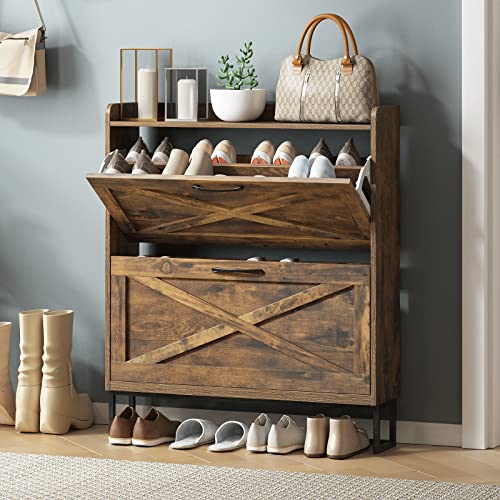
- Best overall: Maupvit Shoe Storage Cabinet with 2 Flip Drawers, Rustic Brown — Check on Amazon
- IRONCK Shoe Cabinet with 2 Flip Drawers, Rattan Doors, Oak — Check on Amazon
- AVZEAR Narrow Shoe Storage Cabinet with 2 Flip Drawers, Natural Linen Panel — Check on Amazon
- Nicetree Shoe Storage Cabinet with 2 Flip Drawers, Gray — Check on Amazon
- Yaheetech Shoe Cabinet, 4-Tier with Louvered Doors and Drawer — Check on Amazon
One further cabinet is reviewed in full below without a purchase link, because its price could not be verified under the $150 ceiling when we checked — it is described honestly so you can judge it yourself.
Read the full guide ↓
Disclosure: As an Amazon Associate, dailyhomedecorating.com earns from qualifying purchases. Links to Amazon on this page are affiliate links; they cost you nothing extra. Listing details such as price and availability change often, so check the current Amazon listing before you buy.
The best shoe cabinet for small apartments under $150 is chosen under rental rules: no drilling if you can avoid it, no footprint you cannot spare, and nothing so bulky it cannot leave through the same door it entered when the lease ends. Apartment entries are rarely rooms — they are a door swing, a sliver of wall and a negotiation with the hallway. In that sliver, an open rack fails twice: it looks temporary, and it spreads. A slim closed cabinet, nine inches deep, turns the sliver into furniture: shoes hidden, top surface working as the landing strip every small apartment lacks, and a profile slim enough to sit behind the door’s swing or along the one free wall.
The six cabinets in this guide were filtered for apartment life specifically. Five carry verified Amazon links and prices inside the ceiling; one tall capacity cabinet is prose-only because its price could not be verified when we checked. Depths cluster at nine to ten inches for the flip-drawer picks — measure yours against the door swing before anything else — and every pick is freestanding flat-pack that one person can receive, carry and assemble without a landlord’s permission slip. Anti-tip anchoring is discussed honestly, including the adhesive and furniture-strap options renters use when screws are off the table.
For apartments the order of virtues is depth, then door-swing clearance, then how completely the top surface can replace the entry furniture you do not have room for.
In this guide
Quick picks: the best shoe cabinet for small apartments under $150 at a glance
| Pick | Format | Key specs | Best for |
|---|---|---|---|
| Maupvit Shoe Storage Cabinet with 2 Flip Drawers, Rustic Brown | Closed flip-drawer cabinet | About 9.45 inches deep; two flip drawers with two layers each; MDF body on metal legs; brand-rated for roughly 24–32 pairs depending on shoe size | Best overall |
| IRONCK Shoe Cabinet with 2 Flip Drawers, Rattan Doors, Oak | Closed flip-drawer cabinet with woven rattan fronts | 9.25 x 23.6 x 39.6 inches; about 45 lb; engineered wood, metal and rattan; two flip drawers, four compartments; adjustable and removable shelf panels; anti-tipping hardware included | Best design |
| AVZEAR Narrow Shoe Storage Cabinet with 2 Flip Drawers, Natural Linen Panel | Closed flip-drawer cabinet with fabric-look linen panels | 31.5 W x 9.25 D x 39.37 H inches; about 40.8 lb; MDF with metal legs; two flip drawers, each with two levels; adjustable center divider | Best wide slim cabinet |
| Nicetree Shoe Storage Cabinet with 2 Flip Drawers, Gray | Closed flip-drawer cabinet, farmhouse gray finish | About 31.5 W x 9.4 D x 41.9 H inches (80 x 24 x 106.5 cm); engineered wood with metal legs; two flip drawers; model NT-SC001 | Best tall slim cabinet |
| Yaheetech Shoe Cabinet, 4-Tier with Louvered Doors and Drawer | Closed swing-door cabinet with louvered doors | About 30.7 x 14.6 x 33.9 inches; painted MDF; four tiers with adjustable shelves; louvered swing doors with magnetic closures; top drawer; rated for about 15–18 pairs | Best for boots and boxes |
| Tribesigns Shoe Cabinet with Doors, 7-Tier, Wood and Gold | Closed swing-door cabinet, tall tiered format | About 29.5 W x 14.6 D x 43.3 H inches; seven adjustable shelves behind two doors; brand capacity claims vary by listing between roughly 24 and 30 pairs | Best for capacity (prose-only) |
Maupvit Shoe Storage Cabinet with 2 Flip Drawers, Rustic Brown: The default recommendation for most entryways: genuinely slim, fully closed, and big inside.
IRONCK Shoe Cabinet with 2 Flip Drawers, Rattan Doors, Oak: The design-led pick: real woven rattan fronts that breathe, in the joint-slimmest body here.
AVZEAR Narrow Shoe Storage Cabinet with 2 Flip Drawers, Natural Linen Panel: The wide-and-calm pick: linen-textured panels that read as furniture, not storage.
Nicetree Shoe Storage Cabinet with 2 Flip Drawers, Gray: The tallest slim cabinet here: extra height buys an extra visual tier of storage.
Yaheetech Shoe Cabinet, 4-Tier with Louvered Doors and Drawer: The traditionalist pick: real swing doors, deep shelves and a drawer for the small stuff.
Tribesigns Shoe Cabinet with Doors, 7-Tier, Wood and Gold: The capacity maximalist: seven shelves behind doors — listed prose-only because its price could not be verified under the ceiling.
How these picks were chosen
Every cabinet in this guide had to pass the same four gates before style was even discussed. First, it had to be a true cabinet: a closed body with doors or flip drawers that hides the shoes completely, because the entire point of spending cabinet money instead of rack money is the closed front. Open racks, fabric cubbies and cube organisers were excluded no matter how many pairs they claimed to hold. Second, its identity had to be verifiable: a real manufacturer listing with a stable model, published dimensions and a specification we could cross-check against at least one independent source, so that the numbers printed here are the numbers that arrive at your door. Third, price: a linked pick needed a sighting at or under the $150 ceiling during research in November 2026 — prices move, which is why the articles say check price on Amazon rather than printing a figure that will rot, but the ceiling was enforced at the moment of selection. Fourth, safety: no product under a CPSC recall was eligible at any price, and every pick had to offer a credible anti-tip solution, because a tall, shallow, loaded cabinet is a piece of furniture that must be anchored.
Apartment-specific checks shaped this edition: packaged weight and box size for stairwell carries, whether assembly needs a second person, and whether the cabinet stands stable on the slightly uneven floors of older buildings. We also favoured cabinets whose tops sit at console height, because in a small apartment that surface is your key bowl, mail tray and bag drop in one.
Within those gates we scored depth, honest capacity, door mechanics, adjustability and finish. Depth because it decides where the cabinet can live. Honest capacity because brand pair-counts assume small shoes, and we translate them into mixed-size reality in every review. Door mechanics because flip drawers, louvered swing doors and tall tiered shelves serve genuinely different households. Adjustability because the shoes you own in five years are not the shoes you own now. And finish because a closed cabinet is furniture: it will be looked at every day, in the room where guests arrive, and it should earn its place visually as well as functionally.
Detailed reviews
Maupvit Shoe Storage Cabinet with 2 Flip Drawers, Rustic Brown — Best overall
The Maupvit is the cabinet that defines this price band, and it earns that position with one number: a depth of roughly nine and a half inches. Most shoe storage is twelve to fifteen inches deep, which is fine in a closet and impossible in a hallway you also have to walk through. At under ten inches the Maupvit hugs the wall like a console table, yet because its two flip drawers each hold two layers of shoes, the brand rates it for roughly twenty-four to thirty-two pairs — the count drops toward the low end with men’s sizes and chunky sneakers, and climbs with flats, sandals and children’s shoes.
The flip-drawer mechanism is the right one for a closed cabinet at this depth. Instead of shelves you reach into, each drawer front tips forward and brings both layers out toward you, so the pair at the back is as easy to grab as the pair at the front. The rustic brown finish and metal corner detailing give it a farmhouse look that photographs well, and the raised metal legs keep the base off damp entryway floors and let a robot vacuum pass underneath.
The honest limitations are the usual ones for MDF flat-pack furniture. The panels are medium-density fiberboard, not solid wood, so the cabinet shrugs off daily use but resents being dragged sideways while loaded — lift it or empty it first. Tall boots do not fit inside the flip drawers at all; plan a separate home for anything above ankle height. Assembly is a two-person, protect-an-afternoon job, and the anti-tip strap in the box is not optional decoration: a nine-inch-deep cabinet loaded at the top should be anchored to the wall, full stop.
In daily use the detail that earns loyalty is the two-layer drawer geometry: the back layer is not a sacrifice zone, it arrives in your hand with the same tip of the front, so rotation actually happens instead of the front three pairs doing all the work while the rest fossilise.
Who it suits: The default recommendation for most entryways: genuinely slim, fully closed, and big inside.
- Slimmest useful footprint in this guide at about 9.45 inches deep
- Two-layer flip drawers make the back row as reachable as the front
- Closed doors hide the entire shoe pile from the room
- Metal legs lift it clear of wet floors and vacuum robots
Honest limitation: MDF panels and flip drawers exclude tall boots; wall anchoring is essential, not optional.
Choose it if its format matches your space and rotation; skip it if its stated limitation is the one thing your household cannot live with. Check on Amazon — check price on Amazon.
IRONCK Shoe Cabinet with 2 Flip Drawers, Rattan Doors, Oak — Best design
IRONCK’s cabinet is what happens when the slim flip-drawer format gets a proper design pass. The drawer fronts are woven rattan set into an oak-finish frame, which does two jobs at once: it softens the big flat face every shoe cabinet presents to the room, and it lets air move through the cabinet, so shoes worn all day dry instead of stewing behind a sealed door. At 9.25 inches deep it is, fractionally, the slimmest cabinet in this guide, and at 23.6 inches wide it is also the narrowest — the one pick here sized for a genuinely tight wall run.
Inside, the two flip drawers divide into four compartments, and the shelf panels adjust or come out entirely, which matters more than it sounds: removing one panel turns a compartment into a double-height slot for high-tops or ankle boots, the shoes that defeat most slim cabinets. IRONCK rates the capacity generously, and in practice the honest expectation is a strong household rotation rather than a collector’s archive — plan around the low-to-mid twenties in mixed sizes. The listed weight of about forty-five pounds gives it a planted feel once assembled, and anti-tipping hardware is included in the box.
Limitations: rattan is a natural material with natural variance, so the weave tone will not be showroom-uniform, and it should be dusted with a soft brush rather than soaked. The narrow width that makes it perfect for tight halls also caps how many pairs sit side by side per layer. And like every cabinet here, it is engineered wood at its core — wipe spills promptly rather than letting water sit in the seams.
In daily use the rattan fronts prove themselves after wet weeks: shoes that would stay damp until morning behind a sealed door are dry by breakfast, and the cabinet never develops the closed-box smell that makes people leave doors ajar and ruin the whole point.
Who it suits: The design-led pick: real woven rattan fronts that breathe, in the joint-slimmest body here.
- Woven rattan fronts ventilate shoes and soften the cabinet’s look
- Joint-slimmest and narrowest body: 9.25 inches deep, 23.6 inches wide
- Adjustable or removable panels create a tall slot for boots and high-tops
- Anti-tipping hardware included; reassuring 45 lb assembled weight
Honest limitation: Natural rattan varies in tone and needs gentle care; narrow width limits pairs per layer.
Choose it if its format matches your space and rotation; skip it if its stated limitation is the one thing your household cannot live with. Check on Amazon — check price on Amazon.
AVZEAR Narrow Shoe Storage Cabinet with 2 Flip Drawers, Natural Linen Panel — Best wide slim cabinet
The AVZEAR takes the same slim flip-drawer blueprint and dresses it differently: the drawer fronts wear a natural linen panel finish that reads softer and more textile than wood grain, which suits entryways that open straight into a living room. It is the widest of the slim cabinets here at 31.5 inches, while holding the same 9.25-inch depth, so it trades wall length for capacity without stealing any more of the walkway.
Each of the two flip drawers carries two levels, and the center divider inside adjusts, letting you widen one side for bulkier shoes and narrow the other for flats and sandals. That small piece of flexibility is what separates cabinets that fit a real household’s mixed shoe pile from cabinets that only fit the shoes in the product photo. The MDF body stands on metal legs, the assembled weight is a manageable forty pounds or so, and the flat top works as a proper landing strip for keys, mail and a plant — at nearly forty inches tall it lands at comfortable console height.
The limitations mirror its siblings: no tall boots inside, MDF that wants coasters under wet umbrellas rather than puddles on the top surface, and an assembly session you should not rush. The linen-look panels also show scuffs differently from wood grain — light marks wipe off, but dark shoe-sole strikes at kick height are more visible on the pale finish, so it suits lower-traffic entries best.
In daily use the wide, calm front changes how the entry feels: guests read it as a sideboard, the key tray lives on top without visual competition, and the linen texture hides the micro-scuffs of daily life better than a gloss finish ever would.
Who it suits: The wide-and-calm pick: linen-textured panels that read as furniture, not storage.
- Widest slim cabinet here: 31.5 inches across at only 9.25 inches deep
- Linen-panel fronts blend into living-room-facing entryways
- Adjustable center divider adapts each drawer to mixed shoe sizes
- Console-height flat top doubles as a key and mail landing strip
Honest limitation: Pale linen-look finish shows dark scuffs at kick height; no tall-boot storage inside.
Choose it if its format matches your space and rotation; skip it if its stated limitation is the one thing your household cannot live with. Check on Amazon — check price on Amazon.
Nicetree Shoe Storage Cabinet with 2 Flip Drawers, Gray — Best tall slim cabinet
Nicetree stretches the slim-cabinet formula upward. At roughly forty-two inches tall it stands noticeably higher than the other flip-drawer picks, and that height is put to work: the two flip drawers are generously proportioned, and the cabinet presents as a proper piece of entry furniture rather than a box that happens to hold shoes. The gray farmhouse finish is the neutral that survives decor changes — it sits as comfortably against white apartment walls as it does in a wood-toned hallway.
The footprint stays honest at about nine and a half inches deep and thirty-one and a half wide, so the Nicetree competes for the same wall runs as its rivals while offering the most imposing — in a good way — presence of the group. Metal legs keep the base clear of the floor, the flat top takes a lamp or a tray without wobbling, and the brand’s numbered-parts assembly approach keeps the build methodical rather than mysterious.
Where it asks for compromise: that height makes wall anchoring even less negotiable than usual, because a tall, shallow, top-loaded cabinet is exactly the geometry anti-tip straps exist for. The gray finish is a specific choice — if your entry is warm woods throughout, the Maupvit or IRONCK tones will sit easier. And as with all flip drawers, the mechanism rewards a smooth pull; teach children to tip the drawer rather than yank it, and it will outlast their school years.
In daily use the extra height quietly becomes shelf space for the household’s tall miscellany — the top sits at a natural lamp height, and the cabinet anchors an entry wall the way a bookcase anchors a study, giving the room a vertical to organise around.
Who it suits: The tallest slim cabinet here: extra height buys an extra visual tier of storage.
- Tallest slim cabinet in the guide at about 42 inches high
- Farmhouse gray finish survives decor changes and hides dust well
- Same slim ~9.4-inch depth as the other flip-drawer picks
- Numbered parts and illustrated instructions simplify assembly
Honest limitation: Tall, shallow profile makes anti-tip anchoring mandatory; gray tone clashes with warm-wood schemes.
Choose it if its format matches your space and rotation; skip it if its stated limitation is the one thing your household cannot live with. Check on Amazon — check price on Amazon.
Yaheetech Shoe Cabinet, 4-Tier with Louvered Doors and Drawer — Best for boots and boxes
The Yaheetech is the deliberate counterpoint to every flip-drawer cabinet above it. Behind its two louvered swing doors sit four proper shelves, about fourteen and a half inches deep — deep enough for men’s shoes to sit heel-to-toe without the toe box kissing the door, deep enough for shoe boxes, and deep enough for the ankle boots that flip drawers refuse. The shelves adjust, so one tier can grow tall enough for boots while the others stay tight for flats. The brand rates it for fifteen to eighteen pairs, fewer than the flip cabinets claim, but every one of those pairs sits in the conventional way, visible at a glance when the doors open.
The louvered doors are functional, not decorative: the slats ventilate the interior continuously, which matters in a deep closed cabinet where air otherwise stagnates. Magnetic closures keep the doors shut with a clean click, and the shallow top drawer is the detail owners end up loving most — keys, sunglasses, dog leads and shoe horns finally get a home that is not the top of the cabinet. At about thirty-four inches tall it also works under windows and wall art that taller cabinets would crowd.
The trade-offs are the footprint and the format. Fourteen-plus inches of depth is a real commitment in a narrow hall — measure the walkway, not just the wall. Swing doors need clear space to open, unlike flip drawers that only tip forward. And fifteen to eighteen pairs is a household rotation, not a whole family’s archive; big households will run this as the daily-shoes cabinet and keep overflow elsewhere.
In daily use the top drawer is the feature owners mention first: it ends the archaeological dig through coat pockets for keys and leads, and because it sits above the shoe tiers, the smalls stay clean while the shoes below do the dirty work.
Who it suits: The traditionalist pick: real swing doors, deep shelves and a drawer for the small stuff.
- Deep 14.6-inch shelves fit men’s shoes, shoe boxes and ankle boots
- Louvered swing doors ventilate the interior around the clock
- Top drawer swallows keys, leads and shoe-care smalls
- Adjustable shelves let one tier grow tall enough for boots
Honest limitation: Deep footprint and swing doors need real floor clearance; capacity tops out around 18 pairs.
Choose it if its format matches your space and rotation; skip it if its stated limitation is the one thing your household cannot live with. Check on Amazon — check price on Amazon.
Tribesigns Shoe Cabinet with Doors, 7-Tier, Wood and Gold — Best for capacity (prose-only)
The Tribesigns is the cabinet for the household that counted its shoes, got a big number, and refuses to split the collection across rooms. Seven adjustable shelves stand behind two full-height doors in a body roughly forty-three inches tall and fourteen and a half deep, and the brand’s capacity claims — which vary a little between its own listings — land somewhere in the mid-twenties to thirty pairs. Shelf height adjusts tier by tier, so boots, high-tops, heels and flats each get a row pitched to their height instead of wasting vertical air.
We are listing it prose-only, without a purchase link, for a specific reason: when we checked its Amazon listing during research for this guide, it showed no featured offer, so we could not verify a current price at or under the $150 ceiling this guide promises. The cabinet itself is a legitimate, widely sold design — but a buying guide that prints a link it cannot price-check breaks its own rule, so here it is described honestly and left for you to price on the day you shop. If it is sitting under the ceiling when you look, it is the capacity pick of this entire list.
Its compromises are scale and depth. This is a big, heavy flat-pack build, the fourteen-inch depth rules out tight hallways, and swing doors this tall need a clear arc of floor in front. The wood-and-gold finish is also a committed look — striking in the right room, loud in the wrong one. Treat it as furniture you choose on purpose, not as a background box.
In daily use the seven shelves reward a household that sorts by person or by purpose: a shelf per family member, a shelf for sport, a shelf for the good shoes — an internal order that a two-drawer cabinet, however good, simply cannot offer.
Who it suits: The capacity maximalist: seven shelves behind doors — listed prose-only because its price could not be verified under the ceiling.
- Seven adjustable shelves: the largest closed capacity in this guide
- Shelf heights tune per tier for boots, heels and high-tops
- Full-height doors keep a very large collection completely hidden
- Doubles as a statement console with a usable flat top
Honest limitation: Listed without a link: no verifiable price under $150 at research time; deep, heavy, and visually bold.
Choose it if you find it priced under the ceiling when you shop and capacity outranks depth; skip it if your space is slim or you want a verified price before you commit. This pick is prose-only in this guide: no purchase link, by the guide’s own verification rule.
Comparison table
| Cabinet | Format | Depth class | Boots? | Ventilation | Link status |
|---|---|---|---|---|---|
| Maupvit 2 Flip Drawers | Flip drawers | Slim (~9.45 in) | No | Closed fronts | Linked |
| IRONCK Rattan 2 Flip Drawers | Flip drawers, rattan | Slim (~9.25 in) | Ankle boots, panel removed | Woven fronts breathe | Linked |
| AVZEAR Linen Panel 2 Flip Drawers | Flip drawers | Slim (~9.25 in), wide | No | Closed fronts | Linked |
| Nicetree 2 Flip Drawers, Gray | Flip drawers | Slim (~9.4 in), tall | No | Closed fronts | Linked |
| Yaheetech 4-Tier Louvered Doors | Swing doors | Deep (~14.6 in) | Yes, shelf adjusted | Louvered doors breathe | Linked |
| Tribesigns 7-Tier with Doors | Swing doors, tiered | Deep (~14.6 in), tall | Yes, shelf adjusted | Closed fronts | Prose-only: price unverified |
Read the table by depth class first: slim and deep cabinets solve different rooms’ problems, and comparing across the classes on capacity alone is how the wrong cabinet gets bought. Within a class, the deciding factors are ventilation, boot handling and how the front will look in your room every day.
How to choose a shoe cabinet that fits your life
Measure depth before anything else. Shoe cabinets come in two depth classes and they are not interchangeable. The slim class, roughly nine to ten inches, stores shoes tilted inside flip drawers and exists for hallways, behind-door walls and apartment entries. The deep class, roughly fourteen to fifteen inches, stores shoes flat on shelves behind swing doors and exists for alcoves, closet walls and generous entries. A deep cabinet in a slim space is a daily annoyance; a slim cabinet in a deep space is merely a missed opportunity. The tape measure, not the product photo, decides which class you are shopping in.
Count your rotation, not your collection. Walk to your door and count the pairs that actually live there across a normal fortnight. That number, plus twenty percent for growth and guests, is your capacity target. Everything else — the boots worn twice a year, the formal shoes, the out-of-season sandals — stores better in labelled boxes in a closet, where it stays cleaner and costs nothing. Cabinets sized to the rotation stay usable; cabinets sized to the archive stay jammed, and a jammed cabinet trains the whole household to dump shoes on the floor beside it.
Match the mechanism to the users. Flip drawers bring the shoes to you and need no side clearance, which suits narrow halls and anyone who dislikes bending to a low shelf; they cap shoe height at ankle level. Swing doors open the whole interior at once, suit households that grab-and-go in the dark, and accept boots and boxes; they need a clear arc of floor. Louvered or woven fronts ventilate continuously and suit sport-heavy households whose shoes come home damp. There is no best mechanism — there is only the mechanism your household’s actual mornings will forgive.
Plan the top surface. A closed cabinet’s top is free furniture: key bowl, mail tray, plant, lamp, the bag that otherwise colonises a chair. Favour flat, level tops at a height that works as a landing strip, keep the styling to a few objects, and never place the cabinet where its top becomes the family’s default dumping shelf — that habit, not capacity, is what makes entries look chaotic.
Anchor it. Every tall or slim cabinet in this guide should be fixed to the wall with its anti-tip strap before the first pair goes in. It takes ten minutes, it is invisible in use, and it converts a theoretical risk into a non-event. Renters can use rated adhesive-anchor straps and keep the heaviest pairs low. This is the one step in the whole purchase that is not a matter of taste.
Measure the door swing first — it disqualifies more cabinets than any other dimension in a small apartment. Then measure the wall run with skirting boards included, and check the floor for slope: slim cabinets on legs forgive uneven floors better than plinth bases. If your lease forbids screws, use a rated furniture anti-tip strap with adhesive anchors and keep the heaviest shoes in the lowest drawer; the physics that matters is a low centre of gravity plus a strap, and both are achievable without a drill.
Common mistakes when buying a shoe cabinet
Buying the headline pair-count. Brand capacities assume small sizes and perfect packing. A cabinet rated for thirty pairs may hold eighteen pairs of adult sneakers. Read the per-pick translations in this guide, count your own rotation, and size up.
Forgetting the boots. Flip drawers and slim shelves exclude tall boots entirely. If boots live by your door in winter, you need one deep or adjustable zone — a swing-door tier with a shelf removed — or a separate boot plan, decided before you buy, not discovered in November.
Ignoring door clearance. Swing doors need an arc; flip drawers need a tip-forward zone; both need a person standing in front. Tape the footprint and the clearance on the floor and walk the route with your hands full before ordering.
Skipping the anti-tip strap. The strap is in the box because the physics is real. Slim and tall cabinets loaded at the top are exactly the profile anchoring exists for. Fit it the day the cabinet is built.
Storing wet shoes inside. A closed cabinet is not a drying room. Wet shoes sealed inside any cabinet will perfume the whole collection. Dry them outside the cabinet first — ventilated fronts help with everyday damp, not with a soaking.
Letting the top become a landfill. The cabinet top is a landing strip, not a storage tier. Once it holds a permanent layer of bags, parcels and clutter, the tidy entry the cabinet was bought to create is gone, however good the cabinet is.
The apartment error is buying the deep cabinet because the capacity looked generous, then living with a hallway you sidle through sideways — in a small flat, depth mistakes are paid for every single day.
Shoe cabinet vs shoe rack vs organiser: an honest comparison
Because this guide only recommends closed cabinets, it owes you the case for the alternatives. An open rack costs a fraction of any pick here, assembles in minutes, ventilates perfectly, accepts any shoe height including ski boots, and lets you see and grab every pair at a glance. Inside a closet, a garage or a utility room, the rack is not the budget option, it is the correct option, and no cabinet in this guide should displace it there. Fabric cubbies and over-door organisers serve dorms, seasonal overflow and children’s outgrown-pair staging, where flexibility beats furniture every time.
The cabinet earns its premium in exactly one situation: when the storage lives in a room. In a room, an open rack displays its contents to everyone who enters, gathers dust on every upper, and visually caps the space at ‘storage area’ no matter how the rest of the room is finished. A closed cabinet removes the display, stops the dust, adds a working top surface, and lets the entry, hall or bedroom be judged on its furniture rather than its footwear. That transformation — not capacity, not organisation, both of which a rack matches — is what the money buys. Judge the purchase on where the shoes will live, and the choice makes itself: closet and utility, rack; room and hallway, cabinet.
One hybrid deserves mention because so many households land on it: a slim cabinet by the door for the daily rotation, and a cheap rack inside a closet for everything else. It costs less than one oversized cabinet, keeps the room-facing storage beautiful and small, and gives boots and occasion shoes a home that does not compete with the morning rush. Several picks in this guide are sized precisely to be the room-facing half of that system.
Apartment tactics: placement, landlords and the move-out test
Small-apartment storage succeeds or fails on placement, and the shoe cabinet has more placement options than renters usually realise. The classic spot is the wall the entry door opens against — dead space in most flats, exactly cabinet-shaped. Behind the bedroom door is the second classic: nine inches of depth hides completely when the door is open and uses a wall nothing else can. The third is the closet wall or the inside of a generous closet itself, where a closed cabinet keeps the shoe rotation separate from hanging clothes. The test for any spot is the walk-past test: carry a laundry basket and a shopping bag past the taped footprint, in socks, at night. If you brush it, move it.
Landlord relations are simpler than feared. A freestanding cabinet needs no permission; it is furniture. The only negotiation is the anti-tip anchor. Many landlords accept a single small screw when it is explained as furniture safety, and patching one screw hole at move-out is a five-minute filler job. Where screws are genuinely forbidden, use a furniture anti-tip strap with rated adhesive anchors, keep the heaviest shoes in the lowest drawer, and never position the cabinet where a child could climb it. Document the wall’s condition with a photo on move-in day and the whole question becomes a non-event at deposit time.
Finally, apply the move-out test before buying: the cabinet should flat-pack or carry out through your door, down your stairs, and into a car without drama. The picks in this guide are all flat-pack designs in the forty-to-fifty-pound class — one-person carries on a good day, two-person on stairs. A cabinet that passes the tape test, the landlord test and the move-out test is not a compromise purchase; in a small apartment it is the difference between an entry that works and an entry that is a daily apology.
Final recommendation
For most homes, start with the Maupvit Shoe Storage Cabinet with 2 Flip Drawers, Rustic Brown: it is the slimmest genuinely useful cabinet here, its two-layer flip drawers hold a real household rotation, and the closed rustic front turns an entryway pile into furniture. If design leads your decision, the IRONCK Shoe Cabinet with 2 Flip Drawers, Rattan Doors, Oak brings woven rattan and ventilation to the same slim footprint. If boots, boxes and big sizes rule your entry, step up in depth to the Yaheetech Shoe Cabinet, 4-Tier with Louvered Doors and Drawer and enjoy shelves that take shoes the way closets do. The AVZEAR Narrow Shoe Storage Cabinet with 2 Flip Drawers, Natural Linen Panel is the wide, calm option for living-room-facing entries, and the Nicetree Shoe Storage Cabinet with 2 Flip Drawers, Gray is the tall, neutral one. The Tribesigns Shoe Cabinet with Doors, 7-Tier, Wood and Gold remains the capacity champion on paper — check its price on the day, and if it sits under the ceiling, it earns its place. Whichever you choose: measure the depth, count the rotation, anchor the cabinet, and the shoe pile by the door becomes a solved problem instead of a daily one.
FAQ
Can I use a shoe cabinet in a rental without drilling into the wall?
The cabinet itself needs no drilling. For anti-tip safety, renters commonly use adhesive-anchor furniture straps rated for furniture, keep heavy shoes low, and never let children climb drawers. If your lease allows one small anchor screw, that remains the strongest option — ask the landlord, many agree when it is one screw.
Where else can a slim shoe cabinet go in a small apartment?
Anywhere nine inches of depth is spare: behind the bedroom door, along a closet wall, at the foot of a hallway, or as a low console behind a sofa. The closed front is what makes it furniture rather than storage, so it can live in sight.
Are these cabinets hard to assemble?
They are flat-pack furniture: expect panels, cams, dowels and an instruction booklet, and budget a calm one to two hours depending on the model. Two people make the tall cabinets easier. Every pick here uses numbered parts; the universal advice is to build on a rug, keep hardware in a bowl, and anchor the cabinet before loading it.
Do shoe cabinets keep dust off shoes?
Yes — that is one of the closed format’s core advantages over an open rack. Doors and flip fronts keep household dust off uppers, so shoes worn weekly stay presentable instead of developing the grey film open storage guarantees.
What should I do with shoes that do not fit the cabinet?
Boots and out-of-season pairs belong in labelled boxes in a closet, under-bed storage, or a simple rack in a utility space. A cabinet works best as the daily-rotation station by the door; forcing the entire collection into it is how cabinets — and hallways — fail.
Related guides on this site
- Best Shoe Cabinet Under $150
- Best Shoe Cabinet For Small Spaces Under $150
- Best Console Table For Small Apartments Under $150
- Best Entryway Bench Under $150
- Best Shoe Cabinet Under $100
Those guides apply the same rules as this one: closed cabinets over open racks where looks matter, verified specifications, no invented prices, and honest notes on the picks that could not be fully verified.


