Where to buy
Check the latest price, availability and delivery on Amazon. Orders are placed on Amazon. We may earn a commission from qualifying purchases.
- Best overall for small spaces: Rose Home Fashion Bamboo Room Divider, 6 Panel, 5.6 Ft Tall Folding Screen — Check on Amazon
- Best for a tiny bedroom: Bonnlo Wood Room Divider, 6 Panel, 5.9 Ft Tall — Check on Amazon
- Best for light-starved small rooms: VEVOR Wood Room Divider, 6 Panel Louvered, 66.9 Inches Tall — Check on Amazon
- Best for odd corners and alcoves: Sorbus 8 Panel Room Divider, Mesh Hand-Woven Design — Check on Amazon
- Best divider that replaces furniture: HOMCOM 6 Panel Room Divider with 3 Display Shelves, Walnut — Check on Amazon
See 1 more Amazon option
- Best for one long, thin room: ECOMEX 8 Panel Wood Room Divider, Louvered — Check on Amazon
Read the full guide ↓
Disclosure: As an Amazon Associate, dailyhomedecorating.com earns from qualifying purchases. Links to Amazon on this page are affiliate links; they cost you nothing extra. Listing details such as price and availability change often, so check the current Amazon listing before you buy.
The best room divider for small spaces under $1000 is a study in proportion, because a small space — a box bedroom, a corner of a landing, the end of a narrow living room, the alcove under the stairs — punishes a divider that is even slightly the wrong size. Too tall and it crowds the ceiling and makes the room feel like a corridor. Too wide and it eats the floor it was meant to organise. Too solid and it steals the little light the room had. But the right screen, scaled honestly, does something close to magic in a small space: it gives a desk its own address, a bed its own privacy, a reading chair its own country — without moving a wall, and without the room feeling divided at all when the screen folds away. Small spaces do not need less dividing than big rooms. They need more precise dividing.
This guide applies the small-space filter to the same under-$1000 tier as our general roundup of the Best Room Divider Under $1000, and the filter is different from the one for small apartments: houses have small rooms too, and their problems are proportion, light and corners rather than leases and deposits. We favoured screens that can work at partial width — folding back panels to run short and dense in a tight gap — because small spaces rarely offer a divider its full span. We weighted height discipline, since a small room wants the lowest screen that still does the job. We weighted light behaviour heavily, because small rooms are usually the rooms furthest from the good windows. And we kept one eye on the folded stack, because in a house with small rooms, storage is usually a cupboard that is already full. If your small space is specifically a rental studio, our companion guide to the Best Room Divider For Small Apartments Under $1000 covers the deposit-and-stairs side of the same problem.
Our short answer: start with the Rose Home Fashion bamboo screen, the gentlest divider in this guide — 5.6 feet tall, light, softly light-filtering, and scaled for rooms where a full-height wall of screen would be too much object. If the small space is a bedroom that needs real privacy, the Bonnlo folds its six tall solid panels down to whatever run the room can take. If the room is dark, the louvered VEVOR divides it without spending its light. The reviews below take each pick through the small-space jobs it does best, with the honest catches, and the measuring method that matters most at this scale: measuring the gap you have, not the wall you wish you had. On a smaller budget, Best Room Divider For Small Spaces Under $700 applies the same proportion filter one rung down.
In this guide
Quick Picks: best room divider for small spaces under $1000
Short on time? Match your small space’s shape to the screen built for it. Every pick sits under the $1000 ceiling — check the live listing for the current price.
| Small-space job | Pick | Why it stands out | Link |
|---|---|---|---|
| Best overall for small spaces | Rose Home Fashion Bamboo Room Divider | 5.6 ft of gentle bamboo zoning — presence without bulk, soft light | Check on Amazon |
| Best for a tiny bedroom | Bonnlo 6 Panel Wood Room Divider | 71 in solid privacy that folds back to fit the run a small room allows | Check on Amazon |
| Best for dark small rooms | VEVOR 6 Panel Louvered Wood Room Divider | Slats divide while passing light into the far corner | Check on Amazon |
| Best for odd corners | Sorbus 8 Panel Room Divider | Eight double-hinged panels wrap alcoves and turn tight corners | Check on Amazon |
| Best furniture replacement | HOMCOM 6 Panel Room Divider with 3 Shelves | Divider plus display shelves — two pieces of furniture in one footprint | Check on Amazon |
| Best for long thin rooms | ECOMEX 8 Panel Wood Room Divider | About 128 in of louvered wall to split a narrow room across its width | Check on Amazon |
How we chose these room dividers for small spaces
Proportion came first. A small room’s divider should be the smallest object that does the job, so we recorded not just each screen’s full dimensions but its useful minimums: how short a run it can make by folding panels back, how tight a corner its hinges can turn, and how low its profile sits against typical ceiling heights. Screens with narrower panels — around 16 inches — turn tighter corners and suit small rooms better than wide-panel designs, and every pick here folds both ways, which is what makes partial-width use stable rather than improvised. The 5.6-foot bamboo screen leads this guide precisely because so many small-space jobs — screening a desk, a chair, a pet corner, a cluttered shelf run — are seated-height jobs that a taller screen would over-serve.
Light came second, and at small scale it is nearly a moral question: a small room usually has one window, sometimes a borrowed one, and a divider that spends the room’s light badly can make the whole space feel like a cupboard. So the picks divide by light behaviour — louvered for sharing, woven for diffusing, bamboo for softening, solid for the rooms where privacy genuinely outranks brightness — and the reviews say plainly which rooms each behaviour serves. Third came the folded reality: in a house of small rooms, a screen that folds to a slim stack and stands in a cupboard corner will be folded and used flexibly; a screen whose stack has no home becomes permanent furniture whether you wanted it or not, so we noted folded thickness honestly, including the eight-panel Sorbus’s chunkier stack.
Finally, versatility across rooms. A small-space divider rarely stays in its first room: the desk screen becomes the nursery screen becomes the guest-room screen. Light weight, neutral finishes and standard folding formats travel best between those jobs, and every pick here is a one-person carry in finishes that suit more than one décor. What follows is six screens matched to the six small-space jobs that come up again and again: gentle zoning, bedroom privacy, dark-room division, corner wrapping, furniture replacement, and the long thin split.
The best room dividers for small spaces under $1000 in detail
1. Rose Home Fashion Bamboo Room Divider, 6 Panel — best overall for small spaces
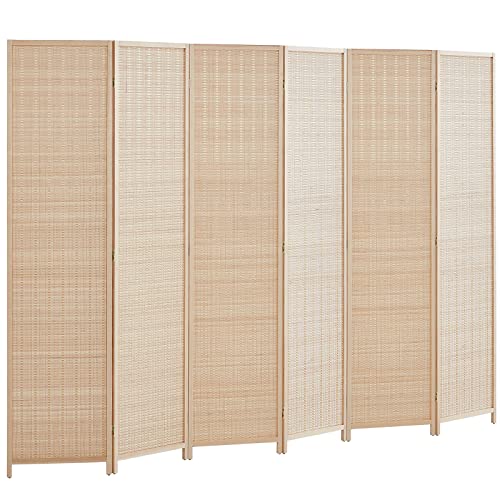
Who it suits: Small rooms that need zoning without a sense of subdivision. The Rose Home Fashion screen is natural bamboo in a solid wood frame, six panels at 5.6 feet tall, and its virtues are all matters of scale. It is tall enough to hide a desk, a reading chair, a dressing table or a cluttered corner from the rest of the room at seated eye level, and short enough that the room’s air and light continue over the top of it, so the space still reads as one room with a place in it, rather than two cramped halves. In a box bedroom or a small living room, that distinction is the whole game: the screen creates privacy of attention, not imprisonment.
The bamboo itself suits small rooms in a second way — it is visually light. Fine natural texture, warm undyed tone, light filtering softly through: the screen occupies far less visual weight than its dimensions suggest, where a solid painted screen of the same size would present a wall. It is physically light too, so the small room’s constant reconfiguration — screen out for the desk in the morning, folded for the yoga mat, back for the evening’s reading — costs nothing, and it folds flat into the sliver of storage small homes actually have. Keep it in dry rooms, expect gentle tone variation between panels as the mark of a natural material, and do not ask it to be a dressing screen for standing adults; within its honest brief, it is the most liveable divider in this guide.
Pros: Seated-height zoning that keeps small rooms feeling whole. Visually light natural bamboo suits small palettes. Very light to move; folds flat into minimal storage. Soft light filtering flatters dim corners. Solid wood frame keeps edges structured.
Honest limitation: At 5.6 ft it cannot give standing privacy — guests changing in a small spare room need a taller pick. Bamboo tone varies between panels and batches. Dry indoor rooms only; not for steamy bathrooms.
Choose it if your small space needs a place defined, not a room divided. Skip it if standing privacy is the job. Check on Amazon for availability, and View on Amazon for panel dimensions.
2. Bonnlo Wood Room Divider, 6 Panel — best for a tiny bedroom
Who it suits: The small bedroom that must do two jobs — the child’s room that hosts sleepovers, the box room split between a bed and a study desk, the spare room where a guest needs to change in genuine privacy. The Bonnlo’s six solid paulownia panels stand 71 inches tall, and in a small bedroom that height and solidity are used differently from in a big room: you rarely need its full 108-inch extended span, and you do not have to use it. Fold two panels back and the same screen makes a shorter, denser, extra-stable run across the exact gap your room offers — a flexibility wide rooms never ask for and small rooms ask for constantly.
Solid panels earn their place in bedrooms for the oldest reason: they block everything, at every angle, in every light — a sibling’s lamp, a hallway spill, a guest’s dignity. The water-based paint finish wipes clean and keeps the surface smooth, and paulownia keeps a tall screen light enough to reposition when the small room’s layout changes, as small rooms’ layouts always do. Plan the light honestly: in a one-window box room, put the bed on the window side if the sleeper is a reader, or accept a good lamp on the far side. What the Bonnlo will not do is decorate — it is a plain, calm, functional wall, and in a tiny bedroom that plainness is often exactly the mercy the room needs.
Pros: Full-height solid privacy for bedrooms and guests. Folds back to shorter, denser runs for tight gaps. Light for a tall screen; easy repositioning. Wipe-clean painted finish. No assembly.
Honest limitation: Blocks light as fully as views — the far side needs a lamp. Plain styling contributes nothing decorative. Run it zigzagged; a straight short run in a draughty doorway line can be nudged.
Choose it if the small bedroom needs a real border. Skip it if the room’s one window must serve both sides. Check on Amazon for colours, and View on Amazon for dimensions.
3. VEVOR Wood Room Divider, 6 Panel Louvered — best for dark small rooms
Who it suits: Small rooms at the back of the house, under the eaves, or facing the wrong way — anywhere the light is borrowed and a solid screen would spend the last of it. The VEVOR’s six louvered wood panels stand 66.9 inches tall and open to roughly 94.5 inches, and the slats are a light-sharing machine: they break the sight line between, say, the bed and the door, or the desk and the room, while daylight filters through and the far corner stays part of the lit room. In a small dark room, that is the difference between a divider that gets used and one that gets folded away by the second grey week.
The two-way hinges matter at small scale: the screen can make a shallow zigzag across a short gap, turn an L to enclose a desk in a corner, or fold back a panel to fit the exact width between a wardrobe and a wall. Its solid wood build and crisp slatted finish also give a small room something small rooms often lack — a sense of deliberate design — because in a compact space the divider is always in view and always close. Its privacy is the louvered kind, partial at oblique angles, so place it for zoning and backdrops rather than changing; and keep a brush for the slats, because dust shows on horizontal wood in close-up rooms sooner than anywhere else.
Pros: Divides without spending a dark room’s light. Crisp design presence at close quarters. Two-way hinges fit exact small gaps and corners. Mid-height suits low ceilings better than tall screens. Solid wood build feels like furniture, not equipment.
Honest limitation: Partial privacy at angles and under backlight. Slats need regular dusting. In the very smallest gaps its full six panels may be more than needed — though folding panels back handles that neatly.
Choose it if light is your small room’s scarce resource. Skip it if the zone needs complete privacy. Check on Amazon for finishes, and View on Amazon for dimensions.
4. Sorbus 8 Panel Room Divider, Mesh Hand-Woven — best for odd corners and alcoves
Who it suits: The small spaces with the strangest geometry: the alcove that wants to be a nursery, the landing corner that wants to be an office, the L-shaped box room, the space under the stairs. Eight double-hinged woven panels — 69 inches tall, about 128 inches wide fully extended — give the Sorbus the tightest turning behaviour in this guide: panels fold both ways at roughly 16-inch intervals, so the screen wraps corners, makes U-shapes around a desk, and concertinas down to a short dense divider for a narrow gap, all with the same object. In small-space terms, it is the screen that fits the room you have rather than the room in the catalogue.
The woven polypropylene panels suit awkward small spaces practically, too: they wipe clean in the dusty under-stairs corner, tolerate the bathroom-adjacent landing’s humidity, and their near-opaque weave gives an alcove bed or a changing corner real privacy in normal light. At about 23 pounds the whole eight-panel unit carries easily between rooms, which matters because odd corners change jobs often. Two honest checks: the folded stack is the thickest here, so confirm its cupboard; and a bright lamp directly behind the weave silhouettes, so light an alcove from its own side. Given those, it is the problem-solver of this guide — the screen to buy when the space itself is the puzzle.
Pros: Wraps corners, alcoves and U-shaped desk bays. Folds down to short dense runs for narrow gaps. Near-opaque woven privacy. Wipe-clean and humidity-tolerant. Light to move between rooms and jobs.
Honest limitation: Thickest folded stack in this guide. Silhouettes under direct backlight. Eight panels are more hardware than a simple straight gap needs.
Choose it if your small space has corners that defeat straight screens. Skip it if your gap is simple and your storage is tight. Check on Amazon for colours, and View on Amazon for dimensions.
5. HOMCOM 6 Panel Room Divider with 3 Display Shelves, Walnut — best furniture replacement
Who it suits: Small rooms where every footprint must hold two jobs. The HOMCOM is a six-panel louvered paulownia screen, 67 inches tall in walnut, with three removable display shelves rated to 22 pounds each — and in a small room, that combination can retire a separate shelving unit entirely. The screen zones the room; the shelves hold the books, plant and objects that would otherwise need a bookcase the floor cannot spare; and the shelves brace the fold so the whole thing stands like furniture. For a small living room or a bedroom-study, it is the most economical footprint in this guide — provided the rest of your storage lives in a proper Best Bookshelf For Small Spaces Under $1000 and the shelves here stay display-light.
The louvered panels keep light moving, which small rooms need, and the walnut finish gives a compact space the furnished warmth that bare dividers can lack — in a small room you are always close to your furniture, and materials read louder. The honest constraints are the shelf model’s usual ones, sharpened by scale: loaded shelves fix the configuration until unloaded, so this screen suits a settled position; and in the smallest rooms, check that the shelf depth and the objects on it do not narrow your walkway. Kept to display duty in a settled spot, it is the pick that makes a small room feel richer rather than merely divided.
Pros: Two furniture jobs in one small footprint. Shelves brace the fold for a settled stance. Louvers keep light circulating. Walnut warmth suits compact, layered rooms. Shelves remove for flat folding.
Honest limitation: Configuration is fixed while shelves are loaded. Shelf capacity is display-grade only. Shelf objects must not encroach on a small room’s walkway.
Choose it if floor space is scarcer than wall space. Skip it if you refold your screen often. Check on Amazon for availability, and View on Amazon for the shelf layout.
6. ECOMEX 8 Panel Wood Room Divider, Louvered — best for one long, thin room
Who it suits: The narrow room that is really two rooms in a trench coat — the long thin living room, the through-lounge, the converted corridor space. Eight louvered paulownia panels span about 128 inches at 67 inches tall, enough to cut a long room across its width at any point and make two genuine spaces, while the slats keep the far end connected to the window instead of sealing it into a dim annex. In narrow rooms the division point is a design decision — a third along for a study end, halfway for equal rooms — and a folding screen lets you audition both before committing, which no other divider type offers at this scale of change.
It arrives fully assembled, so the long room can be two rooms the same evening, and the 360-degree hinges let the run zigzag for stability or fold back section by section when the full length is needed for a gathering. The delivery caveat matters in the houses that have long thin rooms — often older houses with tight stairs — so check the assembled package against your turns and doors before ordering. And in a narrow room, mind the walkway: leave the passage at the screen’s end genuinely comfortable, because in a thin room that passage is the room’s spine and everyone uses it hourly.
Pros: Splits long rooms at any point along their length. Louvers keep the far end daylit. Fully assembled. Folds back in sections for full-length occasions. Lets you audition division points before settling.
Honest limitation: Large assembled delivery — check stairs and doors. Louvered privacy is partial. Overkill for short gaps; a long-room specialist.
Choose it if your small space is small in width, not length. Skip it if access is tight or the gap is short. Check on Amazon for finishes, and View on Amazon for dimensions.
Comparison table
| Pick | Panels | Height | Extended width | Material | Small-space strength |
|---|---|---|---|---|---|
| Rose Home Fashion Bamboo | 6 | 5.6 ft | 6-panel span | Bamboo, solid wood frame | Gentle zoning, lightest visual weight |
| Bonnlo 6 Panel | 6 | 71 in | ~108 in | Solid paulownia, painted | Full bedroom privacy, folds to fit |
| VEVOR Louvered | 6 | 66.9 in | ~94.5 in | Wood, louvered slats | Divides dark rooms without spending light |
| Sorbus 8 Panel | 8 | 69 in | ~128 in | Woven PP fibre, poplar frame | Wraps corners and alcoves |
| HOMCOM with Shelves | 6 | 67 in | 6-panel span | Paulownia, louvered, walnut | Divider plus shelving in one footprint |
| ECOMEX 8 Panel | 8 | 67 in | ~128 in | Paulownia, louvered | Splits long thin rooms |
How to choose a room divider for a small space
Measure the gap, then buy for the fold. Small-space measuring has one rule: the screen’s usable width is about three quarters of its extended width once it stands in a stable zigzag, and less if it turns a corner. Measure your gap precisely — small rooms forgive nothing — then choose a screen whose extended width exceeds the gap by roughly a third. If the gap is very short, prefer a screen whose panels fold back neatly into a dense short run (the Bonnlo and Sorbus both do this gracefully) over a screen designed only to stretch.
Use the lowest height that does the job. Height is privacy, but it is also presence. A desk, a reading chair, a pet corner and a clutter run are seated jobs: a 5.6-foot screen hides them completely from anyone sitting or standing across a small room’s short sight lines, while keeping the ceiling plane and the light shared. A bed or a changing area is a lying and standing job: there, the 71-inch class earns its height. Buying taller than the job needs is the most common way small rooms end up feeling subdivided rather than organised.
Spend the light deliberately. Stand in the small room at midday and at dusk and note where the light actually reaches. If the divider must stand between the window and the zone it creates, choose louvered, woven or bamboo so the zone stays daylit; if the zone is a bed and darkness is a feature, solid panels turn the room’s dimness into an asset. In small rooms there is no neutral choice — every screen is a lighting decision — so make it on purpose.
Protect the walkway and the door arcs. In a small space the divider lives close to traffic. Keep a comfortable passage at one end, check every door’s swing against the screen’s footprint, and leave cleaning access — a few inches at one end — so the corners the screen creates do not become unreachable dust farms. If the only workable position blocks a door’s arc, change the configuration (an L instead of a straight run) before you change the screen.
Let the screen replace something. The small-space question is never just “which divider?” but “what does it retire?” A shelf divider can retire a bookcase. A screen behind a desk can retire the need for a separate backdrop or a rearranged room. A bamboo screen at a bed’s head can retire a headboard. The picks that earn their footprint twice are the ones small rooms keep; the rest migrate to the cupboard. The proportion rules in this section are identical at every budget tier, so if the ceiling here is more than your small space needs, the same logic will serve you one rung down.
Common mistakes in small spaces
Buying big-room dimensions for a small room. An eight-panel screen stretched across a box room is a wall with delusions; match panel count to the measured gap. Defaulting to maximum height. Tall screens in low rooms crowd the ceiling and shrink the space visually — seated jobs want seated heights. Sealing off the only light. A solid screen across a small room’s window side creates a permanent dusk at the far end; if in doubt, choose a light-sharing screen. Ignoring the folded stack. In small homes the cupboard is also small — check the folded dimensions, especially for eight-panel models. Placing the screen on the room’s diagonal. Diagonals waste the corners they create in small rooms; straight runs and Ls aligned to the walls almost always serve better. Forgetting the screen is furniture at close range. In a small space you see the divider’s finish, edges and dust at arm’s length — choose materials that hold up to close inspection and keep the slats and weaves on a light cleaning rhythm.
Small-space layouts that actually work
The desk bay. Turn the screen into a three-sided bay around a desk in a corner — two panels along one wall, the rest across the front — and a small room gains an office with a door’s worth of psychological separation. Louvered and woven screens suit bays best, because a bay that shares light does not feel like a booth. The bed pocket. Run the screen parallel to the bed, a step away from it, rather than across the room: the pocket between screen and bed becomes a private dressing strip, and the rest of the small room keeps its full width. The staggered screen. Two shorter runs with a gap between them — screen, passage, screen — divide a room while keeping a natural walkway and a light path down its centre; it is the layout small through-rooms were made for, and any double-hinged screen here can form one half of it. The backdrop. Sometimes the small space does not need dividing at all — it needs a background: a screen stood behind a sofa, a bed or a desk gives the room a composed focal plane and hides the door, the shelves or the clutter that made the room feel restless. The bamboo and woven picks excel here, precisely because their job is texture, not territory.
Small rooms in real houses: four worked examples
The box bedroom that is also an office. A nine-by-ten room, one window, a single bed along one wall and a desk that has colonised the other. The working answer is the Bonnlo folded to a four-panel run between bed and desk, solid side to the desk: the sleeper gets darkness and privacy, the worker gets a blank, calm backdrop that makes the room’s work half feel like a workplace, and the window — placed, luckily, between them — serves both across the screen’s top edge. The two spare panels fold flat against the wall end of the run, thickening it into something that reads as a deliberate pier rather than a leftover.
The landing office. A wide landing outside the bedrooms, dead space with a socket. A desk fits; concentration does not, because every household journey passes through. The Sorbus in a U around the desk — two panels against the wall, four across the front, two returning — builds a woven study pod that softens the traffic’s sight lines while its weave keeps the landing’s borrowed light. The household rule that makes it work is social, not structural: a closed screen front means a call is on, an open one means knock-free. Small spaces run on signals like that, and a screen is a very good signal.
The living room with the visible kitchen. An open-plan small living room where the sofa faces the kitchen’s working clutter. Nothing needs privacy here — the job is purely visual calm — so the bamboo Rose Home Fashion stands at the kitchen end of the seating area, screening the worktop line at seated height while the room’s light and conversation flow over it. Guests stop seeing the draining board; the cook stops feeling watched. It is the least a divider can do and, in small open plans, often the most valuable thing one can do.
The under-stairs nook. The triangle under a staircase is storage by default and a reading nook by ambition. A short folded-back run of the VEVOR — four panels working, two folded — closes the nook’s open side with slats that let the hall’s light in and throw striped shade across a chair and a cushion. The nook becomes the house’s most contested seat within a week. The lesson generalises across all four examples: in small spaces, the divider’s highest use is rarely splitting a room in half. It is finishing a corner, calming a sight line, or giving one person a boundary the size of a chair — and the screen that does those small jobs precisely is worth more than a wall of screen doing a big job badly.
Care, storage and longevity in a small home
Storage is a rotation, not a location. In a small home the folded screen rarely has one permanent home; it has a rotation — behind the bedroom door in term time, flat under the spare bed when guests come, standing in the hall cupboard during a redecoration. Choose the screen whose folded stack fits the most of your possible spots, and prefer the lighter picks if the rotation involves stairs or a loft hatch. A screen that can live in three places will be used three times as flexibly as one that fits exactly one.
Cleaning at close range. Small rooms put every surface at reading distance, so divider care is visible care. Louvered slats show dust first along their top edges — a microfibre glove run along them monthly keeps a slatted screen looking like joinery. Woven panels hold dust inside the weave; a vacuum brush pass lifts it without wetting anything. Solid painted panels are the forgiving ones: a damp cloth, thirty seconds, done. Bamboo wants dry dusting and patience — never soak it, and keep it out of the steamy rotation entirely. Hinges across all of these are simple metal hardware; a drop of oil on a stiffening hinge, once a year at most, is the entire maintenance schedule beyond cleaning.
Small repairs, honestly assessed. The failures of folding screens in small homes are mundane: a scuffed panel bottom from a hard floor (felt pads prevent the next one), a loosened hinge screw (a screwdriver prevents the sequel), a water ring or a crayon line on a painted panel (touch-up paint exists for exactly this). None of the picks in this guide uses proprietary parts or sealed construction, which is a deliberate selection point — a divider that can be maintained with household tools is a divider that survives a decade of small rooms, and a decade is the right horizon for a purchase at this tier.
When the small space changes. Small rooms change jobs more often than any others in the house — nursery to child’s room to study to spare room inside five years is an ordinary biography. The divider that survives that biography is the one bought for adaptability: standard size, neutral finish, light enough to carry to the next job. That is the quiet argument for every pick in this guide being a folding screen rather than a fixed partition, and for finishes that belong to no single year’s décor. Buy the screen for the house’s future small rooms, not only for the one in front of you, and the under-$1000 ceiling buys a decade of boundaries.
A word about guests in small rooms. The small spare room is where dividers quietly earn their keep most often: a solid or woven screen gives a guest a changing-private corner, a place for their case that is theirs, and the feeling of a room rather than a corner of yours. Set it up before they arrive, put the lamp on the room side, and fold it away the morning they leave — hospitality measured in square feet is still hospitality, and a screen is how a small house offers it generously.
Final recommendation
For most small spaces, buy the Rose Home Fashion Bamboo Room Divider. Its seated height, soft light and light build define a place inside a small room without subdividing the room itself, and it will migrate happily between corners for years. When the job is real bedroom privacy, step up to the tall solid Bonnlo and fold it to fit; when the room is dark, the louvered VEVOR divides without spending light; when the space has corners that defeat straight screens, the Sorbus wraps them. The HOMCOM replaces furniture where floor space is scarcest, and the ECOMEX splits the long thin room nothing else reaches. All six sit comfortably under the $1000 ceiling — at small scale, the money matters less than the measuring, so measure the gap, the fold and the cupboard, and let proportion make the decision. If storage is your binding constraint, start with the HOMCOM shelf divider.
FAQ
What size room divider is best for a small room? The smallest that does the job: for seated zoning, a 5.6 ft screen across a short run; for bedroom privacy, a 71 in solid screen folded back to the width your gap needs. Buy extended width about a third beyond the gap to allow for the stability zigzag, and prefer narrower panels — around 16 inches — for tight corners.
Can a room divider make a small room look bigger? Used well, yes. Defined zones read as more space than one ambiguous room, and light-sharing screens (louvered, woven, bamboo) keep the whole volume bright. Used badly — too tall, too dark, stretched across the middle — a divider shrinks a room. Proportion and light are the whole secret.
How do I divide a small room without blocking light? Choose a louvered, woven or bamboo screen, place it perpendicular to the window wall rather than parallel across it where possible, and keep the top of the room open by using the lowest screen height the job allows. The zone behind a light-sharing screen stays daylit enough for desks and reading chairs.
Is a folding screen stable in a small room’s draughts? Yes, in a zigzag or L configuration — geometry, not weight, keeps screens standing. Small rooms often have a draught line from the door; keep tall light screens out of its direct path, add felt pads on hard floors, and never run a screen fully straight.
Can I use part of a folding screen in a very small gap? Yes — folding screens are routinely used folded back on themselves: run the panels you need and fold the remainder flat against the run or the wall for a denser, shorter divider. Double-hinged models like every pick in this guide handle this neatly, which is one reason panel count should be bought generously and used flexibly.
How do I stop a small room’s divider looking like clutter? Give it one job, one alignment and one neighbour. One job: the screen zones, screens or backdrops — not all three at once. One alignment: parallel or perpendicular to the room’s main wall, never a casual diagonal. One neighbour: a single plant, lamp or chair at its end to anchor it into the room’s composition. A screen with those three disciplines reads as furniture; without them, the same screen reads as something stored upright.
Where should a divider go in a small bedroom? Alongside the bed as a private pocket, or across the room at the bed’s foot to separate a desk or dressing area — whichever keeps the door’s swing and the route to it clear. Put the sleeper’s lamp on the correct side of a solid screen, and the small bedroom gains a room’s worth of privacy for a screen’s worth of floor.
What can I divide besides rooms? In small homes the most valuable divisions are often not room-sized at all: screen the litter tray or the pet’s bed from the kitchen corner, hide the home-office printer and cable nest from the living room, give the hallway’s shoe-and-coat chaos a calm face, or back a hallway desk so the house’s traffic passes behind a screen instead of behind your concentration. A folding screen is the only furniture that can do all of those jobs in the same month, which is why small homes that own one tend to keep it for decades.