Where to buy
Check the latest price, availability and delivery on Amazon. Orders are placed on Amazon. We may earn a commission from qualifying purchases.
- Best overall for small apartments: Bonnlo Wood Room Divider, 6 Panel, 5.9 Ft Tall Folding Partition — Check on Amazon
- Best for a studio sleeping corner: Rose Home Fashion Bamboo Room Divider, 6 Panel, 5.6 Ft Tall — Check on Amazon
- Best dual-purpose divider with shelves: HOMCOM 6 Panel Room Divider with 3 Display Shelves, Walnut — Check on Amazon
- Best for splitting living and sleeping zones: VEVOR Wood Room Divider, 6 Panel Louvered, 66.9 Inches Tall — Check on Amazon
- Best for L-shaped studio layouts: Sorbus 8 Panel Room Divider, Mesh Hand-Woven Design — Check on Amazon
See 1 more Amazon option
- Best for long, narrow apartments: ECOMEX 8 Panel Wood Room Divider, Louvered — Check on Amazon
Read the full guide ↓
Disclosure: As an Amazon Associate, dailyhomedecorating.com earns from qualifying purchases. Links to Amazon on this page are affiliate links; they cost you nothing extra. Listing details such as price and availability change often, so check the current Amazon listing before you buy.
The best room divider for small apartments under $1000 is the hardest-working piece of furniture a small home can own, because in a small apartment a divider is never a luxury — it is how one room becomes two. The studio that must be bedroom, office and living room by turns; the one-bedroom where a partner’s early shift and your late reading need separate pools of light; the rental where the lease forbids so much as a picture hook in the wrong place, let alone a partition wall. A folding screen answers all of it without a single fixing, and when it is chosen well it disappears into the apartment’s life: stood in a zigzag in the morning to make a work zone, folded flat behind the sofa when friends come for dinner, carried to the next apartment when the lease ends because it weighs less than the boxes of books beside it.
Small apartments impose filters that bigger homes can ignore, and this guide applies them ruthlessly on top of the standards in our general roundup of the Best Room Divider Under $1000. Folded size matters as much as standing size, because a screen with nowhere to live when folded will live in the way. Weight matters, because apartment furniture gets moved by one person, often up stairs, and rearranged every time the room’s job changes. Light matters most of all: most small apartments have one good window wall, and a divider that walls off the light creates a gloomy cave at exactly the end of the room that needed help. And dual purpose is gold — a divider that also shelves, displays or backdrops earns floor space that a pure screen merely borrows. Every pick below passed those filters, and the reviews are honest about the apartment-specific catch in each one.
Our short answer: start with the Bonnlo, a tall, solid, featherweight paulownia screen that gives a studio a genuinely private sleeping end, folds flat for storage, and asks nothing of your walls or your deposit. If your sleeping corner needs softness rather than a wall, the bamboo Rose Home Fashion is the gentlest zoning tool here. If floor space must work twice, the HOMCOM’s shelves turn the divider into the storage your apartment forgot to build. The full reviews cover the studio scenarios each pick serves best, the measuring checks that matter at apartment scale, and the mistakes that make small rooms feel smaller. On a tighter budget, Best Room Divider For Small Apartments Under $700 applies the same apartment filter one rung down.
In this guide
Quick Picks: best room divider for small apartments under $1000
Short on time? Match your apartment’s layout problem to the screen built for it. Every pick sits under the $1000 ceiling — check the live listing for the current price.
| Apartment situation | Pick | Why it stands out | Link |
|---|---|---|---|
| Best overall for small apartments | Bonnlo 6 Panel Wood Room Divider | 71 in tall solid privacy, light paulownia, folds flat, no assembly | Check on Amazon |
| Best for a studio sleeping corner | Rose Home Fashion Bamboo Room Divider | Gentle bamboo zoning at 5.6 ft, soft light, lightest feel in this guide | Check on Amazon |
| Best dual-purpose with shelves | HOMCOM 6 Panel Room Divider with 3 Shelves | Divider plus three display shelves rated to 22 lb each — storage a studio lacks | Check on Amazon |
| Best living/sleeping split | VEVOR 6 Panel Louvered Wood Room Divider | Slats divide zones while sharing the apartment’s one good light source | Check on Amazon |
| Best for L-shaped studios | Sorbus 8 Panel Room Divider | Eight double-hinged panels wrap corners and fold to the width you need | Check on Amazon |
| Best for long narrow flats | ECOMEX 8 Panel Wood Room Divider | About 128 in of louvered wall for railway layouts, fully assembled | Check on Amazon |
How we chose these room dividers for small apartments
The first apartment filter is the folded state. Every screen in this guide folds to a flat stack one person can carry, and we favoured the picks whose folded footprint hides in the places small apartments actually have: behind a door, beside a wardrobe, under a bed, in the sliver between sofa and wall. The second filter is weight, for a reason specific to rental life — apartment layouts are provisional. The screen that zones your work desk this year will zone a nursery corner or a guest bed later, and it will certainly move house with you; every pick here is a comfortable one-person carry, and most need no assembly at all, so a divider can be working within the hour it arrives.
The third filter is light economics. In a small apartment, light is a shared resource with one source, and the reviews are explicit about each screen’s light behaviour: solid panels spend light to buy privacy, louvered panels share it, woven panels diffuse it, bamboo softens it. We matched those behaviours to the zones small apartments actually create — sleeping ends need darkness and privacy, work ends need daylight, and the screen between them has to serve both masters at once. The fourth filter is footprint honesty: a screen stands in a zigzag, so its real estate is the zigzag’s depth as well as its length, and we favoured panel widths around 16 inches that turn tight corners in small rooms without eating the floor.
Finally, dual purpose. Floor space in a small apartment is the scarcest currency there is, and a divider that only divides is a harder sell than one that also displays, shelves or serves as the backdrop that makes a work corner feel like a workplace. That is why the shelf-equipped HOMCOM ranks so high here despite being a mid-priced object, and why the woven Sorbus — which can wrap an L, split a room, or fold to half its width as a dense short screen — earns its place as the layout specialist. What follows is six screens that make small apartments bigger in the only way that matters: by making them more usable.
The best room dividers for small apartments under $1000 in detail
1. Bonnlo Wood Room Divider, 6 Panel — best overall for small apartments
Who it suits: Studio and one-bedroom renters whose first need is a sleeping zone that is genuinely private. The Bonnlo’s six solid paulownia panels stand 71 inches tall — the tallest in this guide — and span about 108 inches extended, and solid panels are what a sleeping end wants: no slats to see through at an angle, no weave to silhouette against a lamp, just a calm painted wall that was not there yesterday and leaves no trace when it goes. In a studio, that converts the bed end from “the part of the room with the bed in it” into a bedroom, with everything that does for how the rest of the space feels — the living end stops apologising, the work desk stops facing a pillow.
Apartment virtues stack up behind the headline. Paulownia keeps the whole six-panel screen light enough to carry up stairs and reposition solo, which in rental life is not a convenience but the difference between a screen that gets used flexibly and one that fossilises in its first position. It needs no assembly — unbox, unfold, stand it in a zigzag — and it folds flat to lean behind a door or slide beside a wardrobe when the studio needs to be one room for guests. The water-based paint finish wipes clean and shrugs off the scuffs of small-space living, where everything is closer to everything else. Its one real cost is light: solid panels spend it, so place the screen so the bed gets the shade and the living end keeps the window, and give the sleeping side a warm lamp of its own.
Pros: Tallest, fully private screen — a real bedroom wall for a studio. Very light for its size; one-person moves and house moves. Folds flat for behind-door storage. No assembly, no fixings, deposit-safe. Wipe-clean painted finish suits close-quarters living.
Honest limitation: Blocks light completely — the zone behind it needs its own lamp, and in a north-facing studio that is a genuine planning item, not a footnote. The light build needs a proper zigzag to feel planted in a draughty hallway gap. Styling is plain; it earns its keep by disappearing, not by decorating.
Choose it if your studio needs a private sleeping end above all. Skip it if your one window must serve both zones equally. Check on Amazon for colours, and View on Amazon to check the folded dimensions against your storage spot.
2. Rose Home Fashion Bamboo Room Divider, 6 Panel — best for a studio sleeping corner
Who it suits: Renters who want their studio zoned, not walled. At 5.6 feet tall, the Rose Home Fashion’s natural bamboo panels in a solid wood frame will not hide a standing person — and in a small apartment that is often the smarter trade. A full-height solid wall across a studio can make both halves feel like cupboards; the bamboo screen instead draws a soft line at seated and lying height, which is exactly the sight line that matters for a bed, a sofa or a reading chair, while the room above it stays one connected, daylit volume. The bamboo filters light into a warm glow, so the sleeping corner feels sheltered rather than shut away.
It is also the easiest screen here to live around. Light enough to move with one hand while holding a coffee in the other, quick to fold flat when the studio hosts dinner, and gentle on the eye in the natural-material palettes small apartments favour — because in a small space you see your divider from everywhere, all the time, and a calm object beats a bold one you will tire of. The solid wood frame keeps the edges crisp where all-bamboo budget screens go wobbly. Keep it in dry rooms, treat the tone variation between panels as the honesty of a natural material, and it will serve a succession of small homes gracefully — this is the screen most likely to be the first thing unpacked at the next apartment.
Pros: Soft zoning that keeps a studio feeling like one bright room. Natural bamboo suits small-space natural palettes. Extremely easy to move, fold and store. Gentle light filtering flatters sleeping corners. Solid wood frame adds structure.
Honest limitation: Seated privacy only — standing sight lines pass over its 5.6 ft height, so it will not serve as a dressing screen for guests. Natural bamboo tone varies between panels and batches. Not for steamy bathroom-adjacent use.
Choose it if your studio needs a calm corner more than a wall. Skip it if guests will need to change behind it. Check on Amazon for availability, and View on Amazon for panel sizes.
3. HOMCOM 6 Panel Room Divider with 3 Display Shelves, Walnut — best dual-purpose pick
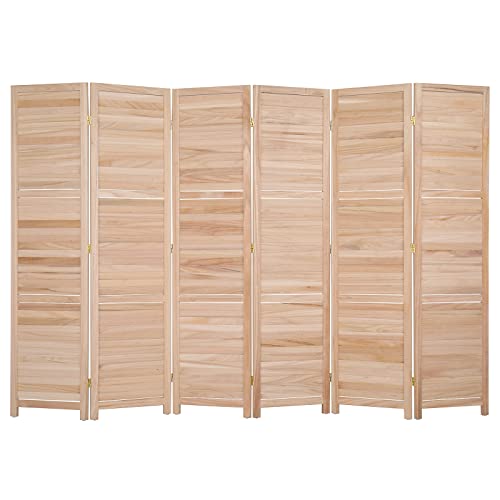
Who it suits: The small apartment that is short on storage as well as short on rooms — which is to say, most of them. The HOMCOM is a six-panel louvered paulownia screen, 67 inches tall in walnut, carrying three removable display shelves rated to 22 pounds each. In a studio or one-bed where the bookcase, the plant stand and the photo shelf were all casualties of the floor plan, a divider that brings its own shelving is not a compromise but a rescue: it zones the room and gives the objects that make it yours a home, in one footprint. The shelves also brace the screen’s fold, so it stands with a settled, furniture-like confidence that suits a semi-permanent position between living and sleeping zones.
Use it with small-space discipline. The shelves are display-grade — plants, frames, a short run of paperbacks, the kettle-side cookbooks — not a substitute for a full Best Bookshelf For Small Apartments Under $1000, and loading them like one makes any screen top-heavy. Kept honest, they are transformative: a studio’s divider becomes its dresser-top, its mantel, its gallery. The louvered panels pass light between zones, which matters in the one-window apartment, and when the lease ends the shelves lift off, the screen folds flat, and the whole arrangement travels. The walnut finish suits the warm, layered look small spaces use to feel rich rather than bare.
Pros: Divider and shelving in one footprint — prime small-space economics. Shelves brace the fold for a settled stance. Louvers share light between zones. Shelves remove for flat folding and moving day. Walnut warmth makes a small room feel furnished, not partitioned.
Honest limitation: Loaded shelves must be unloaded before refolding, so it suits a settled position. Shelf capacity is display-grade only. The walnut tone is a specific commitment in a small room — check it against your floor before ordering.
Choose it if storage and zoning are equally scarce. Skip it if you refold your divider weekly. Check on Amazon for availability, and View on Amazon to see the shelf configuration.
4. VEVOR Wood Room Divider, 6 Panel Louvered — best living/sleeping split
Who it suits: The one-window studio’s central dilemma: how to split living from sleeping without giving either zone the darkness. The VEVOR’s six louvered wood panels, 66.9 inches tall and roughly 94.5 inches wide extended, are the compromise engineered for exactly this — slats that break the sight line between sofa and bed while passing light and air through, so the sleeping end borrows the window’s brightness and the living end never feels walled off from it. If your studio’s window sits at the living end and your bed at the far end, this is the screen that stops the bed end feeling like a cave with a pillow in it.
The two-way hinges let it zigzag across the studio’s waist, turn an L to enclose the bed corner, or fold flat for the evenings the studio becomes a dinner party. The solid wood build reads as furniture at apartment distances — and in a small apartment, every object is at close distance, all the time, which is why the VEVOR’s crisp slatted finish matters more here than it would in a house. Its privacy is the honest louvered kind: excellent for zoning and for a work desk’s backdrop, partial at oblique angles, so a couple sharing a studio should treat it as a territory line rather than a changing screen, and pair it with the bedroom-side lamp trick — light your side, and the slats read as texture, not gaps.
Pros: Shares one window’s light across both zones. Clean slatted finish holds up at close apartment distances. Two-way hinges form L-shaped bed corners. Folds flat for guest nights. Divides without making either zone feel smaller.
Honest limitation: Partial privacy at angles and under backlight — not a dressing screen. Slats need dusting to stay crisp. In a very small studio its 94.5-inch span may be more screen than the waist of the room wants; measure the zigzag, not just the opening.
Choose it if light-sharing decides your studio layout. Skip it if full privacy is the point. Check on Amazon for finishes, and View on Amazon for dimensions.
5. Sorbus 8 Panel Room Divider, Mesh Hand-Woven — best for L-shaped studios
Who it suits: Studios and one-beds with awkward geometry — the L-shaped open plan, the alcove bed, the corner that wants wrapping. Eight double-hinged woven panels, 69 inches tall and about 128 inches wide extended, give the Sorbus a configurational range no six-panel screen matches: run it long, fold it short and dense, or — the apartment party trick — bend it around a corner to enclose an alcove sleeping nook or a desk bay with a genuine second wall. Because the panels fold both ways, the same screen that wraps a corner this year runs straight across a different apartment next year.
The woven polypropylene construction suits rental life in quieter ways too: it wipes clean, tolerates the steamy corner near a kitchenette or bathroom door better than raw wood, does not dent when the vacuum cleaner argues with it, and at about 23 pounds for the full eight panels it is an easy carry down the hall on moving day. Its weave is near-opaque in normal light — a real privacy screen for a guest bed or a changing corner — with the standard woven caveat that a lamp directly behind it silhouettes, so keep lighting on the room side. The folded stack is the thickest here, the one apartment-specific check to run: measure the wardrobe or under-bed space it will call home before it arrives.
Pros: Wraps corners and alcoves no six-panel screen can. Adapts from long wall to short dense screen. Wipe-clean, humidity-tolerant woven panels. Near-opaque privacy for guest and changing corners. Light for its coverage; moving-day friendly.
Honest limitation: Thickest folded stack in this guide — verify storage space. Silhouettes under direct backlight. The weave gathers dust and wants a vacuum brush pass now and then.
Choose it if your apartment’s geometry is the problem. Skip it if storage space for the folded screen does not exist. Check on Amazon for colours, and View on Amazon for dimensions.
6. ECOMEX 8 Panel Wood Room Divider, Louvered — best for long, narrow apartments
Who it suits: The railway flat, the corridor one-bed, the long thin living room where life arranges itself in a line and the only possible division is across the line’s width, partway down its length. Eight louvered paulownia panels span about 128 inches at 67 inches tall — enough to wall a long room into two rooms at any point along its length, with slats that keep the far end connected to the window’s light instead of sealing it into gloom. In a narrow space that light-sharing is not a nicety; it is the difference between a divided flat that works and one whose far room nobody wants to sit in.
It arrives fully assembled, a mercy in a small apartment where there is no spare floor to build furniture on — unbox in the hall, unfold in place, done. The 360-degree hinges let the long run zigzag for stability in the draughty through-line of a corridor flat, or fold back panel by panel to open the room’s full length for guests. Check the delivery box against your building’s stairs and door turns before ordering, because a fully assembled eight-panel screen travels as one large object; and in the narrowest flats, confirm the folded stack’s home as carefully as the standing position. Managed with those two checks, it is the specialist that turns a corridor with furniture into a flat with rooms.
Pros: About 128 in of coverage splits long rooms at any point. Louvers keep the far end daylit. Fully assembled — no build space needed. Hinges fold the run back section by section. Smooth wood panels dust quickly.
Honest limitation: Large assembled delivery — verify stair and door access. Louvered privacy is partial. Eight panels are overkill for short openings; this is a long-room specialist.
Choose it if your flat is long, narrow and short on light at one end. Skip it if your building’s stairs are tight. Check on Amazon for finishes, and View on Amazon for dimensions.
The pre-order checklist for apartment buyers
Ceiling height. Standard screens in this guide run from 5.6 to just under 6 feet. In a standard apartment that is the right band — decisively above seated and lying sight lines, comfortably below the ceiling. In a low-ceilinged conversion, check that a 71-inch screen does not crowd the ceiling line visually; in a high-ceilinged loft flat, accept that the screen divides at human height and the volume above stays shared, which is usually the effect loft dwellers want anyway.
Door swings and radiator lines. Walk the apartment with a tape and mark every door’s full arc on the floor in painter’s tape, plus the wall runs occupied by radiators, skirting heaters and the thermostat. Screens placed in a door’s arc get moved daily and resented weekly; screens placed over a heat source block warmth and dry out wood finishes faster than anywhere else in the room. The tape exercise takes ten minutes and is the single most useful thing an apartment buyer can do before ordering.
The neighbour test. Thin walls cut both ways: your divider will not block sound, and neither will your neighbour’s. What a screen can do in a thin-walled building is purely visual — screening a bed from a window that faces another building, or a desk from a door with a glass panel. If your privacy problem is actually a window problem, a screen placed between window and bed solves it without touching the window treatment your lease may restrict.
Cleaning access. Small apartments collect dust in still corners, and a screen creates two new ones. Leave enough gap at one end to get a vacuum or a mop behind the screen without moving it — a few inches of grace — or choose one of the light picks you can shift with one hand during the weekly clean. Louvered screens want their slats brushed; woven screens vacuum on a brush setting; solid painted panels wipe down fastest of all, which in a small kitchen-adjacent studio is a real, if unglamorous, advantage.
Comparison table
| Pick | Panels | Height | Extended width | Material | Apartment strength |
|---|---|---|---|---|---|
| Bonnlo 6 Panel | 6 | 71 in | ~108 in | Solid paulownia, painted | Private sleeping end, folds flat, lightest tall screen |
| Rose Home Fashion Bamboo | 6 | 5.6 ft | 6-panel span | Bamboo, solid wood frame | Gentle zoning that keeps a studio bright |
| HOMCOM with Shelves | 6 | 67 in | 6-panel span | Paulownia, louvered, walnut | Divider plus display storage in one footprint |
| VEVOR Louvered | 6 | 66.9 in | ~94.5 in | Wood, louvered slats | Shares one window’s light between zones |
| Sorbus 8 Panel | 8 | 69 in | ~128 in | Woven PP fibre, poplar frame | Wraps corners and alcoves; adapts to any layout |
| ECOMEX 8 Panel | 8 | 67 in | ~128 in | Paulownia, louvered | Splits long narrow flats, fully assembled |
How to choose a room divider for a small apartment
Measure three things, not one. The opening, standing: its width at the point you will divide, remembering the screen delivers about three quarters of its extended width in a stable zigzag. The storage, folded: the screen’s folded dimensions against the exact spot it will live — behind the door (check the door still opens fully), beside the wardrobe, under the bed (check the clearance height). And the route: door widths, the turn at the top of the stairs, the lift if there is one, because a screen that cannot reach the room cannot divide it. Apartment buyers who measure all three almost never return a divider; buyers who measure one often do.
Decide which zone gets the window. In most small apartments the divider’s real job is allocating light. Sleeping zones forgive darkness — many people sleep better in the dimmer end — while work zones starve without daylight. So the usual winning layout puts the bed behind the screen at the far end and keeps the desk in the window’s half, with the screen’s opacity chosen accordingly: solid if the sleeper needs true dark and privacy, louvered or woven if the far end must borrow light to stay pleasant in the daytime. Sketch your day honestly — who is home, in which zone, at which hours — and let that, not the floor plan’s symmetry, place the screen.
Keep the walkway sacred. A divider that narrows the route to the bathroom, the kitchen or the front door below a comfortable shoulder’s width will be folded away within a fortnight, however well it zones. Leave a genuine passage at one end, and if the apartment is very small, consider dividing at an angle or with an L that creates the zone while keeping the through-route along one wall. Test the route at night, barefoot, half asleep — that is the route’s real specification.
Prefer dual purpose, demand fold-flat. At apartment scale, single-purpose furniture must justify itself, and the shelf-equipped HOMCOM shows the standard: a footprint that zones and stores beats a footprint that only zones. But never trade away the fold — the ability to return the room to one space for guests, exercise, or a change of mind is the whole reason to choose a screen over a bookcase wall in a rental. If you are furnishing the apartment’s other zones at the same time, Best Room Divider For Small Apartments Under $400 covers the budget end of this same category for secondary rooms.
Think one move ahead. Apartment furniture earns its keep across leases. A screen in a standard size and a neutral finish will fit the next flat’s unknown geometry; an eight-panel screen adapts widest, a light six-panel carries easiest. Avoid the ultra-specific — the screen bought for one alcove in one flat — and your divider becomes part of the permanent kit that makes every future small home work from the first evening.
Common mistakes in small apartments
Buying the standing size and forgetting the folded size. The classic studio error: a beautiful screen with nowhere to go, leaning in the only corner forever. Measure the storage spot first. Wasting the window. A solid screen placed so the living zone keeps the light and the work desk sits in the gloom — or the reverse, a louvered screen where a sleeper needed darkness. Allocate light deliberately. Blocking the door swing. Check every door’s arc against the screen’s position, including the bathroom door at 2 a.m. Stretching the screen straight to reach. Unstable anywhere, worse in a small home where it will be brushed past constantly — buy width for a zigzag. Choosing a screen too grand for the room. Eight panels in a tiny studio is a wall looking for a room; match panel count to the opening, not to ambition. Forgetting the deposit. All six picks here are freestanding and fixing-free — keep it that way, and resist any temptation to stabilise a screen with screws into a landlord’s wall.
Rental rules: dividers and your deposit
A freestanding folding screen is the most deposit-friendly transformation in rental housing: it touches nothing but the floor, requires no permission in any standard lease, and leaves with you. Two habits keep it that way. Put felt pads under the panel feet on hard floors, so months of small repositioning cannot polish a scuff arc into the landlord’s laminate. And keep the screen’s weight honest — never hang shelves, lights or plants from a folding screen’s panels beyond a shelf model’s own rated shelves; a screen is a hinged structure, and overloading it risks the fall that damages the floor you were protecting. Photograph the floor where the screen stands on move-in day if you are especially careful; it takes ten seconds and settles any question at move-out.
One more rental consideration deserves a line, because it decides between picks more often than any specification: the building itself. Walk-up apartments reward the lightest screens — the Bonnlo and the bamboo Rose Home Fashion carry up three flights without a second thought, and both arrive ready to unfold rather than to build on a landing. A fully assembled eight-panel screen like the ECOMEX is a wonderful object in a lift building and a genuine puzzle in a narrow Victorian stairwell. Measure the route the screen will travel, not just the room it will stand in, and let the building have its vote before you order.
Four studio scenarios, four answers
The classic studio rectangle. Bed at one end, sofa at the other, kitchenette along the wall, one window at the living end. The textbook answer is the Bonnlo stood across the bed end in a firm zigzag: full privacy for sleeping and changing, a calm painted face to the living room, and the sofa end keeps every lumen of the window. Add a warm lamp and a small rug inside the sleeping zone and the studio gains a bedroom that feels designed rather than hidden. On guest nights the screen folds behind the door and the studio is one room again in under two minutes.
The work-from-home studio. Here the desk is the zone that matters, and the screen’s second job is to be a backdrop. The VEVOR louvered screen behind the desk chair gives video calls a composed, architectural background, cuts the bed and the kitchenette out of your eyeline during the working day, and shares the window light between desk and living space instead of confiscating it. When the working day ends, folding the screen flat is a genuinely useful ritual — the office closes, and the apartment becomes a home again, which in 300 square feet is not a metaphor but a schedule.
The couple on opposite shifts. One partner sleeps days, the other lives around them. This is the hardest studio problem and it is a light problem before it is a space problem: the sleeper needs darkness and the strongest visual privacy, the awake partner needs a lit, usable room. The Bonnlo’s solid panels are the honest tool — accept the lamp-lit living zone as the price of real daytime sleep — stood so the kitchen and desk sit on the lit side and the bed in the shaded pocket behind the screen. No folding screen blocks sound, so pair it with the household’s quiet conventions; but visual territory alone transforms shift-sharing from endurance into routine.
The one-bed with a baby, a guest, or a lodger-shaped future. Small apartments change jobs faster than houses do: the living room hosts a parent for a month, the corner becomes a nursery, the alcove takes a desk for a new job. This is where the Sorbus’s adaptability out-earns every fixed solution — eight woven panels that wrap the alcove today, split the room for the guest month, and fold to a dense short screen for the nursery corner, then move to the next apartment and do it all again in a different geometry. Buy adaptability when your life is in transition; buy the specialist screen when your layout has settled.
A last apartment habit. Photograph your layout once it works — screen position, lamp side, walkway — and keep the photo on your phone. After every guest visit, party or deep clean that folds the screen away, the photograph puts the apartment back together in minutes instead of another evening of experimentation. Small homes run on systems, and a divider is a system with exactly one moving part; the photo is its instruction manual.
Final recommendation
For most small apartments, buy the Bonnlo 6 Panel Room Divider. It gives a studio the one thing it cannot otherwise have — a private, full-height sleeping end — while folding flat, carrying light and asking nothing of your landlord. If your studio needs softness instead of a wall, the bamboo Rose Home Fashion zones more gently; if it needs storage, the HOMCOM’s shelves make the divider pay rent; and if light is the scarce resource, the louvered VEVOR shares it best. The Sorbus solves awkward geometry, the ECOMEX solves long thin flats, and all six sit comfortably under the $1000 ceiling — in a small apartment, the wisest spend is the screen whose folded home you have already measured. Storage-first readers should start with the HOMCOM shelf divider.
FAQ
What is the best room divider for a studio apartment? For most studios, a tall solid screen like the 71-inch Bonnlo, placed across the sleeping end: it creates a genuinely private bedroom zone and folds away when the studio hosts. If your studio’s single window must light both zones, choose a louvered screen instead so the sleeping end borrows daylight.
Will a room divider make my small apartment feel smaller? A badly chosen one can — too tall, too dark, stretched across the room’s waist. A well-chosen one does the opposite: defined zones feel larger than one ambiguous space, especially when the screen shares light (louvered or woven) and the zones are furnished as real places. Keep the screen below ceiling height and the floor in front of it clear.
Where do I store a folding screen in a small apartment? The usual homes: flat behind a door, beside a wardrobe, under a bed with enough clearance, or in the gap between sofa and wall. Measure the folded stack against the spot before ordering — six-panel screens fold slimmer than eight-panel ones.
Can I use a room divider in a rental without losing my deposit? Yes. Freestanding screens need no fixings and leave no marks. Add felt pads under the feet on hard floors, and the screen is entirely deposit-neutral — one reason dividers are the standard studio solution.
How do I divide a studio for working from home? Put the desk in the window’s half if you can, screen it with a louvered or woven divider that works as a call backdrop, and keep the sleeping zone behind you rather than in your eyeline. The screen’s job is to make the work corner feel like a workplace and the rest of the studio disappear during calls.
Is an eight-panel screen too much for a one-bedroom flat? Only if the opening does not need it. Eight panels earn their place in L-shaped layouts, alcove wrapping and long rooms; for a simple straight division of a small room, six panels fold slimmer, store easier and cost you less storage space.
Can a divider work as a headboard or bed backdrop? Yes — a screen stood behind the bed in a studio does double duty as a headboard and as the visual anchor of the sleeping zone, and it is a common studio trick. Solid and woven screens suit it best; keep a small gap between screen and bed so making the bed does not nudge the screen daily, and never rest pillows or weight against the panels themselves.
How do I keep a divider steady on laminate or wood floors? Felt pads under every panel foot, a proper zigzag rather than a straight run, and an L-turn at one end if the screen lives in a draughty line from the front door. Screens creep on hard floors when they are run too straight; geometry, not weight, is the fix.
What if my studio has an alcove? Alcoves are the easiest studio win: a screen across the alcove mouth turns dead space into a bedroom, a nursery or a walk-in-wardrobe substitute. Measure the alcove opening, choose a screen that covers it at a shallow zigzag — woven and solid screens suit alcove beds best — and you have gained a room without touching the floor plan. The eight-panel Sorbus wraps alcoves with a return wall if the alcove is deep.
How long will a divider last in a small apartment? Years, with the ordinary care tall furniture asks for: dust or wipe the surfaces, oil a stiff hinge, store it folded upright rather than leaned at an angle. The screens in this guide have no consumable parts, and their standard folding formats and neutral finishes are chosen to survive several apartments’ worth of layouts — which, for rental furniture, is the real measure of value.


