Where to buy
Check the latest price, availability and delivery on Amazon. Orders are placed on Amazon. We may earn a commission from qualifying purchases.
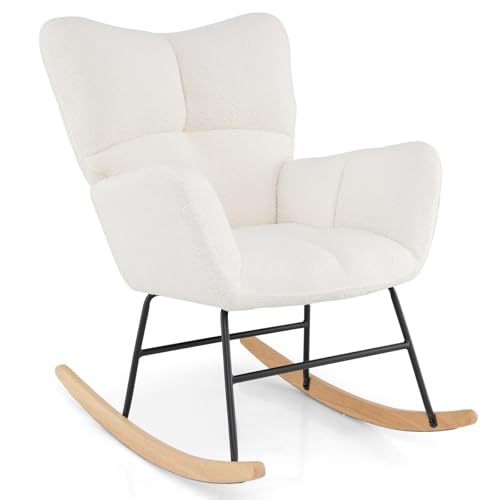
- best overall for small spaces: Giantex Rocking Chair Nursery, Teddy Upholstered, Beige — Check on Amazon
- best low-profile fit: HOMCOM Upholstered Rocking Armchair, Grey — Check on Amazon
- best zero-travel motion: Storkcraft Premium Hoop Glider & Ottoman, White / Light Gray — Check on Amazon
- best narrow design piece: Christopher Knight Home Harvey Mid-Century Modern Fabric Rocking Chair, Grey / Light Walnut — Check on Amazon
See 2 more options
- best use of vertical space: Shine Company Vermont Porch Rocker, White — Check on Amazon
- narrowest minimalist design: Amazon Brand – Stone & Beam Modern Hardwood Rocking Chair, Light Grey — prose-only pick, see the review below for why
Read the full guide ↓
Disclosure: As an Amazon Associate, dailyhomedecorating.com earns from qualifying purchases. Links to Amazon on this page are affiliate links; they cost you nothing extra. Listing details such as price and availability change often, so check the current Amazon listing before you buy.
The best rocking chair for small spaces under $700 is decided by geometry, not upholstery. A rocking chair is the only seat in the house whose footprint moves: a rail rocker needs its depth plus the arc it swings through, a glider needs its depth and almost nothing else, and a tall back can give you full head support while taking no more floor than a dining chair. Shoppers in small spaces — a nursery corner, a bedroom reading spot, a home-office nook, the end of a living room that already has a sofa — do not need a lesser chair. They need the chair whose motion, width and height were designed for the exact gap they have, and they need its real measurements, not a photograph’s impression.
That is how this guide is built. Every pick publishes its dimensions and capacity, and the reviews lead with the space maths: how wide, how deep, how much clearance the motion needs, and where the chair’s comfort comes from — floor area or vertical height. The widths run from 24.5 to just under 30 inches. One pick glides in a flat line and never travels, which makes it the safest choice for a chair placed close to a wall or a crib. One uses a 45-inch back to deliver big-chair comfort on a 27-inch width. And one is prose-only, because its listing had no current tracked Amazon offer at research time — we would rather describe it honestly than link you to a page we could not verify.
Small-space buying has one more rule worth stating early: measure the space you actually have, including the swing, and distrust any chair whose listing will not publish a seat width. If your small space is a whole small apartment, with stairs and a lease attached, the logistics-first version of this shortlist is in Best Rocking Chair For Small Apartments Under $700; if it is one tight corner in a larger home, read on.
In this guide
Quick Picks: best rocking chair for small spaces under $700
| Pick | Best for | Footprint (D x W) | Motion clearance | Capacity | Link |
|---|---|---|---|---|---|
| 1. Giantex Teddy Rocking Chair | Overall small-space balance | 36″ x 26.5″ | Rail arc behind | 330 lb | Check on Amazon |
| 2. HOMCOM Upholstered Rocking Armchair | Low-profile corners | 33.75″ x 25.25″ | Rail arc behind | 330 lb | Check on Amazon |
| 3. Storkcraft Premium Hoop Glider & Ottoman | Zero-travel glide | 30.31″ x 29.92″ | Almost none — stays put | 250 lb | Check on Amazon |
| 4. Christopher Knight Home Harvey | Narrow design corners | 37.3″ x 25.07″ | Rail arc behind | 250 lb | Check on Amazon |
| 5. Shine Company Vermont Porch Rocker | Comfort from height, not floor | 34″ x 27″ | Rail arc behind | 250 lb | Check on Amazon |
| 6. Stone & Beam Modern Hardwood Rocking Chair | Narrowest minimalist fit | 33.75″ x 24.5″ | Rail arc behind | See notes | Prose-only — no live listing verified |
How we chose these small-space rocking chairs
Space maths came first. We required published overall dimensions from every manufacturer and calculated the working footprint the way a small room experiences it: the chair’s depth plus the clearance its motion needs. That single calculation rearranged the category. Some wide, deep rockers that dominate general best-of lists need over 45 inches of working depth; the glider in this guide needs barely more than its own 30.31 inches, because its base never moves. Width was the second screen — nothing here exceeds 30 inches — and seat width the third, because a narrow chair with a narrower seat is a perch, not a place to read.
Comfort per square foot was the deciding idea. In a small space you cannot add floor, but you can add height and upholstery: the Shine’s 45.25-inch back delivers head support on a 27-inch width, the Giantex wraps a full-size sitter in teddy upholstery on 26.5 inches, and the HOMCOM keeps its back at 31.5 inches so a small room keeps its sightlines. We also required a published capacity on every linked pick — 250 to 330 pounds across this list — and screened the category against CPSC recall records, excluding powered nursery recliner-gliders as a class.
One pick is prose-only for an availability reason we state wherever it appears: the Stone & Beam chair’s specification is verified, but no current Amazon offer was tracked for its listing at research time. The other five are linked and actionable today. If your space is small but your budget is smaller, the same geometry-first approach at a lower tier is in Best Rocking Chair For Small Spaces Under $150.
Visual weight was the final screen, and it is the one shoppers feel without naming. Two chairs can share a footprint and occupy a room completely differently: a low, pale, upholstered chair (HOMCOM, Giantex) reads as a fraction of its size, while a tall, dark, slatted one reads larger than it measures. In a small space, visual weight is a real dimension — it decides whether the room feels furnished or full. We weighted it explicitly: every pick here either keeps its profile low, its palette pale, its structure open (slats and rails let light and sight through), or earns its visual presence honestly as the room’s one deliberate focal point. Chairs that were merely bulky — big in the room and ordinary in the seat — did not make the list.
The six small-space rocking chairs in detail
1. Giantex Teddy Rocking Chair — the balanced footprint
The Giantex Rocking Chair Nursery, Teddy Upholstered has the best comfort-to-floor ratio in this guide: 36 inches deep, 26.5 inches wide and 36 inches high, a stated capacity of 330 pounds, and a weight of just 23.5 pounds. The beige teddy upholstery over sponge fill gives it the soft, wrapped feeling of a much larger chair, the seat depth is 19 inches, and the tapered rubberwood feet keep the visual footprint as light as the real one. In a small room, a chair you can slide aside with one hand to vacuum, rearrange or make space for guests is worth more than a few extra inches of cushion.
Who it suits: bedroom reading corners, nursery nooks and small living rooms where the chair must be comfortable daily and movable occasionally. The 26.5-inch width fits the classic dead corner between a bed and a wall or beside a dresser, and the soft silhouette does not fight a small room’s other furniture for attention.
Pros:
- 330-pound stated capacity in a 26.5-inch-wide, 23.5-pound chair
- Compact depth (36″) keeps the rocking arc manageable
- Teddy upholstery delivers big-chair softness on a small footprint
- Light enough to reposition for guests, cleaning or a change of plan
Honest limitation: the 36-inch overall height means the back tops out at the shoulders for taller sitters — there is no head support. The light build can also scoot on hard floors when you sit down; a small rug under the rails is effectively part of the purchase, as it is for every rail rocker here.
Choose it if you want the best all-round balance of comfort, capacity and footprint. Skip it if you need head support — that is the Shine’s trick, below. Check on Amazon
2. HOMCOM Upholstered Rocking Armchair — the low-profile corner chair
The HOMCOM Upholstered Rocking Armchair attacks smallness from the vertical direction: at 31.5 inches high it has the joint-lowest back in this guide, so in a small room it reads as a low lounge chair rather than a looming rocker, while its footprint — 33.75 inches deep by 25.25 inches wide — is the second smallest here. The grey linen-look fabric over foam keeps the look quiet, the curved base is solid rubberwood, and the manufacturer’s 330-pound capacity rating matches the Giantex at the top of this list.
Who it suits: small living rooms where the chair sits in the sightline between the sofa and the screen, low-ceilinged rooms, and anyone furnishing a reading spot under a window or a slope. The low back also makes it the easiest chair here to place in front of shelving or artwork without covering either.
Pros:
- Lowest visual profile: a 31.5-inch back that keeps small rooms open
- Small footprint: 33.75″ deep x 25.25″ wide
- 330-pound stated capacity — the strongest rating at this size
- Neutral grey linen-look fabric; gentlest price band here — check price on Amazon
Honest limitation: low back, no head support — the same trade the profile promises. Long sessions want a cushion at the shoulders. And as a value-brand chair, the finish is tidy rather than refined; in a room where the chair is the centrepiece, the Harvey below presents better.
Choose it if the space is small in every direction, including up. Skip it if you read for hours and lean your head back. Check on Amazon
3. Storkcraft Premium Hoop Glider & Ottoman — the zero-travel answer
The Storkcraft Premium Hoop Glider & Ottoman is the geometric cheat code of this guide. A rail rocker’s working footprint is its depth plus its arc; the Storkcraft’s working footprint is just its footprint — about 30.31 inches deep by 29.92 inches wide — because the enclosed metal ball bearings glide the seat in a flat line while the base stays exactly where you put it. That makes it the only chair here you can place close behind a crib, a sofa back or a wall without a clearance calculation. The set includes a gliding ottoman, the frame is GREENGUARD Gold certified solid wood, the padded arms carry storage pockets, and the rating is 250 pounds.
Who it suits: nurseries first — the chair fits the standard corner beside a crib with no swing room to spare — and any small room where the chair’s neighbours are close: beside a bed, at the end of a sofa, in a bay window. The glide is silent, which in a small home is a space feature too: the chair does not colonise the next room with noise.
Pros:
- Zero travel: the base never moves, so clearance maths is just the footprint
- Shallowest working depth here at about 30.31 inches
- Gliding ottoman included; silent enclosed bearings
- GREENGUARD Gold certified; armrest storage pockets
Honest limitation: it is the widest chair in this guide at 29.92 inches, and its seat is the narrowest at 17.32 inches wide — a combination that fits a defined corner and an average-sized sitter, and nobody else. The 250-pound rating is also a firm ceiling. Measure your own width against that seat before the corner seduces you.
Choose it if depth, not width, is your scarce dimension. Skip it if the gap is narrow or the sitter is broad. Check on Amazon
4. Christopher Knight Home Harvey — the narrow design piece
The Christopher Knight Home Harvey Mid-Century Modern Fabric Rocking Chair is 25.07 inches wide — the narrowest linked chair in this guide — and it uses that narrowness beautifully: a birch frame in a light walnut finish, wooden armrests, grey polyester upholstery and a low 35.43-inch back. At 39.2 pounds it is easy to place precisely, which matters in small spaces where a chair gets angled into a corner at exactly the degree the room allows. The manufacturer’s manual rates it to 250 pounds and specifies wipe-clean care.
Who it suits: the styled small space — a mid-century corner in a compact living room, a reading chair in a home office that also takes meetings, a bedroom chair that must look intentional at this size. The Harvey is the pick when the gap is narrow and the room still has standards.
Pros:
- Narrowest linked width here: 25.07 inches
- Mid-century birch design — a real furniture piece, not a shrunken compromise
- Light 39.2-pound build for precise placement
- Wipe-clean upholstery; wooden armrests at reading height
Honest limitation: depth is the catch — at 37.3 inches plus its rocking arc, the Harvey needs more front-to-back room than its width suggests, so it suits narrow-but-deep gaps better than shallow ones. The 250-pound capacity and firm, upright seat are the other honest costs of the design.
Choose it if your gap is narrow and your taste is mid-century. Skip it if the gap is shallow — take the HOMCOM or the glider. The Harvey’s stationary siblings live in Best Accent Chair For Small Spaces Under $700. Check on Amazon
5. Shine Company Vermont Porch Rocker — comfort from the vertical dimension
The Shine Company Vermont Porch Rocker proves the small-space rule that height is free: on a footprint of 34 inches deep by 27 inches wide — mid-pack here — it rises 45.25 inches, the tallest back in the guide, and delivers the full head support that every compact upholstered chair in this list gives up. The construction is solid acacia hardwood, kiln-dried and sealed, with a slatted back, a seat 15.4 inches off the floor and an 18.5-inch seat depth, rated to 250 pounds and suitable indoors or on a covered porch.
Who it suits: small spaces with ceiling height to spare — which is most of them — and taller sitters whom compact chairs usually abandon. It is also the answer for a small sunroom, enclosed porch or kitchen corner where upholstery would suffer: wood wipes clean, shrugs off sun better than fabric, and asks only for a seat cushion to become a long-session chair.
Pros:
- Tallest back here (45.25″) — real head support on a 27-inch width
- Solid acacia hardwood: nothing to stain, flatten or fade like fabric
- Indoor or covered-porch use doubles its placement options
- Lowest price band in the guide — check price on Amazon
Honest limitation: the seat is unpadded wood, so budget for a cushion if you sit long — and the low 15.4-inch seat height that suits the classic proportions makes standing up harder for stiff knees. Check your doorway height and any low beams on the delivery path; a 45-inch back is the one dimension small-space shoppers forget to measure vertically.
Choose it if your space is short on floor but tall in the corner. Skip it if you want upholstery or a high seat. Check on Amazon
6. Stone & Beam Modern Hardwood Rocking Chair — the narrowest of all, with a caveat
The Amazon Brand – Stone & Beam Modern Hardwood Rocking Chair holds the specification record in this guide: 33.75 inches deep, 24.5 inches wide and 31.13 inches high — the narrowest and joint-lowest design here, in hardwood with light grey upholstery. It appears as a prose-only pick because price trackers showed no current Amazon offer for its listing when we researched this guide, so there is no link and no price claim from us. If it is in stock when you shop, it is the chair for the gap nothing else fits; if it is not, the HOMCOM reproduces its low-profile idea at 25.25 inches wide, today.
Who it suits: the genuinely narrow gap — beside a desk in a box room, at the end of a galley kitchen-diner, in the strip between a wardrobe and a wall — provided you can find it. Its low back keeps it visually silent, which in the smallest rooms is half the battle.
Pros (on specification):
- Narrowest width in the guide: 24.5 inches
- Low 31.13-inch back; hardwood frame; neutral grey upholstery
- Simple rail mechanics, nothing to maintain
Honest limitation: availability is the story — unverified live offers are why this pick carries no Amazon link. The low back also means no head support, and with no published capacity captured in our research, larger shoppers should treat the linked 330-pound picks as the safer small-space answer.
Choose it if it is in stock and the gap is truly 25 inches. Skip it if you are ordering today — the HOMCOM and Harvey cover narrow and low respectively, with live listings.
Side-by-side comparison
| Chair | Width | Working depth | Back height | Capacity | Small-space logic |
|---|---|---|---|---|---|
| Giantex Teddy | 26.5″ | 36″ + arc | 36″ | 330 lb | Balance: compact, light, strong |
| HOMCOM Rocking Armchair | 25.25″ | 33.75″ + arc | 31.5″ | 330 lb | Low profile, small footprint |
| Storkcraft Premium Hoop | 29.92″ | 30.31″ total | 39.96″ | 250 lb | Glide travels zero inches |
| Christopher Knight Home Harvey | 25.07″ | 37.3″ + arc | 35.43″ | 250 lb | Narrowest linked design piece |
| Shine Company Vermont | 27″ | 34″ + arc | 45.25″ | 250 lb | Comfort bought with height |
| Stone & Beam Hardwood | 24.5″ | 33.75″ + arc | 31.13″ | See notes | Narrowest overall — prose-only |
How to choose a rocking chair for a small space
Measure the working footprint, not the catalogue footprint. Tape two outlines on the floor: the chair itself, and the chair plus its motion — several inches behind a rail rocker, essentially nothing behind a glider. Live with the tape for a day and walk your normal paths through it. If the second outline blocks a route you use hourly, the chair is too big for the space no matter what its dimensions say, and the glider becomes the right answer.
Identify your scarce dimension. Small spaces are rarely small in every direction. If width is scarce, the 24.5-to-25.25-inch chairs (Stone & Beam, Harvey, HOMCOM) are your shortlist. If depth is scarce, only the glider truly solves it. If the room is small but the ceiling is ordinary, height is your free dimension — the Shine spends it on head support. Name the constraint before you shop and the list shortens itself.
Check the seat inside the chair. Small chairs hide small seats. The Storkcraft’s seat is 17.32 inches wide inside a 29.92-inch frame; the Giantex gives a 19-inch seat depth inside 26.5 inches of width. Your hips live in the first number, your room in the second — you need both, and any listing that hides its seat width is telling you something.
Use light and vertical tricks honestly. Pale upholstery (teddy beige, boucle ivory in our wider guides) and low backs keep a small room feeling open; a rug slightly larger than the working footprint defines the corner without walls. An over-chair arc lamp lights the seat without spending floor on a table — the apartment-sized options in Best Arc Floor Lamp For Apartments Under $200 suit small corners in houses just as well.
Keep the exit in mind. Small-space chairs get rearranged more than any other furniture. Light weight (the Giantex at 23.5 pounds), simple bases and no wall-hugging recline mechanisms keep the chair flexible. And keep the category rule from our other guides: manual chairs only — the powered nursery recliner-gliders we screened out after recall checks need outlets, clearance and servicing that a small space cannot spare.
The small-space measurement workshop: three real corners
Corner one: the 30-inch gap beside a sofa. You have a slot 30 inches wide and as deep as you like. Width rules here, so the shortlist is the narrow three: the Harvey at 25.07 inches, the HOMCOM at 25.25, and — if it is in stock — the Stone & Beam at 24.5. Each leaves a hand’s width on both sides, which is the difference between a chair that lives in the gap and a chair wedged into it. Depth is your free dimension in this corner, so the Harvey’s 37.3 inches plus its arc is acceptable; angle the chair a few degrees toward the room and the arc swings into open floor instead of toward the wall. The glider cannot help you here — at 29.92 inches wide it technically fits and practically does not.
Corner two: the shallow nursery corner. You have width to spare but only about 34 inches of depth before the chair would crowd the crib or block the door swing. Now depth rules, and the answer is mechanical: the Storkcraft glider’s working depth is its catalogue depth, 30.31 inches, because the base never moves — it is the only chair in this guide that fits this corner with clearance to spare. Every rail rocker fails this corner on paper once you add its arc, and this is the honest moment to accept the fact rather than discover it with a built chair. If a glider’s look does not suit the room, the fallback is the shallowest rail rocker (the HOMCOM at 33.75 inches) placed so its arc swings toward open floor, never toward the crib.
Corner three: the tall, tight bedroom corner. Floor is scarce — roughly 28 by 36 inches — but the ceiling is ordinary and the corner is vertical dead space. This is the Shine’s corner: a 27-inch width, a 34-inch depth plus arc, and a 45.25-inch back that converts unused height into the head support no compact upholstered chair can offer. The runner-up logic is the Giantex: two inches narrower, fully upholstered, no head support, but a softness the wooden chair only reaches with a cushion. Choose between them by what the corner is for — long leaned-back reading (Shine, plus cushion) or soft everyday sitting (Giantex).
The cardboard rehearsal. Whatever your corner, rehearse it before you order. Cut a piece of cardboard — a flattened delivery box is perfect — to the chair’s working footprint: catalogue depth plus six inches for a rail rocker, catalogue depth alone for the glider, at the chair’s full width. Put it on the floor and live around it for a day. Open every door, walk every route, sit on the floor where the chair’s sitter will face. Cardboard is honest in a way imagination is not, and it costs nothing; the five minutes with scissors is the highest-value step in this entire guide.
The vertical rehearsal matters too. Stand in the corner and mark the chair’s back height on the wall with tape. In a small room you will see instantly whether a 45-inch back composes well against your shelves and windows or overwhelms them, and whether a 31.5-inch low back disappears the way you hoped. Small-space furnishing fails upward as often as it fails outward — measure all three dimensions, every time.
A fourth corner, briefly: the rental you cannot change. If the small space is rented, add two constraints to the workshop: nothing that marks (rug under rails, always) and nothing that cannot leave (light weight, simple disassembly). The Giantex and HOMCOM are the rental-native picks here — both under 27 inches wide, both strongly rated, both movable by one person — while the Shine, for all its vertical genius, should be bought by people who expect to keep it through the next home as well.
Common mistakes when buying for a small space
Forgetting the arc. The single most common small-space failure: the chair fits its tape outline and then rocks into the wall, the crib or the bookshelf behind it. Always tape the working footprint — chair plus swing — and if there is no room for the swing, buy the glider.
Assuming “compact” on a listing means measured. Compact is a marketing word. The chairs in this guide earned their place with published dimensions; if a listing gives you adjectives instead of inches, it does not belong in a small space, because you cannot verify the one thing that matters.
Shrinking the seat along with the chair. A small footprint with a perch for a seat will be abandoned within a month, and an abandoned chair is the biggest waste of space of all. Protect the seat dimensions first and let the frame be clever around them.
Blocking the room’s working paths. A chair that fits but forces a sideways shuffle past it, every day, is too big in the only sense that counts. Walk the taped outline at your normal pace, carrying something, before you order.
Ignoring the vertical tape measure. Shoppers measure width and depth, then discover the tall back will not pass a low doorway or sits awkwardly under a slope. The Shine’s 45.25 inches is a feature in the corner and a measurement at the door — check both.
Small-space rockers, room by room
The nursery corner. The nursery’s small space is the most demanding in the house: the chair must fit beside a crib, move quietly at night, and keep its mechanism away from a child who will soon explore it. That is the glider’s home ground, and the Storkcraft’s specification — a 30.31-inch working depth, enclosed bearings, a gliding ottoman that keeps feet off a cold floor — reads like it was written for this paragraph, because it was. Place it so the glide path never crosses the crib’s side, keep cords and curtain pulls out of reach of the seated adult’s shoulder, and let the armrest pockets hold the night shift’s supplies so nobody crosses the room in the dark.
The bedroom corner. Bedroom rockers live closer to their owners than any other chair: they hold the book, the clothes-that-are-not-dirty, and the first five minutes of the morning. Small bedroom corners favour the upholstered compact picks — the Giantex for softness at 26.5 inches wide, the HOMCOM for a low profile under the window — and they punish depth, because the chair competes with the bed’s own generous footprint. Measure from the bed’s edge, not the wall: the working gap is between the chair and the bed, and it must pass a person carrying laundry, at night, without a sideways shuffle.
The home-office nook. A rocker in a working room is a thinking chair, and the office versions of small are about posture and appearance: the Harvey’s upright, tailored seat supports reading and calls, and its mid-century frame looks deliberate on camera in a way a nursery glider never will. Keep the arc out of the desk chair’s rolling territory — two moving chairs in one nook is a collision schedule — and give the rocker the room’s natural light if it gets any, because that is where you will actually sit.
The living-room end. The hardest small space is not small at all: it is the leftover end of a furnished living room, where the chair must join an existing composition. Here the vertical and visual rules dominate — a low back (HOMCOM, Harvey) slides under the room’s sightlines, a tall back (Shine) must be placed where its height is a feature, against a wall or in a bay, and a texture (Giantex’s teddy) should echo one existing textile rather than introduce a new one. The living-room corner is also where the cardboard rehearsal earns its keep twice over, because the chair must fit the room’s traffic and its photograph.
The landing, the hall, the in-between. Small homes have one more space that is not a room: the wide landing, the hall alcove, the bay at the stair turn. A compact rocker turns these into the house’s quietest seat — the Giantex’s 23.5 pounds lets it colonise a landing without committing it, and a rail rocker’s arc needs only the alcove’s own depth. If your home has such a space, it may be the best rocking-chair site you own: out of every room’s way, in nobody’s path, and silent by geography.
Whichever room claims the chair, one small-space habit protects them all: keep the chair’s sector sacred. Small rooms fail by accumulation — the box that waits a week in the glide path, the shoes that colonise the arc, the laundry that turns the rocker into a wardrobe. A chair whose swing stays clear keeps working as a chair; a chair whose swing fills with the room’s overflow becomes furniture-shaped storage within a month. The picks in this guide are sized so their sectors are small enough to defend. Defend yours, and the smallest seat in the house stays the one that is always ready.
That readiness is, in the end, the whole argument of this guide. A small space does not need a smaller life; it needs furniture whose measurements were honest enough to plan around. Every chair here published its numbers, kept its motion inside a defensible sector, and brought a full-size promise — a real seat, a real capacity, a real back — into a footprint a small room can spare. Measure your sector, choose the chair whose logic matches your scarcest dimension, and the corner you thought was too small becomes the seat the whole household quietly prefers.
One chair, everything else: fitting a rocker into a room that already works
Most small spaces are not empty. The chair you are choosing must join a room that already functions — a desk that earns money, a bed that cannot move, a sofa that owns its wall — and the fitting problem is diplomatic as much as geometric. Begin by ranking the room’s existing pieces by how immovable they are, honestly: the bed and the desk usually cannot yield; the side table, the plant and the floor lamp almost always can. The rocker’s corner is carved out of the movable pieces, not the fixed ones, and the movable piece it most often displaces — the side table — is exactly the one an arc lamp and a chair pocket or ottoman can replace. That exchange, table for lamp-plus-storage, is how several corners in this guide’s workshop become possible.
Then negotiate the boundaries in the right units. A rocker does not need a rectangle; it needs a swing sector — a wedge of clear floor behind and in front of its base, narrow at the chair and widening nowhere, because the arc is widest at the rails themselves. Rooms are full of wedges: the sector beside a sofa’s arm, the fan of floor a bay window creates, the triangle a corner desk leaves behind it. Shoppers who think in rectangles conclude there is no room; shoppers who think in sectors find the chair was always going to fit. The cardboard rehearsal from the workshop section is how you test a sector — cut the cardboard to the swing, not the silhouette.
Finally, let the chair pay rent. In a small space, a piece that only does one thing is a luxury; the rocker that also seats a guest, holds the book and the blanket, anchors the reading light and gives the room its calm corner is paying for its sector four times over. That is the standard the six picks here were chosen against — not the smallest chairs we could find, but the chairs whose comfort, capacity and manners justify their footprint in a room where every square foot already has a job. Fit the sector, clear the swing, and the smallest room in the house gains the seat everyone will quietly compete for.
Final recommendation
For most small spaces, the Giantex Teddy Rocking Chair is the balanced answer: compact, light, strongly rated and genuinely comfortable. If depth is your scarce dimension, the Storkcraft glider removes the clearance problem entirely; if width is, the Harvey and HOMCOM fit gaps other chairs cannot; and if your corner has height to spend, the Shine buys head support with it. The Stone & Beam remains the narrowest design on paper — check its stock before you settle. Tape the working footprint, name your scarce dimension, and then check the current price on Amazon. For the same chairs judged on apartment logistics instead of geometry, see Best Rocking Chair For Small Apartments Under $700.
FAQ
How much clearance does a rocking chair need behind it? A rail rocker needs several inches beyond its static depth for the arc — tape the chair’s depth plus a hand’s width as a starting point, more for long-rail designs. A glider needs almost none, because the base does not move; that is why the Storkcraft’s working depth equals its catalogue depth.
What is the smallest rocking chair in this guide? By width, the prose-only Stone & Beam at 24.5 inches; among linked chairs, the Harvey at 25.07 inches wide and the HOMCOM at 25.25 inches with the joint-lowest back. By working depth, the Storkcraft glider wins outright at about 30.31 inches total.
Can a tall person use a small-space rocking chair? Yes, if you choose by dimension rather than by category. The Shine’s 45.25-inch back gives tall sitters head support on a 27-inch width, and the Giantex’s 330-pound capacity and 19-inch seat depth suit larger frames. What tall sitters should avoid is a low back plus a shallow seat together.
Is a glider cheating as a “rocking chair for small spaces”? No — it is the honest engineering answer to the actual problem, which is motion in a confined footprint. If the rocking arc itself is the pleasure you are buying, choose a compact rail rocker and give it its clearance; if the soothing motion is the point, the glider delivers it in less room.
Why is one pick not linked to Amazon? The Stone & Beam chair’s listing had no current tracked Amazon offer at research time. We verify listings before linking, so it is covered as a prose-only pick with its specification stated and its availability problem flagged — if it returns to stock, it is the narrowest option here.
What rug size works under a small-space rocker? Slightly larger than the working footprint — the chair’s outline plus its swing — in a low pile the rails or base can move over freely. The rug also protects the floor and stops a light chair like the Giantex from scooting on hard surfaces.
Can a rocking chair work in a home office? Yes — a small-space rocker is often the best second seat an office can have, for reading, calls and thinking away from the desk. The Harvey’s upright seat and designed look suit a working room best; keep its arc clear of the desk chair’s territory, and expect the rocker to become the room’s favourite seat for everything except typing.
What if my space is small but my budget is smaller? The geometry in this guide scales down in price better than in size: the same measurement method, applied to the budget tier in Best Rocking Chair For Small Spaces Under $150, finds compact chairs whose footprints rival these — what you give up at that level is upholstery quality and capacity headroom, not the space maths.


