Where to buy
Check the latest price, availability and delivery on Amazon. Orders are placed on Amazon. We may earn a commission from qualifying purchases.
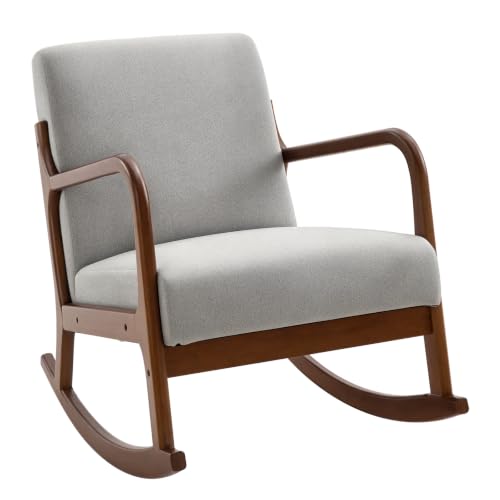
- best overall for apartment living: HOMCOM Upholstered Rocking Armchair, Grey — Check on Amazon
- best lightweight pick for walk-ups: Giantex Rocking Chair Nursery, Teddy Upholstered, Beige — Check on Amazon
- best narrow mid-century fit: Christopher Knight Home Harvey Mid-Century Modern Fabric Rocking Chair, Grey / Light Walnut — Check on Amazon
- best full-size comfort that still fits: Yaheetech Upholstered Rocking Chair, Boucle, Ivory — Check on Amazon
See 2 more options
- best stay-in-place glider: Storkcraft Premium Hoop Glider & Ottoman, White / Light Gray — Check on Amazon
- narrowest minimalist design: Amazon Brand – Stone & Beam Modern Hardwood Rocking Chair, Light Grey — prose-only pick, see the review below for why
Read the full guide ↓
Disclosure: As an Amazon Associate, dailyhomedecorating.com earns from qualifying purchases. Links to Amazon on this page are affiliate links; they cost you nothing extra. Listing details such as price and availability change often, so check the current Amazon listing before you buy.
Choosing the best rocking chair for small apartments under $700 is a logistics problem before it is a comfort problem. The chair has to come up the stairs or fit the elevator, pass a doorway that was not designed for furniture, assemble in the room it will live in because there is no spare room to build it in, rock without eating the walkway, and — when the lease ends — leave without a fight or a deposit deduction. Every pick in this guide was chosen against that reality: compact footprints, honest weights, simple assembly, and prices that leave room in the budget for the rug that protects both the floor and your deposit.
The six chairs below span the apartment-friendly spectrum. The narrowest is just 24.5 inches wide; the lightest weighs 23.5 pounds and can be carried upstairs by one person; one is a glider that stays exactly where you put it, which matters when the chair lives two feet from the television; and one full-size boucle rocker proves that “apartment-sized” does not have to mean a shrunken seat — it means a footprint you have honestly measured. One pick is prose-only because its Amazon listing had no current tracked offer at research time; we describe it anyway because on paper it is the narrowest design here, and we would rather flag the availability problem than hide the chair.
Two apartment rules shaped the list. First, no powered chairs: beyond the category’s recall history with electronic nursery recliner-gliders, a small apartment has no spare outlets and no patience for a chair that needs one. Second, floor respect: rail rockers in rentals belong on rugs or pads, both to protect the landlord’s hardwood and to stop the slow creep across the room that ends with the chair against the wall. If your apartment is generous and you are furnishing for the long term, compare the full-size shortlist in Best Rocking Chair Under $700 as well.
In this guide
Quick Picks: best rocking chair for small apartments under $700
| Pick | Best for | Width | Weight | Capacity | Link |
|---|---|---|---|---|---|
| 1. HOMCOM Upholstered Rocking Armchair | Overall apartment fit | 25.25″ | Light | 330 lb | Check on Amazon |
| 2. Giantex Teddy Rocking Chair | Walk-ups and frequent movers | 26.5″ | 23.5 lb | 330 lb | Check on Amazon |
| 3. Christopher Knight Home Harvey | Narrow mid-century corners | 25.07″ | 39.2 lb | 250 lb | Check on Amazon |
| 4. Yaheetech Boucle Rocking Chair | Full-size seat, measured honestly | 28″ | About 47 lb | 300 lb | Check on Amazon |
| 5. Storkcraft Premium Hoop Glider & Ottoman | Stay-in-place glide near the TV | 29.92″ | 46 lb | 250 lb | Check on Amazon |
| 6. Stone & Beam Modern Hardwood Rocking Chair | Narrowest minimalist design | 24.5″ | See notes | See notes | Prose-only — no live listing verified |
How we chose these apartment rocking chairs
We started with the tape measure. Every pick is under 30 inches wide, and we recorded the three numbers apartment shoppers actually need: overall width for the corner, depth for the rocking clearance, and item weight for the stairs. Chairs with no published weight or dimensions — common among marketplace listings — were excluded, because in a small apartment an unverified dimension is a return waiting to happen. We also required a published capacity from the manufacturer, and screened the category against CPSC recall records, which removed powered nursery recliner-gliders from consideration entirely.
Assembly mattered more here than in any other guide in this series. Apartment chairs get built in their final room, often by one person, so we favoured designs with a handful of parts — a seat body, a back, and a rocking base — over anything with a complex mechanism. The one glider set here (Storkcraft) assembles from a frame, cushions and an ottoman, and its reward is a chair that never travels across the floor: in a room where the chair sits close to other furniture, a glide that stays put is worth more than a dramatic rocking arc.
Finally, we priced the whole corner, not just the chair. A rocker in a rental needs a low-pile rug or rail pads under it; all six picks sit comfortably enough below the $700 ceiling to leave that money unspent — most sit far below it, and the smaller-budget end of the same shortlist is covered in Best Rocking Chair For Small Apartments Under $300.
Noise deserved its own screen, because apartment living is shared living. A rocking chair’s sound comes from three places: the mechanism (glide bearings are the quietest, which is why the Storkcraft leads on this axis), the floor contact (rails on hard floors transmit a soft knock to the room below, almost entirely cured by a rug), and the chair’s own joints (a well-tightened frame is silent; a loose one announces itself). We favoured chairs whose noise story could be managed with a rug and a screwdriver, and we note the honest exception in the reviews: no rail rocker on a bare hard floor is a good neighbour at midnight, whatever its price.
The six apartment rocking chairs in detail
1. HOMCOM Upholstered Rocking Armchair — the apartment all-rounder
The HOMCOM Upholstered Rocking Armchair is the chair we would hand to someone furnishing a first apartment: 33.75 inches deep, 25.25 inches wide and just 31.5 inches high, in grey linen-look fabric over foam, on a curved rubberwood rocking base — and the manufacturer rates the frame to 330 pounds, the joint-highest capacity in this guide. The low back keeps a small living room feeling open, the footprint fits the corner beside a sofa without swallowing the walkway, and the price band is the gentlest here, leaving budget for the rug it should sit on.
Who it suits: renters in studios and one-bedrooms who need a real reading chair that behaves like apartment furniture: modest footprint, neutral colour, no assembly drama, no visual bulk. The grey fabric pairs with whatever sofa came with the flat or followed you from the last one, and the chair is light enough to shift when guests turn the living room into a bedroom.
Pros:
- Compact footprint: 25.25 inches wide, with a low 31.5-inch back that keeps the room open
- 330-pound stated capacity — unusually strong for a chair this size
- Grey linen-look fabric works with any rental palette
- Gentlest price band in the guide — check price on Amazon — leaving room for a rug and lamp
Honest limitation: the low back that makes it apartment-friendly means no head support; long reading sessions want a cushion behind the shoulders. HOMCOM is a value brand, so the finish is honest rather than luxurious, and like every rail rocker it needs a rug or pads on hardwood to protect the floor and stop it creeping.
Choose it if you want the safest all-round apartment buy. Skip it if you are tall and want a back that reaches your head — look at the Yaheetech. Check on Amazon
2. Giantex Teddy Rocking Chair — the walk-up specialist
The Giantex Rocking Chair Nursery, Teddy Upholstered weighs 23.5 pounds. In apartment terms, that number is the whole review: one person can carry it up three flights, turn it sideways through a narrow doorway, and reposition it alone whenever the room changes its mind. It is also a genuinely comfortable chair — beige teddy upholstery over sponge fill, a high wrapping back, tapered rubberwood feet — measuring 36 inches deep, 26.5 inches wide and 36 inches high, with a stated capacity of 330 pounds that belies the featherweight build.
Who it suits: anyone in a walk-up, a shared house or a lease with an end date. It is the chair that survives apartment life logistically: easy in, easy out, easy to sell or hand on. The soft teddy finish also warms up the magnolia-and-laminate palette most rentals come with, and at 26.5 inches wide it fits bedroom corners that a full armchair would block.
Pros:
- 23.5 pounds — the lightest pick here by a wide margin; one-person stairs, doors and moves
- 330-pound stated capacity despite the light build
- Compact 26.5-inch width for bedroom and studio corners
- Teddy upholstery softens a plain rental room instantly
Honest limitation: light chairs move. On hard floors the Giantex can scoot as you sit or stand, so it belongs on a rug — which you wanted under a rocker anyway. The 36-inch back supports shoulders rather than heads, and the sponge seat is firmer than deep foam; marathon lounging is better served by the Yaheetech.
Choose it if stairs, doors or a future move are your real constraints. Skip it if you want a heavy, planted feel. Check on Amazon
3. Christopher Knight Home Harvey — the narrow design piece
The Christopher Knight Home Harvey Mid-Century Modern Fabric Rocking Chair fits where apartment chairs usually fail: at just over 25 inches wide, with a low 35.43-inch back and a light 39.2-pound build, it slides into the gap between a sofa and a bookshelf and looks designed rather than squeezed. The birch frame with its light walnut finish and wooden armrests gives a small room a piece of real furniture design, the grey polyester wipes clean, and the manufacturer’s manual rates it to 250 pounds.
Who it suits: apartment dwellers whose small room still has a style — mid-century, Scandinavian or simply tidy. The Harvey is the chair for the corner by the window with a floor lamp and a stack of books, and its upright seat doubles as a respectable extra chair when guests come and the dining chairs run out.
Pros:
- Narrow 25.07-inch width and low profile for tight corners
- Light 39.2-pound build; easy to move for guests or cleaning
- Mid-century birch design lifts a plain rental room
- Wipe-clean polyester upholstery
Honest limitation: the 250-pound capacity is the joint-lowest here, and the tailored seat is firm and upright — a reading chair, not a nap chair. Check the delivery box against your stairwell turns before ordering any chair, this one included; its assembled size is apartment-friendly, but no assembled chair loves a Victorian staircase.
Choose it if the corner is narrow and the room has standards. Skip it if you need a higher capacity or a softer sit. The same corner, furnished as a set, is covered in Best Accent Chair For Small Apartments Under $700. Check on Amazon
4. Yaheetech Boucle Rocking Chair — full-size comfort, honestly measured
The Yaheetech Upholstered Rocking Chair is the proof that an apartment chair does not have to be a miniature: a 21.7-inch-wide, 21-inch-deep seat, a 26.2-inch backrest and a 300-pound stated capacity, in ivory boucle on rubberwood rails with anti-tip stoppers. The honest part is the footprint — 28 inches wide and 39 inches deep before rocking clearance — which is why it is fourth on this list instead of first: it fits small apartments that have one proper corner to give it, and it will crowd the ones that do not.
Who it suits: taller apartment dwellers and anyone who has suffered a too-small “apartment-sized” chair. The 21-inch seat height is the easiest here to stand up from, the seat fits an adult properly with a book and a cat, and the boucle makes a studio’s living zone feel furnished rather than camped in. Measure first: tape 28 by 42 inches on the floor (footprint plus arc) and live with the tape for a day.
Pros:
- Full adult seat — 21.7 inches wide — in an apartment-viable footprint
- 300-pound stated capacity and anti-tip rail stoppers
- High 21-inch seat suits taller sitters and easy standing
- Boucle finish makes a small living zone feel intentional
Honest limitation: depth is the tax. At 39 inches plus swing room it needs the biggest corner on this list, and ivory boucle in a small, busy apartment — where the chair is also the guest seat and the laundry-folding seat — will work hard to stay ivory. Spot-clean only; keep the snacks at the table.
Choose it if you have one real corner and want a real chair in it. Skip it if the tape test fails — the HOMCOM gives up little and fits almost anywhere. Check on Amazon
5. Storkcraft Premium Hoop Glider & Ottoman — the chair that stays put
The Storkcraft Premium Hoop Glider & Ottoman solves a specifically apartment-shaped problem: in a small room, a rail rocker slowly migrates, but a glider on enclosed metal ball bearings moves in a flat line and stays exactly where you placed it. The set — chair plus gliding ottoman — assembles to about 30 inches deep, 30 inches wide and 40 inches high, is GREENGUARD Gold certified, and is rated to 250 pounds. The padded arms have storage pockets, which in a small apartment is not a gimmick; it is where the remote lives now.
Who it suits: apartment nurseries and living rooms where the chair sits close to a wall, a sofa or a television and cannot be allowed to wander. The glide is silent — a genuine mercy in a flat with thin walls and neighbours below — and the ottoman gives feet-up comfort without the floor space a recliner demands.
Pros:
- Glide stays in place: no migration toward walls or furniture
- Silent enclosed bearings — neighbour-friendly at any hour
- Gliding ottoman included; armrest pockets add real storage
- GREENGUARD Gold certified solid-wood frame
Honest limitation: at 29.92 inches wide it is the widest footprint here, and the seat itself is the narrowest — 17.32 inches — an odd combination that suits average and petite sitters in a defined corner, not sprawling. The traditional nursery styling also stands out in a modern living room; this is the practical pick, not the pretty one.
Choose it if staying put and staying quiet matter most. Skip it if you need a wide seat or a design-led look. Check on Amazon
6. Stone & Beam Modern Hardwood Rocking Chair — the narrowest, if you can find it
On paper, the Amazon Brand – Stone & Beam Modern Hardwood Rocking Chair is the apartment chair perfected: a hardwood frame with light grey upholstery at 33.75 inches deep, 24.5 inches wide and 31.13 inches high — the narrowest and joint-lowest profile in this guide. It is in this guide as a prose-only pick because, at research time, price trackers showed no current Amazon offer for the listing, so we cannot link you to a page we have verified is live. Its tracked price history sits in the budget-to-mid band, and if it returns to stock it deserves its place here on specification alone.
Who it suits: studio dwellers with a genuinely narrow gap — beside a desk, at the end of a galley living room — who find it in stock. Until then, treat it as the benchmark the others are measured against: the HOMCOM matches its low-profile idea at 25.25 inches wide with a live listing, and the Harvey matches its designed look at 25.07 inches.
Pros (on specification):
- Narrowest width here: 24.5 inches
- Low 31.13-inch back keeps small rooms feeling open
- Hardwood frame and neutral grey upholstery suit any rental palette
Honest limitation: availability, again — no verified live offer means no link and no price claim from us. The low back also means no head support, the standard trade at this profile height.
Choose it if it is in stock when you shop and the gap is truly narrow. Skip it if you are ordering today — the HOMCOM is the same idea, available now.
Side-by-side comparison
| Chair | Width | Depth + motion | Weight | Capacity | Apartment standout |
|---|---|---|---|---|---|
| HOMCOM Rocking Armchair | 25.25″ | 33.75″ + rail arc | Light | 330 lb | Low back, strong frame, low price |
| Giantex Teddy | 26.5″ | 36″ + rail arc | 23.5 lb | 330 lb | Easiest carry on the list |
| Christopher Knight Home Harvey | 25.07″ | 37.3″ + rail arc | 39.2 lb | 250 lb | Design piece for narrow corners |
| Yaheetech Boucle | 28″ | 39″ + rail arc | About 47 lb | 300 lb | Full-size seat, biggest corner needed |
| Storkcraft Premium Hoop | 29.92″ | 30.31″, glide stays put | 46 lb | 250 lb | No migration; silent; ottoman included |
| Stone & Beam Hardwood | 24.5″ | 33.75″ + rail arc | See notes | See notes | Narrowest — prose-only, availability |
How to choose a rocking chair for a small apartment
Measure three things, in this order: the doorway, the stairs, the corner. Most apartment chair failures happen at the doorway, not the corner. Note your door width and any tight stair turn, then compare them with the chair’s box and assembled dimensions on the listing. Only then tape the corner: width, depth, and the extra inches the rocking arc needs behind the chair. A glider like the Storkcraft needs the least clearance because it does not travel; a rail rocker’s tape outline should be its depth plus a hand’s width behind.
Weight is a feature. In a house, a heavy chair feels like quality. In a third-floor walk-up, it feels like a mistake you carry. The spread in this guide runs from 23.5 pounds (Giantex) to about 47 (Yaheetech) among the linked picks — all manageable, but if you move often or live alone up stairs, buy toward the light end and accept a rug as the anchor.
Protect the floor and the deposit. Rails concentrate your weight on two lines of wood. On a landlord’s hardwood that means dents, and on laminate it means a chair that skates. A low-pile rug slightly larger than the tape outline solves both, quiets the rock, and defines the reading corner in an open-plan room. It is the cheapest insurance in this entire purchase — and the lighting equivalent, an over-chair lamp that needs no table space, is covered in Best Arc Floor Lamp For Apartments Under $300.
Make the chair earn its footprint twice. In a small apartment every piece should do two jobs: a rocker that is also the guest chair (Harvey’s upright seat), the nursery chair that becomes the reading chair (Storkcraft), or the chair with storage in its arms and ottoman (Storkcraft again). If a chair only rocks, beautifully, in a room that also needs seating for three, it is a luxury the floor plan may not support.
Check the lease before the listing. Most leases care about floors, not furniture — but if yours restricts anything beyond that, a manual, rug-mounted chair is the easiest possible answer. Nothing in this guide plugs in, mounts to a wall, or needs assembly beyond basic tools in the room itself.
The apartment move-in playbook
Before delivery day: walk the route like the box. Measure the building’s pinch points — the front door, the stairwell turn, the elevator door, your own doorway — and compare them with the box dimensions on the listing, not the chair’s. Boxes are rectangular and forgiving at angles a built chair is not. If the route includes a tight turn, the lighter picks in this guide (Giantex at 23.5 pounds, Harvey at 39.2) are the ones that forgive a mistake; a heavy box on a bad staircase is how delivery day goes wrong. Note where the box will wait while you build: in most apartments, that is the room itself, so clear the corner before the doorbell rings.
Build in the room, in the right order. Open the box in the chair’s final room and lay the parts on the rug the chair will sit on — the rug protects the floor during assembly as well as after it. Build the base first, then the seat, then the back, and keep every bolt finger-tight until the chair stands square; rocking chairs assembled slightly twisted rock slightly twisted, forever. Keep the Allen key. Apartments generate exactly one opportunity to lose it — the day you throw the box out — and you will want it at the first monthly tightening and again on move-out day if the chair travels better in two pieces.
Placement is an experiment for the first week. Put the chair where the tape said, then live with it for a few days before deciding the corner is final. Small apartments reveal their real traffic patterns slowly: the route to the kitchen at night, the door that opens wider than you remembered, the socket the lamp actually needs. Rail rockers will also tell you about the floor — a chair that creeps toward one side is reporting a slope, and rotating it a few degrees or centring it on the rug usually settles it. The glider, as ever, skips this chapter: it stays where it lands.
Make the corner multi-use from day one. In a small apartment the rocking corner is also the guest corner, the video-call background and the laundry-folding station. Choose the version of that corner deliberately: a small wall shelf instead of a side table keeps the floor clear, the arc lamp lights the chair without a table’s footprint, and a chair with pockets or a storage ottoman (the Storkcraft’s arms, in this guide) quietly absorbs the remote, the charger and the book. The chair that earns its square footage three ways is the chair that survives the next furniture reshuffle.
Move-out day is part of the purchase. When the lease ends, the playbook reverses: photograph the floor under the rug before you lift it, tighten-check the chair, and decide honestly whether it travels whole (the light picks), in two pieces (most rail rockers separate base from body with the bolts you kept), or to a new home via a marketplace listing — compact, clean, well-kept chairs like the Harvey and HOMCOM resell easily in cities full of people solving the same problem you solved. A chair bought with its exit in mind never becomes the thing abandoned on the kerb at midnight.
Common mistakes when buying a rocking chair for an apartment
Measuring the corner and forgetting the journey. The chair fits the corner perfectly and cannot get up the stairs. Assembled dimensions, box dimensions and item weight are apartment specifications; check all three before ordering, especially in walk-ups and older buildings.
Putting a rail rocker straight on the landlord’s floor. Two rails, one deposit. Rug or pads, from day one — and photograph the floor before and after for your own records, the same way you did at move-in.
Buying the biggest comfort in the smallest room. A 39-inch-deep rocker plus its arc can consume the entire living zone of a studio. If the tape outline leaves no walkway, the chair is too big no matter how comfortable the seat is; drop to the HOMCOM or Giantex class and keep the room usable.
Choosing a chair that cannot leave. If you cannot picture the chair going back down the stairs — disassembled or whole — in one trip with one friend, it is the wrong chair for a rental. Light, simple-base designs are the apartment-native species for a reason.
Skipping the capacity check because the chair looks sturdy. Small chairs carry small print: capacities here run from 250 to 330 pounds. A compact chair with a 330-pound rating (HOMCOM, Giantex) is a genuinely better apartment buy than a larger chair rated lower, because it will serve every guest and every future version of you.
One chair, three apartment layouts
The studio layout: one room, four jobs. In a studio, the rocking chair sits in the living zone and must not annex the sleeping or working zones. The winning arrangement puts a low-backed chair (HOMCOM, or the Harvey) at the edge of the rug that defines “living,” angled toward the room rather than the wall, so its arc swings over the rug and its back never becomes the first thing seen from the bed. The chair doubles as the guest seat and the video-call seat; keep a small wall shelf at its elbow instead of a table, and let the arc lamp stand behind it, outside the walkway. In this layout the chair’s width matters less than its back height — low reads as furniture, tall reads as a wall.
The one-bedroom layout: the chair gets the corner by the window. With a separate bedroom, the living-room corner can take the bigger comfort: this is the Yaheetech’s natural home, or the Storkcraft if the chair doubles as a nursery-overflow seat. Give it the window corner — rocking chairs and daylight belong together — with the lamp behind its shoulder and the walkway passing in front of it, never behind, so the arc is never a trip line. Because the room has a door, noise discipline relaxes; because the corner is permanent, this is the layout where a rug sized generously under the chair pays for itself in floor protection.
The shared-house layout: the chair lives in the bedroom. In a house share, the living room is negotiated territory and the bedroom is yours, so the chair goes where you actually are. Bedroom corners are smaller and the chair sits closer to the bed, which favours the light, narrow picks — Giantex for softness, Harvey for a designed look, HOMCOM for the lowest profile under a window. The bedroom layout’s hidden constraint is the morning route: bed to door, half asleep. Place the chair so its arc never crosses that route, and prefer a chair light enough to shift for the weekly clean, because bedroom corners collect dust exactly where furniture never moves.
What all three layouts share. A rug under the rails, light at the shoulder, the arc swinging toward open floor, and a chair whose weight lets you change your mind. Apartments punish permanence and reward furniture that can be re-decided; every pick in this guide can be re-decided by one or two people in an afternoon. That, more than any single dimension, is what makes a rocking chair apartment furniture rather than a mistake with good upholstery.
A last layout rule: keep the chair out of the door’s swing and the flat’s escape route. Building codes and common sense agree that the path from bed to door should stay clear, and rocking chairs — inviting, corner-shaped, always migrating a few inches — are champion route-blockers. When you place yours, open every door fully, walk the night route once in the dark, and only then declare the corner final. It takes four minutes, and it is the difference between a chair that serves the flat and a chair the flat has to negotiate with.
Living with the chair: the first month in a small apartment
Week one is for settling. New chairs creak a little as joints seat themselves, and new owners rock a lot — the novelty week is the heaviest use the chair will ever get. Expect to re-tighten the base bolts once at the end of the week; expect the chair to find its resting position on the rug; and expect to move it twice. Every apartment chair migrates a few inches in its first days, toward the light, away from the door swing, into the angle that turns out to face the room properly. Let it. The tape outline was a hypothesis; the first week is the experiment.
Weeks two and three are for the household treaty. This is when the chair acquires its real job description, which is never the one on the listing: it becomes the call chair, the guest chair, the place the laundry waits, the seat a flatmate claims. The picks that thrive in shared apartments are the ones whose treaty writes itself — light enough to move without negotiation (Giantex), quiet enough to use at any hour (Storkcraft), neutral enough to belong to everyone’s taste (HOMCOM, Harvey). If a treaty dispute does arise, it is almost always about placement, and the answer is the one this guide keeps giving: the arc goes over the rug, the route stays clear, the chair serves the room in that order.
By the end of the month, do the two-minute audit. Tighten what the novelty month loosened. Check the rug’s position and the floor beneath it — this is your first deposit evidence, and it should be boring. Look at the fabric where life actually landed and start the care habit that matches it: a cloth in reach for the wipe-clean chairs, a brush for the textures. And notice, honestly, whether the chair is where the room wants it. If it is, you bought correctly — the six picks here differ in almost everything except this: each of them, in the right apartment, disappears into the life of the place within a month, and is simply where everyone sits.
Final recommendation
For most small apartments, the HOMCOM Upholstered Rocking Armchair is the right first buy: compact, low-backed, strongly rated and priced so the rug and lamp fit the same budget. If your building has stairs and no elevator, the 23.5-pound Giantex is the chair your back will thank you for; if the room has a style to keep, the Harvey does it in 25 inches of width. The Yaheetech is the full-size reward for apartments with one proper corner, and the Storkcraft is the quiet, stay-put answer for thin walls. Measure the doorway, tape the corner, and then check the current price on Amazon. For tighter budgets, the same brief at a lower tier is covered in Best Rocking Chair For Small Apartments Under $300.
FAQ
What size rocking chair fits a small apartment? Look under 30 inches wide and roughly 34 to 37 inches deep, then add rocking clearance. The linked picks here run from 25.07 to 29.92 inches wide. A glider needs the least extra room because it stays in place; a rail rocker needs a few inches behind its taped outline.
Will a rocking chair damage my landlord’s floor? It can, unprotected: rails concentrate weight and will mark hardwood over time. A low-pile rug or felt rail pads prevent it entirely. Gliders are gentler because the base does not move, but a rug also stops any base scuffing — and it is far cheaper than a deposit dispute.
Can I get a rocking chair up narrow stairs? Choose by weight and box size. The Giantex at 23.5 pounds is a one-person carry; the Harvey at 39.2 pounds is an easy two-person job. All six picks assemble in the room, so the stairs only have to pass the box, not the built chair — check the box dimensions on the listing against your tightest turn.
Is a glider better than a rocker for an apartment? For thin walls and tight clearances, usually yes: a glider is silent and stays where you put it. A rail rocker gives the classic motion and a simpler, lighter chair, at the cost of swing room and floor protection. This guide includes both so the room can decide.
Why is one chair in this guide not linked? The Stone & Beam hardwood rocker is the narrowest design we verified, but its Amazon listing had no current tracked offer at research time. We describe it honestly as a prose-only pick rather than link to a page we cannot stand behind — if it is back in stock when you shop, its 24.5-inch width makes it a genuine contender.
What else does the corner need? A rug under the chair, light at reading height and a small surface for a drink. In a small apartment an arc floor lamp earns its keep because it lights the chair without taking a side table’s footprint — see the apartment picks in Best Arc Floor Lamp For Apartments Under $300 for sizes that suit small rooms.
How loud is a rocking chair through an apartment floor? On bare hard floors, a rail rocker’s rails transmit a soft knock with every cycle — your downstairs neighbour will know your reading schedule. A rug under the rails absorbs nearly all of it, and a glider on enclosed bearings is quieter still, which is why the Storkcraft is the thin-walls pick in this guide. Felt pads on rails are the minimum courtesy in any flat with neighbours below.
Can I assemble these chairs alone? The light rail rockers (Giantex, HOMCOM, Harvey) are realistic one-person builds — the parts are few and none is heavy. The Storkcraft set is also manageable alone, ottoman included. What argues for a second pair of hands is not complexity but awkwardness: holding a back upright while starting its bolts is simply easier with help, and in a small apartment a helper also spots the wall you are about to scuff.
What if my apartment has carpet? Carpet changes the maths in your favour and against it. In your favour: rails cannot mark carpet, the chair will not wander, and the floor below is insulated from sound. Against it: deep pile can foul a glider’s track and will make any rocker feel sluggish, because the rails sink instead of rolling. On medium or deep carpet, prefer a glider on a low board or a rail rocker on a firm rug/mat placed over the pile — and check the Storkcraft’s glide path stays clear of the carpet’s edge, which is the one thing that can jam it.
Should I buy the rocking chair before or after the sofa? After, if you can — the sofa is the bigger commitment and the chair should be sized and styled against it: measure the gap the sofa leaves, match the chair’s back height to the sofa’s visual weight, and let the chair’s fabric be the quieter of the two. If the chair must come first (a nursery corner that later migrates to the living room is the common case), buy the most neutral, standard-sized pick you can — in this guide, the HOMCOM or the Harvey — because a chair chosen without a sofa to answer to needs to be able to answer to any sofa later.
How do I stop the chair drifting across a hard floor over time? Drift is the rails reporting two things: a floor that is not perfectly level, and a rocking rhythm that walks the chair toward its strong side. The fixes are layered — a rug first, which solves most cases outright; felt pads under the rail ends second, which add grip at the contact points; and a quarter-turn of the chair third, which sometimes aligns the rails with the floor’s slope instead of across it. A glider, once again, opts out of the problem entirely, which is worth remembering if your floors are old, beautiful and determinedly uneven.


