Where to buy
Check the latest price, availability and delivery on Amazon. Orders are placed on Amazon. We may earn a commission from qualifying purchases.
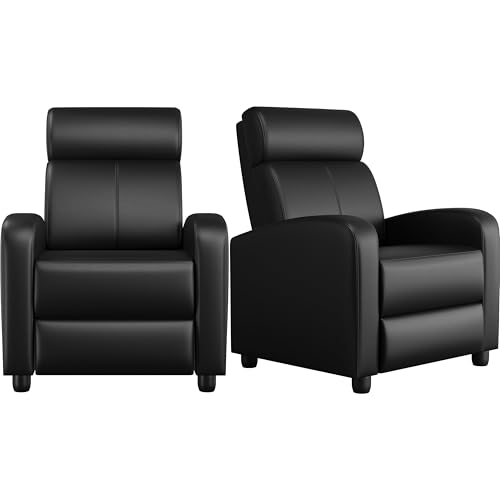
- Best for small spaces: Yaheetech Recliner Chair, Set of 2, PU Leather, Black — Check on Amazon
- Flamaker Futon Sofa Bed, Faux Leather, Black — Check on Amazon
- Yaheetech Convertible Sofa Bed, Dark Gray — Check on Amazon
- Homall Recliner Chair, PU Leather, Black — Check on Amazon
- DHP Emily Futon Sofa Bed, Dark Gray Linen — Check on Amazon
One honest note before the list: the RIHEREFY RV Loveseat Recliner reviewed below is a genuine two-seat recliner engineered for tight spaces, but at research time it sat above this guide’s $300 budget, so it appears as a prose-only step-up pick with no link.
Read the full guide ↓
Disclosure: As an Amazon Associate, dailyhomedecorating.com earns from qualifying purchases. Links to Amazon on this page are affiliate links; they cost you nothing extra. Listing details such as price and availability change often, so check the current Amazon listing before you buy.
Shopping for the best reclining sofa for small spaces under $300 means solving two shortages at once — money and square footage — and being lied to about both. The money lie first, because it shapes everything: a brand-new full-size reclining sofa with a genuine footrest mechanism is not a product verified listings sell at $300; the steel linkage under each seat is what the price would have to buy, and it does not fit the arithmetic. The space lie is subtler: listings advertise the closed footprint, while you live with the open one — a recliner that is 33 inches deep in the photograph and 62 inches long across your walkway every evening. This guide works with verified numbers for both. It recommends the forms that genuinely deliver reclining in small rooms: true recliner chairs at 26.5 inches wide that can angle into corners, compact convertibles of 61 to 62.5 inches whose backs lean back and fold flat, and — as a prose-only benchmark — the one wall-hugger loveseat designed from birth for RV-tight geometry, priced above this budget and labeled as such.
Small spaces reward flexibility over furniture. A loveseat is a fixed rectangle that dictates the room; a pair of chairs is a kit that adapts to it — together for a film, angled for conversation, split between a desk corner and a window when the room changes jobs. A convertible earns its footprint twice, once as seating and once as a bed. And every mechanism here is manual, because in a small room an outlet is a location decision and a cord is a trip line. The ranking below therefore leads with the Yaheetech recliner-chair pair — the only linked route to two genuine footrests, in the narrowest seats in the guide — followed by the two compact convertibles, the single Homall for one-person rooms, and the DHP Emily for the small-but-not-tiny room that can spend 71 inches on its anchor. Each review gives the open dimensions where the maker publishes them; in a small space, those are the specifications that decide whether you keep the piece or curse it.
In this guide
Quick Picks
Each row names a small-space situation and the product that suits it. Picks marked “adjustable-back alternative” lean back in steps but have no footrest — read the full review before deciding that is enough.
| Small-space situation | Pick | Why it stands out | Link |
|---|---|---|---|
| Best overall for small spaces | Yaheetech Recliner Chair, Set of 2, PU Leather, Black | Two true recliners at 26.5 inches each — angle them, corner them, split them between rooms | Check on Amazon |
| Best compact couch | Flamaker Futon Sofa Bed, Faux Leather, Black | 61 inches wide, 67 lb, three back positions and a flat bed mode | Check on Amazon |
| Best convertible with capacity | Yaheetech Convertible Sofa Bed, Dark Gray | 62.5 inches, stated 772 lb frame, 140° lounge position, drinks tray | Check on Amazon |
| Best single-seat solution | Homall Recliner Chair, PU Leather, Black | One true recliner mechanism in the smallest commitment — check price on Amazon | Check on Amazon |
| Best for a small room with one good wall | DHP Emily Futon Sofa Bed, Dark Gray Linen | 71 inches of armless split-back seating that folds flat — worth it where the wall allows | Check on Amazon |
| Closest true loveseat (above budget) | RIHEREFY RV Loveseat Recliner, 54.5 Inch | A real dual recliner with wall-hugger geometry — verified, but priced above $300 at research time, so no link | Prose-only — see review |
How These Picks Were Chosen
Filter one was mechanism honesty. A product is a true recliner in this guide only if a mechanism raises a footrest while tilting the back. Step-back convertibles were included — in small spaces they are often the rational furniture — but they are labeled “adjustable-back alternative” in every table and review, and their reviews state that feet stay on the floor. Products that were neither were excluded regardless of title.
Filter two was verification. Every ASIN was cross-checked against an independent record — retailer listing, price tracker or maker documentation — in November 2026, and every dimension and capacity quoted comes from those records. Prices in this category move constantly, so this guide prints no fixed figure for any product; check price on Amazon for the current number. The one verified product above the budget at research time, the RIHEREFY, appears prose-only with its reason stated, rather than linked under a ceiling it does not meet.
Filter three was small-space fitness, judged on the numbers that decide real rooms: width first, then the open footprint (reclined length for chairs, flat length for convertibles), then wall clearance behavior — whether the piece reclines into the room behind it or, in the wall-hugger’s case, slides forward instead — then seat height, and finally adaptability: can the piece change arrangement or room when the space changes jobs? We did not sit in these products; where a listing left a key dimension unpublished, the review says so instead of filling the gap with a guess.
The 6 Best Reclining Sofa Options for Small Spaces Under $300
Yaheetech Recliner Chair, Set of 2, PU Leather, Black
Who it suits: Small living rooms, dens and multi-use rooms where seating must adapt — angled for films, turned for conversation, split when the room changes jobs.
The pair leads this guide because small spaces punish fixed furniture and reward kits. Each chair is a genuine push-back recliner: lean back and the footrest rises, through three positions, adjustable from 0 to 90 degrees, over a pocket-spring seat with a stated capacity of 265 lb. And each chair is just 26.5 inches wide and 39.2 inches tall — narrow enough to angle into a corner, pair along a short wall, or separate entirely, one by the screen and one in a reading nook, when a single rectangle would fit nowhere. The PU and PVC leather wipes clean, the backs detach for carrying through tight doors, and the whole arrangement can be re-planned in an afternoon without buying anything. No loveseat in this budget offers a true mechanism at all; this offers two, in the most placeable form available.
The geometry bill comes due in one place: behind each chair. Push-back recliners travel rearward, and fully open each chair runs about 62 inches long, so the pair wants a wall with a recline allowance or a corner where the travel is free — measure the open footprint, not the catalogue depth. The 19.5-inch seats suit small-to-average builds, and two chairs are two seats, not a sprawl: no shared cushion, no lying across. Small rooms, which rarely have sprawl space anyway, are where the trade is cheapest. For pricing, check price on Amazon, and confirm the two-pack configuration on the listing before ordering. For the non-reclining third seat a small room sometimes needs, see Best Accent Chair Under $300.
- Two genuine push-back recliners — real footrests, three positions each.
- 26.5 inches wide per chair: angle, corner, pair or split them.
- Pocket-spring seats; detachable backs for tight doorways.
- Rearranges in minutes as the room changes jobs.
Honest limitation: Needs rear clearance and about 62 inches of length per chair when open; seats suit average builds; no shared seat.
Choose it if adaptable true reclining beats a fixed couch. Skip it if your only wall cannot spare recline clearance — read the wall-hugger note in the RIHEREFY review first.
Flamaker Futon Sofa Bed, Faux Leather, Black
Who it suits: The smallest rooms in the guide’s scope — box rooms, studio corners, spare-room offices — where the couch must be light, narrow and occasionally a bed.
At about 61 inches wide and 67 lb, the Flamaker is the couch a small space can actually negotiate with. One person can shift it to clean behind it, turn it for a projector night, or carry it to the next room when the floor plan changes its mind. Its click-clack back sets at 105° for sitting, 135° for leaning back into a film, and 180° flat, where the frame becomes a guest bed and the removable armrests — cup holders and all — become its pillows. The maker states a 500 lb capacity, and the black faux leather keeps a small room’s biggest object visually quiet while wiping clean after the snacks that small-room living serves on the couch by default.
The label discipline applies in full: this is an adjustable-back alternative with no footrest and no mechanism, and its seat is the firm, shallow perch of its class — roughly 18 inches deep — which tall users feel across a long evening. Faux leather over foam runs warm. None of that prevents it being the correct answer where floor space is the scarcest currency in the home: it is the only verified piece here that gives a genuinely small room two seats, a lounge angle and a bed, at a weight the room’s owner can move alone. For pricing, check price on Amazon; at research time it sat comfortably inside this budget. Rooms a size up should compare Best Loveseat For Small Spaces Under $300.
- 61 inches wide and 67 lb — movable by one person.
- Three back positions; flat bed mode; armrest cup holders.
- Removable armrests double as pillows in bed mode.
- Low visual weight in black faux leather; wipes clean.
Honest limitation: No footrest; firm, shallow seat; faux leather runs warm in a small room.
Choose it if the room is truly small and the couch must multitask. Skip it if depth and softness matter more than footprint.
Yaheetech Convertible Sofa Bed, Dark Gray
Who it suits: Small rooms that host — a living room that takes guests, a den that doubles as the spare room — needing a bit more substance than the Flamaker in nearly the same footprint.
For 1.5 inches more width than the Flamaker, the Yaheetech convertible buys a different class of structure: an engineered wood frame with foam-wrapped sinuous spring support and a stated maximum capacity of 772 lb, the highest in this guide. Its backrest offers the deepest lounge angle of any convertible here — 140°, between the 105° sitting position and the 180° flat bed — and its center folds down into a tray with two cup holders, which in a small room is not a gimmick but a side table you do not have to find floor for. The bed mode spans 62.5 by 37 inches, the armrests remove to free its full width, and the dark gray polyester on chrome-plated legs keeps the piece light on its feet visually. In a small room that must seat two daily and sleep one occasionally, this is the balanced answer.
Honest limits, unchanged by the praise: no footrest, no mechanism — an adjustable-back alternative — and a low seat, about 14 inches high with roughly 19 inches of depth, that suits the lounge posture and tests older knees. Fabric absorbs spills the Flamaker sheds. For pricing, check price on Amazon; it sat in the lower-middle of this budget at research time. If the room’s real problem is a fixed two-seater rather than a convertible, Best Sofa For Small Spaces Under $300 is the companion guide.
- 62.5 inches wide with the deepest convertible lounge angle here: 140°.
- Stated 772 lb capacity — engineered wood frame, sinuous springs.
- Drop-down drinks tray saves a side table’s footprint.
- Flat bed mode with removable armrests; chrome-plated legs.
Honest limitation: No footrest; low 14-inch seat; fabric drinks spills.
Choose it if your small room hosts and needs substance in 62.5 inches. Skip it if a higher seat or a true mechanism is required.
Homall Recliner Chair, PU Leather, Black
Who it suits: One-person small rooms — a den, a bedroom corner, a gaming nook — where the entire seating budget should become one genuinely good recliner.
The Homall makes the small-space argument for quality over quantity. Rather than spreading $300 across a compromised couch, it concentrates the spend on a single true recliner: push-back mechanism, double-thick padded footrest, thick padded seat and back, wide curved armrests, PU leather that keeps a small room’s main object presentable. In a room that seats one person ninety percent of the time, that concentration is simply correct — the chair becomes the room’s purpose, and the floor it does not occupy becomes the room’s breathing space. It is also the lowest-tier linked pick in this guide, and the natural first half of a future pair.
Its small-space caveats are the recliner family’s: the push-back action needs rear clearance and roughly five feet of length in use, so it claims the room’s one recline-friendly wall and the layout follows; it is sized for average builds; and its PU surface will wear at the contact points over years of daily use. None of these is hidden, and for the solo small room none is decisive. For pricing, check price on Amazon — the lowest tier here is the point.
- A genuine recliner mechanism with a padded footrest.
- Concentrates the budget on the seat actually used nightly.
- Compact footprint leaves a small room its breathing space.
- The lowest tier in this guide — check price on Amazon.
Honest limitation: One seat only; needs recline clearance; PU wear over time.
Choose it if one person’s perfect seat anchors the room. Skip it if two seats are a nightly requirement.
DHP Emily Futon Sofa Bed, Dark Gray Linen
Who it suits: Small rooms with one good long wall — a narrow living room, a den — that can spend 71 inches on the anchor piece and want it to look like the decision was aesthetic, not financial.
The Emily tests this guide’s premise usefully: not every small space should buy small. Where one wall can take it, 71 inches of armless, tufted linen on chrome legs gives a narrow room a single calm horizontal instead of a clutter of small pieces — and because there are no armrests, all 71 inches are seat. The split back adjusts per half, so the room’s two regulars sit and lounge independently, and the whole piece folds flat when the small room must become the guest room. DHP’s brand backing and the line’s finish range make it the pick least likely to look like a compromise in a room guests actually see.
Its conditions are strict, and in a small space they should be. Seventy-one inches plus passing room is the whole wall budget of many rooms — measure honestly, and walk the tape line before ordering. The seat is firm and low, the center split is felt in bed mode, linen absorbs spills, and there is no footrest: an adjustable-back alternative wearing the best tailoring in the guide. For pricing, check price on Amazon; the line sat mid-budget at research time. If the wall cannot take it, the two convertibles above are the same idea at 61 to 62.5 inches — and Best Loveseat Under $300 covers the fixed-frame field.
- 71 inches of armless seat — one calm anchor for a narrow room.
- Split back adjusts per sitter; folds flat for guests.
- Tufted linen and chrome legs — the tailored look of the guide.
- Established brand support.
Honest limitation: The largest footprint here; firm, low, armless; no footrest.
Choose it if one good wall deserves the room’s best piece. Skip it if the wall is under 71 inches of free run — it will not forgive optimism.
RIHEREFY RV Loveseat Recliner, 54.5 Inch (Prose-Only: Above This Budget)
Who it suits: Small-space buyers whose rooms cannot spare recline clearance at all — the wall is the wall — and who are weighing whether a true wall-hugger loveseat justifies leaving this budget behind.
This is the small-space specialist’s specialist. Designed for RVs, where every inch is audited, the RIHEREFY compresses a genuine double recliner into 54.5 inches of width — narrower than every couch in this guide — with two independent manual mechanisms, two footrests, a split back tilting from about 110° to 140°, and a stated 330 lb per seat. Its defining trick is geometric: wall-hugger linkage slides the seat forward as it reclines, so the piece can sit close to a wall and still open fully, abolishing the rear-clearance tax that push-back chairs levy on every room in this guide. Cup holders, side pockets and roughly 90% pre-assembly complete a brief written by people for whom space is the whole problem.
It is prose-only because at research time its price sat clearly above this guide’s $300 ceiling — the wall-hugger mechanism and the dual linkage are exactly the hardware this budget cannot buy — so it carries no purchase link here. Read it as the benchmark: if your room’s geometry truly forbids clearance, this class of RV loveseat is what the solution costs, and checking its current price on Amazon directly is the honest next step. If the room can spare two feet behind a chair, the Yaheetech pair at the top of this guide delivers the same mechanisms for considerably less.
- True dual recliner in 54.5 inches — the narrowest true loveseat verified.
- Wall-hugger geometry: reclines without rear clearance.
- Stated 330 lb per seat; cup holders and side pockets.
- About 90% pre-assembled.
Honest limitation: Priced above this guide’s budget at research time — hence no link — and its theater styling is functional rather than decorative.
Choose it if your wall forbids clearance and the budget can grow. Skip it if $300 is a hard ceiling; the chair pair solves the same problem in budget.
Comparison Table
| Product | Type | Best small-space use | Link |
|---|---|---|---|
| Yaheetech Recliner Chair, Set of 2 | True push-back recliners ×2, 26.5 in each | Adaptable true reclining anywhere | Check on Amazon |
| Flamaker Futon Sofa Bed | Adjustable-back convertible, 61 in, 67 lb | The smallest rooms; movable alone | Check on Amazon |
| Yaheetech Convertible Sofa Bed | Adjustable-back convertible, 62.5 in | Small rooms that host and sleep guests | Check on Amazon |
| Homall Recliner Chair | True push-back recliner, single seat | One-person rooms and nooks | Check on Amazon |
| DHP Emily Futon Sofa Bed | Split-back convertible, 71 in, armless | One good wall, fully used | Check on Amazon |
| RIHEREFY RV Loveseat Recliner | True dual recliner loveseat, 54.5 in, wall-hugger | Zero-clearance rooms — above budget | Prose-only |
How to Choose a Reclining Sofa for a Small Space on $300
Measure the open footprint first. In a small space the closed dimensions are a storage statistic. What matters is the reclined length of a chair (about 62 inches for the Yaheetech), the flat length of a convertible in bed mode, and the walkway that remains beside both. Tape the open outline on the floor and live with the tape for a day before ordering.
Interrogate the wall. Push-back recliners need clearance behind them; convertibles need length in front when flat; wall-huggers need almost nothing behind but cost more than this budget holds. Your wall geometry, honestly assessed, eliminates half the catalogue before price enters the discussion — let it.
Prefer kits over monuments. Two 26.5-inch chairs fit more real rooms than one 60-inch rectangle: corners, angles, split placements, a chair that migrates to the desk in work hours. In small spaces, adaptability is a specification, and it belongs on the comparison table next to width.
Count the second job. A convertible’s bed mode deletes a guest solution from the floor plan; a chair pair’s second job is rearrangement. Decide which second job your space actually needs — sleeping a guest monthly, or re-composing weekly — and let that, not the headline width, break ties.
Check seat height against the room’s people. The convertibles sit about 14 inches high. In a small room that low profile is visually right and physically wrong for anyone with bad knees. Compare the figure with a seat you already own; small rooms forgive many things, but not a chair a regular sitter cannot rise from.
Common Mistakes in Small Spaces
Shopping by closed dimensions. The single most expensive habit in this category. A piece that fits the wall upright and annexes the walkway open has not fit at all; it has merely been delivered.
Placing a push-back recliner flush to the wall. It will either refuse to open or machine its upholstery against the paintwork nightly. Clearance is part of the product; if the room cannot pay it, the product is a wall-hugger or a convertible, not a push-back chair.
Believing a “reclining sofa” title at a too-good price. Small-space searches surface the same unverifiable listings as every other search: full power reclining sofas at prices no independent source confirms. In a small room the cost of the error doubles — the wrong piece is also the piece you cannot get back down the stairs easily.
Filling the room to the walls. A small space with no negative space reads smaller than a small space with one honest gap. The 61-inch convertible in a 70-inch alcove looks intentional; the 71-inch one in the same alcove looks like a storage decision.
Ignoring the doorway on the way in — and out. Check box dimensions against the tightest turn, prefer detachable backs, and keep packaging until the piece has survived a week of evenings. Small spaces generate returns at the highest rate in furniture, almost always for fit, almost always preventable with tape.
What $300 Actually Buys in This Category
A reclining mechanism is welded steel: pivots, springs and a footrest assembly rated to hold a tilted adult through thousands of cycles. A loveseat needs two sets, mounted in a frame that can take the leverage, shipped in a box the size of a wardrobe — and verified listings for that product begin above this guide’s budget, which is why its one true representative here is prose-only. The budget’s honest exits are the two this guide is built on. Chairs shrink the mechanism count to one per seat and the frame to 26.5 inches, fitting both the money and the room. Convertibles delete the mechanism entirely and spend the savings on the small space’s other currencies: disciplined width and a bed mode. Wall-hugger loveseats solve the geometry completely and charge accordingly. Anyone advertising all three solutions at once, at this price, is selling a listing that independent sources cannot verify — and in a small space, where a mistake is measured in both dollars and square feet, verification is the whole game.
Room by Room: Where Each Form Earns Its Footprint
The multi-use living room. The hardest brief: seating, cinema, guest room and sometimes office in one rectangle. The convertibles were born for it — the Yaheetech where hosting is weekly, the Flamaker where the room is smallest — because their bed mode deletes an entire furniture category from the plan. Pair either with a single recliner chair only if the open footprints can coexist; in most small living rooms, the couch or the chairs is the honest choice, and this guide’s rankings are written to force it.
The den or box room. Small, single-purpose, and therefore the recliner chair’s natural habitat. A Homall in a den is a complete room: one true mechanism, a lamp, a shelf. The room’s smallness stops being a constraint because the furniture’s ambition matches it — nobody asks a den to seat four.
The bedroom corner. Reading and viewing in the room you sleep in asks for a chair, not a couch: the Yaheetech pair’s second chair, exiled here, is a common and happy outcome of buying the two-pack. Watch the recline clearance against the bed’s side, and prefer the chair over a convertible — a bed-shaped object in a bedroom is redundant in a way a recliner never is.
The home-office edge. A small room that works all day and relaxes at night benefits from the split personality of a chair pair: one at the desk’s side for a reading break, angled away from the screen so the posture — and the psychology — changes. Convertibles in offices tend to become clothes storage with a backrest; chairs keep their job.
The hallway-adjacent nook. Dead space beside a door or under a stair is where the 26.5-inch width earns its keep: a single recliner converts an unusable wedge into the house’s most contested seat, provided the door’s swing and the chair’s recline travel do not intersect. Measure both arcs — doors and recliners are equally unforgiving.
Clearance Geometry, in Plain Terms
Three numbers govern every reclining purchase in a small space, and listings print them reluctantly, so here is how to think about each. Reclined length is the product’s true depth in use: for the Yaheetech chair, about 62 inches against a 33.5-inch upright depth — nearly double. Any room plan drawn from upright dimensions is a plan for a room that exists only in photographs. Rear travel is how far the backrest moves backward through that recline: on a push-back chair it is most of the difference between the two depths, which is why wall placement fails; on a wall-hugger it approaches zero, because the seat slides forward to compensate — the linkage is literally trading front space for back space inside its own frame.
Side clearance is the forgotten third number. Arms, levers and the simple act of sitting down all need elbow room; a chair wedged between a wall and a bookcase with an inch to spare is a chair you enter like a vehicle. Leave a hand’s width at minimum on the mechanism side of any recliner, and a body’s width of passage beside any couch. Finally, a note on the numbers you cannot get: where a listing omits reclined length, estimate it as upright depth plus seat depth plus a margin — then treat the estimate as a reason to choose a product whose maker publishes the real figure. In small spaces, the unpublished dimension is the one that was going to hurt.
When the Small Space Is Temporary: Buying for the Next Room Too
Small spaces are often a season, not a destiny — the starter flat, the in-between house, the year near a job — and furniture bought for a season should be chosen for its second life. This is where the forms in this guide diverge sharply. The recliner-chair pair has the best second life in the set: two compact true recliners become a larger living room’s secondary seating, a bedroom’s reading chair and a den’s viewing chair, in any combination, without ever looking like survivors of a smaller room. Their detachable backs and one-person carries make the move itself cheap, which is the hidden half of second-life value.
The convertibles’ second life is narrower but real: a 61-to-62.5-inch sofa bed becomes the permanent guest solution of a bigger home’s spare room, a role in which its firmness stops mattering and its bed mode becomes the entire point. The Emily, in a larger room, graduates to the formal seat it always resembled. What none of these pieces should become is the next room’s main family sofa — that job wants the budget this guide could not spend, the true multi-seat recliner whose prose-only representative stands above as the marker. Buy the small-space piece for the small space, let it retire gracefully into a supporting role, and let the upgrade, when the rooms grow, be the mechanism purchase made once and properly. Furniture chosen with its retirement planned is the opposite of disposable; it is how households with changing floor plans build a stock of pieces that keep earning their footprint for a decade.
Small Details Small Spaces Punish
Beyond the headline geometry, small rooms amplify small frictions until they define the ownership experience. Cords: every pick in this guide is manual partly because a small room has no spare outlet geography — a power recliner’s cable would cross the exact walkway the room cannot spare, and a motor’s transformer becomes one more object on a floor with no objects to spare. Sound: in a small space you sit close to your furniture’s noises; a click-clack hinge’s snap and a frame’s creak are intimate at four feet in a way they never are at twelve, which is another argument for testing every position during the return window, in the actual room, at night.
Cleaning access is the third quiet tax. A couch that cannot be moved cannot be cleaned behind, and in a small room the dust line behind an immovable piece is a permanent resident; the Flamaker’s 67 lb and the chairs’ individual lightness are, in this light, hygiene features. Storage cuts the other way: small spaces crave it, and this category mostly refuses it — none of the linked picks hides meaningful storage — so let the drinks tray and cup holders be the storage, and resist any listing that promises a storage reclining sofa at this price, a combination this research could not verify from any independent source. The small space rewards the buyer who counts these frictions before the box arrives; they are, in aggregate, the difference between furniture that fits a room and furniture that fits a life in that room.
A Short Measuring Protocol for Small Spaces
Everything this guide recommends reduces to twenty minutes with a tape measure and a roll of painter’s tape, done in this order. First, the wall run: measure the exact length of wall the piece will occupy, subtracting skirting, radiators, sockets you must keep reachable and the swing of any door — the number that remains, not the wall’s full length, is your width budget, and it eliminates options honestly. Second, the depth budget: from that wall, measure to the nearest fixed obstruction — a doorway’s swing, a radiator, the edge of a rug that must stay — and keep the walkway rule in view, because a small room’s depth is shared between furniture and passage in a way a large room’s never is.
Third, tape the open footprint of your leading candidate on the floor at full size: reclined length for a chair, flat length for a convertible, using the verified dimensions in the reviews above. Live around the tape for a day — cook, cross the room, open the doors — because small-space fit is a behavior, not a measurement, and the tape will tell you things the numbers cannot. Fourth, measure the delivery path’s tightest turn and compare it with the box dimensions, preferring detachable-back pieces where the turn is marginal. Buy only when all four checks pass; in a small space, a return is not an inconvenience but a second tenancy of the wrong furniture in the room you live in. The protocol is unglamorous, and it is the entire difference between the households that keep these picks for years and the ones reviewing them angrily from beside a wedged box.
Final Recommendation
Start with the Yaheetech recliner-chair pair: two genuine mechanisms in the narrowest, most placeable form this budget allows, ready to angle, split and migrate as the room demands. If the space needs a couch shape, take the Flamaker where every inch and pound counts, or the Yaheetech convertible where hosting and capacity matter more. One-person rooms should concentrate the whole budget on the Homall’s single true recliner, and the small room with one good wall should spend it on the Emily and enjoy the calm. The prose-only RIHEREFY stands as the honest marker of the complete solution — a true wall-hugger loveseat — for the day the budget grows. Measure open, respect the wall, and a small space will hold more reclining than its floor plan promised.
Frequently Asked Questions
What is the smallest true reclining option under $300? A single recliner chair. The Homall and each chair of the Yaheetech pair are about 26.5 inches wide with genuine footrest mechanisms — the smallest verified way to own a real recline in this budget. No verified two-seat reclining sofa fits both the price and a small room; the closest, the RIHEREFY at 54.5 inches, sits above the budget and appears prose-only.
How much clearance does a recliner need in a small room? A push-back chair needs its full open length — roughly 62 inches — plus space behind the backrest as it travels. A wall-hugger design reduces the behind-chair requirement to a few inches by sliding the seat forward as it opens, which is why that geometry dominates RV furniture and commands its price.
Is a convertible futon a good small-space substitute for a recliner? For leaning back and hosting guests, yes; for feet-up reclining, no — its back adjusts in steps and there is no footrest. Small rooms often benefit more from the convertible’s second job (a bed) than from a mechanism, but the choice should be made knowingly, which is why this guide labels every pick.
Two chairs or one loveseat for a small living room? Two chairs, in most small rooms: they angle into corners, split around a desk or window, move through doors easily and let each sitter recline independently. A loveseat wins only when the shared seat itself — sprawling together, a unified look — is the point of the purchase.
How do I check whether a piece will fit before it arrives? Tape three outlines on the floor: upright footprint, open footprint, and the turning path from the door. Compare the box dimensions with the tightest doorway or stair turn. If the open outline eats the walkway, the piece does not fit, whatever the closed dimensions promised.
Why is the wall-hugger loveseat in this guide not linked? Because its verified price at research time was above the $300 budget. It is described in full as a prose-only step-up so small-space shoppers can judge the category honestly; you can check its current price on Amazon directly if your room’s geometry makes it the right answer.