Where to buy
Check the latest price, availability and delivery on Amazon. Orders are placed on Amazon. We may earn a commission from qualifying purchases.
- Best overall for small spaces: Furinno Turn-N-Tube 3-Tier Entertainment Center for TVs up to 32 Inch, Espresso/Black — Check on Amazon
- Furinno Turn-N-Tube 3D 3-Tier Entertainment TV Stand, Oak — Check on Amazon
- Furinno JAYA Simple Design Corner TV Stand, Espresso/Black — Check on Amazon
- Furinno Turn-S-Tube Wide TV Entertainment Center, Espresso/Black — Check on Amazon
See 2 more Amazon options
- Furinno Econ TV Stand Entertainment Center with Doors, Espresso — Check on Amazon
- Furologee TV Stand for TVs up to 55 Inch with Soundbar Shelf, White — Check on Amazon
Read the full guide ↓
Disclosure: As an Amazon Associate, dailyhomedecorating.com earns from qualifying purchases. Links to Amazon on this page are affiliate links; they cost you nothing extra. Listing details such as price and availability change often, so check the current Amazon listing before you buy.
The best media console for small spaces under $50 is not really a smaller version of a normal media console — it is a different strategy. A small space, whether it is a studio’s sleeping corner, a spare bedroom doing duty as a den, a hallway alcove, a dorm room or the short wall of a living room in a full-size house, punishes the two dimensions ordinary consoles are generous with: width along the wall and depth into the room. The stands that work in these spots win by going vertical instead of wide, by settling into corners instead of demanding a flat wall, or by staying so shallow and low that the room barely registers them. This guide to the best media console for small spaces under $50 ranks the verified budget field by exactly those strategies. Its overall pick is a tall, narrow tower just 31.5 inches wide with the deepest shelves in the guide — check price on Amazon — because the purest small-space problem is a short wall and a TV that still deserves a proper home. Around it sit a shallow wide stand for tight living rooms, a corner stand for dead angles, a low wide stand for a big TV in a compact room, a compact cabinet with doors for a small den, and a slim styled stand barely 11.8 inches deep.
One distinction runs through the whole guide, because “small space” hides two different problems. The first is a small footprint: the floor patch itself is tiny, and the answer is vertical or corner geometry. The second is a small feeling: the floor exists, but the room is visually or functionally crowded, and the answer is shallow depth and low height, so the console stops claiming attention and walkway. The picks below are labeled by which problem they solve, and the buying checklist helps you name your own problem before you spend anything — because the most common small-space mistake is buying a footprint solution for a feeling problem, or the reverse. Below: quick picks, the small-space filter, detailed reviews, a comparison table, a measuring method for tight spots, the mistakes that make small spaces smaller, and the questions tight-room buyers ask.
In this guide
Quick Picks
Short on time, or comparing several options at once? Each row below names a small-space situation and the stand that suits it, with a link to the listing.
| Small-space situation | Pick | Why it stands out | Link |
|---|---|---|---|
| Best overall for small spaces | Furinno Turn-N-Tube 3-Tier Entertainment Center, up to 32 Inch | The smallest footprint in the guide — 31.5 inches wide — with the deepest shelves; check price on Amazon | Check on Amazon |
| Best shallow stand for a tight living room | Furinno Turn-N-Tube 3D 3-Tier Entertainment TV Stand, Oak | Only 11.7 inches deep, yet wide enough for TVs up to 50 inches | Check on Amazon |
| Best for a dead corner | Furinno JAYA Simple Design Corner TV Stand, Espresso/Black | Curved shelves convert a corner into a TV wall for sets up to 46 inches | Check on Amazon |
| Best for a big TV in a compact room | Furinno Turn-S-Tube Wide TV Entertainment Center, Espresso/Black | Wide enough for a 55-inch TV, low enough not to crowd the room | Check on Amazon |
| Best compact cabinet with doors | Furinno Econ TV Stand Entertainment Center, Espresso | Closed storage in a 42.1-inch body — a small den’s whole media cabinet | Check on Amazon |
| Slimmest styled pick | Furologee TV Stand for TVs up to 55 Inch, White | 11.8 inches deep and visually light — a console that barely registers | Check on Amazon |
How These Picks Were Chosen
The field is the verified budget field used across this series: real Amazon listings that live in or regularly visit the under-$50 tier, with dimensions, TV ratings and — only where maker and retailer sources agree — weight capacities that this guide is willing to print. Where retailer figures for a model differ, the review prints no capacity and says why. We did not assemble these stands ourselves; every specification is documented in this article’s sources file. The small-space filter then re-ranked the field on three measurements that ordinary rankings ignore. Footprint area came first — width multiplied by depth, the honest square footage a stand consumes — and on that measure the guide’s overall pick uses barely half the floor of a conventional console. Depth came second, because in tight rooms depth is walkway. Vertical storage came third: tiers gained by height cost no floor at all, which is why a three-tier tower outranks wider two-tier stands for this lens.
Two exclusions deserve stating. Wall-mounted floating consoles, the internet’s favorite small-space answer, are excluded: they need studs, tools and permission that many small-space dwellers — renters, dorm residents, anyone in a room they do not own — do not have, and a guide that assumes them fails the readers who need it most. Everything here is freestanding and tool-light. Narrow bookcases and cube storage re-purposed as TV stands are also excluded: their shelf heights and depths are wrong for components, and their tops are rarely rated for a TV at all. Every pick below is a stand designed for a television, with a published maximum TV size.
Prices in this category move with promotions, so check the current price on Amazon for each pick before ordering. One pick, the Furologee, visits the under-$50 tier on promotion rather than living in it; its review flags that plainly, as does the checklist. Finally, a safety note that tight rooms make more important, not less: every stand here is light, and a TV in a small space sits closer to passing traffic, elbows and bag straps than in any other room. Anchor the TV to the wall wherever the situation allows; where it genuinely does not, choose the lowest and widest pick and keep the tall tower out of the plan. The reviews repeat this where it matters most.
The 6 Best Media Consoles for Small Spaces Under $50
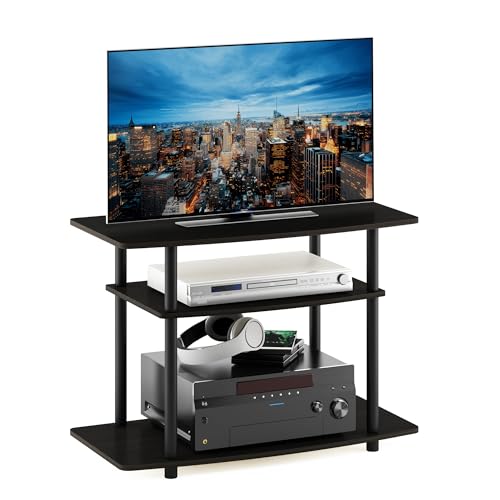
Furinno Turn-N-Tube 3-Tier Entertainment Center for TVs up to 32 Inch, Espresso/Black
Who it suits: The purest small-space problem — a short wall, a narrow alcove, a dorm or spare-room corner — with a TV of 32 inches or under that still needs real shelves beneath it.
This tower wins the guide because it treats floor as the scarce resource it is. The footprint is 31.5 inches wide by 15.79 inches deep — the smallest in the guide — and the storage goes up instead of out: three full tiers rising to 23.31 inches high, rated for TVs up to 32 inches and up to 50 pounds, the strongest headline capacity figure here on the smallest stand here. The depth deserves emphasis, because it is the specification small stands usually sacrifice: at 15.79 inches these are the deepest shelves in the guide, so a game console, a cable box or a small player sits entirely on the tier, fully supported, instead of hanging its nose over the edge the way it does on shallow compact stands. In practice the tower furnishes the spots nothing else in this guide can: the wall between a door and a closet, the alcove at the end of a hall, the corner of a home office where a second screen lives, the dorm wall shared with a desk and a mini-fridge. Assembly is the hand-twist Turn-N-Tube system — no tools, no hardware, buildable in the very spot it will occupy, which in a small space is not a convenience but a necessity. Check the current price on Amazon; it is one of the most accessibly positioned stands in the guide.
The conditions are inseparable from the design. The 32-inch ceiling is absolute — the top panel is 31.5 inches wide, and a larger TV overhangs it on both sides — so this is a stand for a settled small TV, not a placeholder for an upgrade. Height is the second condition: 23.31 inches lifts the screen to bed and desk-chair height beautifully, and overshoots a low sofa’s sightline just as surely, so match it to the seat it serves. Third, a tall narrow unit in a tight room stands exactly where people squeeze past, which makes the TV anchor a condition of this recommendation, not a footnote: strap the set to the wall, place the tower out of the squeeze path if the room allows any choice at all, and keep the heaviest gear on the lowest tier, where it lowers the center of gravity. Bought with those three understandings, it is the most shelf per square foot in the entire budget tier.
- 31.5 (W) x 15.79 (D) x 23.31 (H) inches — the smallest footprint in the guide; TVs up to 32 inches, rated up to 50 lb.
- Deepest shelves here: components sit fully on the tier despite the compact width.
- Three vertical tiers furnish alcoves, dorms and short walls nothing wider can use.
Honest limitation: A hard 32-inch TV ceiling, a height matched to beds and desks rather than low sofas, and a tall profile that must be anchored and kept out of squeeze paths.
Choose it if your wall is short and your TV is small and settled. Skip it if the TV might grow, or the spot is a walkway edge — the shallow wide pick below is safer there.
Furinno Turn-N-Tube 3D 3-Tier Entertainment TV Stand, Oak
Who it suits: A tight living room — in a house or an apartment — where the wall is long enough but every inch of depth is walkway, rug or breathing room.
This is the small-feeling solution: not the smallest footprint in the guide, but the shallowest full-size one. At 43.8 inches wide, 11.7 inches deep and 16.2 inches high, rated for TVs up to 50 inches with a documented 40 pounds on the top panel, it presses the TV wall almost flat against the wall itself. In a compact living room that shallowness is transformative — the coffee table can sit at a conversational distance, the rug lies fully flat, and the route across the room stops being a sideways shuffle past a cabinet. The stepped three-level top parks a soundbar or small speakers beside the screen’s level, the two open tiers take the standard console-and-streamer inventory with air around it, and the pale oak finish refuses to darken a small room the way a big espresso unit does. It twists together by hand with no tools and comes apart the same way, which matters in small spaces that get rearranged seasonally — and they all do. Check the current price on Amazon; this model sits at the heart of the tier.
Shallow is a trade, and the currency is component depth: an 11.7-inch shelf will not host a full-size AV receiver, and in a small room there is no hiding a component that overhangs — it is right there, at eye level, announcing itself. Measure your deepest device first; the modern small-space inventory of a console, a streamer and a soundbar fits perfectly, and anything deeper argues for the tower above or the Econ below. The open tiers also show their cables, and in a small room you sit close enough to read them, so the five-minute cable bundle is part of this purchase. Anchor the TV as always. For the commonest tight-room brief — a real TV, a real sofa, not enough floor between them — this is the guide’s most surgical answer.
- 43.8 (W) x 11.7 (D) x 16.2 (H) inches — the shallowest full-width stand in the guide; TVs up to 50 inches, 40 lb top capacity.
- Low height and pale finish keep a compact room feeling open.
- Tool-free build and rebuild — small spaces get rearranged, and this stand keeps up.
Honest limitation: Shelf depth excludes deep receivers, and open cables are very visible at small-room distances.
Choose it if your wall is long, your floor is short and your gear is modern and slim. Skip it if your components are deep — buy depth, not shallowness, in that case.
Furinno JAYA Simple Design Corner TV Stand, Espresso/Black
Who it suits: Any room — small apartment, spare bedroom, awkward den — where the corner is empty and the flat walls are all spoken for.
Corners are the small-space cheat code, and this is the stand that cashes it. The JAYA’s curved tiers are shaped to settle into a corner across a 42.04-inch top, 15.55 inches deep and 22.75 inches high, rated for TVs up to 46 inches with up to 35 pounds on the top panel; the unit weighs 27.8 pounds, the steadiest-feeling Furinno in this guide. What it buys a tight room is a whole wall: the TV leaves the flat surfaces, so the long wall takes the sofa or the bed properly, the second wall takes the desk or dresser, and the corner — previously the room’s dead wedge, good only for a plant that is slowly forgiving you — becomes the media wall. The curved side shelves are genuinely useful at this scale: router, remotes, a small speaker, the plant again but happier. Four tiers separate working gear in the wide center sections from display at the curved ends. In the smallest rooms this guide serves — the box room, the studio, the under-stairs den — a corner TV is often the only layout that leaves the room a room. Check the current price on Amazon.
Do the corner homework first. Tape the diagonal footprint on the floor: a corner stand reaches further into the room along its diagonal than its width suggests, and in a very small room that reach is the measurement that decides. Sit in every seat and check the diagonal sightline and the window glare at your watching hours. Note the capacity honestly — 35 pounds on top is the guide’s lowest, ample for a modern 40- to 46-inch panel and wrong for an older heavy set, so weigh before assuming. And keep the anchor strap in the plan; two walls brace a corner stand, but bracing is not anchoring. Where the corner is truly free, no pick here returns more usable room per dollar.
- 42.04 (W) x 15.55 (D) x 22.75 (H) inches; TVs up to 46 inches; top holds up to 35 lb; unit weight 27.8 lb.
- Converts dead corner volume into the media wall and frees both flat walls.
- Curved side shelves put small essentials at the room’s edge, not its center.
Honest limitation: The lowest top capacity in the guide, and a diagonal reach into the room that must be taped and tested before ordering.
Choose it if your corner is empty and your walls are full. Skip it if your seating cannot turn diagonal, or your TV is heavy for its size.
Furinno Turn-S-Tube Wide TV Entertainment Center, Espresso/Black
Who it suits: The compact living room with an uncompact TV — a 55-inch panel that needs a wide top, in a room that needs the stand to stay low and quiet about it.
A big TV in a small room fails in two ways: physically, when its feet overhang a narrow stand, and visually, when a tall bulky console turns the room into a shrine. This stand answers both. At 47.25 inches wide, 13.4 inches deep and just 15.9 inches high, rated for panels up to 55 inches, it is wide enough for a 55-inch set’s feet to stand fully planted — the fit rule that cannot be negotiated — and low enough that the big screen floats as a picture rather than looming as furniture. The 13.4-inch depth is the small-space middle path: consoles sit properly, yet the stand claims noticeably less floor than a conventional cabinet. The espresso and black finish recedes in the evening, the square tubes twist together without tools in about ten minutes by the maker’s account — build it in place, since a built 47-inch stand dislikes small doorways — and the open tiers keep the setup’s heat and cables manageable with one gathered bundle. Check the current price on Amazon, as the wide models drift in and out of this tier with promotions.
The duty this pick imposes is verification. Published weight capacities for this model differ between retailers, so this guide prints no figure; read the Amazon listing’s own stated limits and weigh your TV and top-surface gear against them before ordering — a current 55-inch LED panel is light for its size, but the total on the top is the number that matters. Check the low height from your seat, too: ideal from a low sofa, low from a high one. And anchor the panel — in a small room the strap vanishes behind the screen, and a big TV on a light stand in a tight traffic pattern is precisely the setup anchoring exists for. For the big-screen small room, it is the only top in this guide honestly wide enough at this price.
- 47.25 (W) x 13.4 (D) x 15.9 (H) inches — the widest top and lowest profile in the guide; TVs up to 55 inches.
- Low silhouette keeps a big screen proportional in a compact room.
- Middle-path depth fits consoles without claiming cabinet floor.
Honest limitation: Verify the listing’s own weight limits (retailer figures differ), and confirm the low viewing height suits your seating.
Choose it if the TV is 55 inches and the room is not. Skip it if your panel is an older heavy model — step up a tier for capacity.
Furinno Econ TV Stand Entertainment Center with Doors, Espresso
Who it suits: A small den, guest room or compact living room that needs its media storage closed — because in a small space, visible clutter shrinks the room faster than furniture does.
The Econ’s small-space argument is psychological as much as physical, and it is correct: a room reads at the size of its calmest surface, and an open stand full of gear makes a small room read small. This cabinet-style stand — 42.1 inches wide, 13.5 inches deep, 22.8 inches high, for TVs up to 46 inches, with a published weight limit of 70 pounds in the listing’s specification table and a 30-pound unit weight — closes concealed doors over its storage, so the chargers, cases, spare leads and second console leave the room’s visual field entirely. An adjustable open shelf keeps the working component ventilated and remote-visible at the height it needs. In a compact den or a guest room that doubles as an office, that closed front is the difference between a room that feels borrowed and a room that feels finished. Assembly is a conventional hardware build, the longest in this guide — build it in its final position, because a small space gives you no room to build anywhere else. Check the current price on Amazon; it sits at the top of the tier, and the doors are the purchase.
Measure the small-space specifics before ordering: the doors need swing clearance, so confirm they open fully without meeting the bed, desk or coffee table that shares the tight room — a cabinet whose doors open halfway is storage denied. The 46-inch TV ceiling excludes big-screen compact rooms, which belong to the Turn-S-Tube above. Heat discipline applies: working gear on the open shelf, storage behind the doors. And at 30 pounds this is the least rearrangeable pick here, in the guide whose readers rearrange most — if your small space changes layout monthly, the twist-apart stands will forgive you more. For a settled small room, the Econ’s closed calm is worth the commitment.
- 42.1 (W) x 13.5 (D) x 22.8 (H) inches; TVs up to 46 inches; listing weight limit 70 lb; unit weight 30 lb.
- Doors remove visual clutter — the fastest way to make a small room read larger.
- Adjustable open shelf keeps the working component at the right height, ventilated.
Honest limitation: Doors need swing clearance in a tight room, and the 30-pound build is the least movable pick in a guide full of movers.
Choose it if your small space is settled and visual calm is the goal. Skip it if you rearrange often or your TV exceeds 46 inches.
Furologee TV Stand for TVs up to 55 Inch with Soundbar Shelf, White
Who it suits: Bright, tight rooms — a small living room, a studio, a narrow den — where the console must be present physically and absent visually.
The Furologee is the guide’s ghost: a black metal frame and white top, 46.7 inches long, 11.8 inches deep and 21.8 inches high, listed for TVs up to 55 inches, at about 19 pounds — the lightest pick here. In a small space, visual weight is real weight, and this stand has almost none: thin frame lines instead of solid sides, a pale top that borrows the wall’s light, and open shelves that you can see through to the wall behind, so the room’s boundaries stay where the architecture put them. The dedicated soundbar shelf centers the bar under the screen — in a small room, where the listener sits close, a properly placed soundbar does more for the experience than any other single upgrade — and the open tiers below hold the console and streamer with air around them. Its lightness is also a small-space practical gift: when the room renegotiates — desk against the other wall, bed turned, guests coming — this is the stand one person can lift and re-place in a minute. It assembles with labeled conventional hardware. Check the current price on Amazon: this stand visits the under-$50 tier on promotion and can sit above it between sales, so its place in the guide is conditional on your cart.
The transparency cuts both ways, and in a small room you will notice: an open frame shows cables at close range, so the gathered single drop behind the stand is not polish but necessity. The 11.8-inch depth fits the slim modern inventory and nothing deeper — a receiver belongs in a different setup. A 19-pound frame in a tight traffic pattern must have its TV anchored; the strap hides behind the panel and the floating effect survives. And if the price is above the tier when you shop, compare it honestly in Best Media Console For Small Spaces Under $100 rather than stretching quietly. In tier, for a bright tight room, it is the stand that takes the least — of floor, of light, of attention — while doing the whole job.
- 46.7 (L) x 11.8 (D) x 21.8 (H) inches; listed for TVs up to 55 inches; about 19 lb — the lightest pick in the guide.
- See-through open frame and pale top preserve the room’s visual boundaries.
- Dedicated soundbar shelf — close-range listening done properly.
Honest limitation: Cables show at small-room distances without disciplined routing, shelves are shallow, and the price visits this tier on promotion — check the current price on Amazon.
Choose it if your tight room is bright and your inventory is slim and modern. Skip it if your gear is deep, or the cart shows it above this tier.
Comparison Table
| Product | Size (W x D x H) | Max TV | Small-space strength | Link |
|---|---|---|---|---|
| Furinno Turn-N-Tube 3-Tier, up to 32 Inch | 31.5 x 15.79 x 23.31 in | 32 inch | Smallest footprint, deepest shelves, vertical storage | Check on Amazon |
| Furinno Turn-N-Tube 3D 3-Tier, Oak | 43.8 x 11.7 x 16.2 in | 50 inch | Shallowest depth for tight living rooms | Check on Amazon |
| Furinno JAYA Corner TV Stand | 42.04 x 15.55 x 22.75 in | 46 inch | Corner geometry frees the flat walls | Check on Amazon |
| Furinno Turn-S-Tube Wide, Espresso/Black | 47.25 x 13.4 x 15.9 in | 55 inch | Big TV at the lowest, calmest height | Check on Amazon |
| Furinno Econ TV Stand with Doors | 42.1 x 13.5 x 22.8 in | 46 inch | Closed storage — visual calm in a small room | Check on Amazon |
| Furologee TV Stand with Soundbar Shelf, White | 46.7 x 11.8 x 21.8 in | 55 inch | Lightest, slimmest, visually transparent | Check on Amazon |
How to Choose the Best Media Console for Small Spaces Under $50
- Name your problem first: footprint or feeling. A tiny floor patch needs vertical or corner geometry (the tower, the JAYA). A crowded-feeling room needs shallow depth and low height (the 3D 3-Tier, the Turn-S-Tube). Buying one solution for the other problem is the classic small-space error.
- Compute the footprint, not just the width. Width times depth is the floor you are spending. The tower in this guide spends about half the floor of a conventional console; know your number before you order.
- Tape it on the floor and live around it for a day. In a small space, tape at the stand’s true dimensions — including a corner stand’s diagonal — reveals walkway theft that no measurement list can.
- Match depth to your deepest component. Depths here run 11.7 to 15.79 inches. Slim modern gear fits the shallow end; anything deeper must be bought for honestly, because an overhanging component in a small room is a permanent visual event.
- Use height deliberately. Vertical storage is free floor, but the screen must land at your seat’s eye level — tower height for beds and desks, low height for sofas.
- Anchor with extra care in tight rooms. Small spaces put stands in traffic. Strap the TV to the wall wherever possible; where impossible, low and wide only, and never the tower.
- Prefer stands you can build and move in the space. Tool-free twist-apart designs and a 19-pound frame forgive rearrangement; a 30-pound cabinet build commits you. Small spaces rearrange — buy for the habit.
- Count visual weight as well as floor. Pale finishes, open frames and closed doors all shrink a stand’s presence; a dark open stand full of gear grows it. Choose the presence your room can afford.
- Check the cart against the tier. Promotions move these prices weekly; if a pick sits above $50 when you shop, the honest comparison is Best Media Console For Small Spaces Under $100.
Where Small Consoles Actually Live
It is worth naming the rooms this guide is really for, because “small space” buyers often shop apologetically, as if their room were a failed large one. It is not — each of these spots has a correct console, and most of them are in this guide. The spare bedroom that became a den: the tower or the Econ, at bed-and-armchair height, with the doors closed on the gear when guests return the room to its first job. The dorm room: the tower again, tool-free because dorm rules and toolboxes do not mix, sized for the TV that fits a desk wall. The hallway alcove and the landing: a shallow 3D 3-Tier, flat against a wall that was never going to hold anything deeper. The under-stairs nook and the box room: the corner JAYA, turning the house’s most awkward angle into its cinema. The compact living room of an ordinary house, which is most readers’ actual case: the low Turn-S-Tube under a big TV, or the shallow oak stand under a 50-inch, with the floor between sofa and screen kept gloriously empty.
The pattern underneath the list is the guide’s thesis: a small space does not need a lesser console, it needs a more deliberate one — chosen by footprint arithmetic, taped before it is bought, anchored once it arrives, and edited like the room it shares. Readers whose small space is specifically a small apartment, with a lease attached, will find the same stands re-ranked by rental logic in Best Media Console For Small Apartments Under $50; the general field without the space filter is in Best Media Console Under $50.
Small Spaces, Sound and the Things Nobody Measures
Two small-space realities rarely appear in console guides, and both belong in a buyer’s head before the order. The first is sound. A compact room is an unforgiving acoustic box: a soundbar or speakers placed on a hard, light shelf in a small hard-floored room can sound brighter and harsher than the same gear in a carpeted living room, and a console or streamer fan that would be inaudible across a big room is a presence at six feet. The practical answers cost nothing: put the soundbar on its intended shelf or the stand’s top, centered, as the Furologee’s layout assumes; keep a rug or soft furnishing somewhere in the room’s first reflection zone if the sound is brittle; and favor the open stands in this guide for any device with a fan, because a closed cabinet in a small room does not just trap heat, it gives the fan a resonating box to sing into. None of this requires different furniture — it requires placing the furniture you buy with your ears as well as your tape measure.
The second reality is light. In a small room the TV is a larger share of the visual field, and its glow is a larger share of the room’s light after dark. A low stand that keeps the screen’s center near seated eye level is not only a posture kindness, it keeps the picture out of the standing eyeline of anyone crossing the room, and a stand whose finish does not glare back — the matte laminates and the white top in this guide all behave well — keeps the wall calm when the screen is off. If the room doubles as a bedroom, the tower’s bed-height screen and a soundbar’s volume at close range argue for the simplest discipline of all: the setup that can be switched off, fully, from one remote, with no row of standby lights staring across a small dark room. A power strip with a switch, gathered into the cable bundle this guide keeps prescribing, is the unglamorous accessory that makes a small space restful — and like everything else in this section, it costs less than the stand it completes.
Common Buying Mistakes
- Buying a footprint solution for a feeling problem. If the room is crowded rather than tiny, a tower will not help — shallow and low will.
- Reading width and ignoring the footprint product. Two stands of equal width can differ by half in the floor they consume.
- Forgetting the corner stand’s diagonal. Its reach into the room is its longest dimension, and it is the one nobody tapes.
- Putting the tall tower in a squeeze path. Tall, narrow and bumped is the one combination anchoring cannot fully forgive — place it out of traffic or choose low and wide.
- Letting a deep component push a shallow stand off the wall. The resulting cable-and-dust canyon is a permanent feature of the room; measure the gear first.
- Overfilling open shelves in a small room. At close range, every object is foreground. Edit to the devices in use and one or two calm objects.
- Assuming the next room will be bigger and buying for it. Buy for the space you have; this tier’s prices make the honest purchase cheap and the speculative one pointless.
- Judging the space empty. Small rooms are judged in use — door swinging, bag on shoulder, second person passing. Live around the tape for a day before ordering.
Final Recommendation
- Most small spaces: Furinno Turn-N-Tube 3-Tier Entertainment Center for TVs up to 32 Inch.
- A tight living room: Furinno Turn-N-Tube 3D 3-Tier Entertainment TV Stand, Oak.
- A dead corner: Furinno JAYA Simple Design Corner TV Stand.
- A big TV, compact room: Furinno Turn-S-Tube Wide TV Entertainment Center, Espresso/Black.
- Closed, calm storage: Furinno Econ TV Stand Entertainment Center with Doors.
- Bright and barely there: Furologee TV Stand for TVs up to 55 Inch, White.
Begin with the tower if your wall is short and your TV is settled at 32 inches or under — nothing in this tier stores more on less floor — check price on Amazon. If your problem is depth rather than width, the shallow oak 3D 3-Tier is the surgical pick; if it is geometry, the corner JAYA; if it is a big screen, the low Turn-S-Tube; if it is visual noise, the Econ’s doors or the Furologee’s ghost of a frame. Name the problem, tape the footprint, anchor the TV, and a small space stops being a compromise and becomes what it always was: a room that rewards precision.
Frequently Asked Questions
What is the smallest media console that still works properly?
In this guide, the tower-format stand at 31.5 inches wide and 15.79 inches deep — small in footprint, but with full-depth shelves and a published rating for TVs up to 32 inches and up to 50 pounds. Smaller than that, products stop being TV stands in any honest sense: tops go unrated and shelves shrink below component depth. Small should mean deliberate, not inadequate.
Is a tall or a low console better for a small space?
It depends on the seat and the traffic. Tall consoles spend no extra floor and suit beds, desks and chairs; low consoles suit sofas and are calmer in walkways. The deciding questions are your seated eye level and whether the stand sits in a passing line — tall in a squeeze path is the one arrangement this guide advises against at any price.
Can a small space handle a 55-inch TV?
Yes, with the right stand geometry: a low, wide top like the Turn-S-Tube’s 47.25 inches keeps the panel planted and proportional, and the screen’s thinness means the room loses almost nothing to the TV itself. Verify the listing’s stated weight limit for that model, anchor the set, and check your viewing distance — in a compact room you will sit closer, which most viewers quickly stop noticing.
How do I measure a corner for a TV stand?
Measure both walls from the corner, then tape the stand’s diagonal footprint on the floor — the diagonal is the dimension that reaches into your room. Sit in each seat and test the sightline to the corner at your usual watching hours, checking window glare, and confirm the outlet is within cable reach. The JAYA’s published dimensions (42.04 inches across, 15.55 deep) are the ones to tape.
Are open or closed consoles better in a small room?
Closed fronts make a small room read calmer and larger, which is the Econ’s argument; open shelves ventilate better, weigh less and rearrange more easily, which is everyone else’s. If your gear is minimal and modern, open is honest and airy. If your under-TV reality is a drawerful of cables and cases, doors buy visual square footage that no footprint saving can match.
When should a small space step up to the $100 tier?
When the space is small but the demands are not: a TV over 55 inches, a deep receiver, or a permanent room — a den you own rather than rent — where cabinet construction will serve for a decade. Best Media Console For Small Spaces Under $100 covers that ground. For the rooms in this guide, the under-$50 picks solve the geometry completely.