Where to buy
Check the latest price, availability and delivery on Amazon. Orders are placed on Amazon. We may earn a commission from qualifying purchases.
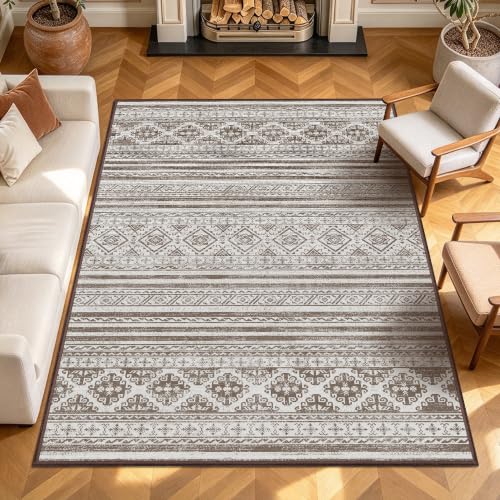
- Best overall for small spaces: RUGSURE Washable Area Rug, Moroccan Brown, 5′ x 7′ — Check on Amazon
- Loloi II Layla Collection LAY-03 Area Rug, Olive/Charcoal, 5′ x 7’6″ — Check on Amazon
- befbee Washable Area Rug, Vintage Beige/Blue, 5′ x 7′ — Check on Amazon
- GarveeHome Provence Washable Rug, Botanical Sage Green, 5′ x 7′ — Check on Amazon
See 2 more Amazon options
- SAFAVIEH Adirondack Collection ADR109H Area Rug, 5’1″ x 7’6″, Ivory & Rose — Check on Amazon
- OLANLY Machine Washable Shag Area Rug, Beige, 5′ x 7′ — Check on Amazon
Read the full guide ↓
Disclosure: As an Amazon Associate, dailyhomedecorating.com earns from qualifying purchases. Links to Amazon on this page are affiliate links; they cost you nothing extra. Listing details such as price and availability change often, so check the current Amazon listing before you buy.
Choosing the best living room rug for small spaces under $300 is an exercise in visual physics, because in a compact room a rug is never just a rug — it is the largest single surface the eye takes in, and it will either argue that the room is bigger than it is or confess the true dimensions at a glance. The rules are different here from a full-size room. Coverage must be calibrated, not maximized: a rug that runs wall to wall shrinks a small space, while one that floats with a calm border of floor around it makes the same square footage read as composed and intentional. Profile must be thin, because small rooms stack functions — the rug sits under the sofa, the desk chair’s patrol route and the door’s swing all at once. And pattern must be chosen like an optical instrument: the right scale and tone opens a room up; the wrong one closes it down like a lid. This guide works in the 5×7 size class — 5′ x 7′, 5′ x 7’6″ and 5’1″ x 7’6″ — where every pick fits comfortably under $300, check price on Amazon for the current figure, leaving budget headroom that small-space shoppers are better off spending on the right pad and the right layout than on a bigger rug.
A note on what “small space” means here, because it is broader than “small apartment”: a compact living room in a house, a narrow railroad-style room, a den that doubles as a guest room, a tiny home’s single living zone, the sitting end of an open-plan studio. The renter-specific concerns — deposits, landlords, lease-length moves — get their own treatment in our companion guide to the Best Living Room Rug For Small Apartments Under $300; this guide is about the geometry and optics of smallness itself, whoever owns the floor. Its six picks were chosen for thin profiles, space-opening palettes and patterns, and constructions that tolerate a room where every piece of furniture is within arm’s reach of every other. Read the sizing and layout sections with particular care — in a small space, placement decisions are worth more than any single product choice, and the best rug placed badly will lose to a lesser rug placed well every time.
In this guide
Quick Picks
Six 5×7-class rugs chosen for compact rooms. Each row names the small-space problem a rug solves and links to the listing; all were checked in the 5×7 size class against this guide’s budget.
| Buyer type | Pick | Why it stands out | Link |
|---|---|---|---|
| Best overall for small spaces | RUGSURE Washable Area Rug, Moroccan Brown, 5′ x 7′ | About 1/6 inch thin — defines the zone without adding visual or physical bulk anywhere | Check on Amazon |
| Best style for a small room | Loloi II Layla Collection LAY-03, Olive/Charcoal, 5′ x 7’6″ | A designer vintage print that makes a compact room look curated rather than cramped | Check on Amazon |
| Best light-and-airy print | befbee Washable Area Rug, Beige/Blue, 5′ x 7′ | Pale vintage tones that keep a small room bright, washable and non-slip | Check on Amazon |
| Best soft washable | GarveeHome Provence Washable Rug, Sage Green, 5′ x 7′ | Faux-wool softness and a calm botanical print that makes small rooms feel like gardens | Check on Amazon |
| Best room-brightening woven rug | SAFAVIEH Adirondack Collection ADR109H, Ivory & Rose, 5’1″ x 7’6″ | Real woven pile in ivory tones that bounce light around a dim, compact room | Check on Amazon |
| Best cozy-zone rug | OLANLY Machine Washable Shag Rug, Beige, 5′ x 7′ | Deep shag that turns one small corner into the warmest seat in the home | Check on Amazon |
How These Picks Were Chosen
Size came first, and in small spaces size is a range, not a point. The 5×7 class is the default because it satisfies the small-room version of the classic rule: front legs of the seating on the rug, a border of visible floor on at least two sides, and no edge running under a door’s swing or a wall’s baseboard. Every pick was checked in that class — 5′ x 7′ for most, 5′ x 7’6″ and 5’1″ x 7’6″ for the two designer and woven picks — on Amazon.com in the United States. At this size, all six sit well within the under-$300 budget, which reframes the purchase: the surplus belongs to a slim quality pad and, for rooms at the larger end of small, to considering whether a design’s next size up serves the layout better. The reviews say plainly where that trade exists instead of pretending the ceiling binds here.
Profile was the second filter, and it was strict. Small rooms concentrate obstacles — door swings, chair legs, fold-out mechanisms, the traffic lane that cannot be routed around the rug because there is nowhere else for it to go. Thick pile fails that environment mechanically, bunching, catching and wearing in the lane. So this list is dominated by flat and low constructions: a 1/6-inch flatweave, 0.13-inch printed rugs, low washable prints, with one woven pick at about 3/8 inch admitted because its brightness earns its thickness, and one shag admitted under strict placement conditions as a zone rug rather than a room rug. Each review states its pick’s obstacle behavior explicitly, because in a small space the wrong centimeter of thickness is a daily tax.
Optics were the third filter. We favored palettes that return light — beige-blue, sage, ivory — or that use mid-tone pattern to define a zone crisply against pale floors, and pattern scales that read as texture at small-room viewing distances rather than as large motifs the furniture would amputate. A medallion designed for an 8×10 looks beheaded under a small room’s sofa; the vintage prints here were chosen because their distressing dissolves the motif into a field that survives partial coverage gracefully. Care was the final filter: small rooms are high-use rooms, so washable or easily maintained constructions dominate, and anything subject to a safety recall was excluded. For space-saving furniture that pairs with these rugs, our guide to the Best Nesting Tables Under $300 covers the small-room essential that tucks away when the floor needs to breathe.
The Best Living Room Rug for Small Spaces Under $300: Our 6 Picks in Detail
RUGSURE Washable Area Rug, Moroccan Brown, 5′ x 7′
Who it suits: The genuinely tight room — the den, the narrow living room, the studio corner — where the rug must define a zone while adding absolutely nothing for doors, chairs and feet to collide with.
The RUGSURE leads this guide because its defining specification, a thickness of about 1/6 inch, is the small-space superpower. At that profile the rug behaves like a drawn boundary rather than a physical object: doors swing over it in silence, a desk chair rolls across its edge without the little climb that tips drinks, a fold-out bed deploys across it, and the traffic lane crosses it without wearing a visible path into pile that does not exist. The Moroccan pattern in warm brown does the zoning work visually — a defined, deliberate rectangle of pattern that tells the eye “this is the living area” inside a larger or awkwardly shaped room — while its mid-brown tones camouflage the concentrated debris of a space where everything happens within the same few square meters. It is machine washable and water resistant with a non-slip surface, so the whole zone can be reset in a wash cycle, and it folds away to almost nothing when the room needs to become something else entirely.
Pros: The thinnest rug in this guide and the most obstacle-proof object in it. Machine washable, quick-drying and non-slip. The patterned rectangle defines a zone with graphic clarity — exactly the optical job a small space needs done. Folds and stores in minimal space, a real virtue where storage is the scarcest resource. The brown Moroccan design hides mixed debris superbly.
Honest limitation: Thin means thin: there is no underfoot cushion at all, and on a cold hard floor in winter the room will feel it — a slim pad helps but adds back some of the thickness the pick exists to avoid, so choose one or the other deliberately. The flat profile can read as mat-like in a room striving for plushness. And its light weight means strong vacuum suction can lift edges mid-clean; a gentler setting is the price of the profile.
Choose it if obstacles, doors and multi-use define your small space. Skip it if barefoot comfort is the purchase’s purpose and your room has no obstacles to justify the trade. Check price on Amazon for the 5′ x 7′ in Moroccan Brown — in the tightest rooms, the RUGSURE is often the only pick that fits the floor plan and the door swing at once.
Loloi II Layla Collection LAY-03 Area Rug, Olive/Charcoal, 5′ x 7’6″
Who it suits: Small rooms that refuse to look small-minded — the compact living room whose owner wants guests to say “what a great room” before they notice its dimensions.
In a small space, the rug is the room’s largest design statement, and the Layla is the strongest statement available at this size and budget. Its vintage Persian-style design, printed on a power-loomed polyester base with a 0.13-inch pile and canvas back, has the detail and color depth of a rug from a much larger, more expensive room — and that borrowed grandeur is a legitimate small-space strategy: one genuinely handsome object at the center makes the whole room read as curated, and curated rooms are perceived as larger than bare ones of the same size. The olive-charcoal palette is the other half of the trick, shifting between green, gold, grey and brown so it mediates whatever furniture a small room has accumulated, while its distressed field — no single motif for the sofa to behead — survives the heavy furniture coverage that small layouts impose. Flat, light and rollable, it also behaves impeccably among obstacles.
Pros: Maximum design presence per square foot — the pick most likely to make a small room look intentional. The distressed field pattern tolerates partial coverage gracefully, essential when furniture covers half the rug. Near-flat profile clears doors and welcomes chair movement. No shedding, and surface-sitting crumbs vacuum away in seconds. Light enough to reposition solo while you tune the layout, which small rooms always require.
Honest limitation: A darker, richer palette absorbs light rather than returning it, so in a dim small room the Layla defines the zone at some cost to brightness — the ivory Adirondack below is the counter-pick for that floor plan. The print’s directional fade needs an orientation decision. And flatness means the pad provides all cushion; in a small room choose a slim pad so the door math still works.
Choose it if your small room has decent light and you want it to look designed. Skip it if the room is dim and needs brightening, or washability outranks looks. Check price on Amazon for the 5′ x 7’6″ in Olive/Charcoal; the Layla also anchors our house-scale guide if a future move takes you to an 8×10 room.
befbee Washable Area Rug, Vintage Beige/Blue, 5′ x 7′
Who it suits: Small, bright rooms — and small, dim rooms hoping to become bright — that need the eye to travel across the floor without catching on anything dark or heavy.
The befbee’s contribution to a small space is lightness in both senses. Its vintage print runs pale — beige warmed with soft blue — and pale floors are the oldest small-room trick there is, returning window light instead of swallowing it and blurring the boundary between rug and surrounding floor so the room’s footprint reads larger. The distressing keeps that paleness practical, giving crumbs and dust somewhere to hide visually, and the construction completes the small-space brief: low profile, non-slip, stain resistant and machine washable at a size that fits real machines. It is the pick that makes a small room feel like a deep breath — calm floor, clear zone, nothing heavy anywhere.
Pros: The most space-opening palette in the guide. Washable and non-slip with a door-friendly low profile. The vintage distressing disguises everyday marks that a pale solid would advertise. Accessible position in the budget leaves room for a slim pad and the rest of the room’s needs. Light and flexible for the frequent small adjustments small-room layouts demand.
Honest limitation: Pale is a discipline: dark spills show, and while they wash out, the interval between spill and laundry is visible in a way the brown RUGSURE would forgive. The print’s detail is softer than the Layla’s — atmosphere rather than artwork — and the blue in the palette cools a room slightly, which north-facing spaces should count as a cost. Like all thin washables it offers surface, not cushion.
Choose it if brightness and calm are your small room’s needs and your messes are washable ones. Skip it if your household’s debris runs dark and daily, or you want maximum pattern presence. Check price on Amazon for the 5′ x 7′ in Beige/Blue.
GarveeHome Provence Washable Rug, Botanical Sage Green, 5′ x 7′
Who it suits: The small room that needs softening — a boxy den, a spare-room conversion, a compact living room of hard surfaces — where the rug’s job is to make few square meters feel gentle.
The Provence is this guide’s softness specialist among the washables: a faux-wool hand feel under a botanical sage-green vintage print, machine washable with a non-slip backing. In small spaces softness has an outsized effect, because the rug is not a distant floor treatment — it is within touching distance of every seat, and its texture is part of every hour spent in the room. The sage botanical design contributes the other small-room gift, a suggestion of garden and outdoors in rooms that may have neither, rendered at a scale and softness that reads as calm texture from a chair rather than as a busy pattern competing with the walls. At 5′ x 7′ it washes in standard large-capacity machines, which in a compact home usually means the difference between a rug that gets washed and a rug that gets replaced.
Pros: The softest washable hand feel in the guide. A calm, nature-toned palette that enlarges small rooms emotionally rather than optically. Machine washable at a practical size, with non-slip backing and no pad requirement. The botanical print hides pale dust and pet hair well between washes.
Honest limitation: Sage is a commitment — it will argue with strong warm palettes, particularly reds and oranges, in a way the neutral picks do not. The faux-wool surface, while soft, is a print up close rather than a weave. And as a washable with some body to it, it dries more slowly than the ultra-thin RUGSURE, a small logistical note for homes without outdoor drying space.
Choose it if your small room needs calm and softness and your palette runs green, white or neutral. Skip it if your furnishings are strongly warm-toned or you need the absolute thinnest profile. Check price on Amazon for the 5′ x 7′ in Sage Green.
SAFAVIEH Adirondack Collection Area Rug, ADR109H Ivory & Rose, 5’1″ x 7’6″
Who it suits: The dim compact room — basement den, north-facing living room, the interior room of a railroad layout — where the scarcest resource is light and the rug must work as a reflector.
The Adirondack is the one woven rug in this guide, and its case is optical before it is tactile. Power-loomed polypropylene pile, about 3/8 inch, over a jute backing, in a distressed vintage floral of ivory and rose: held against a small room’s light problem, that pale surface is a tool, bouncing window and lamp light back into the room and lifting the whole space’s perceived size. The slightly generous 5’1″ x 7’6″ dimensions suit small rooms whose seating zone runs a touch larger than a strict 5×7. Underfoot, the real pile gives a compact room the finished, settled feeling flat rugs cannot — in a small home, where the living room is also the everything room, that sense of doneness matters daily. Polypropylene’s stain resistance and non-shedding nature keep the pale strategy maintainable.
Pros: The strongest brightening effect in the guide, in a real woven texture. Slightly larger footprint than standard 5×7 for small-but-not-tiny zones. Soft, settled feel that makes a compact room feel finished. Stain-resistant, non-shedding, and the distressed pattern forgives the concentrated wear lanes small rooms impose.
Honest limitation: At about 3/8 inch it is the thickest working pick here — run the door test before committing, because a small room’s doors are exactly the ones with no clearance to spare. Ivory shows dark spills between cleanings, and the jute backing must not be soaked. It is also the heaviest pick to shift when a small room’s layout changes, though at this size it remains a one-person job.
Choose it if your small room’s problem is darkness and you want woven substance. Skip it if door clearance is measured in millimeters or your spills are constant. Check price on Amazon for the 5’1″ x 7’6″ in Ivory & Rose.
OLANLY Machine Washable Shag Area Rug, Beige, 5′ x 7′
Who it suits: The small space with one defined lounge zone — the window corner, the reading chair’s territory, the movie-watching end of a studio — where a pocket of deep comfort matters more than whole-room practicality.
Small rooms run on zones, and the OLANLY is a zone rug: a deep, soft shag in warm beige that converts its five-by-seven footprint into the most comfortable square meters in the home. In a compact space that conversion is disproportionately valuable — there is no spare room to retreat to, so the cozy corner has to be built inside the room you have, and a shag’s texture draws its boundary more completely than any flat rug can. What keeps it in a practical guide is its rare second feature: machine washability, almost unheard of in shag, which rescues the category from its usual crumb-archive fate. Placed by the rules — in the lounge zone, out of the traffic lane, away from the dining spill radius — it is the small room’s luxury, honestly bounded.
Pros: The deepest comfort in the guide, creating a true nest zone. Machine washable, which no shag has any business being and this one is. Warm beige palette layers coziness over cold floors without darkening the room. Defines a sub-zone within a small room more completely than color or pattern alone.
Honest limitation: Shag obeys shag rules: it traps crumbs between washes, rolling chairs and fold-out mechanisms must keep their distance, and doors may not clear it. It needs regular shaking and appropriate vacuuming. Deployed as a whole-room rug in a busy small space, it becomes the highest-maintenance object you own — its place in this guide is conditional on placement, and the review means that condition seriously.
Choose it if your small space has a defined lounge zone starving for comfort. Skip it if the room is one undifferentiated multi-use area — take the RUGSURE and zone with pattern instead. Check price on Amazon for the 5′ x 7′ in Beige.
Comparison Table
The six small-space picks side by side. Read “profile” and “optical effect” together — in a compact room those two columns decide more than any other specification.
| Pick | Size checked | Construction | Profile | Optical effect | Best for | Link |
|---|---|---|---|---|---|---|
| RUGSURE Moroccan, Brown | 5′ x 7′ | Washable flatweave, non-slip | About 1/6 in | Defines the zone crisply | Tightest, busiest small rooms | Check on Amazon |
| Loloi II Layla LAY-03, Olive/Charcoal | 5′ x 7’6″ | Printed polyester, canvas back | 0.13 in | Adds designed richness | Style-led compact rooms | Check on Amazon |
| befbee Vintage, Beige/Blue | 5′ x 7′ | Washable printed, non-slip | Low | Brightens and expands | Pale, calm small rooms | Check on Amazon |
| GarveeHome Provence, Sage Green | 5′ x 7′ | Washable faux wool, non-slip back | Low | Softens and calms | Boxy rooms needing gentleness | Check on Amazon |
| SAFAVIEH Adirondack ADR109H, Ivory & Rose | 5’1″ x 7’6″ | Power-loomed polypropylene, jute back | About 3/8 in | Reflects light, lifts the room | Dim compact rooms | Check on Amazon |
| OLANLY Shag, Beige | 5′ x 7′ | Machine washable shag | Deep pile | Creates a cozy sub-zone | The lounge corner | Check on Amazon |
How to Choose a Living Room Rug for a Small Space
Calibrate coverage; do not maximize it. The small-room rule is front legs on, border showing. A 5×7-class rug under the seating group, with a visible margin of floor on at least two sides, reads as a designed zone inside a larger world; the same furniture on a wall-to-wall rug reads as a small room wearing a carpet. If your zone measures between sizes, choose the smaller rug and the bigger border — in compact rooms, restraint reads as space. Our Best Area Rug For Small Rooms Under $300 guide extends the same calibration to the rest of a compact home.
Let light decide the palette. In a bright small room, mid-tone pattern like the Layla’s olive or the RUGSURE’s brown defines the zone without penalty. In a dim small room, the palette is a lighting decision: ivory, beige-blue and sage return the light you have, and a dark rug spends it. Stand in your room at its darkest regular hour and choose accordingly.
Match pattern scale to viewing distance. Small rooms are viewed from close range and from above, at angles where large motifs get amputated by furniture. Distressed field patterns — every vintage print in this guide — dissolve gracefully under partial coverage. Save bold, large-scale designs for rooms where most of the rug will actually be visible.
Run the obstacle audit. List everything that crosses the rug’s footprint: door swings, chair patrols, fold-out mechanisms, the unavoidable traffic lane. Thin picks — RUGSURE first, then the printed and washable flats — are engineered answers to long lists. Admit the woven Adirondack only if the list is short and its brightness is needed; admit the shag only as a zone rug outside the lane entirely. Tighter budgets for the same rooms are covered in our Best Living Room Rug For Small Spaces Under $150 guide.
Spend the surplus on flatness. Because the 5×7 class sits well under this budget, the best use of the remainder is a slim, dense pad cut an inch smaller than the rug: it keeps edges registered, stops migration on hard floors, and adds a whisper of cushion without reopening the door-clearance question. A thick pad under a thin rug defeats the engineering you just paid for.
Coordinate the rug with the room’s second-largest surface. In a small room, after the floor, the biggest visual masses are the sofa and the curtains or wall behind it. The rug should agree in temperature with at least one of them — warm with warm, cool with cool — so the room’s few large elements read as a set rather than a negotiation. This is why the guide’s palettes are all mediators: olive, taupe-brown, beige-blue and sage each contain both a warm and a cool note, letting a small room’s accumulated furniture find something in the rug to agree with. When you cannot decide between two finalists, choose the one that shares a tone with the sofa; the sofa is the harder piece to replace, and in a small room the rug’s first job is to make the seating look like it belongs exactly where it is.
What the Budget Buys at 5×7 — and What It Should Not
Because the 5×7 class sits comfortably inside this guide’s ceiling in every design here, small-space shoppers face a pleasant but real risk: spending the surplus on the wrong upgrade. The wrong upgrade is thickness. It is tempting to reason that money left over should buy a plusher rug, but in a small room plushness is purchased with the exact currency the room cannot spare — door clearance, chair mobility, fold-out clearance and visual lightness. A thick rug in a compact multi-use room is not a luxury version of a thin one; it is a different and usually worse tool. The second wrong upgrade is size for its own sake, already covered in the mistakes below: square footage beyond the zone buys obstacles, not grandeur.
The right upgrades are quieter. First, the pad: a slim, dense, quality pad is the highest-value purchase in this entire guide’s ecosystem, because it converts a flat rug’s weaknesses — migration, edge lift, a hint of hardness — without touching its strengths, and it protects the floor beneath in rooms where the floor and the rug are in unusually intimate contact. Second, construction tier within the same design family: where a beloved print exists in both a basic and a better-finished version, the better edging and backing are worth more in a small room than in a large one, because the rug is seen and touched at close range all day. Third, the second rug: small homes live by zones, and two coordinated 5×7-class rugs — one for the living zone, one for the sleeping or working zone of the same open space — often serve a compact home better than one flagship piece, visually stitching the zones into a single scheme. The picks in this guide were chosen to make all three upgrades available inside the budget rather than consuming it, which is the real meaning of “under $300” at this size: not a constraint endured, but a surplus to allocate with intent.
Small-Space Layout Rules Worth More Than the Rug
Three placement rules do more for a compact room than any upgrade in rug quality. First, align the rug with the seating, not the walls: in crooked or narrow rooms, a rug squared to the sofa reads as intentional, while one squared to a skewed wall advertises the skew. Second, keep the border honest — a roughly even margin of floor on the visible sides makes the zone look measured; if one side must run close to a wall, let it be the side behind the sofa, where no one sees the compromise. Third, protect the lane: position the rug so the room’s natural walking path crosses its short dimension or misses it entirely, because a lane worn along a small rug’s length divides it visually into two smaller rugs. Add the orientation habit — directional prints like the Layla should pour their lighter end toward the room’s light source, which deepens the brightening effect — and a modest rug in a small room will outperform an expensive one placed carelessly, every single time.
A Note for Tiny Homes, Dens and Converted Rooms
Some small spaces are not really living rooms at all, and they deserve a paragraph of their own. The tiny home’s living zone is typically a fixed footprint between a kitchen counter and a loft ladder, with storage built into every vertical surface — there, the RUGSURE’s fold-away thinness is not a convenience but a system requirement, because the rug may need to lift for access panels, fold for a convertible bed, or roll into a bench cavity, and a rug with body or pile simply refuses those duties. The converted den or spare room has the opposite problem: it is a living room by day and a bedroom by night, so the rug lives under a fold-out or a daybed’s daily transformation, and the winning picks are the ones whose edges survive being walked on, dragged over and occasionally slept beside — the printed Layla and the washable flats, whose surfaces forgive the double shift. The narrow railroad room, finally, is a geometry problem: its living zone is a corridor with furniture, and the rug’s job is to widen it visually, which argues for running the 5×7’s long dimension across the room’s width rather than along it, placing the pattern’s calmest field in the walkway and letting the seating anchor the far end. In each case the budget behaves the same way — the 5×7 class leaves headroom — and the deciding factors are the room’s transformations, not its decorations. Name the transformation your room performs daily, and the right pick in this guide identifies itself.
Common Buying Mistakes
Going wall to wall to “make it cozy.” Full coverage shrinks a small room and eliminates the border that makes a zone read as designed. Float the rug, show the floor.
Buying the 8×10 because it was within budget. Under $300 buys an 8×10 in these designs’ larger sizes, but in a small room that size runs under everything, fights every door and buries the layout. The budget’s headroom is for the pad, not for square footage you do not need.
Choosing a large medallion print. At 5×7 under furniture, a big central motif is mostly hidden and reads as clutter at the edges. Distressed fields were invented for exactly this geometry.
Ignoring the door swing until delivery day. Measure the clearance, include the pad in the math, and let the number choose between the 1/6-inch RUGSURE and the 3/8-inch Adirondack — not hope.
Placing a shag in the traffic lane. The OLANLY earns its place as a zone rug. In the lane, its comfort becomes a cleaning regime within a month.
Final Recommendation
For most small spaces, buy the RUGSURE in 5′ x 7′: its 1/6-inch profile and crisp Moroccan zoning solve the mechanical and optical problems of compact rooms simultaneously, and it washes when the concentrated life of a small space catches up with it. If your room has light and wants style, the Loloi Layla is the design statement; if it lacks light, the SAFAVIEH Adirondack’s ivory weave is the remedy, with the pale befbee as the washable route to the same brightness. The GarveeHome Provence softens boxy rooms in sage and faux wool, and the OLANLY shag — placed strictly in the lounge zone — builds the cozy corner a small home otherwise has nowhere to put. Measure the zone, audit the obstacles, choose the palette by your light, and any of the six will make a small room live larger than its dimensions under $300.
Frequently Asked Questions
What size rug makes a small living room look bigger?
Counterintuitively, a properly bordered 5×7-class rug usually beats both smaller and larger options: big enough to unify the seating group, small enough to leave a visible floor border that the eye reads as extra space. Light or mid-tone colors strengthen the effect. A rug that is too small fragments the room; one that runs wall to wall confesses its true size.
Should a small room’s rug be light or dark?
Light, if the room is dim — pale rugs return light and blur their own edges, enlarging the perceived footprint. In a bright small room, a mid-tone patterned rug like the Layla or RUGSURE defines the zone without shrinking it and hides the concentrated wear small rooms produce. Very dark rugs in dim small rooms are the one combination to avoid.
How thin should a rug be for a small multi-use room?
As thin as the obstacles demand. If doors swing over the rug or chairs roll across it daily, stay at or below about a quarter inch — the RUGSURE at roughly 1/6 inch is the safest engineering in this guide. A woven rug around 3/8 inch works where doors clear it and the layout is static. Measure your lowest door gap, including any pad, before deciding.
Can I layer rugs in a small space?
Yes, and it is a good small-space technique: a large thin washable base, like the RUGSURE, with a smaller soft rug centered on the lounge zone gives coverage, washability and comfort while keeping every layer manageable. Keep the top layer well inside the base’s borders and the total thickness at the edges low enough for doors and feet.
Do small rooms need a rug pad?
A slim one helps most picks lie flat and stay registered, which matters more in small rooms because a shifted rug is a larger share of the visible floor. Choose a thin, dense pad cut slightly smaller than the rug, and include its thickness in your door-clearance math. The non-slip washable picks can work without one on grippy floors.
Is a patterned rug or a plain rug better for a small room?
A distressed, small-scale pattern is usually better: it defines the zone, hides the concentrated wear of compact living, and survives being partly covered by furniture. Plain pale rugs enlarge light rooms but show every mark; plain dark rugs shrink the feel of the room. The vintage prints in this guide were chosen because their patterns behave like texture at small-room distances.
What if my small living room is an odd shape?
Anchor the rug to the seating group and let the odd angles belong to the leftover floor, not the rug. A standard rectangle squared to the sofa reads as the room’s calm center even in L-shaped, narrow or angled spaces; trying to follow the walls with the rug’s orientation imports every architectural quirk into the one surface you control. If the seating zone itself is angled — a corner sofa in a bay, for instance — align the rug to the sofa’s dominant axis and accept a triangular border at the quiet end of the room.