Where to buy
Check the latest price, availability and delivery on Amazon. Orders are placed on Amazon. We may earn a commission from qualifying purchases.
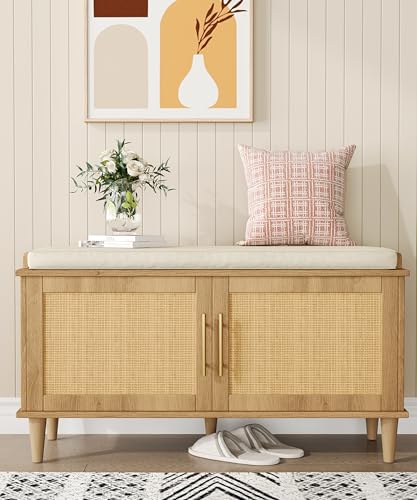
- Best overall for small spaces: Akxomel Rattan Shoe Storage Bench with Cushion and 2 Doors, Natural Oak — Check on Amazon
- GDFStudio Rustic Storage Bench with 4 Doors, Adjustable Shelves and Removable Cushion, Gray Wash — Check on Amazon
- Crosley Furniture Holbrook Hall Tree with Shoe Rack Bench and Coat Hooks, Distressed White — Check on Amazon
- Zihanhome Chenille Upholstered Entryway Bench with Solid Wood Shelf, Beige — Check on Amazon
See 2 more Amazon options
- Walker Edison Industrial Metal and Wood Entryway Bench, 48 Inch, Grey Wash — Check on Amazon
- Walker Edison Julian Rustic Farmhouse Lift-Top Entry Bench with Bottom Rack, 48 Inch, Grey — Check on Amazon
Read the full guide ↓
Disclosure: As an Amazon Associate, dailyhomedecorating.com earns from qualifying purchases. Links to Amazon on this page are affiliate links; they cost you nothing extra. Listing details such as price and availability change often, so check the current Amazon listing before you buy.
Hunting for the best entryway bench for small spaces under $700 is really hunting for square inches. In a compact home the entry is shared territory: the same few feet serve as hallway, shoe store, coat drop and the route every bag, bike and grocery trip takes through the house. A bench that is merely small is not enough — a small bench with two pairs of storage simply moves the pile to the floor beside it. What a small space needs is efficiency: storage that goes vertical or hides behind doors, depth held near 15 or 16 inches so the passage stays a passage, and ideally a second job — guest seating, a landing surface, a place to sit that is not the edge of the bed.
That is where the under-$700 budget earns its keep in a small home. Cheaper benches spend their money on looking like furniture; this tier can spend it on mechanisms and density — adjustable shelves that reconfigure as needs change, cabinets that swallow ten pairs in a 40-inch width, a hall tree that stacks coats above shoes above a seat in a single column of wall. Every pick here was verified for dimensions, materials and maker-stated capacities, because in a small space a two-inch error in a listing is the difference between a bench that fits and a bench that lives in the return queue.
Our short answer is the Akxomel: 39.4 inches wide, 15 inches deep, and a maker-stated eight to twelve pairs hidden behind its rattan doors — the best storage-per-inch ratio in this guide. If your small space is a narrow hall with height to spare, the Crosley Holbrook’s 38-inch vertical format is the alternative to beat. And if your compact home has one long, thin wall, the Walker Edison’s 48-inch seat at 15.75 inches deep turns a liability into the most useful surface in the entry. The reviews below give each pick’s real footprint and its honest cost in space or care.
In this guide
Quick Picks: Best entryway bench for small spaces under $700
Small-space entryways are a geometry problem before they are a shopping problem. These six picks were ranked by footprint efficiency — storage per inch of floor, depth discipline and dual-duty value — with the under-$700 budget spent where small homes feel it most.
| Buyer type | Pick | Why it stands out | Link |
|---|---|---|---|
| Best overall for small spaces | Akxomel Rattan Shoe Storage Bench with Cushion and 2 Doors, Natural Oak | The smallest footprint in the guide — 39.4 x 15 in — hiding roughly 8 to 12 pairs behind rattan doors | Check on Amazon |
| Best compact cabinet | GDFStudio Rustic Storage Bench with 4 Doors, Adjustable Shelves and Removable Cushion, Gray Wash | Four doors of closed storage at only 15.9 inches deep, for small entries that must look tidy | Check on Amazon |
| Best narrow hall tree | Crosley Furniture Holbrook Hall Tree with Shoe Rack Bench and Coat Hooks, Distressed White | Only 38 inches wide and stores vertically: bench, hidden shoes, hooks and a shelf in one column of wall | Check on Amazon |
| Best dual-duty studio bench | Zihanhome Chenille Upholstered Entryway Bench with Solid Wood Shelf, Beige | An upholstered bench that earns its floor space twice — entry storage by day, extra seating by evening | Check on Amazon |
| Best slim open rack | Walker Edison Industrial Metal and Wood Entryway Bench, 48 Inch, Grey Wash | The slimmest depth of any wide bench here at 15.75 inches, with an open rack that never blocks a passage | Check on Amazon |
| Best hidden storage, full width | Walker Edison Julian Rustic Farmhouse Lift-Top Entry Bench with Bottom Rack, 48 Inch, Grey | A full 48-inch seat whose storage hides under the lift-up top — for small homes with one long wall | Check on Amazon |
How these picks were chosen
The six picks come from the verified under-$700 entryway pool — Amazon US products with maker or listing dimensions, materials and capacities we could confirm — re-ranked under small-space rules. Depth was the first filter: every pick here is 18 inches deep or less, and four of the six are under 16. Storage density was the second: closed or hidden capacity per inch of width, with the maker’s own pair counts and shelf figures used where published. Dual-duty value was the third: in a small home a bench that also seats guests properly outranks one that only stores.
Capacities are printed exactly as makers state them, including the modest ones, and the one pick whose capacity we could not verify consistently — the Walker Edison Julian — says so in its review rather than carrying an invented figure. Tall units are flagged for the wall anchoring their makers direct. As across this batch, there are no static prices and no fixed star ratings: the under-$700 figure is the budget ceiling each pick was screened against, and every link simply invites you to check the current price on Amazon.
A note on what small-space shoppers should distrust: photographs. Entry benches are routinely photographed in lofts with twelve-foot ceilings and acres of floor, which makes a 48-inch bench look petite and a hall tree look modest. The only honest scale is the tape measure against your own wall, which is why every review in this guide leads with the verified footprint and why the how-to section insists on a taped floor outline before ordering.
Detailed reviews
1. Akxomel Rattan Shoe Storage Bench with Cushion and 2 Doors, Natural Oak — Best overall for small spaces
Key specs (maker / listing figures): 39.4 in wide x 15 in deep x 20 in tall; seat height 20 in. Two rattan-panel doors with gold-tone handles hiding an adjustable middle shelf with three height settings; maker states room for roughly 8 to 12 pairs inside; 30 mm seat cushion with anti-slip Velcro strips; solid wood legs. Maker-rated capacity: up to 250 lb.
Start with the numbers, because in a small space the numbers are the review: 39.4 inches wide, 15 inches deep, 20 inches tall. That is the smallest footprint in this guide, and behind the two rattan doors sits an adjustable shelf with three height settings and a maker-stated capacity of roughly eight to twelve pairs. No other pick hides as much per inch. The natural oak finish and solid wood legs keep the visual weight as low as the physical footprint, and the 30 mm cushion with anti-slip strips makes the seat comfortable enough to serve as the small home’s spare chair.
The maker rates the bench to 250 lb. The compromises are the honest ones for this design: the 20-inch seat is high for small children, and rattan door panels — lightly ventilating, very current — will not survive being the household’s kicking target, so site it out of the door swing. The three shelf heights matter more than they sound: boots in winter, trainers in summer, and the shelf moves instead of the bench being replaced. For a small entry that must look calm and hold a household’s shoes, this is the efficiency benchmark.
Who it suits: Small homes and apartments where the entry is a few feet of shared wall and shoes must vanish.
Pros
- Best storage-per-inch in the guide: roughly 8 to 12 pairs in 39.4 x 15 in
- Three shelf heights adapt storage by season
- Light visual footprint in natural oak and rattan
- Cushioned seat doubles as spare seating
Honest limitation: 20-inch seat is tall for children, and rattan panels must be kept out of kicking range.
Choose it if floor area is the scarcest thing you own. Skip it if your entry takes heavy knocks and toddler traffic.
Seen the specs and the limitation above and still interested? Check on Amazon for the current listing details.
2. GDFStudio Rustic Storage Bench with 4 Doors, Adjustable Shelves and Removable Cushion, Gray Wash — Best compact cabinet
Key specs (maker / listing figures): 42.7 in wide x 15.9 in deep x 17.4 in tall; about 50.4 lb. Four shutter-style doors, adjustable shelving, two-drawer storage in the line, removable cushion and a grey wash finish over wood construction. Maker-rated maximum weight recommendation: 200 lb.
The GDFStudio in grey wash is the small-space pick for households whose clutter is not only shoes. Four shutter doors with adjustable shelves hide footwear and bags, drawer storage in the line takes the keys, gloves and leads, and the removable cushion tops a footprint of 42.7 inches wide by just 15.9 deep — cabinet density without corridor-blocking depth. The grey wash finish is a small-space asset in itself: pale enough to keep a compact entry feeling open, forgiving enough to hide the scuffs that tight quarters guarantee.
The maker rates the seat to 200 lb, the lowest figure in this guide — plan it as one person’s shoe-changing seat, not the household’s gathering perch. Closed cabinets need dry shoes, so the boot tray remains part of the small-space system, ideally a slim one that slides under the bench itself. At about 50 lb the assembled unit can be shifted by one person for cleaning or a layout rethink, which in a small home — where layouts get rethought often — is worth more than it sounds. Shutter doors lean soft-rustic; in a pale scheme that reads as texture rather than theme.
Who it suits: Compact homes needing maximum closed storage for mixed clutter, in a slim depth and pale finish.
Pros
- Four doors plus drawers — most closed storage per inch after the Akxomel
- Slim 15.9-inch depth preserves the passage
- Grey wash keeps small entries feeling open
- About 50 lb — movable for cleaning and re-layouts
Honest limitation: 200 lb seat rating suits one sitter; cabinets need dry shoes and a boot tray alongside.
Choose it if your small entry must hide mixed clutter, not just shoes. Skip it if two adults need to sit together regularly.
Seen the specs and the limitation above and still interested? Check on Amazon for the current listing details.
3. Crosley Furniture Holbrook Hall Tree with Shoe Rack Bench and Coat Hooks, Distressed White — Best narrow hall tree
Key specs (maker / listing figures): 38 in wide x 18 in deep x 70 in tall; about 110 lb assembled. Two base cabinets with double doors, magnetic closures and an adjustable, removable shelf in each (maker-rated 15 lb per shelf); open stationary shelf rated 20 lb; four double-prong hooks rated 5 lb per hook; full-length oatmeal bench cushion with a removable cover; MDF and birch veneer construction with recessed paneling. Hook limit is the headline number here: 5 lb per double hook, 15 lb per cabinet shelf, 20 lb on the open shelf (maker figures).
When floor is scarce but the wall is tall, the Holbrook trades width for height better than anything here: 38 inches wide, 18 deep, 70 tall. Inside that column live a cushioned bench, two shoe cabinets with adjustable shelves and magnetic doors, an open shelf for post and keys, and four double hooks for coats. For a small home without a coat closet, it is the difference between an entry system and an entry pile. The removable cushion cover washes, and Crosley publishes the working limits plainly — 5 lb per hook, 15 lb per cabinet shelf, 20 lb on the open shelf.
Depth is the figure to respect: at 18 inches it is the deepest pick in this guide, so it belongs on a wall where the passage can spare it, not in the narrowest corridor. At about 110 lb assembled it is a commit-once piece, and it must be anchored to the wall as the maker directs — in a small home with children, that anchoring is doubly non-negotiable. Assembly is a two-person job. None of that diminishes what it achieves: no other pick organises this much of a small household’s arrival routine in 38 inches of width.
Who it suits: Small homes with ceiling height to spare, no coat closet, and a wall that can take 18 inches of depth.
Pros
- Narrowest width here at 38 inches, storing vertically
- Shoes hidden, coats hooked, keys shelved in one column
- Removable cushion cover
- Honest maker limits for every hook and shelf
Honest limitation: Deepest pick at 18 inches, heaviest at about 110 lb, and anchoring is mandatory.
Choose it if you have height and no coat closet. Skip it if your passage cannot spare 18 inches of depth.
Seen the specs and the limitation above and still interested? Check on Amazon for the current listing details.
4. Zihanhome Chenille Upholstered Entryway Bench with Solid Wood Shelf, Beige — Best dual-duty studio bench
Key specs (maker / listing figures): 44 in wide x 16 in deep x 18.5 in tall; seat height 19 in. Poplar wood frame and legs, chenille upholstery over high-resilience foam, and an open solid wood shelf underneath for shoes, books or bins; protective foot pads included per the maker. Maker-rated maximum weight recommendation: 300 lb.
In the smallest homes the entry bench shares a room with the sofa, and the Zihanhome is built for that double life. Chenille upholstery over high-resilience foam, slim poplar legs and a single floating wood shelf give you a piece that reads as a living-room bench — and the maker’s 300 lb rating and 19-inch seat height mean it works as one, seating guests at the same height as your dining chairs. Its footprint, 44 by 16 inches, is mid-pack here; its trick is not smallness but usefulness per hour of the day.
Storage is the deliberate sacrifice: one open shelf, sized for the daily pairs of one or two people. In a small space that only works if the rest of the shoe collection lives in a closet — treat this bench as the visible station of a system stored elsewhere. Pale chenille needs fabric protection and a household that keeps the shelf tidy, because in an open-plan small home there is nowhere for a messy bench to hide. If those conditions hold, no other pick makes a compact entry feel as intentional.
Who it suits: Studio and one-bedroom homes where the bench must double as living-room seating and look the part.
Pros
- Design-bench looks that suit open-plan small homes
- Maker-rated to 300 lb with a chair-like 19-inch seat
- Honest guest seating as a second job
- Compact 44 x 16 in footprint
Honest limitation: One open shelf only — the wider shoe collection needs closet storage elsewhere.
Choose it if dual-duty seating matters as much as storage. Skip it if this bench must be your entire shoe store.
Seen the specs and the limitation above and still interested? Check on Amazon for the current listing details.
5. Walker Edison Industrial Metal and Wood Entryway Bench, 48 Inch, Grey Wash — Best slim open rack
Key specs (maker / listing figures): 48 in wide x 15.75 in deep x 18 in tall; seat height 18 in. Powder-coated steel frame with high-grade MDF panels and a melamine coat the maker describes as moisture resistant; angled metal shoe rack plus an adjustable storage shelf on one side; seats two. Maker-rated maximum weight recommendation: 240 lb.
The Walker Edison is the small-space specialist for one specific geometry: the long, thin entry. Its seat runs a full 48 inches — the widest here — while its depth is held to 15.75 inches, the slimmest of any wide bench in the guide. Along a narrow hall wall that combination is gold: two people can sit, or one person and the day’s bags, without the bench ever projecting into the walkway. The angled metal rack below airs shoes openly, the adjustable side shelf takes boots or a basket, and the maker’s moisture-resistant melamine coat suits entries that double as the home’s wet zone.
The maker rates the seat to 240 lb. Open storage in a small home is visible storage, so this pick belongs in a defined hallway rather than inside the living area, and the rack wants a weekly wipe to keep dust from advertising itself. Engineered panels are the material compromise; the steel frame is the compensation, and the unit disassembles more gracefully than the cabinet benches when a move comes. For small homes whose entry is a corridor, this is the layout that finally fits.
Who it suits: Small homes with a long, narrow entry wall or corridor-style hall.
Pros
- 48-inch seat at only 15.75 inches deep — unique geometry
- Open rack airs shoes where no mudroom exists
- Moisture-resistant coat for wet entries
- Disassembles relatively easily for moves
Honest limitation: Open storage shows dust and disorder; panels are engineered board.
Choose it if your small space is long and thin. Skip it if your bench will sit inside the living room’s sightline.
Seen the specs and the limitation above and still interested? Check on Amazon for the current listing details.
6. Walker Edison Julian Rustic Farmhouse Lift-Top Entry Bench with Bottom Rack, 48 Inch, Grey — Best hidden storage, full width
Key specs (maker / listing figures): 48 in wide (maker size); wood construction with powder-coated metal accents in a grey rustic finish; lift-up top opening to a hidden storage compartment; open slatted bottom rack for shoes. Confirm the exact depth and height on the current listing before ordering, as the maker has sold this design in more than one finish. Confirm the current maker capacity figure on the listing before ordering; no figure is printed here because we could not verify one figure consistently across sources.
The Julian is the wide option for small homes whose single spare wall is a long one. Across 48 inches it pairs a lift-up top — a hidden compartment for the seasonal and occasional clutter that small homes have nowhere else to file — with an open slatted bottom rack for the daily shoes. The grey farmhouse finish with powder-coated metal accents keeps it light in tone, and the concept is sound small-space thinking: hidden storage for what you touch weekly, open storage for what you touch twice a day.
Two honest notes. We could not verify one consistent maker capacity figure for this model across sources, so if a specific load matters, confirm the current figure on the listing before ordering — this guide prints no number rather than a shaky one. And the lift-top discipline applies: the seat must be cleared to open the compartment, so load it with the weekly and seasonal layer, not the daily grabs. Depth and height also vary by finish in this line, so confirm the exact figures on the listing against your taped outline. Judged on concept and footprint flexibility, it earns its place as the full-width hidden-storage option.
Who it suits: Small homes with one long wall, wanting hidden storage for seasonal clutter plus an open daily rack.
Pros
- Hidden lift-top compartment plus open daily shoe rack
- Full 48-inch seat for two
- Pale grey finish keeps compact entries light
- Storage split by frequency of use — smart small-space logic
Honest limitation: Maker capacity and exact depth/height need confirming on the current listing; seat must clear to open the lid.
Choose it if you have width but need clutter invisible. Skip it if a verified capacity figure is essential before you buy.
Seen the specs and the limitation above and still interested? Check on Amazon for the current listing details.
Comparison table
Footprints first — every figure below is a maker or listing figure, and the depth column is the one that decides small-space success.
| Pick | Footprint / size | Storage style | Maker capacity note |
|---|---|---|---|
| Akxomel Rattan Shoe Bench, Natural Oak | 39.4 x 15 in; 20 in tall | Two rattan doors, adjustable shelf | 250 lb (maker) |
| GDFStudio Rustic Storage Bench, Gray Wash | 42.7 x 15.9 in; 17.4 in tall | Four shutter doors + adjustable shelves | 200 lb (maker) |
| Crosley Holbrook Hall Tree | 38 x 18 in; 70 in tall | Two closed cabinets + hooks + shelf | 5 lb per hook; 15 lb per shelf (maker) |
| Zihanhome Chenille Bench with Wood Shelf | 44 x 16 in; 18.5 in tall | One open wood shelf under upholstered seat | 300 lb (maker) |
| Walker Edison Industrial Bench, 48 Inch | 48 x 15.75 in; 18 in tall | Angled open rack + adjustable shelf | 240 lb (maker) |
| Walker Edison Julian Lift-Top Bench | 48 in wide; confirm depth/height on listing | Hidden lift-top compartment + slatted rack | Not verified consistently — confirm on listing |
How to choose: best entryway bench for small spaces under $700
Measure the space three ways before looking at a single bench: the wall width available, the depth that leaves a comfortable walking lane (in a small home, guard that lane fiercely), and the height to the first obstruction. Then tape the footprint of your finalist on the floor and live with the outline through a full day’s comings and goings. Small-space fit is a behaviour, not a dimension — the tape test reveals the door swing, the bag route and the elbow room that numbers alone hide.
Rank by storage per inch, then by second jobs. A 39-inch cabinet that hides ten pairs beats a 48-inch bench that hides four, every time, in a small home. After density, ask what else the piece does: seats guests at dining height, provides the landing surface for post and keys, or goes vertical to replace a coat rack. Pieces with two jobs effectively halve their footprint, which is the real maths of compact living.
Respect the working limits and the wet-shoe rule. Maker capacities — seat, shelf and hook figures are all printed in this guide — tell you how the storage actually behaves under load. Closed cabinets in a small home need dry shoes and a slim boot tray in the system, or the one piece of entry furniture you own becomes the one that smells. Finally, keep the exit in mind: weights here run from about 40 to 110 lb, and the lighter end is a real advantage when small-space living means moving more often.
Common mistakes to avoid
Mistake one is trusting photographs for scale. Benches are shot in lofts; your entry is not a loft. A 48-inch bench that looks delicate in a listing can dominate a 40-inch wall, and a hall tree can crowd a low ceiling. The tape outline and the verified dimensions in this guide exist precisely to defeat the photograph. Mistake two is buying small instead of dense — a petite bench with token storage guarantees the floor pile returns, now arranged around a piece of furniture.
Mistake three is blocking the infrastructure: radiators, thermostats, intercoms, the door swing, the closet that must still open. In a small home every one of those is within a foot of the entry wall, and a bench that fights any of them will be resented daily. Mistake four is forgetting verticality in both directions — failing to use the wall height you have (the Holbrook’s whole case) and failing to anchor a tall unit once you do use it.
And the quiet mistake: no system around the bench. A slim boot tray, a washable runner that protects the floor and catches grit, and hooks where coats actually land turn a good bench into a working entry. In a small space the bench is the anchor of that system, not a substitute for it — buy the humble pieces with it and the whole entry will feel larger than the sum of its inches.
Final recommendation
For most small spaces, buy the Akxomel and do not look back: no pick in this guide hides more shoes in less floor, and its cushioned seat works as the spare chair every compact home needs. If your small home has height and no coat closet, the Holbrook is the vertical answer; if it has a long thin wall, the Walker Edison turns that wall into the hardest-working surface in the entry. Measure honestly, tape the outline, and let storage-per-inch — not the photograph — make the final call.
Start with the Akxomel Rattan Shoe Bench, Natural Oak if it fits your measurements. If it does not, the Crosley Holbrook Hall Tree is the alternative we would buy next in this budget.
Layout patterns for compact entries
Compact entries repeat in a few shapes, and each shape has a bench pattern that works. The corridor entry — a hall barely wider than the door — wants the slim-depth solution: the Walker Edison’s 48-inch seat at 15.75 inches deep, or the Akxomel against the longest wall, with the walking lane defended at all costs and nothing, ever, stored on the floor beside the bench. The alcove entry — a recess, a space under stairs, the end of a room — wants density: the GDFStudio’s cabinets or the Akxomel again, filling the recess fully so no dead corners collect bags. A bench that exactly fills an alcove reads as built-in, which is the highest compliment small-space furniture can earn.
The open-plan entry — a door opening straight into the living space — wants concealment and a second job. Closed storage (Akxomel, GDFStudio) keeps the room’s sightline calm, and a bench that seats guests properly, like the Zihanhome at its maker-rated 300 lb, stops being entry furniture that happens to be in the room and becomes room furniture that happens to run the entry. The tall-wall entry — narrow floor, generous height, often in older housing — is the Holbrook’s pattern: 38 inches wide, storage stacked to 70 inches, coats above shoes above seat in one disciplined column.
Whichever pattern fits, three layout rules hold. Keep the door swing sacred: mark its arc and let nothing enter it. Keep the bench out of the radiator’s blast and the room’s main walking diagonal. And leave the composition one piece of breathing room — in a small space, the empty stretch of wall beside a well-chosen bench is what makes the bench look intentional rather than merely squeezed in. Measure, tape, live with the outline, then order: that sequence is worth more than any single product decision in this guide.
Longevity in a small home: buying once, moving well
Small-space households move more often and replace furniture more reluctantly — there is no spare room to exile a mistake to — so longevity is a small-space feature, not a luxury. Read the picks through that lens. Solid wood, in the wider guide’s Acadian class, repairs and refinishes. Cabinet benches around 50 lb, like the GDFStudio, move with one person and reconfigure with adjustable shelves as the household’s storage changes. The Akxomel’s three shelf heights are the same idea in miniature: the bench adapts instead of being replaced when shoe sizes and seasons change.
Weight is the honest proxy for moving pain. The spread in this guide — from compact cabinets one person can shift, to the Holbrook at about 110 lb — maps directly onto moving-day reality. A tall hall tree is a magnificent organiser and a genuine commitment; choose it when the home is stable for a few years, and choose the lighter densities when a move is already on the horizon. Keep the maker’s hardware and instructions, photograph the assembly, and a good bench will survive three homes. Lose them, and even a quality piece becomes flat-pack archaeology.
Care scales down, too, in a small home — which is fortunate, because there is no utility room to hide neglect in. A washable runner, a boot tray, felt pads, a weekly five-minute reset of the bench’s contents: that is the entire maintenance department. The households whose compact entries work are not the ones with the most storage; they are the ones whose storage, habits and floor plan agree with each other. Every pick in this guide can anchor that agreement — the reviews exist to help you choose the one whose terms your household will actually keep.
Before you order: the small-space checklist
Small spaces punish assumptions, so verify these six things in order. One: the three measurements — wall width, depth to the walking lane’s edge, height to the first obstruction — written down, not remembered. Two: the tape test through a full day, including the door swing, the bag route and the moment two people pass each other. Three: the density test — your real pair count and clutter inventory against the pick’s verified storage, with the Akxomel’s maker-stated eight to twelve pairs and the GDFStudio’s four doors as the benchmarks to beat.
Four: the second-job test — name the bench’s other role (guest seat, landing surface, coat system) and confirm the figures support it: seat rating, seat height, hooks. Five: the infrastructure test — radiator, thermostat, intercom, closet swing and the wall’s suitability for anchoring if you choose the Holbrook’s vertical pattern. Six: the exit test — assembled weight and whether the piece comes apart, judged against your stairs and your likelihood of moving within two years.
Pass the list and the pattern chooses itself: density for the alcove, slim depth for the corridor, concealment and dual duty for the open plan, vertical storage for the tall wall. The benches in this guide are all honest tools for compact living; the checklist simply matches the tool to the geometry you actually have — which, in a small space, is the whole of the art.
Beyond the bench: completing the compact entry
The bench is the anchor, but a compact entry is finished by three small companions, each chosen with the same measurement discipline. The first is the mirror or hook rail above the bench — whichever your storage pattern lacks. If the bench hides shoes but offers no hooks, a rail at a deliberate height completes the system; if the bench is a hall tree, a mirror above a nearby surface returns the light that tall furniture borrows. Mount either with the wall’s structure in mind, and in rentals only with the permission the lease requires.
The second companion is light. Small entries are usually the darkest square metres in the home, and a bench under poor light invites the pile — nobody organises what they cannot see. A warm bulb, a small lamp on a nearby surface, or even a battery picture light above the mirror changes the entry’s behaviour out of proportion to its cost. The third companion is the floor layer: a washable runner sized to the bench’s footprint plus the standing zone in front of it. It catches grit before the rest of the home does, protects the floor under the household’s heaviest traffic, and — in a compact home — visually declares the entry’s territory, which helps the whole system hold its borders.
None of these companions needs to be expensive, and all of them should be bought with the bench rather than after it, because they are sized and styled against it. Together they are the difference between a bench placed in a small space and an entry designed for one. The households that get compact living right rarely own more things; they own things that agree with each other. Start that agreement at the front door.
The one-metre rule: protecting the standing zone
Every entry bench, whatever its footprint, needs a partner measurement that never appears on a listing: the standing zone. Sitting to change shoes takes the bench’s depth plus roughly a metre in front of it for legs, bags and the second person passing behind. In a small space that metre is contested territory — it is also the corridor, the kitchen route, the bathroom path — which is why compact entries fail socially even when the furniture fits. Defend the zone in the layout: no storage creep into it, no bike parked across it, the runner marking it as the bench’s territory. When the zone survives, the bench gets used as designed, twice a day, without negotiation. When it does not, the bench becomes the thing shoes are changed standing next to — and the whole purchase quietly fails. Measure the zone, not just the bench.
And a closing thought on patience, because compact entries reward it. Live with any new bench for a full month of seasons-in-miniature — a wet week, a guests weekend, a delivery-heavy few days — before judging it or adding to it. Small-space systems reveal their real gaps slowly: the shelf that is one pair short in boot season, the hook that is one coat short when visitors arrive. Adjust the adjustable, add the one missing companion piece, and resist the urge to solve a seasonal peak with permanent furniture. The entries that work in small homes are tuned, not just bought — and every pick in this guide was chosen to be tunable: shelves that move, storage that splits by frequency, formats that fit more than one pattern of room.
FAQ
What is the best bench size for a small entryway?
Prioritise depth: 15 to 16 inches keeps a passage comfortable. The Akxomel pairs the smallest footprint here (39.4 x 15 in) with a maker-stated 8 to 12 pairs of hidden storage. Whatever you choose, tape the footprint on the floor and walk the route before ordering.
How do I store shoes in a small space without a pile?
Closed, dense storage: cabinets with adjustable shelves use every inch, unlike open racks sized by pairs on a shelf. The Akxomel and the grey-wash GDFStudio both hide the collection behind doors. Keep a slim boot tray for wet pairs so cabinets only ever hold dry shoes.
Is a hall tree too big for a small home?
Not if the wall is tall and the width is free: the Holbrook is only 38 inches wide and stores vertically — bench, hidden shoes, hooks and a shelf in one column. It is the deepest pick here at 18 inches and must be wall-anchored, so check both the passage depth and your lease before choosing it.
Can an entryway bench replace other furniture in a small home?
That is exactly the right question to ask. A bench rated for seating (the Zihanhome and Acadian-style picks at 300 lb in our wider guide) doubles as guest seating; a hall tree replaces bench, rack and hooks at once. The more jobs a piece honestly does, the smaller its effective footprint.
What seat height suits a small-space bench?
The same 17 to 20 inch comfort band as anywhere — small spaces do not change bodies. Higher seats around 19 to 20 inches (Zihanhome, Akxomel) double best as dining-height guest seating; lower seats suit households with small children. Check the figure in the verified specs before ordering.
Related guides
Furnishing the rest of a compact home? These are the neighbouring guides worth your time: