Where to buy
Check the latest price, availability and delivery on Amazon. Orders are placed on Amazon. We may earn a commission from qualifying purchases.
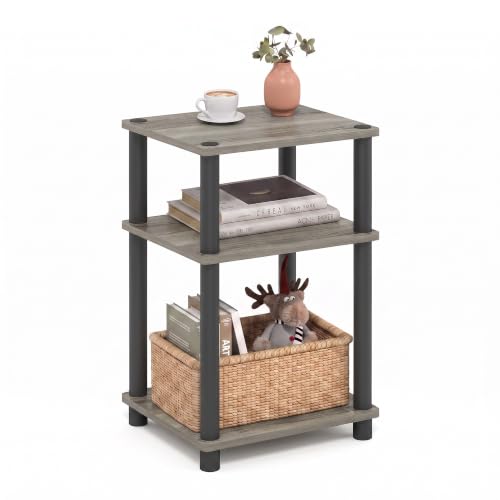
- Best overall for small spaces: Furinno JUST 3-Tier Turn-N-Tube End Table (11087) — Check on Amazon
- VASAGLE C-Shaped Side Table with Charging Station (ULET362G01) — Check on Amazon
- Nathan James Amalia Round Accent End Table with Faux Marble Top — Check on Amazon
- VASAGLE Side End Table with Charging Station, 2 Drawers (ULET321B02) — Check on Amazon
See 2 more Amazon options
- VASAGLE 21.7-Inch Round Side Table, 2-Tier End Table (ULET56BX) — Check on Amazon
- Nathan James Mina Rattan Wood End Table with Storage (33201) — Check on Amazon
Read the full guide ↓
Disclosure: As an Amazon Associate, dailyhomedecorating.com earns from qualifying purchases. Links to Amazon on this page are affiliate links; they cost you nothing extra. Listing details such as price and availability change often, so check the current Amazon listing before you buy.
The best end table for small spaces under $150 wins on geometry, not on charm alone. A small space — a box-room living area, a narrow Victorian terrace, a snug bedroom corner, the gap between a sofa and a wall that measures in single digits of inches — does not need a scaled-down version of a big room’s table. It needs a table designed around the constraint: storage stacked vertically instead of spread horizontally, a footprint measured in inches and honest about them, a shape that fits the gaps real rooms actually offer, or no footprint at all. This guide stays under $150 — check price on Amazon for the current figure on any listing — and ranks six verified tables by how intelligently they occupy, or refuse to occupy, a small space.
The strategies here are distinct, and choosing between them is the real decision. Vertical stacking: the Furinno turns 1.1 square feet of floor into three shelves. Footprint refusal: the VASAGLE C-table slides its base under the sofa and floats its surface over the seat. Compression: the narrow VASAGLE squeezes drawers, shelving and charging into a 13.8-inch width. Shape-shifting: two round tables — a featherweight 18-inch accent and a two-tier 21.7-inch workhorse — fit corners and curves that reject rectangles. And concealment: the Mina, the largest footprint here, argues that in a small space a closed door is worth inches because visual clutter shrinks a room faster than furniture does. Each review gives the exact dimensions, because in a small space the dimensions are the review.
Our short answer: for most small spaces, start with the Furinno — the smallest verified footprint with real storage, at the gentlest budget position in this guide. If the space has no floor at all beside the seat, the C-table is the answer and nothing else is. If the slot beside your sofa is narrow but deep, the narrow VASAGLE converts it into the hardest-working storage in the room. Read on for the measurements, the load limits and the honest cases where a slightly larger footprint earns its inches.
In this guide
Quick Picks
Short on time? This table matches each table to the job it does best in this guide.
| Buyer type | Pick | Why it stands out | Link |
|---|---|---|---|
| Best budget, tool-free pick | Furinno JUST 3-Tier Turn-N-Tube End Table | The smallest footprint here — 11.5 x 13.4 inches — with three shelves stacked vertically | Check on Amazon |
| Best slide-under pick for tight seating | VASAGLE C-Shaped Side Table with Charging Station | Footprint effectively zero: the base hides under the sofa itself | Check on Amazon |
| Best compact modern accent | Nathan James Amalia Round End Table | An 18-inch disc that fits corners, alcoves and gaps no rectangle can use | Check on Amazon |
| Best for charging and hidden storage | VASAGLE Charging End Table with 2 Drawers | Full drawers-and-charging storage compressed into a 13.8-inch width | Check on Amazon |
| Best round pick with no sharp corners | VASAGLE 21.7-Inch Round 2-Tier End Table | A round plan that lets a tight room’s traffic curve around it | Check on Amazon |
| Best enclosed storage and warm texture | Nathan James Mina Rattan End Table | Cabinet storage in a 19 x 17 inch footprint for rooms that must hide things | Check on Amazon |
How These Picks Were Chosen
Every model was verified against its Amazon listing and, where published, the manufacturer’s manual and specification sheet — dimensions in this guide are the makers’ own, because a small-space recommendation built on guessed inches would be worthless. Unverifiable models were excluded, as was anything with a known safety recall, and the under-$150 ceiling is a hard filter: check price on Amazon before buying, since finish and seller changes move listings. We then ranked by footprint first — the literal floor area each table claims — and by what the design does with the vertical column above that footprint.
Beyond size, we checked the small-space practicalities that listings rarely mention. Can the table be carried through a narrow hallway and up a tight stair turn by one person? All six can; the lightest is 6.2 lb. Does it level on uneven old floors? Several picks have adjustable feet. Does its shape waste the corners of its own footprint, or fit the curved and angled gaps small rooms offer? Round and C-shaped designs scored for answering that question well. And does the table’s storage reduce the room’s other furniture — a table that replaces a storage box has a negative footprint in honest accounting, which is why the two storage-heavy picks rank despite not being the smallest here.
A note on honesty about ‘small’: a 19-inch-wide cabinet is not a small table, and we do not call the Mina one. It is included because small spaces fail in two ways — no room for furniture, and no room for things — and for the second failure a compact cabinet is the correct tool. Every pick below is labeled with its true footprint so you can match it to your measured gap rather than to our adjectives.
The 6 Best End Tables for Small Spaces Under $150
Furinno JUST 3-Tier Turn-N-Tube End Table (11087)
Who it suits: The tightest gaps in the house: beside-bed slots, alcoves, the last fourteen inches beside any sofa or chair.
Start with the number that decides everything in a small space: 11.5 by 13.4 inches. That is the Furinno’s footprint — barely over one square foot — and above it stand three full shelves reaching 22.8 inches high. The design insight is vertical: where a conventional table spends its floor on one surface, the JUST stacks the surface three times, so the book, the plant, the lamp and the basket each get a level in a column of air that was previously unemployed. It assembles by hand — Turn-N-Tube poles, no tools — weighs 6.2 lb, and its rounded shelf corners soften a shape that will inevitably live in a traffic pinch-point. In the geography of small rooms, this is the table that fits the places nothing else fits, at the most budget-friendly position in this guide; check price on Amazon.
The capacity honesty is essential precisely because the table invites stacking: each shelf is rated to 15 lb, the unit to 45 lb total. Load it as designed — heaviest items on the bottom shelf, light lamp or none on top — and it serves indefinitely; treat the top tier as a bookcase for atlases and it will tell you so. Composite shelves and plastic poles are the tier’s materials, with a one-year warranty. In a small space, that trade is usually right: the scarce resource is floor, not decades.
Its final small-space virtue is impermanence. A 6.2 lb tool-free table can be tried in the alcove, moved to the bedside, rebuilt in the hallway in minutes — small rooms are puzzles that get re-solved as life changes, and this is the piece that never resists the re-solving. For renters especially, it is the lowest-risk square foot in this guide.
- The smallest footprint in the guide — 11.5 x 13.4 in — with three shelves stacked vertically.
- Tool-free assembly and a 6.2 lb build: try it in any gap in the house in minutes.
- Rounded corners for pinch-points, at the most budget-friendly position here.
Honest limitation: Light-duty limits — 15 lb per shelf, 45 lb total — so heavy items go low and heavy lamps go elsewhere; budget materials will not age like veneer.
Choose it if your gap is genuinely tiny and your storage need is real. Skip it if the table must carry a heavy lamp or serve as the room’s primary, long-term piece.
VASAGLE C-Shaped Side Table with Charging Station (ULET362G01)
Who it suits: Seats with zero adjacent floor: sofas against walls, daybeds, window seats and chairs in corners.
Every other table in this guide negotiates for floor. The C-table declines the negotiation. Its flat steel base slides under the sofa — into space that is already occupied by the sofa’s own shadow — its spine rises behind the cushion, and its top, 11.8 by 15.7 inches, floats over the seat at 24.4 inches. The floor footprint, in any honest accounting, is the thickness of a steel plate under furniture that was already there. For a small space, that is not an incremental improvement; it is a new category of possible. Seats that could never have an end table — the daybed against the wall, the sofa wedged between radiators, the reading chair in the bay — get a surface, and because two AC outlets and two USB ports are built into the top on a 6.5-foot cord, they get a powered surface.
The discipline the design demands is its load limit: 22 lb maximum, full stop. A laptop, a mug, a novel — the intended load — are comfortably inside it. The floating top is not a shelf, a seat or a lean-to, and in a small space where every surface gets drafted into extra duty, this exemption must be deliberate. Adjustable feet level the base on old floors, the build weighs 9.2 lb, and the gray oak top disappears against neutral upholstery. It sits mid-tier in this guide’s budget; check price on Amazon.
Think of it as reclaiming the third dimension: the air over your sofa cushion is the largest unused surface in a small room, and this is the only pick that furnishes it. Paired with any small conventional table elsewhere, it doubles a tight room’s working surfaces without adding a single visible footprint.
- Effectively zero floor footprint — the base lives under the sofa itself.
- A powered, laptop-sized surface delivered to seats no table can stand beside.
- Slides in and out in seconds as the small room’s needs change through the day.
Honest limitation: The 22 lb limit is strict and the top holds one person’s things only; there is no storage, and the base needs a sofa or bed with under-clearance to slide beneath.
Choose it if your seat has no floor beside it at all. Skip it if you need storage, a lamp stand, or a surface for shared and heavy loads.
Nathan James Amalia Round Accent End Table with Faux Marble Top
Who it suits: Corners, bays and between-chair gaps — the curved and leftover spaces that rectangles waste.
Small spaces are rarely small rectangles; they are small leftovers — the curve of a bay, the angle between two chairs, the round-shouldered corner by the window. The Amalia, an 18-inch disc on three solid rubberwood legs, is shaped for leftovers. A round footprint has no corners demanding clearance, so it tucks into geometries that reject every rectangular table in this guide, and at 8.7 lb it can be auditioned in every corner of the house in a single afternoon. The white faux-marble laminate top does small-space work too: it reflects light in the dim corners small rooms collect, and it wipes clean instantly, so the little table can serve drinks, plants and projects in rotation without carrying the evidence.
The numbers suit the role: 18 inches diameter, 18 inches high, a 75 lb weight limit that laughs at any load a perch will meet, and pre-applied pads that keep rental floors pristine as it migrates. It sits mid-tier in this guide’s budget; check price on Amazon. Beside a low chair or daybed its height is exactly hand-level; beside a standard sofa it serves as the lower, lighter satellite rather than the main table.
There is no storage, by design — in the smallest spaces, the winning object is often the one that adds a surface without adding a container to fill. If your small space’s problem is a missing perch rather than missing storage, the Amalia is the most space-efficient answer here: nearly all surface, nearly no presence.
- Round 18-inch footprint fits bays, corners and angled gaps rectangles cannot use.
- 8.7 lb with floor pads fitted — audition it in every corner in an afternoon.
- Bright laminate top lightens dim small-space corners and wipes clean.
Honest limitation: No storage and a low 18-inch height; it is a perch for low seating, not a main table for a tall sofa.
Choose it if your small space is a shape problem — a corner or curve with no surface. Skip it if the problem is storage; the Furinno and narrow VASAGLE solve that one.
VASAGLE Side End Table with Charging Station, 2 Drawers (ULET321B02)
Who it suits: The classic small-space slot: a narrow but deep gap beside the sofa that currently holds nothing but dust.
Many small living rooms have exactly one furniture opportunity: the slot beside the sofa, perhaps fourteen inches wide but two feet deep, presently occupied by a floor lamp’s base and optimism. The narrow VASAGLE is dimensioned for that slot — 13.8 inches wide, 23.6 inches deep, 24 inches high — and it converts the slot into the hardest-working storage in the room: two drawers, an open shelf, a magazine holder against the wall, and a charging station with two AC outlets and two USB-A ports on a 6.5-foot cord built into the top. In footprint accounting this table is nearly free, because it occupies space that was already lost; in function accounting it replaces a table, a drawer unit and a power strip simultaneously.
It is also, unexpectedly, the strongest table in this guide: 160 lb rated on top, 200 lb overall, 30.4 lb of steel and particleboard. A small space often forces one table to carry the big lamp, and this is the narrow pick that can. Assembly is a standard flat-pack half hour, after which the slot is infrastructure. It sits at the upper end of this guide’s budget; check price on Amazon, and weigh the storage furniture it makes unnecessary.
The small-space caveats: drawers are rated at 5 lb each — organization, not archive — and the charging cord needs an outlet within 6.5 feet, which in a tight room usually means choosing the sofa end nearest the socket for this table. Where the slot exists, no pick converts it more completely.
- Converts a 13.8-inch-wide dead slot into drawers, shelving and charging.
- The strongest build in the guide (160 lb top) for small rooms’ one big lamp.
- Rear magazine holder uses the against-wall inches every other table wastes.
Honest limitation: Drawers are 5 lb-rated organizers, and the footprint only pays off in a genuinely narrow, deep gap — measure yours before ordering.
Choose it if you have the classic narrow slot beside the sofa. Skip it if your gap is wide and shallow, where the round picks will serve better.
VASAGLE 21.7-Inch Round Side Table, 2-Tier End Table (ULET56BX)
Who it suits: Pinch-points and through-routes in small rooms, where a square table would narrow the path and catch every passer-by.
A small room’s floor plan is a set of paths, and furniture either respects them or taxes them. The round VASAGLE respects them: its 21.7-inch circular plan presents no corner to the route between door and sofa, so hips, laundry baskets and vacuum cleaners curve around it instead of colliding. That makes it the right ‘larger’ table for a small space — a full-size surface, big enough for a lamp and a book together, whose shape refunds the circulation space its diameter borrows. The second round shelf below doubles the storage in the same footprint, the steel frame is ring-braced, and adjustable feet settle it on the uneven floors of the older, smaller homes where it will mostly live.
Specifications in small-space terms: 21.7 inches diameter and height, 66 lb top rating, 22 lb on the lower shelf, 12.3 lb to lift for the thorough cleans small rooms demand. The rustic finish hides dust between those cleans. It sits mid-tier in this guide’s budget; check price on Amazon. As the one main table in a compact living room, it balances surface, storage and circulation better than any rectangle of similar size.
The trade is open storage: in a small room everything shows, so discipline or a lidded basket on the lower shelf completes the system. If your small space’s binding constraint is the walkway rather than the wall, this is your pick.
- Round plan keeps a small room’s walkways flowing around a full-size surface.
- Two tiers in one footprint — 66 lb top, 22 lb shelf — with adjustable feet.
- Lifts one-handed for cleaning the tight rooms that need it most.
Honest limitation: Open tiers display clutter in a room with no hiding places; the 21.7-inch diameter still needs a real patch of floor, unlike the C-table.
Choose it if your small room’s paths matter as much as its surfaces. Skip it if floor beside the seat does not exist — that is the C-table’s brief.
Nathan James Mina Rattan Wood End Table with Storage (33201)
Who it suits: Small spaces whose real shortage is not floor but hiding places — rooms that feel tiny because everything is visible.
The Mina is this guide’s deliberate exception: at 19 inches wide and 17 deep it has the largest footprint here, and it earns every inch by attacking the other small-space disease — visibility. In a compact room, the chargers, remotes, paperwork and small objects of life are always in view, and the eye reads that as smallness. The Mina closes a rattan cane door on a full shelf of it, keeps one open cubby for the single styled object, and presents the room with a warm, intentional piece of furniture instead of a storage situation. The result is a small room that feels larger with the table in it than without it — the only pick here that can honestly claim that.
The build justifies the footprint in a longer tenancy: 90 lb top rating, 30 lb per shelf, a settled 25 lb weight, and a lifetime manufacturer warranty. At 22 inches high it suits standard seating, and the oak-and-black finish pairs with the neutral palettes small rooms rely on. Assembly takes around forty minutes with a Phillips screwdriver. It sits toward the upper end of this guide’s budget; check price on Amazon.
Place it where its door faces the room and its calm can do the most work — the main sofa’s end, not the hidden corner. The cane wants gentle dusting and the front is not stain resistant, so the spill-heavy seat is not its home. For the small space that is small because everything shows, this is the cure, measured in perception rather than inches.
- A closed shelf that makes a small room feel larger by hiding its clutter.
- Lifetime warranty and strong ratings — a longer-tenancy anchor piece.
- Warm cane-and-oak presence that reads as decor, not storage, in a visible room.
Honest limitation: The largest footprint in the guide and the longest assembly; it solves the visibility problem, not the floor problem.
Choose it if your small space feels small because everything is on show. Skip it if floor inches are the true shortage — the Furinno or C-table answer that one.
Comparison Table
| Product | Type | Best use | Link |
|---|---|---|---|
| Furinno JUST 3-Tier Turn-N-Tube End Table | 3-tier open shelf table | Alcoves, beside-bed gaps and any vertical-storage opportunity | Check on Amazon |
| VASAGLE C-Shaped Side Table with Charging Station | C-shaped charging table | Sofa seats with literally no floor beside them | Check on Amazon |
| Nathan James Amalia Round End Table | Round accent table | Reading corners, window bays and between-chair gaps | Check on Amazon |
| VASAGLE Charging End Table with 2 Drawers | Narrow charging table with drawers | The narrow slot beside a sofa in a tight living room | Check on Amazon |
| VASAGLE 21.7-Inch Round 2-Tier End Table | Round 2-tier table | Pinch points where a square table would block the path | Check on Amazon |
| Nathan James Mina Rattan End Table | Cabinet-style rattan table | Small rooms whose calm depends on closed storage | Check on Amazon |
How to Choose the Best End Table for Small Spaces Under $150
- Measure the gap, then read footprints, not adjectives. This guide’s true footprints: Furinno 11.5 x 13.4 in, narrow VASAGLE 13.8 x 23.6 in, Amalia 18 in round, round VASAGLE 21.7 in round, Mina 19 x 17 in, C-table effectively zero. Your measured gap picks the shortlist; features only rank within it.
- Stack vertically when floor is the constraint. A three-tier column (Furinno) triples the surface on one square foot. In small spaces, always ask what a design does with the air above its footprint.
- Consider refusing the floor entirely. If no gap exists beside the seat, a C-shaped table that slides under the sofa is not a compromise — it is the only design that adds a surface without adding a footprint. Respect its 22 lb limit and it will serve daily.
- Use shape as a space tool. Round tables fit bays and corners, keep walkways flowing and waste no clearance on corners. In angular leftovers and curved rooms, shape saves more space than size does.
- Count replaced furniture as negative footprint. A narrow table with drawers and charging can retire a storage box and a power strip; a cabinet can retire a basket system. The honest footprint of a multitasker is its own minus what it removes.
- Keep it movable. Small spaces get re-solved constantly. One-person weights (6.2 to 30.4 lb here), flat-pack rebuilds and floor pads let a table participate in the re-solving instead of resisting it.
For a small room’s center and edges, scale down deliberately with Best Coffee Table Under $150.
Common Buying Mistakes
- Shopping by the word ‘small’ in a listing instead of the printed dimensions — small is a claim, inches are a fact, and the gap in your room only accepts facts.
- Buying a wide, shallow table for a narrow, deep slot (or the reverse) and losing the room’s one good furniture opportunity to a shape mismatch.
- Forgetting the space above the sofa: overlooking the C-table option and concluding a seat ‘cannot have a table’ when its floor is full.
- Overloading the lightest tables because they are the only surfaces — 15 lb per shelf and 22 lb total are the rules that keep small tables standing.
- Filling a small room with open shelves and then wondering why it feels smaller: visibility is volume, and one closed door can be worth a foot of floor.
- Choosing a table too heavy or rigid to move, in the one kind of home that rearranges monthly — small-space furniture must stay negotiable.
Final Recommendation
- Best overall for small spaces: Furinno JUST 3-Tier Turn-N-Tube End Table.
- Best no-floor-space pick: VASAGLE C-Shaped Side Table with Charging Station.
- Best tuck-anywhere accent: Nathan James Amalia Round End Table.
- Best narrow storage pick: VASAGLE Charging End Table with 2 Drawers.
- Best round small-space pick: VASAGLE 21.7-Inch Round 2-Tier End Table.
- Best compact cabinet pick: Nathan James Mina Rattan End Table.
For most small spaces the Furinno is the first buy: the smallest footprint, three shelves, no tools, no drama. The C-table owns the seats with no floor, the narrow VASAGLE owns the sofa slot, and the Mina owns the clutter. Measure your gap before you fall in love, check price on Amazon for the listing you choose, and remember that in a small space the best table is the one whose inches all work.
Measuring a Small Space Properly: The Five Numbers That Decide Everything
Small-space furniture fails on measurement more than on quality, because small spaces punish approximation. A table two inches too wide does not fit ‘slightly worse’ in a tight gap — it does not fit, and it then lives in the walkway as a daily apology. So measure like it matters, in the order that matters. First, the gap itself: width and depth at floor level, with the neighboring furniture in its real, lived position — cushions plumped, sofa pushed to its habitual spot — because gaps measured in a tidied room shrink in a lived one. Second, the height the surface must meet: the sofa arm or bed top it will serve, from the floor, since a small table at the wrong height wastes its entire footprint. Third, the path the table must travel: door widths, the hallway turn, the stair angle — small homes often sit in old buildings whose routes are as tight as their rooms.
Fourth, the clearances nobody lists: the under-sofa gap, if a C-table is in contention, measured at the sofa’s lowest rail rather than its highest; the swing of the door that opens into the corner; the radiator’s projection in winter rooms. Fifth, the outlet geometry — where power actually is, and how many feet of cord separate it from the table’s intended home — because in small spaces the charging picks are often the highest-value picks, and their 6.5-foot cords are exact, not approximate. Write the five numbers down. They are the brief. Every pick in this guide publishes its own corresponding numbers, and matching the two sets — before any question of style — is the entire secret of small-space buying.
A last measurement habit separates the successful small room from the almost-right one: mock the footprint before ordering. Masking tape on the floor in the table’s exact rectangle or circle takes ninety seconds and reveals what numbers hide — the vacuum cleaner’s turning circle, the door’s arc, the shin that passes at midnight. Live with the tape for a day. Small spaces forgive many things, but they never forgive an unmeasured purchase, and tape is the cheapest forgiveness available.
- Measure the lived gap: furniture in its real position, cushions plumped, at floor level.
- Measure the route in: doors, hallway turns and stairs are part of the footprint decision.
- Measure clearances: under-sofa height, door swings and radiator projections decide the clever picks.
- Tape the footprint: a day lived with masking tape on the floor prevents a year of apology furniture.
Small Spaces Beyond the Living Room: Bedside, Hallway and the Reading Corner
The end table’s small-space talents transfer to every tight room in the house, and the picks here were chosen partly for that portability. At the bedside, the same narrow dimensions that fit a sofa slot fit the gap between bed and wall — the narrow VASAGLE’s drawers and charging are, if anything, even more at home there, and the Furinno’s three shelves swallow the bedside accumulation of books, water and devices in a square foot. In a hallway, where depth is the scarcest dimension in the home, the slim picks stand against the wall as key-and-mail infrastructure without narrowing the passage into a slalom, and the round picks remove the corner that every passer-by’s hip would otherwise audit daily.
The reading corner — that chair by the window that small homes defend fiercely — is where the light picks shine: the Amalia floats to it in one hand and its bright top gathers the corner’s light; the C-table serves a chair with no side floor at all; the round VASAGLE anchors a corner with a lamp and a proper book surface. The principle running through all of it is the principle of this guide: in a small space, furniture should be judged by the ratio of service to footprint, carried easily between the rooms that need it, and honest about its limits. Buy on that principle and the small rooms stop feeling like compromises. They start feeling edited — which is what, at their best, they are.
Small-Space Storage Math: What Each Table Actually Holds
Small spaces run on honest arithmetic, so let us do the storage sums for this guide’s picks in the units that matter — the objects of an ordinary evening. The Furinno’s three shelves hold, in practice, a small lamp or plant on top, a stack of four to six books on the middle shelf, and a basket or a games collection below: call it a dozen objects in one square foot of floor, the best objects-per-foot ratio in this guide. The narrow VASAGLE holds more and hides most of it: two drawers of smalls — remotes, chargers, coasters, correspondence — a shelf of books, a magazine file against the wall, and a top that still takes the big lamp; its ratio is lower than the Furinno’s only because its footprint, while narrow, is deep. The Mina holds a shelf of clutter invisibly and a cubby of display visibly, which in perception terms is the highest-value storage of all: objects removed from view count double in a small room.
The round tables store in the open and therefore store honestly: the round VASAGLE’s lower shelf takes a basket or a book stack in full view, and the Amalia stores nothing at all — its contribution to the arithmetic is the surface itself, eighteen inches of it, delivered to a corner that had none. The C-table likewise stores nothing and is proud of it: its sum is one person’s working set — laptop, drink, book, phone on charge — held in the air over a seat, at a floor cost of zero, which makes its objects-per-foot ratio technically infinite and practically the best in the guide for the seats it serves.
The lesson of the sums is that ‘storage’ is not one quantity. Count objects, count hidden objects, and count floor, and each pick in this guide wins a different column — which is why the right question in a small space is never ‘which table is best’ but ‘which shortage is mine’. Floor, hiding places, or surfaces: name the shortage, and the arithmetic points at the table.
- Objects per foot: the Furinno’s vertical column wins on raw count in the smallest footprint.
- Hidden objects count double: in a small room, the Mina’s door and the narrow VASAGLE’s drawers buy perceived space, not just storage.
- Zero-floor surfaces: the C-table’s ratio is unbeatable where the seat has no floor to give.
- Load the sums honestly: every count above assumes the makers’ ratings — heaviest low, light-duty picks loaded lightly.
When to Skip the End Table Entirely: Honest Alternatives for Impossible Spaces
A small-space guide earns its credibility by admitting the cases where even its cleverest pick is the wrong answer. If the seat in question already stands beside a windowsill, a radiator cover or a built-in ledge at roughly arm height, that architecture is your end table, and adding furniture to compete with it shrinks the room for nothing — put the budget into a good lamp that clamps or stands instead. If the only gap measures under ten inches and the sofa has no under-clearance for a C-table’s base, the honest solution is a wall-adjacent tray on the arm itself or a floor lamp with an integrated shelf, not a table forced into a space that will resent it daily. And if the room’s shortage is not surfaces but light, an end table is the wrong purchase entirely: the same budget buys the lamp first, and the table conversation can wait for the room to reveal where a lit surface would actually live.
These exceptions share a principle with every recommendation in this guide: a small space should contain only objects whose job is named and whose footprint is justified. The six picks here justify theirs — by stacking, floating, compressing, curving or concealing — in the six ways a small room most often needs. Where none of those six jobs is yours, the most small-space-literate purchase is no table at all, and the money stays ready for the object your room is actually missing.
There is a quiet satisfaction specific to small spaces that this guide is really selling: the moment a room that felt like a compromise starts to feel chosen. It rarely arrives with a renovation. It arrives when the gap beside the sofa — measured, taped, thought about — receives exactly the table it was asking for, and the books leave the floor, the phone charges where you sit, and the path through the room runs clear. Small rooms reward that precision out of all proportion to the money involved, which never exceeds the under-$150 ceiling of this guide and often lands far below it. Measure honestly, buy once, check the live listing before you commit, and let the little room be little on purpose — edited, intentional, comfortable to live in every single day and entirely yours to enjoy.
Frequently Asked Questions
What is the smallest useful end table footprint?
In this guide, 11.5 by 13.4 inches — the Furinno’s three-tier column, which stays useful by stacking vertically to 22.8 inches high. Below roughly a square foot, a table stops holding a lamp and a drink together comfortably. The exception is the C-shaped design, whose footprint is effectively zero because its base slides under the sofa and its surface floats over the seat.
How do I fit an end table where there is no floor space?
Use the space under and over the seat itself. A C-shaped table’s base slides beneath the sofa — check your sofa’s under-clearance — and its top cantilevers over the cushion at working height. The VASAGLE pick here adds built-in outlets and USB ports, and its limit is 22 lb: a laptop, drink and book, never a seat or a shelf-load.
Round or square: which is better for a small space?
Round, more often than not. A round table fits corners and bays without clearance waste, keeps walkways flowing in pinch-points, and removes corners from crowded traffic. Square and rectangular tables win only when the gap itself is a clean rectangle — like the narrow slot beside a sofa, where the 13.8-inch-wide VASAGLE converts dead space into drawers and charging.
Can a bigger table ever suit a small space?
Yes, when it replaces more than it occupies. A compact cabinet like the Mina (19 by 17 inches) can retire baskets, boxes and visible clutter that were consuming the room’s edges and the eye’s patience. Judge a small-space table by the room’s total object count after it arrives, not by its footprint alone.
What load can small end tables safely hold?
Exactly what their makers state, which in this guide ranges from 15 lb per shelf (Furinno) and 22 lb total (C-table) up to 160 lb on the narrow VASAGLE’s top. Small tables are not weak tables by definition — they are specific tables. Put heavy items low, keep heavy lamps on the strongly rated picks, and never sit or stand on any of them.
How do I stop a small-space end table looking cluttered?
Give the top a two-object rule — lamp plus current book, or drink plus phone — and route everything else to a lower shelf, a drawer or behind a door. Lidded baskets civilize open shelves instantly. And choose at least one closed-storage pick for the room: in a small space, hidden storage is what makes the visible surfaces possible.


