Where to buy
Check the latest price, availability and delivery on Amazon. Orders are placed on Amazon. We may earn a commission from qualifying purchases.
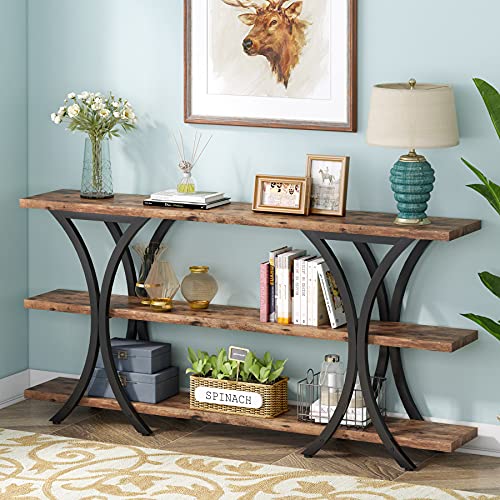
- Best overall for small spaces: Tribesigns 70.8 Inch Narrow Console Table with 3-Tier Shelves — Check on Amazon
- Best slim and strong: Tribesigns 70.9 Inch Console Table, Rustic Brown (HOGA-F1809) — Check on Amazon
- Best open and airy: Plank+Beam Modern Solid Wood Console Table, 46 Inch — Check on Amazon
- Best narrow solid wood: Plank+Beam Solid Wood Console Table, 56 Inch, Black — Check on Amazon
- Best tiny footprint: SAFAVIEH Tinsley Bottom Shelf Console Table, Greige (CNS5724A) — Check on Amazon
- Best narrow with drawers: SAFAVIEH Samantha 2-Drawer Console Table, Distressed Black (AMH5710B) — Check on Amazon
Read the full guide ↓
Disclosure: As an Amazon Associate, dailyhomedecorating.com earns from qualifying purchases. Links to Amazon on this page are affiliate links; they cost you nothing extra. Listing details such as price and availability change often, so check the current Amazon listing before you buy.
The best console table for small spaces under $1000 is an exercise in depth discipline, because small spaces — the narrow hallway, the foyer that is really a door with ambitions, the alcove behind the sofa, the landing that must stay a landing — are not small in every direction. Most have length or height to spare; what they cannot spare is the foot of floor between the wall and the walkway. That is why this guide is organized around a single number: every pick here is 12 inches deep or within a whisker of it, and the two longest tables in the roundup manage their near-six-foot spans at just 11.8 inches of depth. Under a $1000 ceiling, shallow stops meaning flimsy. You can have three full tiers in a foot of depth, a metal frame that keeps a 71-inch span rigid at 11.8 inches, solid pine milled to a clean 12-inch profile, and drawers in a footprint barely wider than the door it stands beside.
Small-space shopping fails in predictable ways, and most of them are not about size at all. People measure the wall and forget the walkway, so the table fits and the room does not. They buy a deep table “for the storage” and discover that depth is the one currency a tight space cannot spend. They choose a table so small it reads as an apology — a 24-inch sliver on a six-foot wall — when the space was only ever shallow, not short, and a long slim table would have transformed it. And they overlook the vertical: in a small space, the third dimension is free, and a tiered console at 35 inches high can hold what a standard table needs a whole extra piece of furniture to handle. The picks below were chosen to dodge all four failures.
Each model was verified against its manufacturer or retailer listing for dimensions, materials and storage layout — depth figures especially, since a rounded “about 12 inches” in a roundup can hide the inch that blocks your hallway. If your small space is specifically a small apartment, our Best Console Table For Small Apartments Under $1000 guide covers the renter-and-studio angles in depth; if the budget is the tighter constraint, the Best Console Table For Small Spaces Under $400 roundup applies the same depth rules lower down the tiers. What follows is the small-space edition complete: quick picks, the selection logic, six detailed reviews, a side-by-side comparison, measuring advice for tight quarters, and the mistakes that matter most when there is no room for error — literally.
In this guide
Quick picks: the best console table for small spaces under $1000 at a glance
| Pick | Best for | Size (W × D × H) | Depth | Storage |
|---|---|---|---|---|
| Tribesigns 70.8″ Narrow Console Table, 3-Tier | Best overall for small spaces | 70.87 × 11.81 × 35.43 in | 11.81 in | 3 open tiers |
| Tribesigns 70.9″ Console Table (HOGA-F1809) | Best slim and strong | 70.9 × 11.8 × 31.9 in | 11.8 in | 2 open tiers |
| Plank+Beam Modern Console Table, 46″ | Best open and airy | 46.25 × 12 × 32 in | 12 in | Open top only |
| Plank+Beam Solid Wood Console Table, 56″ Black | Best narrow solid wood | 56 × 12 × 32 in | 12 in | Open top only |
| SAFAVIEH Tinsley Console Table (CNS5724A) | Best tiny footprint | 28 × 11.8 × 28 in | 11.8 in | Bottom shelf |
| SAFAVIEH Samantha 2-Drawer Console (AMH5710B) | Best narrow with drawers | 35.8 × 13.8 × 29.5 in | 13.8 in | 2 drawers + shelf |
Read the depth column as the headline. Five of the six picks sit at 12 inches or under — genuinely hallway-safe territory — and the sixth, the Samantha, trades a little depth for the only real drawers in the list, a trade worth making when the small space in question is an entry that needs to hide things. Length runs the full range from the 28-inch Tinsley, made for the wall segment nothing else fits, to the two 71-inch Tribesigns models that prove a small space can still take a big gesture if the gesture is thin enough.
How picks were chosen
Verification followed the batch standard — dimensions, materials and storage confirmed from manufacturer or retailer listings, with the Plank+Beam modern’s 46.25 × 12 × 32 inch figures taken from its Amazon product overview as checked by a retailer review of the exact model — and then three small-space filters were applied without mercy. First, depth: a hard ceiling of about 12 inches for the open picks, because the standard interior doorway and hallway leave roughly three feet of passage and a console may ethically spend one foot of it. The Samantha’s 13.8 inches is the single deliberate exception, admitted because drawers at small scale are rare enough to be worth two inches where a foyer, rather than a through-hallway, is the setting.
Second, vertical efficiency. Small spaces have unused height, so we favored designs that stack function — the three-tier Tribesigns, the two-tier HOGA-F1809, the shelf under the Tinsley and Samantha — over designs that spend their whole budget on a single surface. Third, visual weight: in a tight space, a table that reads light (open frames, visible floor beneath, pale or matte finishes) preserves the room’s sense of air, so we weighted open construction and finishes that do not advance toward the eye. The HOGA-F1809’s listing also publishes a 220 lb maximum load, which matters in small spaces because the console often doubles as the bookcase, the media stand and the plant shelf simultaneously — one piece doing three jobs must be honestly rated for the pile-up.
Excluded: anything deeper than 14 inches, demilune and corner novelties whose shape fits exactly one spot and no other, wall-mounted floating consoles (a different product category with different installation stakes), and any model whose published depth disagreed between its own listing’s sections. Price is a ceiling only; each pick is positioned qualitatively and the current figure lives on its listing.
Detailed reviews
1. Tribesigns 70.8 Inch Narrow Console Table with 3-Tier Shelves — best overall for small spaces
Who it suits: Anyone whose small space is long and shallow — a hallway wall, a behind-sofa run, a studio’s single real wall. This Tribesigns model pairs a 70.87-inch span with just 11.81 inches of depth and stacks three open tiers into 35.43 inches of height. It is the clearest proof in this guide that “small space” describes depth, not ambition: this table holds more than most full-size consoles while spending less floor than any of them.
The tier system is what makes it work. Top tier: the styled surface, lamp and objects, at a height that reads like proper furniture. Middle tier: the library and basket layer, the working storage. Bottom tier: the floor-adjacent heavy layer, shoe trays and storage boxes where weight belongs. Because each tier runs the full 70 inches, the table can be zoned left-to-right as well as top-to-bottom — entry zone at the door end, display zone in the middle, media or book zone at the far end — a whole wall of organization in the depth of a paperback novel standing upright. At roughly 50 lb it is also substantial enough to sit planted once loaded and anchored.
Pros:
- Three full-length tiers in only 11.81 inches of depth
- 70.87-inch span turns a shallow wall into a storage system
- Zoning by tier and by section suits multi-job small spaces
- Tall profile uses the vertical dimension small spaces waste
Honest limitation: At 35.43 inches it is tall for a console and will rise above a low sofa back — it belongs on walls and in hallways first. All three tiers are open, so everything stored is displayed, and a tall narrow piece must be wall-anchored for safety.
Choose it if your space is shallow but long and you need maximum capacity. Skip it if you need hidden storage or a low profile behind a sofa. Check on Amazon
2. Tribesigns 70.9 Inch Console Table, Rustic Brown (HOGA-F1809) — best slim and strong
Who it suits: Small spaces where the console must double as load-bearing furniture — the book wall, the media-adjacent surface, the plant collection’s home. The HOGA-F1809 runs 70.9 inches long at 11.8 inches deep and 31.9 inches high, with engineered-wood surfaces on a black metal trestle frame, a full-length lower tier, and a listing that states a 220 lb maximum load.
That published load figure is the reason this model anchors so many small-space plans. In a tight home the console rarely gets to be decorative-only; it accumulates the vinyl collection, the oversized art books, the row of ceramic pots. A frame rated and stated for real weight lets you plan that pile-up honestly instead of discovering the limit by sag. The metal frame is also the visual trick: black structure reads as line rather than mass, so a near-six-foot table occupies a small room’s eye far less than a wooden piece of the same size, and the 31.9-inch height — lower than its three-tier sibling — behaves behind standard sofa backs.
Pros:
- Listing states a 220 lb maximum load — plan real weight on it
- 11.8-inch depth with a full-length lower tier
- Metal frame keeps a long span rigid and visually light
- 31.9-inch height works behind most sofas
Honest limitation: Surfaces are engineered wood with a wood-look finish, not solid timber. Two open tiers mean no concealed storage, and the industrial frame is a style commitment that traditional rooms may not want.
Choose it if your slim console must carry serious weight. Skip it if solid wood or hidden storage matters more. Check on Amazon
3. Plank+Beam Modern Solid Wood Console Table, 46 Inch — best open and airy
Who it suits: Small spaces that feel smaller than they are — the low-light entry, the narrow living room where every solid object seems to advance toward you. Plank+Beam’s modern console is 46.25 × 12 × 32 inches of solid pine in a blonde finish, built as an open frame: a top, four legs, and air where other tables put panels.
Air is the feature. In a small space, the floor a table lets you see is floor you still psychologically own, and the wall showing through an open frame keeps the room’s boundaries where they belong. The blonde pine compounds the effect by borrowing and returning light rather than absorbing it. This is the pick for the small space whose problem is feeling, not capacity — a room with adequate storage elsewhere that needs a surface for a lamp and a landing zone without a visual penalty. It also moves between spots gracefully: entry this year, behind the sofa next, plant stand in the bright corner after that, because an open 46-inch frame fits almost any 46 inches of wall.
Pros:
- Open frame preserves sightlines, floor and light
- Solid pine in a space-brightening blonde finish
- 46.25 × 12 inch footprint fits most small walls
- Role-flexible: entry, sofa back, plant or display surface
Honest limitation: No storage and no published load limit — it is a styled surface, not a workhorse. Homes needing the console to hide or hold a household’s worth of things should take a tiered or drawer pick instead.
Choose it if your small space needs light more than storage. Skip it if capacity is the whole problem. Check on Amazon
4. Plank+Beam Solid Wood Console Table, 56 Inch, Black — best narrow solid wood
Who it suits: Buyers who want the small-space depth discipline in honest solid wood with a graphic finish. The Classic Plank+Beam measures 56 × 12 × 32 inches, milled from knot-free solid pine, finished in black with non-toxic, low-VOC finishes — the full length of a standard sofa at the depth of a bookshelf.
Behind a sofa is the highest-value small-space placement there is, and this table is built precisely for it: 56 inches matches the sofa’s span, 32 inches lands at typical back height, and 12 inches of depth hides in the shadow the sofa already casts, so the room gains a lamp surface, a drink ledge and a display line for effectively zero perceived floor. The black finish earns its place in small rooms for a counterintuitive reason — a single dark, deliberate line organizes a pale small space, giving the eye a horizon to rest on instead of a scatter of small pale objects. Solid pine also means the piece tolerates the rearrangements small-space living demands, season after season.
Pros:
- Solid knot-free pine at a true 12-inch depth
- 56-inch span matches standard sofas for behind-sofa use
- Black finish gives small pale rooms a defining line
- Low-VOC, non-toxic finish chemistry
Honest limitation: Top only — no shelf, no drawers — so its storage contribution is the baskets you slide underneath yourself. Black also shows dust, and behind a sofa is exactly where dust gathers undisturbed.
Choose it if behind-sofa is your placement and solid wood is your standard. Skip it if you need built-in storage tiers. Check on Amazon
5. SAFAVIEH Tinsley Bottom Shelf Console Table, Greige (CNS5724A) — best tiny footprint
Who it suits: The truly tiny spot: the 28-inch wall segment beside a door, the end of a short hallway, the nook between a closet and a window where nothing standard fits. The Tinsley, from SAFAVIEH’s Home Collection, measures just 28 × 11.8 × 28 inches, with a bottom shelf, in a soft greige finish — and at a published 11 lb, it is light enough to carry under one arm and trial in three spots before lunch.
Do not mistake its size for a compromise. A 28-inch console with a shelf performs the essential console jobs at miniature scale: a small lamp or a plant on top, keys in a bowl beside it, and the shelf below for a basket, a pair of shoes or the mail stack. In a small space, one well-placed tiny table outperforms a larger table placed badly, because it leaves every walkway untouched. The greige finish — that deliberate blend of grey and beige — is the chameleon choice for small rooms, agreeing with both warm and cool palettes, and the traditional-tinged silhouette keeps a small traditional home from feeling like it settled for dorm furniture.
Pros:
- 28 × 11.8 inch footprint fits wall segments nothing else can
- Bottom shelf doubles the tiny top’s usefulness
- Published 11 lb — effortless to move and trial in place
- Greige finish bridges warm and cool small-room palettes
Honest limitation: Capacity is miniature by definition: one lamp, one bowl, one basket. On a long wall it will look lost, and its light weight means it should not carry anything tall and top-heavy.
Choose it if your spot is genuinely tiny. Skip it if your wall is long — scale up to a slim 46- or 70-inch pick instead. Check on Amazon
6. SAFAVIEH Samantha 2-Drawer Console Table, Distressed Black (AMH5710B) — best narrow with drawers
Who it suits: Small entries where things must disappear. The Samantha is a pine console of 35.8 × 13.8 × 29.5 inches with two drawers, a lower shelf, turned legs and a distressed black finish, at a published 27 lb. It is the deepest pick in this guide by a small margin — the deliberate exception, admitted because it is the only compact model here that hides clutter in real drawers.
Drawers change what a small entry can be. Open shelves in a tiny foyer display the household’s smallest chaos at eye level; two drawers swallow it — keys, mail, chargers, sunglasses, the dog kit — and return a clean surface that makes a small space feel twice its size, because visual calm is a dimension too. The lower shelf keeps a basket or the daily shoes, and the distressed finish is small-space camouflage: in tight quarters furniture gets bumped by bags, doors and life, and a finish born distressed never shows it. Place it in a foyer niche rather than a through-hallway, where its extra two inches of depth will never meet traffic.
Pros:
- Two real drawers — rare concealed storage at this scale
- Lower shelf adds an open basket or shoe zone
- Distressed finish hides the bumps of tight quarters
- Compact 35.8-inch width for foyer niches
Honest limitation: At 13.8 inches deep it is not for through-hallways; measure the passage honestly. The traditional turned-leg styling also will not blend into a stark modern scheme, and two drawers are a ration, not an abundance.
Choose it if hiding clutter matters more than the last two inches of depth. Skip it if the table must stand in a narrow through-passage. Check on Amazon
Comparison table
| Model | Size (W × D × H) | Material | Storage | Watch out for |
|---|---|---|---|---|
| Tribesigns 3-Tier, 70.8″ | 70.87 × 11.81 × 35.43 in | Engineered wood | 3 open tiers | Tall; anchor it; all storage visible |
| Tribesigns HOGA-F1809, 70.9″ | 70.9 × 11.8 × 31.9 in | Engineered wood + metal frame | 2 open tiers | Not solid wood; industrial style |
| Plank+Beam Modern, 46″ | 46.25 × 12 × 32 in | Solid pine, blonde | None | Surface only, no storage |
| Plank+Beam Classic, 56″ Black | 56 × 12 × 32 in | Solid knot-free pine | None | Black shows dust behind sofas |
| SAFAVIEH Tinsley (CNS5724A) | 28 × 11.8 × 28 in | Wood, greige finish | Bottom shelf | Miniature capacity; keep loads light |
| SAFAVIEH Samantha (AMH5710B) | 35.8 × 13.8 × 29.5 in | Pine | 2 drawers + shelf | Deepest pick; foyer niches, not hallways |
How to choose a console table for a small space
Measure the passage, not just the wall. The governing number in a small space is the walkway that remains after the table arrives. As a working rule, keep at least about 30 inches of clear passage in hallways and behind-sofa gaps you actually walk through; that rule is what turns “12 inches deep or less” from a preference into arithmetic. Tape the footprint on the floor, then walk the route with a laundry basket and a grocery bag — the two official measuring instruments of small-space life.
Spend height before depth. When a space is tight, grow upward: tiers and shelves multiply capacity inside the same footprint, which is why the three-tier Tribesigns leads this guide. A 35-inch tiered console can out-store a standard console and a half, while a deeper table merely out-blocks. The one caution is proportion — tall pieces in tiny rooms should stay visually light, with open construction and space between objects, or the room trades cramped floors for looming walls.
Scale length to the wall, not to your storage wishes. Small spaces are usually short on depth, not length, and undersizing length is the subtle failure: a tiny table marooned on a long wall makes the room look emptier and cheaper, while a slim full-length table makes it look designed. Match the table to roughly two-thirds or more of its wall segment. The exception is the genuine niche — the 28-inch segment beside a door — where the Tinsley’s miniature footprint is exactly right and anything longer is impossible. If you are working a lower tier of budget with the same geometry, our Best Console Table For Small Spaces Under $700 guide keeps the same depth ceiling.
Decide what the space must hide. Small spaces amplify visual clutter because there is nowhere for the eye to rest away from it. If the console stands in a foyer or living area, concealed storage (the Samantha’s drawers) or disciplined open storage (tiers zoned with identical baskets) protects the calm. If it stands in a low-traffic spot — a landing, a guest corner — an open styled surface like the Plank+Beam models is enough, and its lightness becomes the contribution.
Small-space placements that actually work
The catalogue of awkward spots is finite, and each has a console answer. The hallway that is a through-route: depth is law here — 12 inches or under, open or tiered, with nothing stored that protrudes. The slim Tribesigns models were designed for this wall; style the top sparsely because everything on it is seen in passing, at speed, forever. The foyer niche: the recess beside the door where coats want to live. This is the one small spot that can absorb a slightly deeper piece, which is why the drawer-equipped Samantha belongs here: the niche walls protect its flanks, no traffic squeezes past, and its drawers turn dead architecture into the home’s most useful two square feet. The behind-door wall: usable only if the table’s depth clears the door’s swing with the handle’s projection included — measure with the door open at ninety degrees, not with optimism.
The landing: stair landings are found space, and a small console with a lamp converts one from a pass-through into the home’s quietest corner — reading chair optional, but the lamp is not, because landings are where a house’s light usually gives up. The 28-inch Tinsley was born for this square of floor. The alcove and the chimney breast’s flanks: older homes are full of 30- to 48-inch recesses that reject standard furniture; a compact console plus a mirror above turns the recess into a dressing or display moment, and the Plank+Beam modern’s open frame keeps shallow alcoves from feeling plugged. Between two windows or doors: the orphaned wall segment in a living room, usually 36 to 60 inches, is a console’s natural habitat — measure it, match the table to two-thirds or more of it, and hang one piece of art to complete the composition. The rule across all six spots is the same: the table should look inevitable, as if the architecture had been waiting for it.
Making a slim console feel intentional, not apologetic
Small-space furniture fails aesthetically when it looks like a compromise — standard furniture’s smaller, sadder sibling. A slim console escapes that fate through three deliberate moves. Commit to the full wall segment. A long, thin table that owns its wall reads as a design decision; a short, thin table floating in the middle of a long wall reads as a shortage. When in doubt, size length up and depth down — that is the entire geometry of this guide in one sentence. Give it one substantial companion. A large mirror, a tall lamp or a single oversized frame above a slim console supplies the visual weight the table itself forgoes, and the pairing looks curated rather than miniaturized. Keep the styling adult. Full-size objects — a real lamp, real books, a ceramic bowl with presence — signal that the table is a chosen surface, not a scaled-down one. The fastest way to make a slim console look apologetic is to decorate it with small things; the fastest way to make it look intentional is one big, confident object and a lot of well-kept emptiness around it.
There is a final, quieter point: small spaces reward furniture that can be seen through, under and around. Open tiers, visible floor lines and light finishes keep a tight room’s boundaries legible, and a room whose boundaries you can see always feels larger than its measurements. That is why so many picks here are open-framed, and why the heaviest-looking option — the drawer-front Samantha — is recommended only for niches, where walls on three sides do the visual containing for it.
Common mistakes
- Rounding depth in your favor. “About a foot” that is actually 15 inches will block a hallway every day. Read the listing’s published depth and measure your passage with the same honesty.
- Buying small in every direction. Shallow was the requirement; short and low were not. A table that is tiny in all three dimensions reads as lost, not space-saving.
- Forgetting baseboards and door trim. In tight spaces, a half-inch of baseboard pushes the table out and tilts the effective depth. Measure from the baseboard, and check that doors near the table still swing free.
- Loading a light table like a bookcase. Respect published load figures where they exist, keep heavy items on the lowest tier, and never stack a tall, heavy arrangement on a lightweight frame like the 11 lb Tinsley.
- Skipping the anchor on tall slim pieces. The taller and narrower the console, the more it needs its anti-tip hardware installed — in a small space you brush past furniture constantly, and a hip-check should never be a hazard.
- One table, five jobs, no zones. Multi-job consoles work only when each job owns a zone — a tier, a section, a basket. An unzoned multi-job table is just a pile with a surface.
Styling formulas for slim consoles
A narrow top is not a styling handicap; it is a stricter editor, and three formulas reliably pass its edit. The tall bookend: one tall object — a lamp, a vase with branches — at one end, a low horizontal stack at the other, and clear space between. The asymmetry suits long slim tables especially, because it gives the eye a start and a finish along the span. The repeat: two or three identical elements spaced evenly — matching baskets on a lower tier, a row of the same plant in the same pot — which turns a tiered console’s length into rhythm. Repetition is the slim table’s best friend because it reads as intention at any scale, and it is the one styling trick that makes open storage look designed instead of accumulated. The single statement: for the shortest tops, like the Tinsley’s 28 inches, one object only — a substantial lamp or a single ceramic piece — with the rest of the surface deliberately bare. On a tiny top, restraint is not the absence of styling; it is the styling.
Two cross-cutting rules apply to every formula. Keep objects inside the top’s footprint with a margin — on a 12-inch-deep surface, an object overhanging the edge by an inch looks precarious and eventually becomes so, in a passage where shoulders and bags pass daily. And light the arrangement: a lamp at one end is not merely decor on a slim console, it is the device that makes a shallow hallway feel like a room at night, pooling light on the wall the table stands against. Small spaces are judged in the evening more than the morning; style for the lamp-lit version.
When a console is the wrong answer
Honest guides name their category’s limits. A console is the wrong purchase in four small-space situations. When the passage is under about 30 inches clear: no freestanding table belongs there — a wall-mounted shelf at console height, or hooks alone, serve the landing-strip job without spending passage you do not have. When the need is a desk: consoles are too shallow for knees and monitors; a small writing desk or a wall-mounted drop-leaf respects both the worker and the room. When the storage need is bulk: if the entry must swallow a stroller, a bike or sports bags, the answer is a dedicated storage piece or a rethought closet, not a console bravely failing. When the wall is mostly door: some entries are all swing and no segment — there, a mirror and a single hook rail outperform any table. Naming these cases is not a concession; it is how the console earns its place in the spaces where it genuinely is the answer — shallow, long, vertical and calm.
The measuring session: one hallway, worked end to end
Because small-space success is decided with a tape measure, here is one complete worked example. The space: a hallway 44 inches wide between walls, with a six-foot unbroken run on the left, a baseboard standing a half-inch proud, and a doorway at the far end whose door opens into the hall. Step one, the passage budget: 44 inches of hall minus a target of at least 30 inches of clear passage leaves 14 inches of theoretical depth — minus the baseboard’s half inch, 13.5 inches of honest depth. That single subtraction already eliminates every standard console on the market and admits only the slim class this guide covers. Step two, the swing check: the far door opens against the left wall’s end; its handle projects about 2.5 inches, so the table’s last few inches must stay clear of the swing arc — the usable run is therefore about five and a half feet, not six. Step three, the candidates: at 11.81 inches deep, the three-tier Tribesigns leaves over 31 inches of passage and uses the run’s height; at 12 inches, the Plank+Beam modern leaves the same passage with a calmer profile; the Samantha, at 13.8 inches deep, would leave barely 30 inches before the baseboard correction — legal on paper, miserable with a laundry basket, and so it is correctly ruled out for this spot and saved for a foyer niche.
Step four, the tape rehearsal: the finalist’s footprint goes on the floor in painter’s tape for a full day of traffic — school run, groceries, the dog’s evening circuit — because dimensions that work at noon can fail at the 8 a.m. rush. Step five, the vertical audit: with the three-tier model chosen, its 35.43-inch height is checked against the hallway’s picture rail and the light switch it must not swallow, and its anchor point is located on a stud before the box is opened. Total elapsed measuring time: about twenty minutes. Total returns avoided: all of them. This is the unglamorous truth of small-space furnishing — the room is won or lost before anything is ordered, and the tape measure is the most important piece of furniture you own.
Pre-purchase checklist for small spaces
Passage measured after the baseboard: the clear width that remains, not the wall-to-wall number, is the one the table must respect. Depth at or under 12 inches for through-routes — or a written exception, in a niche, for the sake of drawers. Length matched to the segment: two-thirds or more of the wall the table will own, unless the spot is a genuine niche with its own arithmetic. Height spent deliberately: tiers chosen when capacity is the problem, a low profile chosen when a sofa back sets the ceiling. Swing arcs checked: every door near the spot opened fully, handles included, against the taped footprint. Load planned low and honest: published figures respected, heavy objects assigned to the lowest tier, nothing tall and top-heavy on a lightweight frame. Anchor located: a stud found and the hardware ready for assembly day. One styling formula chosen: tall bookend, repeat, or single statement — decided now, so the table arrives into a composition instead of collecting the room’s leftovers. In a small space there is no room for a wrong purchase to hide in; this checklist is how the right one is recognized before it ships.
Final recommendation
If your small space is long and shallow, the Tribesigns 3-Tier Narrow Console is the standout: three full tiers of capacity in under 12 inches of depth is the best storage-per-inch ratio in this guide. If the console must carry real weight — books, vinyl, ceramics — the Tribesigns HOGA-F1809 pairs the same slim depth with a published 220 lb load figure and a lower, sofa-friendly height. And for the genuinely tiny spot, the SAFAVIEH Tinsley proves 28 inches is enough for a lamp, a landing zone and a shelf — provided everything else in the room is earning its place too. Measure the passage, spend height before depth, and let length follow the wall: those three rules will land any small space on the right console.
FAQ
How deep should a console table be for a small space? Twelve inches or less is the working ceiling for hallways and tight behind-sofa gaps, and every open pick in this guide meets it. A foyer niche can absorb up to about 14 inches if nothing has to squeeze past — that is the only setting where the drawer-equipped Samantha’s 13.8 inches makes sense.
Can a long console table work in a small space? Yes — length is rarely the constraint; depth is. A 70-inch table at 11.8 inches deep fits a shallow wall beautifully and can make a small room feel more designed, not less. Just confirm the route in: long tables need doorways and corners they can actually turn through.
Are tiered consoles better than single-surface ones for small spaces? For capacity, decisively yes: tiers multiply storage inside the same footprint. For calm, it depends on discipline — open tiers must be zoned and edited, or they display the clutter they were meant to solve. Households that cannot maintain open storage should choose drawers instead.
What is the smallest useful console table? Around 28 inches wide with a shelf, like the Tinsley here: enough for a lamp, a keys bowl and one basket. Smaller than that, a wall shelf or a stool usually does the job better and costs the room less.
Should a small-space console be anchored? Tall or narrow models, yes — install the anti-tip hardware, especially anywhere people brush past daily or children climb. Low, wide, heavily loaded pieces are inherently steadier, but anchoring is minutes of work for a permanent margin of safety.
What can I use instead of a console in a tiny entry? If no floor footprint exists at all, a wall-mounted shelf at console height plus hooks above performs the same landing-strip job with zero depth. The moment you have 12 inches of depth and 28 inches of wall, though, a small freestanding console like the Tinsley adds a shelf and a sturdier surface that a floating shelf cannot match.
How do I hide cords in a small space? Route the lamp cord down the leg nearest the outlet and along the baseboard in a paintable cover; in a small room a loose cord is proportionally more visible, not less. Battery or rechargeable lamps are the zero-cord alternative for spots far from any outlet.
Can a slim console hold a television? Only within its published limits and with the weight centered — and most slim consoles in this guide are styled-surface furniture, not media furniture. A small TV on the load-rated HOGA-F1809 is a defensible improvisation; on a lightweight piece like the 11 lb Tinsley it is not. When in doubt, the TV belongs on furniture built for it.
What do I do if my only spot is 10 inches deep? Go shallower in function, not just in furniture: a wall-mounted shelf at console height with a hook rail above performs the landing-strip job at zero floor depth, and a narrow stool or plant stand can hold the single lamp. Forcing a 12-inch table into a 10-inch passage is how hallways become obstacle courses.


