Where to buy
Check the latest price, availability and delivery on Amazon. Orders are placed on Amazon. We may earn a commission from qualifying purchases.
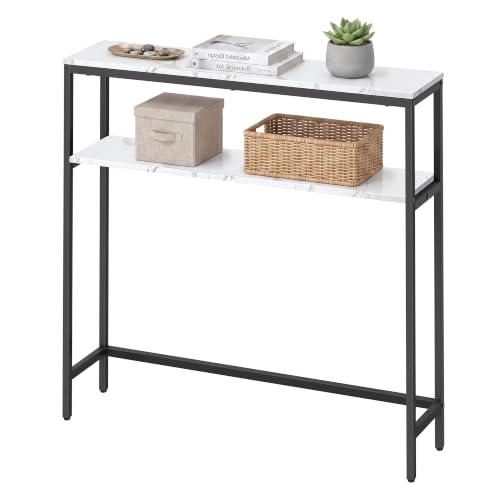
- Best overall for small spaces: VASAGLE Console Table, 2-Tier Narrow Sofa Table, Marble White and Ink Black (ULNT130W59V1) — Check on Amazon
- SAFAVIEH Samantha Entryway Console Table, Distressed Black (AMH5710B) — Check on Amazon
- VASAGLE 39.4-Inch Console Table with Tempered Glass Shelves (ULGT027B01) — Check on Amazon
- Nathan James Beacon Wooden Sofa Console Table with Drawers — Check on Amazon
- Nathan James Virgo Wood Accent Storage Console Table, Light Brown — Check on Amazon
- SAFAVIEH Landers Brown 3-Drawer Console Table (CNS5711C) — Check on Amazon
Read the full guide ↓
Disclosure: As an Amazon Associate, dailyhomedecorating.com earns from qualifying purchases. Links to Amazon on this page are affiliate links; they cost you nothing extra. Listing details such as price and availability change often, so check the current Amazon listing before you buy.
Every home has one: the wall that is too short, the hallway that is too narrow, the corner that furniture forgot. The best console table for small spaces under $400 is the piece that turns those leftover strips into working parts of the home — a landing zone where there was only a passage, a display shelf where there was only a wall, storage where there was only air. Small-space furnishing is a discipline of inches. A console that is two inches too deep blocks the door’s swing; one that is a foot too wide crowds the room’s only good wall; one that is visually heavy makes a compact room feel smaller than its measurements, while a light, open or glass design can add a full furniture function and somehow leave the room feeling larger. Under $400, the category offers real answers to this discipline — genuinely narrow engineering, compact real-wood designs, transparent construction — but only if you shop by measurement and visual weight rather than by photograph, because photographs are taken in rooms much bigger than yours.
This guide ranks the strongest verified consoles under $400 strictly by small-space performance. Depth leads the criteria, because in a tight spot depth is destiny: it decides whether the walkway survives. Footprint efficiency follows — how much surface and storage each inch of floor buys you. Then visual weight, the underrated dimension: in a compact room, a see-through frame and a solid block of identical size are not the same piece of furniture, and we score them differently on purpose. Finally, flexibility — a small-space console often has to be a hallway piece this year and a behind-sofa piece next, and the designs that rotate roles earn their keep longest. The general ranking for standard rooms lives in Best Console Table Under $400, and renters will find the apartment-specific version in Best Console Table For Small Apartments Under $400; this guide is for anyone — house or apartment — whose problem is a particular tight spot that needs solving precisely.
Our short answer: the narrow VASAGLE is the small-space champion, at 7.9 inches deep with two shelves — it fits the spots no other console in this guide can enter. The SAFAVIEH Samantha is the compact wood answer when the tight spot still needs drawers. The glass VASAGLE solves the room that cannot take visual bulk. The Nathan James Beacon is the pick when the small space must also be the storage. The Virgo suits the compact living room that needs an open, airy sofa table. And the Landers is here as the honest exception — a big table that earns its place only in the one small-space scenario where length, not depth, is the free dimension.
In this guide
Quick Picks
In a hurry? This table matches each console to the tight spot it solves best.
| Buyer type | Pick | Why it stands out | Link |
|---|---|---|---|
| Best overall for small spaces | VASAGLE 2-Tier Narrow Console Table (ULNT130W59V1) | 7.9 inches deep with two shelves — fits hallways and nooks nothing else can | Check on Amazon |
| Best compact console with drawers | SAFAVIEH Samantha Console Table (AMH5710B) | Two deep drawers in a 35.8-inch pine frame for short entry walls | Check on Amazon |
| Best when visual bulk is the problem | VASAGLE Console Table with Tempered Glass Shelves (ULGT027B01) | Three glass shelves add function a small room can see through | Check on Amazon |
| Best small-space storage | Nathan James Beacon Console Table with Drawers | Two drawers and a basket shelf — storage density for tight entries | Check on Amazon |
| Best for compact living rooms | Nathan James Virgo Console Table, Light Brown | Open, pale and 29 inches high — an airy sofa table for small rooms | Check on Amazon |
| Best for the long, thin room | SAFAVIEH Landers 3-Drawer Console Table (CNS5711C) | 47.3 inches of storage for the one small space with a long wall | Check on Amazon |
How These Picks Were Chosen
The budget screen came first, as always: genuine, currently listed Amazon products inside the under-$400 ceiling — check the current price on Amazon before you buy, because listing prices move — and nothing from a product line under a current safety recall. Then every candidate was re-scored on small-space mathematics. We measured depth against real constraints: the roughly 30 inches of clear passage a hallway needs, the few inches typically available behind a sofa pushed near a wall, the swing radius of the doors that open into most entry nooks. A console that fails those numbers fails the guide, whatever its other virtues.
We did not hands-on test these tables. We compared verified specifications — width, depth, height, weight, shelf and drawer configuration — and weighted three things photographs cannot show. The first is storage density: usable storage divided by footprint, the ratio that decides whether a small space gains a system or just a surface. The second is visual weight: open frames, pale finishes and glass occupy less of a room’s perceived space than solid dark construction of the same dimensions, and in compact rooms perceived space is the resource being managed. The third is role flexibility: pieces that work in a hall, behind a sofa and against a bedroom wall across their lifetime outrank pieces fitted to a single spot.
One more criterion ran quietly through the ranking: what the piece does to the room’s light. Small spaces are usually short of daylight as well as floor area, and furniture placed against the window wall or opposite the only window either returns that light or swallows it. Pale finishes and glass reflect and transmit; dark solid pieces absorb. That is why this guide’s order is not simply a depth chart — the glass VASAGLE outranks deeper-storage rivals for bright-starved rooms, and the pale Virgo outranks moodier options for the compact living room — because in a small space, a console that costs you light has charged you twice: once in inches, once in brightness. When two picks tie on measurements, choose the one that keeps the room luminous.
Safety hardware was checked with small spaces specifically in mind.
Tight spots get bumped — hips, bags, vacuum cleaners, children — so stability matters more, not less, and included anti-tip kits and adjustable feet are flagged in every review where they appear.
The 6 Best Console Tables for Small Spaces Under $400
VASAGLE Console Table, 2-Tier Narrow Sofa Table, Marble White and Ink Black (ULNT130W59V1)
Who it suits: Narrow hallways, short entry nooks, the wall beside a door, the gap behind a sofa — any spot where the available depth is in single digits and a standard console simply cannot go.
Start with the number that wins this guide: 7.9 inches. That is the VASAGLE’s depth, against 13 to 14 inches for every wood console here — a difference of roughly 40 percent of the footprint, surrendered back to your walkway. In a 36-inch hallway, a standard console leaves an awkward 22-inch passage; this one leaves a comfortable 28. Behind a sofa, it slips into gaps that exist in real rooms — the six-to-nine-inch slot between sofa back and wall that is otherwise dead space with a power outlet in it. In an entry nook, it stands where a bench or a standard table would block the door. And it does this without giving up the console’s actual functions: the marble-look top, 31.5 inches wide, holds a lamp, a key bowl and a mirror above; the lower shelf takes shoes, baskets or books. Two shelves, a real surface, single-digit depth. Steel tubing and engineered board make the geometry possible — the frame is rigid at dimensions where wood joinery would flex — and the black-and-white palette suits the contemporary interiors most tight modern floor plans come with.
The ownership details suit tight quarters unusually well. At about 14 pounds, it is the one console you can lift out of the way to clean behind — and in small spaces, the dust behind furniture is a real fraction of the home’s total dust. Adjustable feet silence it on uneven floors, which matters when the table stands in a passage where it will be brushed daily. The included anti-tip kit addresses the one structural truth of tall, narrow furniture: anchor it, especially in a home with children, and the installation is complete. The engineered top wipes clean in one pass, so the surface that catches every arrival’s keys and coffee stays presentable with seconds of effort.
The compromises are honest and specific. The top’s static load is rated at 55 pounds — decor and daily objects, yes; a seat for a tying-shoe child or a heavy stone planter, no. A 7.9-inch surface fits slim things: a tray, a narrow lamp, a bowl — not a sprawling mail center or a wide-based table lamp, so check your lamp’s base diameter against it. And there are no drawers; the small-space storage system here is a basket on the lower shelf and discipline on top. If your tight spot is tight in width rather than depth, read on — the next pick is yours.
- 7.9-inch depth — the only console here that fits single-digit gaps, with two full shelves across 31.5 inches.
- About 14 lb with adjustable feet and an included anti-tip kit: light, level and safe in high-traffic tight spots.
- Marble-look wipe-clean top and ink-black frame for contemporary small interiors.
Honest limitation: The top is rated to 55 lb and fits only slim objects; no drawers, so storage means baskets.
Choose it if depth is your binding constraint — a hallway, a nook, a behind-sofa gap. Skip it if your spot is short on width but fine on depth, or you need drawers.
SAFAVIEH Samantha Entryway Console Table, Distressed Black (AMH5710B)
Who it suits: Short walls and compact entries in traditionally styled homes — the tight spot that needs real drawers and real wood in the smallest standard footprint.
Not every small space is shallow; some are simply short. The wall beside the front door in an older house, the landing at a stair turn, the dining-room wall between two doorways — these spots have normal depth and three feet of width, and they defeat long consoles completely. The Samantha is built for them: 35.8 inches wide, 13.8 deep, 29.5 high, the most compact wood console in this guide, with storage that punches above its footprint. Two drawers, each about 15.2 inches wide and 11 inches deep, swallow the entry’s entire small-object population; a lower shelf takes the basket or the books; the pine top holds the lamp and the tray. Storage density — the small-space metric that matters — is excellent: this is a full entry system in under three feet of wall.
The material and finish suit tight, high-contact spots. Pine takes knocks as dents rather than chips, and the distressed black finish converts those dents into character while hiding the scuffs that bags, keys and shoe heels deliver in a confined entry where everything passes within inches of the furniture. Black also performs a small-space trick: a dark, leggy piece against a pale wall reads as a deliberate accent rather than a space claim, especially with the turned legs lifting the body so the floor line continues underneath — the eye sees floor, and the room feels bigger. At about 27 pounds the Samantha is easy to position precisely, which in a tight spot is half the installation: an inch left or right is the difference between clearing the door trim and not. SAFAVIEH’s American Homes Collection has produced this design for years, and its proportions are the classic ones for a reason.
Know its edges. At 13.8 inches deep it cannot solve the narrow-hallway problem — if depth is your constraint, the VASAGLE above is the answer and this is not. The soft pine top wants a tray under the key drop. And under 36 inches of width means behind a wide sofa it will look marooned; its home is the short wall, where it looks — and is — exactly sized.
- Two deep drawers (about 15.2″W x 11″D) plus a shelf in a 35.8″W x 13.8″D x 29.5″H frame — top storage density here.
- Distressed black pine hides the scuffs of confined, high-contact entries; legs keep the floor line visible.
- About 27 lb — easy to position to the inch in a tight spot.
Honest limitation: Standard depth cannot fix a narrow hallway, and the soft top needs a tray; too small for long sofa walls.
Choose it if your tight spot is a short wall needing drawers. Skip it if depth is the constraint or your wall is long.
VASAGLE 39.4-Inch Console Table with Tempered Glass Shelves (ULGT027B01)
Who it suits: Compact rooms that are not short of floor so much as short of air — small living rooms and studios where a solid console would make the space feel closed in.
Some small spaces fail on a dimension no tape measure reads: visual volume. A 40-inch solid wood console in a 10-by-12 room is not too big for the floor; it is too big for the eye, subtracting light and sight lines the room cannot spare. The glass VASAGLE is the engineering answer to that failure. Three tempered glass shelves on a black steel frame — 39.4 inches wide, 11.8 deep, 28.7 high — provide a top surface and two full shelves while occupying almost no visual volume at all. The wall shows through it. The floor shows through it. Light crosses it. In a small room, that transparency is worth actual square feet of perceived space, and it makes this the rare console that can stand mid-room — behind a sofa as a divider in a studio — without splitting the space into two smaller, darker halves.
Function survives the disappearing act. Tempered glass is the furniture-grade standard, strong in service and designed to crumble into blunt granules if it ever fails; the frame’s rated static capacity is 66 pounds; an anti-tip kit is included for the wall placements. Plants are the surprise beneficiary: on wood shelves, lower levels are shade gardens where plants go to fade, but light reaches every glass shelf, so a small room’s greenery can stack vertically — using the wall’s height instead of the floor’s width, which is the fundamental small-space exchange. At about 30 pounds the piece repositions easily when the room’s layout rotates, as small rooms’ layouts constantly do.
The costs are upkeep and concealment. Glass in a small room is always at close range, so fingerprints and dust are always visible; the weekly wipe is not optional if the piece is to look like the idea you bought. There is no closed storage — in a compact room, that means lidded boxes on the shelves are part of the purchase, or your clutter becomes the room’s most visible feature. And the black frame, while thin, sets a contemporary tone that traditional small rooms may not want. Buy it for the rooms it understands.
- Three tempered glass shelves: full function with near-zero visual volume — perceived space preserved.
- 39.4″W x 11.8″D x 28.7″H, 66 lb rated capacity, anti-tip kit included; light reaches plants on every shelf.
- Works floated behind a sofa as a divider that does not darken or split a small room.
Honest limitation: Fingerprints and dust are always visible at close range, and there is nowhere to hide clutter.
Choose it if your room is short of light and air rather than floor. Skip it if you need drawers or a low-upkeep surface. Modern small spaces in particular are argued in Best Console Table For Modern Homes Under $400.
Nathan James Beacon Wooden Sofa Console Table with Drawers
Who it suits: The small entry or one-wall living area where the console must be the entire storage system — the piece that gives a tight home a junk drawer, a shoe station and a landing surface in 37 inches.
Small spaces punish furniture that only does one thing, and they reward density: function packed per inch. The Beacon is the density pick of this guide. Two real drawers close away the small-object chaos that, in a tight home, has nowhere else to exist — in a big house the junk drawer lives in the kitchen; in a small one, it lives here, or it lives on every surface. Below the drawers, the woven seagrass shelf lines up baskets: shoes, bags, dog kit, the household’s overflow, organized vertically inside 37 inches of wall and 14 inches of floor. The top — light brown, wire-brushed, forgiving of scuffs — is the landing tray, the lamp stand and the plant shelf. No other pick converts a small footprint into a complete entry system this efficiently, and the boho warmth of the seagrass keeps the system from looking like storage furniture.
At 31 inches high, the Beacon also stands at the most useful height for the second small-space job: the sofa table. In compact living rooms the sofa usually anchors the main wall, and a console behind it replaces the side tables there is no floor for — drinks, books, the lamp, the remote, all within arm’s reach of the seat, all off the coffee table. The Beacon’s drawers then face their second shift as living-room storage. Nathan James lists a lifetime manufacturer warranty for the piece, which matters in small homes where every item is used harder and moved more often.
Density has a price, and it is depth: 14 inches is the deepest footprint in this guide, so the Beacon cannot go where the VASAGLE goes. Behind a sofa it pushes the seating 14 inches into the room — tape that layout before ordering, because in the smallest living rooms those inches come out of the walkway. The seagrass shelf is open and woven: baskets are effectively required, dust settles, and wet shoes belong elsewhere. This is the pick for the small space that is short on storage, not the one that is short on inches.
- Two drawers plus a basket-ready seagrass shelf: the highest storage density in this guide, in 37 inches of wall.
- 31-inch height doubles as an ideal sofa table for compact living rooms.
- Wire-brushed finish hides wear; lifetime manufacturer warranty per the listing.
Honest limitation: The 14-inch depth is the deepest here — it solves storage shortages, not depth shortages.
Choose it if your small space’s real deficit is storage. Skip it if depth is the deficit — that is the narrow VASAGLE’s entire purpose.
Nathan James Virgo Wood Accent Storage Console Table, Light Brown
Who it suits: Compact living rooms needing a behind-sofa table that adds surface and shelving while keeping the room feeling open, pale and calm.
The Virgo’s small-space virtue is that it is mostly air. An open frame — wire-brushed light brown top, one full lower shelf, faux mortise-and-tenon details — means the wall and floor continue through the piece, and a compact room keeps its sight lines. At 40 inches wide it is sized for the loveseats and compact sofas small living rooms actually contain, and at 29 inches high it is the joint-lowest console here, which is precisely right behind lower modern seating: the top lands at the back cushions, in reach, without a shelf-edge looming behind the sitters’ heads. The lower shelf does the quiet work — the room’s books, the media boxes, a basket for the remotes and chargers — clearing the coffee table in rooms where the coffee table is also the dining table, the desk and the footrest.
The pale finish is a small-room asset in its own right. Light wire-brushed wood returns the room’s scarce daylight instead of absorbing it, and the raised-grain texture hides both dust and the light scratches of a piece that lives within arm’s reach of everything. At about 40 pounds the Virgo feels planted and permanent once placed — no wobble when a reaching hand leans on it from the sofa — and Nathan James’ lifetime manufacturer warranty per the listing covers the long term. It also rotates roles gracefully across a home’s life: sofa table now, hallway piece when the layout changes, bedroom surface later; open designs fit anywhere because they assert so little.
Its limits mirror the Beacon’s in reverse. Storage is entirely open — in a small room, where the console is visible from every seat, anything you store is part of the décor, so baskets and editing are the system, and households with a clutter surplus should buy drawers instead. The 14-inch depth costs the same floor behind a sofa as any standard console. And the 29-inch height that suits sofas makes it a modest presence on a tall entry wall. It is a living-room specialist, and within that specialty it is excellent.
- Open frame and pale finish add a sofa table’s function without closing in a compact room.
- 40″W x 14″D x 29″H — the right height behind loveseats and low compact sofas.
- Lower shelf clears the coffee table by taking books, media and a charger basket.
Honest limitation: All storage is visible, and the standard 14-inch depth costs real floor behind the sofa.
Choose it if your compact living room needs surface and air in equal measure. Skip it if you need concealed storage or a shallow hallway piece.
SAFAVIEH Landers Brown 3-Drawer Console Table (CNS5711C)
Who it suits: The one small-space geometry the other picks cannot serve: the long, thin room — a narrow living room, a galley-style entry hall — where width is plentiful and everything else is scarce.
Every guide needs its honest exception, and the Landers is this one’s. At 47.3 inches wide it is the largest console here, and for most tight spots it is disqualified on sight. But small spaces come in more than one shape. The long, narrow living room — common in older houses and townhouses — has exactly one generous dimension: a long wall. Against that wall, the Landers’ length stops being a liability and becomes the strategy: one piece that serves as entry storage, media shelf and display surface along a wall that would otherwise host three competing small pieces and look cluttered with all of them. Its three basket drawers and tall lower shelf — about 15 inches of clearance, the most in this guide — consolidate a small home’s storage into a single run, freeing every other wall. Behind a full-size sofa in a compact-but-long room, the same consolidation applies.
The pine farmhouse construction suits the role: it survives being the hardest-working piece in the house, its brown finish and turned legs give a plain narrow room a furnished anchor, and at 29.5 inches high it keeps the long wall’s profile low and calm. If your small space is long rather than tiny, this is genuinely the right buy — check the current price on Amazon and measure the wall twice.
There is also a styling dividend to consolidation that small-space dwellers underestimate. Three small tables along a wall need three separate styling decisions and still read as fragments; one long console needs one composition — lamp, stack, plant, repeated at intervals — and reads as intention. In a narrow room that visual calm is worth as much as the storage, because the eye travels the long wall constantly and finds either rhythm or clutter. The Landers, styled with restraint, gives a thin room the former. It is the only pick in this guide that can make a small space feel more designed by being bigger, which is why it survives the cut despite failing every other small-space metric we track.
For every other geometry, the warnings are the review:
47.3 inches needs a five-foot run with breathing room; the basket drawers are shallower than solid ones; the farmhouse styling is a room-defining commitment; and at about 35 pounds it is a planned move, not a casual one. Small-space buying is matching the piece to the shape of the shortage — and this piece matches exactly one shape.
- Three basket drawers plus a tall shelf consolidate a small home’s storage into one long run.
- 47.3″W x 13″D x 29.5″H pine frame — the long-wall specialist for narrow rooms and galley halls.
- One substantial piece replaces three small ones, reducing visual clutter along the main wall.
Honest limitation: The widest table here by far — right for long rooms, wrong for every other tight spot.
Choose it if your small space is long and thin with a wall to match. Skip it if your shortage is width or depth — the picks above exist for those rooms. Families working with a long entry wall will find the household case made in Best Console Table For Families Under $400.
Comparison Table
| Product | Size (W x D x H) | Storage | Best small-space use | Link |
|---|---|---|---|---|
| VASAGLE Narrow (ULNT130W59V1) | 31.5″ x 7.9″ x 31.5″ | 2 open shelves | Narrow hallways, nooks, behind-sofa gaps | Check on Amazon |
| SAFAVIEH Samantha (AMH5710B) | 35.8″ x 13.8″ x 29.5″ | 2 deep drawers + shelf | Short entry walls needing drawers | Check on Amazon |
| VASAGLE Glass (ULGT027B01) | 39.4″ x 11.8″ x 28.7″ | 3 glass shelves | Rooms short of light and air | Check on Amazon |
| Nathan James Beacon | 37″ x 14″ x 31″ | 2 drawers + seagrass shelf | Maximum storage density | Check on Amazon |
| Nathan James Virgo | 40″ x 14″ x 29″ | Open lower shelf | Compact living rooms, behind loveseats | Check on Amazon |
| SAFAVIEH Landers (CNS5711C) | 47.3″ x 13″ x 29.5″ | 3 basket drawers + tall shelf | Long, thin rooms only | Check on Amazon |
How to Choose a Console Table for a Small Space
Name the shortage before you shop. “Small space” is four different problems wearing one coat: short of depth (hallways, behind-sofa gaps), short of width (nooks, landings, the wall beside a door), short of storage (the home with no closets to spare), and short of light and air (the compact room that feels smaller than it measures). Each shortage has a different correct console — the 7.9-inch VASAGLE, the compact Samantha, the dense Beacon, the transparent glass VASAGLE respectively — and buying across them is the classic small-space error. Walk your tight spot, decide which resource is actually scarce, and let that decision, not a photograph, pick the table.
Measure the passage, not just the placement. A console’s footprint is only half its spatial cost; the other half is the clearance it leaves. Keep about 30 inches of walkway in halls and past entries. Check door swings against the table’s corners — a door that opens onto a console corner will find it daily. Behind a sofa, add the table’s depth to the sofa’s and re-measure the room’s remaining walkway before ordering. And use painter’s tape: outline the footprint on the floor, live with it for a day, carry laundry past it. Tape is the cheapest returns insurance in furniture.
Budget visual weight like floor space. In a compact room, perceived size is a real quantity, and furniture spends it. Open frames, glass, pale finishes and legs that lift the body off the floor all cost less perceived space than solid, dark, plinth-based pieces of identical dimensions, because the eye keeps reading floor and wall through them. If your room’s problem is feeling closed in, choose the piece you can see through and put a mirror above it; the combination can change a room’s feel more than any single dimension on the spec sheet.
Stack vertically, store densely. Small spaces grow upward. Prefer consoles whose lower shelf has real clearance — measured against your baskets, not the listing’s adjectives — and plan the wall above as part of the furniture: mirror, hooks, a slim shelf. Inside the footprint, density wins: drawers and lidded baskets hold more per inch, invisibly, than open piles ever will. The goal is a tight spot that works like a system — landing zone on top, storage inside, display above — rather than a table that merely fits.
Work the dead zones nobody else wants. Every home has spatial leftovers that standard furniture ignores: the wall segment between two doors, the stretch under a staircase, the landing where the hallway turns, the few feet behind a sofa that open-plan rooms strand in the middle of nowhere. These are console-shaped opportunities. A shallow console under the stairs becomes the home’s charging and mail station; the landing piece becomes a mini-library with a lamp, turning a pass-through into a place. When you inventory your home for a console, walk it looking for these leftovers specifically, tape measure in hand, and note each one’s governing dimension — one will be depth-bound, one width-bound, one height-bound by a railing or a window. The right console for a dead zone is the one whose strongest dimension matches the zone’s weakest, and a home with its dead zones furnished feels larger than a home with bigger rooms left half-empty.
Let one piece do the work of a zone. In a small space, a console should rarely be only a table. Anchored by a mirror or artwork above and a rug or runner below, it defines a zone — entry, reading nook, bar, vanity — inside a room that has no walls to spare for one. This zoning is the real return on a small-space console: not the surface itself, but the function it legitimizes. Plan the zone when you buy the table. If it is an entry zone, the hooks and the shoe solution are part of the purchase. If it is a reading zone, the lamp and the basket for books are. A console bought as a zone succeeds; a console bought as an object spends its life collecting the objects of zones that were never finished.
Keep the piece movable and anchored.
Small spaces get rearranged more than any others, because their layouts are experiments. Favor pieces one person can shift — or at least pieces that break down — and when the layout settles, anchor tall or narrow tables to the wall: tight spots are bump zones, and stability is a safety feature, not a nicety. Adjustable feet are worth real money in older buildings, where the floor under a tight spot is rarely the level one.
Common Mistakes When Buying a Console Table for a Small Space
Buying standard depth for a narrow hallway. The 13-to-14-inch console is the industry’s default and the hallway’s enemy. In a corridor, depth is the whole decision: under 10 inches or do not buy. More small-space consoles are returned for this single reason than for any defect.
Solving the wrong shortage. A storage-dense table in a depth-starved hall, a transparent table in a home drowning in clutter — each is a good product failing an unasked question. Diagnose the spot first: depth, width, storage or light. Then buy.
Forgetting the door. Entry nooks live beside doors, and doors swing. A console that clears the wall but not the door’s arc will collect a dent a week and eventually a broken corner. Measure the swing, with the door opened the way people actually open it — all the way, with bags in hand.
Letting the small table become the only surface. In tight homes the console attracts everything: mail, keys, tools, the plant, the speaker, the router. Without assigned containers — a tray, a drawer, one basket — the piece becomes a 31-inch monument to overflow, in the room least able to hide it. Small-space consoles need systems even more than big ones do.
Skipping the anchor because the spot is tight. Tight spots are where tables get bumped, leaned on and pulled at. A tall narrow console in a passage is precisely the piece that must be fixed to the wall. The kits are cheap, sometimes included, and invisible once installed.
Final Recommendation
For most small spaces, the answer is the narrow VASAGLE: at 7.9 inches deep it fits the spots that defeat every standard console, while still giving you two shelves and a real landing surface — check price on Amazon. If your tight spot is a short wall that needs drawers, choose the SAFAVIEH Samantha. Take the glass VASAGLE when the room is short of light, the Beacon when it is short of storage, the Virgo for a compact living room’s sofa wall, and the Landers only when your small space is long rather than tiny. Diagnose the shortage, tape the footprint, anchor the result — and the leftover strip of your home becomes one of its hardest-working parts.
Frequently Asked Questions
What is the narrowest console table worth buying?
Around 8 inches deep is the practical floor for a freestanding console that still holds a lamp and a tray — the narrow VASAGLE in this guide, at 7.9 inches, sits right at it. Shallower than that, you are looking at wall-mounted ledges, which are a different product with different (landlord-relevant) installation requirements.
How much walkway should a console table leave in a hallway?
About 30 inches of clear passage is the comfort line for a hallway used with bags, laundry or a stroller; 24 inches is passable for a low-traffic corridor. Subtract the table’s depth from the hallway’s width and check the remainder before ordering — that subtraction, not the table’s beauty, decides whether it works.
Can a console table make a small room look bigger?
Yes, if it is chosen for visual lightness: glass or open frames, pale finishes, legs that reveal the floor beneath. These add function while preserving sight lines, and paired with a mirror above, a console can make an entry feel measurably more open. A solid dark piece of the same size does the opposite.
Where should a console table go in a small living room?
Behind the sofa is usually the highest-value placement: it adds a lamp surface, drinks space and a storage shelf without consuming a wall or a corner. Confirm the sofa can move forward by the table’s depth without breaking the room’s walkway, and pick a height at or just below the sofa’s back — 29 to 31 inches covers most compact seating.
Is one long console or two small pieces better for a small space?
Usually one piece, if the wall allows it: a single console reads as calm architecture, while multiple small pieces read as clutter and waste the gaps between them. The exception is the genuinely tiny or L-shaped spot, where one compact table placed precisely beats a long one placed approximately.