Where to buy
Check the latest price, availability and delivery on Amazon. Orders are placed on Amazon. We may earn a commission from qualifying purchases.
- Best overall for small spaces: VASAGLE 31.5-Inch Narrow Console Table, Marble White and Ink Black — Check on Amazon
- HOOBRO 47.2-Inch Skinny Console Table with Power Outlets, Greige — Check on Amazon
- HOOBRO 29.5-Inch Narrow Console Table, 3-Tier, Black — Check on Amazon
- FURINNO Frans Turn-N-Tube Console Table, Black Oak — Check on Amazon
- VASAGLE 39.4-Inch Narrow Console Table, Heather Greige and Ink Black — Check on Amazon
See 1 more Amazon option
- Yaheetech 42-Inch Console Table, Tempered Glass, Gold — Check on Amazon
Read the full guide ↓
Disclosure: As an Amazon Associate, dailyhomedecorating.com earns from qualifying purchases. Links to Amazon on this page are affiliate links; they cost you nothing extra. Listing details such as price and availability change often, so check the current Amazon listing before you buy.
The best console table for small spaces under $150 is not really a smaller version of a normal console table — it is a different tool for a different problem. Small spaces are not small homes. They are the leftover geometry inside homes of every size: the hallway that is four inches too narrow for standard furniture, the wall segment between two door casings, the dead strip behind the sofa, the nook under the stairs, the landing where three doors compete. These spots share one trait — full-size furniture cannot go there, so they collect nothing, or worse, they collect clutter on the floor. A console table designed for them, genuinely narrow rather than merely short, converts dead geometry into the most useful surface in the house: a landing strip, a charging point, a display ledge, a shoe library.
Judging for small spaces inverts the usual priorities. Depth becomes the headline specification — every pick here is under 10 inches deep except one glass table that earns its place by being visually weightless — and the right question stops being “how much can it hold” and becomes “how much space does it return”. A 7.9-inch-deep table that lets a hallway stay a hallway while adding two tiers of storage has not consumed space; it has manufactured it. Stability needs a fresh look too, because tall-and-narrow is the classic tip-over profile: the best small-space tables ship with anti-tip kits or are designed to be braced by the sofa they hide behind. And visual weight counts double in a tight spot — glass and open frames keep a narrow passage feeling like air, where a solid board table of identical dimensions can feel like a roadblock. Readers whose small space comes with a small budget should start with our guide to the Best Console Table For Small Spaces Under $100; those furnishing a whole compact room can compare the Best Console Table For Small Spaces Under $300.
Our short answer: the 31.5-inch VASAGLE marble-look console is the small-space default — 7.9 inches deep, two tiers, an anti-tip kit in the box, and a ledge-like profile that reads as architecture. If your small space is the gap behind a sofa, the 5.9-inch powered HOOBRO is the only pick that truly fits it. If your spot is a hallway end or a nook under 30 inches wide, the HOOBRO three-tier and the FURINNO Frans divide that territory between them. And if the problem is a long, thin wall rather than a short one, the 39.4-inch VASAGLE stretches storage along it at the same 7.9-inch depth. The reviews below take each space type in turn; the sections after them cover measuring, placement and the errors that make small spaces feel smaller.
In this guide
Quick Picks
In a hurry? This table matches each console table to the small space it was born for.
| Buyer type | Pick | Why it stands out | Link |
|---|---|---|---|
| Best overall for small spaces | VASAGLE 31.5-Inch Narrow Console Table, Marble White | 7.9 in deep, two tiers, anti-tip kit included — the ledge that fits anywhere | Check on Amazon |
| Best behind a sofa | HOOBRO 47.2-Inch Skinny Console Table with Power Outlets | 5.9 in deep with built-in charging — uses the dead gap behind the couch | Check on Amazon |
| Best compact storage | HOOBRO 29.5-Inch Narrow Console Table, 3-Tier | Three tiers and an 88 lb top rating in a 29.5 in frame | Check on Amazon |
| Best for tiny nooks | FURINNO Frans Turn-N-Tube Console Table | Only 23.6 in wide — fits wall segments nothing else can use | Check on Amazon |
| Best for long hallways | VASAGLE 39.4-Inch Narrow Console Table | Full-length storage at the same 7.9 in depth | Check on Amazon |
| Best visual lightness | Yaheetech 42-Inch Console Table, Tempered Glass, Gold | Glass tiers all but disappear — space feels bigger, not fuller | Check on Amazon |
How These Picks Were Chosen
Specifications for every pick were verified from the manufacturer’s own listing data — dimensions, materials, load figures — and no product with a safety recall was considered, as in our other console roundups. The small-spaces lens then applied its own four filters.
True narrowness. “Narrow” is the most abused word in this category; plenty of tables wear it at 12 to 14 inches deep, which is standard, not narrow. This roundup’s working picks run 5.9 to 9.4 inches deep. The single exception, the Yaheetech glass table at 14 inches deep, is included for a different small-space problem — visual crowding rather than physical fit — and its review says so plainly.
Storage density. A small-space table must pay rent in storage: two or three tiers, or a powered top that replaces a separate charging station. Single decorative ledges with no second surface were cut unless the footprint was so small that any surface at all was a win.
Stability at narrow depth. The shallower the table, the more seriously we took its stability story — an included anti-tip kit, a frame designed to be sofa-braced, or a low centre of gravity. Where a pick needs help the maker does not provide, the review says what to add.
Visual weight. In a tight passage, how a table looks is a functional property. Open steel frames, mesh shelves and glass keep sightlines moving; we favoured them over solid panels at equal dimensions, because a small space that feels bigger is, in every way that matters to the people walking through it, bigger.
What did not make the cut is worth a sentence. Several tables marketed for small spaces are simply standard consoles in shorter lengths — 29 inches long but 13 or 14 inches deep — which solves the wrong dimension entirely. A few ultra-slim wall-mounted ledges looked ideal and were excluded on verification: no published load figure, or mounting hardware that assumes wall constructions many homes do not have. And the very cheapest no-name narrow tables publish dimensions that disagree between their own title and specification table, which in a lens where two inches decide everything is disqualifying on its own. The six above are the ones whose numbers hold still when you check them.
On price: figures in this category shift with sales and finish, so none are printed. All six picks sit within the under-$150 band at the time of writing — check the current price on Amazon for the exact variant you choose.
The 6 Best Console Tables for Small Spaces Under $150
Six answers to six different tight spots. Identify your space type first — hallway, sofa gap, nook, long wall — and the right pick usually selects itself.
VASAGLE 31.5-Inch Narrow Console Table, Marble White and Ink Black (ULNT130W59V1)
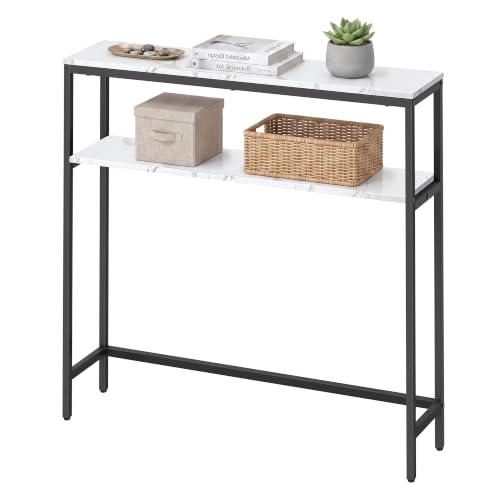
The reference small-space console. At 7.9 inches deep, 31.5 inches wide and 31.5 inches tall, this VASAGLE is shallow enough to stand in a hallway and leave the hallway intact, while its two tiers still give you a display surface and a working shelf. The marble-white top on an ink-black steel frame reads as a built-in ledge — the highest compliment furniture in a tight spot can earn — and the specification is honest about its role: a maximum weight recommendation of 55 pounds, an item weight of just 14 pounds, adjustable feet for the uneven floors small old hallways tend to have, and an anti-tip kit included in the box, which a table of these proportions genuinely requires and too many rivals omit.
Who it suits: hallways, entry alcoves, the wall beside a door, the end of a galley kitchen — any spot where depth is the scarce resource and a lamp-plus-keys-plus-one-beautiful-object composition is the goal.
Pros:
- 7.9-inch depth — fits passages standard consoles make impassable
- Anti-tip kit included; adjustable feet for level placement
- Marble-look top reads as architecture, wipes clean like laminate
- Two tiers keep a landing zone and a storage shelf in one ledge
- 14 lb — reposition it in seconds when the space’s job changes
Honest limitation: 55 pounds total capacity and a 31.5-inch top define a display ledge, not a storage workhorse — plan on a lamp, a tray and one object, not a family’s worth of gear. The tiers are close-set, so tall baskets and boots do not fit; measure your intended shelf items against the gap before ordering.
Choose it if depth is your constraint and the spot is a passage. Skip it if you need volume storage — the HOOBRO three-tier holds more in a similar footprint. One placement note from experience with ledges this slim: centre it on its wall run rather than pushing it to one end. A narrow table shoved into a corner reads as stored; the same table centred, with a mirror or print centred above it, reads as designed — and in a small space, that difference is most of what guests perceive. Check on Amazon
HOOBRO 47.2-Inch Skinny Console Table with Power Outlets
The gap behind a sofa is the most wasted small space in the average home: four to eight inches of dust territory between the sofa back and the wall. This HOOBRO was designed to annex it. At 5.9 inches deep — the narrowest console in this entire group of roundups — and 47.2 inches long, it slides into that gap and converts it into infrastructure, with power outlets and USB ports built into the top so the lamp and the phones charge where they live instead of via a cord crossing the room. At 31.5 inches tall it sits right at typical sofa-back height, and the greige finish disappears behind upholstery, which is precisely what a behind-sofa table should do.
Who it suits: anyone with a floating or wall-offset sofa, open-plan rooms where the sofa back is on display, and households whose charging cables currently live on the floor.
Pros:
- 5.9-inch depth fits the sofa gap no other table can use
- Built-in outlets and USB end the extension-cord era
- 47.2-inch length spans a loveseat or most of a three-seater
- Creates a drinks-and-remotes ledge exactly where people sit
- Quiet finish keeps the sofa the visual focus
Honest limitation: there is no storage under the top and the top itself is a perch — a drink, a phone, a remote — not a surface for objects with any footprint. It is also a one-job table: if the sofa moves against the wall, this piece loses its reason to exist, so buy it for the layout you actually keep.
Choose it if your small space is behind the sofa. Skip it if you need shelves or a freestanding entry table. Renters should note the extra dividend: because the table lives behind the sofa, it needs no wall anchor at all — the sofa is the anchor — which makes it the one pick in this roundup that solves a small space with zero trace left behind. Check on Amazon
HOOBRO 29.5-Inch Narrow Console Table, 3-Tier (BB73XG01)
Where the VASAGLE ledge optimises for depth, this HOOBRO optimises for density: three tiers inside a 29.5-inch length and 9.4-inch depth, with published ratings that embarrass larger tables — 88 pounds on the tabletop, 33 pounds on each of the two metal mesh shelves below. At 29.5 inches tall and 13.6 pounds, it is the pick for the end of a hallway, the wall segment beside a bathroom door, or the corner of a small dining area that needs a serving and storage point. The mesh shelves shed grit and moisture, which makes the bottom tier a genuine shoe shelf rather than a shelf that merely tolerates shoes.
Who it suits: small spaces that must store, not just display — compact entries, hallway ends, studio corners — and anyone whose tight spot is also a high-traffic one.
Pros:
- Three tiers in a 29.5-inch footprint — top storage density here
- Tabletop rated to 88 lb; mesh shelves to 33 lb each
- Mesh shelves shed shoe grit and wipe clean fast
- 9.4-inch depth keeps passages honest
- Light enough to lift aside for cleaning with one hand
Honest limitation: the 29.5-inch top is a lamp and a key bowl, not a composition, and small loose items need a tray or basket on the mesh tiers. The listing does not highlight an anti-tip kit; in a freestanding spot, add adhesive straps or place it where a fall is blocked.
Choose it if your small space must work as storage. Skip it if your spot is a styling moment — the marble-look VASAGLE wears that job better. It is also the most forgiving pick here for imperfect walls and floors: the black frame disappears against shadows, the mesh hides a multitude of scuffs, and the whole table reads as utility in the best sense — the piece that makes a tight corner stop being an apology and start being a system. Check on Amazon
FURINNO Frans Turn-N-Tube Console Table
Some small spaces are not narrow — they are short. The wall segment between a door casing and a corner, the end of a kitchen run, the patch beside a wardrobe: 24 inches of wall that standard furniture ignores. The Frans is built to exactly that measure: 23.6 inches wide, 9.3 inches deep, 31.4 inches tall. FURINNO’s Turn-N-Tube construction — panels joined by hand-twisted tubes — keeps it at 16.7 pounds, assembles without tools, and knocks down in minutes if the nook’s job changes. In small-space terms it is the opportunistic pick: the table you buy for the leftover spot you have measured three times and given up on.
Who it suits: tiny nooks, short wall segments, under-stair corners and rental corners — anywhere a 24-inch surface with shelves converts dead wall into a landing point.
Pros:
- 23.6-inch width fits segments no other pick can use
- Hand-twist assembly — no tools, minutes to build or move
- 9.3-inch depth respects tight passages
- Multiple levels turn a ledge into storage
- Lightweight and easy to relocate as rooms change
Honest limitation: light-duty is the honest description. The tube-and-panel build that makes it portable is the least rigid construction here, and it should be loaded like a ledge — keys, a small lamp, a plant, a few books — not like a bookcase. Stabilise it against its wall; a table this light earns an adhesive strap.
Choose it if your spot is under 26 inches wide. Skip it if you need load capacity or a substantial furniture presence. In the smallest nooks, pair it with a wall hook or two above rather than a mirror — hooks earn their keep daily in leftover spaces, and the combination of ledge plus hooks is the closest thing a 24-inch wall can offer to a full entryway system. Check on Amazon
VASAGLE 39.4-Inch Narrow Console Table (ULNT131K02V1)
The long-hallway answer. This VASAGLE stretches the same 7.9-inch depth as its 31.5-inch sibling across a full 39.4 inches, giving a narrow corridor a continuous two-tier surface: plants and prints along the top, shoes and baskets along the bottom, and a passage that still passes. The heather greige top over an ink-black steel frame suits the neutral palettes most hallways wear, and the steel frame keeps a long, slim structure rigid where an all-board table would flex. In a small home, a hallway fitted this way stops being circulation and becomes a room — a gallery, a library wall, a shoe library — which is found space in the truest sense.
Who it suits: long narrow hallways, studio walls, the stretch behind a dining table, and anyone whose small space is linear rather than compact.
Pros:
- 39.4 inches of surface at only 7.9 inches deep
- Two full-length tiers multiply a hallway’s storage
- Steel frame keeps the long span rigid
- Greige-and-black finish suits neutral corridors
- Same narrow-line anti-tip provision as its sibling — verify your variant on the listing
Honest limitation: everything placed on it must fit a 7.9-inch depth — narrower than a dinner plate — so audit your lamp bases and baskets first. The open tiers also mean a hallway display is a public display; in a busy household the corridor can look busy if the shelves are not edited.
Choose it if your small space is a long wall or hallway. Skip it if your items are wide or you need concealed storage. Hallway-specific note: run the table on the wall opposite the bedroom doors if you have the choice — doors opening against a console’s end are the one daily collision even a 7.9-inch depth cannot fully forgive, and the opposite wall usually offers the longer uninterrupted run anyway. Check on Amazon
Yaheetech 42-Inch Console Table, Tempered Glass, Gold
The exception that proves the lens. At 14 inches deep this Yaheetech is not physically narrow at all — it is here because some small spaces are not short on inches but on light and air, and a solid table of any depth makes them feel caved-in. Tempered glass tiers on a gold iron frame all but disappear: sightlines pass through, light passes through, and the room keeps its volume while gaining a surface. The specification supports real use — 99 pounds on the tabletop, 55 pounds on the lower shelf, at 42 inches long and 30 inches tall — so this is no ornament; it is a full console that happens to be visually weightless.
Who it suits: small living rooms and dining areas where a solid console would crowd the eye, rooms with limited natural light, and anyone whose “small space” problem is feeling, not fitting.
Pros:
- Glass tiers preserve light and sightlines in compact rooms
- Strong published ratings: 99 lb top, 55 lb shelf
- 14-inch depth fits full-size lamps and objects
- Gold frame adds warmth without visual bulk
- Two tiers keep the composition simple
Honest limitation: it does not solve a physical fit problem — if your passage is narrow, 14 inches of depth is 14 inches, however invisible. Glass also shows dust and fingerprints and displays everything stored, so it rewards tidy households in rooms that are small but calm, not small and chaotic.
Choose it if your space is small but the table spot is standard-sized. Skip it if depth is the actual constraint — that is what the 7.9-inch picks are for. One styling dividend of glass in a tight room: seasonal changes cost nothing. The table vanishes behind whatever the season puts on it — greenery in spring, ceramics in winter — which makes it the most adaptable piece in this roundup for people who restyle often. Check on Amazon
Comparison Table
The six small-space picks side by side. Depth is the deciding column in this roundup; check the live listing for current price and finishes.
| Pick | Dimensions (D x W x H) | Storage | Standout figure | Link |
|---|---|---|---|---|
| VASAGLE 31.5-Inch, Marble White | 7.9 x 31.5 x 31.5 in | 2 tiers | 55 lb capacity; anti-tip kit included | Check on Amazon |
| HOOBRO 47.2-Inch with Outlets | 5.9 x 47.2 x 31.5 in | Powered top | 5.9 in deep — narrowest here | Check on Amazon |
| HOOBRO 29.5-Inch 3-Tier | 9.4 x 29.5 x 29.5 in | Top + 2 mesh shelves | Top rated 88 lb | Check on Amazon |
| FURINNO Frans Turn-N-Tube | 9.3 x 23.6 x 31.4 in | Multi-level shelves | 23.6 in wide — shortest here | Check on Amazon |
| VASAGLE 39.4-Inch Narrow | 7.9 x 39.4 x 31.5 in | 2 tiers | Full length at 7.9 in deep | Check on Amazon |
| Yaheetech 42-Inch Glass, Gold | 14 x 42 x 30 in | 2 glass tiers | 99 lb top rating; visually weightless | Check on Amazon |
How to Choose a Console Table for a Small Space
Measure the passage, then the wall. In small spaces the order matters: first confirm the walkway that remains after the table is in (30 inches clear is the floor, 36 is comfortable), then check the table’s length against the wall run. Most failed small-space purchases measured only the wall. Include the door swing and any radiator, vent or skirting heater in the passage calculation — a table that fits the tape measure but blocks the heat or the door is a return waiting to happen.
Classify your small space before shopping. Passage spaces (hallways, entries) need depth discipline above all. Gap spaces (behind sofas, beside wardrobes) need exact-fit dimensions. Nook spaces (under stairs, alcoves) need short lengths and light visual weight. Feeling-small spaces need glass and openness, not smaller furniture. Each class has a pick in this roundup; buying across classes is how a 14-inch glass table ends up in a 9-inch hallway problem.
Anchor the narrow ones. A 7.9-inch-deep, 31.5-inch-tall table is a lever. The marble-look VASAGLE ships with an anti-tip kit — fit it. For the others, use screws where permitted, adhesive straps where not, or placement braced by a sofa or corner. Never leave a tall narrow table freestanding in a traffic path and call the job done.
Exploit the vertical. Small spaces have the same ceiling height as big ones. Tiers, and the wall above the table — a mirror, a print, a hook rail — are where small-space storage actually lives. A two-tier table with a mirror above it does the work of a piece three times its footprint. The companion pieces follow the same logic: see our guides to the Best Entryway Bench For Small Spaces Under $150 and the Best End Table For Small Spaces Under $150 for the rest of a compact entry or living corner.
Test with tape before you spend. Mark the candidate’s footprint on the floor with painter’s tape and live with the outline for 48 hours. Small-space fit is a behaviour, not a dimension: you will learn whether shoulders brush it, whether the vacuum bumps it, whether the dog’s route survives it — none of which a tape measure can tell you. The tape test is free and it has saved more small-space purchases than any review, including this one.
Prefer the table that can change jobs. Small spaces change purpose as households do — the nursery landing becomes a homework ledge becomes a display shelf. Light, simple, neutral tables migrate between jobs; highly specialised ones do not. Within this roundup, the two VASAGLE ledges and the HOOBRO three-tier are the migrants; the powered behind-sofa table is the specialist, superb at one job and committed to it.
Keep one surface honest. In a small space, a console’s top should hold a landing tray and at most two considered objects. The moment it becomes general storage, the space reads as cluttered at exactly the spot the eye lands first. Storage belongs on the lower tiers, inside baskets, out of the sightline — a discipline that matters even more here than in our Best Coffee Table For Small Spaces Under $150 roundup, because there is nowhere else for the eye to go.
Corners, Angles and Awkward Architecture
Real small spaces rarely offer a clean rectangle of wall. They offer the wall with the angled ceiling, the corner where two passages meet, the stretch interrupted by a return vent at exactly table height. A few working rules cover most of them. At a corner, stop the table a few inches short rather than wedging it in — a small shadow gap reads as intention, a friction fit reads as a mistake, and the gap gives the vacuum its access. Under a sloped ceiling or stair angle, the low picks win: at 29.5 inches the HOOBRO three-tier tucks under slopes that the 31.5-inch tables clip, so measure the height at the wall, not at the room’s centre. Beside a vent or radiator, open-frame and mesh designs are the only honest choice — they let air move — and even then, leave the manufacturer’s clearance and never drape the table’s contents over a heat source.
On uneven old floors, which small older homes specialise in, adjustable feet stop being a bullet point and become the product: the marble-look VASAGLE’s feet let a 7.9-inch-deep table stand un-rocked on a sloping hall floor, and an un-rocked narrow table is a safe narrow table. Level first, anchor second, load third — in that order, every time.
Placement Ideas for Leftover Spaces
The under-stair nook. A short console — the Frans or the 29.5-inch HOOBRO — turns the triangular dead zone into a charging and landing point, especially paired with a small lamp that makes the nook feel intentional rather than forgotten.
The landing. Stair landings collect nothing and serve no one. A 7.9-inch ledge with a plant and a stack of books makes it the house’s smallest library, and nobody’s passage is harmed at that depth.
The bedroom wall strip. The 12 inches between a wardrobe and the door is a vanity waiting to happen: narrow console, mirror above, one stool that tucks under. The marble-look VASAGLE was practically designed for this photograph.
The dining-room sliver. A long shallow console along a dining wall becomes a serving surface at exactly counter-adjacent height — drinks, dishes and the things that otherwise crowd the table. The 39.4-inch VASAGLE earns its keep every time guests come.
The bathroom-adjacent hallway. Linen overflow, a basket of towels, a plant that likes the humidity’s edge: a mesh-shelf HOOBRO handles the damp-adjacent duty without complaint and wipes clean in seconds.
The window wall. The strip beneath a low window is dead in most rooms because standard furniture blocks the light or the radiator beneath the sill. A low, open console — the 29.5-inch HOOBRO is the height that fits most sills — turns it into a plant ledge that gets the best light in the house, with the lower tiers for watering cans and pots. Check the radiator clearance honestly, keep fabrics and paper off the bottom tier in heating season, and the deadest wall in the room becomes its greenest.
Common Buying Mistakes
Trusting the word “narrow” on the listing. Narrow is unregulated marketing. Read the depth figure: under 10 inches is narrow, 10 to 12 is standard-slim, above that is a normal console wearing a costume.
Measuring the wall and not the walkway. The table fits; the passage does not. Always compute what remains, including door swings, before ordering.
Skipping the anchor on a slim table. The narrower the table, the more it needs anchoring. A kit in the box is a feature; fitting it is the purchase’s final step, not an optional extra.
Filling every tier. Small-space storage works when the lower tiers hold contained things — baskets, shoes, closed boxes — and the top stays nearly empty. A small table loaded to the edges makes the space feel smaller than no table at all.
Buying a solid table for a light problem. If the room feels small rather than being small, the fix is transparency and openness. A board-construction table in a dark compact room spends visual volume you did not have.
Ignoring what is behind the wall spot. Vents, radiators, outlets and thermostats all live on small-space walls. A console that covers a vent or strands an outlet creates two problems while solving one — survey the wall before the table arrives.
A Measuring Walkthrough: The Five Numbers
Small-space buying succeeds or fails on five measurements, taken in this order. One: passage width. Measure the hallway or gap at its narrowest point — skirting to skirting, not wall to wall at shoulder height. Two: the remainder. Subtract your candidate’s depth. If the answer is under 30 inches, the candidate is wrong for a passage, whatever its other virtues; drop a depth class, from 9.4 to 7.9 to 5.9, until the remainder works. Three: wall run. Measure between obstructions — casings, vents, outlets, thermostats — not the whole wall. The table should leave a hand’s width at both ends or fit the run exactly; in-between lengths look accidental. Four: the swing and slide map. Doors, drawers opposite, and the path of anything wheeled — vacuum, pram, laundry basket — all claim space the tape measure calls empty. Mark the door’s arc in tape on the floor and live with it for a day before ordering. Five: item depth. Measure the three things you most want on the table — lamp base, basket, book depth — against the shelf depth. A console that cannot take your actual lamp is a sculpture, not a solution.
Write the five numbers down and shop with them open. Every pick in this roundup publishes its dimensions in the listing, so the comparison is arithmetic, not guesswork — and arithmetic is what separates the small-space purchases that feel inevitable from the ones that go back in the box.
Small Spaces in Rentals and Family Homes
Two contexts bend the rules further. In rentals, the small-space table must stabilise without screws and leave without a trace. The strategies from our apartment guide apply unchanged — adhesive straps, sofa-braced placement, bottom-heavy loading — with one addition: choose tables light enough to carry out alone, because the tight hallway that justified the table also has to release it on moving day. Every pick here is under about 17 pounds except the glass Yaheetech, and all knock down or carry as-is through a standard doorway.
In family homes, small spaces are usually the high-traffic ones — the hall by the door, the landing outside bedrooms — and traffic plus children reorders the priorities: anchoring becomes non-negotiable, glass leaves the shortlist for ground-floor passages, and the lower tiers should hold the soft, boring, stable things (shoe baskets, blankets) rather than anything a climbing toddler would find rewarding. The mesh-shelf HOOBRO and the marble-look VASAGLE, anchored, are the family-proof end of this roundup; the glass pick belongs in the calmer small spaces — a dining corner, a primary bedroom — where small hands are visitors rather than residents.
Keeping a Small-Space Console Tidy
The physics of small spaces is unforgiving: a tight spot has no “away” for clutter to be put, so the console’s discipline is the space’s discipline. Three habits do the work. Containers with lids or walls on the lower tiers — baskets and boxes, never loose piles — because in a passage, loose items migrate to the floor within a week. A one-in-one-out rule for the top: the ledge holds a lamp, a tray and one object; a new object earns its place by replacing, not joining. A monthly two-minute reset, because small systems drift fast and reset cheap: empty the tray, evict anything that belongs to another room, wipe the surface, done.
Cleaning access is the other half of keeping. Every pick here can be lifted or slid aside by one person, which matters more than it sounds — the corner behind a small-space table is where dust goes to retire, and a table you cannot move is a table whose corner you will stop cleaning. Mesh shelves and glass wipe in seconds; the marble-look top wants a damp cloth and nothing abrasive. Build the fortnightly slide-aside into the routine and the tight spot stays the calmest square footage in the home, which is the entire point of furnishing it properly.
Final Recommendation
For most small spaces, buy the VASAGLE 31.5-Inch Narrow Console Table. It is the rare product designed honestly for its brief: shallow enough for real passages, tiered enough to store, anchored by an included kit, and good-looking enough to read as part of the architecture. If your tight spot is behind the sofa, take the HOOBRO 47.2-Inch Skinny Console Table with Power Outlets instead and let it turn dead space into the room’s charging heart. Measure the passage before the wall, anchor whatever you buy, and check the current price on Amazon before you order. Small spaces do not need less furniture — they need furniture that was designed for them, and under $150, that finally exists. Start with the tape on the floor, be honest about which kind of small your space is, and the table you choose will feel less like a purchase and more like a discovery: the room was always there, waiting for a surface shallow enough to reveal it.
Frequently Asked Questions
How narrow is a console table for small spaces?
Genuinely narrow consoles run 8 to 10 inches deep; the slimmest useful models reach 5.9 to 7.9 inches. Anything listed as “narrow” at 12 to 14 inches deep is a standard console. Always buy by the printed depth figure, and leave at least 30 inches of clear passage in any walkway the table stands in.
Can a console table make a small space feel bigger?
Yes — the right one. Glass and open-frame tables preserve sightlines and light, a mirror above doubles the visual depth, and getting shoes, bags and clutter off the floor removes the visual noise that makes tight spaces feel chaotic. The wrong table — solid, deep, overfilled — does the opposite, which is why placement and editing matter as much as the purchase.
Are narrow console tables stable?
They are stable when installed as intended: levelled on their adjustable feet, loaded heaviest at the bottom, and anchored to the wall — the marble-look VASAGLE in this roundup includes the anti-tip kit for exactly this reason. Freestanding and unanchored in a traffic path, a tall narrow table is a tip risk in any home; the fix takes ten minutes.
What can I actually store on a 7.9-inch-deep console?
More than you would expect, in the right shapes: keys and mail in a tray, a slim lamp, books stood upright, shoes and low baskets on the lower tier, plants in narrow pots. What does not fit is anything with a footprint wider than a dinner plate — wide storage bins, big lamp bases, large baskets. Audit your intended items’ depths before ordering.
Is a behind-sofa table worth it in a small living room?
It is one of the highest-value pieces in a small room, because it uses space that is otherwise pure loss — the gap behind the sofa — and returns a surface for lamps, drinks and charging right where people sit. The powered model in this roundup also removes the extension cords that make small rooms look improvised.
Where else can a narrow console table go besides an entryway?
Landings, under-stair nooks, bedroom wall strips as a vanity base, dining-room walls as a serving ledge, and hallway ends as a linen or book station. The pattern is the same everywhere: a shallow, tiered surface converts leftover geometry into a working zone. If a spot in your home collects floor clutter, it is probably asking for one of these. Walk your home with the five numbers from the measuring section in hand and you will likely find two or three such spots — most houses have more leftover geometry than their owners ever notice, and each one is a small room’s worth of function hiding in plain sight.
Should I choose a narrow table or a short table for a small space?
Diagnose the constraint first. If the problem is passage — people must walk past the table — depth is the constraint and you need a narrow table (under 10 inches deep) at whatever length the wall allows. If the problem is a short wall segment with open floor in front of it, length is the constraint and a short standard-depth table can work. Most small spaces are passage problems wearing a length disguise, which is why this roundup is built mostly from genuinely narrow designs.
How do I style a console table in a very small space without clutter?
One tall thing, one flat thing, one tray. A lamp or tall vase for height, a low stack of books or a shallow bowl for the horizontal, and a tray that corrals the daily small items into a single visual object. Then stop. In a small space the styling is mostly subtraction — the discipline of the empty half of the surface is what makes the occupied half look designed.