Where to buy
Check the latest price, availability and delivery on Amazon. Orders are placed on Amazon. We may earn a commission from qualifying purchases.
- Best overall for small apartments: HOOBRO 29.5-Inch Narrow Console Table, 3-Tier, Black — Check on Amazon
- FURINNO Frans Turn-N-Tube Console Table, Black Oak — Check on Amazon
- VASAGLE 39.4-Inch Narrow Console Table, Heather Greige and Ink Black — Check on Amazon
- HOOBRO 29.5-Inch Console Table with 2 Fabric Drawers, Greige and Black — Check on Amazon
- Yaheetech 2-Tier Console Table with X-Design, Black — Check on Amazon
See 1 more Amazon option
- HOOBRO 47.2-Inch Skinny Console Table with Power Outlets, Greige — Check on Amazon
Read the full guide ↓
Disclosure: As an Amazon Associate, dailyhomedecorating.com earns from qualifying purchases. Links to Amazon on this page are affiliate links; they cost you nothing extra. Listing details such as price and availability change often, so check the current Amazon listing before you buy.
Finding the best console table for small apartments under $150 is really an exercise in millimetres. In a house, a console table that is two inches too deep is a shrug. In a 450-square-foot apartment, those two inches are the difference between a hallway you walk through and one you sidle through, between a front door that opens fully and one that clips the furniture every single day. Apartment entries are rarely rooms at all — they are a door, a stretch of wall, and a traffic path to everywhere else — and the console table has to earn its place inside that geometry while still doing the job: a landing strip for keys and mail, storage for the things that otherwise live on the floor, and the one styled surface that makes the place feel like a home rather than a container.
Apartment life adds three more tests that houses do not. The first is the lease: anchoring a tall, narrow table normally means a screw into a stud, and many leases say no — so this roundup pays attention to which tables can be stabilised renter-style, with adhesive straps, placement behind a sofa, or sheer low-and-light design. The second is the move: apartment furniture gets carried down stairwells and into elevators every year or two, so weight and knock-down-ability are real features, and every pick here is light enough for one person to carry and simple enough to rebuild without tears. The third is the studio problem: in a one-room home the console often has to be two things — entry table by the door and sofa table or room divider six feet away — so versatility scores highly. Tighter budgets are covered in our guide to the Best Console Table For Small Apartments Under $100, and readers in larger rentals can compare the Best Console Table For Small Apartments Under $300.
Our short answer: the 29.5-inch HOOBRO three-tier is the apartment default — 9.4 inches deep, three levels of storage, a tabletop rated to 88 pounds, and light enough to move for cleaning with one hand. If your entry wall is longer but no deeper, the 39.4-inch VASAGLE runs the same trick at just 7.9 inches deep. If your apartment’s entry is literally the back of the sofa — a studio layout — the 5.9-inch powered HOOBRO was designed for exactly that gap. And if you need the absolute smallest footprint that still counts as a console, the FURINNO Frans is 23.6 inches wide and assembles by hand. The reviews below judge each pick by apartment rules: depth, door swing, moving day, and what it stores per inch it steals.
In this guide
Quick Picks
In a hurry before a viewing or a move-in date? This table matches each console table to the apartment situation it handles best.
| Buyer type | Pick | Why it stands out | Link |
|---|---|---|---|
| Best overall for small apartments | HOOBRO 29.5-Inch Narrow Console Table, 3-Tier | 9.4 in deep, three tiers, 88 lb top rating — storage per inch is unbeatable | Check on Amazon |
| Smallest footprint | FURINNO Frans Turn-N-Tube Console Table | Just 23.6 in wide and 9.3 in deep; hand-twist assembly for easy moves | Check on Amazon |
| Best long and slim | VASAGLE 39.4-Inch Narrow Console Table | Full 39.4 in of surface at only 7.9 in deep — the hallway specialist | Check on Amazon |
| Best hidden storage | HOOBRO 29.5-Inch Console Table with 2 Fabric Drawers | Two drawers hide apartment clutter in a 29.5 in frame | Check on Amazon |
| Best standard-size value | Yaheetech 2-Tier Console Table with X-Design | 40 in X-braced table at the low end of the budget for bigger rentals | Check on Amazon |
| Best for studios | HOOBRO 47.2-Inch Skinny Console Table with Power Outlets | 5.9 in deep with built-in charging — turns a sofa back into an entry | Check on Amazon |
How These Picks Were Chosen
Every pick’s dimensions, materials and load figures were verified from the manufacturer’s own listing data, as in our other console roundups, and nothing with a safety recall was considered. The apartment lens then applied four filters that house-sized guides can ignore.
Depth discipline. No pick here is deeper than about 12 inches, and the specialists run 5.9 to 9.4 inches. In a small apartment, depth is the currency everything is priced in, and a table that spends it on looks instead of storage fails the brief.
Storage per inch. A small apartment cannot afford decorative-only furniture. Each pick had to store vertically — two or three tiers, drawers, or both — because the floor footprint is fixed but the air above it is free. Single-surface tables were cut unless they brought something exceptional, like built-in power.
Move-ability. Every pick weighs between about 14 and 25 pounds and flat-packs or knocks down simply. Apartment furniture that cannot survive a stairwell, or that takes two people and an hour to rebuild, is a liability at lease-end, so heavy board-construction consoles were excluded from this lens entirely.
Renter-safe stability. Tall, narrow tables need anchoring; leases often forbid screws. We favoured picks that include anti-tip hardware (usable in owned homes) and designs that can be stabilised without drilling — adhesive furniture straps, placement against a sofa, or low centres of gravity — and we are explicit in each review about the stability picture.
What was cut tells the story of this lens. The handsome board-construction consoles from our general roundup — the drawer models families love — are absent here, because 35-to-42-pound tables with 60-to-90-minute cam-lock builds are the wrong shape for rental life. The glass display consoles are absent too: beautiful, but a studio’s console is a work surface, not a vitrine. And several ultra-cheap no-name tables publish dimensions that shift between the title, the images and the specification table — unverifiable is disqualifying. What remains is six tables whose numbers check out and whose designs respect the lease, the stairwell and the square footage equally.
On price: this category’s prices move with sales and finish choices, so no static figures are printed. All six picks sit in the under-$150 band at the time of writing — check the current price on Amazon for the exact variant you want.
The 6 Best Console Tables for Small Apartments Under $150
Six tables measured by apartment rules. Depth first, storage per inch second, moving day third — and every one of them small enough to argue for its place. One pattern worth noticing before the details: the two HOOBRO 29.5-inch models share a frame and differ only in what the top tier does — open shelf versus fabric drawers — which makes them the cleanest illustration in this roundup of the apartment’s core choice, display versus concealment, at identical size and near-identical money. Start there if you are torn; the rest of the list is about length, depth and the powered outlier.
HOOBRO 29.5-Inch Narrow Console Table, 3-Tier (BB73XG01)
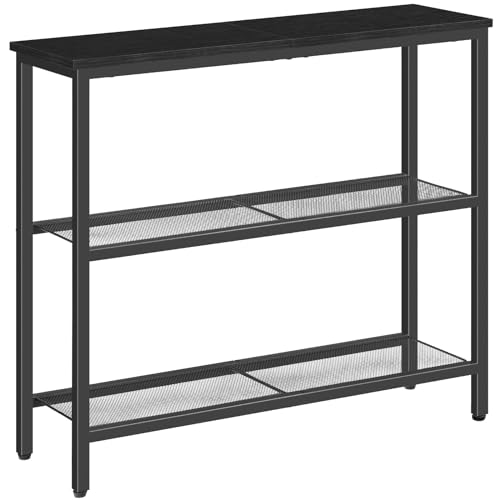
This is the apartment console perfected at its simplest: 29.5 inches long, 9.4 inches deep, 29.5 inches tall, with a particleboard top and two metal mesh shelves under it. The numbers that matter are all strong for the size — the tabletop is rated to 88 pounds, each mesh shelf to 33 pounds, and the whole table weighs 13.6 pounds, so it lifts aside for vacuuming with one hand. The mesh shelves are quietly brilliant in an entry: shoe grit and rain drips fall through instead of pooling, and the open structure keeps a small hallway feeling like air rather than furniture. Three tiers in a 29.5-inch footprint means the table stores like a piece twice its size: keys and a lamp up top, shoes and a bag in the middle, the rarely-used layer at the bottom.
Who it suits: renters in studios and one-bedrooms whose “entryway” is a wall segment by the door, and anyone whose hallway passage is the tightest in the home. It is also the easiest possible first console for a first apartment — cheap to buy, trivial to move, hard to get wrong.
Pros:
- 9.4-inch depth fits apartment hallways standard consoles block
- Three tiers of storage in a 29.5-inch footprint
- Tabletop rated to 88 lb; mesh shelves to 33 lb each
- Mesh shelves shed grit and moisture from shoes
- 13.6 lb — one-handed moves for cleaning and rearranging
Honest limitation: the top is a perch for a key bowl, a small lamp and a plant — not a styled vignette — and loose small items need a tray or basket on the mesh shelves or they will drop through. The listing does not highlight an anti-tip kit, so stabilise it renter-style: adhesive straps, or placement where a fall is blocked.
Choose it if you want the default small-apartment console. Skip it if you have a longer wall and can use the VASAGLE’s extra surface — in an apartment, unused wall length beside a short table tends to become a shoe pile, and the longer table is how you prevent it. Check on Amazon
FURINNO Frans Turn-N-Tube Console Table
The Frans is the smallest true console in this roundup: 23.6 inches wide, 9.3 inches deep and 31.4 inches tall — closer to a hallway ledge with shelves than a table, and all the better for the tiniest entries. FURINNO’s Turn-N-Tube system is the apartment-friendly part: the tubes twist together by hand, so assembly needs no tools, disassembly for a move takes minutes, and there are no cam locks to lose in a box. At 16.7 pounds it carries up a stairwell under one arm. The black oak finish is neutral enough for any rental’s existing palette, which matters when you cannot paint.
Who it suits: the smallest studios, dorm-adjacent rentals, and anyone whose entry is a 24-inch wall segment between the door and the kitchen. It is also the pick for serial movers — the table that has lived in four apartments and will live in a fifth. In a home this small, the console’s other job is morale: it is likely the first styled surface a guest sees, and a 24-inch ledge with a plant and a framed print does that work as honestly as a table three times its size.
Pros:
- Smallest footprint here: 23.6 in wide, 9.3 in deep
- Turn-N-Tube hand assembly — no tools, fast knock-down for moves
- Lightweight and genuinely one-person portable
- Multiple shelf levels for its size
- Neutral finish works with any rental’s fixed palette
Honest limitation: this is a light-duty piece. The tubes-and-panels construction that makes it portable also makes it the least rigid pick here — it will not love a heavy lamp plus a leaning stack of books, and the maker publishes modest expectations for a reason. Treat it as a landing ledge and shoe shelf, not as storage furniture, and stabilise it against a wall.
Choose it if your entry space is measured in inches, not feet. Skip it if you need load capacity or a grown-up furniture feel. Check on Amazon
VASAGLE 39.4-Inch Narrow Console Table (ULNT131K02V1)
If the HOOBRO is the apartment default, this VASAGLE is its long-format sibling: a full 39.4 inches of two-tier surface stretched over just 7.9 inches of depth, at 31.5 inches tall, in heather greige over an ink-black steel frame. That depth figure is the shallowest of any standard console here — shallower than most shoe racks — which makes it the one pick that can run along a studio’s only wall, behind a door’s swing path in some layouts, or down a hallway that every other table in this roundup would narrow into a complaint. The greige finish is the renter’s friend: it reads as intentional design against the landlord-white walls you are not allowed to change.
Who it suits: apartments with a longer entry wall or hallway run but no depth to spare, and studio dwellers who want one continuous surface that works as entry table, plant ledge and book shelf along a single wall.
Pros:
- Only 7.9 inches deep with a full 39.4-inch length
- Two tiers along the whole run — serious linear storage
- Steel frame keeps a long, slim table rigid
- Greige-and-black finish lifts plain rental walls
- VASAGLE includes an anti-tip kit in this narrow-table line — verify on the listing for your variant
Honest limitation: 7.9 inches of depth means cereal-box geometry: everything you place must be narrower than a dinner plate is wide, so check your lamp base and basket widths. The two tiers are also open — in a studio, everything stored is part of the room’s look, for better or worse.
Choose it if your wall is long and your depth is nearly zero. Skip it if your items are bulky or you need drawers. One more apartment-specific virtue: at this depth the table can stand in the strip of wall most floor plans waste — beside a door casing, along a kitchen’s outer wall, even in a wide closet doorway — and every one of those placements is storage the apartment did not know it had. Check on Amazon
HOOBRO 29.5-Inch Console Table with 2 Fabric Drawers (BG71XG01)
Small apartments have a specific visual problem: everything is close to everything else, so clutter has nowhere to be far away. This HOOBRO answers with concealment — two fabric drawers in a 29.5-inch frame, over two open tiers, at the same 9.4-inch depth as its sibling. The drawers take the chargers, mail, masks, dog bags and spare keys that otherwise colonise every surface in a one-room home, and because they are fabric, they weigh almost nothing and cannot slam. The published structure figures match the three-tier model: an 88-pound tabletop rating and 33 pounds per mesh shelf, at 15.8 pounds total weight.
Who it suits: studio and one-bedroom renters whose entry and living space are the same room, where a console’s contents are always on show — and anyone who works from home at a nearby desk and needs the visual noise gone.
Pros:
- Two fabric drawers hide the small-clutter category completely
- 9.4-inch depth, same apartment-friendly footprint as the 3-tier
- Tabletop rated to 88 lb; shelves to 33 lb each
- Soft drawers: no slamming in a one-room home, no pinched fingers
- Light enough to rearrange a studio layout solo
Honest limitation: fabric drawers hold soft, light things well and heavy or sharp things badly — overstuff them and they bulge against the frame. The open tiers below are mesh, so small items still need a basket. And in a studio, remember the drawers hide clutter from sight, not from existence: the weekly reset still applies.
Choose it if visual calm is the priority in a small footprint. Skip it if your storage is heavy or you prefer rigid drawers. Check on Amazon
Yaheetech 2-Tier Console Table with X-Design
Not every apartment is tiny. Plenty of rentals have a proper entry wall and a hallway with room to breathe, and for those, stepping up to a standard 40-inch console buys a calmer, more furniture-like presence than the specialists above. The Yaheetech is the value way to do it: a roughly 40-inch top and lower shelf on X-braced sides, about 32 inches tall, at the low end of this budget band. The X-bracing is the substance — it keeps an inexpensive frame rigid — and the black finish is forgiving of rental wear. It flat-packs simply and rebuilds without drama at the next address.
Who it suits: larger one- and two-bedroom rentals with a real entry wall, roommates furnishing a shared place on a budget, and anyone who wants one console to serve now and survive the next move.
Pros:
- Standard 40-inch size at the low end of the budget
- X-braced frame stays rigid where plain-leg tables wobble
- Two open tiers suit baskets, shoes and bags
- Dark finish hides rental-life scuffs
- Simple assembly; easy to knock down and rebuild
Honest limitation: at standard depth it spends more of your hallway than the narrow picks — measure the passage honestly before choosing size over slimness. No drawers, and the listing does not highlight anti-tip hardware, so plan renter-safe stabilising (adhesive straps or sofa-braced placement) from day one.
Choose it if your apartment can take a standard console and budget leads. Skip it if depth is your binding constraint. Check on Amazon
HOOBRO 47.2-Inch Skinny Console Table with Power Outlets
The studio special. In a one-room apartment there is often no entry wall at all — the door opens into the living space, and the only “hallway” is the gap behind the sofa. This HOOBRO was designed for that gap: 47.2 inches long, an extraordinary 5.9 inches deep, 31.5 inches tall, with power outlets and USB ports built into the top. It turns the back of the sofa into the apartment’s infrastructure — lamp plugged in where it stands, phones charging on the surface, keys landing on the same ledge — and it does it in space that was previously storing nothing but dust. The greige-and-black finish disappears behind upholstery, which in a studio is a virtue: the room reads as one calm space, not a corridor with furniture in it.
Who it suits: studio dwellers, anyone whose sofa floats in the room, and renters tired of extension cords crossing the floor to reach a lamp or charger.
Pros:
- 5.9-inch depth uses the dead space behind a sofa
- Built-in outlets and USB end the extension-cord problem
- 47.2-inch length spans most apartment sofas
- Creates an “entry” landing zone in a door-opens-to-living-room layout
- Quiet greige finish keeps a one-room home feeling unified
Honest limitation: the top is a perch, not a storage surface — drinks, a phone, a key tray, and that is the inventory — and there is no storage beneath it. It also only works where a sofa back (or a wall with an outlet plan) gives it a reason to exist; as a freestanding entry table in an open area it looks and feels too slight.
Choose it if your studio’s entry is the back of your sofa. Skip it if you need shelf storage — the 3-tier HOOBRO is your pick. Check on Amazon
Comparison Table
The six apartment picks side by side. Depth and weight are the apartment columns; check the live listing for current price and finishes.
| Pick | Dimensions (D x W x H) | Weight | Standout figure | Link |
|---|---|---|---|---|
| HOOBRO 29.5-Inch 3-Tier | 9.4 x 29.5 x 29.5 in | 13.6 lb | Top rated 88 lb; shelves 33 lb | Check on Amazon |
| FURINNO Frans Turn-N-Tube | 9.3 x 23.6 x 31.4 in | 16.7 lb | Smallest footprint; tool-light build | Check on Amazon |
| VASAGLE 39.4-Inch Narrow | 7.9 x 39.4 x 31.5 in | — | 7.9 in deep at full length | Check on Amazon |
| HOOBRO 29.5-Inch Fabric Drawers | 9.4 x 29.5 x 29.5 in | 15.8 lb | 2 drawers; top rated 88 lb | Check on Amazon |
| Yaheetech 2-Tier X-Design | About 11.8 x 40 x 32 in | — | Low end of this budget band | Check on Amazon |
| HOOBRO 47.2-Inch with Outlets | 5.9 x 47.2 x 31.5 in | — | 5.9 in deep; built-in power | Check on Amazon |
How to Choose a Console Table for a Small Apartment
Measure the door swing first. In apartments, the entry door usually swings into the exact wall a console wants. Open the door fully, mark its arc on the floor with tape, and place the table outside it — or accept a table the door will tap daily, which loosens joints and nerves alike. If the swing eats the whole wall, that is your answer: the console belongs behind the sofa instead.
Spend depth like money. Add up what the table’s depth leaves you: hallway width minus table depth should stay at or above 30 inches of passage, and in a studio the table should never be the widest thing in a traffic path. The picks here run 5.9 to about 12 inches deep for a reason — in this lens, the 9.4-inch HOOBROs are the standard and anything deeper must justify itself with storage.
Think in zones, not rooms. A studio console often has to mark the boundary between “entry” and “living” — a job it does by existing, with a lamp on it, where the zones change. Place it to divide, light it to signal, and let the lower shelves face the zone they serve: shoes toward the door, blankets toward the sofa.
Plan the renter-safe anchor. If your lease allows screws, use the included anti-tip kit and be done. If it does not, you have honest options: adhesive furniture straps (weaker, but real), placing the table behind the sofa where the sofa braces it, loading the bottom shelf heaviest, and choosing lower, lighter tables. What is not an option is a tall, narrow, unanchored table in a home with a climbing child or a large dog — reposition the table instead.
Check the floor, not just the wall. Rental floors are rarely level, and a rigid little table on a sloping floor rocks — and a rocking table loosens its own joints. Adjustable feet, which several picks here include, are the fix; failing that, a felt pad under the short leg. Test with a marble or a phone level app before you load the shelves.
Count the vertical, not the horizontal. When comparing two apartment consoles, count shelf surfaces, not inches of length. A 29.5-inch three-tier stores more than a 40-inch single-shelf table, in less wall. The apartment question is never “how much wall does it take” but “how much floor-life does it give back” — shoes off the floor, bags off the sofa, keys off the counter.
Let colour do the decorating you cannot. Renters usually cannot paint, paper or change flooring — which makes the console’s finish one of the few colour decisions in the entry that is actually theirs. A greige or black frame against landlord-white walls reads as a deliberate scheme; a wood tone warms a grey laminate floor. Choose the finish as you would choose a paint colour, because functionally, that is what it is.
Buy for the next move, too. Favour tables under about 25 pounds that knock down flat, keep the assembly hardware in a labelled bag taped to the underside, and photograph the assembled table before disassembly. Your future self, in a new hallway at 9 p.m., thanks you. If you are furnishing the whole rental at this budget, the matching pieces are in our guides to the Best Entryway Bench For Small Apartments Under $150, the Best Coffee Table For Small Apartments Under $150 and the Best End Table For Small Apartments Under $150.
Small-Apartment Layouts That Work
The door-wall studio. Console against the wall beside the door (outside the swing), mirror above, one hook rail for coats. The console’s shelves face the room and hold shoes below, daily carry in the middle, keys and mail on top. This is the HOOBRO 3-tier’s home turf. A washable runner under the console’s front edge completes the zone: it catches the grit the entry generates, defines the boundary visually, and goes in the wash on the same cycle as the towels. In a studio, that three-foot runner does the work of a wall.
The floating-sofa studio. Sofa perpendicular or floating, powered skinny console behind it, lamp at one end. The “entry” becomes the sofa’s back: keys and chargers land there, and the room keeps a visual boundary without a wall. Add a small rug under the sofa’s front legs and the zone reads as intentional.
The hallway one-bedroom. A long, shallow console — the 7.9-inch VASAGLE — runs the hall, with the lower tier as a shoe library and the top as a gallery ledge. The hallway stops being a corridor you pass through and becomes the apartment’s second room, which in 500 square feet is not a small thing.
The no-entry rental. Door opens straight into the kitchen-living space, no wall segment at all. Then the console goes against the nearest perpendicular wall or the back of a bookcase, shallow and disciplined, with a tray defining the landing zone. The FURINNO Frans was built for this leftover geometry.
The shared-house rental. Three roommates, one hallway, four sets of keys. The console becomes neutral infrastructure: a drawer or basket per person on the fabric-drawer HOOBRO or the Yaheetech with baskets, a house rule that the top stays clear, and the hallway stops being the place where everyone’s morning goes to argue. In shared homes the console’s real product is not storage — it is the absence of friction, and it is worth more than any single person’s styling opinion.
Assembly in a Small Space
Building furniture in an apartment has its own logistics. The box arrives in a hallway you share with neighbours, the build happens on the only clear floor you have, and the packaging has to leave via the same stairwell. The picks here are kind on all three counts: compact cartons, builds of roughly 20 to 40 minutes, and hardware counts a renter can keep track of on a coffee table. Build on a rug or the flattened carton to protect both the floor — your deposit thanks you — and the panels’ edges. The FURINNO’s hand-twist tubes are the extreme case: no tools, no Allen key to lose, and a build you can do sitting on the floor.
Two habits pay off. First, assemble the table in the room and position it will live in; a 39.4-inch console built in the living room and carried through a 30-inch doorway at an angle is a small puzzle you do not need. Second, keep the box until the return window closes, flattened behind the sofa — if the table is wrong for the space, the box is the difference between a painless return and a donation. Apartment shopping is iterative; the first console teaches you your real depth and swing numbers, and the right one is often the second purchase. Buying from listings with clear dimensions — every pick here — is how you make it the first.
Common Buying Mistakes
Measuring the wall, forgetting the door. The swing arc is the apartment mistake. Tape it on the floor before you order anything.
Buying house-depth furniture. A 14-inch-deep console in an apartment hallway is a daily tax on every trip through it. In small homes, depth discipline is the whole game.
Choosing a heavy, permanent piece for a temporary home. Board-heavy consoles that take two people to move will be sold at a loss at lease-end or, worse, moved at great expense. Light, knock-down designs are the renter’s friend.
Skipping stability because the lease says no holes. No-drill does not mean no plan. Adhesive straps, sofa-braced placement and bottom-heavy loading exist precisely for renters; use at least one.
Letting the console become the closet. In a small apartment the console is visible from everywhere, so its clutter is the room’s clutter. Drawers or baskets are not optional styling — they are the mechanism that keeps a one-room home calm.
Forgetting the delivery route. The table that fits the wall still has to arrive: stairwell turns, elevator doors and a 30-inch apartment door all vote. Check the carton dimensions on the listing against your tightest turn before ordering — the compact picks here ship kindly, but the standard-size Yaheetech’s box deserves the check.
Ignoring the outlet. Apartment outlets are few and oddly placed. If the console will hold a lamp or chargers, confirm an outlet within cord reach that does not cross a walkway — or choose the powered HOOBRO and make the problem disappear.
Renting Rules, Deposits and Moving Day
The lease shapes this purchase more than the catalogue does. Most standard leases prohibit or limit wall fixings, which is why this roundup treats anchoring as a spectrum rather than a single instruction: screws into a stud where the lease allows, adhesive straps where it does not, and placement strategies — behind the sofa, in a corner, bottom-loaded — everywhere. If you are unsure, ask the landlord in writing; property managers routinely approve two small filled holes for furniture safety, and an email approval costs nothing and protects the deposit conversation later. Photograph the wall behind the table on move-in day, before anything is placed, so its condition is never a matter of memory.
Moving day is the second design brief. Every pick in this roundup weighs under about 25 pounds and either flat-packs or knocks down by hand, and that is not an accident — it is the filter. When you disassemble, tape the hardware bag to the underside of the top panel, wrap glass-free panels in the moving blanket you already own, and carry the table in the first load, not the last: in the new place it becomes the landing surface that organises everyone else’s boxes. If a table cannot make that journey gracefully, it is not apartment furniture, whatever the listing calls it. This is also the honest argument against the heavy board-construction consoles in this price band for renters: they are fine furniture for owners and a recurring fee — in movers, in damage, in resale losses — for anyone on a twelve-month lease.
One more rental reality deserves a line: light. Rental entries are the worst-lit square footage in most homes — a single ceiling fixture, often behind the door’s swing. A console table is the natural home for the lamp that fixes this, and a lamp at standing height transforms an entry from a pass-through into a place. If the outlet is in the wrong spot, the powered HOOBRO or a rechargeable lamp solves it without an extension cord across the traffic path. Budget the lamp into the same purchase decision as the table; in a rental entry, the two are really one piece of furniture.
The Apartment Console Kit: What Actually Lives On It
A small console earns its place through a short, disciplined inventory. On top: a lamp if the entry has no good light of its own (in many rentals it does not, and the console lamp becomes the light you actually live by), a tray or shallow bowl that defines the landing zone, and one object that is there purely because you like it — the plant, the print, the small sculpture — because a purely functional surface makes a rental feel temporary. Middle tier: the daily carry, organised by container — a basket for bags and hats, a closed box for chargers and cables. Bottom tier: shoes in current rotation, on a washable mat if the shelves are solid, straight on the mesh if you chose the HOOBROs.
What does not live on it: anything whose home is another room. The console fails — in an apartment, visibly and daily — when it becomes overflow storage for the whole home. The rule that keeps it working is one sentence: if it does not serve leaving, arriving, or the room it stands in, it does not live here. Apply it monthly with a bag in hand; a small apartment forgives many things, but not a landing strip that has become a shelf of postponed decisions.
Final Recommendation
For most small apartments, buy the HOOBRO 29.5-Inch Narrow Console Table. It stores like a bigger table, fits like a smaller one, carries a serious load rating, and moves like the rental furniture it is. If your wall is long and your depth is nearly nothing, the VASAGLE 39.4-Inch Narrow Console Table at 7.9 inches deep is the same idea stretched to fit. Measure the door swing, count your depth twice, stabilise the table the renter-safe way, and check the current price on Amazon before you order — then enjoy an entryway that finally fits the apartment it serves. A small apartment does not need less furniture; it needs furniture measured as carefully as the rent was. Every pick in this roundup was. Choose the one whose depth matches your tightest passage and whose storage matches your actual clutter, and the smallest room in your home will start doing the biggest organisational work.
Frequently Asked Questions
What size console table works best in a small apartment?
For most small apartments: 29 to 40 inches long, 8 to 10 inches deep, and 29 to 32 inches tall. That envelope holds a lamp, a landing tray and two or three storage tiers while leaving at least 30 inches of passage in a typical rental hallway. Studios with no entry wall do better with a 5.9-inch behind-sofa model than with any freestanding table.
How do I anchor a console table without drilling, as a renter?
Use adhesive furniture straps rated for furniture (weaker than screws, but a real restraint), place the table where a sofa or wall return braces it, and load the lowest shelf heaviest to lower the centre of gravity. If your household includes a climbing toddler, be stricter: choose the lowest, most braced placement available, and consider asking the landlord — many will permit two small screw holes for child safety, especially if you offer to fill them at move-out.
Can a console table work in a studio apartment?
It is arguably the most useful piece in a studio. A console creates an entry zone where none exists, divides living from sleeping areas without a wall, and adds vertical storage in a footprint under 10 inches deep. The behind-sofa powered model and the long shallow wall model in this roundup are both studio-first designs.
Will a narrow console table hold enough to be useful?
Yes, if it stores vertically. The 29.5-inch HOOBRO in this roundup carries an 88-pound top rating and two 33-pound shelves across three tiers — more usable storage than many full-size single-shelf consoles. What narrow tables cannot do is wide objects: check that your lamp base, baskets and bags fit the depth before ordering.
Is it worth buying a console table for a one-year lease?
If the entry currently has no landing surface, yes — the daily friction of keys-on-the-floor living is real, and every pick here is inexpensive within the budget band, light enough to move with you, and simple to resell locally if the next place does not need it. Buy the knock-down, sub-25-pound designs and the table becomes part of your portable household kit.
Where should a console table go if my apartment door opens into the living room?
Behind the sofa is the classic answer — it creates a landing strip at the room’s centre of gravity and a boundary that makes the space feel zoned. The alternatives are the nearest perpendicular wall segment, or the back of a low bookcase used as a divider. In all three spots, a shallow table (under 10 inches) with a defined tray zone works best.
How much weight can a narrow apartment console table hold?
More than its size suggests, on the steel-frame models. The HOOBRO tables in this roundup publish an 88-pound tabletop rating and 33 pounds per mesh shelf. The light tube-construction FURINNO is the exception — treat it as a light-duty ledge. Always read the per-surface rating on the listing for your exact variant, and put the heaviest items on the lowest shelf.
What can I do if my apartment has no entryway at all?
Manufacture one. A shallow console, a mirror or print above it, and a small rug beneath creates a psychological and practical entry zone in a few square feet — the place where outside things stop and home things start. Behind-the-sofa placement achieves the same with the sofa as the boundary. Studios that add this one zone consistently feel larger, because the alternative — entry clutter spread across the whole room — is what actually eats the space.


