Where to buy
Check the latest price, availability and delivery on Amazon. Orders are placed on Amazon. We may earn a commission from qualifying purchases.
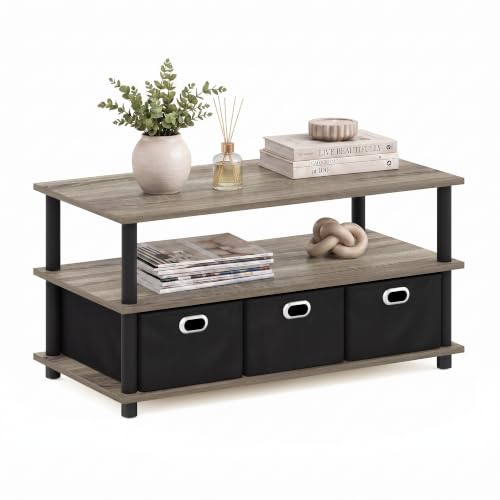
- Best overall for small spaces: Furinno Turn-N-Tube Coffee Table, 3-Tier, French Oak Grey — Check on Amazon
- VASAGLE MAEZO Round Coffee Table, 2-Tier, 31.5 Inch, Heather Greige — Check on Amazon
- Furinno JAYA Oval Coffee Table with Storage Bin, Walnut — Check on Amazon
- WLIVE Lift Top Coffee Table with Hidden Compartment, 39 Inch, Brown — Check on Amazon
See 2 more Amazon options
- Yaheetech Lift Top Coffee Table with Hidden Storage, 38.6 Inch, Rustic Brown — Check on Amazon
- Yaheetech 2-Tier Coffee Table with Storage Shelf, X Design, Black — Check on Amazon
Read the full guide ↓
Disclosure: As an Amazon Associate, dailyhomedecorating.com earns from qualifying purchases. Links to Amazon on this page are affiliate links; they cost you nothing extra. Listing details such as price and availability change often, so check the current Amazon listing before you buy.
The best coffee table for small spaces under $100 is a study in what a table can afford to be when the room cannot afford the table. A small space — a compact living room, a den, a snug sitting area, the end of an L-shaped room that never quite became a zone — punishes furniture in specific ways. There is no walkway to spare, so corners become collisions. There is no visual slack, so a heavy, dark table shrinks the room every hour of the day, not just when someone bumps into it. And there is no overflow storage elsewhere, so a table that only holds a mug is spending the scarcest resource in the house — floor — on the least possible return. Small-space furniture is therefore not regular furniture shrunk; it is furniture re-thought around footprint, shape and lightness.
This guide compares six real under-$100 Amazon listings — check the current price on the listing before you buy, because this tier’s prices move often — by small-space criteria: footprint in inches, depth especially (the dimension that decides whether a walkway survives), shape, visual weight, and storage or function earned per square foot. The same six tables appear in our general roundup, Best Coffee Table Under $100, and in the apartment-specific guide, Best Coffee Table For Small Apartments Under $100; here the context is any tight room in any home, from a small family living room to a reading corner that needs a table of its own. The Furinno Turn-N-Tube leads on pure footprint discipline. The round VASAGLE follows for rooms where people must flow around the table, and the oval Furinno JAYA takes third as the narrow, soft-edged answer for shallow seating areas.
A note on depth, because it is the small-space dimension shoppers most often ignore: living rooms fail at the front edge of the sofa. A table 24 inches deep in front of a sofa in a 10-foot room leaves a walkway measured in inches and a room that feels like a queue. Every pick here is between 15.5 and 20 inches deep — the narrow band that lets a small room keep a genuine passage in front of its seating — and the narrowest, the Turn-N-Tube at 15.5 inches, exists precisely for rooms where even 20 is too much.
In this guide
Quick Picks
Every inch spoken for? This table matches each pick to the small-space problem it solves.
| Buyer type | Pick | Why it stands out | Link |
|---|---|---|---|
| Best overall for small spaces | Furinno Turn-N-Tube Coffee Table, French Oak Grey | Smallest footprint in the guide — 31.2 x 15.5 inches — with three tiers | Check on Amazon |
| Best for flow around the table | VASAGLE MAEZO Round Coffee Table, Heather Greige | Round top returns its corners to the room as passage space | Check on Amazon |
| Best narrow and soft-edged | Furinno JAYA Oval Coffee Table, Walnut | Oval top, shallow depth and a bin for the small room’s clutter | Check on Amazon |
| Best multifunction | WLIVE Lift Top Coffee Table, 39 Inch, Brown | A desk and dining surface folded into a coffee table’s footprint | Check on Amazon |
| Best storage in a small footprint | Yaheetech Lift Top Coffee Table, 38.6 Inch, Rustic Brown | The guide’s largest hidden compartment plus a shelf, in 38.6 inches | Check on Amazon |
| Best for small but real living rooms | Yaheetech 2-Tier Coffee Table, X Design, Black | Full-size strength and a media shelf for compact three-seat sofas | Check on Amazon |
How These Picks Were Chosen
We measured smallness in three ways. The first is footprint: length by depth, with the guide capped at about 40 by 20 inches and a preference for the shallow end, because depth is what walkways feel. The second is shape efficiency: in a tight room, a table’s corners are wasted floor that people collide with, so round and oval designs earned credit for returning that space to circulation. The third is visual weight — a small room reads a table’s bulk, not its tape measure. Leggy, open designs with air beneath them (all six picks qualify to some degree) keep a small room feeling like a room; a solid block of the same dimensions would feel like an obstacle.
Function per square foot was the second test, because a small space cannot host single-purpose furniture. Tiers, shelves, bins and compartments all convert the same footprint into storage; lift tops convert it into a desk and dining table. We scored each design on what its footprint earns beyond a surface. The third test was practical smallness: weight (a table in a tight room gets moved for cleaning, guests and rearranging more than any other furniture in the house — the picks run from 12.4 to about 42 pounds) and assembly feasible within the room itself, since small spaces rarely offer a spare floor elsewhere for building furniture.
Budget discipline applied as everywhere in this batch: all six are genuine under-$100-tier Amazon listings, verified by ASIN, with live prices left on the listing page. Capacities are quoted from the makers and treated as ceilings for light, ordinary loads — small-space tables are not exempt from physics, and the lightest picks here are honest about being light-duty.
The 6 Best Coffee Tables for Small Spaces Under $100
Furinno Turn-N-Tube Coffee Table, 3-Tier, French Oak Grey
Who it suits: The genuinely tight room — small living rooms, dens, reading corners and any seating area where the walkway in front of the sofa is measured in inches.
This is the smallest honest coffee table in the guide, and smallness is its whole design. The footprint is 31.2 inches long by just 15.5 inches deep, at 15.8 inches high — dimensions that fit in front of a loveseat or a pair of chairs in rooms where a standard 20-inch-deep table would seal the passage shut. What keeps it from being merely a token surface is the three-tier layout: the top takes drinks and the current book, the middle tier takes remotes and a small console or tablet, and the bottom tier takes magazines, a throw or a basket. Vertical storage is the small-space trick — the same floor, three surfaces — and this table is built entirely from it.
The rest of the design serves tight rooms just as directly. It weighs about 12.4 pounds, so it can be lifted aside one-handed when the room must convert — guests sitting on the floor, a yoga mat unrolled, children playing — and moved back just as easily. Assembly is tool-free: the signature tubes twist together by hand, so it can be built in the exact patch of floor it will occupy, which in a small space is often the only patch there is. The pale French oak grey finish does visual work too, keeping the table light in the sightline so the room reads its walls, not its furniture.
The limits are capacity and presence. Each surface is rated for about 20 pounds, 40 in total — a light-duty table for the light loads of a sitting area, not a media center or a footrest for the whole family. Its low height suits drinks and reading, not dining. It is also the least expensive pick in the guide — check the current price on Amazon. For the room that truly has no space, it is not the compromise option; it is the only category of answer that works, executed about as small as a useful table can be.
- Smallest footprint here: 31.2 x 15.5 in — the shallow depth preserves walkways.
- Three tiers triple the storage the same floor would otherwise give.
- Tool-free assembly and 12.4 lb weight; builds and moves within the tight room itself.
Honest limitation: Light-duty (about 20 lb per surface) and low — a drinks-and-books table, not a dining, working or heavy-load surface.
Choose it if space is the binding constraint and loads are light. Skip it if the table must work as a desk, dining table or media stand.
VASAGLE MAEZO Round Coffee Table, 2-Tier, 31.5 Inch, Heather Greige
Who it suits: Small seating groups arranged around a rug — a loveseat and chairs — and rooms where the route through the living area passes close by the table.
The round table is the small-space classic, and the MAEZO is its best-executed budget version here. The geometry is the argument: a 31.5-inch circle at 17.7 inches high occupies less usable room than a rectangle of similar service, because the corners a rectangle spends are exactly the floor a tight room needs for passage. People flow around a circle without thinking about it — no hip-checks, no squeezed sideways passes — and in a small room that unconscious ease is felt every day. The two-tier form adds a lower surface for books and a basket, and the tapered legs with curved transitions keep the design visually light, which in a small room is a form of space in itself. The heather greige finish completes the effect: pale, warm-neutral, and quiet in the sightline.
Service matches the shape. A loveseat-and-armchair grouping — the standard small-room arrangement — gets a reachable edge in front of every seat, something a short rectangle cannot offer the chair at the side. Assembly is labeled-parts flat-pack, estimated by the maker at about 20 minutes, and at about 25 pounds the table is stable in place yet movable by one person when the room rearranges.
Capacity is the honest cost: the top is rated at up to 66 pounds and the lower tier at 44 — drinks, books, a laptop and decor, not equipment stacks — and a round lower tier holds less than a rectangular shelf. It sits mid-tier in this guide’s budget — check the current price on Amazon. Choose it when the room’s problem is flow, and it will feel less like furniture placed in the room and more like room the furniture gave back. Seating chosen on the same space logic is covered in Best Accent Chair For Small Spaces Under $100.
- Round top frees passage space that corners consume in tight rooms.
- Two tiers and a reachable edge for every seat in a wrap-around grouping.
- Greige finish and tapered legs keep visual weight low — space you can see.
Honest limitation: Modest capacities (66 lb top / 44 lb tier) and a round shelf that stores less than rectangular rivals.
Choose it if traffic flows around the table and seating wraps it. Skip it if you need a work surface or maximum shelf volume.
Furinno JAYA Oval Coffee Table with Storage Bin, Walnut
Who it suits: Shallow seating areas — a sofa against a long wall with limited floor in front — and small rooms that need their clutter to have an address.
The JAYA’s oval is the rectangle’s answer to the round table’s argument. At 35.4 inches long it serves a sofa’s length properly, but the oval ends shed the corners, so the walkway past its ends stays open and hips stay unbruised; at 19.7 inches deep it sits in the shallow band small rooms require, and at 16.4 inches high it keeps the profile low. For the common small-room layout — sofa on the long wall, television opposite, a passage at one end — the oval is frequently the shape that fits the geometry best, which is why designers reach for it in tight rooms.
Its second small-space virtue is the storage bin. Beneath the top, shelves flank a central compartment holding a fabric bin — in a small room, where there is no sideboard and no spare drawer, that bin is where remotes, chargers, coasters and the room’s small debris are supposed to live. A small room’s tidiness is mostly a storage-address problem: rooms look cluttered when objects have no home, and this table provides one inside a footprint that was already spent. The walnut finish warms compact rooms, which can feel stark when every surface is pale.
The build is light-duty — composite panels on plastic tube legs, about 23.2 pounds, a stated maximum load of 40 pounds — so the loads should stay at the drinks-books-laptop level, and nobody should sit on it. Assembly is simple, one-person, in-room work. It sits at the budget-friendly end of the guide — check the current price on Amazon. For shallow rooms that need a sofa-length table without the corner tax, it is the most considerate shape here.
- Oval ends keep end-of-sofa walkways open while serving the sofa’s full length.
- Fabric storage bin gives a small room’s clutter a home inside the footprint.
- Shallow 19.7 in depth and low 16.4 in profile suit tight seating areas.
Honest limitation: Light-duty build (stated 40 lb maximum, plastic tube legs) — light loads only, no sitting.
Choose it if your room is shallow and long rather than square. Skip it if the table must carry heavy gear or double as seating.
WLIVE Lift Top Coffee Table with Hidden Compartment, 39 Inch, Brown
Who it suits: Small living rooms that must also be offices and dining rooms — the multi-use room where one footprint has to cover three furniture jobs.
The WLIVE attacks the small-space problem from the opposite direction: not less table, but more per table. The footprint is 39.4 by 19.7 inches — mid-pack here — but the top lifts from 16.9 to about 22.7 inches, converting the surface into a desk that fits a 17-inch laptop or a dining height for two, and beneath it a hidden compartment stores the work kit so the room returns to a living room when the day ends. In a small room, the relevant comparison is not table versus table; it is this table versus a table plus a desk plus a dining set, three footprints the room does not have. By that arithmetic, the WLIVE is the smallest option in the guide.
Small-room details check out. The angled legs leave about 8.2 inches of clearance, so a robot vacuum — a small-space appliance if ever there was one — cleans beneath it instead of orbiting it. The steel lift frame moves smoothly and lowers without dropping, and the closed top’s maker rating of up to 200 pounds makes the table a confident surface for the room’s everything-else: board games, serving dishes, the occasional pile of laundry being folded. The warm brown finish keeps the multifunction from looking utilitarian.
The limits: the raised top is rated for about 11 pounds, so the desk is a laptop desk and the dining is plate-and-glass dining, with serving dishes kept on the closed section. At 39.4 inches long it also needs a loveseat-or-larger sofa to sit in proportion; in front of two armchairs it would crowd. It sits at the upper end of the guide’s budget — check the current price on Amazon. For the small room with three jobs, it is the most economical use of floor available under $100.
- Desk and dining surface folded into a coffee table footprint — three jobs, one floor cost.
- Hidden compartment erases work gear; closed top rated up to 200 lb.
- 8.2 in leg clearance admits a robot vacuum beneath.
Honest limitation: Raised top limited to about 11 lb, and the 39.4 in length needs a loveseat-scale sofa to sit in proportion.
Choose it if your small room works triple shifts. Skip it if the room only needs a quiet surface — the smaller picks spend less floor.
Yaheetech Lift Top Coffee Table with Hidden Storage, 38.6 Inch, Rustic Brown
Who it suits: Small rooms with a storage deficit — compact living rooms whose blankets, games and consoles currently live on the floor or the sofa.
In a small room, visible clutter is not a tidiness issue; it is a space issue, because every object on the floor or sofa is occupying room the household needs. This Yaheetech is the guide’s storage answer inside a coffee table’s footprint: 38.6 by 19.7 inches at 16.5 inches high, containing the largest hidden compartment here — about 33.9 by 15.4 by 4.2 inches — plus an open lower shelf. Blankets, board games, the console and controllers, the spare cushions’ covers: the compartment takes the layer of living that makes small rooms look smaller, and the lift top (to about 22 inches) still provides the sofa-dining and laptop function when the room needs it.
The rustic, water-resistant veneer is small-room practical: textured finishes hide the scuffs that tight quarters inflict — in a small room, everything passes close by the table, so the table gets touched by everything — and spills wipe off. Stated capacities are mid-tier and credible: about 77 pounds total, the top 44 closed and 22 raised, the compartment 33, the shelf 40. At roughly 42 pounds it is the heaviest pick here, so build it in the room it will serve; small rooms rarely offer a staging area anyway.
It sits at the upper end of the guide’s budget — check the current price on Amazon. If your small room’s floor is currently doing storage work, this table is how the floor gets given back.
- Largest hidden compartment in the guide plus an open shelf, in 38.6 inches.
- Lift top included — storage does not cost the room its dining/work surface.
- Rustic water-resistant veneer hides the scuffs tight quarters cause.
Honest limitation: Heaviest pick (about 42 lb) — assemble in position — and the raised top caps at about 22 lb.
Choose it if the room’s problem is stuff with nowhere to go. Skip it if the room is so tight that 38.6 inches crowds the walkway — drop to the 31-inch class.
Yaheetech 2-Tier Coffee Table with Storage Shelf, X Design, Black
Who it suits: Small-but-real living rooms — a compact three-seat sofa, a television, and a household that wants one sturdy table with a media shelf rather than a featherweight.
Small spans a range, and at its upper end — a living room of perhaps 10 by 12 feet with a proper sofa — the light-duty picks start to feel like the compromise. The Yaheetech 2-Tier is the full-strength option that still respects small-room dimensions: 39.5 by 20 inches at 18 inches high, inside the guide’s footprint cap, with the strongest stated capacities here (top up to 198 pounds, shelf up to 154) on black X-frames that brace the build at about 31.6 pounds. Its full lower shelf is the small room’s media unit: console, games, books and a throw basket, all inside the table’s footprint — storage a small room gets without surrendering another wall to furniture.
The small-space caveats are proportion and openness. At the guide’s maximum footprint, it needs the knee-gap check done honestly — 14 to 18 inches in front of the sofa — and in a truly tight room it will crowd where the 31-inch picks breathe. The open shelf displays its contents, so baskets are the difference between storage and visible clutter; the black frame, at least, makes a styled shelf look intentional in modern and industrial-leaning small rooms.
It sits mid-tier in the guide’s budget — check the current price on Amazon — and it is the pick for the small room that is a household’s main room: the one that will still feel solid when the room’s life is at full volume. Overflow storage for the same rooms is covered in Best Bookshelf For Small Spaces Under $100.
- Full strength (top up to 198 lb) inside a small-room footprint cap.
- Full lower shelf doubles as the media unit the room has no wall for.
- X-frame build at 31.6 lb — planted, racking-resistant, room-respecting.
Honest limitation: The guide’s joint-largest footprint — genuinely tight rooms should size down — and all storage is open display.
Choose it if your small room is the main room and needs a real table. Skip it if walkways are already measured in single inches.
Comparison Table
| Product | Type | Best use | Link |
|---|---|---|---|
| Furinno Turn-N-Tube Coffee Table | 3-tier, tool-free | The tightest rooms; shallowest footprint | Check on Amazon |
| VASAGLE MAEZO Round Coffee Table | Round, 2-tier | Flow around the table in wrap-around seating | Check on Amazon |
| Furinno JAYA Oval Coffee Table | Oval with storage bin | Shallow, long rooms; corner-free ends | Check on Amazon |
| WLIVE Lift Top Coffee Table | Lift-top with hidden storage | Small rooms working as office and dining room | Check on Amazon |
| Yaheetech Lift Top Coffee Table | Lift-top with hidden storage | Maximum hidden storage per square foot | Check on Amazon |
| Yaheetech 2-Tier Coffee Table | Open-shelf, X-frame | Small main rooms needing strength and a media shelf | Check on Amazon |
How to Choose a Coffee Table for a Small Space
- Measure depth before length. Depth decides whether the walkway survives. In tight rooms, stay at or under 20 inches deep — every pick here qualifies, and the shallowest is 15.5.
- Keep the knee gap sacred. Fourteen to eighteen inches between sofa edge and table edge. If a table you love breaks the gap, it is the wrong table for the room, whatever its other virtues.
- Spend corners wisely. In circulation-heavy rooms, round and oval tops return floor to movement. In a quiet corner arrangement, a rectangle’s extra surface may be worth its corners. Match shape to traffic, not fashion.
- Count storage as floor. A tier, shelf, bin or compartment inside the footprint is floor you do not spend on separate storage. In small spaces, the table with storage is effectively the smaller table.
- Prefer visual lightness. Legs and air beneath read as space; solid bases read as bulk. Pale finishes extend the effect. A small room is judged by the eye before the tape measure.
- Weight is a feature. Small-room tables move constantly — for cleaning, guests, games on the floor. Under about 25 pounds is one-person easy; the heaviest pick here (about 42 lb) should be a deliberate choice, not a surprise.
- Multifunction beats miniature. If the room must host work or dining, a lift-top at 39 inches serves the room better than a fixed table at 31 — the comparison is against the extra furniture, not the smaller table.
- Check the live price and finish. This tier’s prices move and finishes vary in price; confirm your configuration is within the under-$100 frame on the listing.
Making a Small Room Feel Bigger Around Its Table
The table is the room’s center, so its treatment steers how big the room feels. Keep the top mostly clear — in a small room, a cluttered tabletop reads as a cluttered room, because there is no visual elsewhere to dilute it; the storage picks above exist to make that discipline easy. Choose one pale or reflective element on the table (a light tray, a glass bowl) to borrow light. Keep the rug larger than the table’s zone so the eye reads a defined area rather than a squeezed one, and let the table sit fully on it.
Height discipline helps too: in a small room, keep the table at or below seat height and avoid stacking tall objects on it — a tall plant or lamp on the table raises the room’s visual center and shrinks it. Finally, leave one direction open. A small room feels bigger when at least one path through it is completely unobstructed; arrange the table so that path survives, even if it means choosing the 31-inch table over the 39. The room will repay the restraint every day.
Coffee Tables for Secondary Spaces: Dens, Corners and Guest Rooms
Small spaces are not always whole rooms. Some of the hardest-working coffee tables serve a den corner, a reading nook at the end of a hallway, a guest room that doubles as an office, or the sitting end of a large bedroom — places where a full living-room table would be absurd, but a surface is still needed for the book, the cup and the lamp-lit hour. The compact end of this guide was practically designed for these assignments. The Turn-N-Tube’s three tiers make it a reading corner’s complete furniture: current book on top, next books in the middle, the throw below, in a 31 by 15.5-inch footprint that fits beside a single armchair where no conventional table fits at all. The VASAGLE’s round form suits the nook’s geometry — corners are where small spaces waste their area, and a circle wastes none of it.
Secondary spaces also forgive the light-duty builds that a main room would expose. A guest room’s table carries a carafe, a phone charger and a visitor’s paperback; a den corner’s table carries one household’s quiet habits, not its full traffic. Matching the table’s duty to the space’s actual load is the entire discipline — the mistake is buying main-room strength for a corner (wasted money and bulk) or corner strength for a main room (a wobble by Christmas). Judge the space’s real life, and the guide’s capacity figures will sort the picks for you.
These secondary assignments have one more virtue worth naming: they are where a household can experiment cheaply. A finish or shape you are unsure about — the pale grey, the round form — can prove itself in a den for a season before it is trusted with the living room, at a price where a failed experiment is a spare-room table rather than a regret.
When Even 31 Inches Is Too Much
Honesty requires a boundary: some spaces should not have a coffee table at all. If preserving the 14-inch knee gap and one clear walking route leaves less than about 28 inches of length in front of the seating, a coffee table — any coffee table — will make the room worse: harder to move through, harder to clean, and visually crammed. In those rooms the better answers are a pair of small side tables at the sofa’s ends, a narrow console behind the sofa if the layout allows one, or a storage ottoman that serves as surface, seat and storage in a soft-edged form. None of those are in this guide’s scope, and recommending them anyway is the correct call: the best small-space advice is sometimes that the space wants a different furniture category.
Between that boundary and comfort sits the territory this guide covers — rooms with roughly 30 to 40 inches of honest table room in front of the seating. If your measurement lands there, the picks above divide it cleanly: the 31-inch class (Turn-N-Tube, VASAGLE) for the lower end, the 35-inch JAYA in the middle, and the 39-inch class (both lift-tops, the 2-Tier) for rooms at the generous end of small. Measure first, including the gap, and let the tape — not optimism — assign you to a class. Small rooms reward that honesty more than any other kind of room, because in a small room there is nowhere for a mistake to hide.
Visual Weight: Why Some Tables Shrink a Room and Others Do Not
Two tables with identical measurements can leave a small room feeling completely different sizes, and the difference is visual weight — how much of the room’s light and sightline the table interrupts. A table reads heavy when it is dark, solid to the floor, and tall; it reads light when it is pale, leggy and low. In a small space, visual weight is not an aesthetic nicety: it is the difference between a room that feels like its true dimensions and one that feels a size smaller all day. This is why the guide’s picks are all leg-standing designs with air beneath them, and why the pale finishes — the Turn-N-Tube’s French oak grey, the VASAGLE’s heather greige — earn explicit praise in a small-space context: they return light to the room instead of absorbing it.
The floor’s visibility is the mechanism. The more continuous floor the eye can see, the larger the room registers — which is why a leggy table over a visible rug feels smaller than a solid table of the same footprint, and why the under-table zone matters: keep it empty or nearly so. A lower tier stuffed to the edges cancels the effect; a lower tier holding one basket or a neat row of books preserves it. Small-space owners should treat the space under the table as part of the room’s visible floor and furnish it with the same restraint as the top.
Height completes the picture. Sightlines in a seated room run horizontally, and a table at or below seat height stays under them, letting the eye travel to the walls — the room’s actual boundaries. Every inch above seat height is an inch of wall the table hides. The picks here, at 15.8 to 18 inches, all respect that geometry; when you shop beyond this guide, treat any coffee table taller than your sofa’s seat as a small-space risk, whatever its footprint promises. In tight rooms, the tape measure tells you whether a table fits; visual weight tells you whether the room survives it.
One practical test combines all three factors before you buy. Clear the floor where the table would go, then mark its footprint with painter’s tape at the dimensions of the pick you are considering — 31 by 15.5 inches, say, or 39.5 by 20. Live with the tape for a day: walk the room’s routes, sit on the sofa with your feet where they naturally go, open every door and drawer nearby, and run the vacuum. Then stand in the doorway and judge the taped rectangle’s visual claim on the room. If the tape feels generous, the table will feel right; if the tape already crowds the room, no finish or shape will rescue the real object, and the correct move is down a size class. Ten minutes of tape has saved more small rooms than any buying guide, this one included — use it, especially before ordering the largest picks in a room you have not measured since the sofa arrived, because memory flatters floor space and tape never does.
Common Buying Mistakes
- Measuring length and forgetting depth. The 24-inch-deep table that looked fine online seals the walkway in a 10-foot room. Depth is the small-space dimension.
- Sacrificing the knee gap. A table jammed against the sofa is unusable for drinks and legs alike; a smaller table with a proper gap serves better than a big one without.
- Choosing a solid, dark, heavy table for a small room. Visual bulk shrinks the space hourly. Legs, air and pale finishes are space by other means.
- Buying storage-free in a room with no storage. The clutter will live on the table’s top instead, and a small room cannot hide a messy center. Bins, shelves and compartments are space equipment.
- Ignoring the moving reality. If the table must shift for the vacuum, the air mattress or the games night, a 40-plus-pound table becomes a grudge. Match weight to how often the room converts.
- Overloading the compact picks. The 20-pounds-per-shelf class is honest light duty. Asking it to be a media stand ends in a sagging shelf and a smaller room’s bigger problem.
- Letting the table colonize the only open path. One completely clear route through the room is what makes the rest of the furniture feel chosen rather than crammed. Protect it.
- Assuming small means cheap-looking. The round and greige picks here show the opposite: in small rooms, a composed design reads as more space, which is the most expensive effect there is.
Final Recommendation
- Most small spaces: Furinno Turn-N-Tube Coffee Table.
- Flow and wrap-around seating: VASAGLE MAEZO Round Coffee Table.
- Shallow, long rooms: Furinno JAYA Oval Coffee Table.
- Multi-use small rooms: WLIVE Lift Top Coffee Table.
- Storage-short small rooms: Yaheetech Lift Top Coffee Table.
- Small main rooms: Yaheetech 2-Tier Coffee Table.
Our top two for small spaces are the two kinds of small-space intelligence. The Furinno Turn-N-Tube is subtraction done right — the least floor a useful table can occupy, with tiers that give the floor back in storage. The VASAGLE MAEZO is geometry done right — a round form that returns its corners to the room and makes tight seating feel easy. Households whose small room must also work and dine should step past both to the WLIVE, and those whose small room is drowning in visible stuff to the Yaheetech lift-top. Measure the depth, protect the gap, check the live price on the listing, and let the table give the room more than it takes.
Frequently Asked Questions
What is the ideal coffee table size for a small living room?
About two-thirds of the sofa’s seating length, no more than 20 inches deep, and level with or just below seat height — with 14 to 18 inches of knee gap preserved. For most small rooms that lands between 31 and 40 inches long; the shallow 31-inch class suits the tightest floor plans.
Are round coffee tables better for small spaces?
For flow, yes: a round top’s missing corners become passage space, and every seat in a wrap-around grouping gets a reachable edge. For pure surface and shelf volume per inch, rectangles win. Choose round when traffic passes the table; choose rectangular when the room is quiet and storage leads.
How can a coffee table add storage to a small room?
By building it into the footprint: extra tiers and open shelves for the visible layer, bins for the clutter layer, and hidden compartments under lift tops for the layer you want gone entirely. A table with storage is floor you do not spend on a separate storage piece — in a small room, that is the whole game.
What coffee table height works in a small room?
Within an inch or two of the sofa’s seat height — typically 16 to 18 inches — and never so tall that it looms over low seating. All six picks here stand between 15.8 and 18 inches. Lower profiles also keep sightlines open, which makes the room itself feel larger.
Is a lift-top table too big for a small space?
Not when the room needs what it replaces. A 39-inch lift-top that serves as coffee table, desk and dining table occupies less total floor than the three separate pieces. If your small room only needs a quiet surface, though, the 31-inch fixed tables are the smaller, simpler answer.
How do I stop a small room’s coffee table from looking cluttered?
Give the clutter an address inside the table (bin, shelf, compartment), keep the top to a few chosen objects, and use a tray to corral the daily small things into one composed group. In a small room the tabletop is the room’s face — its tidiness is the room’s tidiness, and five minutes of resetting it each evening is the cheapest redecorating a small home ever gets.


