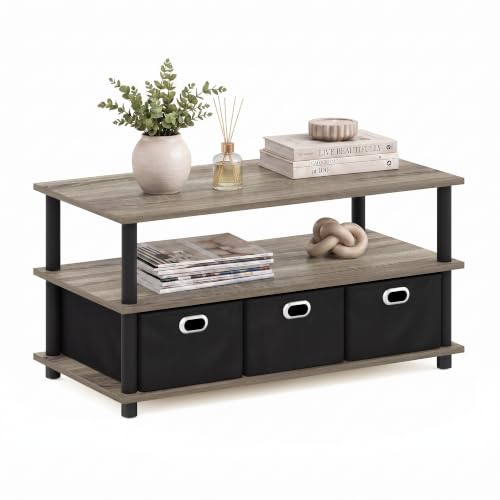
Where to buy
Check the latest price, availability and delivery on Amazon. Orders are placed on Amazon. We may earn a commission from qualifying purchases.
- Best overall for small spaces: Furinno Turn-N-Tube Coffee Table, French Oak Grey — Check on Amazon
- HOOBRO Oval Coffee Table, Rustic Brown and Black — Check on Amazon
- Furinno Jaya Oval Coffee Table with Bin, Walnut — Check on Amazon
- Furinno Modern Simplistic Criss-Cross Coffee Table, Espresso — Check on Amazon
See 2 more Amazon options
- Furinno Simple Design Coffee Table, Espresso — Check on Amazon
- Yaheetech Lift-Top Coffee Table, Espresso, 38.6 inch — Check on Amazon
Read the full guide ↓
Disclosure: As an Amazon Associate, dailyhomedecorating.com earns from qualifying purchases. Links to Amazon on this page are affiliate links; they cost you nothing extra. Listing details such as price and availability change often, so check the current Amazon listing before you buy.
The best coffee table for small spaces under $50 is a study in inches, because a small space — a narrow living room, a compact den, a box room doing duty as a sitting room, the tight end of an open-plan floor — forgives nothing. A table two inches too deep steals the walkway; a table two inches too long crowds the armchairs; a table with square corners in a tight circulation path collects a bruise a week. But small-space buying is not only about shrinking. It is about what the table gives back for the floor it takes: storage that replaces a cabinet the room cannot fit, an open frame that lets light and sightlines through so the room reads bigger, and a shape that turns the room’s tightest corner from a collision point into a passing place. This guide ranks six verified tables by that exchange rate — function returned per square foot surrendered — and it measures everything twice, because in a small space you should too.
Our first recommendation is the Furinno Turn-N-Tube, the joint-smallest footprint here with the cleverest storage: three tiers and three bins in a 31.2 by 15.5-inch outline. The HOOBRO oval follows, its narrow depth and corner-free ends made for tight circulation. The Jaya oval trades a little depth for the strongest storage and capacity story. The Criss-Cross buys visual space with its open X-frame. The Simple Design is the honest maximum — the biggest table a small space can sometimes still take — and the Yaheetech lift-top, flagged throughout as reaching this budget on sale positioning, is the multi-function answer when the small space must also be an office. For every pick, check price on Amazon before you buy; the live listing holds the only current figure for your chosen finish.
In this guide
Quick picks: the best coffee table for small spaces under $50 at a glance
| Pick | Best for | Size (W x D x H) | Small-space virtue | Link |
|---|---|---|---|---|
| Furinno Turn-N-Tube, French Oak Grey | Best overall for small spaces | 31.2 x 15.5 x 15.8 in | Smallest footprint + 3 bins of storage | Check on Amazon |
| HOOBRO Oval Coffee Table, Rustic Brown | Best for tight circulation | 35.4 x 15.7 x 17.3 in | Narrow depth; no corners to collide with | Check on Amazon |
| Furinno Jaya Oval with Bin, Walnut | Best storage per footprint | 35.4 x 19.7 x 16.4 in | Built-in bin; 40 lb maker rating | Check on Amazon |
| Furinno Modern Simplistic Criss-Cross | Best visual lightness | 35.4 x 19.6 x 16 in | Open X-frame lets sightlines through | Check on Amazon |
| Furinno Simple Design, Espresso | Best maximum surface | 35.5 x 21.6 x 15.7 in | Full shelf; biggest top a small room can take | Check on Amazon |
| Yaheetech Lift-Top, Espresso | Best multi-function (sale tier) | 38.6 in long | Desk + dining + storage in one footprint | Check on Amazon |
Two numbers decide most small-space purchases: depth, because it sets the walkway, and storage, because it decides whether the table replaces furniture or merely adds to it. The reviews below keep both numbers in front of you for every pick.
How these picks were chosen
The batch’s standard verification applied first: a real, currently listed coffee table with a confirmable identity; dimensions, materials and maker-stated capacity confirmable from the listing or maker; honest positioning inside the under-$50 tier, with the lift-top labelled as reaching it on sale; and coverage of the forms this lens needs. The small-spaces lens then applied its own three filters. First, a footprint ceiling: nothing over roughly 39 inches long or 22 inches deep, with the leaders near 31 by 16 inches. Second, a return-on-floor test: every pick had to give something back for its footprint — storage volume, circulation kindness, visual lightness or a second function — because a small space cannot afford a table that only holds drinks. Third, proportion range: the shortlist had to span from true-compact to the largest size a small room can absorb, so readers can locate their own room’s ceiling honestly instead of being sold the smallest table by default.
We excluded nesting sets whose price covered one table, glass tops we could not verify, and designs whose storage was decorative. Maker capacity figures are quoted and attributed throughout, because small-space tables get used for dining, work and storage simultaneously — the loads stack up exactly where the room is tightest.
As across the batch, no product prices are printed. Picks are positioned qualitatively in the tier, and each review tells you to check price on Amazon for the live figure in your finish.
The six best coffee tables for small spaces under $50, reviewed
1. Furinno Turn-N-Tube Coffee Table, French Oak Grey — best overall for small spaces
Who it suits. Narrow living rooms, dens and box rooms; anyone whose current table is the room’s main obstacle; renters and movers who value toolless assembly.
The Turn-N-Tube wins this lens on arithmetic: at 31.2 inches long and 15.5 inches deep it occupies roughly two-thirds the floor of a standard coffee table, yet its three-tier layout — described in the listing as two open shelves with three storage bins — stores like a table half again its size. In a small space, vertical storage is the only free storage, and this design is built vertically. The twist-together construction needs no tools, the maker rates the top at up to 20 pounds and the lower shelf at up to 20 pounds, and at about 12.4 pounds the table itself can be lifted aside one-handed when the room needs its floor back for exercise, play or a guest bed. The French Oak Grey finish keeps the small outline visually quiet.
Pros. The smallest footprint with the deepest storage in the guide; genuinely toolless assembly; light enough to clear the floor in seconds; a pale, contemporary finish that does not darken a small room.
Honest limitation. A 31.2-inch top is a drinks-and-books surface: dining for two means trays on laps or a folding side table drafted in, and the 20-pound rating is a ceiling, not a target. The plastic tubes announce the tier at close range, and the table’s lightness means a determined bump can shift it — position the long side toward the sofa.
Choose it if floor space is your scarcest resource and clutter is your second scarcest. Skip it if the table must host full meals or a workstation — the lift-top below exists for that room, and our Best Coffee Table For Small Apartments Under $50 guide covers the apartment version of the same trade-offs.
Check on Amazon — check price on Amazon, and confirm the French Oak Grey/Black colourway is selected.
2. HOOBRO Oval Coffee Table, Rustic Brown and Black — best for tight circulation
Who it suits. Small spaces the household walks through, not just sits in — through-rooms, open-plan ends, and any layout where the table stands between the sofa and everywhere else.
The HOOBRO’s contribution is geometric: an oval 35.4 inches long but only 15.7 inches deep, at 17.3 inches high, so it offers a full-length surface while its missing corners return the passing room that a rectangle would tax. The particleboard top sits on a black metal frame over two open tiers; the maker rates each tier at a maximum static load of 33 pounds; the table weighs 15.4 pounds. In a tight room the open frame matters as much as the outline — sightlines and light pass under the top, so the table occupies the room visually at a discount to its true size.
Pros. Narrow depth with full length; corner-free passing; the best per-tier maker rating among fixed-top picks; open tiers that store without enclosing; the tallest stance for higher sofas in compact rooms.
Honest limitation. Fifteen-point-seven inches of depth is a living surface, not a working one — laptops overhang and dinner trays crowd. The rustic brown finish warms and slightly darkens a room, which the smallest, darkest spaces may not want. It is also the newest listing in the guide.
Choose it if your small space is a thoroughfare. Skip it if you need depth for work and dining — that requirement points to the Simple Design, if your room can take it, or the lift-top if it cannot.
Check on Amazon — check price on Amazon; brand-store sightings position this model well inside the tier, but the live figure governs.
3. Furinno Jaya Oval Coffee Table with Bin, Walnut — best storage per footprint
Who it suits. Small spaces with no spare cupboard: craft and hobby corners, gaming dens, and compact family rooms where the coffee table is also the toy box and the blanket store.
The Jaya asks for a little more floor than the leaders — 35.4 by 19.7 inches at 16.4 inches high — and repays it with the guide’s strongest combination of a built-in storage bin and a maker-stated maximum of 40 pounds, in a 23.2-pound build that stays planted. The oval outline keeps its circulation manners despite the larger footprint, and in a small space the bin is not a nicety: it is the difference between a room that resets in five minutes and a room whose clutter lives permanently on the sofa. The walnut finish adds warmth that small, north-facing rooms in particular tend to lack.
Pros. The most storage-and-capacity per square foot here; corner-free outline; a heavier, planted build; a warm finish for cold-feeling rooms.
Honest limitation. The 19.7-inch depth is a real claim on a tight room — tape it before ordering — and the oval’s usable working area is smaller than the dimensions imply for laptops and trays. The listing’s secondary data is inconsistent on small details, so regard the bin as simple open storage.
Choose it if storage pressure exceeds floor pressure in your small space. Skip it if every inch of walkway is spoken for — the Turn-N-Tube stores nearly as cleverly in two-thirds the depth.
Check on Amazon — check price on Amazon for the Walnut finish. Families in compact rooms will also find its safety case in our Best Coffee Table For Families Under $50 guide.
4. Furinno Modern Simplistic Criss-Cross Coffee Table, Espresso — best visual lightness
Who it suits. Small spaces that feel smaller than they are — low-ceilinged rooms, rooms with one window, rooms where the furniture seems to advance on you — and style-led buyers generally.
The Criss-Cross attacks the feeling of smallness rather than its measurement. Its X-shaped frames open the volume under a 35.4 by 19.6-inch top at 16 inches high, so the eye reads floor through the table and the room’s boundaries stay where the walls put them. A lower shelf carries the storage layer, the maker rates the table at 25 pounds maximum, and it weighs 19 pounds. Paired with a pale rug and a low sofa, it is the pick most likely to make a visitor overestimate the room’s size — a legitimate design outcome, and the one this lens exists to find.
Pros. The most designed silhouette in the guide; negative space that visually enlarges a room; a real lower shelf; classic proportions for a compact three-seater or loveseat.
Honest limitation. Visual lightness is not storage depth: the open frame stores less discreetly than bins or a compartment, and the design has less lateral stiffness if dragged — lift it to move it. The espresso finish shows dust quickly, and in a dark small room it adds shadow rather than contrast.
Choose it if your room’s problem is how it feels, not only how it measures. Skip it if hidden storage is the priority — bins and compartments beat an open shelf for visual calm, as the modern-homes discussion in our Best Coffee Table For Modern Homes Under $50 guide explains.
Check on Amazon — check price on Amazon for the Espresso finish.
5. Furinno Simple Design Coffee Table, Espresso — best maximum surface
Who it suits. The larger end of small: rooms around 10 by 12 feet where a compact table would look lost and the household needs one real surface for meals, games and work.
Small is a spectrum, and the Simple Design marks its honest upper edge: a 35.5 by 21.6-inch top — the widest and deepest in this guide — at 15.7 inches high, with a full lower shelf beneath. If your room passes the tape test at this size, no other pick gives you as much working surface or as much open storage, and the design’s long record at this tier means no surprises. It weighs 18.6 pounds, assembles with cam-locks, and the maker states a maximum of 20 pounds for the top.
Pros. The most surface and shelf per dollar in the guide; classic proportions; a neutral finish that fits rooms furnished from many sources.
Honest limitation. The 21.6-inch depth is exactly what most small spaces cannot spare — this pick is included so you can locate your room’s ceiling, not as a default. If the tape test leaves you under 14 inches of walkway, believe the tape and buy smaller. The 20-pound top rating is also the joint-lowest here.
Choose it if your “small” room is small-ish and surface-hungry. Skip it if the walkway maths fails — and compare the whole field in our base guide to the Best Coffee Table Under $50.
Check on Amazon — check price on Amazon; colourways on the listing are priced separately.
6. Yaheetech Lift-Top Coffee Table, Espresso, 38.6 inch — best multi-function, on sale positioning
Who it suits. Small spaces with two jobs: the den that is also the office, the spare room that is also the guest room, the living room corner where someone works all day without a desk.
Multi-function is the small-space endgame, and the lift-top is its purest form: a 38.6-inch table whose top rises to working and dining height, with a hidden compartment for the laptop, a foldable drawer and an open shelf — three furniture jobs in one footprint. Maker-stated capacities lead the guide: 44 pounds closed, 22 pounds lifted, 33 pounds in the compartment, 40 pounds on the shelf. It reaches this budget on sale positioning rather than as an everyday figure — deal coverage of this lift-top family has sighted it in the tier on sale against a higher list price — and this guide flags that condition wherever the pick appears.
Pros. Replaces a desk for laptop work and dining; hidden storage that keeps a dual-use room looking single-use; the strongest stated capacities here; still within small-space length.
Honest limitation. At about 42 pounds it is the least movable pick by far — in a small space that rearranges often, that weight is a daily tax. Assembly is the longest in the guide, the mechanism needs a rule around small children, and the pick only stands while its sale positioning holds; at its everyday figure it belongs to the tier covered by our Best Coffee Table Under $100 guide.
Choose it if your small space must work two jobs and you catch it on sale. Skip it if the room rearranges weekly or the budget must be an everyday figure.
Check on Amazon — check price on Amazon; this pick is only a pick while the live price sits inside the budget.
Comparison table
| Table | Footprint (in) | Depth | Maker capacity | Gives back | Link |
|---|---|---|---|---|---|
| Furinno Turn-N-Tube | 31.2 x 15.5 | 15.5 in | 20 lb top / 40 lb total | 3 tiers + 3 bins of storage | Check on Amazon |
| HOOBRO Oval | 35.4 x 15.7 | 15.7 in | 33 lb per tier | Corner-free circulation | Check on Amazon |
| Furinno Jaya Oval | 35.4 x 19.7 | 19.7 in | 40 lb max | Bin storage + capacity | Check on Amazon |
| Furinno Criss-Cross | 35.4 x 19.6 | 19.6 in | 25 lb max | Visual lightness | Check on Amazon |
| Furinno Simple Design | 35.5 x 21.6 | 21.6 in | 20 lb top | Maximum surface + shelf | Check on Amazon |
| Yaheetech Lift-Top | 38.6 long | — | 44 lb closed / 22 lb lifted | Desk + dining functions | Check on Amazon |
The depth column is the one to shop by: the shortlist spans 15.5 to 21.6 inches, and in a small space those six inches are not a detail — they are the walkway, the rug border and the difference between a room that flows and a room that negotiates.
How to choose a coffee table for a small space
Measure the room’s leftovers, not the room. What matters is the rectangle of floor remaining after sofa, chairs and media unit are placed. Tape that leftover, then choose a table that leaves 14 to 18 inches of walkway on the traffic side and at least a hand’s width elsewhere. If the leftover cannot host a table with those clearances, the honest answer may be the smallest pick here — or a side-table arrangement instead, and there is no shame in a room that admits it.
Shop depth before length. Length runs parallel to the sofa and is forgiving; depth projects into the room and is not. A 35-inch table at 15.7 inches deep lives smaller than a 31-inch table at 21.6 inches deep — which is why the narrow HOOBRO outranks the wider Simple Design in this lens despite its smaller name.
Demand a return on floor. Every square foot the table takes should repay you: bins or a compartment that retire a storage box, an open frame that returns light and sightline, a lift top that retires a desk. A table that returns nothing but a surface must be small enough to justify itself on surface alone.
Match height to the seat, not the room. Small rooms tempt buyers toward low tables, but the governing number is your sofa’s compressed seat height: within about two inches keeps reaching comfortable. The picks here span 15.7 to 17.3 inches, covering the common range of compact sofas.
Keep the exit easy. Small spaces change function — the den becomes a nursery, the spare room becomes an office. A light, toolless or easily moved table adapts with the room; a 42-pound lift-top commits the room to its current job. Choose the commitment level your next two years actually support.
Common mistakes in small spaces
Scaling by photograph. Compact tables photograph large. The 31.2-inch and 35.5-inch picks in this guide look near-identical in listing images and differ by a quarter of their footprint. Dimensions and the tape test are the only honest scale.
Centring the table and stranding the walkway. In a small room the table often belongs slightly off-centre — closer to the sofa, farther from the traffic path. Symmetry is a large-room luxury; circulation is a small-room necessity.
Buying storage that opens into the room. Drawers and doors need swing and pull space that small rooms may not have on the table’s working side. Open shelves, bins and lift-up compartments — the storage forms in this guide — take their access from above or the front without claiming more floor.
Letting the rug decide badly. A small rug under an oversized table makes both look wrong, and legs straddling the rug’s edge rock. Size the table to sit fully on the rug with a border to spare, or fully off it.
Filling the surface because it is there. In a small room, a covered coffee table reads as a storage unit and shrinks the space visually. One tray, one stack, one object — the rest belongs in the storage you chose the table for.
Final recommendation
For most small spaces, buy the Furinno Turn-N-Tube: it returns the most function per square foot in this guide — three tiers and three bins inside the smallest footprint, light enough to give the floor back whenever the room needs it. If your small space is a thoroughfare, take the HOOBRO Oval and its corner-free narrow profile instead. Measure the leftover floor, tape the outline, walk the route — in a small space, the tape measure is the review that matters most, and every pick here is sized to pass it in the right room.
Small-space layouts: three worked examples
Concretely: in a 9-by-11-foot living room with a 72-inch sofa on the long wall, the Turn-N-Tube or the HOOBRO leaves a genuine walkway to the door while keeping drinks and books in reach — the two layouts that work are the table centred on the sofa with storage bins facing the room, or the oval offset toward the television so the door-side pass stays wide. In a 10-by-12 room with a loveseat and two armchairs, the Jaya or the Criss-Cross anchors the grouping without closing it: the oval suits the armchair arrangement because its ends echo the chairs’ angles, while the X-frame suits a pale, low room that needs visual air. In a dual-purpose den of any size above 8 by 10, the lift-top against the sofa turns the room’s lounge corner into its office corner, and the rest of the floor stays free for the room’s second life. Notice that in every example the table was chosen last, after the seating and the traffic were fixed — in small spaces that order is not a preference but a method, because the table is the only piece whose size can flex by six inches without changing what the room is.
Measuring a small space properly: a short masterclass
Most small-space furniture regrets begin with a measurement that was never taken, so here is the full method this guide assumes, in the order a buyer should perform it. First, place or imagine the seating exactly where it will live, and sit in it: measurements taken standing over an empty room describe a room nobody uses. Second, measure the compressed seat height — sit, then measure from floor to the top of the cushion beside your thigh — because that number, not the showroom figure, chooses the table’s height band. Third, tape the table’s candidate footprint on the floor at the size of the largest pick you are considering, and perform the room’s actual movements for a day: the route to the kitchen, the reach for the door, the path a laundry basket takes, the sweep of the vacuum. Fourth, check the rug: the table’s feet should land fully on or fully off it, with the taped outline showing you which. Fifth, check the vertical: in a small space the table’s height interacts with window sills, radiator tops and the television’s lower edge, and a table two inches too tall can block a sightline the room cannot spare. Buyers who run all five steps rarely return furniture; buyers who skip step three return it within the month, because step three is the one that measures the room as it is lived in rather than as it is drawn.
The method also produces the guide’s most useful negative result: sometimes the taped outline shows that the room’s leftover floor is a shape no rectangle fills well — an L, a wedge, a corridor. Ovals forgive irregular leftovers better than rectangles, which is a geometric reason, beyond fashion, that two of the six picks here are oval. And sometimes the tape shows the leftover is simply too small for any coffee table, in which case the honest purchase is a pair of side tables and this guide has done its job by telling you before the box arrives.
Beyond the living room: small spaces elsewhere in the house
The small-spaces lens reaches further than living rooms, and the same shortlist serves the rest of the house with minor translation. In a compact primary bedroom used as an evening sitting space — a reading chair, a small television, a door that closes on the household — the Turn-N-Tube’s bins hold the chargers and books while its footprint respects the bed’s circulation. In a child’s bedroom that doubles as a playroom, the Jaya’s oval and capacity lead for the reasons the family guide sets out, at a scale a small bedroom can absorb. In a home-office corner or a landing nook, the lift-top converts a chair into a workstation without claiming a desk’s footprint, provided its weight is acceptable on that floor. In a conservatory or sunroom, the HOOBRO’s metal frame tolerates the temperature swings that swell and shrink wooden joints — though no laminate top in this guide should sit in standing sun and weather, and this tier is indoor furniture, full stop. The through-line is the lens itself: measure the leftover, demand a return on floor, and let the tape — not the listing photograph — arbitrate.
The small-space buyer’s pre-purchase checklist
Before any pick in this guide is ordered, run the checklist that small-space experience has written. One: the taped footprint has survived a full day of the room’s real traffic, including its worst hour — the morning rush, the children’s return, the dog’s evening circuit. Two: the compressed seat height of the actual sofa has been measured, and the chosen table’s height sits within about two inches of it. Three: the storage form matches the clutter inventory — you have literally listed the objects the table must store and confirmed they fit the bins, shelf or compartment you are buying. Four: the load honesty check — the household’s real uses, including the unglamorous ones, fit inside the maker’s stated capacity with room to spare. Five: the delivery route has been walked — door, hall, stairs, lift — against the product’s weight, and the answer is one person or two, decided in advance. Six: the rug question is settled — feet fully on or fully off, border to spare. Seven: the exit is imaginable — if the room changes job in a year, the table has a next home, a next room or a next owner. A pick that passes all seven is not merely a good small-space table; it is a purchase the room will never make you regret, which in a small space — where a mistake is visible from every seat, every day — is the only standard worth shopping to.
And a closing observation for the small-space buyer who feels apologetic about the room itself: small spaces are where furniture earns its keep most visibly, and a table chosen by measurement, storage logic and honest load will outperform, in daily satisfaction, a large room’s careless purchase at ten times the price. The constraint is not the enemy of the choice. In this guide’s experience, it is the making of it.
Storage forms in small spaces: bins, shelves and compartments compared
Because storage is the small-space table’s repayment on its footprint, the three forms in this guide deserve a direct comparison. Bins — the Turn-N-Tube’s three, the Jaya’s one — are the fastest storage ever fitted to furniture: objects are dropped, not arranged, which means the system survives tired evenings and children’s tidying. Their cost is visibility and dust: open bins show their contents and gather what the room sheds, so they suit hard small objects — remotes, controllers, chargers, toys — and fail soft, pale ones. Open shelves — the Simple Design’s full shelf, the HOOBRO’s lower tier, the Criss-Cross’s shelf — are the librarian’s form: books, baskets and board games in ordered rows, everything visible at a glance. They repay the most floor per object stored and demand the most discipline, because a shelf’s disorder is on permanent display in a room too small to look away from it. The hidden compartment — the lift-top’s alone — is the vault: laptops, documents, blankets and the valuable or unsightly, invisible until summoned. It repays in calm rather than volume, and it costs the mechanism’s weight and assembly. The small-space buyer’s rule follows directly: inventory your clutter honestly, and buy the form that matches its majority. A room whose clutter is small and hard wants bins; a room whose clutter is books wants a shelf; a room whose clutter is a laptop and a life wants the compartment — and a room with all three wants the pick whose secondary form covers the runner-up, which is why the tiered, binned leader of this guide is so hard to beat in genuinely small spaces.
FAQ
What is the ideal coffee table size for a small living room? For most small rooms, 31 to 36 inches long and 15 to 20 inches deep, leaving 14 to 18 inches of walkway on the traffic side. The tape test on your own floor overrides any general rule — measure the leftover space, not the room’s headline dimensions.
Do oval coffee tables really save space? They save collision space, not floor space: the footprint is similar to a rectangle’s, but the missing corners return passing room exactly where people walk. In through-rooms that trade is worth more than the surface it costs.
How can a coffee table make a small room look bigger? By letting the eye through it: open frames, raised legs, pale finishes and glass-free sightlines under the top all keep the floor visually continuous. The Criss-Cross in this guide is built on exactly that principle.
Is a lift-top a good idea in a small space? When the space has two jobs, yes — it retires a separate desk. When the room rearranges often, its weight argues against it. Judge by your room’s second job, not by the mechanism’s novelty.
How much clearance does a coffee table actually need? Fourteen to eighteen inches between the table and the sofa is the comfortable band for reaching and passing; twelve inches is the workable minimum in a genuinely tight room, and below that the table becomes an obstacle its owners climb around rather than use. On the traffic side, keep the full band if the route is a through-route. The tape test reveals your room’s real numbers in an afternoon, and the shortlist’s depth span — 15.5 to 21.6 inches — exists so that most rooms can find a pick that respects them.
Are two small tables better than one coffee table in a small space? Sometimes. A pair of small tables can split for guests, flank a sofa as side tables, and vacate the centre entirely — a flexibility no single table matches. The costs are surface continuity (no single span for games or a large tray) and a busier visual field. In rooms whose centre must regularly empty — exercise, play, a guest bed — the pair wins; in rooms with a settled seating group, the single table’s calm wins. The picks in this guide start small enough that the single-table answer remains available to most small spaces.
What if no coffee table fits my space? Then the space is telling you the truth: use a pair of small side tables or a narrow console behind the sofa instead. A room without a coffee table beats a room whose coffee table is its main obstacle, and the picks here start small enough that few genuine sitting rooms need to reach that conclusion.
What under $50 buys a small space — the honest summary
The tier’s offer to a small space, stated once and plainly: genuinely compact footprints down to about 31 by 16 inches; storage that repays floor in bins, shelves and a hidden compartment; one true multi-function design that retires a desk; corner-free outlines that return circulation; and open frames that return light. Its asks: light-duty load ratings respected as ceilings, laminate protected by coasters and prompt wipes, and measurements taken before money is spent — the tape test is this tier’s entrance fee. A small space bought for on those terms is not a diminished version of a large room. It is a room where every piece, the coffee table first among them, can explain exactly what it is doing there — and under $50, as this shortlist shows, is enough to make that true.
One final encouragement, earned from every layout this guide worked through: a small space with a correctly chosen coffee table does not feel like a compromise anyone is enduring. It feels deliberate — a room where the walkway flows, the surface serves, the clutter has a home and the eye can rest. That feeling is available at this budget, in these footprints, with these six tables. Measure honestly, choose by your room’s tightest hour, and the smallest room in the house can become the one that works hardest and apologises least.


