Where to buy
Check the latest price, availability and delivery on Amazon. Orders are placed on Amazon. We may earn a commission from qualifying purchases.
- Best overall for small spaces: SIMPLIHOME Amherst Multi-Cube Bookcase, Solid Wood, 44 Inch, Black — Check on Amazon
- Camaflexi Shaker Style 6-Shelf Bookcase, Solid Wood, 72 Inch, Cherry — Check on Amazon
- Sauder Barrister Lane 10-Cubby Bookcase, Scribed Oak — Check on Amazon
- Palace Imports Solid Wood 6-Tier Bookcase, Stackable Modular, 71.5 Inch, Gray — Check on Amazon
- Concepts in Wood 5-Shelf Storage Cabinet Bookcase, 30 x 72 Inch, Cherry — Check on Amazon
- IRONCK Triple Wide 5-Tier Bookshelf, Industrial, 69.3 Inch — Check on Amazon
Read the full guide ↓
Disclosure: As an Amazon Associate, dailyhomedecorating.com earns from qualifying purchases. Links to Amazon on this page are affiliate links; they cost you nothing extra. Listing details such as price and availability change often, so check the current Amazon listing before you buy.
The best bookcase for small spaces under $2000 is chosen by inches, not by taste. In a small space — a box room, a studio corner, a hallway landing, the wall between two doors — every bookcase decision is a trade against floor you walk on, light you cannot spare, and doors that must still swing. A generous budget is unusually powerful here, because the failure mode of small-space storage is cheapness: shallow particleboard that sags, wobbles and looks temporary. At this ceiling you can buy compact footprints in solid wood, slim depths that still take real books, and low formats that slide under windows and stairs.
Three measurements govern everything that follows. Footprint: the floor a case occupies, where a 30-by-13-inch tall case often beats a wide low one — or loses to it, depending on whether your spare area is vertical or horizontal. Depth: 11 to 13 inches is the whole game for books; shallower novelty shelves cannot take a hardcover row, and deeper cases jut into walkways. And visual volume: a closed-back, solid-sided case is a block in the room, while an open grid of the same dimensions is mostly air — in a small space that difference is worth shelves.
Our small-space short answer: the SIMPLIHOME Amherst is the default pick — solid wood, 44 inches tall, on legs that let light, air and a robot vacuum pass beneath, small enough for a corner and good enough to look at all day. The Camaflexi is the vertical answer, six real shelves on a 30-inch footprint. The Sauder cubby case is the horizontal answer for under windows and stairs. The Palace gives a slim 32-inch solid-wood bay that can later join a bigger system; the Concepts cabinet hides a small room’s clutter behind doors; and the IRONCK, at under 12 inches deep, is the shallow grid for the one long wall. For a tighter ceiling the same inch-by-inch logic appears in our Best Bookcase For Small Spaces Under $1000 guide, and open-shelf alternatives are compared in the Best Bookshelf For Small Spaces Under $2000.
In this guide
Quick Picks
In a hurry? This table matches each bookcase to the job it does best in this guide.
| Buyer type | Pick | Why it stands out | Link |
|---|---|---|---|
| Best overall for small spaces | SIMPLIHOME Amherst Multi-Cube Bookcase, Solid Wood, 44 Inch, Black | Solid wood cube case on tapered legs, just 44 inches tall | Check on Amazon |
| Best tall and narrow | Camaflexi Shaker Style 6-Shelf Bookcase, Solid Wood, 72 Inch, Cherry | Solid pine, real depth, adjustable plus fixed shelves | Check on Amazon |
| Best low and wide | Sauder Barrister Lane 10-Cubby Bookcase, Scribed Oak | Ten cubbies plus a display top in a low, wide case | Check on Amazon |
| Best slim solid wood | Palace Imports Solid Wood 6-Tier Bookcase, Stackable Modular, 71.5 Inch, Gray | Solid wood modular system that grows into a wall | Check on Amazon |
| Best hidden storage | Concepts in Wood 5-Shelf Storage Cabinet Bookcase, 30 x 72 Inch, Cherry | Five shelves hidden behind doors — calm and dust-free | Check on Amazon |
| Best shallow wall grid | IRONCK Triple Wide 5-Tier Bookshelf, Industrial, 69.3 Inch | Fourteen open sections across nearly 70 inches | Check on Amazon |
How These Picks Were Chosen
Small-space screening began with a tape measure. Any pick whose depth could not take a standard hardcover row was cut, however pretty; any pick that needed a wide wall to make sense had to justify itself as a low format. We then weighted visual lightness — open frames, legs, pale finishes — because in small rooms a case is judged by how much room is left after it arrives. Stability was assessed per format: tall picks needed closed backs, bracing shelves and anchor provision; low picks needed the inherent stability of a wide, low stance.
As with every guide in this series, the paper trail was checked pick by pick: dimensions, depths, shelf counts and materials verified against manufacturer and retailer listings, with the sources recorded in the notes published alongside this guide. No static prices are printed, because furniture pricing moves constantly and a stale figure helps no one; each pick links to its live Amazon listing, where you check the current price and the exact dimensions of the finish variant you are ordering — on a purchase decided by inches, confirm the listing’s numbers against your wall one final time before you buy.
One screening rule was unique to this guide: the two-foot rule. Every pick had to remain fully usable — doors openable, shelves loadable, bins removable — with no more than the space in front of it that a small room can actually spare, and had to be cleanable without moving it, because in a small space a case that cannot be cleaned around becomes a permanent dust farm. Legs, closed backs and shallow depths all scored under this rule, which is why the legged Amherst leads the list and why every depth in this guide is stated to the fraction.
The 6 Best Bookcases for Small Spaces Under $2000
SIMPLIHOME Amherst Multi-Cube Bookcase, Solid Wood, 44 Inch, Black
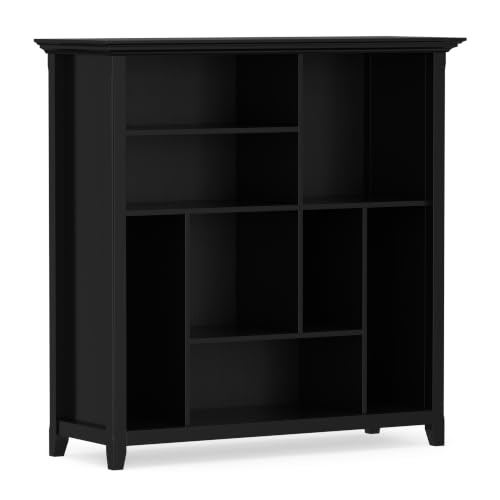
The SIMPLIHOME Amherst Multi-Cube Bookcase is the compact solid-wood option in this guide, and its proportions are its argument. At 44 inches tall it stands on tapered legs like a piece of mid-century furniture rather than a storage tower, and its cube compartments are sized for the way living rooms actually accumulate things: a stack of coffee-table books here, a basket there, a speaker, a plant, a row of novels. SIMPLIHOME builds the Amherst line from solid wood, so despite its smaller footprint it has the material honesty of the big Camaflexi and Palace cases rather than the laminate panels of most compact organizers.
The raised, legged design earns its keep in real rooms. Air circulates underneath, a robot vacuum can pass below, and the piece can sit over a floor register or against a wall with baseboard heating without the trapped-dust gap a plinth base creates. The black finish and clean transitional lines make it the easiest pick here to drop into a modern scheme, and at 44 inches it slides under most windowsills and below wall-mounted art without competing with it. Fixed cube shelves keep the structure rigid — there is nothing to wobble out of adjustment — and the whole unit is light enough for one person to reposition when a room gets rearranged.
Capacity is the obvious trade. This is a bookcase for a curated shelf or two, not a library; a household with hundreds of books will fill it in an afternoon. The fixed cubes share the cubby limitation of the Sauder — very tall books must lie flat in a stack rather than stand — and the open compartments offer no dust protection. Treat it as the quality compact anchor in a room, possibly one of a pair, rather than a whole storage plan.
Who it suits: the corner, the bedside wall, the space beside a desk — anywhere a low, handsome, solid-wood piece can hold a working shelf of books. Choose it if your small space needs quality at furniture scale. Skip it if the space must store an archive; it is a jewel box, not a warehouse.
What we like:
- Solid wood construction in a compact, legged furniture format
- 44-inch height fits under windows and art; robot-vacuum-friendly clearance
- Black transitional styling drops straight into modern schemes
- Light enough to move and rearrange single-handed
Honest limitation: The smallest capacity in this guide by a wide margin — a curated display piece, not a library — and fixed cubes force oversized books to lie flat.
Camaflexi Shaker Style 6-Shelf Bookcase, Solid Wood, 72 Inch, Cherry
The Camaflexi Shaker Style 6-Shelf Bookcase is the pick that most clearly shows what a generous ceiling buys you in this category: real wood. The whole frame is solid pine sourced from renewable plantations, not a veneer over particleboard, and that changes how the piece ages. Edges can be sanded, dings can be touched up, and the shelves do not have the hollow, drummy feel of flat-pack panels when you slide a heavy row of hardcovers onto them. At 72 inches tall and 30 inches wide it is a classic single-bay library case, and the 13-inch depth is deeper than the 11- to 12-inch shelves on most budget cases, so art books, binders and storage boxes sit fully supported instead of overhanging the front edge.
Six shelves divide the height, four of them adjustable on pegs and two fixed for structural rigidity. That mix matters more than it sounds. The fixed shelves brace the case so it stays square, while the adjustable ones let you set a tall opening for atlases or vinyl at the bottom and tighter rows for paperbacks above. The back is fully closed rather than open or a thin dust panel, which keeps books from being pushed through, stops the case racking side to side, and gives the whole unit a finished, furniture-like feel from the front. A wall-mounted anti-tip kit is included in the box, and on a case this tall you should treat fitting it as part of assembly, not an optional extra.
The Shaker styling is deliberately plain: flat rails, square posts, no applied ornament. In cherry finish it reads traditional, but the same plainness is why it survives style changes — it is a background piece that lets the books be the decoration. Assembly is a real job rather than a ten-minute task; solid pine panels are heavier than particleboard, and you will want a second person for standing the case up and for the wall anchor step.
Who it suits: the narrow vertical bay — between a door and a window, at the end of a hallway — where floor is scarce but height is free. Choose it if six deep shelves on 30 inches of width solve your problem. Skip it if the ceiling is low or sloped; measure the top clearance and the stand-up pivot first.
What we like:
- Solid pine throughout — repairable, sandable, no veneer to chip through
- Four adjustable shelves plus two fixed bracing shelves
- Closed back adds rigidity and keeps books from pushing through
- Anti-tip kit included, and the 13-inch depth swallows art books and binders
Honest limitation: Solid pine is a softwood: it is far tougher than particleboard, but a dropped hardcover corner or a dragged metal bookend will mark it in a way hardwood would shrug off, and the 30-inch width means serious libraries will need two units side by side.
Sauder Barrister Lane 10-Cubby Bookcase, Scribed Oak
The Sauder Barrister Lane 10-Cubby Bookcase turns the bookcase on its side. Instead of a tall tower it is a low, wide credenza of storage: 53.15 inches across, just 47.52 inches tall, divided into ten cubbyholes. That format solves problems the tall cases cannot. The top surface becomes a gallery ledge at standing eye level for framed photos, plants and a lamp. The cubbies swallow fabric bins, board games, vinyl records, photo boxes and the family clutter that never fits gracefully on open book shelves. Sauder even includes ID label tags for the cubbies, a small admission that this piece is really an organizing system.
Because it is low, it fits where tall cases cannot go: under a window, beneath a wall-mounted television, along a half-wall in an open-plan space, or at the foot of a staircase wall. It is also the most inherently stable format in this guide — a wide, low case with its weight spread across 53 inches of floor is far less tip-prone than a 72-inch tower, though anchoring is still good practice where children climb. The Scribed Oak finish gives the engineered-wood panels a planked, cottage character that hides everyday scuffs better than a flat gloss would.
The honest limitations follow from the format. Cubbies are fixed, so a tall atlas or an oversized coffee-table book may fit in none of them; measure your largest items against the cubby openings before you buy. Engineered wood with a laminate finish cannot be refinished if it is damaged, and a low case gives you display and organizing capacity rather than maximum book linear footage — a serious library still needs a tall case or two beside it.
Who it suits: under the window, under the stairs, along the low wall a tall case cannot use. Choose it if your small space’s spare area is horizontal and your storage is bins and games as much as books. Skip it if floor width is your scarcest resource; at 53 inches it spends width to save height.
What we like:
- Ten cubbies organize bins, games, records and clutter that open shelves handle badly
- Low 47.5-inch height fits under windows and TVs; top doubles as a display ledge
- Wide, low stance is inherently stable; ID label tags included
- Scribed Oak cottage finish hides scuffs and suits relaxed interiors
Honest limitation: Fixed cubbies cannot adapt to oversized books, and engineered wood cannot be sanded or refinished — it is an organizer first and a bookcase second.
Palace Imports Solid Wood 6-Tier Bookcase, Stackable Modular, 71.5 Inch, Gray
The Palace Imports Solid Wood 6-Tier Bookcase comes from a maker that builds exclusively from solid wood, and it shows in the details. The frame is 100 percent Brazilian pine, kiln-dried and made in Brazil, with no MDF or particleboard anywhere in the structure. At 32 inches wide and 71.5 inches tall it gives you a slightly wider bay than the standard 30-inch case, and the six tiers — four of them adjustable — are deep, square-edged shelves that suit a mix of books and display pieces.
What really separates this case from the others here is that it belongs to a modular system. The unit is designed to stack and to combine with matching pieces from the same line, including versions with doors and drawer organizers, so a single case today can become a two- or three-case wall later without a style mismatch. For anyone furnishing gradually, or who knows a collection will keep growing, that expandability is worth more than a slightly lower price on a dead-end design. The gray finish on this version is the contemporary option in the range: it lightens the visual weight of a tall case and sits comfortably next to the painted cabinetry and pale upholstery common in newer interiors.
Because the wood is solid, the case carries weight the way furniture used to: shelves can be loaded with full rows of books rather than a decorative scattering. The trade-offs are the honest ones that come with any real-wood flat-pack — assembly takes care and time, pine can arrive with visible grain variation and the occasional knot, and the finish is a painted surface that should be treated like painted furniture, not knocked about with metal storage bins.
Who it suits: the small room in a home you are staying in — a slim solid-wood bay today that can join a full system when a bigger room arrives. Choose it if you are buying once, for the long term. Skip it if a gray painted finish clashes with a warm, dark small room; in low light it can read cold.
What we like:
- 100% solid Brazilian pine — no MDF or particleboard in the frame
- Modular and stackable: grows into a wall system with matching door and drawer units
- Slightly wider 32-inch bay with four adjustable shelves
- Gray finish lightens a tall case for contemporary rooms
Honest limitation: As a painted solid-wood piece it asks for gentler handling than a laminate case — metal bins and dragged objects can scuff the finish — and grain and knot variation between units means a later add-on may not match an earlier one perfectly.
Concepts in Wood 5-Shelf Storage Cabinet Bookcase, 30 x 72 Inch, Cherry
The Concepts in Wood 5-Shelf Storage Cabinet is the only pick in this guide that hides its contents, and for many rooms that is the entire point. Behind its doors are five shelves in a 30-inch-wide, 72-inch-tall cabinet, so the visual result in the room is a calm, closed piece of furniture rather than a wall of spines, board games, photo albums and charging cables. Concepts in Wood builds its cases with wood construction and solid wood trim rather than the paper-laminate panels of the cheapest cabinets, and the cherry finish gives it the warm, traditional presence of a pantry or library cabinet.
Closed storage changes how a bookcase gets used day to day. Dust settles on the top of the cabinet instead of on every book. Visual clutter disappears behind doors, which matters in open-plan rooms where the living area is also the office, the playroom and the guest room. Inside, adjustable shelving lets you divide the cabinet between tall items below — board games, binders, a printer paper stash — and ordinary book rows above. It is equally at home as a kitchen or laundry cabinet, which is a useful second life for a piece bought for a living room today.
The compromises are built into the concept. Doors mean you cannot see or grab a book without opening the cabinet, so it suits reference collections, archives and clutter better than the books you read nightly. A closed cabinet this tall also concentrates its visual weight; it reads as a solid block of furniture and needs a little breathing room around it. And like every tall case in this guide, it must be anchored to the wall — a loaded, door-fronted cabinet is exactly the profile anti-tip guidance was written for.
Who it suits: the small room that must look calm — a studio sleeping area, a tiny home office — where open shelves would shout. Choose it if hiding everything is the brief. Skip it if the room is very small and the case would stand close to seating; a solid block at arm’s length can feel like a wall advancing.
What we like:
- Doors hide clutter and keep dust off books and stored items
- Five shelves in a standard 30-inch bay — easy to place and to pair
- Wood construction with solid wood trim, warm cherry finish
- Works beyond the living room: pantry, laundry or office storage in a second life
Honest limitation: Closed doors add a step between you and your books, so it is the wrong pick for a reading chair’s everyday library, and the solid, blocky front needs visual breathing room in a small room.
IRONCK Triple Wide 5-Tier Bookshelf, Industrial, 69.3 Inch
The IRONCK Triple Wide 5-Tier Bookshelf answers a different question from the traditional cases above: not “how do I store books beautifully in one bay?” but “how do I fill a whole wall?” It stretches 69.3 inches wide — more than double a standard bookcase — and divides that width into three columns and five tiers, giving fourteen open sections to arrange. At 69.3 inches tall it stops short of the ceiling-hugging height of the 72-inch cases, which makes the top shelf reachable without a step stool for most adults.
Construction is a powder-coated metal frame with P2-grade MDF boards, and the maker rates each shelf at up to 66 pounds, which is a serious figure for an open etagere and enough for full rows of hardcovers on the lower tiers. Each shelf carries a low front baffle — a raised lip that stops books, boxes and ornaments from sliding off the front edge, a small detail you appreciate the first time you bump the frame while vacuuming. The open sides and back keep the piece visually light for its size; a solid case this wide would dominate a room, while the IRONCK reads as a grid you see through as much as at.
Be clear-eyed about the materials, because this is the one pick here that is not solid wood. MDF boards in a steel frame are strong in compression and perfectly serviceable for books, but they will not take refinishing, they dislike standing water from overwatered plants, and the industrial look — black frame, wood-tone boards — commits your room to a direction. Within that direction, though, nothing else in this guide gives you this much organized wall per purchase, and the flat-pack delivery is far easier to get up stairs and through doorways than a one-piece wide case would be.
Who it suits: the long shallow wall — a hallway wide enough to furnish, a studio’s full-length side — where 11.8 inches of depth is all the room can give. Choose it if you need many sections without visual mass. Skip it if your books are deep art volumes; the shallow shelves will not take them upright and flat stacks waste the grid.
What we like:
- Nearly 70 inches of width and fourteen sections in a single unit
- Maker-rated 66 lb per shelf — genuinely book-capable for an open etagere
- Front baffles stop books and decor sliding off the shelf edges
- Open frame stays visually light despite the size; flat-pack is stair-friendly
Honest limitation: MDF boards cannot be refinished and must be kept dry, and at 11.8 inches deep the shelves are shallower than the solid-wood cases here — oversized art books and deep storage boxes will overhang.
Comparison Table
| Pick | Dimensions | Material | Shelves | Standout feature |
|---|---|---|---|---|
| SIMPLIHOME Amherst Multi-Cube Bookcase, Solid Wood, 44 Inch, Black | 44″H multi-cube | Solid wood | Fixed cube shelves | Low cube organizer format |
| Camaflexi Shaker Style 6-Shelf Bookcase, Solid Wood, 72 Inch, Cherry | 30″W x 13″D x 72″H | 100% solid pine | 6 (4 adjustable, 2 fixed) | Deep shelves; anti-tip kit included |
| Sauder Barrister Lane 10-Cubby Bookcase, Scribed Oak | 53.15″W x 12.13″D x 47.52″H | Engineered wood, Scribed Oak finish | 10 cubbyholes | Gallery display top; ID label tags; model 414724 |
| Palace Imports Solid Wood 6-Tier Bookcase, Stackable Modular, 71.5 Inch, Gray | 32″W x 71.5″H | 100% solid Brazilian pine | 6 (4 adjustable) | Part of a modular system; made in Brazil |
| Concepts in Wood 5-Shelf Storage Cabinet Bookcase, 30 x 72 Inch, Cherry | 30″W x 72″H | Wood construction, cherry finish | 5, behind doors | Concealed storage; model KT613B-3072-C |
| IRONCK Triple Wide 5-Tier Bookshelf, Industrial, 69.3 Inch | 69.3″W x 11.8″D x 69.3″H | Metal frame, P2-grade MDF boards | 14 open sections, 5 tiers | 66 lb per shelf (maker rating) |
How to Choose
Measure a small space like a surveyor. Record the wall’s width between obstructions, the height to the lowest ceiling feature, and the depth available before the case would cross a walkway line — as a rule, keep 30 inches of clear passage in front of any case you will load daily. Note door swings and radiator positions; a bookcase that blocks a swing or cooks against a radiator fails regardless of its dimensions on paper. Photograph the space with a tape measure in frame; it will save you from optimistic memory at the product page.
Then choose the direction of your spare space. Vertical spare space — a tall blank bay — argues for the Camaflexi or Palace. Horizontal spare space — a low wall, a window run — argues for the Sauder or Amherst. A shallow-but-long wall argues for the IRONCK. Match depth to your deepest regular item: paperbacks live happily at 11 inches, hardcovers want 12, and binders, boxes and art books want the Camaflexi’s 13. Buying depth you do not need wastes the room; buying less than your books need wastes the case.
Making a Small Space Feel Bigger With the Right Case
A bookcase can return space as well as take it. Legs are the first trick: the Amherst’s raised stance lets the floor line run unbroken beneath it, and the eye reads the room as its full size. Open frames are the second: the IRONCK’s grid is mostly air, so a wall of storage does not become a wall of furniture. Pale or room-toned finishes are the third — the Palace’s gray recedes where a dark tower would advance. And a clear top is the fourth: the moment a small room’s bookcase grows a skyline of boxes, the ceiling feels lower.
Loading style matters at this scale too. Keep the heaviest visual density — full book rows, dark bindings, storage boxes — on the lowest shelves, and let the top shelves hold fewer, lighter things. It is the shelving version of a horizon line: weight low, air high, and the room breathes. In the smallest spaces, consider the discipline of the Concepts cabinet for the working clutter and one small open case for the books that deserve to be seen; two right-sized pieces will always beat one case straining to be both.
Corners, Alcoves and Other Found Spaces
Small homes hide storage space in geometry most people walk past. The alcove beside a chimney breast is typically 30 to 36 inches wide — exactly one standard bookcase bay, and the Camaflexi or the Palace will fill it like a built-in for the price of a freestanding case. The wall at the turn of a staircase, the landing wide enough for a low case, the dead rectangle behind a door that opens against the adjacent wall: each of these is a bookcase site once you start measuring with intent rather than furnishing by room name.
Corners deserve a special note, because the instinct is to buy a corner unit and the reality is that two small straight cases usually beat one. A corner case wastes its deep apex on objects you cannot reach, while an Amherst on one wall and a low case on the other leave the corner itself for a plant or a lamp — and both cases remain standard, movable furniture when the room changes. The exception is the genuinely tiny room where the corner is the only site; there, a single compact cube case angled or squared into the corner is the honest solution, and capacity expectations should be set accordingly.
Found spaces come with found constraints. Alcoves collect dust and sit over heating pipes; landings are bump zones where anchoring matters most; the wall behind a door exists only when the door is closed, and the case must be shallower than the door’s clearance from the wall — measure it with the door open at ninety degrees, not from the floor plan. None of these constraints is a reason to skip the space. They are the specification sheet for choosing which of this guide’s six formats belongs there.
The reward for this surveyor’s work is disproportionate. A small home with a bookcase in its alcove, a low case on its landing and cubes by its desk stops feeling like a place where storage is a problem and starts feeling like a place that was planned. That feeling — not the shelf count — is what an under-$2000 budget buys in a small space, and it is available in almost every home once the tape measure comes out.
Fitting Day: From Tape Outline to Loaded Shelf
Begin with the tape outline you made while measuring — footprint on the floor, height line on the wall — and keep it in place until the case is standing. Small-space fitting errors are almost never about the case; they are about the obstruction nobody re-checked: the skirting board that adds half an inch of depth, the socket exactly where a leg lands, the door that opens six inches further than memory said. The tape makes all of it visible while the mistake is still free.
Assemble in the largest available space, but finish in position. Small cases like the Amherst and the Sauder can be carried in whole; tall slim cases should be assembled lying down in the room, stood with the pivot you measured, and walked the last inches into their bay rather than dragged — dragging shifts level, marks floors and, in a tight bay, takes paint off the wall you were trying to keep. Shim for level before anchoring; a case shimmed after anchoring strains its own strap.
Load in the small-space order: anchor, then the bottom shelf fully, then upward, heaviest and darkest low. Stop halfway and sit in the room’s main seat to judge the visual weight — in a small space you are composing from that chair, not from the doorway, and a top shelf that looked fine standing may loom from sitting height. Adjust while the case is half-loaded; it will never be easier than it is at that moment.
Finish with the maintenance reality of tight quarters. Leave the gap behind the case exactly as planned for air, confirm you can reach the anchor and the back of the lowest shelf with a duster, and photograph the finished bay for your records. In a small home, every later rearrangement starts from knowing precisely what fit and why — and the photograph, unlike memory, does not round the inches in your favour.
Common Buying Mistakes
Buying by width and forgetting depth. In small spaces depth is the dimension that collides with walkways and door swings. A 13-inch case in an 11-inch plan is a bruised hip waiting to happen — check depth against your passage, not just your wall.
Choosing a case that fills the wall exactly. A case with no clearance reads as a blockage and cannot be leveled or cleaned around. Leave a few inches at the sides; the room will feel larger and the case will look chosen rather than wedged.
Storing heavy and dark at the top. Top-heavy loading is both a stability risk and a visual one. Heavy rows low, light objects high — the room feels calmer and the case is safer.
Ignoring the door swing. The classic small-space failure: a case that fits the wall perfectly and is struck by the door every day. Tape the swing arc on the floor before you order.
Skipping the anchor because the room is small. Small rooms mean closer contact, more bumps, and furniture used as handholds. Tall cases get anchored in small spaces most of all.
Final Recommendation
Start with the Amherst if your small space needs one good piece; start with the Camaflexi if it needs one serious bookcase. The Sauder owns the low walls, the IRONCK the shallow long one, the Concepts the room that must stay calm, and the Palace the small room with a long future. Every one of them was chosen to give a small space furniture it does not have to apologize for — solid, stable and sized by the inch.
Final checks before ordering: photograph your measurements, tape the footprint on the floor, confirm the live listing’s dimensions for your finish, and plan the anchor. In a small space there is no such thing as a minor dimension error — but with the tape work done, an under-$2000 case is the rare purchase that makes a small room feel both bigger and better furnished at once.
Small spaces reward decisiveness. The tape measure has told you which format fits; the only remaining question is whether you will buy it at the level the space deserves. A small room shows its furniture at close range, all day, every day — flaws cannot hide at the back of a big room here. That is why this guide insists on solid wood, real depth and honest construction for the smallest rooms of all: in a small space, the bookcase is not in the room, it practically is the room. Buy the one you will be glad to look at from three feet away, and the inches will take care of themselves.
And keep the measurements you made. Small-space households rearrange and move more often than most, and a notebook page with the bay’s width, depth, ceiling and pivot figures is a permanent asset: the next case, the next room and the next home all get furnished faster because this purchase taught you your own numbers. That, in the end, is the skill small-space living builds — not squeezing, but knowing exactly what fits, and refusing everything that does not.
Start with the top pick — Check on Amazon — or the runner-up format, the Check on Amazon.
Frequently Asked Questions
What is the best bookcase size for a small space?
It depends on the direction of your spare space: a 30-inch-wide tall case for a vertical bay, a low case under 48 inches for a window wall, or a shallow grid under 12 inches deep for a long wall. The constant is depth discipline — 11 to 13 inches is all books need, and every extra inch is taken from your floor.
Are tall bookcases a bad idea in small rooms?
No — height is free storage in a small room, and a slim tall case like the Camaflexi often stores more per square foot than any low unit. The conditions are anchoring, low heavy loading, and checking the stand-up pivot and ceiling clearance before delivery.
How do I make a bookcase feel less bulky in a tiny room?
Choose legs or an open frame, a pale or room-toned finish, and keep the top clear. Load heavy and dark low, light and sparse high. If the room still feels crowded, move the clutter behind doors — that is the Concepts cabinet’s whole argument.
What depth do small-space bookcases need for real books?
Eleven inches is the floor for mixed paperbacks and hardcovers; twelve is comfortable; thirteen — the Camaflexi — takes binders and art books. Below eleven inches you are buying a display shelf, not a bookcase, whatever the listing calls it.
Can a bookcase work in a hallway?
Yes, if the depth keeps a clear passage — the IRONCK’s 11.8-inch grid is the hallway pick here — and if the case is anchored, because hallways are bump zones. Keep everyday items on the shelves you pass and archives at the ends.
Should I buy one medium case or two small ones for a small space?
Two small ones, placed where the room offers two fragments of wall, usually beat one medium case hunting for a wall that does not exist. A pair of Amherst cubes or an Amherst plus a low Sauder follows the room’s actual geometry instead of fighting it.
Is a corner bookcase worth it for a small space?
Usually two small straight cases outperform one corner unit: the corner’s deep apex is hard to reach and wastes volume, while standard cases stay movable and useful in the next room. A corner unit earns its place only when the corner is literally the only available site.
How much clearance does a bookcase need in front of it?
About 30 inches of clear passage for a case you load daily, and enough for cabinet doors to open fully plus your own standing room for the Concepts. In tighter spots, choose open or cubby formats whose contents slide out rather than swing out.
My space is between standard sizes — what do I do?
Buy down, not up. A case an inch narrower than the bay can be centred, shimmed and styled to look built-in; a case an inch too wide is a return. If the gap offends you, a matching storage box or a plant fills it better than a forced fit ever will.