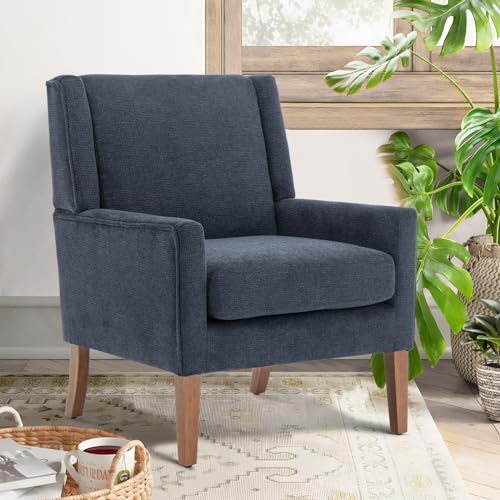
Where to buy
Check the latest price, availability and delivery on Amazon. Orders are placed on Amazon. We may earn a commission from qualifying purchases.
- Best overall for small spaces: COLAMY Wingback Accent Chair, Model 2237 — Check on Amazon
- Karl home Nursery Rocking Chair (KHRC2432) — Check on Amazon
- Yaheetech Mid-Century Accent Armchair, Linen-Look Fabric, Beige — Check on Amazon
- Yaheetech Bouclé Accent Chair with Ottoman, Ivory — Check on Amazon
- Yaheetech Velvet Barrel Chairs, Set of 2, Blue — Check on Amazon
- CHITA Swivel Barrel Chair, Faux Leather, Stone Grey — Check on Amazon
Read the full guide ↓
Disclosure: As an Amazon Associate, dailyhomedecorating.com earns from qualifying purchases. Links to Amazon on this page are affiliate links; they cost you nothing extra. Listing details such as price and availability change often, so check the current Amazon listing before you buy.
The best armchair for small spaces under $400 is a measurement before it is a style. Small spaces — the box room, the bedsit, the narrow end of a living room, the corner that is not quite a place — punish furniture that was chosen from photographs. They reward chairs with published dimensions, raised legs that show the floor, and shapes that use corners instead of fighting them. They also reward honesty: a chair that claims to be ‘compact’ without printing a single number is asking you to gamble a return on its word.
This guide is built on verified numbers. Every pick is a real chair sold on Amazon within the under-$400 ceiling, and the lead pick publishes the most useful small-space specification in the roundup: the COLAMY Wingback at 28.74 inches wide and 28.94 inches deep, under six square feet of floor for a full wingback with a 300 lb rating. We print no prices — they change constantly, so check price on Amazon — and no ratings, because a small space is measured in inches, not stars.
The short answer: the COLAMY is the default for genuinely small spaces. The Karl home nursery rocker colonises the wasted corner, the Yaheetech linen chair minimises visual weight, the bouclé chair-and-ottoman reconfigures around the day, and the velvet pair solves the guest problem by splitting across rooms. The CHITA swivel closes the list for awkward, open small spaces that need a chair to turn rather than travel.
In this guide
Quick Picks
In a hurry? This table matches each chair to the job it does best.
| Buyer type | Pick | Why it stands out | Link |
|---|---|---|---|
| Best overall for small spaces | COLAMY Wingback 2237 | Verified compact footprint for a full wingback — under 29 inches wide | Check on Amazon |
| Best for a tight corner | Karl home Nursery Rocking Chair | Purpose-built for nursery use — smooth, quiet rocking brief | Check on Amazon |
| Best for visual lightness | Yaheetech Linen Mid-Century Armchair | Linen-look texture reads tailored rather than budget | Check on Amazon |
| Best two-piece for flexible spaces | Yaheetech Bouclé Chair with Ottoman | Matching ottoman included — a true feet-up lounge setup | Check on Amazon |
| Best way to seat two in a small space | Yaheetech Velvet Barrel Chairs (Set of 2) | Two matched chairs inside one under-$400 budget | Check on Amazon |
| Best where the chair must turn | CHITA Swivel Barrel Chair | 360-degree swivel — one chair serves several directions | Check on Amazon |
How These Picks Were Chosen
Verified dimensions were the entry ticket. A pick had to publish real overall measurements in its Amazon listing data, and those measurements had to be defensible for a small space — or, like the swivel, the chair had to offer a function that repays its footprint. ‘Compact’ as an adjective earned nothing; compact as a number earned a review.
We then balanced the six slots across the small space’s real situations: the tiny floor plan, the dead corner, the visually cramped room, the flexible one-room life, the guest problem, and the awkward-shaped space. One chair cannot solve all six, and a guide that pretended otherwise would be selling, not advising.
Substance was not sacrificed to size. The picks include a solid-wood 300 lb wingback and chairs from makers with defined model lines, because small-space furniture gets moved, bumped and re-purposed more than any other kind. Light in footprint, yes; flimsy, never — and where a pick asks a discipline of its owner, the review says so.
Best armchair for small spaces under $400
Six chairs, six different answers to the same budget. Each review states who the chair suits, the verified details that matter, its honest limitation, and a plain choose-or-skip verdict.
COLAMY Wingback Accent Chair, Model 2237
Best overall for small spaces. Small-space buying is a verified-numbers discipline, and the COLAMY publishes the numbers that win: 28.74 inches wide, 28.94 inches deep, 36.22 inches high — a true wingback, with wings, a 300 lb rating and a solid wood frame, in a footprint under six square feet. Many chairs marketed for small spaces publish no dimensions at all; this one publishes compact ones. The 19.29-inch seat height completes the case: in a small space every chair is also a spare dining seat and an occasional desk seat, and this is the height that does all three jobs.
The verified numbers first: this chair measures 28.94 inches deep, 28.74 inches wide and 36.22 inches high, with a seat 21.65 inches wide and 19.88 inches deep at a seat height of 19.29 inches. COLAMY rates it to 300 lb. The frame is solid wood and the tapered legs are rubberwood, a genuine hardwood that is noticeably denser than the pine or plastic feet common on chairs at the accessible end of the market. The wingback shape is the oldest in this guide, updated here with a cleaner, mid-century-leaning line: a high winged back, a thick padded seat and curved, padded arms.
In daily use, the wingback’s virtues compound quietly. The upright back supports a full evening’s reading without the slump a deep lounge chair induces, the wings block the draught from a hallway door in winter, and the seat height means standing up mid-chapter to answer the door is a non-event. It is also the chair guests choose when they want to talk rather than sprawl, which makes it the natural second seat in a conversation pair. Care is simple: vacuum the fabric weekly, brush crumbs out of the seat seam, and let the rubberwood legs do their work on felt pads if your floor is wood.
- Verified compact footprint for a full wingback — under 29 inches wide
- 19.29-inch seat height is easy to stand up from
- Solid wood frame and rubberwood legs at a 300 lb rating
- Wings make a corner feel sheltered for reading
Honest limitation: The seat is 19.88 inches deep, which is a lounge seat rather than a perch: shorter sitters may want a small cushion behind the lower back so their feet rest flat, and the fixed wings mean it will never feel as open or sprawling as a barrel chair.
The verdict. Choose the COLAMY Wingback 2237 if the strengths above match your room and your household; skip it if its honest limitation is the one thing your space cannot accept. Check on Amazon
Karl home Nursery Rocking Chair (KHRC2432)
Best for a tight corner. Corners are the small space’s wasted asset, and a nursery-designed rocker like Karl home’s KHRC2432 is built for exactly that geometry: nursery rooms are small rooms, and this chair was designed to rock inside one. Tucked into a bedroom or living-room corner it creates a seat where the floor plan said none existed — for feeding, reading or simply sitting somewhere that is not the bed or the sofa. Its one spatial demand is honesty about the runway: the floor in front of and behind the runners must stay clear, which in a small space means that strip is sacred, not storage.
Karl home’s model KHRC2432 is a rocking chair designed for the nursery, and nursery design is a stricter brief than living-room design: the chair must rock smoothly and quietly at 3 a.m., support a feeding parent for long sessions, and fit rooms that are usually the smallest in the house. A purpose-built nursery rocker answers that brief directly rather than adapting a living-room chair to it, and when the night feeds end, the same chair moves to a bedroom corner or reading spot and keeps working.
Nursery furniture is judged at 3 a.m., and that is where a purpose-built rocker earns its price: the rock is there when you sit down half-asleep, the chair supports a feeding parent through the long session, and the whole thing fits the small room the nursery usually is. By day it becomes the room’s reading chair, and after the baby years it emigrates — to a bedroom, a landing, a grandparent’s corner — still rocking, still useful. Keep the runners’ path clear, give it a rug on hard floors, and it will serve three chapters of family life without complaint.
- Purpose-built for nursery use — smooth, quiet rocking brief
- Designed for long feeding and settling sessions
- Fits the small rooms nurseries usually occupy
- Defined model (KHRC2432) in Karl home’s line
Honest limitation: It is a specialist: the nursery-first design means a living room wanting a tailored, formal accent chair should choose the wingback or mid-century picks instead, and like every rocker it needs clear floor in front of and behind the runners.
Choose it / skip it. Choose the Karl home Nursery Rocking Chair when its best quality is the one your room is missing; skip it when the limitation above describes your daily life too closely. Check on Amazon
Yaheetech Mid-Century Accent Armchair, Linen-Look Fabric, Beige
Best for visual lightness. In a genuinely small space, how much room a chair appears to take is half the battle. The Yaheetech’s raised splayed legs show floor beneath the seat, its beige linen-look fabric reflects the room’s light rather than absorbing it, and its mid-century proportions were designed in an era of smaller homes. It is the pick for the space that must feel uncluttered even while furnished — a bedsit corner, a box-room study, the end of a narrow living room — and it moves between those roles without ever looking like emergency furniture.
Yaheetech’s mid-century armchair in beige is the classic recipe of the style: a tailored fabric seat and back, linen-look upholstery with a visible woven texture, and splayed wooden legs that angle outward in the mid-century manner. Beige is the deliberate choice here — it is the colour that disappears into the widest range of existing rooms, working over wood floors, grey sofas and patterned rugs alike without arguing with any of them. Yaheetech builds at volume, which is exactly why this design sits comfortably inside an under-$400 budget while wearing a fabric that reads more expensive than flat polyester.
Day to day, this is the chair that disappears into the room’s life in the best way. The linen-look weave shrugs off the visual noise of daily use — a crease here, a cushion mark there — better than flat fabrics, and beige forgives the pale dust of a lived-in home between vacuums. It is light in character rather than in build: easy to angle toward the light for reading, easy to pull into a conversation circle, easy to move rooms when the household rearranges, as households do. Keep a fabric brush by it and attend to spills promptly, and it will look composed for years.
- Linen-look texture reads tailored rather than budget
- Beige works with almost any existing sofa and rug
- Splayed wooden legs give the true mid-century silhouette
- A safe, proven design from a high-volume maker
Honest limitation: Light beige linen-look fabric is the least forgiving surface in this guide for spills and pet hair — it brushes and vacuums well, but a dark drink spill needs attention immediately, not after the film ends.
Bottom line. The Yaheetech Linen Mid-Century Armchair earns its place when its pros solve your problem; its limitation is stated plainly so you can judge whether it touches yours. Check on Amazon
Yaheetech Bouclé Accent Chair with Ottoman, Ivory
Best two-piece for flexible spaces. An ottoman in a small space sounds like a luxury until you count its jobs: footrest, spare seat, side surface with a tray, and — pushed against the wall — out of the way entirely. This bouclé pair lets a small space reconfigure: chair alone for everyday, chair plus ottoman for the evening’s lounging, ottoman as the extra seat when a guest arrives. The ivory bouclé keeps the pair visually pale and unified. The discipline it asks is real: two pieces must both have a home position, or flexible becomes cluttered.
This Yaheetech pairs a bouclé-upholstered accent chair with a matching ottoman, both in ivory. Bouclé — the looped, textured yarn that defines so much current furniture — is doing real work here: its nubby surface catches light, hides minor marks better than flat weaves, and makes a simple chair shape look deliberately designed. The ottoman is the second half of the proposition. It turns the chair into a feet-up lounge seat, works as a spare perch when guests arrive, and can stand in as a side surface with a tray on top.
The daily rhythm of this set is feet up, every evening, without negotiation — the ottoman is already there, matched, at the right height. That sounds like a small thing until you have lived with a chair that makes lounging the default rather than the exception. The ottoman also absorbs the household’s overflow: the tray with tea, the folded throw, the guest who arrives when the sofa is full. Bouclé care is the standing cost — a weekly pass with the upholstery tool, crumbs shaken out of the loops — and in return the pair keeps the soft, composed look that made you buy it.
- Matching ottoman included — a true feet-up lounge setup
- Bouclé texture is the defining fabric of current interiors
- Ottoman doubles as guest seating or a tray table
- Ivory brightens darker rooms
Honest limitation: Ivory bouclé is a commitment: the textured loops hold dust and crumbs more than smooth fabrics, so it wants a weekly vacuum with an upholstery tool, and it is the wrong choice directly beside a toddler’s snack zone or a muddy-pawed dog’s favourite route through the room.
The verdict. Choose the Yaheetech Bouclé Chair with Ottoman if the strengths above match your room and your household; skip it if its honest limitation is the one thing your space cannot accept. Check on Amazon
Yaheetech Velvet Barrel Chairs, Set of 2, Blue
Best way to seat two in a small space. The small-space paradox: you still have guests. A matched pair of compact barrel chairs seats two properly — and the set-of-two trick this guide loves is splitting the pair: one in the living room, one in the bedroom, reunited when company comes. Blue velvet makes each single chair feel like a deliberate jewel rather than half a set, and the barrel shape’s curved back wastes no corner the way square arms do. Inside one under-$400 purchase, it is the most flexible seating a small home can own.
A matched pair of barrel chairs in blue velvet. Velvet is the fabric that does the most decorative work per dollar in furniture: its pile catches light differently across a curve, so a barrel back shifts between deep and bright tones as you move around the room, and a saturated blue pair becomes the deliberate focal point of a neutral scheme. As with the PU pair in this guide, the set-of-two format is the value story — a symmetrical, finished-looking arrangement from a single order, inside the under-$400 ceiling for both chairs together.
A velvet pair changes how a room is used: people sit facing each other more, because the chairs invite it, and the conversation area becomes the room’s centre of gravity. Velvet asks for a minute’s ritual — a brush of the pile in one direction when you tidy — and repays it by looking freshly upholstered long after flat fabrics have gone tired. Blue is a forgiving colour for daily life, hiding the pale lint and pet hair that ivory shows, and the barrel curve means the colour shifts as you cross the room, so the pair never looks static.
- Two matched chairs inside one under-$400 budget
- Blue velvet is an instant focal point in neutral rooms
- Velvet pile plays with light across the barrel curve
- Instant symmetry either side of a fireplace or sofa
Honest limitation: Velvet shows pressure marks and needs its pile brushed in one direction to look its best, and a matched pair is a stronger visual commitment than a single chair — measure the room for two chairs, not one, before ordering.
Choose it / skip it. Choose the Yaheetech Velvet Barrel Chairs (Set of 2) when its best quality is the one your room is missing; skip it when the limitation above describes your daily life too closely. Check on Amazon
CHITA Swivel Barrel Chair, Faux Leather, Stone Grey
Best where the chair must turn. Some small spaces are not tiny rooms but awkward ones — an L-shaped lounge, a bay window, a bedsit where the chair sits between bed and desk. There, a swivel earns its footprint: the CHITA turns to face each zone instead of being dragged between them, arrives fully assembled, and wipes clean. Respect its measurements honestly: at 32.3 inches wide with a full turning circle to keep clear, it is the pick for the awkward-but-open small space, not the truly tiny one — for that, the COLAMY above is the answer.
The CHITA is a barrel chair — back and arms in one continuous curve — mounted on a 360-degree swivel base. Verified dimensions are 31.5 inches deep, 32.3 inches wide and 28.7 inches high, with a seat 21.7 inches deep and 20.9 inches wide at a low 16.9-inch seat height. It is rated to 350 lb, the frame is FSC-certified, the upholstery is stone grey faux leather, and it arrives fully assembled: unbox, place, sit. The swivel is the functional heart of the design — the sitter turns to face the sofa, the TV or the window without dragging legs across the floor.
Living with a swivel changes small habits. You stop standing up to join a conversation across the room; you turn. You stop dragging the chair to the window for morning light; you rotate. The faux leather asks for a damp cloth now and then and nothing else, and because the chair arrives assembled, ownership starts at sitting rather than at a parts inventory. Two honest notes from the design itself: the low seat makes it a chair you sink into, so pair it with a side table at the right height for drinks, and give the base a clear circle — a swivel that bumps a table leg twice a day stops feeling like a feature.
- 360-degree swivel — one chair serves several directions
- Arrives fully assembled, nothing to build
- 350 lb capacity, the highest verified rating in this guide
- Faux leather wipes clean with a damp cloth
Honest limitation: At 32.3 inches wide it is the broadest chair in this guide, and the 16.9-inch seat height is low: relaxing for lounging, but anyone with knee or hip trouble should try the measurement against a chair they already find easy before ordering.
Bottom line. The CHITA Swivel Barrel Chair earns its place when its pros solve your problem; its limitation is stated plainly so you can judge whether it touches yours. Check on Amazon
What Under $400 Buys a Small Space — and What It Does Not
It buys verified compactness with real substance behind it: a sub-29-inch wingback with solid wood and a 300 lb rating, a corner rocker designed for small nursery rooms, flexible two-piece seating, and pairs that split across rooms. At this ceiling, small does not have to mean compromised — the constraint that actually matters is the buyer’s tape measure, not the budget.
It does not buy folding, stacking or vanishing. Every chair here is a permanent resident of its floor space, and the small-space skill is giving that space a job description before the chair arrives. Nor does the budget repeal geometry: a rocker still needs its runway and a swivel its circle, in a bedsit exactly as in a barn conversion.
Comparison Table
| Pick | Best for | Key verified detail |
|---|---|---|
| COLAMY Wingback 2237 | Best overall for small spaces | Solid wood frame and rubberwood legs at a 300 lb rating |
| Karl home Nursery Rocking Chair | Best for a tight corner | Fits the small rooms nurseries usually occupy |
| Yaheetech Linen Mid-Century Armchair | Best for visual lightness | Splayed wooden legs give the true mid-century silhouette |
| Yaheetech Bouclé Chair with Ottoman | Best two-piece for flexible spaces | Ottoman doubles as guest seating or a tray table |
| Yaheetech Velvet Barrel Chairs (Set of 2) | Best way to seat two in a small space | Velvet pile plays with light across the barrel curve |
| CHITA Swivel Barrel Chair | Best where the chair must turn | 350 lb capacity, the highest verified rating in this guide |
Small-Space Layouts: Three Ways to Place One Armchair
Layout one: the corner conversion. Take the room’s deadest corner — the one currently holding a plant and good intentions — and angle the chair across it at forty-five degrees, with a small side surface and a lamp behind the chair’s shoulder. Angling reads as intentional where flat-against-the-wall reads as stored, and a corner rocker or the wingback both thrive here: the wingback’s height gives the corner architecture, the rocker gives it a reason. This is the layout that adds a room’s worth of function to a floor plan that had none spare.
Layout two: the room divider that isn’t. In a bedsit or open small space, place the armchair with its back to the bed zone and its face to the living zone, on a rug that belongs to the living side. The chair’s back becomes the boundary — low enough not to darken either side, solid enough to make two rooms out of one. A swivel is the deluxe version of this layout, turning between zones; a barrel chair’s curved back is the prettiest boundary, with no sharp corners to catch a hip in a tight pass.
Layout three: the split pair. One chair lives in the living space, its twin in the bedroom, each a complete small composition with a lamp or a stack of books. Guests reunite them; daily life enjoys two furnished rooms instead of one crowded one. It is the layout only a set-of-two pick can offer, and in a small home it is often the smartest money in this guide — two spaces solved by one purchase, each chair small enough to belong where it sits.
The Numbers That Matter: A Small-Space Measuring Guide
Four numbers decide whether an armchair belongs in a small space, and all four should come from the listing, not from hope. Overall width is the headline: under 29 inches is genuinely compact for a full armchair, 29 to 31 is workable, and above 32 the chair must justify itself with a function like a swivel. Overall depth matters almost as much and is quoted less honestly — measure it, and remember that a chair placed at an angle spends its depth diagonally, which is sometimes the saving of a layout.
Seat height is the comfort number: around 19 inches multitasks between lounging, dining and desk use, while 17 inches and below is a dedicated lounge sit that small spaces can afford only when another seat does the upright jobs. Seat depth decides who the chair fits — under 20 inches suits most adults without a cushion; deeper seats are taller sitters’ chairs, or cushion chairs for everyone else.
The fourth number is the one listings never print: functional clearance. A rocker needs its runway, front and back. A swivel needs its circle. A chair in a walkway needs its pass-by width. Add clearance to footprint before you fall in love, and the small space will reward you with the rarest of its pleasures — a room that is small and yet completely uncramped, furnished with a chair that was measured into it like it was built there.
Beyond the Living Room: Chairs for Bedrooms, Hallways and Studies
Small spaces hide seating opportunities outside the living room, and an armchair chosen well colonises all of them. The bedroom is the first: a chair by the window becomes the dressing seat, the reading retreat and the honest home of the clothes that are not dirty enough for the laundry — a role every household needs filled and should fill deliberately, with a chair whose fabric survives it. A nursery rocker like the Karl home here is the bedroom’s natural citizen after the baby years, and a wingback in a bedroom corner gives the room a second destination besides the bed.
The hallway is the connoisseur’s small space. A wide landing or an entrance hall with room for one chair gains a putting-on-shoes seat, a waiting-for-the-taxi seat, a place that turns a corridor into a room. The chair for a hallway should be the household’s narrowest and most upright — footprint first, posture second, upholstery that tolerates bags and coats third. It will be sat in for ninety seconds at a time, a hundred times a month, and it earns its floor completely.
The study corner — increasingly, in small homes, a desk in a bedroom or a landing — asks the armchair question in reverse: not a work chair, but the chair beside the work, for reading, thinking and the calls that need a human seat rather than a task chair. Seat height near 19 inches keeps it compatible with the desk when a visitor needs a place in the meeting. The through-line of all three rooms is this guide’s whole argument: in a small home, one well-measured armchair is not a compromise. Deployed with intent, it is how the home gains rooms it does not have.
When Not to Buy an Armchair
Honesty requires a section this guide could have skipped: sometimes the small space should not get an armchair at all. If the footprint tape test leaves no honest walkway, if the only available corner is the one the door needs, if the room already holds a sofa that seats the household and the chair would be a monument to optimism — the right purchase is no purchase, or a smaller one: a side chair without arms, an ottoman that serves as the occasional seat, a floor cushion with genuine intention behind it.
The test is use. An armchair in a small space must be sat in daily, or it is storage shaped like furniture. The picks in this guide earn their floor by multitasking — dining height, guest duty, split pairs, corners colonised — but they cannot manufacture a use that does not exist. Measure, tape, imagine the ordinary Tuesday. If the chair is in that Tuesday, buy it with confidence and this guide’s blessing. If it is only in the photograph of the room you wish you had, save the $400 and the six square feet, and let the small space stay honestly, comfortably itself.
How to Choose an Armchair for a Small Space
1. Measure the space three ways
The footprint on the floor, the volume it occupies visually, and the clearance it needs to function — a rocker’s runway, a swivel’s circle, a recliner’s arc. Small spaces fail on the third measurement most often, because it is the one nobody takes.
2. Tape it and live with it
Painter’s tape in the chair’s verified dimensions, on your floor, for a full day. Sit in the taped outline with a book. If the space feels claimed rather than filled, the chair is too big — no review can overrule your own floor.
3. Exploit corners and verticality
Corners hold chairs that open floor cannot. A taller, narrower chair — the wingback’s 36.22-inch height in a 28.74-inch width — uses the vertical dimension small spaces have spare, and reads as a place, not an obstacle.
4. Make every piece hold two jobs
Chair plus ottoman is seat, lounge and guest perch. A split pair is two rooms’ seating. A 19-inch seat height is a dining chair in disguise. In a small space, single-purpose furniture is the true luxury good — and the one to avoid.
5. Keep the floor visible
Raised legs, pale upholstery, one chair instead of two: visible floor is what the eye reads as space. Choose the chair that shows the most floor doing its job, and the room will feel larger than its measurements.
Common Buying Mistakes
Trusting the word ‘compact’
Compact is unregulated poetry. A chair 32 inches wide has been sold as compact for a studio. The defence is arithmetic: overall width and depth, in inches, from the listing — the standard every pick in this guide was held to.
Forgetting functional clearance
The chair fits; the rocking doesn’t. The chair fits; the swivel hits the bookshelf. Measure the space the chair needs in motion, not just at rest — it is the most expensive centimetre in small-space buying.
Buying two pieces with one home
Chair-and-ottoman sets and pairs are wonderful in small spaces only when each piece has a planned position. Two pieces, one home, equals one piece permanently in the way. Plan both positions before ordering either.
Dark, low and skirted in a tiny room
A low, dark, solid-base chair in a small space reads as a boulder. The same budget buys raised legs and pale fabric that let light and sightlines pass. Visual weight is a real dimension; measure it too.
Solving guests with a bigger sofa
The instinct to seat guests by enlarging the main furniture shrinks the room every day for an event that happens monthly. A split pair of armchairs — one per room, reunited for guests — solves the same problem at a fraction of the daily cost.
Final Recommendation
Buy the COLAMY Wingback 2237 for a genuinely small space. Its verified 28.74-by-28.94-inch footprint is the smallest honest claim in this guide, and it arrives with a 300 lb rating, a solid wood frame, rubberwood legs and a 19.29-inch seat height that lets it moonlight at a table. It is the rare small-space chair that asks you to compromise on nothing except the idea that small means lesser.
Take the Karl home rocker if your small space has a dead corner and a baby or a book habit; take the velvet pair if guests are the problem; take the bouclé set if your one room must reconfigure daily. Tape the footprint, respect the clearances, check the current price on Amazon — and enjoy a small space that finally has a proper chair in it.
Close the process the way it began: with the tape measure. Confirm the footprint, the functional clearance and the delivery route one last time, and confirm the chair’s planned second job — dining overflow, guest duty, the bedroom’s reading seat — is a job your home actually has. A small space forgives a modest chair; it does not forgive an unemployed one.
If the checks pass, order without second-guessing. Small-space furnishing fails by hesitation as often as by error — the corner stays empty, the books stay stacked on the floor, the room stays almost-finished. A measured, verified, honestly chosen armchair ends that. Six square feet, properly spent, is all it takes to give a small home the one thing it was missing: a place to sit that feels like it was always there.
Ready to decide? Start with our top pick — Check on Amazon — or compare the runner-up — Check on Amazon — before you order.
Frequently Asked Questions
What is the smallest usable armchair footprint?
The COLAMY in this guide is 28.74 inches wide by 28.94 inches deep — under six square feet — while remaining a full wingback with a 300 lb rating. Much below a 27-inch width, chairs stop fitting adult sitters comfortably. Judge any chair by its published overall dimensions, and be suspicious of any ‘compact’ chair that publishes none.
How do I know a chair will fit before it arrives?
Tape the verified footprint on your floor and live with it for a day, then add the functional clearance: a rocker’s runway, a swivel’s turning circle. Check the delivery route too — door widths and stair turns decide what can enter a small home at all.
Can one armchair really work in a one-room space?
Yes, if it multitasks: a seat height around 19 inches works for lounging, dining and desk use; a chair-and-ottoman set reconfigures between day and evening; a swivel faces every zone without moving. The picks here were chosen for exactly those second jobs.
Is an ottoman worth it in a small space?
When it holds several jobs, yes: footrest, guest seat, tray surface, and a piece that parks against the wall when floor is needed. The bouclé set in this guide is the example. The condition is discipline — the ottoman needs a planned home position, not a permanent orbit in the walkway.
How can two chairs work in a small home?
By living apart: one in the living room, one in the bedroom, reunited for guests. A matched pair like the velvet set here makes each single chair look deliberate rather than separated, and the pair costs less than two individual purchases.
What makes a chair look smaller than it is?
Raised legs that show the floor beneath, pale or quiet upholstery, and a taller-narrower silhouette rather than a low wide one. Visual weight is why the linen Yaheetech and the wingback work in small spaces despite being full-size chairs.
What if my space is between sizes — will a 32-inch chair work?
It can, if the space is awkward rather than tiny and the chair’s function repays the width — the swivel in this guide is the case in point. Tape the footprint, check the turning circle against your furniture, and be honest about which kind of small your space is.
Are chair-and-ottoman sets a bad idea in small spaces?
Only without a plan. An ottoman that has a home position — against the wall, under the window — and three jobs (footrest, seat, surface) earns its footprint. An ottoman bought as an afterthought becomes the room’s permanent obstacle.


