Amazon product examples to compare

ASIN: B0H9Y3L9CSView on Amazon

ASIN: B0CN1M97HJView on Amazon

ASIN: B0GMQ1Y44JView on Amazon
Certain content that appears on this site comes from Amazon. This content is provided “as is” and is subject to change or removal at any time. Product examples and images are supplied through Amazon Creators API; check the current listing for specifications and availability.
As an Amazon Associate, DailyHomeDecorating.com earns from qualifying purchases.
An above ground pool lives or dies by its pump. The pump pulls water through the filter, keeps circulation moving so sanitizer reaches every corner, and stops algae and cloudy water from taking hold in the hottest weeks. When the pump is well matched to the pool, water stays clear with modest effort. When it is not, the symptoms are familiar: water that never quite clears, a filter that clogs or channels, and a pump that runs all day while doing too little — or one so oversized that it overwhelms a small filter and pushes debris straight through it.
Shopping for the best above ground pool pumps is therefore less about finding the most powerful unit and more about matching three things: the volume of your pool, the type of filter the pump has to push water through, and the way you use and store the equipment. Most above ground pools are seasonal and small to midsize, and their pumps are often sold as pump-and-filter combos rather than standalone units. This guide explains how to size and choose among those options in plain terms, without rankings or invented specifications, so you can build a short list that fits your pool.
What to Look for First
Start with the pool itself, not with a product listing. Look up your pool’s water volume, note the filter type you have or plan to buy, and think about how many hours a day you expect to run the system. Those facts make every specification easier to judge.
Flow Rate and Turnover
Flow rate is the amount of water a pump moves in a given time, usually expressed in gallons per hour or per minute. The useful way to think about it is turnover: how long the pump takes to push the entire volume of your pool through the filter once. Many owners aim to turn over the full volume at least once a day in the swimming season, and more often in hot weather or with heavy use, because filtration and sanitizer distribution both depend on that circulation.
Two cautions matter here. First, the flow printed on a box is a maximum under ideal conditions; real flow drops once water moves through hoses, fittings, a skimmer, and a filter collecting debris. Second, pump and filter must be matched. A pump that pushes far more water than the filter is rated for does not clean better; it can force debris through the media and raise pressure. A pump that is far too weak leaves dead spots and cloudy water. Judge a combo as a system, and a replacement pump against the filter it will serve.
Head and Plumbing Resistance
Head is the resistance the pump works against. Above ground setups are usually compact, with the pump close to the pool at ground level, so vertical lift is rarely the main issue. Resistance still adds up: long or undersized hoses, tight bends, and a dirty filter all make the pump work harder and deliver less flow than its headline rating suggests.
Keep plumbing runs as short and straight as the layout allows, use hoses of the diameter the system was designed for, and treat rising pressure or weaker return flow as a prompt to clean or backwash the filter rather than as a sign you need a bigger pump.
Power and Motor Size
Pump power is commonly described by motor horsepower, but horsepower numbers are easy to misread and are not directly comparable across every listing, because different rating conventions exist. For a small to midsize pool, the practical question is simpler: can this motor sustain the flow your filter needs, for the hours you plan to run it, without overwhelming the filter? A modest motor correctly matched to a small pool will outperform a large motor fighting a mismatched filter, and it will usually cost less to run.
Also consider speed options. Single-speed pumps run at one full speed whenever they are on. Some systems offer two speeds or a built-in timer, letting you circulate at a gentler pace for more hours instead of blasting at full power for a few. Longer, gentler circulation often filters better, provided flow still keeps the skimmer working.
Materials and Build Quality
An above ground pool pump lives outdoors, in sun, splash, and humidity. Look for a housing that resists weather and pool chemicals, corrosion-resistant hardware, and a strainer basket and lid that feel sturdy rather than brittle, because that lid will be opened many times a season. The pump should sit stable and level, with fittings that match common above ground hose sizes so you are not stacking adapters.
Check how the unit comes apart for service. A strainer lid you can remove by hand, a basket you can lift out and rinse, and a drain plug for winterizing all make routine care more likely to happen. If you store the pump indoors over winter, weight and how completely it drains matter too.
Types of Above Ground Pool Pumps Explained
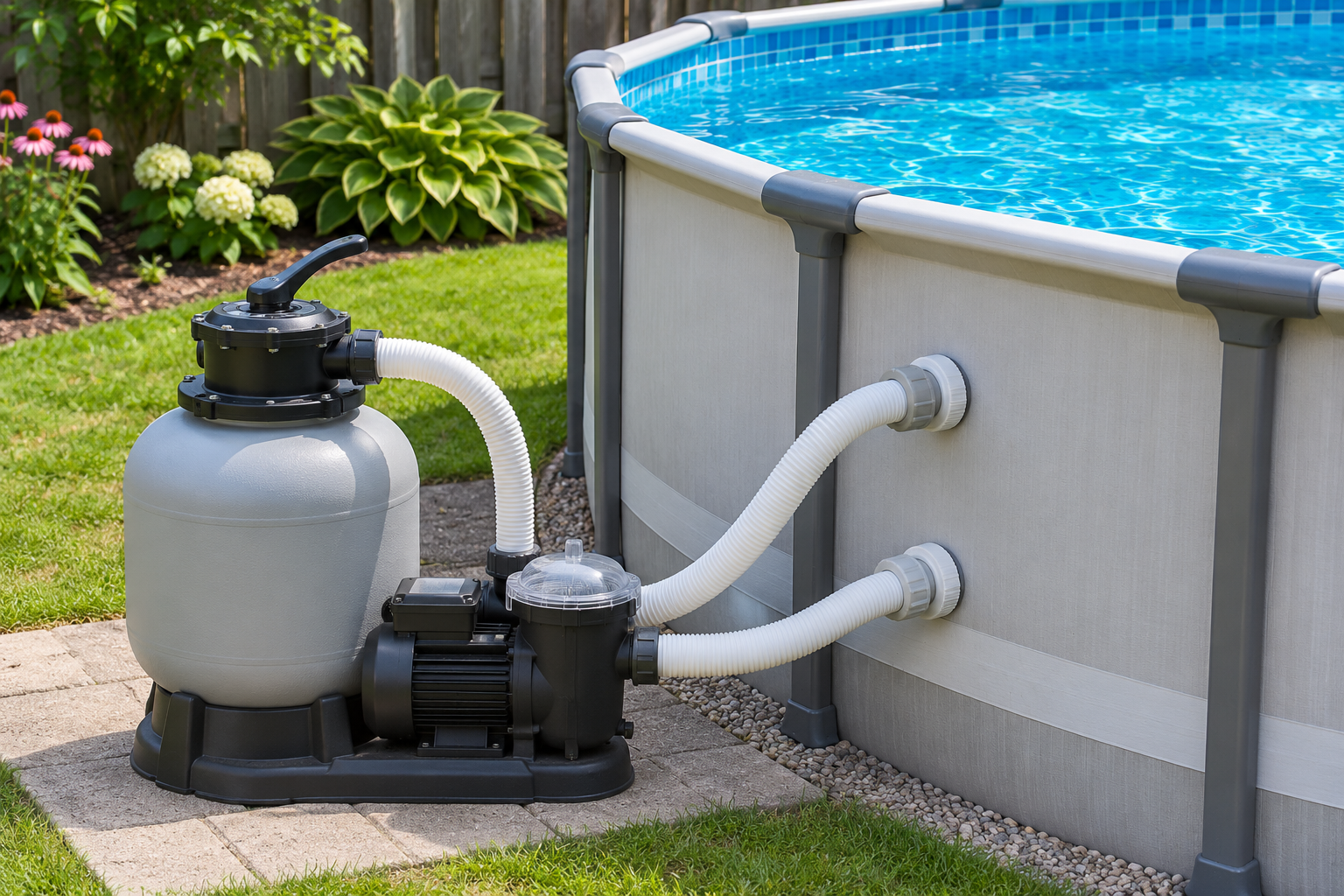
Sand Filter Pump Combos
The most familiar setup pairs a pump with a sand filter tank in one system. Water is pushed through a bed of filter sand, which traps debris, and the filter is cleaned by backwashing — reversing the flow briefly to flush dirt out a waste line. Sand combos are popular for midsize pools because they handle a lot of water, tolerate heavy debris loads, and need media changes only occasionally. Their trade-offs are size and weight, the need for a place to discharge backwash water, and filtration that is less fine than some alternatives.
Cartridge Filter Pump Systems
Cartridge systems push water through a pleated filter element with a large surface area. They filter finely, do not need backwashing, and cleaning means removing the cartridge and rinsing it with a hose, which saves water and suits yards where backwash discharge is awkward. Compact cartridge combos are common on smaller pools and are easy to store. The ongoing cost is the cartridge itself: elements wear out and must be replaced periodically, so keeping a spare is a practical habit.
Standalone Replacement Pumps
If your filter tank is sound but the pump has failed, a standalone pump sized to that filter can be the sensible purchase. This route demands the most care in matching: connection sizes, fittings, flow range, and mounting must all suit the existing filter. Measure fittings before ordering, and confirm the pump is intended to sit below the pool’s water line, as most above ground systems are flooded-suction setups in which water flows down to the pump.
Small All-in-One Units
The smallest soft-sided pools often use compact all-in-one units, where a small pump and cartridge live together at the pool wall. These are simple and adequate for very small volumes used lightly, but they struggle as pool size, bather load, or heat increases. Once you move up in size, a separate pump-and-filter combo usually makes water care noticeably easier.
Key Features That Actually Matter
Built-In Timer and Controls
A timer is one of the most useful features on an above ground system. Consistent daily circulation matters more than occasional marathon runs, and a timer delivers that consistency even when you are away. Look for controls you can set without a manual in hand, and a simple override so you can run extra hours after a storm or a pool party.
Strainer Basket and Priming
A clear or easily opened strainer lid lets you see debris before it becomes a problem, and a generous basket catches leaves before they reach the impeller. Because most above ground pumps sit below the water line, they usually prime readily, but air leaks at the lid seal or hoses can still cause loss of prime and noisy, weak operation. A sound lid seal and evenly tightened clamps are small details with outsized effects.
Hose Fittings and Compatibility
Above ground pools use a mix of hose diameters and proprietary connectors, and adapters are a common hidden cost. Before buying, confirm the pump’s inlet and outlet sizes against your pool’s wall fittings, skimmer, and hoses. A system that connects directly, with no stack of reducers, leaks less and flows better.
Cord, Plug, and Weather Protection
Check the cord length against the distance to your outdoor outlet, because extension cords are not an appropriate permanent solution for pool equipment. Many pumps include a ground-fault protected plug or require a protected outlet — a safety feature to keep, not bypass. Also note how the motor housing sheds water and whether the unit should sit under a cover in your climate.
How to Choose by Use Case
Small Soft-Sided and Frame Pools
For small pools used by a few people, prioritize simple setup, a cartridge system you can rinse quickly, and flow honestly matched to a modest volume. Oversizing is the usual error here: a large pump on a small pool wastes energy and can overwhelm small wall fittings. A compact combo with a timer is usually the sweet spot.
Midsize Frame Pools in Daily Use
Daily family use means sunscreen, grass, insects, and steady debris. A sand combo or a larger cartridge system will hold clarity with less frequent attention. Plan run time around use — many owners circulate during and after swimming hours — and size so the system turns the volume over without running at its limit all day.
Larger Above Ground Pools
As diameter and depth grow, volume rises quickly, and so does the cost of undersizing. Look at flow at realistic resistance rather than maximum flow, choose filtration with enough capacity for the volume, and make sure hoses and fittings do not bottleneck a stronger pump. For these pools, buying the correctly matched system once is cheaper than a season of chemicals spent fighting cloudy water caused by under-circulation.
Seasonal Setup and Storage
If your pool comes down or is winterized each year, choose equipment you can drain fully, disconnect easily, and carry to storage without strain. Cartridge systems and smaller combos generally store most easily. Label hoses and fittings at teardown, and store seals and plugs in a bag attached to the pump. Spring setup then becomes reassembly of a known system rather than a puzzle.
Safety Around Electricity and Water
Pool pumps combine electricity, water, and people in wet conditions, so safety is not an optional section. Always plug the pump into a ground-fault circuit interrupter (GFCI) protected outlet, and test that protection regularly using the outlet’s or plug’s test button. A GFCI cuts power quickly if current leaks along an unintended path, and it is one of the most important protections around any pool.
Switch the pump off and unplug it before opening the strainer lid, cleaning the filter, or adjusting hoses, and never reach into the pump while it is running. Route cords so they cannot sit in puddles or be cut by lawn equipment, and never operate a pump with a damaged cord or cracked housing. Swimmers should be out of the pool while you service equipment, and local codes may require specific distances, bonding, or a dedicated circuit — follow those rules or have a qualified electrician handle the electrical side.
Installation Tips That Prevent Problems
Good installation is mostly leveling, sealing, and patience. Set the pump and filter on a firm, level base — a purpose-made pad, pavers, or a stable platform — close to the pool wall fittings, so the unit cannot tip or strain its hoses. Connect hoses with the correct clamps, following the flow direction marked on the filter, and prime the system as the manual directs before the first start.
For a sand system, rinse the filter as instructed before returning filtered water to the pool, so loose fines do not blow back in. For a cartridge system, confirm the element is seated and the lid sealed evenly. Purge trapped air, then start the pump and walk the setup: check every clamp for drips, confirm strong return flow, and note the clean-filter pressure reading if your filter has a gauge. That baseline later tells you when the filter needs cleaning. Leave enough access to remove the basket and cartridge without dismantling hoses each time.
Care and Maintenance
Above ground pumps rarely fail without warning signs. Flow fades and noise creeps up as the basket fills, cartridges load with debris, or sand channels and stops filtering evenly. A simple routine prevents most of it. Empty the strainer basket regularly — more often when trees are shedding or after storms — and rinse cartridges whenever flow weakens or pressure rises above the clean baseline. Backwash a sand filter when its gauge or flow indicates loading, and follow the manual on when the sand itself needs refreshing.
Inspect hose clamps, lid seals, and O-rings through the season; a worn seal is far cheaper to replace than a pump run dry or sucking air. Listen to the pump weekly: new grinding or squealing is an early warning worth acting on. At season’s end, drain the pump and filter completely, clean and dry cartridges, and store the pump protected from freezing, since trapped water that freezes can crack housings.
Common Mistakes to Avoid
The most common buying mistake is oversizing the pump relative to the filter, in the belief that more power means cleaner water. In practice it can mean worse filtration, higher pressure, and wasted electricity. The opposite mistake is keeping a tiny bundled pump on a pool that has outgrown it, then compensating with chemicals for a circulation problem.
Other frequent errors include running the pump too few hours because there is no timer, judging flow by the box’s maximum rating instead of performance through a real, partly loaded filter, mixing hose sizes with improvised adapters that leak, and letting the basket overflow until flow collapses. Running the pump dry or with a closed valve, and storing the unit wet so it corrodes or freezes, are just as damaging. Finally, do not bypass electrical protection to stop a GFCI from tripping — a tripping device is information. Find the fault or call an electrician.
Frequently Asked Questions
How many hours a day should an above ground pool pump run?
It depends on pool volume, pump flow, weather, and use, but the goal is to turn over the full volume at least once daily, and more in heat or heavy use. Many owners land on several hours a day, split or continuous, adjusted by water clarity. A timer makes whatever schedule you choose consistent.
Can I use a bigger pump with my existing filter?
Only within the filter’s rated flow range. A pump that exceeds what the filter is designed to handle can damage media, raise pressure, and actually filter worse. Check the filter’s specified range and choose a pump whose real output in your setup sits comfortably inside it.
Is sand or cartridge filtration better for an above ground pool?
Neither is universally better. Sand handles heavy debris and larger volumes with simple backwash cleaning and infrequent media changes. Cartridge filters finer, saves backwash water, and suits smaller pools, at the cost of rinsing and periodically replacing elements. Match the choice to your pool size, debris load, and tolerance for each kind of upkeep.
Why does my pool stay cloudy even though the pump runs?
Common causes are a loaded or channeled filter, too few run hours, air leaks reducing real flow, and water chemistry that filtration alone cannot fix. Clean or backwash the filter, confirm strong return flow and a sealed strainer lid, increase run time, and test the water. If flow is weak with a clean filter and no leaks, the pump may be undersized or failing.
How do I winterize an above ground pool pump?
Turn off and unplug the pump, drain it and the filter completely using their drain plugs, disconnect hoses, clean the filter media or cartridge, and store the pump dry and protected from freezing. Keep plugs and seals with the pump so spring setup is straightforward.
Can I run an above ground pool pump on an extension cord?
A permanent pool pump should plug directly into a properly protected outdoor outlet of the correct rating, not rely on a general-purpose extension cord, which can overheat, drop voltage, and create a hazard in wet conditions. If the outlet is too far away, have a qualified electrician address the supply.
Above-Ground Pool Pumps to Compare
- Pentair Dynamo above-ground pump (340210): A 1.5 HP, 115 V configuration; Pentair says to confirm local inventory with a pool professional. Search Amazon by exact model · Manufacturer specifications.
- Hayward PowerFlo Matrix (W3SP1593): A 1.5 HP, 115 V above-ground option; match its flow to the pool filter’s rating. Search Amazon by exact model · Manufacturer data sheet.
Conclusion
The best above ground pool pumps are the ones matched to your pool as a system: enough real flow to turn the volume over daily, a filter type that suits your debris load and your patience for its cleaning routine, plumbing that connects without a tower of adapters, and controls that keep circulation consistent. Size honestly, respect the pump-and-filter match, plug into proper ground-fault protection, and build the small habits — basket checks, timely filter cleaning, careful winter storage — that keep seasonal equipment alive for many summers. Shortlist a few systems that meet those criteria, compare their manuals and fitting sizes, and choose the one whose upkeep you will actually keep up with.