Where to buy
Check the latest price, availability and delivery on Amazon. Orders are placed on Amazon. We may earn a commission from qualifying purchases.
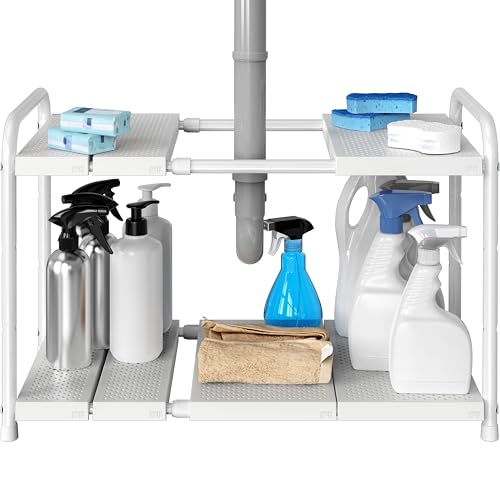
- Best overall: Simple Houseware Under Sink 2-Tier Expandable Shelf Organizer Rack — Check on Amazon
- YouCopia RollOut Caddy, 8-Inch Wide — Check on Amazon
- Copco Under-Sink Pantry and Cabinet Organizer Turntable, 18-Inch — Check on Amazon
- REALINN Under Sink Organizer, 2-Tier Pull-Out, 1-Pack, Black — Check on Amazon
See 2 more Amazon options
- YouCopia RollOut Caddy, 5-Inch Wide — Check on Amazon
- madesmart 2-Tier Organizer with Sliding Baskets, Frost — Check on Amazon
Read the full guide ↓
Disclosure: As an Amazon Associate, dailyhomedecorating.com earns from qualifying purchases. Links to Amazon on this page are affiliate links; they cost you nothing extra. Listing details such as price and availability change often, so check the current Amazon listing before you buy.
Finding the best under sink organizer under $25 means solving a plumbing problem before it is a shopping problem. Every sink cabinet is a negotiation between storage and the drain tailpiece, the P-trap, the supply lines and, in most kitchens, a garbage disposal that occupies the exact center of the space. The organizers that win this negotiation do not fight the plumbing — they route around it, sit beside it, wrap it or spin within the space it leaves. This guide compares the formats that genuinely work — sliding baskets, expandable shelf racks, rolling caddies, L-shaped metal pull-outs and turntables — at the under $25 budget, judged for everyday kitchen use.
The cabinet under a kitchen sink is the most hostile storage space in the house. It is dark, it is damp, it is interrupted by a drain tailpiece, a P-trap, two supply lines and — in most homes — a garbage disposal hanging exactly where a shelf wants to be. Bottles go in upright and come out lying down. The good bottle of degreaser migrates to the back, behind the bulk vinegar, and is effectively lost until the next full clean-out. An under sink organizer earns its money by imposing three things on that chaos: levels, so the vertical space is used; access, so the back row can be reached without unloading the front row; and boundaries, so categories of supplies stop interbreeding.
This guide compares the proven formats honestly. Sliding baskets like the madesmart bring the back row to you. Expandable shelf racks like the Simple Houseware build levels around the plumbing itself. Rolling caddies like the YouCopia RollOut thread the gaps nothing else fits. Metal L-shaped pull-outs like the REALINN wrap the disposal. None of them is magic, and the wrong shape for your plumbing is worse than none at all — which is why measuring, covered in detail below, matters more than brand.
Our short answer: start with the Simple Houseware Expandable Shelf Rack. It is the pick that fits the widest range of cabinets at this tier and solves the access problem — the back row — most completely. The sections below explain every pick in detail, walk through the measurements that decide fit, and flag the mistakes that send the most organizers back to the returns pile, including the disposal clearance almost nobody checks until the box is open.
In this guide
Quick Picks
In a hurry? This table matches each organizer to the cabinet situation it handles best within the under $25 budget.
| Buyer type | Pick | Why it stands out | Link |
|---|---|---|---|
| Best for wide cabinets and awkward plumbing | Simple Houseware Under Sink 2-Tier Expandable Shelf Organizer Rack | Expandable two-tier shelf rack with removable panels; Heavy-duty metal frame with perforated panels | Check on Amazon |
| Best for deep cabinets | YouCopia RollOut Caddy, 8-Inch Wide | Rolling caddy with adjustable dividers and removable basket; Plastic with rear wheels | Check on Amazon |
| Best budget spinning access | Copco Under-Sink Pantry and Cabinet Organizer Turntable, 18-Inch | Revolving turntable organizer; Plastic, white and gray | Check on Amazon |
| Best single metal pull-out | REALINN Under Sink Organizer, 2-Tier Pull-Out, 1-Pack, Black | Two-tier metal pull-out, single unit; Metal frame with sliding drawer | Check on Amazon |
| Best for the narrow gap beside the trap | YouCopia RollOut Caddy, 5-Inch Wide | Rolling caddy, slim width; Plastic with rear wheels | Check on Amazon |
| Best overall sliding-basket pick | madesmart 2-Tier Organizer with Sliding Baskets, Frost | Two sliding baskets with adjustable dividers; BPA-free plastic | Check on Amazon |
How These Picks Were Chosen for the best under sink organizer under $25
Under $25 is where real under-sink organizing begins: the expandable Simple Houseware rack, single REALINN and Simple Houseware units, the slim YouCopia caddies and the Copco turntable all genuinely compete in this band, and every pick below is a linked, verifiable product. You will organize one cabinet properly at this tier — not the whole house — and that is exactly the right scope.
We did not hands-on test these organizers. Instead we compared manufacturer specifications and listing data on the things that decide whether an under-sink organizer survives real use: footprint against real plumbing layouts, tier height against real bottle heights, drawer and slide mechanics, stated weight capacities, and materials against the damp reality of the cabinet. Models with unverifiable specifications, no stated dimensions, or designs that ignore the trap entirely were excluded, however good their photos looked.
The criteria that mattered most for this guide were:
- Measured fit around the trap, disposal and supply lines, with clearance for the door and hinges
- Access style — sliding, rolling or spinning — matched to cabinet depth
- Material that survives damp: plastic, PET, coated or stainless metal, never bare steel or wood
- Capacity honest about bottle heights: standard spray bottles need roughly 10 to 11 inches of clear tier height
- Stability: non-slip feet or a frame that stays put when a drawer is pulled
- Cleanability, because every under-sink cabinet eventually hosts a slow leak
One more filter deserves stating plainly: honesty about tier fit. A two-tier organizer is a physical object with a real cost floor, and below a certain budget the branded, verifiable options simply do not exist. Where that is the case in this guide, we say so and present the closest step-ups without links, rather than filling the page with unverifiable no-name products.
The plumbing problem: traps, disposals and the space that is actually usable in the best under sink organizer under $25 search
The single most useful thing to understand about under-sink storage is that the cabinet’s advertised width is a lie by omission. A 36-inch sink base might offer 34 inches inside, a 32-inch door opening, and — once the disposal and trap take their share — two usable lanes of about 11 inches each. Organizers are bought against the first number and returned because of the third. The formats in this guide were chosen because their dimensions are honestly stated and their shapes acknowledge the plumbing: lanes, wraps, spans and circles, rather than one big rectangle pretending the trap is not there.
Bottle height is the second hidden constraint. A standard spray bottle stands roughly 10 to 11 inches tall with its trigger; a dish soap bottle about 9; a tub of dishwasher pods about 6. A two-tier unit therefore needs roughly 11 inches of clear height in at least one tier to be genuinely useful, and the cabinet needs the total height to match. Several picks below publish their tier geometry; where a listing does not, we treated that silence as a mark against it.
Detailed reviews
1. Simple Houseware Under Sink 2-Tier Expandable Shelf Organizer Rack — Best for wide cabinets and awkward plumbing
Format: Expandable two-tier shelf rack with removable panels. Size: Expands from about 15 to 25 in wide; about 11.75 in deep; shelf heights at 2, 4, 9 and 13 in. Material: Heavy-duty metal frame with perforated panels.
This is the organizer that treats the plumbing as a design input instead of an obstacle. The frame expands from roughly 15 to 25 inches wide, the perforated shelf panels come in large and small pieces you can remove or reposition, and the shelf levels sit at several heights — so the drain tailpiece and P-trap pass through gaps you create, while shelf surface fills the rest of the cabinet. It does not slide; instead it converts the whole cabinet into two usable levels. For wide cabinets where one small two-tier unit would leave dead space on both sides, this full-width approach stores more than any pair of baskets.
Day to day, what matters about the Simple Houseware Expandable Shelf Rack is that it removes decisions. Supplies have addresses, the addresses do not move, and the cabinet goes back to being infrastructure instead of a daily puzzle.
Owners tend to judge this pick after the first deep clean, when the unit comes out, wipes down and goes back without a fight — that cycle, repeated monthly, is where it quietly wins.
Fit notes: The Simple Houseware Expandable Shelf Rack rewards an honest sketch of your plumbing: mark the trap’s position on paper, note that its size runs expands from about 15 to 25 in wide; about 11.75 in deep; shelf heights at 2, 4, 9 and 13 in, and confirm the unit claims a lane rather than the cabinet’s center. Ninety seconds of sketching is the difference between a custom-feeling fit and a return label.
Who it suits: Everyday kitchen use shoppers whose cabinet measurements match the footprint above and who want expandable two-tier shelf rack with removable panels access.
Pros
- Expands 15 to 25 inches to fit the cabinet you actually have
- Removable panels route around the trap and supply lines
- Four shelf height positions for tall and short bottles
- Metal frame carries real weight without flex
Honest limitation
- No sliding access — back items still need reaching
- Assembly takes longer than a drop-in basket unit
- Perforated panels let small items tip if placed carelessly
Choose it if its footprint matches your measured lane and its format matches how you actually use the cabinet. Skip it if your plumbing layout contradicts its shape — no organizer in this guide is good enough to overcome a bad fit. Check on Amazon
2. YouCopia RollOut Caddy, 8-Inch Wide — Best for deep cabinets
Format: Rolling caddy with adjustable dividers and removable basket. Size: 8 in wide rolling bin; fits beside most traps. Material: Plastic with rear wheels.
The RollOut Caddy solves the deepest problem under a sink — the back of the cabinet — with wheels instead of drawers. It is a narrow bin on rear wheels with two adjustable dividers and a removable inner basket; you roll it out like a tiny filing drawer, take what you need, and roll it back. At eight inches wide it threads the gap beside a P-trap or disposal where a full two-tier frame will not fit, which makes it the best friend of awkward cabinets. It holds less than a two-tier, but everything it holds is genuinely reachable, and a pair of them — one per side — is a legitimate full-cabinet system.
For a general-purpose cabinet, the YouCopia RollOut Caddy 8-Inch covers the widest spread of ordinary jobs — daily dish supplies up front, weekly cleaners behind — without specialising so hard that it becomes awkward outside its niche.
The practical test is the dinner rush: one hand wet, the other holding a pan, and the supply you need arrives in a single motion. This design passes that test when its dividers are set snugly.
Fit notes: Treat the stated size of the YouCopia RollOut Caddy 8-Inch — 8 in wide rolling bin; fits beside most traps — as a contract: measure your tallest bottle and your clear height, and let those two numbers vote before your eyes do. Cabinets punish optimism and reward arithmetic, every single time.
Who it suits: Everyday kitchen use shoppers whose cabinet measurements match the footprint above and who want rolling caddy with adjustable dividers and removable basket access.
Pros
- Wheels make the back of the cabinet reachable
- Narrow 8-inch width fits beside plumbing
- Dividers and removable basket included
- No assembly beyond placing dividers
Honest limitation
- Lower total capacity than a two-tier frame
- Wheels need a flat cabinet floor to roll well
- Tall bottles can tip when rolling if dividers are loose
Choose it if its footprint matches your measured lane and its format matches how you actually use the cabinet. Skip it if your plumbing layout contradicts its shape — no organizer in this guide is good enough to overcome a bad fit. Check on Amazon
3. Copco Under-Sink Pantry and Cabinet Organizer Turntable, 18-Inch — Best budget spinning access
Format: Revolving turntable organizer. Size: 18 in diameter revolving tray. Material: Plastic, white and gray.
The Copco turntable is the low-tech answer that keeps outliving fancier systems: an 18-inch revolving tray that spins the back of the cabinet to the front. It has no tiers, so it cannot double your vertical storage — but it also has no drawers to jam, no frame to assemble and no footprint conflict beyond its circle, and it is the cheapest credible way to make a deep cabinet honest. It works best for a cluster of similar bottles — cleaning sprays on one tray — and pairs beautifully with a two-tier unit on the other side of the trap. In very small cabinets the 18-inch circle may be too wide; measure the door opening, not just the interior.
In everyday use, the Copco 18-Inch Turntable earns its place through consistency: it opens the same way every time, bottles stay where you put them, and the back row stops being a rumour. That boring reliability is exactly what a main kitchen cabinet needs.
Where this pick earns loyalty is the restock: bottles lift out in groups, the tray wipes in seconds, and everything returns to visible addresses instead of a fresh pile.
Fit notes: Before ordering the Copco 18-Inch Turntable, hold your tape against the listing’s key measurement — 18 in diameter revolving tray — and compare it with your door opening, not just the interior. If the margin is under half an inch on any side, choose the next format down in this guide rather than gambling on a squeeze.
Who it suits: Everyday kitchen use shoppers whose cabinet measurements match the footprint above and who want revolving turntable organizer access.
Pros
- Spinning access with zero moving-part failures
- Cheapest credible fix for deep cabinets
- No assembly at all
- Easy to lift out and hose down
Honest limitation
- Single level — no vertical doubling
- 18-inch circle needs a wide door opening
- Bottles can topple if spun hard
Choose it if its footprint matches your measured lane and its format matches how you actually use the cabinet. Skip it if your plumbing layout contradicts its shape — no organizer in this guide is good enough to overcome a bad fit. Check on Amazon
4. REALINN Under Sink Organizer, 2-Tier Pull-Out, 1-Pack, Black — Best single metal pull-out
Format: Two-tier metal pull-out, single unit. Size: Single-unit footprint for one cabinet side. Material: Metal frame with sliding drawer.
The single-pack REALINN is the same metal pull-out idea in one unit: a two-tier frame whose drawer slides out of the cabinet so supplies stored at the back are a pull away. It suits the common setup where one side of the cabinet is lost to the disposal and only one side is truly organizable — or a bathroom vanity where one unit is the whole job. The metal build feels a class above plastic baskets, and the black finish hides the scuffs a working cabinet inevitably delivers.
Day to day, what matters about the REALINN 2-Tier Pull-Out 1-Pack is that it removes decisions. Supplies have addresses, the addresses do not move, and the cabinet goes back to being infrastructure instead of a daily puzzle.
In the cabinet, the detail that decides satisfaction is the first week: load it, live with it, and move one category per day until the layout matches your hand’s habits rather than the other way round.
Fit notes: The REALINN 2-Tier Pull-Out 1-Pack rewards an honest sketch of your plumbing: mark the trap’s position on paper, note that its size runs single-unit footprint for one cabinet side, and confirm the unit claims a lane rather than the cabinet’s center. Ninety seconds of sketching is the difference between a custom-feeling fit and a return label.
Who it suits: Everyday kitchen use shoppers whose cabinet measurements match the footprint above and who want two-tier metal pull-out, single unit access.
Pros
- Metal frame feels sturdy under full bottles
- Sliding drawer solves back-row access
- Single unit suits vanities and half-usable cabinets
- Black finish hides wear
Honest limitation
- One unit only — wide cabinets may want the two-pack
- Costs more per tier than plastic rivals
- Check drawer slide clearance against door hinges
Choose it if its footprint matches your measured lane and its format matches how you actually use the cabinet. Skip it if your plumbing layout contradicts its shape — no organizer in this guide is good enough to overcome a bad fit. Check on Amazon
5. YouCopia RollOut Caddy, 5-Inch Wide — Best for the narrow gap beside the trap
Format: Rolling caddy, slim width. Size: 5 in wide rolling bin. Material: Plastic with rear wheels.
The five-inch RollOut is the specialist for the sliver of space every sink cabinet wastes — the four-to-six-inch strip between the trap and the cabinet wall, or between a disposal and the door hinge. It will not organize a whole cabinet, and it does not pretend to: it turns dead width into a rolling home for dish soap, hand soap refills, sponge packs and the brush collection. Pair it with any main organizer in this guide and the combination covers the cabinet better than either does alone. In genuinely small kitchens, two of these plus a turntable can be the entire system.
For a general-purpose cabinet, the YouCopia RollOut Caddy 5-Inch covers the widest spread of ordinary jobs — daily dish supplies up front, weekly cleaners behind — without specialising so hard that it becomes awkward outside its niche.
Owners tend to judge this pick after the first deep clean, when the unit comes out, wipes down and goes back without a fight — that cycle, repeated monthly, is where it quietly wins.
Fit notes: Treat the stated size of the YouCopia RollOut Caddy 5-Inch — 5 in wide rolling bin — as a contract: measure your tallest bottle and your clear height, and let those two numbers vote before your eyes do. Cabinets punish optimism and reward arithmetic, every single time.
Who it suits: Everyday kitchen use shoppers whose cabinet measurements match the footprint above and who want rolling caddy, slim width access.
Pros
- Fits the narrow gaps other organizers waste
- Rolls out for full access
- Perfect add-on to a main two-tier unit
- Dividers keep slim bottles upright
Honest limitation
- Very small capacity on its own
- Not a standalone whole-cabinet solution
- Best on smooth, level cabinet floors
Choose it if its footprint matches your measured lane and its format matches how you actually use the cabinet. Skip it if your plumbing layout contradicts its shape — no organizer in this guide is good enough to overcome a bad fit. Check on Amazon
6. madesmart 2-Tier Organizer with Sliding Baskets, Frost — Best overall sliding-basket pick
Format: Two sliding baskets with adjustable dividers. Size: About 14.4 in deep x 9.1 in wide footprint class; two stacked baskets. Material: BPA-free plastic.
The madesmart is the reference design in this category: two plastic baskets that slide out independently on a frame, with dividers you can reposition so spray bottles stand upright instead of dominoing. The lower basket is the workhorse — dish soap, sponges, scrub refills — while the upper basket suits shorter bottles and pods. Because the baskets lift out, you can carry the whole tier to the counter when you deep-clean, and the plastic wipes down after the inevitable slow leak from a detergent bottle. It is sized for one side of a standard sink cabinet, leaving the other side for the trap, the disposal and tall bottles standing on the cabinet floor.
In everyday use, the madesmart 2-Tier Organizer (Frost) earns its place through consistency: it opens the same way every time, bottles stay where you put them, and the back row stops being a rumour. That boring reliability is exactly what a main kitchen cabinet needs.
The practical test is the dinner rush: one hand wet, the other holding a pan, and the supply you need arrives in a single motion. This design passes that test when its dividers are set snugly.
Fit notes: Before ordering the madesmart 2-Tier Organizer (Frost), hold your tape against the listing’s key measurement — about 14.4 in deep x 9.1 in wide footprint class; two stacked baskets — and compare it with your door opening, not just the interior. If the margin is under half an inch on any side, choose the next format down in this guide rather than gambling on a squeeze.
Who it suits: Everyday kitchen use shoppers whose cabinet measurements match the footprint above and who want two sliding baskets with adjustable dividers access.
Pros
- Both baskets slide out independently, so the back row is reachable
- Adjustable dividers keep spray bottles upright
- Baskets lift out for cleaning and restocking
- BPA-free plastic will not rust in a damp cabinet
Honest limitation
- Plastic frame flexes if you overload the top basket with heavy bottles
- Too wide to pair two-across in narrow 24-inch cabinets with a center disposal
Choose it if its footprint matches your measured lane and its format matches how you actually use the cabinet. Skip it if your plumbing layout contradicts its shape — no organizer in this guide is good enough to overcome a bad fit. Check on Amazon
A zoning blueprint for everyday kitchen use
The daily lane. Reserve the most accessible tier — the front of the sliding basket, the front half of the turntable — for the five things you touch every day: dish soap, hand soap refill, sponge, scrub brush and dishwasher pods if you use them. Daily items earn front placement because every second of digging is a second multiplied by hundreds of repetitions a year.
The weekly lane. Behind or above the daily zone go the weekly supplies: surface spray, degreaser, drain maintenance, the good glass cleaner. These tolerate one extra motion to reach. In a two-side layout, the weekly lane usually lives on the opposite side of the trap from the daily lane, which balances the cabinet and keeps the door-side light.
The deep reserve. Bulk refills, the spare bottle of everything and the rarely used specialty cleaners belong at the very back or on the cabinet floor behind the units — reachable during the monthly slide-out, invisible the rest of the time. The mistake to avoid is mixing the reserve into the daily lane, where bulk bottles crowd out the items you actually reach for and recreate the original clutter inside an expensive organizer.
Whatever blueprint you adopt, draw it once — on paper or in a phone note — and load the cabinet to the drawing rather than to instinct. Instinct loads by bottle shape and recreates piles; a blueprint loads by frequency and hazard, which is the entire difference between a cabinet that stays organized and one that was organized once, briefly, for a photograph.
Comparison table
| Pick | Format | Material | Best for | Link |
|---|---|---|---|---|
| Simple Houseware Expandable Shelf Rack | Expandable two-tier shelf rack with removable panels | Heavy-duty metal frame with perforated panels | Best for wide cabinets and awkward plumbing | Check on Amazon |
| YouCopia RollOut Caddy 8-Inch | Rolling caddy with adjustable dividers and removable basket | Plastic with rear wheels | Best for deep cabinets | Check on Amazon |
| Copco 18-Inch Turntable | Revolving turntable organizer | Plastic, white and gray | Best budget spinning access | Check on Amazon |
| REALINN 2-Tier Pull-Out 1-Pack | Two-tier metal pull-out, single unit | Metal frame with sliding drawer | Best single metal pull-out | Check on Amazon |
| YouCopia RollOut Caddy 5-Inch | Rolling caddy, slim width | Plastic with rear wheels | Best for the narrow gap beside the trap | Check on Amazon |
| madesmart 2-Tier Organizer (Frost) | Two sliding baskets with adjustable dividers | BPA-free plastic | Best overall sliding-basket pick | Check on Amazon |
How to choose: making the best under sink organizer under $25 decision
Step one: measure the five numbers. Interior width, door opening width, depth, clear height to the lowest plumbing, and the trap’s position. Every failed under-sink purchase in history failed on one of these five. The door opening deserves emphasis: it is always narrower than the interior, and rigid units must pass through it — or be assembled inside, which is the expandable rack’s quiet superpower.
Step two: choose the format by plumbing, not preference. Disposal in the center with two lanes: narrow two-tiers, caddies or the L-shaped pull-out. No disposal and a wide cabinet: the expandable rack converts the most space. Deep cabinet where things vanish: sliding drawers, rolling caddies or a turntable — anything that moves the back row forward. Shallow vanity: a single compact two-tier or the five-inch caddy in the side gap.
Step three: check tier heights against your tallest bottle. Measure your tallest spray bottle and require that number, plus half an inch, in at least one tier. Then check the stated weight capacity against your heaviest item — bulk detergent belongs on the cabinet floor or the sturdiest low tier, never on a light top drawer.
Step four: match the system to everyday kitchen use. Re-read the criteria in the How These Picks Were Chosen section with your household in mind. The right organizer is the one whose zoning, access style and capacity match your actual routine — the most expensive unit that fights your habits will lose to a cheaper one that follows them.
Step five: do a bottle inventory before you buy capacity. Pull everything out of the cabinet and count honestly. Most households find between twelve and twenty items, of which a third are duplicates, expired or simply unused. Organize for the inventory you keep after that cull, not the one you started with — buyers who skip the cull buy twice the organizer they need, fill it with things they do not use, and conclude wrongly that organizing does not work. The cull is also the moment to note your tallest bottle, your heaviest bottle and your most-grabbed bottle; those three measurements and habits should drive the final choice between the picks above more than any brand preference.
A note on budget at the under $25 tier. Money in this category buys three things in order: fit, access and finish. Fit is non-negotiable and free — it costs only measuring. Access is where spending first pays: a drawer, wheel or turntable that reaches the back row is worth more than any material upgrade. Finish — chrome over black, wood grain over clear — is legitimately last. Allocate your under $25 budget in that order and you will not regret the purchase; reverse the order and you will own a beautiful organizer that does not fit, holding bottles you cannot reach.
Common mistakes to avoid
Buying by cabinet width alone and forgetting the door opening is narrower than the interior.
Ignoring the garbage disposal. it hangs lower and wider than the trap and eats the center of the cabinet
Storing bulk detergent jugs on a top tier rated for a fraction of their weight.
Skipping the leak check. installing a new system over a slow drip guarantees a ruined cabinet floor and a moldy organizer — fix plumbing first, organize second
Overloading drawers past their stated capacity, which bends slides and cracks baskets within months.
Storing chemicals and food-adjacent supplies in one undifferentiated unit because the cabinet felt too small to zone.
Formats compared: baskets, racks, caddies, pull-outs and turntables
Sliding baskets (madesmart, Simple Houseware) are the balanced default: two levels, moving access, no installation. Expandable racks (Simple Houseware) store the most in wide, disposal-free cabinets and assemble in place, but nothing slides. Rolling caddies (YouCopia RollOut) own the narrow lanes and deep cabinets, at the cost of total capacity. Metal pull-outs (REALINN) feel the sturdiest and wrap plumbing best, at the highest prices. Turntables (Copco) are the simplest and cheapest access upgrade, with a single level. Most well-organized cabinets combine two formats — a two-tier on one side of the trap, a caddy or turntable on the other — and this guide’s picks are chosen to combine cleanly.
Materials follow the same logic. Plastic and PET are immune to rust and wipe clean in seconds, which is why they dominate a damp category; their cost is flex under real weight. Stainless and powder-coated metal carry more and feel better, and are worth it where bottles are heavy or use is constant. What neither survives is neglect: any organizer in a cabinet with an active leak is a temporary organizer.
Care, cleaning and long-term use
Under-sink organizers live where leaks happen, so maintenance is mostly moisture management. Put a washable waterproof mat under the units before you install them. Once a month, slide everything out — this takes two minutes with the formats in this guide — and wipe the trays and the cabinet floor; this is also your leak early-warning system, because you will see a damp patch months before it becomes damage. Wash plastic baskets in warm soapy water when a detergent bottle weeps; dry metal frames fully before returning them. Check bottle caps and pump seals at the same time: most under-sink mess is not plumbing failure, it is a slow product leak that a tray caught and a monthly wipe removes.
When to upgrade or replace an under sink organizer
The honest lifespan question has two halves: the unit, and the layout. Units in this guide, correctly loaded, serve for years — but layouts expire faster, because households change what they store. The cook who takes up bulk buying, the family that adds a second bathroom’s worth of supplies to the same cabinet, the renter who moves to a home with a disposal: each inherits a layout designed for a previous life. Re-run the five measurements and the bottle inventory whenever the household shifts, and treat the organizer as the last thing you change, not the first — often the same unit, re-zoned, is the whole upgrade.
Replacement, when it comes, should be surgical. Keep the units that still fit their lanes, replace only the one whose format the new plumbing or the new routine has defeated, and let the survivor’s measurements specify its new partner. A cabinet built up this way — piece by piece, each piece earning its place — ends up fitting its home better than any single grand purchase.
Final recommendation
For most readers shopping the best under sink organizer under $25, the Simple Houseware Expandable Shelf Rack is the buy: it fits the widest range of real cabinets, solves the back-row problem properly, and sits honestly inside the under $25 budget — Check on Amazon. If your cabinet has a central disposal, look first at the REALINN L-shaped option; if it is wide and disposal-free, the expandable Simple Houseware rack converts the most space; and whatever main unit you choose, the slim YouCopia caddy in the leftover lane is the highest-value add-on in the category — Check on Amazon for the runner-up pick as well. Measure first, and the first unit you buy will be the last one you need to buy.
Setting up your system in the first week
Day one: empty the cabinet completely, clean the floor, lay the mat, and fix any active drip before anything goes back in. Sort everything you removed into three piles — daily, weekly, and why-do-we-own-this — and be ruthless with the third. Day two: place the main unit, load daily items at the front of the easiest tier, weekly items behind or above, and set dividers so bottles stand snug. Day three to seven: live with it, and move exactly one thing per day if the layout fights you — small corrections in the first week are how a system becomes yours. At the end of the week, photograph the cabinet. That photo is your reset standard for every future tidy-up, and your shopping list discipline: if a new bottle has no address in the photo, something else leaves.
Frequently asked questions
How do I measure my cabinet for an under sink organizer?
Measure four things: the interior width, the door opening width (always smaller), the depth from door to back wall, and the clear height from the cabinet floor to the lowest point of the disposal or trap. Then map the plumbing: note where the trap sits left-to-right, because most organizers work beside it, not under it. Write the numbers down before you shop — every pick in this guide lists its footprint class so you can compare directly.
Will an under sink organizer fit around a garbage disposal?
Usually, yes — on one side of it. Disposals hang in the center of most cabinets, leaving a working lane on each side. Narrow two-tier units, rolling caddies and L-shaped designs like the REALINN are made for exactly those lanes. Full-width expandable racks work too, because their panels can be removed where the disposal hangs. What will not work is a wide rectangular unit centered in the cabinet.
Are plastic or metal under sink organizers better?
Both survive if chosen well. Plastic and PET never rust and wipe clean easily, which suits damp cabinets; their weakness is flex under heavy bottles. Powder-coated or stainless metal feels sturdier and carries more weight, but cheap bare steel rusts at the first leak. In a cabinet with any history of drips, plastic or stainless construction is the safer long-term bet.
How do I stop bottles tipping over in a sliding organizer?
Use the dividers — they exist precisely for this. Group bottles by height, keep the tallest against the back wall of the basket, and do not leave a single bottle alone in a wide compartment where it can build momentum when the drawer moves. Rolling caddies need the same treatment: snug dividers, no lone bottles.
How long do under sink organizers last?
Plastic and PET units in a dry cabinet last for years; the enemies are overload and leaks, not time. Metal frames last longer under heavy loads if their finish stays intact. Expect to replace a budget plastic basket that has been chronically overloaded, and expect a correctly loaded unit of any material in this guide to outlast the bottles it holds by a wide margin.
Should I organize the bathroom sink the same way?
The same formats work, with two adjustments: vanities are shallower, so check depth first, and bathroom bottles are shorter, so tier heights matter less and narrow caddies matter more. Multi-packs in this guide exist precisely so one purchase can cover the kitchen and a vanity in the same format.
What goes under the sink that should not?
Keep out anything the damp and the chemicals can harm: open food packages, fresh produce, pet food in paper bags, medicines, paper goods you cannot afford to lose to a leak, and anything flammable near a disposal’s motor housing. The cabinet’s legitimate residents are cleaning supplies, sink tools, sealed backstock where this guide’s pantry rules are followed, and trash and recycling consumables.
Is a pull-out organizer worth it over a simple bin?
In a shallow cabinet, honestly, a simple bin is nearly as good — everything is already within reach. The deeper the cabinet, the more the answer flips: past about twenty inches of depth, a static bin guarantees a lost back row, and sliding, rolling or spinning access pays for itself in found bottles and abandoned duplicates within a few months.


