Where to buy
Shopping for the best spice rack under $150? Check the latest price, availability and delivery on Amazon for the picks below. Orders are placed on Amazon. We may earn a commission from qualifying purchases.
- Best large uniform system: SpaceAid Spice Rack Organizer with 36 Spice Jars and 386 Labels — Check on Amazon
- Kamenstein 20-Jar Revolving Countertop Spice Rack (30020) — Check on Amazon
- YouCopia Chef’s Edition SpiceStack 30-Bottle Spice Organizer — Check on Amazon
- SpaceAid Spice Rack Organizer with 28 Spice Jars and 386 Labels — Check on Amazon
- YouCopia SpiceStack Adjustable Spice Rack Organizer, 24-Bottle — Check on Amazon
- Evermill Spice Rack System (maker-direct) — step-up option, see the review below (sold outside the linked picks for this tier)
Read the full guide ↓
Disclosure: As an Amazon Associate, dailyhomedecorating.com earns from qualifying purchases. Links to Amazon on this page are affiliate links; they cost you nothing extra. Listing details such as price and availability change often, so check the current Amazon listing before you buy.
Finding the best spice rack under $150 is really a search for the right format at the right size, because a spice rack is not one product but a family of them — step shelves, pull-down drawers, slide-outs, carousels, wall racks, drawer inserts and complete jar systems — and each one solves a different kitchen problem. This guide compares six verified options for everyday home cooks, explains exactly how each one stores, presents and refills your spices, and is honest about the tiers: where a budget genuinely buys a good rack, the picks are linked so you can check price on Amazon; where it does not, the picks are described prose-only as step-ups rather than dressed up as bargains. No static prices and no fixed ratings appear anywhere below — only measurements, capacities and mechanics you can verify.
A spice rack sounds like the simplest purchase in the kitchen, right up until you stand in front of the category and discover it is actually six different products wearing one name. There are step shelves that lift jars inside a cabinet, drawer systems that pull out and tip down, carousels that spin on the counter, wall racks that colonise dead vertical space, drawer inserts that hide the whole collection in a drawer, and complete systems that arrive with their own uniform jars and labels. They solve different problems. The cook who cannot see past the front row of a deep cabinet needs elevation or drawers. The cook with no cabinet to spare needs a wall or a counter footprint. The cook drowning in mismatched grocery bottles needs a uniform fleet, not another shelf. This guide treats the keyword plainly — the best spice rack under your stated budget — and judges every format against the others, so the right answer emerges from your kitchen’s geometry rather than from a brand’s marketing.
Two distinctions run through everything below, and they matter more than any single product. The first is rack versus system: a bare rack organises jars you already own, while a system replaces them with a uniform fleet. Neither is better in the abstract — bare racks are cheaper and waste nothing you own, systems are tidier and make stock levels obvious — but buying one while needing the other is the most common disappointment in this category. The second distinction is visibility style: step shelves and wall racks show every label simultaneously, drawers show them on demand at a reading angle, and carousels show them sequentially as you spin. Think about how you actually search mid-recipe — scanning a shelf, or spinning to a known position — because you will repeat that gesture thousands of times.
A $150 ceiling does not mean you should spend $150 on a rack — it means the ceiling stops ruling anything out. The linked picks below are the finest mainstream systems we verified; the headroom buys the largest capacities, a second format for a second location, or a rack plus the spice fleet to fill it. One pick, Evermill, is prose-only because it is sold direct by its maker with no Amazon listing.
One clarification before the picks, because the two categories are constantly confused: this guide is about the rack — the shelf, drawer, carousel or system that holds the jars. If what you need is the jars themselves, our companion guide to Best Spice Jars Under $150 covers fleets of empty jars in detail. Several systems below include jars as part of the rack package, and where they do, the review treats the jars as part of the system rather than as a separate jar purchase. Everything else here is rack-first: bring your own jars, or adopt the included fleet, but judge the furniture before the glassware.
In this guide
Quick Picks
In a hurry? This table matches each pick to the job it does best for everyday home cooks. Full reasoning, limitations and choose-or-skip advice follow in the detailed reviews.
| Buyer type | Pick | Why it stands out | Link |
|---|---|---|---|
| Best large uniform system | SpaceAid Spice Rack Organizer with 36 Spice Jars and 386 Labels | 36 uniform square jars end the core-plus-overflow two-system problem | Check on Amazon |
| Best large revolving rack with spices included | Kamenstein 20-Jar Revolving Countertop Spice Rack (30020) | 20 prefilled jars cover a full family working set from day one | Check on Amazon |
| Best high-capacity cabinet system | YouCopia Chef’s Edition SpiceStack 30-Bottle Spice Organizer | 30 full-size or 60 half-size capacity retires every overflow spot in the kitchen | Check on Amazon |
| Best complete cabinet system under mid budgets | SpaceAid Spice Rack Organizer with 28 Spice Jars and 386 Labels | Complete system: rack, 28 square glass jars, 386 waterproof labels, marker and funnel | Check on Amazon |
| Best adjustable drawer system | YouCopia SpiceStack Adjustable Spice Rack Organizer, 24-Bottle | Adjustable dividers and heights fit mixed bottle shapes instead of exiling them | Check on Amazon |
| Best design-led direct system (prose-only) | Evermill Spice Rack System (maker-direct) | Design-led countertop presence — the rack is intended as a visible kitchen piece | Step-up — see review |
How picks were chosen for the best spice rack under $150
We built the pool from the rack makers whose listings publish real specifications — SpaceAid, YouCopia, Copco, madesmart, DecoBros and Kamenstein among them — then verified each linked product’s ASIN, format, dimensions and capacity against its Amazon listing as surfaced in search and maker information. Products without verifiable specifications were excluded, however good their marketing looked. Evermill appears once, prose-only and clearly labelled, because it is sold direct by its maker and has no Amazon listing to verify or link.
- Visibility first: every pick had to make labels genuinely readable — by elevation, by pull-down angle, by wall-plane display or by rotation — not merely store jars in a smaller pile.
- Published dimensions and capacities: we only linked products whose makers or listings state real measurements, tier counts and bottle capacities, so you can measure your space against facts.
- Format coverage: the six picks span step shelf, caddy, wall, countertop, drawer-system and jar-system formats, because the best spice rack is the one whose format matches your kitchen.
- Honest tier fit: a pick is only linked at tiers its real price band fits; step-ups are labelled prose-only instead of being smuggled under a ceiling they exceed.
- No invented figures: no star ratings, no review counts, no static prices anywhere in this guide — check price on Amazon for the current figure on the day you buy.
A note on what a spice rack is not: it is not a freshness device. No rack in this guide seals, chills or preserves — that work belongs to the jars and their lids. The rack’s job is access: visibility, reach and order. We judged racks purely on that job, which is why a simple step shelf can outrank a beautiful carousel for a cook who searches by scanning, and why the honest limitation in every review below names the cook or the kitchen the pick will frustrate.
The main spice rack formats, compared
Step shelves are the original fix: a tiered insert that lifts back rows inside a cabinet or pantry. They cost the least, install in seconds, and show every label at once — but they cannot retrieve anything; what you see is all you get, and deep cabinets still ask you to reach. Pull-down drawer systems (the YouCopia pattern) keep spices in the cabinet but bring them to you, drawers sliding out and tipping down to a reading angle; they are the kindest format for high cabinets and shorter cooks, at the price of a larger cabinet footprint. Slide-out vertical organizers colonise narrow gaps and present a column of bottles sideways — unbeatable per inch, bounded in capacity. Countertop stands and carousels trade counter space for zero-reach access: stands show all labels in stepped rows, carousels show one face at a time but ask only a finger’s push. Wall and door racks spend vertical space nothing else wants and display the fleet like a library, at the price of screws and a swing-clearance check. Drawer inserts hide the fleet in a drawer, labels up, at the exact point of prep — the format that changes behaviour least and delights most, provided a drawer can be donated. Jar-inclusive systems cut across all of these: the format varies, but the fleet becomes uniform, which is a visibility upgrade in itself. Read the six reviews below with this map in hand and each pick’s trade-offs will read as geometry, not marketing.
Detailed reviews
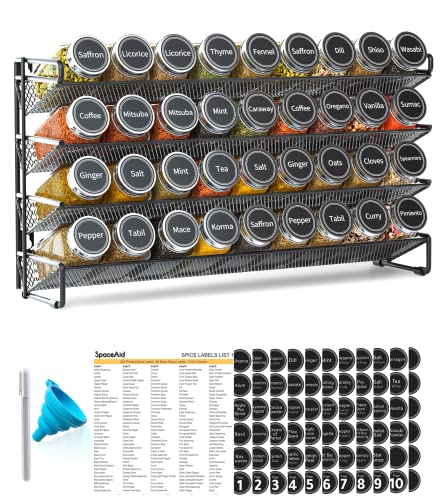
SpaceAid Spice Rack Organizer with 36 Spice Jars and 386 Labels
Best for: Best large uniform system | Format: 4-tier rack with jars included | Material: Steel rack; square glass jars
Size: 17.2 in W x 10.8 in H x 4.4 in D rack | Jars: 36 square 4 oz glass jars, 386 labels, chalk marker and funnel included
The SpaceAid Spice Rack Organizer with 36 Spice Jars and 386 Labels — full details below.
The 36-jar SpaceAid is the 28-jar system scaled for households that cook across cuisines: thirty-six square four-ounce glass jars on a four-tier steel rack a little over seventeen inches wide, with the same three hundred eighty-six waterproof labels, chalk marker and collapsible funnel. Thirty-six is a meaningful threshold — it is roughly where a collection stops being ‘the basics plus a few’ and becomes a working library spanning weeknight staples, a baking shelf and at least one cuisine you cook seriously. The square-jar geometry keeps paying rent at this size, packing a third more jars into the width than round bottles would allow, and the rack still offers cabinet, countertop, pantry and door-or-wall placements. Families who batch-cook, meal-preppers who rotate spice blends weekly, and anyone tired of a uniform core plus a chaotic overflow will recognise this as the single-system answer.
Who it suits: This pick suits everyday home cooks whose kitchen matches its format — read the size and jars lines above against your own space before anything else, because format fit decides satisfaction more than any feature list. Within that fit, it is the strongest verified option of its type at this tier.
Pros
- 36 uniform square jars end the core-plus-overflow two-system problem
- Same complete kit: 386 waterproof labels, marker and funnel included
- Four placement options — cabinet, counter, pantry, door or wall
- Square jars maximise capacity per inch at large collection sizes
Honest limitation: Seventeen-plus inches of width and nearly eleven of height demand a cabinet or pantry bay that can genuinely spare them — small kitchens should take the 28-jar or a drawer system instead. Filling and labelling thirty-six jars is a half-day project the first time.
Choose it if the format matches your space and the capacity matches your counted fleet. Skip it if the limitation above describes your kitchen — a better-fitting format is waiting elsewhere in this guide. Check on Amazon for the current listing, and confirm the dimensions there against your measurements before ordering.
Kamenstein 20-Jar Revolving Countertop Spice Rack (30020)
Best for: Best large revolving rack with spices included | Format: Revolving countertop carousel with spices included | Material: Polished stainless steel rack; glass jars with black caps
Size: Countertop carousel, 20-jar capacity | Jars: 20 jars, prefilled with spices; free refills for 5 years per maker programme
The Kamenstein 20-Jar Revolving Countertop Spice Rack (30020) — full details below.
The twenty-jar Kamenstein 30020 is the Heritage concept at family scale: twenty prefilled glass jars in a polished stainless carousel, cap labels you can read from above while it spins, and the same five-year refill programme from the maker. Twenty jars crosses the line from ‘staples’ into a genuinely useful working set for households that cook most nights — enough slots for the weeknight core, the baking spices and a small rotation of cuisine-specific blends without exiling anything to a cupboard overflow. The polished finish makes it the most display-worthy rack in this guide, the piece that sits by the hob like equipment rather than storage. As with the sixteen, the trade is fixed: you are adopting Kamenstein’s fleet and refill ecosystem in exchange for never decanting, never labelling and never running out mid-recipe because a refill programme has your back.
Who it suits: This pick suits everyday home cooks whose kitchen matches its format — read the size and jars lines above against your own space before anything else, because format fit decides satisfaction more than any feature list. Within that fit, it is the strongest verified option of its type at this tier.
Pros
- 20 prefilled jars cover a full family working set from day one
- Five-year maker refill programme removes refill shopping entirely
- Polished stainless carousel reads as equipment, not clutter, beside the hob
- Cap labels readable from above while spinning — fast mid-recipe finds
Honest limitation: The fixed prefilled selection and jar format lock you into the maker’s ecosystem; bulk-buyers and own-blend makers will chafe. It claims permanent counter space, so kitchens counting every inch should weigh a cabinet or drawer system instead.
Choose it if the format matches your space and the capacity matches your counted fleet. Skip it if the limitation above describes your kitchen — a better-fitting format is waiting elsewhere in this guide. Check on Amazon for the current listing, and confirm the dimensions there against your measurements before ordering.
YouCopia Chef’s Edition SpiceStack 30-Bottle Spice Organizer
Best for: Best high-capacity cabinet system | Format: Large 3-drawer pull-down organizer | Material: Plastic with universal drawers
Size: Largest SpiceStack footprint (see listing for exact dimensions) | Jars: No jars included — holds 30 full-size or 60 half-size bottles
The YouCopia Chef’s Edition SpiceStack 30-Bottle Spice Organizer — full details below.
The Chef’s Edition is the SpiceStack for collections that outgrew the standard models: thirty full-size bottles — or sixty half-size — across three deep universal drawers that pull out and tip down inside a generous cabinet bay. At this capacity the drawer logic really proves itself, because the alternative for thirty bottles is a shelf where at least ten jars are always hidden behind ten others. Here every bottle presents label-up in seconds, grouped by drawer — weeknight in one, baking in another, blends in the third is the arrangement most owners settle on. It is unapologetically a cabinet investment: it wants a wide, tall bay and rewards it by retiring every other spice overflow spot in the kitchen. Serious home cooks, recipe developers and big-family kitchens that treat spices as infrastructure rather than decoration are the audience, and for them this is frequently the last spice organizer they buy.
Who it suits: This pick suits everyday home cooks whose kitchen matches its format — read the size and jars lines above against your own space before anything else, because format fit decides satisfaction more than any feature list. Within that fit, it is the strongest verified option of its type at this tier.
Pros
- 30 full-size or 60 half-size capacity retires every overflow spot in the kitchen
- Three deep drawers group collections by cuisine or task
- Universal drawers accept the mixed bottle shapes large collections accumulate
- Pull-down presentation keeps even the thirtieth bottle findable in seconds
Honest limitation: Needs a genuinely wide, tall cabinet bay — measure twice, because this is the largest footprint in the SpiceStack family. At thirty bottles the unit is heavy when loaded, so lower cabinets or sturdy shelving suit it better than a flimsy high shelf.
Choose it if the format matches your space and the capacity matches your counted fleet. Skip it if the limitation above describes your kitchen — a better-fitting format is waiting elsewhere in this guide. Check on Amazon for the current listing, and confirm the dimensions there against your measurements before ordering.
SpaceAid Spice Rack Organizer with 28 Spice Jars and 386 Labels
Best for: Best complete cabinet system under mid budgets | Format: 4-tier rack with jars included | Material: Steel rack; square glass jars
Size: 13.4 in W x 10.8 in H rack | Jars: 28 square 4 oz glass jars, 386 waterproof labels, chalk marker and funnel included
The SpaceAid Spice Rack Organizer with 28 Spice Jars and 386 Labels — full details below.
The SpaceAid 28-jar system is the decant-everything answer: a four-tier steel rack, twenty-eight square glass jars, three hundred eighty-six waterproof labels, a chalk marker and a collapsible funnel, engineered to move an entire spice collection out of mismatched grocery bottles in one sitting. Square jars are the quiet headline — they pack edge to edge with no wasted crescents between round bottles, so twenty-eight jars fit a thirteen-inch rack that would hold far fewer rounds. The label library is the other headline: hundreds of pre-printed waterproof labels mean the system survives sink splashes and oily fingers, and the funnel makes refills a thirty-second job instead of a countertop spill. The rack itself works in a cabinet, on a counter, in a pantry, or mounted on a door or wall, which gives the system a second life if you move kitchens. This is the pick we hand to anyone who says the words ‘start from scratch’.
Who it suits: This pick suits everyday home cooks whose kitchen matches its format — read the size and jars lines above against your own space before anything else, because format fit decides satisfaction more than any feature list. Within that fit, it is the strongest verified option of its type at this tier.
Pros
- Complete system: rack, 28 square glass jars, 386 waterproof labels, marker and funnel
- Square jars pack without wasted gaps — more spices per inch of shelf
- One rack works in cabinet, on counter, in pantry, or door/wall mounted
- Waterproof labels survive splashes and greasy handling at the stove
Honest limitation: Decanting twenty-eight jars is a real project — set aside an afternoon, and accept that odd-shaped specialty tins will not join the uniform fleet. The four-tier height needs a cabinet with genuine vertical clearance, so measure before committing.
Choose it if the format matches your space and the capacity matches your counted fleet. Skip it if the limitation above describes your kitchen — a better-fitting format is waiting elsewhere in this guide. Check on Amazon for the current listing, and confirm the dimensions there against your measurements before ordering.
YouCopia SpiceStack Adjustable Spice Rack Organizer, 24-Bottle
Best for: Best adjustable drawer system | Format: Adjustable pull-down drawer organizer | Material: Plastic with adjustable dividers
Size: Cabinet footprint for standard upper cabinets (see listing) | Jars: No jars included — holds 24 bottles; 104 labels included
The YouCopia SpiceStack Adjustable Spice Rack Organizer, 24-Bottle — full details below.
The adjustable SpiceStack is the grown-up evolution of the original: the same pull-out, tip-down drawer logic, now with adjustable dividers and shelf heights that adapt to the bottles you actually own, plus a hundred and four included labels to finish the job. That adjustability matters because real spice collections are not uniform — squat paprika tins, tall garlic-powder bottles, half-size specialty jars — and fixed-geometry organizers force you to exile the misfits to a chaotic overflow shelf. Here, the drawers reconfigure around the collection instead of the other way round. Twenty-four bottles covers the great majority of home repertoires, and the drawers still present every label at a reading angle from inside an ordinary upper cabinet. If the original SpiceStack is the reliable sedan, this is the same car with the adjustable seats — the one households keep when the collection grows up.
Who it suits: This pick suits everyday home cooks whose kitchen matches its format — read the size and jars lines above against your own space before anything else, because format fit decides satisfaction more than any feature list. Within that fit, it is the strongest verified option of its type at this tier.
Pros
- Adjustable dividers and heights fit mixed bottle shapes instead of exiling them
- Pull-down drawers present all 24 bottles label-up at a comfortable angle
- 104 included labels finish the system without a second purchase
- No installation — sits in the cabinet and reconfigures in minutes
Honest limitation: Still a cabinet-bound system: cooks who want spices at the counter beside the hob should look at a stand or wall rack instead. The plastic build, while sturdy, lacks the heirloom feel of bamboo or steel at the top tiers of this guide.
Choose it if the format matches your space and the capacity matches your counted fleet. Skip it if the limitation above describes your kitchen — a better-fitting format is waiting elsewhere in this guide. Check on Amazon for the current listing, and confirm the dimensions there against your measurements before ordering.
Evermill Spice Rack System (maker-direct)
Best for: Best design-led direct system (prose-only) | Format: Countertop rack with refillable jars, sold direct by the maker | Material: Maker-specified rack and jars (see maker site)
Size: Countertop system (see maker site for current configuration) | Jars: Refillable jars with maker spice refills, sold as a direct system
Evermill represents the design-led end of the spice rack world: a countertop rack and refillable jar system sold directly by the maker rather than through Amazon, built around the idea that the rack is furniture and the spices are a refill service. We include it prose-only — there is no Amazon listing to link — because at the upper tiers of this guide it is the comparison serious buyers keep asking about: a curated jar fleet, a rack designed to be looked at, and refills sourced and shipped by the maker. The honest trade-offs are equally clear. A direct system means direct pricing, maker-dependent refill availability, and none of the one-click convenience or easy returns of a marketplace purchase. Households who treat the kitchen counter as a designed space and want the refill relationship handled for them will find it compelling; everyone else is better served by the linked systems in this guide, which is why Evermill appears here as context, not as a linked pick.
Who it suits: This pick suits everyday home cooks whose kitchen matches its format — read the size and jars lines above against your own space before anything else, because format fit decides satisfaction more than any feature list. Within that fit, it is the strongest verified option of its type at this tier.
Pros
- Design-led countertop presence — the rack is intended as a visible kitchen piece
- Refillable jar system with maker-supplied spice refills
- Curated fleet removes decanting and label decisions
Honest limitation: Sold only direct by the maker — no Amazon listing, so no marketplace pricing, delivery or returns convenience. Refill availability depends on the maker’s programme over time, unlike standard jars you can refill from any source.
Choose it if you can stretch beyond this tier’s ceiling — it is presented prose-only because its real price band sits above this budget, and we will not pretend otherwise. Skip it if the ceiling is firm; the linked picks above solve the same problem inside the budget. Search the maker’s name on Amazon to find its current listing when you are ready to step up.
Comparison table
Every pick side by side on the facts that decide fit: format, size, whether jars are included, and who should take it home. Prices are deliberately absent — check price on Amazon on the day you buy.
| Pick | Format | Size | Jars included | Best for |
|---|---|---|---|---|
| SpaceAid Spice Rack Organizer with 36 Spice Jars and 386 Labels | 4-tier rack with jars included | 17.2 in W x 10.8 in H x 4.4 in D rack | Yes — see review | Best large uniform system |
| Kamenstein 20-Jar Revolving Countertop Spice Rack (30020) | Revolving countertop carousel with spices included | Countertop carousel, 20-jar capacity | No — use your own | Best large revolving rack with spices included |
| YouCopia Chef’s Edition SpiceStack 30-Bottle Spice Organizer | Large 3-drawer pull-down organizer | Largest SpiceStack footprint (see listing for exact dimensions) | No — use your own | Best high-capacity cabinet system |
| SpaceAid Spice Rack Organizer with 28 Spice Jars and 386 Labels | 4-tier rack with jars included | 13.4 in W x 10.8 in H rack | Yes — see review | Best complete cabinet system under mid budgets |
| YouCopia SpiceStack Adjustable Spice Rack Organizer, 24-Bottle | Adjustable pull-down drawer organizer | Cabinet footprint for standard upper cabinets (see listing) | No — use your own | Best adjustable drawer system |
| Evermill Spice Rack System (maker-direct) | Countertop rack with refillable jars, sold direct by the maker | Countertop system (see maker site for current configuration) | Maker system — see review | Best design-led direct system (prose-only) |
How to choose: making the best spice rack under $150 decision
Start with location, not product. Walk to your kitchen and answer one question: where will this rack live? Inside a cabinet points to step shelves, pull-down drawers or a slide-out. On the counter points to stands and carousels. On a wall or door points to mounted wire racks. Inside a drawer points to an expandable insert. Every format in this guide is the best answer somewhere and the wrong answer somewhere else, and location eliminates half the field instantly.
Then count your jars — honestly, including the overflow in the pantry and the duplicates you will find while counting. Under fifteen jars, a step shelf or caddy suffices and a big system is overkill. Fifteen to twenty-five is the heartland where drawer systems and 28-jar fleets shine. Beyond thirty, only the largest systems retire the overflow problem; anything smaller just relocates it. Match capacity to the counted number, not to the number you wish you had.
Finally, decide the jar question. If your current bottles are a chaos of shapes, a uniform jar system pays for itself in visibility and calm. If your bottles are already reasonably uniform — one grocery brand’s jars, say — a bare rack preserves that investment. And if you do not want to decant anything ever, the prefilled carousels exist precisely for you.
Whatever format you choose, run the same three measurements before ordering: the width of the space, the depth of the space, and the height of the tallest jar or the clearance the mechanism needs. Write them on a note in your phone and compare them against the comparison table and the listing itself. Spice racks fail by millimetres, not by concepts — the right format in the wrong size is simply the wrong rack, and every return in this category begins with a measurement nobody took.
Setting up and loading your rack
Setup day decides whether the rack stays organised, so do it in the right order. First, empty the current spice chaos completely onto a counter — every jar, including the pantry overflow and the drawer strays. Consolidate duplicates (oldest to the front), discard anything ground that has lost its aroma, and count what remains: that number, not your guess, is the fleet the rack must hold. Second, install or place the empty rack and live with its position for one cooking session before loading it; a rack that fights the cabinet door or the prep flow should move now, not after it is full. Third, load by zone, not by alphabet: the spices you used this week go in the prime positions — front row, top drawer, eye-level tier — and occasionals take the rest, with labels facing the direction you will actually read them from (fronts for shelves, lids for drawers and carousels). Fourth, if the system includes jars and labels, decant in one sitting with the funnel, label body and lid before filling the next jar, and write the fill month on the base. Finally, cook with the new layout for a week before judging it: every household moves exactly two or three jars after the first real week, and that small rearrangement is the system settling, not failing.
For everyday home cooks, one extra setup habit pays for itself: photograph the loaded rack on day one. The photo becomes the reference when the system drifts — and all shared or high-throughput systems drift — because restoring a photographed layout takes two minutes and no decisions. Keep the photo on your phone, refresh it after any deliberate rearrangement, and let it settle the recurring question of where a jar lives.
Common mistakes to avoid
Buying capacity before counting jars
Shoppers guess ‘about twenty’ and discover thirty-four, including duplicates of cumin in three locations. Count first, including pantry overflow, then buy capacity for the counted fleet plus a little growth — not double, and not exactly the count, because collections creep.
Ignoring cabinet interior measurements
Rack dimensions are meaningless until they meet your cabinet’s interior width, depth and shelf height. The gap between a rack that fits and one that almost fits is a return label. Measure the interior, subtract door-hinge intrusion, and compare against the published dimensions in our comparison table.
Choosing a carousel for a scanning brain
Carousels show one face at a time. If you find things by scanning a whole field at once, a step shelf or wall rack will feel faster every single day, and the carousel will feel like a toy you tolerate. Match the visibility style to how you actually search.
Decanting without a labelling plan
Uniform jars are only an upgrade if every jar is labelled the day it is filled — paprika and smoked paprika are indistinguishable at a glance, and cayenne forgives nobody. Use the included label libraries, label lids as well as fronts, and date the fill on the base.
Storing the rack over the hob
Steam and heat are spice killers, and a rack directly over the cooking surface bathes in both. Any format in this guide works better a step to the side — close enough to reach mid-recipe, far enough that the jars stay cool and dry.
Forgetting the door-swing test
Wall and door-mounted racks add depth to a door’s swing path. Before mounting, tape a jar’s worth of cardboard to the door and swing it: if it kisses the cabinet frame, choose a shallower home or a different format.
Rack, jars and the system question
Because this guide is rack-first, it is worth stating the system question plainly once more. A bare rack — step shelf, caddy, wall rack, drawer system, insert — presumes your jars are worth keeping: reasonably uniform, sound lids, labels you can read. A jar-inclusive system presumes they are not, and replaces the fleet wholesale. Audit your jars before you shop, not after the rack arrives: line them up, count shapes, check lids. If three or more shapes compete and half the labels face different directions, the fleet is the problem and a system is the answer. If the fleet is tidy and only the storage is chaotic, a bare rack is the cheaper, less wasteful fix — and leaves budget for the spices themselves.
One more consideration separates satisfied owners from returners: the growth question. Spice collections change — a new cuisine phase, a baking era, a gift set at the holidays — and a rack bought at exactly today’s capacity has no answer for next year’s jars. The formats differ in how they grow. Step shelves and caddies multiply cheaply (a second unit beside the first), drawer systems and jar fleets mostly do not — they are replaced, not extended — and wall racks grow by the tier if wall remains. None of this argues for buying the biggest system today; it argues for knowing, before you buy, what your own growth path looks like if the collection expands by half. The reviews above note each pick’s ceiling plainly, so the choice can be made with the future in view rather than discovered against it.
Care is mercifully simple across every format here. Wipe racks monthly — spice dust is fine, abrasive and faintly greasy, and it builds up exactly where jars sit. Plastic and coated steel take a damp cloth; bamboo wants a dry or barely damp one and no soaking; chrome wire appreciates being dried after washing to protect the finish. Once a season, empty the rack fully, check every jar for aroma (a ground spice that smells like dust is done, whatever the date says), consolidate duplicates, and let the empty-rack moment be your inventory audit. Ten minutes, four times a year, is the entire maintenance contract of a well-chosen rack.
Final recommendation
If you read nothing else: start with the format that matches your space, and within that format start with SpaceAid Spice Rack Organizer with 36 Spice Jars and 386 Labels — our lead pick for everyday home cooks at this tier, chosen because its format solves the most common version of the problem for the most kitchens. It is not the right answer for every kitchen in this guide, and the reviews above are deliberately plain about who should skip it and for what. But as a default — the pick to beat, the one the others must argue against for your specific space — it earns the position.
Shortlist: SpaceAid Spice Rack Organizer with 36 Spice Jars and 386 Labels — Check on Amazon | Kamenstein 20-Jar Revolving Countertop Spice Rack (30020) — Check on Amazon
Above all, respect the tier honestly. A budget is information, not a challenge: at tiers where the linked picks are few, that is the market telling you what money buys in this category, and a good rack inside the budget will serve you better than a great system bought by pretending the budget was higher. Measure your space, count your jars, choose your format — in that order — and the best spice rack under $150 stops being a search and becomes a decision you only make once.
Frequently asked questions
What is the best type of spice rack for a typical kitchen?
For a typical cabinet-based kitchen, a step shelf is the cheapest genuine fix and a pull-down drawer system is the most satisfying one. Countertop stands and carousels suit kitchens with counter space to spare, wall racks suit kitchens with none, and drawer inserts suit kitchens with a spare wide drawer. The best type is the one whose location you actually have free.
Is it better to buy a spice rack with jars included or use my own jars?
If your current jars are mismatched shapes from many brands, a jar-inclusive system gives you uniformity, tight packing and labels in one purchase. If your jars are already fairly uniform, a bare rack is cheaper and wastes nothing. The middle path — a rack now, jars later — works too, because most racks accept standard jars whenever you are ready.
How many spices does an average home cook actually need on a rack?
Most households actively use somewhere between fifteen and thirty spices; the rest of a large collection is occasional. A rack sized for your active fleet, with occasionals stored elsewhere, beats a giant rack half-filled with jars you touch twice a year. Count what you used in the last month and size for that plus modest growth.
Should spices be stored in a cabinet, a drawer or on the counter?
All three work if the spot is cool, dry and away from direct hob steam. Cabinets and drawers add darkness, which spices prefer; counters add instant access, which cooks prefer. The genuinely bad locations are above the hob, beside the kettle’s steam vent, and on a sunny windowsill.
Do revolving spice racks hold as much as tiered racks?
Generally fewer jars per footprint at small sizes, more convenience per reach. A carousel trades simultaneous visibility for one-finger access. If your collection is sixteen to twenty jars and lives on the counter, a carousel is entirely practical; beyond that, tiered and drawer formats scale better.
How do I keep a spice rack organised after the first month?
Assign every jar a fixed home, return it there while you cook rather than after, and audit the rack when you write a shopping list — the two-minute habit that prevents duplicates. Uniform systems help because a gap in the row is visibly a missing jar, which is itself a reminder.
Related guides
Keep organising the same corner of the kitchen with these companion guides:


