Where to buy
Check the latest price, availability and delivery on Amazon. Orders are placed on Amazon. We may earn a commission from qualifying purchases.
- Best overall: Joseph Joseph DrawerStore Compact Cutlery Organizer, Small, Grey — Check on Amazon
- madesmart Classic Large Silverware Tray, Granite — Check on Amazon
- madesmart Classic Small Silverware Tray — Check on Amazon
- Basic five-compartment plastic cutlery tray (unbranded, prose-only pick) (prose-only pick — no verified listing at this tier, see the review below)
- Expandable bamboo drawer dividers, pair (unbranded, prose-only pick) (prose-only pick — no verified listing at this tier, see the review below)
- Small clear storage bins, mixed set (unbranded, prose-only pick) (prose-only pick — no verified listing at this tier, see the review below)
Disclosure: As an Amazon Associate, dailyhomedecorating.com earns from qualifying purchases. Links to Amazon on this page are affiliate links; they cost you nothing extra. Listing details such as price and availability change often, so check the current Amazon listing before you buy.
If you are searching for the best kitchen drawer organizer under $15, you already know the real problem is not a shortage of storage products — it is that most drawer organisers are designed for a standard drawer that many kitchens do not have, and for a household that tidies once and photographs it. This guide takes the opposite approach. It starts from your budget of under $15, narrows the field to organisers that genuinely earn their space at that level, and explains — pick by pick — who each one suits, where it falls short, and when you should skip it and choose a different style instead.
This guide judges drawer organisers the way a working kitchen does: by whether the drawer still makes sense on a tired weeknight, three months after the organiser went in. Every pick below was chosen for a standard cutlery or gadget drawer, measured against real drawer dimensions, and assessed on how it handles the mix most homes actually own — a place setting’s worth of cutlery, a handful of gadgets, and the small loose items that migrate into every drawer.
The shortlist below is the same one we would hand to a friend with this budget: a small number of organisers, each the best answer to a different version of the problem. If your drawer is a standard cutlery drawer, the top picks will fit and work immediately. If your drawer is narrow, deep, shallow or shared with another job, the modular and expanding options further down are there for you. Internal guides that pair naturally with this one include Best Airtight Food Storage Containers Under $15 for the pantry side of the same system, and the other drawer layouts in Best Kitchen Drawer Organizer Under $15 — read the fit notes before you order anything, because drawer organisation succeeds or fails on measurements, not on enthusiasm.
One promise before the picks: this guide does not print fixed product prices, because Amazon prices move. Where a pick has a live listing, we say check price on Amazon and link you to it. Where a tier has no verifiable branded product, we say so honestly and describe what to buy in a shop instead, as a prose-only pick with no link. Under $15 is the budget frame for everything that follows — the framing is fixed, the live price is yours to check.
In this guide
Quick picks: the best kitchen drawer organizer under $15 shortlist
Six picks, six different answers. Start with the first row that matches your drawer and your problem.
| Pick | Style | Best for | Where to check |
|---|---|---|---|
| Joseph Joseph DrawerStore Compact, Small | Moulded plastic with angled, overlapping compartments and cutlery icons | Overall balance of fit, visibility and cleaning | See the full review below |
| madesmart Classic Large Silverware Tray | BPA-free plastic with soft-grip lining and non-slip rubber feet | The household’s main cutlery drawer | See the full review below |
| madesmart Classic Small Silverware Tray | BPA-free plastic with soft-grip lining | Small items and flexible layouts | See the full review below |
| Basic unbranded five-compartment tray | Thin moulded plastic, five flat compartments | Odd or non-standard drawer widths | Prose-only — see review |
| Expandable bamboo drawer dividers | Spring-loaded bamboo divider bars that press against the drawer sides | A single stubborn problem (bags, gadgets or overflow) | Prose-only — see review |
| Small clear bins, mixed set | Clear plastic bins in mixed small sizes | The second drawer or the next job along | Prose-only — see review |
How these picks were chosen
We weighted four things. First, fit: the organiser must suit common drawer widths and depths, or adjust to them. Second, visibility: you should see what you need without excavation. Third, stability: linings, feet and weight that stop the organiser sliding every time the drawer moves. Fourth, cleaning: crumbs and drips are guaranteed, so anything that cannot be wiped or rinsed quickly loses marks.
Every linked pick in this guide was verified against a live Amazon listing or the manufacturer’s own product information before it was included, and the sources for each pick are recorded with this article. That verification step is why some tiers in this series contain prose-only picks: when we could not verify a branded product at the budget, we described the product type honestly instead of attaching a link we could not stand behind. Specifications quoted — dimensions, compartment counts, materials — come from the manufacturer or the listing, not from other roundups.
We also applied a survivorship test: would this organiser still be the right answer after the novelty wears off? Trays that only work when loaded one specific way, bins that need constant re-arranging, and dividers that creep were marked down, however good they look in a photograph. What survived is a list biased toward boring reliability — organisers that keep working when the drawer is loaded in a hurry, by someone who did not read this guide.
Finally, the budget itself was treated as a design constraint, not just a filter. Under $15 means the whole solution should land under $15: where a single product does the job, that is the pick; where the honest answer at this level is a combination — an organiser plus the drawer it cannot cover left for a later purchase — the reviews say so plainly.
The best kitchen drawer organizer under $15 picks, reviewed in detail
1. Joseph Joseph DrawerStore Compact Cutlery Organizer, Small, Grey
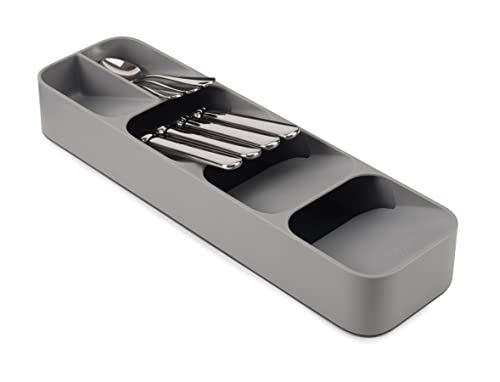
This is the small-space specialist in the Joseph Joseph DrawerStore line. Instead of laying forks, knives and spoons flat in separate wide channels, it stacks each type in an angled, overlapping slot, so a full place setting for a household takes up roughly half the drawer width of a conventional tray. Moulded icons on each slot tell you what goes where, which sounds like a gimmick until a guest is unloading the dishwasher and everything still lands in the right place. The trade-off for that compactness is visibility: handles sit on top of each other, so you identify pieces by handle shape rather than seeing the whole utensil laid out flat.
Materials and build: Moulded plastic with angled, overlapping compartments and cutlery icons. Fit: Compact footprint made for narrow drawers; the angled slots stack cutlery vertically instead of side by side. In a everyday kitchen, what matters most is fit, visibility, cleaning and how the layout survives daily use; judged on that basis, this pick earns its place at number 1 in this budget because it solves its specific job without demanding compromises elsewhere in the drawer. Treat the dimensions as the deciding factor: check them against your drawer’s internal measurements before ordering, because a quarter-inch is the difference between a drawer that glides and a drawer that jams.
Who it suits: Anyone whose main frustration matches what this organiser fixes — and, at this budget level, anyone who wants that fix handled by one purchase rather than a system of parts. It is less suitable if your drawer is an unusual shape, in which case the modular options elsewhere in this guide will serve you better.
In daily use: The test of any drawer organiser is the third week, not the first day. By then the novelty layout has met the reality of how your household actually cooks and unloads the dishwasher. This is where the Joseph Joseph DrawerStore Compact, Small earns or loses its place in a everyday kitchen: sections that match real habits stay tidy on their own, while sections that fight them quietly fill with whatever was in someone’s hand. Load it the way the design intends for the first week — it takes that long for a new layout to become the path of least resistance — and judge it after a normal fortnight of meals, not after the careful first arrangement. If a section keeps collecting the wrong items, that is information about the layout, not a failure of discipline: swap that section’s job to match what actually lands there, and the system will hold.
Pros:
- Stacks cutlery vertically, freeing half the drawer for other storage
- Moulded icons make it obvious where each type of cutlery belongs
- One-piece moulding wipes clean and has no seams to trap crumbs
Honest limitation: Stacked layout hides the working end of each utensil, so picking out one specific fork takes a second longer than with a flat tray.
Choose it if the fit matches your drawer and the job above is the one you need done. Skip it if your drawer measurements rule it out or you need a different style of storage entirely. Check on Amazon — check price on Amazon on the live listing, since prices and availability change.
2. madesmart Classic Large Silverware Tray, Granite
The madesmart Classic Large is the conventional flat tray done properly. Six compartments lay cutlery out flat and visible, the soft-grip lining stops pieces sliding and rattling every time the drawer opens, and rubber feet keep the whole tray from travelling. Icons moulded into the compartments keep sorting simple. It does not stack, expand or fold, and that is precisely its appeal for a lot of households: everything is visible at a glance, it rinses clean in seconds, and it has been a steady, widely available design for years rather than a novelty.
Materials and build: BPA-free plastic with soft-grip lining and non-slip rubber feet; six compartments. Fit: About 16 x 12.9 inches, sized for a standard kitchen drawer, with a wide compartment for serving pieces. In a everyday kitchen, what matters most is fit, visibility, cleaning and how the layout survives daily use; judged on that basis, this pick earns its place at number 2 in this budget because it solves its specific job without demanding compromises elsewhere in the drawer. Treat the dimensions as the deciding factor: check them against your drawer’s internal measurements before ordering, because a quarter-inch is the difference between a drawer that glides and a drawer that jams.
Who it suits: Anyone whose main frustration matches what this organiser fixes — and, at this budget level, anyone who wants that fix handled by one purchase rather than a system of parts. It is less suitable if your drawer is an unusual shape, in which case the modular options elsewhere in this guide will serve you better.
In daily use: The test of any drawer organiser is the third week, not the first day. By then the novelty layout has met the reality of how your household actually cooks and unloads the dishwasher. This is where the madesmart Classic Large Silverware Tray earns or loses its place in a everyday kitchen: sections that match real habits stay tidy on their own, while sections that fight them quietly fill with whatever was in someone’s hand. Load it the way the design intends for the first week — it takes that long for a new layout to become the path of least resistance — and judge it after a normal fortnight of meals, not after the careful first arrangement. If a section keeps collecting the wrong items, that is information about the layout, not a failure of discipline: swap that section’s job to match what actually lands there, and the system will hold.
Pros:
- Flat layout keeps every piece visible and quick to grab
- Soft-grip lining and rubber feet stop sliding and rattling
- Simple, durable design that rinses clean in seconds
Honest limitation: Fixed footprint: drawers narrower than the tray simply cannot use it, and it leaves side gaps in wide drawers.
Choose it if the fit matches your drawer and the job above is the one you need done. Skip it if your drawer measurements rule it out or you need a different style of storage entirely. Check on Amazon — check price on Amazon on the live listing, since prices and availability change.
3. madesmart Classic Small Silverware Tray
The small madesmart Classic applies the same flat, soft-grip-lined layout as the large tray to a smaller footprint, which makes it the natural pick for a narrow drawer, a smaller household, or a second tray dedicated to children’s cutlery or baking tools. Five compartments cover the everyday set without pretending to swallow serving pieces for twelve. As with the large version, the appeal is visibility and simplicity: cutlery lies flat, stays put on the lined base, and the tray lifts out for a quick rinse.
Materials and build: BPA-free plastic with soft-grip lining; five compartments. Fit: Smaller footprint for narrow drawers, small households and second drawers. In a everyday kitchen, what matters most is fit, visibility, cleaning and how the layout survives daily use; judged on that basis, this pick earns its place at number 3 in this budget because it solves its specific job without demanding compromises elsewhere in the drawer. Treat the dimensions as the deciding factor: check them against your drawer’s internal measurements before ordering, because a quarter-inch is the difference between a drawer that glides and a drawer that jams.
Who it suits: Anyone whose main frustration matches what this organiser fixes — and, at this budget level, anyone who wants that fix handled by one purchase rather than a system of parts. It is less suitable if your drawer is an unusual shape, in which case the modular options elsewhere in this guide will serve you better.
In daily use: The test of any drawer organiser is the third week, not the first day. By then the novelty layout has met the reality of how your household actually cooks and unloads the dishwasher. This is where the madesmart Classic Small Silverware Tray earns or loses its place in a everyday kitchen: sections that match real habits stay tidy on their own, while sections that fight them quietly fill with whatever was in someone’s hand. Load it the way the design intends for the first week — it takes that long for a new layout to become the path of least resistance — and judge it after a normal fortnight of meals, not after the careful first arrangement. If a section keeps collecting the wrong items, that is information about the layout, not a failure of discipline: swap that section’s job to match what actually lands there, and the system will hold.
Pros:
- Right-sized for narrow drawers where the large tray will not fit
- Soft-grip lining keeps small sets from sliding into a heap
- Easy second tray for kids’ cutlery or a baking drawer
Honest limitation: Five compartments fill quickly; households with large place settings will outgrow it.
Choose it if the fit matches your drawer and the job above is the one you need done. Skip it if your drawer measurements rule it out or you need a different style of storage entirely. Check on Amazon — check price on Amazon on the live listing, since prices and availability change.
4. Basic five-compartment plastic cutlery tray (unbranded, prose-only pick)
Below a certain budget, the honest recommendation is the unbranded five-compartment tray sold in supermarkets and discount home stores. We could not verify a branded version with a stable Amazon listing at this tier, so this pick is prose-only: no link, no invented brand. What you get is a flat tray with channels for knives, forks, spoons and a spare section. The plastic is thinner than the branded trays above, it slides unless you add a liner, and it will not last a decade — but it organises a drawer today for very little money, and it is the right buy when the alternative is no tray at all.
Materials and build: Thin moulded plastic, five flat compartments. Fit: Standard small footprint sold in supermarkets and discount home stores. In a everyday kitchen, what matters most is fit, visibility, cleaning and how the layout survives daily use; judged on that basis, this pick earns its place at number 4 in this budget because it solves its specific job without demanding compromises elsewhere in the drawer. Treat the dimensions as the deciding factor: check them against your drawer’s internal measurements before ordering, because a quarter-inch is the difference between a drawer that glides and a drawer that jams.
Who it suits: Anyone whose main frustration matches what this organiser fixes — and, at this budget level, anyone who wants that fix handled by one purchase rather than a system of parts. It is less suitable if your drawer is an unusual shape, in which case the modular options elsewhere in this guide will serve you better.
In daily use: The test of any drawer organiser is the third week, not the first day. By then the novelty layout has met the reality of how your household actually cooks and unloads the dishwasher. This is where the Basic unbranded five-compartment tray earns or loses its place in a everyday kitchen: sections that match real habits stay tidy on their own, while sections that fight them quietly fill with whatever was in someone’s hand. Load it the way the design intends for the first week — it takes that long for a new layout to become the path of least resistance — and judge it after a normal fortnight of meals, not after the careful first arrangement. If a section keeps collecting the wrong items, that is information about the layout, not a failure of discipline: swap that section’s job to match what actually lands there, and the system will hold.
Pros:
- Cheapest way to get a drawer organised today
- Available in physical stores, so you can check the fit before paying
- Flat layout keeps everything visible
Honest limitation: Thin plastic flexes and cracks sooner than branded trays, and it slides without a drawer liner.
Choose it if the budget is the hard constraint and you want the job done now. Skip it if you can stretch to one of the linked branded picks above, which will outlast it. This is a prose-only pick: we could not verify a branded version with a stable Amazon listing at this tier, so there is deliberately no purchase link.
5. Expandable bamboo drawer dividers, pair (unbranded, prose-only pick)
Divider bars solve a different problem from trays: instead of compartments, they split a drawer into long lanes, which suits spatulas, tongs, rolling pins and foil boxes better than small sections. Unbranded bamboo divider pairs are widely sold at this budget, but listings and branding change too often for us to pin one verified Amazon listing here, so this pick is prose-only. Look for spring-loaded ends with rubber pads, check the length range against your drawer’s depth, and expect to re-seat them occasionally — dividers that rely on friction can creep when a drawer is slammed.
Materials and build: Spring-loaded bamboo divider bars that press against the drawer sides. Fit: Adjustable length; creates two or three long lanes inside almost any drawer. In a everyday kitchen, what matters most is fit, visibility, cleaning and how the layout survives daily use; judged on that basis, this pick earns its place at number 5 in this budget because it solves its specific job without demanding compromises elsewhere in the drawer. Treat the dimensions as the deciding factor: check them against your drawer’s internal measurements before ordering, because a quarter-inch is the difference between a drawer that glides and a drawer that jams.
Who it suits: Anyone whose main frustration matches what this organiser fixes — and, at this budget level, anyone who wants that fix handled by one purchase rather than a system of parts. It is less suitable if your drawer is an unusual shape, in which case the modular options elsewhere in this guide will serve you better.
In daily use: The test of any drawer organiser is the third week, not the first day. By then the novelty layout has met the reality of how your household actually cooks and unloads the dishwasher. This is where the Expandable bamboo drawer dividers earns or loses its place in a everyday kitchen: sections that match real habits stay tidy on their own, while sections that fight them quietly fill with whatever was in someone’s hand. Load it the way the design intends for the first week — it takes that long for a new layout to become the path of least resistance — and judge it after a normal fortnight of meals, not after the careful first arrangement. If a section keeps collecting the wrong items, that is information about the layout, not a failure of discipline: swap that section’s job to match what actually lands there, and the system will hold.
Pros:
- Creates long lanes that trays cannot, ideal for utensils and wrap boxes
- Fits almost any drawer because the length adjusts
- No footprint wasted on tray walls
Honest limitation: Friction-fit dividers can creep out of position, and they give no small-item compartments.
Choose it if the budget is the hard constraint and you want the job done now. Skip it if you can stretch to one of the linked branded picks above, which will outlast it. This is a prose-only pick: we could not verify a branded version with a stable Amazon listing at this tier, so there is deliberately no purchase link.
6. Small clear storage bins, mixed set (unbranded, prose-only pick)
At the lowest budgets, a handful of small clear bins is often more useful than one cutlery tray, because the worst drawer chaos comes from small loose items, not from forks. Generic mixed bin sets are sold everywhere at this tier, but we could not verify one branded set with a stable listing at this exact budget, so treat this as a prose-only, buy-it-anywhere recommendation: choose bins about 2 inches tall so the drawer still closes over them, group one job per bin, and resist mixing leftovers into the same bin ‘temporarily’, which is how the junk drawer is born.
Materials and build: Clear plastic bins in mixed small sizes. Fit: Small squares and rectangles for clips, ties, batteries and measuring spoons. In a everyday kitchen, what matters most is fit, visibility, cleaning and how the layout survives daily use; judged on that basis, this pick earns its place at number 6 in this budget because it solves its specific job without demanding compromises elsewhere in the drawer. Treat the dimensions as the deciding factor: check them against your drawer’s internal measurements before ordering, because a quarter-inch is the difference between a drawer that glides and a drawer that jams.
Who it suits: Anyone whose main frustration matches what this organiser fixes — and, at this budget level, anyone who wants that fix handled by one purchase rather than a system of parts. It is less suitable if your drawer is an unusual shape, in which case the modular options elsewhere in this guide will serve you better.
In daily use: The test of any drawer organiser is the third week, not the first day. By then the novelty layout has met the reality of how your household actually cooks and unloads the dishwasher. This is where the Small clear bins, mixed set earns or loses its place in a everyday kitchen: sections that match real habits stay tidy on their own, while sections that fight them quietly fill with whatever was in someone’s hand. Load it the way the design intends for the first week — it takes that long for a new layout to become the path of least resistance — and judge it after a normal fortnight of meals, not after the careful first arrangement. If a section keeps collecting the wrong items, that is information about the layout, not a failure of discipline: swap that section’s job to match what actually lands there, and the system will hold.
Pros:
- Targets the small loose items that cause most drawer chaos
- Clear walls keep contents visible
- Can be bought a few at a time as the budget allows
Honest limitation: No dividers inside each bin, so discipline matters more than the product.
Choose it if the budget is the hard constraint and you want the job done now. Skip it if you can stretch to one of the linked branded picks above, which will outlast it. This is a prose-only pick: we could not verify a branded version with a stable Amazon listing at this tier, so there is deliberately no purchase link.
Comparison table
| Pick | Material | Fit in one line | Link |
|---|---|---|---|
| Joseph Joseph DrawerStore Compact, Small | Moulded plastic with angled, overlapping compartments and cutlery icons | Compact footprint made for narrow drawers; the angled slots stack cutlery vertically instead of side by side | Check on Amazon |
| madesmart Classic Large Silverware Tray | BPA-free plastic with soft-grip lining and non-slip rubber feet; six compartments | About 16 x 12.9 inches, sized for a standard kitchen drawer, with a wide compartment for serving pieces | Check on Amazon |
| madesmart Classic Small Silverware Tray | BPA-free plastic with soft-grip lining; five compartments | Smaller footprint for narrow drawers, small households and second drawers | Check on Amazon |
| Basic unbranded five-compartment tray | Thin moulded plastic, five flat compartments | Standard small footprint sold in supermarkets and discount home stores | Prose-only |
| Expandable bamboo drawer dividers | Spring-loaded bamboo divider bars that press against the drawer sides | Adjustable length; creates two or three long lanes inside almost any drawer | Prose-only |
| Small clear bins, mixed set | Clear plastic bins in mixed small sizes | Small squares and rectangles for clips, ties, batteries and measuring spoons | Prose-only |
How to choose a kitchen drawer organizer under $15
Measure the drawer, not the gap in the units. Internal width, depth and height, taken with a tape measure at the narrowest points. Drawer boxes are often narrower than the cabinet they sit in, runners intrude, and some drawers slope at the back. Write the three numbers on a sticky note on the drawer front until the organiser arrives; it prevents the most common return in this category.
Decide what the drawer is for — only that. One drawer, one job: cutlery, gadgets, or pantry consumables. Organisers fail when a drawer tries to be two things, because the layout that suits cutlery cannot suit foil boxes. If one drawer must do two jobs in your kitchen, choose modular bins and give each job a hard boundary of bins rather than letting them interleave.
Match the style to the contents. Flat trays for visibility and speed. Stacked, angled trays for density in narrow drawers. Expanding trays for non-standard widths. Modular bins for mixed small items and odd shapes. Dedicated organisers — like the bag storage box in this guide — for the one problem that wastes the most space. Picking the style first and the product second prevents most disappointing purchases.
Plan for cleaning from day one. One-piece trays rinse fastest; modular sets take longer but let you wash one bin at a time; bamboo wants a wipe, not a soak. None of these is a reason to reject a pick, but the right match between the organiser and your tolerance for cleaning is a reason the drawer will still be organised in a year.
Spend the budget where the drawer is opened most. Under $15 buys a lot of organisation if it is concentrated on the drawer you open twenty times a day, and disappointingly little if it is spread thinly across four drawers. One drawer done properly teaches you what your household maintains; the rest can follow in later purchases, guided by the related layouts in Best Kitchen Drawer Organizer Under $50 and Best Airtight Food Storage Containers For Pantry Organization Under $15.
Common mistakes
Skipping the measurements. Buying for the drawer you wish you had. Measure the internal width, depth and height of the actual drawer — including the slope at the back of some drawers and any screws or runners that intrude — before ordering anything.
Organising before decluttering. An organiser sized for everything you own today, including the third peeler and the fondue forks, is an organiser sized wrong. Empty the drawer, remove what has not been used in a year, and organise what remains — the right product is often one size smaller and one tier cheaper than your first instinct.
Filling every compartment on day one. Leave one section or bin deliberately under-filled. Drawers accumulate: a new gadget, a gift, the good scissors. A system with no slack becomes a system with an overflow pile on top of it within a month.
Putting wet items straight into bamboo or lined trays. A quick shake or a second on a tea towel first. Constant damp shortens the life of bamboo, lifts linings, and is the main reason organisers start to smell like the drawer they were meant to fix.
Buying a matching set for every drawer at once. Different drawers need different styles. Cutlery wants a tray; gadgets want depth; pantry overflow wants bins and a bag organiser. Uniform sets look tidy in a listing photograph and underperform in a real kitchen.
Final recommendation
For most readers searching for the best kitchen drawer organizer under $15, the first pick is the right place to start: Joseph Joseph DrawerStore Compact, Small. Start with the Joseph Joseph DrawerStore Compact Cutlery Organizer, Small, Grey — Check on Amazon to check price on Amazon. If your drawer points the other way, the runner-up is the madesmart Classic Large Silverware Tray, Granite. It matches the way this budget is best spent — one organiser that fixes the main drawer properly — and it leaves the rest of this guide’s picks available as the second step when you know exactly what your household needs next.
If your drawer is unusual — very narrow, very deep, or doing two jobs — skip the headline pick and go modular or expanding instead; the reviews above are written so you can make that call in one reading. And if the honest answer at under $15 for your specific problem is one of the prose-only picks, buy it in a shop with the drawer measurements in your pocket. The best organiser is the one that fits your drawer and your habits, and every option in this guide was chosen to be exactly that for somebody.
FAQ
How do I measure a drawer for an organizer?
Measure the inside of the empty drawer box: width between the sides, depth from front to back, and height from the base to the underside of whatever is above, with the drawer closed. Use the smallest measurement if the drawer tapers, and leave a small margin — an organiser that exactly equals the internal width will scrape or jam.
How many compartments does a kitchen drawer organizer need?
Most households do well with five to eight sections: knives, forks, spoons, teaspoons, serving pieces, and one or two gadget zones. More compartments than that usually means each section is too small to be useful.
Are bamboo drawer organizers hygienic?
Yes, with simple care: wipe them clean, dry them after washing, and do not soak them or put soaking-wet utensils into them daily. Bamboo is naturally dense and resists absorbing moisture in normal use, which is why it is used for chopping boards as well as drawer organisers.
Should I choose a tray, an expanding organizer or modular bins?
Choose a tray for a standard cutlery drawer where everything should be visible. Choose an expanding organiser when the drawer width is non-standard and a fixed tray would leave a wasted gap. Choose modular bins when the contents are mixed, small or change often, or when the drawer shape is awkward.
How do I stop an organizer sliding inside the drawer?
Use an organiser with non-slip feet or a soft-grip base, add a thin non-slip drawer liner underneath, or choose a heavier material such as bamboo. Sliding is worst in half-empty drawers; a liner fixes it regardless of the organiser.
Is under $15 enough for a good kitchen drawer organizer?
Yes, if the budget is spent on one drawer and one job. At this level you can buy a well-made tray, an expanding organiser or a useful modular set. What the budget will not do is organise every drawer in the kitchen at once — and guides that promise otherwise are usually recommending products too thin to last.
A note on drawer height, because it decides more purchases than any other measurement: most cutlery trays are around 2 inches tall, bag organisers need about 3 inches, and stacked cutlery designs need enough clearance for handles to sit above the tray rim without catching the drawer above. Measure from the drawer base to the underside of the worktop or the drawer above, with the drawer closed, not to the top of the drawer front — the front is almost always taller than the usable space behind it.
Liners deserve a mention in any drawer guide. A thin non-slip liner under any tray or bin set stops migration, muffles rattle, and catches the crumbs that otherwise work underneath and become surprisingly hard to remove. Liners are sold by the roll and cut with scissors; they are the cheapest upgrade in this entire guide and the one most likely to make a budget organiser feel like a premium one.
Cleaning rhythm matters more than cleaning method. Any organiser in this guide can be wiped, rinsed or shaken out in a couple of minutes; what makes drawers grim is leaving it for six months. Tie the job to something you already do — the day the dishwasher gets a deep clean, or the first Saturday of the month — and no organiser here will ever reach the state that makes people want to throw it away and start again.
If you are organising more than one drawer, do them in order of opening frequency, not in order of mess. The cutlery drawer is opened dozens of times a day; the gadget drawer a handful; the miscellaneous drawer, ideally, rarely. Finishing the high-frequency drawer first gives you the daily payoff that motivates the rest, and it teaches you which style of organiser your household actually maintains before you buy for the other drawers.
One more practical test before any organiser earns a permanent place: the guest test. Ask someone who did not set the drawer up to put away a handful of clean cutlery and find the potato peeler. If they can do both without asking, the layout is legible and will survive real life. If they hesitate, the sections need clearer boundaries — icons, clearer bins, or fewer, bigger categories. Legibility is the difference between a system and a preference, and only systems survive a household.
Weight is an underrated specification in this category. A loaded cutlery drawer is already heavy; a flimsy organiser adds flex and rattle without adding strength, while a solid one makes the whole drawer feel calmer and quieter. You cannot judge this from a listing photograph, which is why the reviews above call out construction wherever it is a genuine strength or a genuine weakness of a pick, rather than repeating the marketing line.
Finally, a word about buying in stages. Drawer organisation does not need to happen in one order. Start with the single organiser that fixes the worst drawer, live with it for a fortnight, and let what you learn — your household’s loading habits, your drawer’s real dimensions, the items you forgot you owned — choose the next purchase. Every pick in this guide stands alone; none of them requires buying a matching system to work.
Related guides
More layouts from the same series: Best Kitchen Drawer Organizer For Families Under $15, Best Kitchen Drawer Organizer For Meal Prep Under $15, Best Kitchen Drawer Organizer For Pantry Organization Under $15, Best Kitchen Drawer Organizer For Small Kitchens Under $15 — plus the pantry companion guide, Best Airtight Food Storage Containers Under $15.


